Many travellers ask themselves the question before setting off: can you really drink alcohol in Marrakech? The short answer is yes. Morocco is a Muslim country where Islam is the state religion, but the sale and consumption of alcohol are legal for tourists and non-Muslims, within a clearly defined framework. In practice, you can enjoy a glass of wine, a cold beer or a cocktail in hotel bars, licensed restaurants, rooftops and nightclubs across the city, and buy bottles in certain supermarkets that have a dedicated section. Nothing illegal or clandestine, then, as long as you respect a few rules and show some discretion.
You do, however, need to understand the spirit of the place: here, alcohol is not at the centre of social life the way it can be in Europe. It stays discreet, almost entirely absent from the traditional medina, more present in the modern districts of Gueliz and Hivernage, and generally more expensive than in Europe because of taxes. Drinking in moderation, never drinking in the street and staying respectful of the local cultural context are the keys to enjoying a drink with peace of mind without offending local people. This guide takes stock, in a factual and honest way, of the legal framework, the good addresses by type of venue, prices, restricted periods such as Ramadan, and the customs to know so you can enjoy alcohol in Marrakech with complete peace of mind.
Independent guide, not affiliated with ONDA or any establishment; information provided for the traveller’s practical use.
In brief
- Legal? Yes, for non-Muslims and tourists, in licensed establishments and certain supermarkets.
- Where to drink? Hotel bars, tourist restaurants, rooftops, clubs — mainly in Gueliz and Hivernage.
- Where to buy? The “cave” (wine and spirits) section of certain supermarkets (Carrefour, Acima, Marjane, Atacadao) and specialist merchants such as Nicolas, essentially in Gueliz.
- In the medina? Very few points of sale; alcohol is concentrated in the new city.
- Prices? High (heavy taxes): expect to pay double, or even more, compared with Europe.
- Legal age? 18; proof of identity may be requested.
- To avoid: drinking in public spaces, visible drunkenness, and assuming everything is open during Ramadan.
Is alcohol allowed in Morocco? The legal framework
Let’s start by clearing up the most common misunderstanding. Unlike some Gulf countries where alcohol is very strictly controlled, Morocco allows its production, sale and consumption. The country even has a long-established wine industry, partly inherited from the protectorate period, and produces millions of bottles every year. Alcohol in Marrakech is therefore neither forbidden nor taboo from a strictly legal standpoint: it is regulated.
The essential nuance lies in the distinction between Muslims and non-Muslims. Moroccan law in principle forbids selling alcohol to a Moroccan Muslim. In practice, this rule is applied with a great deal of flexibility for the rest of the year, but it explains why points of sale remain discreet, physically separated (a closed-off section, a separate entrance) and why staff may, in theory, ask for proof of identity. For foreign tourists and non-Muslims, residents and visitors alike, the regime is far more liberal: buying and drinking within an authorised setting poses no problem at all.
The “authorised” framework mainly covers establishments holding a licence: classified hotels, authorised riads, tourist restaurants, bars, clubs and nightclubs, as well as the airport’s duty-free shops. To this are added the approved supermarkets that have a specific section. Outside these venues, consumption is prohibited, and this is where the most important rule to remember comes in: it is forbidden to drink alcohol in public spaces. No can in the street, no bottle on a bench, no glass on the terrace of an unlicensed café. Obvious drunkenness in public can also be penalised.
Finally, one administrative peculiarity is worth knowing: in Morocco, decisions relating to the sale of alcohol largely fall to the wali (the prefect) of each city. What is authorised in Marrakech may therefore differ slightly from practice in Casablanca, Agadir or Fes, particularly regarding opening hours and closure periods. Marrakech, an eminently touristic city, applies a relatively open framework. To place this question within the wider trip, our complete guide to things to do in Marrakech sets these practical aspects in the context of the whole stay.
Where to have a drink in Marrakech: hotel bars, rooftops, Gueliz and Hivernage
If you simply want to enjoy a drink in a pleasant setting, there is no shortage of options. You do, however, need to know where to look, because venues serving alcohol are not evenly spread across the city. They are very clearly concentrated in two modern districts.
Hotel bars and terraces
This is the simplest and most reassuring option for a first drink. The vast majority of classified hotels and palaces have a bar, often paired with a terrace or a pool where you can order wine, beer and cocktails from early afternoon until the evening. The atmosphere is hushed, the service professional, and you never have to wonder about the legality of the situation. Charming riads, on the other hand, do not all serve alcohol: some hold a licence, others only let you bring your own bottle, and many do not serve it at all. It’s best to ask when booking if this matters to you. To choose your accommodation with full knowledge, see our guide on where to stay in Marrakech.
Rooftops and nightlife
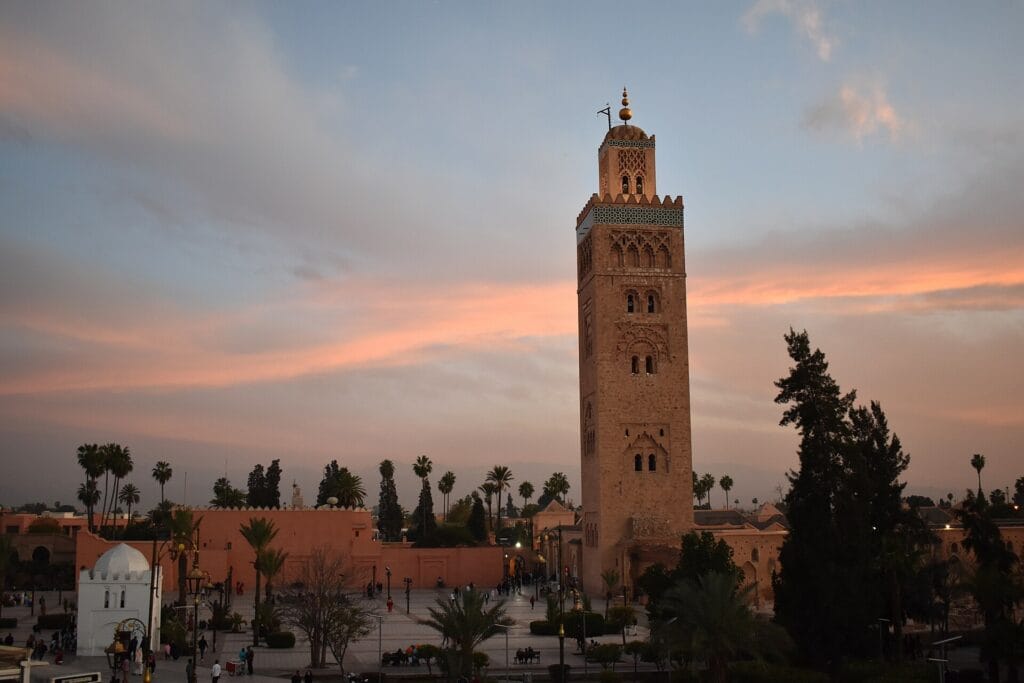
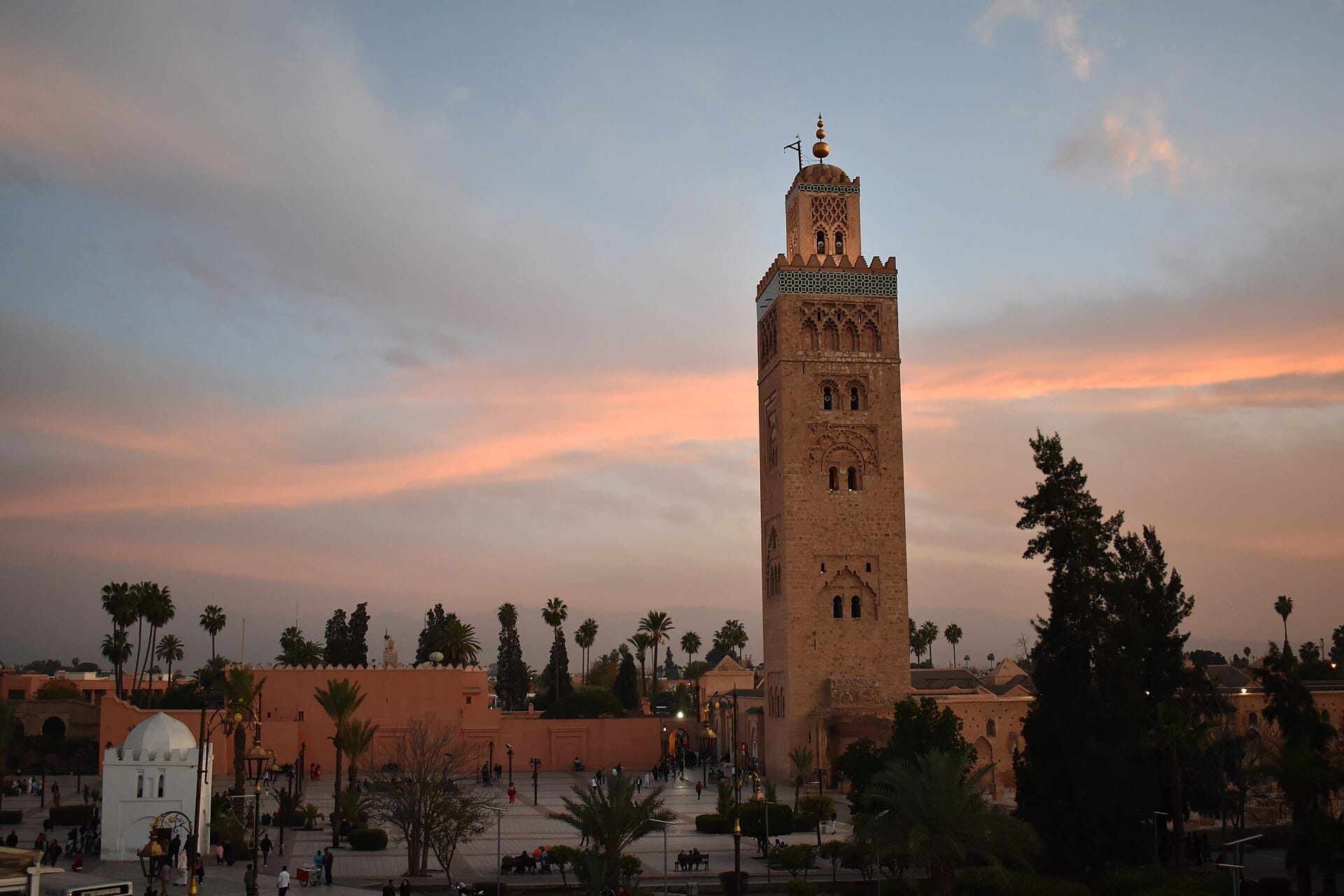
Marrakech is renowned for its rooftops, those elevated terraces that offer a view over the medina, the ochre roofs and, on clear days, the snow-capped chain of the Atlas. Several of them, notably around Jemaa el-Fna square and in the modern districts, serve drinks and cocktails at sunset, a particularly prized moment. The city also has atmospheric bars, lounges and nightclubs that keep the night alive, especially in Hivernage. For a detailed selection of elevated addresses and evening venues, refer to our article on Marrakech nightlife and rooftops. Just keep in mind that nightclubs charge high prices and that smart dress is often required.
Gueliz and Hivernage, the districts for a drink
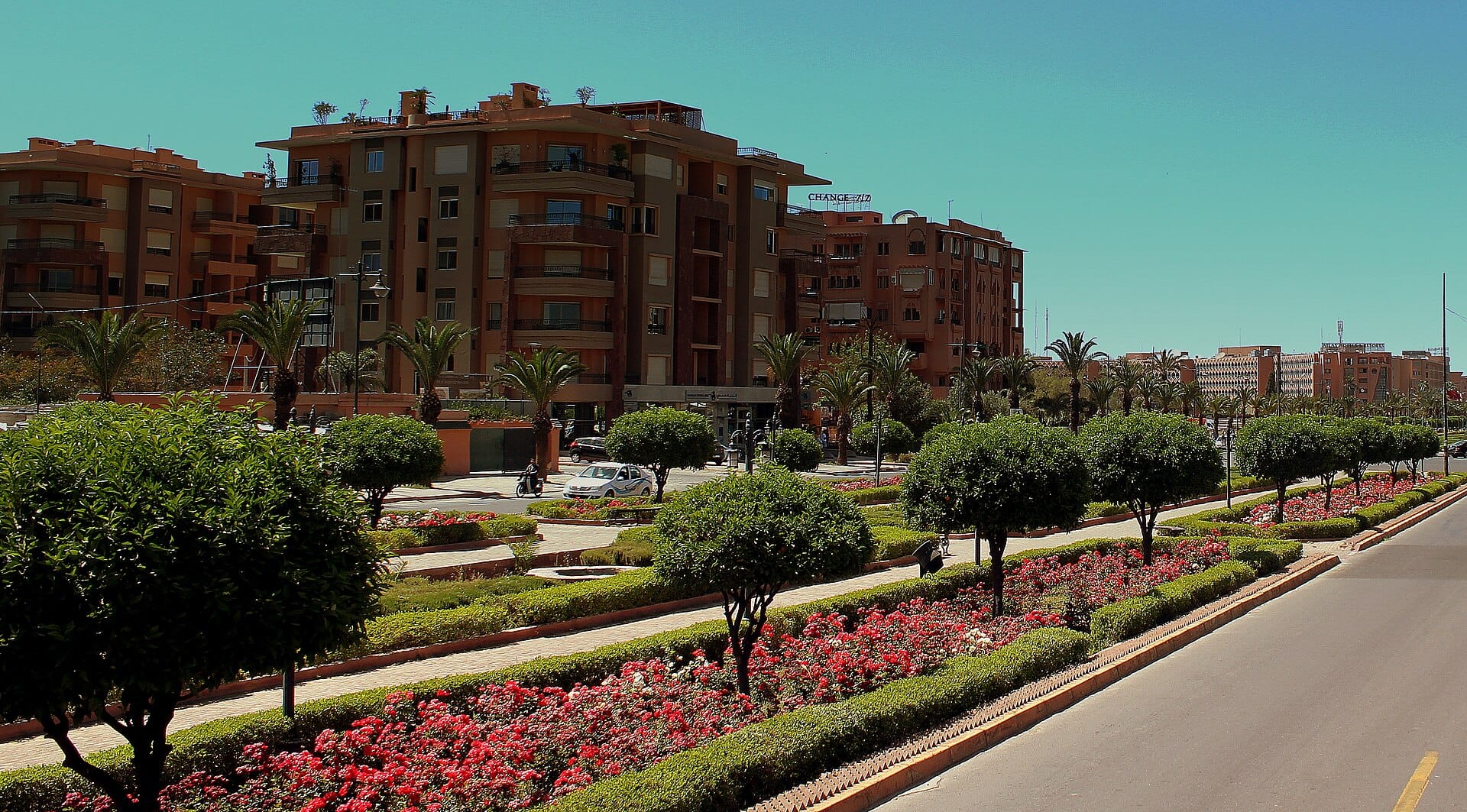
Two districts concentrate most of the options. Gueliz, the new city built during the colonial era, lines up modern cafés, international restaurants, brasseries and bars where you can order a drink without difficulty. It is also where most take-away points of sale are found. Discover this district in more detail in our dedicated guide to Gueliz. Neighbouring Hivernage is the district of grand hotels, clubs and chic establishments: it is the heart of the city’s festive nightlife. Conversely, if you are staying in the heart of the medina, you will often need to head to these districts or climb up to a rooftop to find somewhere to toast.
Where to buy alcohol in Marrakech: supermarkets, hours and restrictions
To buy alcohol in Marrakech and drink it in your hotel, riad or rental, you need to go through the approved supermarkets. Not all of them sell it: only certain chains have a dedicated section, often called the “cave”, sometimes set apart from the rest of the store or accessed by a separate entrance, precisely because of the legal framework mentioned above.
The most reliable addresses are in Gueliz and in the outlying commercial zones. There you will find in particular the Carrefour Market and Acima stores, as well as the Marjane and Atacadao hypermarkets, which offer beer, wine and spirits. There are also specialist merchants, including the Nicolas chain. The choice is decent without being huge: a few brands of local and imported beer, a range of Moroccan and foreign wines, and the usual spirits. Remember to check availability before making a long trip, as stock and authorisations can vary.
As for opening hours, expect the alcohol section to be open generally from late morning (around 11 a.m.) until the evening (sometimes 10 or 11 p.m.), but with one prudent rule to remember: the section often closes earlier than the rest of the store. It is therefore advisable to do your shopping before 8 p.m. to avoid any nasty surprises. On Friday, the day of the main prayer, sales may be suspended during prayer times or hours reduced. Finally, sales are usually interrupted during major religious festivals, such as Eid, and throughout the month of Ramadan (see below). The minimum age is 18, and proof of identity may be requested at the checkout.
One last useful habit: as you leave the store, your bottles are generally placed in an opaque bag. Carry them discreetly, without showing them off, and put them away once you are back at your accommodation. This is not a legal obligation but a widely shared custom of respect.
Alcohol prices in Marrakech: taxes and rough estimates
Here is a point that often surprises travellers: alcohol is expensive in Morocco. It is subject to heavy taxes, so prices reach, or even exceed, those charged in Europe, in a country where the cost of living is otherwise lower. This is therefore not the area where you will save money. The prices below are given purely as an indication; they fluctuate depending on the establishment, the season and the exchange rate (1 euro being worth around 11 Moroccan dirhams, MAD).
- Local beer (50 cl) at the supermarket: around 15 to 25 MAD (£1.30 to £2.20).
- Beer at a bar or terrace: often 40 to 80 MAD (£3.50 to £6), more in chic venues.
- Bottle of Moroccan wine in a store: from 60 to 120 MAD (£5 to £10) for an entry-level option, much more for fine vintages.
- Glass of wine at a restaurant: around 50 to 90 MAD (£4.50 to £7.50).
- Cocktail on a rooftop or in a club: frequently 90 to 150 MAD (£7.50 to £12), sometimes more.
- Imported spirits: considerably more expensive than in Europe because of import duties.
To factor this cost into your overall financial planning, our Marrakech travel budget guide details the main spending balances on the ground. A simple tip: buying from a supermarket for a quiet aperitif in your riad works out far cheaper than stacking up drinks at a venue, where the mark-up is high.
The medina versus the new city: two atmospheres
Understanding the geography of Marrakech helps enormously in knowing where to look. The city is broadly divided into two worlds. On one side, the medina, the old fortified city listed as World Heritage, with its souks, its labyrinthine alleys, its mosques and its traditional atmosphere. On the other, the new city, mainly the districts of Gueliz and Hivernage, with wide avenues and a resolutely modern feel.
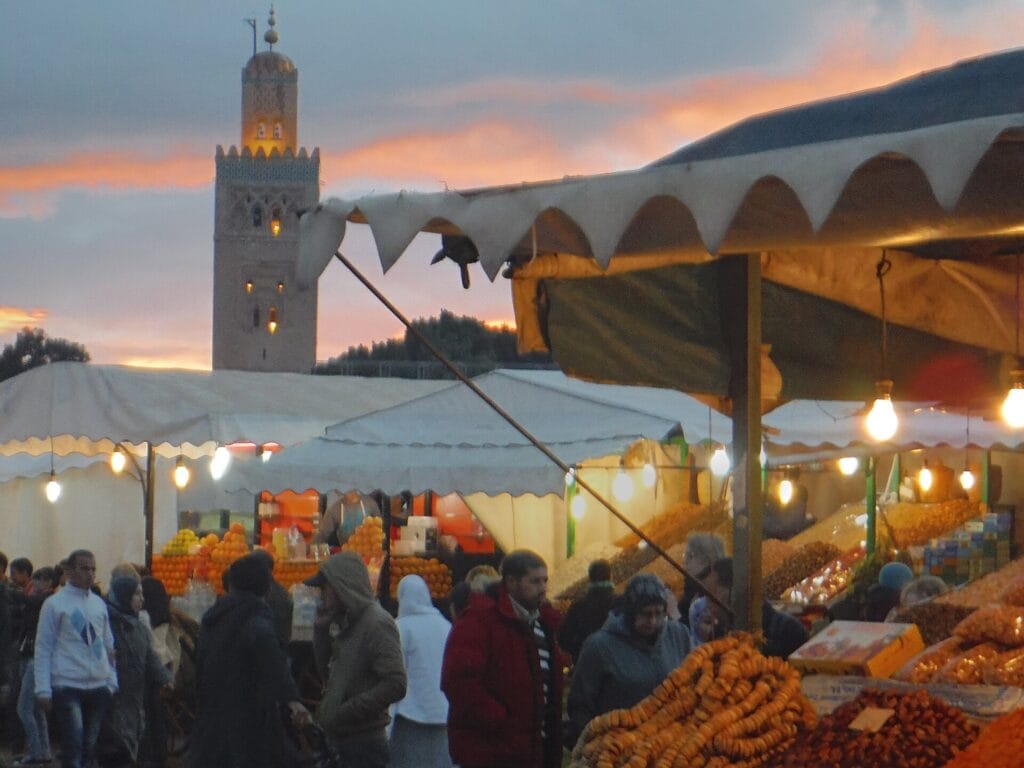
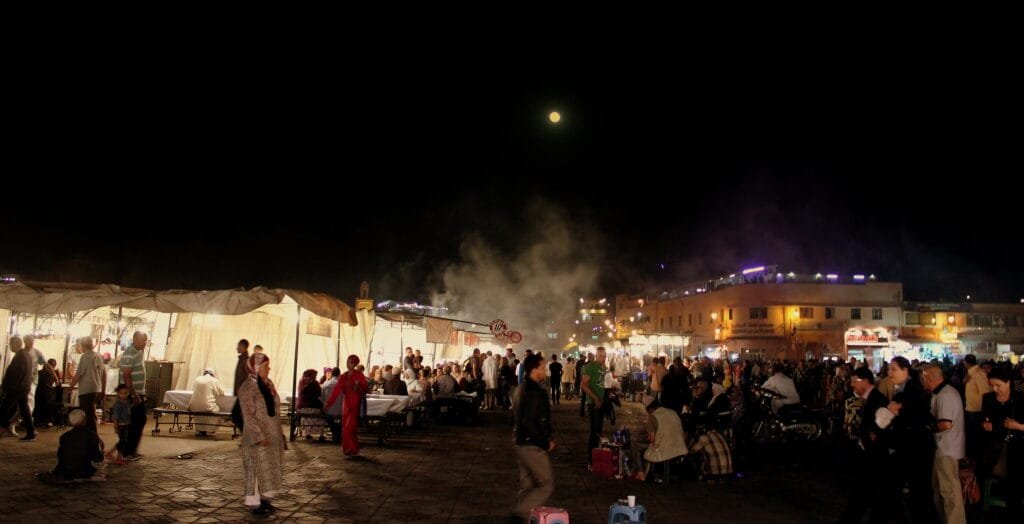
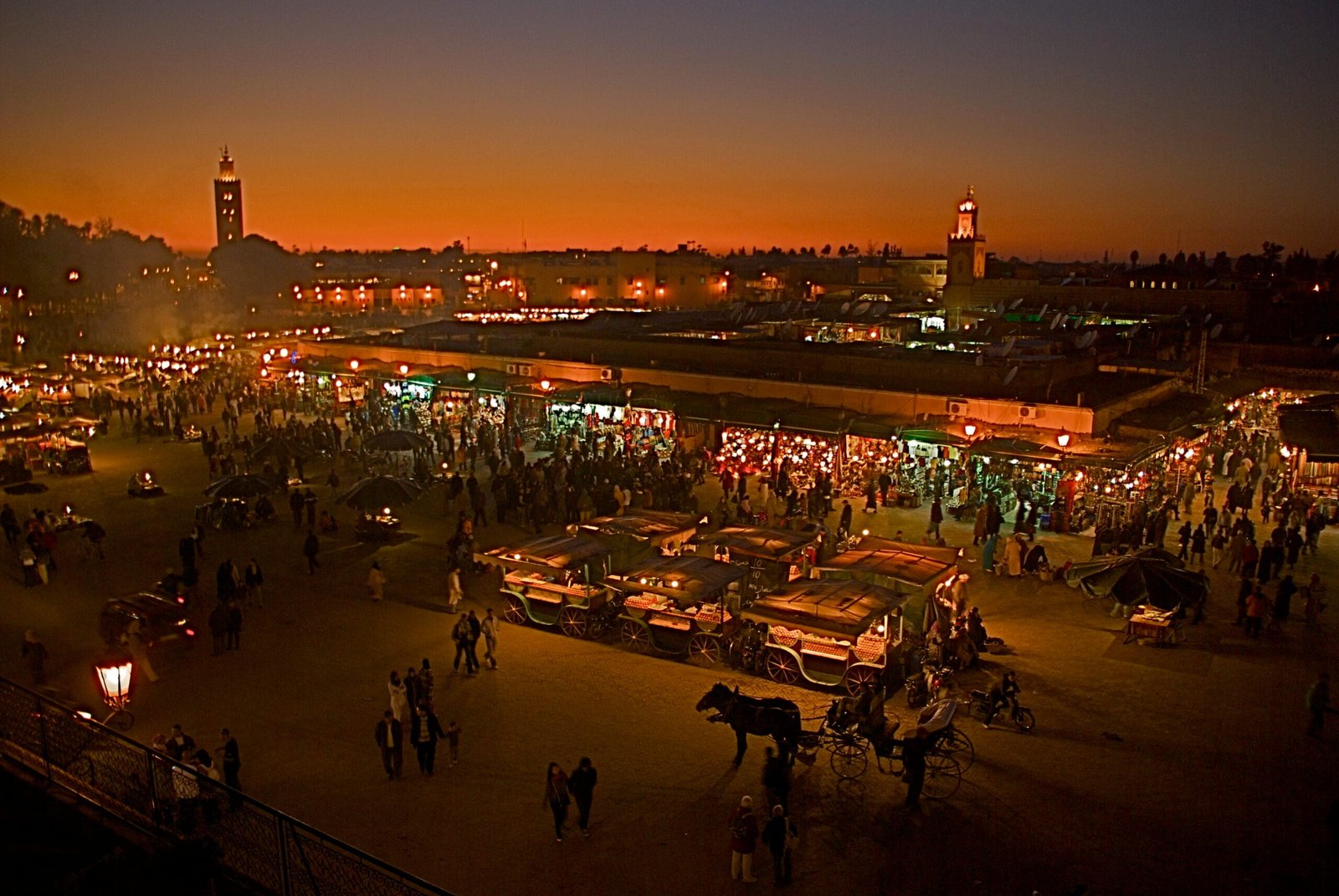
In the medina, alcohol is very scarcely present. You will find almost no take-away points of sale, the cafés serve mint tea, juices and soft drinks, and Jemaa el-Fna square, the beating heart of the old city, has no bars as such at street level. The rare chances to have a drink there are up high, on certain licensed panoramic terraces, or in riads and hotels holding a licence. This scarcity is no accident: it reflects the traditional and popular character of the district, where the majority of residents do not drink alcohol.
The new city, by contrast, offers the full range: bars, international restaurants, supermarkets with a cave section, clubs. If easy access to a drink is one of your criteria, staying in Gueliz or Hivernage, or at least nearby, makes things simpler. Conversely, staying in the medina for its authenticity means accepting a few trips across town. Many travellers actually combine the two: days in the souks, dinners and evenings in the new city. For meals, our selection of where to eat in Marrakech distinguishes licensed restaurants from alcohol-free tables.
During Ramadan: restrictions to know about
The month of Ramadan significantly changes things. During this sacred period of fasting, which shifts each year according to the lunar calendar, the sale of alcohol is heavily restricted, including, in practice, for non-Muslims. Supermarket “cave” sections generally close for the whole month, and many bars and restaurants suspend alcohol service or scale back their activity.
Some exceptions remain, essentially in international hotels and certain establishments geared towards tourist clientele, which may continue to serve alcohol to their guests, sometimes only in reserved areas and on presentation of a foreign passport. But nothing is guaranteed, and since the rules depend on local decisions by the wali, the situation can vary from one year to the next. If your stay falls during Ramadan, the wisest course is to enquire directly with your hotel before arriving.
Beyond the sole question of alcohol, Ramadan transforms the rhythm of the city: shifted hours, calmer days, lively evenings after the breaking of the fast. It is a fascinating period to experience for those who respect it. Our guide on Marrakech during Ramadan details everything you need to know to plan your trip at this time with tact.
Discretion and respect: the common-sense rules
Beyond the law, what matters most comes down to attitude. Morocco warmly welcomes visitors and does not impose its religious codes on them, but a minimum of respect for the local context makes all the difference and will spare you any awkwardness. A few simple principles are enough.
- Never drink in the street. It is forbidden and very poorly regarded. Consumption takes place in the venues designed for it (establishments, private accommodation).
- Stay discreet with your purchases. Opaque bag, sober transport, no showing off bottles.
- Avoid visible drunkenness. Loud or tipsy behaviour in public offends local people and can lead to trouble. Moderation is your best ally.
- Do not offer alcohol to a Moroccan without knowing whether they drink; many do not, out of religious conviction, and the offer could cause embarrassment.
- Adapt to the place and the moment: what is normal in a Hivernage club is not so in a medina alley or near a mosque.
This discretion is not only a matter of politeness: it also contributes to your safety, by avoiding needless exposure. On the general precautions to take in the city, see our article on safety and scams in Marrakech. In practice, a respectful and measured traveller encounters no difficulty enjoying a drink during their stay.
Does Moroccan wine exist? Yes, and it’s worth a detour
Many visitors are unaware that Morocco is a wine-producing country, with a centuries-old viticultural tradition. The climate, sunny but tempered by altitude in certain regions, lends itself to growing vines. Tasting a Moroccan wine is one of the experiences you can enjoy on the ground, and it is also, often, the most affordable option at a restaurant.
The main wine regions are located in the north and centre of the country, rather far from Marrakech itself. The Meknes region, in the foothills of the Atlas, is the historic heart of production, with recognised appellations such as Guerrouane and Beni M’Tir. The grape varieties there are often of French origin — cabernet sauvignon, merlot, syrah, cinsault, grenache, carignan — inherited from long-standing exchanges with Mediterranean viticulture. Further west, towards the plains near Casablanca, the Boulaouane area is famous for its “gris” wine, a very pale and refreshing rosé, undoubtedly the best-known Moroccan wine.
You will thus find Moroccan reds, whites, rosés and gris wines in supermarkets and on the menus of licensed restaurants. Prices remain reasonable for entry-level options, and some more ambitious vintages offer good value for money. To delve deeper into the history and geography of this production, the Wikipedia page devoted to Moroccan wine provides a complete overview.
Practical tips for having a drink in Marrakech
To finish, here is a series of concrete recommendations that pull together everything above and will save you time on the ground.
- Plan your purchases ahead. Stop by the supermarket early in your stay and outside Friday if possible, bearing in mind the early closure of the alcohol section.
- Check the licence when booking. If you have your heart set on a dinner with drinks or an aperitif, confirm that your riad or restaurant serves alcohol, or allows “BYOB” (bring your own bottle).
- Favour Moroccan wine at the restaurant: more affordable than imports and often a pleasant surprise.
- Keep change and proof of identity: the legal age is 18 and a check is possible.
- Look up the dates of Ramadan before booking if access to alcohol matters to you; the rules change markedly during that month.
- Take a taxi or walk home after an evening out, and never drive after drinking: Morocco applies zero tolerance and checks do happen.
- Stay measured and discreet: it is the best way to enjoy a drink without a cultural misstep.
In summary, alcohol in Marrakech is accessible, legal and of good quality for those who know where to look, but it fits within a discreet and respectful framework. By knowing the right districts, the opening hours and the customs, you will fully enjoy a rooftop at sunset or a glass of local gris wine, without ever putting yourself at odds with the culture that welcomes you.
Frequently asked questions about alcohol in Marrakech
Can you drink alcohol in Marrakech as a tourist?
Yes. Drinking alcohol is legal for tourists and non-Muslims in licensed establishments (hotels, restaurants, bars, rooftops, clubs) and in private accommodation. The only firm prohibition concerns consumption in public spaces: you do not drink in the street.
Where to buy alcohol in Marrakech to take away?
In approved supermarkets that have a “cave” section, mainly in Gueliz and on the outskirts: Carrefour Market, Acima, Marjane, Atacadao, as well as specialist merchants such as Nicolas. The medina, for its part, has almost no take-away points of sale.
Is alcohol expensive in Marrakech?
Yes, relatively. Because of high taxes, prices are comparable to or higher than those in Europe. A beer at a bar often costs £3.50 to £6, a rooftop cocktail £7.50 to £12. Buying Moroccan wine at a supermarket remains the most economical option.
Can you buy alcohol during Ramadan?
It is very restricted. The “cave” sections generally close for the whole month and many establishments suspend service. Some international hotels continue to serve their foreign guests, sometimes on presentation of a passport, but nothing is guaranteed. Enquire with your hotel.
Is there alcohol in the medina of Marrakech?
Very little. The old city has a traditional character and mostly has alcohol-free cafés. The only chances to have a drink there are on certain licensed panoramic terraces or in riads and hotels holding a licence. The options are concentrated in the new city (Gueliz, Hivernage).
How old do you have to be to buy alcohol in Morocco?
The legal age is 18. Proof of identity may be requested at the supermarket checkout. It is also inadvisable to offer alcohol to a Moroccan Muslim, as many do not drink out of religious conviction.
Images under free licence via Wikimedia Commons: © procsilas (CC BY 2.0); © calflier001 (CC BY-SA 2.0); © Misa.stefanovic.07 (CC BY-SA 4.0). Sources: Wikimedia Commons.Photo credits: royalty-free illustrative images (Marrakech, rooftops, Gueliz district, sunset). Information verified for indicative purposes; opening hours, prices and authorisations may change and depend on local decisions.