Choosing where to stay in Marrakech shapes the whole success of your trip: depending on which district you lodge in, you will experience a total immersion in the medina, modern hotel comfort in Guéliz, or the luxurious calm of a Palmeraie garden. This complete guide compares the districts, the riads and the hotels, with indicative price ranges and all the practical tips to book with peace of mind.
Quick answer: which district to stay in Marrakech?
If you want immersion and authenticity, sleep in a riad in the medina, close to Jemaa el-Fna square. If you prefer modern comfort, restaurants and nightlife, choose Guéliz, the new district. For luxury and palace hotels, aim for the Hivernage. For calm, greenery and a pool (with a car essential), opt for the Palmeraie. Finally, for an authentic, heritage atmosphere that is less touristy, the Kasbah and the Mellah are excellent alternatives to the south of the medina.
In brief: the essentials to remember
- Medina: historic heart, charming riads, authentic atmosphere, but pedestrian and noisy alleys.
- Guéliz: modern district, hotels to international standards, shops, best value for money.
- Hivernage: palace hotels, spas and chic nightlife, between Guéliz and the medina.
- Palmeraie: calm, greenery, large complexes with a pool; car or taxi essential.
- Kasbah & Mellah: heritage districts in the south of the medina, more open and less touristy.
- Riad = traditional house with a patio, often inaccessible by car: plan for a transfer and luggage carrying.
- Indicative budget: from ~€30/night (small budget) to €300 and more (luxury), with strong discounts off-season (November–March).
Riad or hotel in Marrakech: what’s the difference?
The first question to settle, even before choosing your district, is that of the type of accommodation. In Marrakech, the choice is clear: the traditional riad or the modern hotel. The two offer radically different experiences.
What exactly is a riad?
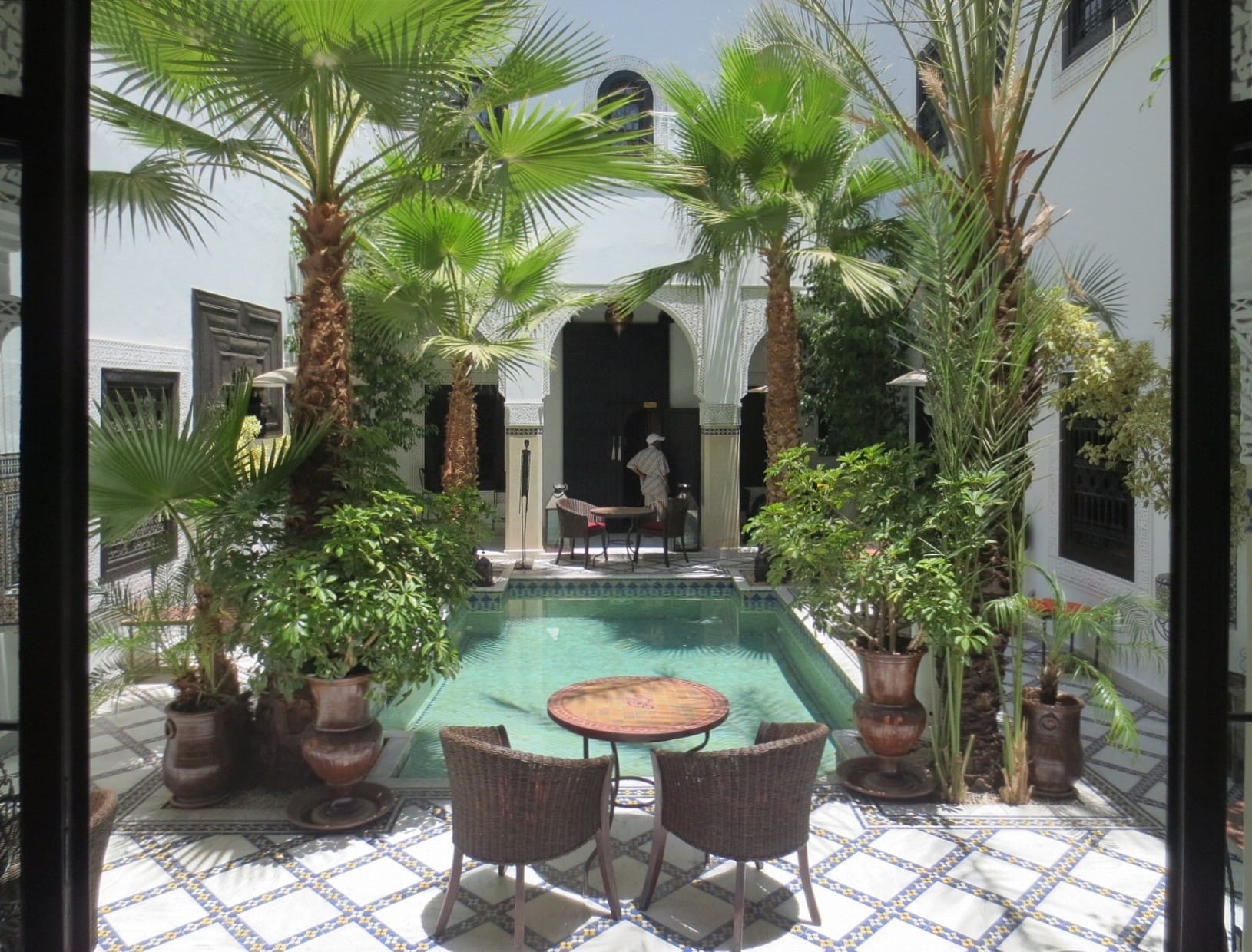
A riad is a traditional Moroccan house organised around an inner patio, often adorned with a fountain, orange or lemon trees, and decorated with zellige (ceramic mosaics), carved plaster and cedar wood. The architecture faces inward: the windows look onto the courtyard and not onto the street, which creates a haven of coolness, intimacy and silence, sheltered from the bustle of the souks. Most riads have a rooftop terrace offering a view over the medina and, frequently, over the snow-capped peaks of the Atlas in winter. More than 1,500 riads turned into guesthouses are counted in the medina of Marrakech alone.
Staying in a riad means choosing charm, authenticity and a personalised welcome: the establishments are generally small (5 to 10 rooms), the Moroccan breakfast is often served on the terrace, and the team can arrange your excursions, a home-cooked dinner or a hammam session. It is the ideal option for a cultural immersion.
The strengths of the modern hotel
Hotels, concentrated in Guéliz, the Hivernage and the Palmeraie, rely on services to international standards: lifts, large pools, uniform air conditioning, a gym, parking, room service, 24-hour reception and direct access by car. They are particularly suited to families with children, travellers with reduced mobility, business stays and those who seek above all comfort and predictability. In return, they rarely offer the soul and character of a traditional residence.
| Criterion | Riad (medina) | Hotel (Guéliz / Hivernage / Palmeraie) |
|---|---|---|
| Atmosphere | Authentic, intimate, heritage | Modern, standardised, spacious |
| Size | Small (5-10 rooms) | Medium to large |
| Car access | Often impossible (carrying on foot) | Direct, with parking |
| Ideal for | Couples, cultural immersion | Families, comfort, business |
| Pool | Small or rooftop plunge pool | Large pool, often heated |
Good news: you don’t have to choose once and for all. Many travellers combine the two formulas, spending for example two or three nights in a riad in the medina then a night in a hotel-resort in the Palmeraie to relax by the pool before the return home. To plan a typical stay, see our Marrakech in 3 Days itinerary.
The Medina: the historic heart to sleep in a riad
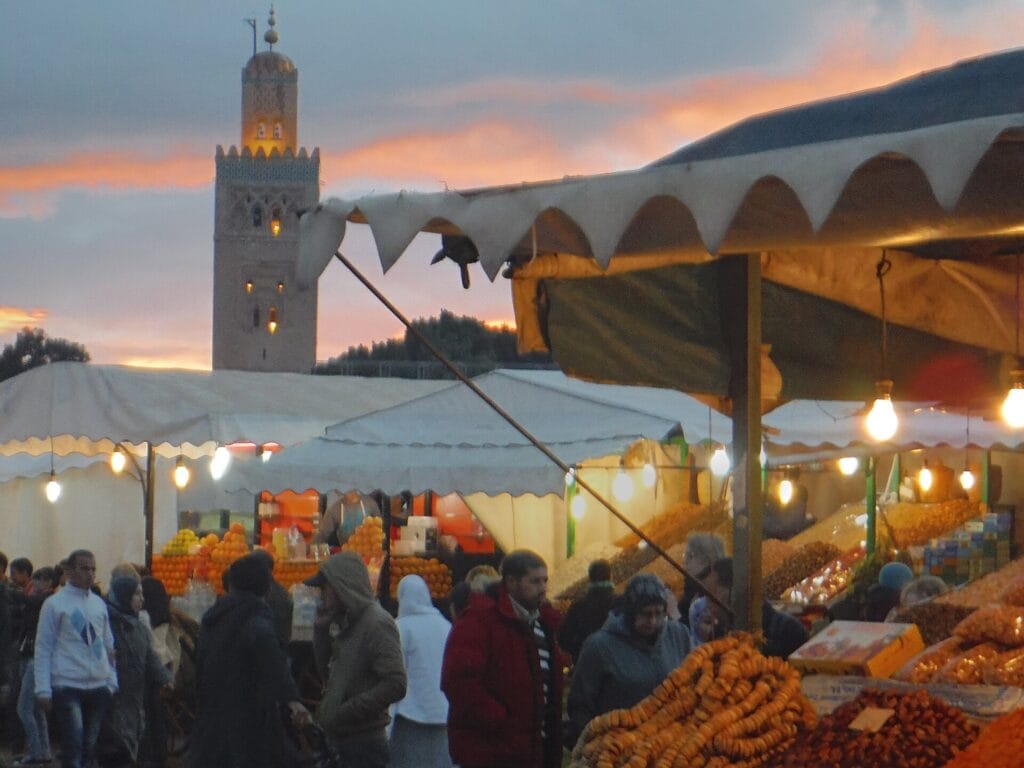
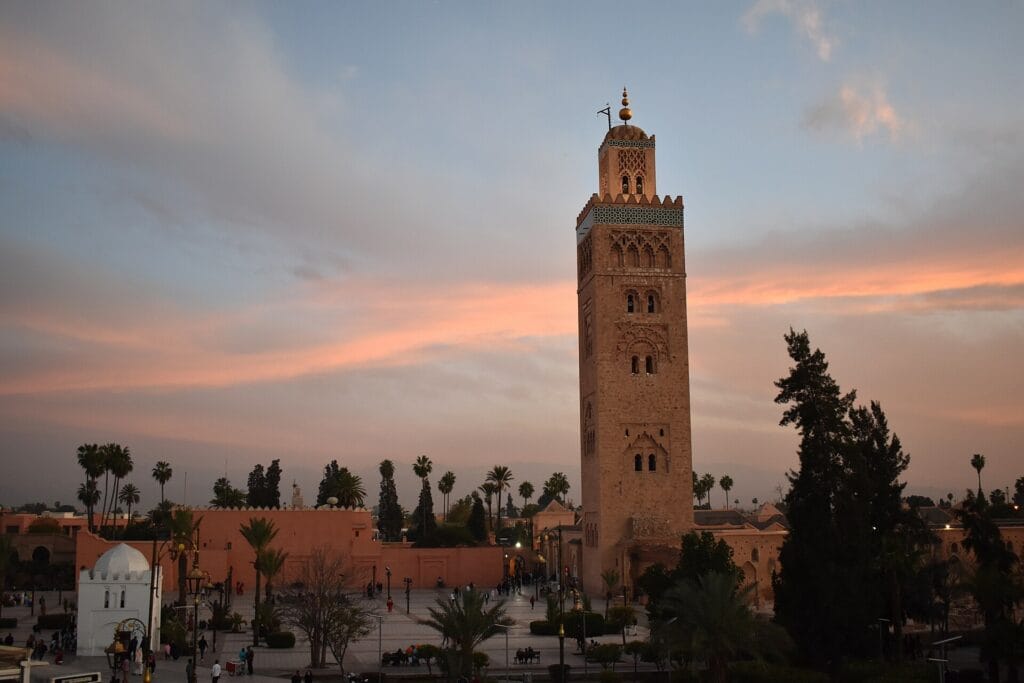
The medina is the old fortified town of Marrakech, encircled by its famous ochre earthen ramparts. It is the most emblematic district to sleep in a riad in Marrakech and live to the rhythm of the souks, the muezzins and Jemaa el-Fna square. A World Heritage site, it holds the bulk of the historic monuments. To understand its full richness, discover the history of Marrakech on Wikipedia and the listing of the medina as a UNESCO World Heritage site.
Advantages of staying in the medina
- Maximum immersion: you sleep at the heart of history, a few minutes’ walk from the souks and the main monuments.
- The widest choice of charming riads at every budget.
- Everything is done on foot: Jemaa el-Fna square, the Bahia Palace or the Secret Garden are reachable without a vehicle.
- Incomparable character and change of scene, with terraces offering superb views.
Drawbacks to know about
- Pedestrian alleys not accessible by car: the taxi drops you at the entrance of the district (a bab, or gate), then you walk or have your luggage carried.
- Noise and bustle: the medina never really sleeps; the rooms facing the patio are quieter.
- Sometimes difficult orientation in the maze of alleys, especially on arriving at night.
- Frequent solicitations (fake guides, sellers) around the tourist areas.
To learn all about the beating heart of the medina, read our ultimate guide to Jemaa el-Fna square. Indicative budget: an economy riad can be booked from €30 to €60 a night, a mid-range riad between €70 and €140, and a luxury riad between €180 and €320 and more.
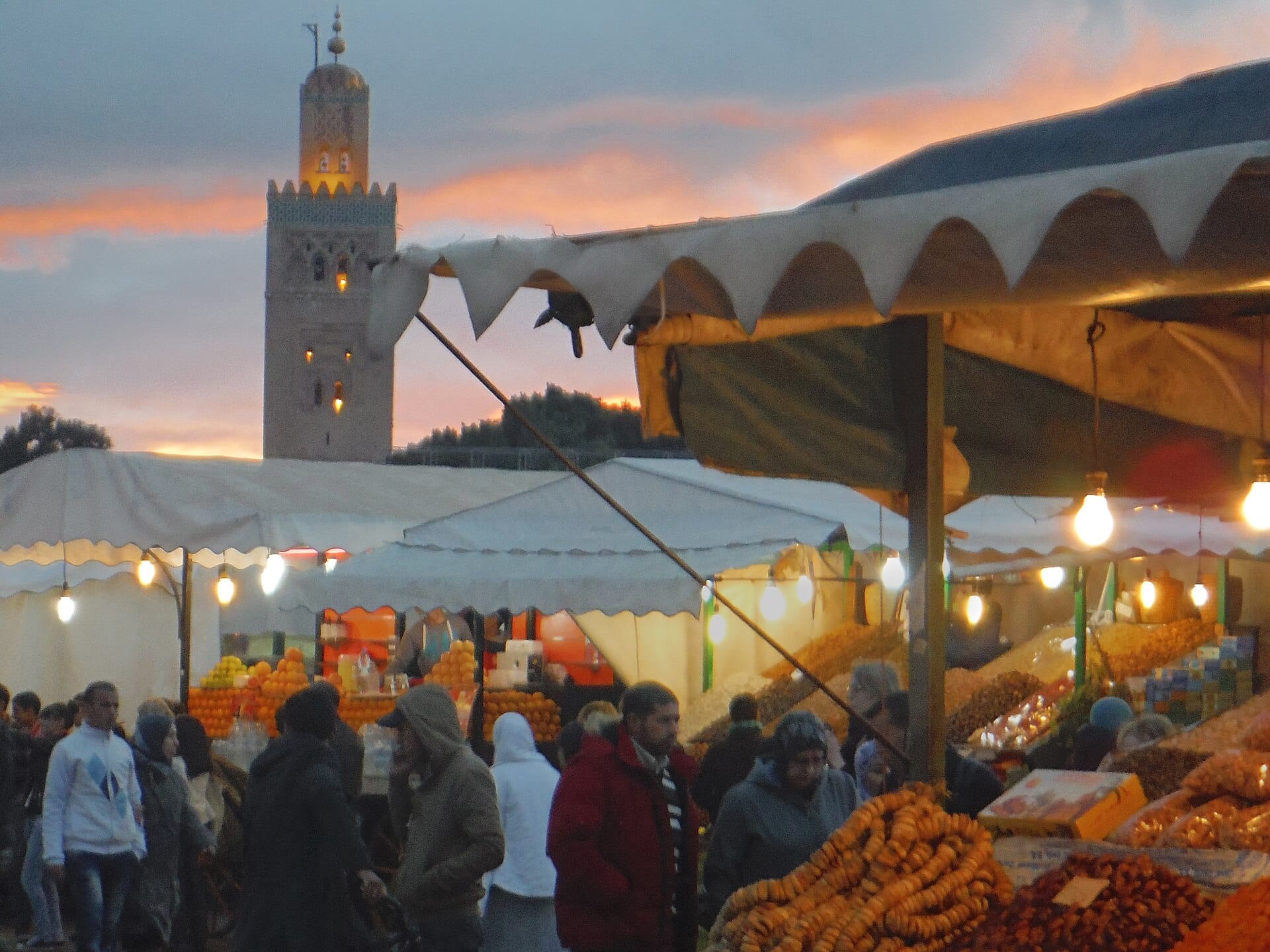
Guéliz: the modern and practical district
Guéliz is the new town of Marrakech, born in the era of the protectorate. It is the most modern and Westernised district, with its broad avenues, its designer boutiques, its terrace cafés, its art galleries and a lively nightlife. The accommodation on offer leans towards classic hotels, apart-hotels and contemporary addresses with a pool.
It is often the best value for money: for equivalent services, the rates are a little gentler than in the medina, and you enjoy modern comfort (lift, parking, large rooms). Guéliz appeals to travellers who want varied restaurants, a pharmacy on the corner and easy getting around, while remaining 10–15 minutes by taxi from Jemaa el-Fna square.
- Advantages: international comfort, direct car access, shops and restaurants, calmer atmosphere in the evening, good value for money.
- Drawbacks: less charm and authenticity, you need to take a taxi to reach the medina.
Indicative budget: a functional 2-3 star hotel can be found from €30 to €50 a night; count on €80 to €150 for a contemporary 4-star with a pool.
Hivernage: the district of palace hotels and luxury
Wedged between Guéliz and the medina, the Hivernage is the chic and leafy district of Marrakech. It is here that the large international hotels, the legendary palace hotels, the spas and the renowned clubs are concentrated, amid peaceful gardens and broad avenues lined with palm trees.
The Hivernage is the ideal choice for an upmarket stay: you enjoy spectacular pools, gourmet restaurants and elegant nightlife, while being a few minutes on foot or by horse-drawn carriage from the medina. It is also a very safe and calm district, appreciated by honeymooning couples and travellers seeking tranquillity without straying from the centre.
- Advantages: high-standing palace hotels and spas, immediate proximity to the medina, gardens and calm, safety.
- Drawbacks: an expensive district, an atmosphere more international than typically Moroccan.
Indicative budget: establishments in the Hivernage often start at around €120-150 a night and climb without a ceiling for the palace hotels (€300 and well beyond).
The Palmeraie: calm, greenery and resorts with a pool
Located to the north-east of the city, the Palmeraie is a vast oasis planted with tens of thousands of palm trees, founded in the 11th century at the same time as the city. It is the district of prestige, discretion and nature: here you find large hotel complexes, villas and resorts with golf, gardens and large pools.
The Palmeraie is perfect for a relaxing stay, far from the bustle of the centre: ideal for resting, enjoying the sun by the pool or travelling as a family with plenty of space. Its main drawback is the distance: you need to allow 20 to 30 minutes by car to reach the medina, and a rental car or taxis are essential for every trip.
- Advantages: great calm, greenery, spacious resorts with large pools, ideal for families and relaxation.
- Drawbacks: far from the centre, car/taxi compulsory, little neighbourhood life on foot.
Indicative budget: very variable, from €70 for a simple guesthouse to several hundred euros for a 5-star resort with spa and golf.
Kasbah and Mellah: authenticity to the south of the medina
To the south of the medina, the Kasbah and the Mellah form two historic districts that are more open, calmer and distinctly less touristy than the immediate surroundings of Jemaa el-Fna, while remaining rich in heritage.
The Kasbah, the former royal quarter
The Kasbah was the royal and administrative sector of the city. It houses emblematic monuments such as the Saadian Tombs and lies a stone’s throw from the Bahia Palace. The district offers a real local neighbourhood life, while remaining within walking distance of the major sites. You find fine riads there, often at gentler rates than in the centre of the medina. Small caveat: being a very old area, some accommodation presents constraints of comfort and accessibility.
The Mellah, the former Jewish quarter
The Mellah, the former Jewish quarter founded in the 16th century, charms with its typical alleys, its wooden balconies and its traditional market (spices, textiles, jewellery). It is a district with a local, authentic atmosphere, ideal for those who want to lodge in the medina while avoiding the busiest areas, and yet stay close to the main monuments of the south.
Indicative budget: close to that of the medina, often a little more affordable, with very good mid-range riads between €60 and €130 a night.
Transfers and access: why the medina is reached on foot
This is the most important point to anticipate before booking in the medina: vehicles cannot circulate in the historic alleys. In practical terms, your taxi or transfer drops you at the nearest drivable point (generally a bab, one of the gates of the wall), then you walk a few minutes on foot to the riad.
The vast majority of riads arrange the carrying of luggage: a member of the team (sometimes with a cart) comes to welcome you at the drop-off point and carries your suitcases to the door. It is a common service, but a small tip is appreciated. So remember to travel light and favour luggage that is easy to wheel.
- Airport transfer: most riads and hotels offer a private transfer from the airport (count on around €20 to €30 depending on the distance and the establishment). It is strongly recommended for a first arrival, especially at night, as finding a riad in the medina can be confusing.
- Communicate your arrival time and the exact meeting point to the riad; send them your flight number.
- Taxis: negotiate the price before getting in (or check that the meter is running); night rates are higher.
To prepare your arrival and your transfer options, see our guide to Marrakech Menara Airport (RAK). And to organise your visits once settled in, our complete guide “Things to Do in Marrakech” will be invaluable.
Indicative budgets: how much does a night in Marrakech cost?
Prices vary greatly depending on the season, the type of establishment and the district. Here are indicative ranges per night for a double room, as an order of magnitude (approximate exchange rate: about 11 Moroccan dirhams for 1 euro).
| Range | Riad (medina) | Hotel (Guéliz / Hivernage / Palmeraie) |
|---|---|---|
| Small budget | ~€30 to €60 | ~€30 to €50 |
| Mid-range | ~€70 to €140 | ~€80 to €150 |
| Luxury | ~€180 to €320 and + | €200 to €500 and + (palace hotels) |
Good to know: travelling off-season (November to March, outside the holidays) often lets you obtain discounts of 30 to 50% on riads. Stays of three nights or more also open the door to reductions: don’t hesitate to write directly to the riad to negotiate.
Booking tips for choosing where to stay in Marrakech
- Book early in high season (spring, autumn, school holidays, year-end holidays): the best riads are fully booked several weeks in advance.
- Check the exact location and the walking distance from the taxi drop-off point, especially in the medina.
- Read recent reviews on cleanliness, the quietness of the rooms, the quality of the breakfast and help with the transfer.
- Ask for a room on the patio rather than on the street if you are sensitive to noise.
- Confirm the airport transfer in writing, with the meeting point and your flight number.
- Have cash (dirhams): many small riads prefer cash payment for the balance and extras.
- Match the district to your programme: medina for visits on foot, Guéliz for comfort, Palmeraie for relaxation.
How to choose according to your traveller profile
- Couple / honeymoon: charming riad in the medina or palace hotel in the Hivernage.
- Family with children: hotel in Guéliz or resort with a pool in the Palmeraie, for space and car access.
- First cultural visit: medina, to do everything on foot and soak up the atmosphere.
- Small budget: economy riad in the medina or functional hotel in Guéliz.
- Relaxing / wellness stay: Palmeraie or Hivernage, for the spa and the pool.
- Solo traveller: medina, Kasbah or Mellah, for neighbourhood life and meeting people.
Which season to favour for booking?
The choice of period influences both the comfort of your stay and the price of your accommodation. Spring (March to May) and autumn (September to November) are the high season: the climate is ideal, the riad terraces are pleasant morning and evening, but the best establishments fill up fast and rates are at their highest. Book then several weeks in advance.
Winter (December to February) remains an excellent period: the days are mild and sunny, even if the evenings are cool — an asset for riads, which often have fireplaces and thick blankets. Outside the school holidays and the year-end festivities, it is the season of the best deals, with discounts reaching 30 to 50% on riads. Summer (June to August) is very hot (temperatures regularly exceed 40°C): favour then accommodation with a pool and effective air conditioning, which naturally points towards the hotels of Guéliz, the Hivernage or the resorts of the Palmeraie.
In every case, match your district to the season: in the height of summer, a riad without a pool at the heart of the medina can quickly become stifling, whereas in winter, the charm of an evening by the fireside in a covered patio takes on its full meaning.
FAQ: where to stay in Marrakech
What is the best district to stay in Marrakech for a first visit?
For a first visit, the medina is the best choice: you sleep at the heart of history, in a charming riad, and everything is done on foot (souks, Jemaa el-Fna, monuments). If you prefer modern comfort, Guéliz is an excellent alternative, 10-15 minutes by taxi from the centre.
Should you choose a riad or a hotel in Marrakech?
Choose a riad for the charm, the authenticity and the immersion in the medina. Opt for a hotel if you prefer international comfort, a large pool, direct car access and standardised services (ideal for families). You can also combine the two on a single stay.
Why can’t you reach your riad by car?
The alleys of the historic medina are too narrow and pedestrian: cars do not circulate there. Your taxi or transfer drops you at the nearest gate (bab), then the riad team carries your luggage to the entrance, a few minutes’ walk away.
How much does a night in Marrakech cost?
As a guide, count on around €30 to €60 for small-budget accommodation, €70 to €150 for a mid-range, and €180 to €500 and more for a luxury riad or a palace hotel. Prices drop sharply off-season (November–March).
Is the Palmeraie a good district to stay in?
Yes, if you are looking for calm, greenery and a large pool, notably as a family or for a relaxing stay. On the other hand, it is far from the centre (20-30 minutes by car): a rental car or taxis are essential. To visit the city on foot, prefer the medina.
Which district to choose for a luxury stay in Marrakech?
The Hivernage concentrates the palace hotels, spas and gourmet restaurants, while remaining close to the medina. The Palmeraie offers prestigious resorts with golf and large gardens. Finally, the medina also holds exceptional luxury riads for those who want to combine refinement and authenticity.
Conclusion: find the district that suits you
There is no single answer to the question “where to stay in Marrakech“: it all depends on your travel style. The medina and its riads for immersion, Guéliz for comfort and good value for money, the Hivernage for luxury, the Palmeraie for relaxation, the Kasbah and the Mellah for quiet authenticity. Anticipate the transfer and the carrying of luggage in the medina, book early in high season, and match the district to your programme. Have a great stay in the ochre city!
Images under free licence via Wikimedia Commons: © Arnaud 25 (CC BY-SA 3.0); © Elgaard (CC BY-SA 4.0); © Ymblanter (CC BY-SA 4.0). Sources: UNESCO and Wikipedia.Photo credits
The illustrative images in this article come from royalty-free image banks (such as Unsplash, Pexels or Wikimedia Commons). Each photograph must be credited to its author according to the licence in force at the time of integration. These visuals are provided purely for illustration and do not represent any specific establishment.
Disclaimer: the price ranges and practical information mentioned in this article are indicative and liable to change (season, exchange rate, availability). They do not constitute a commercial offer. Always check the rates and conditions directly with the establishment at the time of your booking.