Quick answer: Le Jardin Secret in Marrakech is a complex of two historic riads nestled on Rue Mouassine, in the heart of the medina. Restored over nearly ten years, Le Jardin Secret opened to the public in 2016. Here you discover two complementary gardens — a traditional Islamic garden and an exotic garden bringing together plants from all five continents — irrigated by a centuries-old khettara, as well as a panoramic tower offering a 360° view over the rooftops of the medina and, on a clear day, over the Atlas. Allow about 100 dirhams for the garden entrance and 40 dirhams more for the tower, with a visit of one hour on average.
In brief: the essentials on Le Jardin Secret
- What? A historic complex of two riads and two gardens, restored and opened in 2016.
- Where? 121 Rue Mouassine, medina of Marrakech, about a 5-minute walk from Jemaa el-Fna square.
- Area: nearly 4,000 m², organised according to the Islamic plan of the chahar bagh (garden in four parts).
- To see: the Islamic garden, the exotic garden, the khettara (traditional irrigation) and the 17-metre panoramic tower.
- Indicative prices: garden 100 DH (full price), tower +40 DH. Reduced rates and free entry for young children.
- Hours: open every day from 9:30 a.m.; closing between 6 p.m. and 7:30 p.m. depending on the season.
- Recommended duration: 45 minutes to 1 hr 30 depending on your pace and a stop at the café.
Le Jardin Secret of Marrakech: a haven of peace hidden in the medina
There is, behind the high earthen walls of Rue Mouassine, a place that generations of visitors long overlooked. Nothing, from the busy lane, hints at what lies beyond the discreet door: neither the palm trees, nor the water channels, nor the tower that dominates the rooftops. It is precisely this contrast that gave Le Jardin Secret its name. While the medina of Marrakech overflows with noise, colours and haggling, here you cross a threshold and the tumult suddenly falls silent. Your pace slows, your ear settles on the lapping of the water, and you understand why so many travellers describe the place as one of the most soothing in the city.
The secret garden of Marrakech is not a simple park: it is a palatial complex restored with the care of a goldsmith, where architecture, botany and traditional hydraulic engineering together tell five centuries of Marrakchi history. Unlike more outlying sites such as the Majorelle Garden, Le Jardin Secret is experienced in the very heart of the old town, between two immersions in the souks of Marrakech. This is what makes it an ideal stop: a moment of coolness and silence, a few steps from the effervescence.
History of Le Jardin Secret: from the Saadians to the caids
The history of the site is inseparable from that of the Mouassine district, one of the most prestigious in the medina. Understanding its past helps to grasp why Le Jardin Secret holds a special place among the city’s monuments.
The Saadian origin (16th century)
The foundations of the estate date back to the 16th century, at the time when the Saadian sultan Moulay Abd-Allah undertook to develop the new Mouassine district. The Saadian dynasty, which left its mark on Marrakech — we owe it in particular the famous Saadian tombs and part of the Badi Palace — then developed vast residences with gardens in this area. The palace that occupied the current site of Le Jardin Secret was, however, destroyed at the end of the 17th century, in the wake of the Saadian decline and the political upheavals that shook the city.
The revival in the 19th century
The land long remained abandoned before experiencing a second life in the mid-19th century. The caid al-Hajj Abd-Allah U-Bihi, a powerful notable of the time, took possession of the place and had a new palace built there, whose general layout corresponds to what is visited today. The estate then passed through several influential hands. At the beginning of the 20th century, it became the residence of al-Hajj Muhammad Loukrissi, a figure close to power who was appointed chamberlain of sultan Moulay Abd al-Hafiz in 1908. Loukrissi lived in the palace from 1912 until his death in 1934.
Abandonment then restoration (2016)
After 1934, the palace was once again neglected and gradually deteriorated over decades. The idea of saving it and opening it to the public was born in 2012. An ambitious restoration project followed, led by Moroccan and Italian teams, with the contribution of the British landscape designer Tom Stuart-Smith for the design of the gardens. The craftsmen brought back to honour traditional know-how — zellige, carved plaster (gebs), worked cedar wood — while rehabilitating the ancestral irrigation system. Le Jardin Secret finally opened its doors to the public in 2016, revealing to Marrakech a heritage treasure that had long remained invisible. This restoration is in keeping with the spirit of safeguarding the medina, a UNESCO World Heritage Site since 1985.
The Mouassine district, setting of Le Jardin Secret
One can only fully understand the secret garden of Marrakech by placing it in its district. Mouassine is one of the oldest and most refined areas of the medina, developed under the Saadians in the 16th century as a prestigious residential and religious hub. The district is organised around the Mouassine mosque and its famous fountain, a monumental ensemble intended to supply water to the inhabitants, the animals and ritual ablutions — three basins for three uses. This fountain, a masterpiece of carved wood and zellige, testifies to the importance given to water in Marrakchi urban planning, the same logic that governs the channels of Le Jardin Secret.
To stroll through Mouassine is to cross a maze of lanes where craftsmen’s workshops, riads converted into guesthouses, fabric stalls and galleries alternate. The district is renowned for its foundouks — those former caravanserais with a central courtyard where merchants and their mounts lodged — several of which today house leather, metal or textile craftsmen. Located on the edge of the great souks, Mouassine offers a gentle transition between the commercial bustle and the preserved interiors. It is in this dense and historic fabric that Le Jardin Secret unfolds its 4,000 m² of greenery, like an unexpected clearing in the middle of stone and earth.
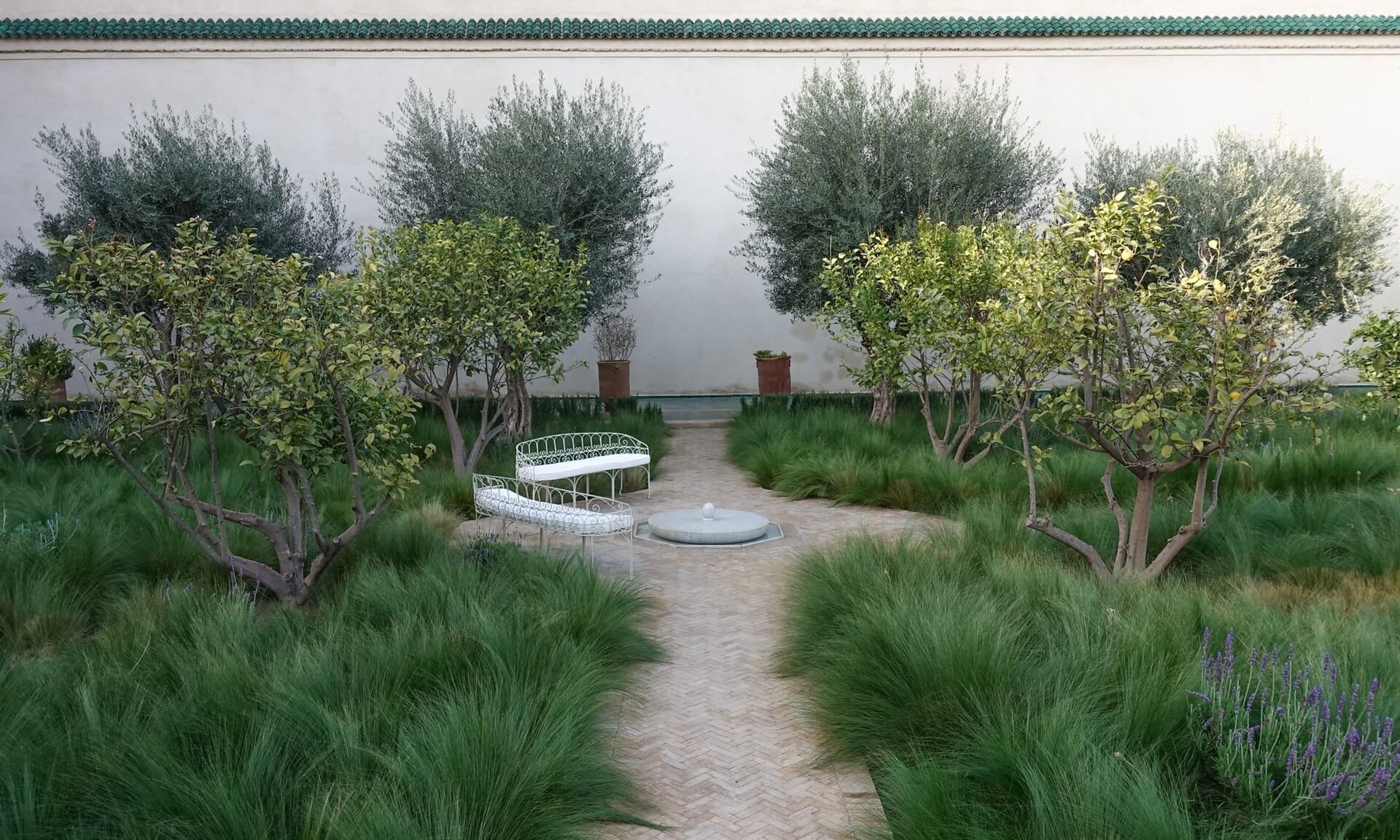
The two gardens: Islamic and exotic
The heart of the visit lies in the duality of the place. The secret garden of Marrakech is indeed made up of two distinct plant spaces, separate but in dialogue with one another, each carrying a different vision of the world.
The Islamic garden and the principle of the chahar bagh
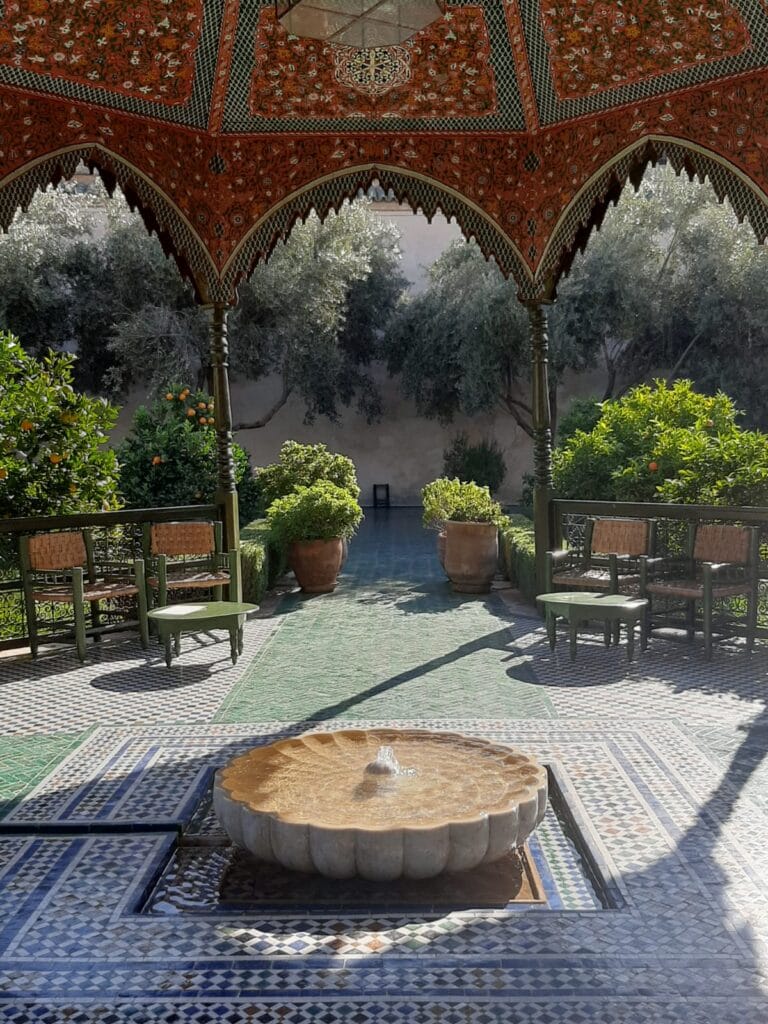
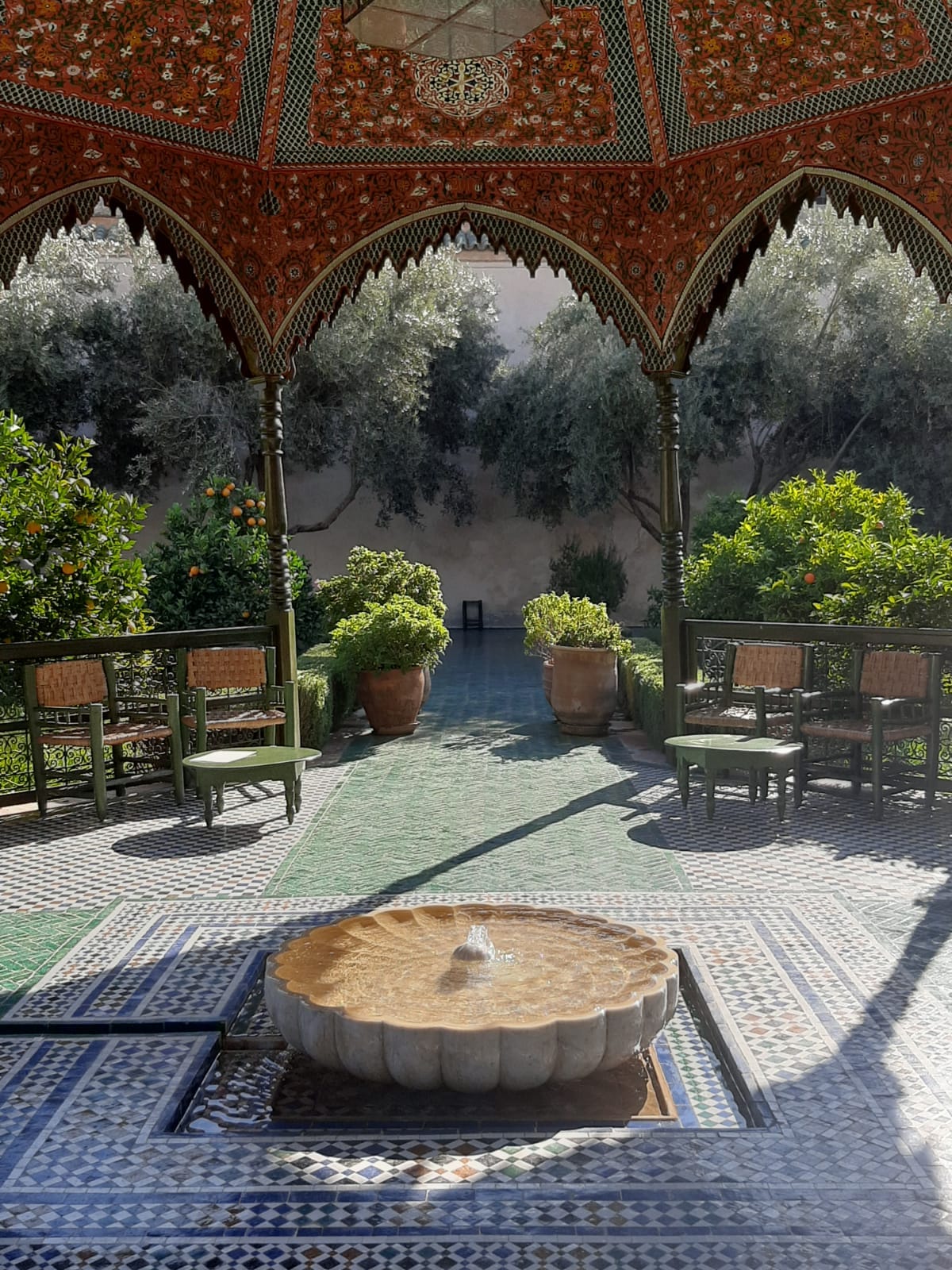
The first garden obeys the age-old rules of the Islamic garden. It is organised according to the plan of the chahar bagh, literally “four gardens” in Persian: a space divided into four parts by two crossing axes of water. This geometry is not gratuitous. In the Islamic tradition, it evokes the garden of paradise described in the Quran, crossed by rivers and planted with nourishing trees. Here you find the classic species of the Mediterranean and Moroccan orchard: orange trees, lemon trees, olive trees, fig trees and pomegranate trees, whose foliage provides welcome shade. At the centre, the channels and basins do not serve only to irrigate: the mirror of the water, the reflection of the sky and the murmur of the fountains are part of a sensory experience designed for peace and contemplation.
The exotic garden, a collection from five continents
The second garden deliberately breaks with this geometric rigour. Conceived as a counterpoint, the exotic garden gathers species from the five continents: cacti and succulents from the Americas, African euphorbias, Australian mimosas and acacias, plants from Asia and the Mediterranean basin. This collection illustrates the adaptability of plants to the semi-arid climate of Marrakech and echoes the city’s long tradition of botanical acclimatisation. The contrast between the two gardens is striking: on one side the spiritual and symbolic order of classical Islam, on the other the free and cosmopolitan exuberance of a botanical cabinet of curiosities.
This dialogue between the two spaces is by no means fortuitous. The landscape designer Tom Stuart-Smith, together with the Moroccan craftsmen, conceived the visitor’s route as a gradual passage: you leave the meditative order of the Islamic orchard to enter the profusion of the exotic garden, before finding again, further on, the coolness of the water and the pavilions. As the seasons pass, the garden changes its face: the flowering of the citrus trees and the scent of orange blossom in spring, generous shade in summer, warm hues in autumn. Taking the time to sit on a bench, to listen to the song of the birds drawn by this oasis and to let the minutes slip by is an integral part of the experience — it is here that the name “secret garden” takes on its full meaning.
Architecture, pavilions and craftsmanship
Beyond the vegetation, Le Jardin Secret is a manifesto of the Moroccan art of building. The restoration mobilised maâlems, those master craftsmen who are the guardians of techniques passed down from generation to generation. Everywhere, the eye settles on details: the zellige, that mosaic of glazed terracotta tiles cut by hand and assembled into geometric patterns of mathematical precision; the gebs, finely carved plaster that runs like lace along the walls and arches; the ceilings and doors of painted or inlaid cedar, an aromatic and durable species typical of the Atlas.
The complex is organised around two main pavilions. One, named Oud el-Ward, houses an exhibition devoted to the history of the place and the Mouassine district. The other, Hbiqua, regularly presents photographic and cultural exhibitions. The site also preserves the remains of a 19th-century hammam, partially restored, which recalls that a great Marrakchi residence was a complete organism, equipped with its own spaces for hot water and well-being. This attention to authenticity — restoring rather than rebuilding anew, preserving the traces of time — makes Le Jardin Secret a model of heritage rehabilitation within the medina.
The khettara: the hydraulic genius of Le Jardin Secret
If the gardens delight the eye, it is an invisible system that brings them to life. One of the most fascinating aspects of Le Jardin Secret is indeed its mode of irrigation: the khettara, a network of underground galleries that conveys water by the sole force of gravity, without any pump.
This process, inherited from very ancient hydraulic techniques and perfected in the Arab-Muslim world, consists of capturing water upstream — traditionally coming from the foothills of the Atlas and the water table — then leading it through long buried channels, gently sloped, to the points of use. In Marrakech, it is these khettaras that made it possible, from the Middle Ages, to transform an arid plain into an urban oasis and to supply the city’s countless gardens. At Le Jardin Secret, the network has been carefully restored: the water still flows today in the historic channels and irrigates each plot exactly as it did centuries ago. To understand this system is to grasp all the genius of a civilisation that had made the management of water an art of living.
The panoramic tower and the view over the medina
The highest point of the visit, in the literal sense, the tower of Le Jardin Secret rises to about 17 metres, making it one of the tallest structures in the district. Accessible since 2018 for an extra charge, it is climbed by a narrow spiral staircase — worth noting for people prone to vertigo, claustrophobia or with reduced mobility, as the ascent can prove tricky.
The effort is amply rewarded. From the summit terrace, the view opens up to 360° over the ocean of earthen rooftops of the medina, the minarets that punctuate it and, on a clear day, the snow-capped line of the High Atlas on the horizon. It is one of the rare genuinely accessible elevated viewpoints in the heart of the old town, and an ideal moment to understand the dense and labyrinthine layout of Marrakech. Photography enthusiasts will favour late morning or the raking light of late afternoon.
Practical information: hours, prices and location
Where is Le Jardin Secret?
Le Jardin Secret is located at 121 Rue Mouassine, in the very heart of the medina of Marrakech. It is easily reached on foot: allow about 5 to 10 minutes from Jemaa el-Fna square, heading up towards the Mouassine district and its famous fountain. As is often the case in the medina, access is only on foot or by horse-drawn carriage as far as the outskirts; taxis drop you off at the gates of the old town. If you arrive from outside Marrakech, Marrakech-Menara airport is about fifteen minutes by car from the medina.
Opening hours
Le Jardin Secret is open every day, weekends and public holidays included. The hours vary according to the season. As an indication:
- March to September: 9:30 a.m. – 7:30 p.m.
- February and October: 9:30 a.m. – 6:30 p.m.
- November to January: 9:30 a.m. – 6:00 p.m.
- During Ramadan: 9:30 a.m. – 4:30 p.m.
The last entry is generally 30 minutes before closing time. It is wise to check the up-to-date hours on the official website before your visit, as these may be adjusted.
Indicative prices
- Garden entrance, full price: 100 dirhams (MAD)
- Reduced rate (under 24): 80 dirhams
- Moroccan residents: 50 dirhams
- Groups (15 people and more): 80 dirhams per person
- Access to the tower: 40 dirhams (30 dirhams at the reduced rate), from age 6
- Free entry: children under 12, people with reduced mobility, press and tourism professionals
These amounts are given as an indication and may change. An annual subscription option also exists for regular visitors and residents of Marrakech.
How much time to allow?
The visit lasts on average from 45 minutes to 1 hr 30. You can extend the moment by sitting down at one of the site’s cafés, set up in the pavilions, for a mint tea in the shade of the palm trees. The pavilions also house small permanent exhibitions — one devoted to the history of the place, the other to photography — as well as a partially restored 19th-century hammam, further witnesses to the refinement of the residence.
Visiting tips to make the most of Le Jardin Secret
- Come early in the morning or in late afternoon: the light is more beautiful for photos and there are fewer visitors.
- Favour spring or autumn: the summer heat of Marrakech can be overwhelming in the middle of the day.
- Wear comfortable shoes: access is on foot through the lanes of the medina, and the tower is climbed by a narrow staircase.
- Adopt respectful attire for the place and the local culture, shoulders and knees preferably covered.
- Combine the visit with an exploration of the Mouassine district, its fountain and its mosque, then an immersion in the nearby souks.
- Keep some change in dirhams: the entrance and the tower are paid on site.
Le Jardin Secret in a stay in Marrakech
Le Jardin Secret fits naturally into any discovery of the city. Its central position makes it a perfect stop between two visits of the medina, to slot into a 3-day itinerary in Marrakech. You can, for example, combine it, in the same morning, with a walk through the souks and then the contemplation of the Mouassine fountain, before heading to Jemaa el-Fna for lunch.
Garden lovers will not stop there. Marrakech is a city of oases and parks, and Le Jardin Secret dialogues from a distance with other must-see sites: the Majorelle Garden and its famous blue, or the venerable Menara Gardens with their basin and their pavilion facing the Atlas, historic emblems of the city. To organise all your visits and miss none of the treasures of the ochre city, consult our complete guide “Things to do in Marrakech”, which lists the sites, districts and experiences not to be missed.
Frequently asked questions about Le Jardin Secret in Marrakech
Where is Le Jardin Secret in Marrakech?
Le Jardin Secret is located at 121 Rue Mouassine, in the heart of the medina of Marrakech, about a 5 to 10 minute walk from Jemaa el-Fna square. Access is only on foot through the lanes of the old town.
What is the entrance price of Le Jardin Secret?
The garden entrance costs about 100 dirhams at full price, with reduced rates (80 DH for those under 24, 50 DH for Moroccan residents). Access to the panoramic tower is paid as an extra, about 40 dirhams. Children under 12 enter free. These prices are indicative and liable to vary.
What are the opening hours?
Le Jardin Secret opens every day at 9:30 a.m. Closing varies according to the season: around 7:30 p.m. from March to September, 6:30 p.m. in February and October, 6:00 p.m. from November to January, and 4:30 p.m. during Ramadan. The last entry takes place 30 minutes before closing.
How much time do you need to visit Le Jardin Secret?
Allow on average 45 minutes to 1 hr 30. The duration depends on your pace, the climb up the tower and a possible break in one of the garden’s cafés. It is an ideal visit for a parenthesis of calm between two discoveries of the medina.
What is a khettara?
The khettara is a traditional irrigation system made up of underground galleries that convey water by gravity, without a pump, from a source or a water table to the gardens. This ancestral process made it possible to supply water to the oases and gardens of Marrakech for centuries. At Le Jardin Secret, this historic network has been restored and still works.
Is Le Jardin Secret worth the visit?
Yes, particularly for travellers seeking a moment of calm in the heart of the medina, history and beautiful architecture. The combination of two contrasting gardens, a restored traditional hydraulic system and a tower offering a rare panoramic view over Marrakech makes it one of the most original and restful visits in the old town.
Images under free licence via Wikimedia Commons: © Abdeaitali (CC BY-SA 4.0); © Bernhard Holub (CC BY-SA 4.0). Sources: UNESCO and Wikipedia.Photo credits: to be completed when the images are inserted (mention the author and source of each visual, royalty-free images or appropriate licence).
Disclaimer: the hours, prices and practical information mentioned in this article are given as an indication and may change. We recommend that you check this information with the official website of Le Jardin Secret before your visit.