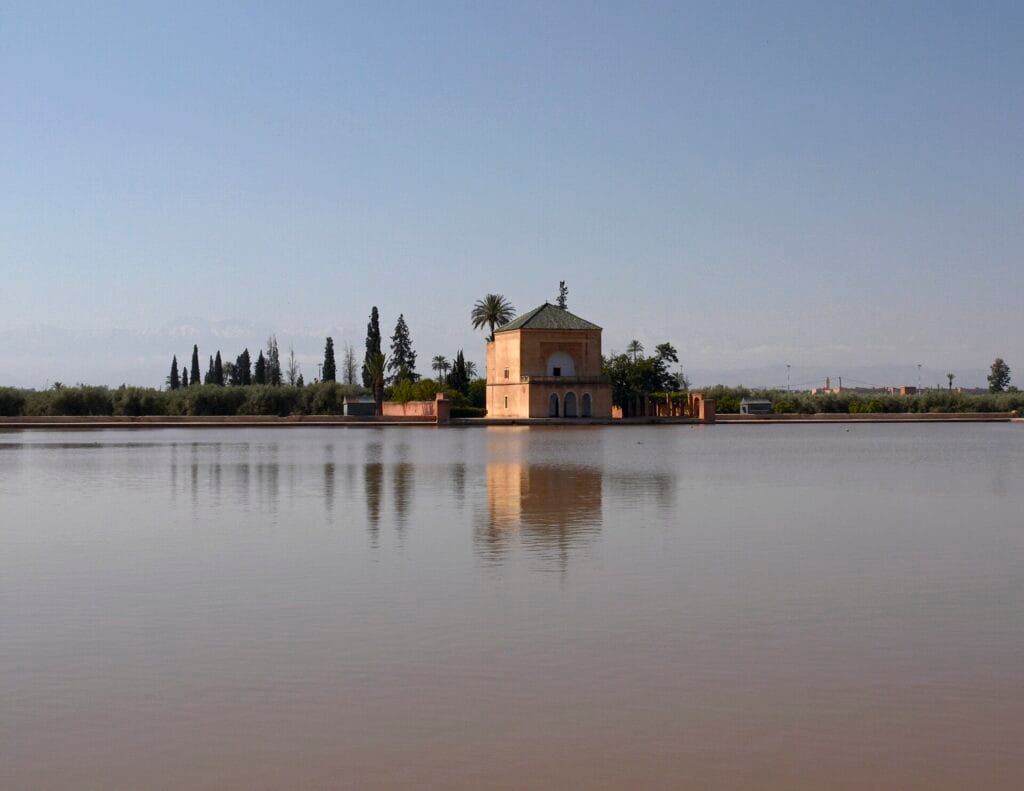
Quick answer: the Menara Gardens are one of the oldest landscaped olive groves in Menara Marrakech, created in the 12th century under the Almohad dynasty. Here you can admire a huge irrigation basin facing an elegant pavilion, with the snow-capped Atlas range as a backdrop. Access to the Menara garden is free (open daily, roughly 8 a.m. to 6 p.m.); only the visit of the pavilion is paid (indicative price around fifty dirhams). The site lies about 2 to 3 km west of the medina: allow 10 to 15 minutes by taxi.
If Marrakech is the “red city,” it is also a city of water and greenery, a paradox shaped by centuries of hydraulic ingenuity on the edge of the desert. Among its historic gardens, the Menara holds a special place: at first glance less spectacular than the much-photographed Majorelle Garden, it nonetheless offers an image that has become an emblem of the imperial city. This great mirror basin, the pavilion with its green tiles and the white silhouette of the Atlas peaks make up one of the most recognisable postcards of Morocco. In this complete guide, we look back at the history of the Menara Gardens, their remarkable irrigation system, what to see, and everything you need to know to plan your visit (opening hours, indicative prices, access, best time to go).
In brief: the essentials on the Menara Gardens
- Name: Menara Gardens (from the Arabic manzah/menzeh, “belvedere” or “pleasure pavilion”).
- Date of creation: 12th century, under the Almohad dynasty (around 1130), at the time of the founding and rise of Marrakech.
- Area: a vast olive grove of about one hundred hectares, planted with dozens of olive varieties.
- The basin: a huge reservoir of roughly 195 by 160 metres, the heart of the irrigation system.
- The pavilion: a menzeh of Saadian origin, rebuilt in the 19th century, opening onto the basin.
- Access: garden free; visit of the pavilion paid (indicative price ~50 DH per adult).
- Location: about 2-3 km west of the medina, on the Menara road, not far from the airport.
- Not to be missed: the view of the snow-capped Atlas and the reflection of the pavilion in the water, especially in late afternoon.
The history of the Menara Gardens: eight centuries of Almohad ingenuity
To understand the Menara is to go back to the very origins of Marrakech. The city was founded in the mid-11th century by the Almoravids, then profoundly transformed the following century by the Almohads, who made it one of the great capitals of the Muslim West. It is in this context, around the year 1130, under the reign of the Almohad sultan Abd el-Moumen (Abd al-Mu’min), that the Menara olive grove was laid out. Far from being a mere pleasure park, it first met a vital need: to feed a rapidly expanding city, in a plain — the Haouz — subject to drought and heat.
The Almohads were formidable water engineers. Where other civilisations would have retreated before the aridity of the climate, they built a network capable of capturing, transporting and storing water from the mountains to green the plain. The Menara thus became both a productive orchard — olive oil being a strategic product — and a demonstration of the organising power of imperial rule. The great basin, fed from the foothills of the Atlas, is its most visible symbol: a mirror of water set in the middle of the olive grove, at once useful and majestic.
Over the centuries, the dynasties that succeeded one another in Marrakech — Saadians, then Alaouites — maintained and embellished the site. It was in the Saadian era, in the 16th century, that a first pavilion (menzeh) appeared at the edge of the basin, a place of rest and contemplation for the sovereigns. The pavilion visited today, for its part, dates from the 19th century: it was rebuilt around 1869 under the Alaouite dynasty. This long continuity makes the Menara a rare witness to the hydraulic and political history of the city, far more than an ornamental garden.
This heritage dimension is part of a larger whole. The medina of Marrakech, with its monuments and historic gardens, has been listed as a UNESCO World Heritage Site since 1985. Even though the Menara lies outside the ramparts, it fully belongs to this cultural landscape shaped by centuries of land management. To delve deeper into the history and description of the site, the encyclopaedic entry on Wikipedia dedicated to the Menara gardens is a good complementary source.
What does the name “Menara” mean?
The word “Menara” derives from Arabic and refers to the idea of a menzeh or manzah, that is, a pleasure pavilion, a belvedere from which to contemplate the landscape. Some also link the term to a “lantern” or an elevated landmark, in reference to the silhouette of the pavilion overlooking the basin. In any case, the name clearly expresses the vocation of the place: a space designed for the pleasure of the eyes as much as for agricultural usefulness. It is this dual nature — productive and contemplative — that gives the Menara Gardens their unique character.
The great basin and the irrigation system: the hydraulic genius of the khettaras
The beating heart of Menara Marrakech is its basin. This immense rectangular stretch of water, about 195 metres long by 160 metres wide, covers nearly three hectares on its own. It is not an ornamental basin but a genuine agricultural reservoir: it stores the water needed to irrigate the surrounding olive grove, allowing supply to be regulated throughout the year, including during the driest months. In the past, fish farming was also practised here, and legend has it that the sultans came to train at swimming.
But where does this water come from, in such an arid plain? The answer lies in one word: the khettaras. These underground drainage galleries, inherited from the hydraulic know-how of the medieval Islamic world (close to the Persian qanats), capture water from the water tables located at the foot of the Atlas and convey it by gravity, over long distances, to the gardens and the city. At the Menara, the water thus travels several dozen kilometres — on the order of thirty kilometres — from the Atlas heights to the basin. This network, entirely underground to limit evaporation, is one of the finest engineering achievements of the Almohad era.
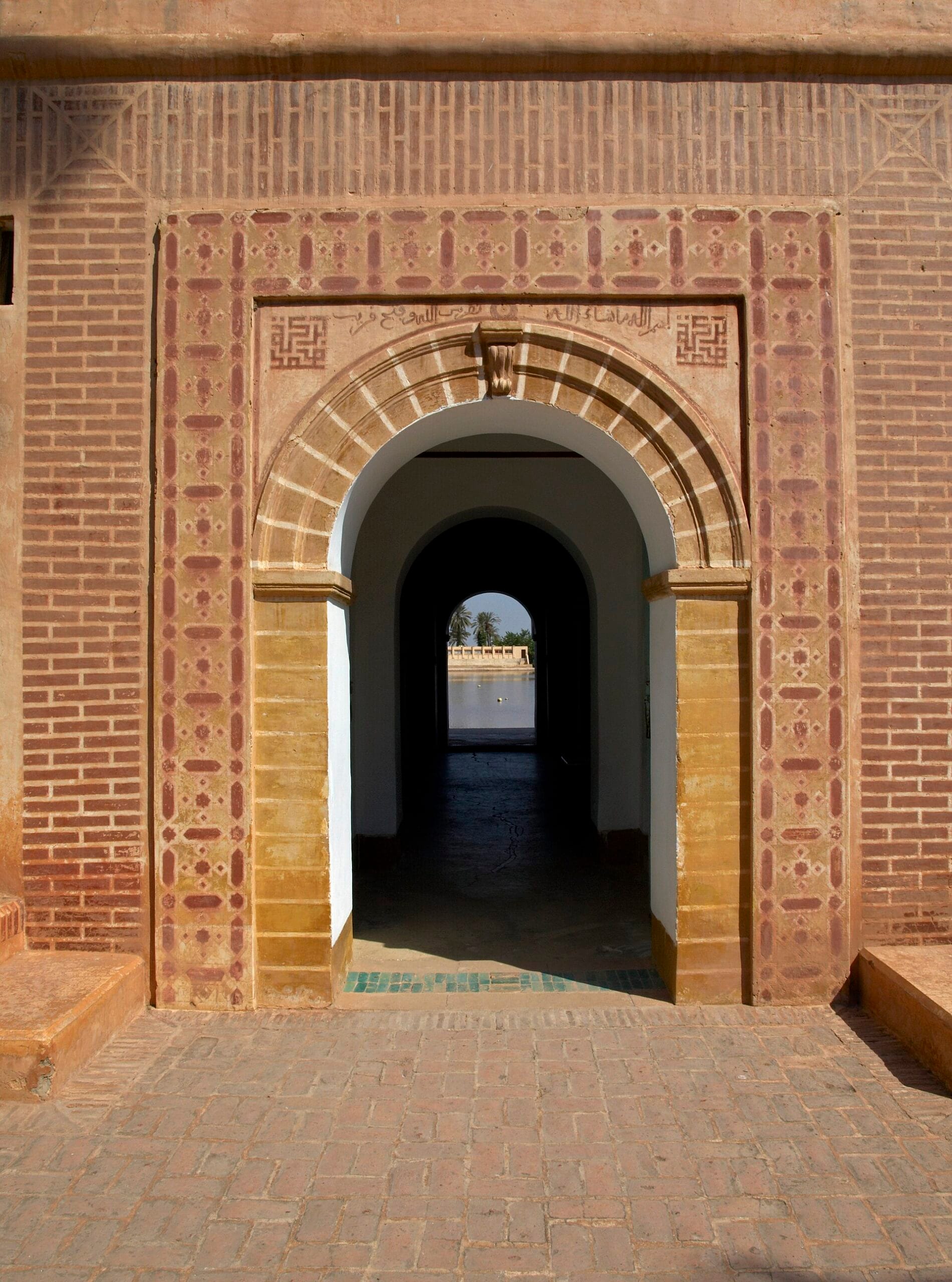
Understanding this system completely changes the way one looks at the site. The Menara basin is not a “backdrop”: it is the visible outcome of an invisible network, a work designed to transform a desert plain into a nourishing orchard. It is precisely this mastery of water that made possible the life of a great capital on the edge of the desert. Even today, the whole illustrates how Saharan and pre-Saharan civilisations knew how to cope with the scarcity of water — an issue more topical than ever.
An olive grove of more than 100 hectares
Around the basin stretches the olive grove proper: about one hundred hectares planted with thousands of olive trees, among which many varieties are counted. These trees, some of which are very old, are not there for the beauty of the landscape alone: they produce olives and oil, perpetuating the agricultural vocation of the place. Strolling between the rows of olive trees, away from the bustle of the basin, offers a rare moment of calm in the immediate vicinity of the city. It is also an excellent place to understand why the Menara remains, above all, a useful garden.
The Menara pavilion: belvedere of the sultans
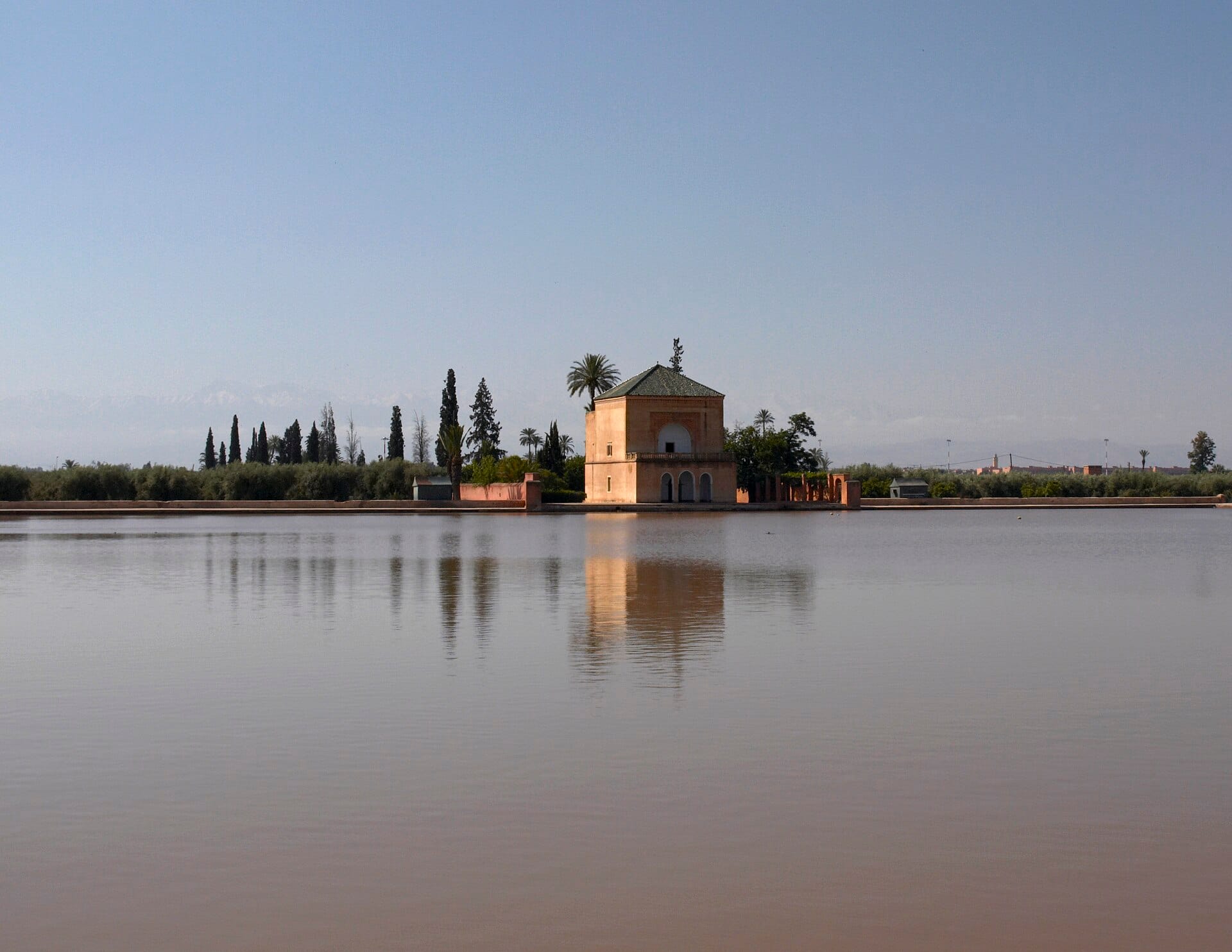
On the shore of the basin stands the famous pavilion, that building topped with a pyramidal roof of green tiles that appears in so many photographs. This menzeh has its origins in the Saadian era (16th century), but the current building was rebuilt in the 19th century, around 1869, under the Alaouite dynasty. Originally, it served as a place of retreat and reception for the sovereigns, who came to rest, receive guests, and contemplate the landscape from its windows and terrace.
The interest of the pavilion lies as much in its architecture as in its viewpoint. From the upper floor, the view embraces the basin, the olive grove and, on a clear day, the High Atlas range whose peaks remain snow-capped for much of the year. It is this superimposition — the water in the foreground, the pavilion, then the mountains — that composes the iconic image of the Menara. The visit of the interior of the pavilion is paid, but remains very affordable; it is worthwhile above all for the elevated view and for the atmosphere of the place.
Around the pavilion there also hovers an aura of legend. Popular tradition evokes stories of royal loves and secrets linked to the basin; some are without historical basis, but they are part of the folklore attached to the site and add to its charm. They should be taken for what they are: tales passed down from generation to generation, more poetic than accurate.
The view of the Atlas: the symbol of Marrakech
If the Menara Gardens have become a symbol of Marrakech, it is largely thanks to this panorama. The contrast between the mirror of water, the greenery of the olive trees and the white barrier of the Atlas sums up on its own the geography of the city: an urban oasis at the foot of high mountains, at the gates of the desert. This image adorns countless postcards, tourist brochures and posters, to the point of being inseparable from the visual identity of the city.
To capture this panorama in the best conditions, it is all a matter of timing. Late afternoon, when the light turns golden and the wind drops, offers a calmer basin and therefore a sharper reflection of the pavilion. The winter and spring months, when the Atlas is well covered in snow and the sky is clear, give the most spectacular view of the peaks. Conversely, in high summer, the heat haze can blur the mountains. To best plan your stay according to the season, consult our guide to the best time to visit Marrakech.
Visiting the Menara Gardens: practical information
Opening hours
The garden is in principle accessible every day, generally from around 8 a.m. to 6 p.m. (the range may vary slightly according to the season). The pavilion, for its part, opens for a shorter period, often from 9 a.m. to 5 p.m. These hours are given as an indication: it is best to plan your visit during the day and avoid turning up just before closing, especially if you wish to go up to the pavilion.
Prices (indicative)
- Access to the garden and the basin: free.
- Visit of the pavilion: paid, on the order of about fifty dirhams for an adult, with reduced rates for children, Moroccans and foreign residents in Morocco.
- Parking: possible nearby, sometimes in exchange for a small tip to the attendant.
These amounts are provided for indicative purposes and may change. No reservation is necessary for the garden; you simply turn up on site. Keep some change in dirhams for the entrance to the pavilion and for any small incidental fees.
How to get to the Menara Gardens?
The site is located west of the medina, about 2 to 3 kilometres from Jemaa el-Fna square, on the Menara avenue. Several options are available to you:
- By petit taxi: the simplest and quickest solution (10 to 15 minutes from the centre). Remember to ask for the meter to be switched on or to agree on the price in advance.
- On foot: possible from the medina (allow 40 to 45 minutes), but the route offers little shade and is therefore not very pleasant in full heat.
- By bus: several urban lines serve the area; an economical option if you are not in a hurry.
- By bicycle or horse-drawn carriage: for a more picturesque outing, provided you organise it well.
Good to know: the Menara is located not far from Marrakech-Menara airport (RAK), which incidentally bears the same name. It is an ideal visit to fit in at the start or end of your stay, for example before a late-afternoon departure flight, if your time allows.
How much time to allow?
A visit to the Menara does not take much time: one hour to an hour and a half is generally enough to walk around the basin, go up to the pavilion and stroll a little in the olive grove. It is therefore a stop that is easily combined with other visits in the same half-day. The Menara does not have the density of detail of a garden like Majorelle; its interest lies in its atmosphere, its history and above all its view — hence the importance of carefully choosing the time of day.
Tips for a lovely visit
- Aim for late afternoon: softer light, a calmer basin, a sharper reflection of the pavilion and fewer visitors.
- Favour winter and spring: the snow-capped Atlas then stands out clearly in the background.
- Protect yourself from the sun: the site offers little shade around the basin; a hat, water and sunscreen are useful.
- Keep some change: for the entrance to the pavilion and any parking fees.
- Combine visits: the Menara pairs well with other sites in the west of the city or with an end of day before the airport.
- Manage your expectations: this is a place of atmosphere and panorama, not a lush botanical garden. You will enjoy it all the more.
The Menara in your stay in Marrakech
The Menara fits naturally into a programme for discovering the city. It perfectly complements the visit of the other gardens and monuments, each offering a different facet of Marrakech. Where the Menara relies on space, water and Almohad history, other sites appeal through their intimacy or their exuberant vegetation.
To extend the experience of the gardens, do not miss the Majorelle Garden, with its famous blue and its collection of exotic plants, as well as Le Jardin Secret in the heart of the medina, a magnificent example of a traditional riad-garden. Nature lovers will also appreciate the Palmeraie park and the Agdal gardens, another great neighbouring Almohad creation, also centred on a vast system of basins.
If you have little time, the Menara fits perfectly into a condensed programme: our Marrakech in 3 days itinerary helps you spread out the visits without rushing. And for an overview of everything the city has to offer — monuments, souks, gardens, gastronomy and excursions —, refer to our complete guide “Things to do in Marrakech”, which places the Menara in the big picture of the ochre city.
Frequently asked questions about the Menara Gardens
Are the Menara Gardens free?
Yes. Access to the garden and the great basin is free for everyone. Only the visit of the interior of the pavilion is paid, for a modest price (on the order of about fifty dirhams for an adult, as an indication), with discounts for children and residents in Morocco.
What are the opening hours of the Menara garden?
The garden is generally open every day, from around 8 a.m. to 6 p.m., while the pavilion follows a shorter period, often from 9 a.m. to 5 p.m. These hours are indicative and may vary according to the season; plan your visit during the day so as not to be caught out.
What is the best time to visit the Menara?
Winter and spring are ideal: the sky is often clear and the Atlas well covered in snow, which enhances the panorama. During the day, late afternoon offers the most beautiful light and a calmer basin, favourable to the reflection of the pavilion. Summer remains possible, but heat and haze can dim the view of the mountains.
How to get from Jemaa el-Fna to the Menara?
The simplest is to take a petit taxi: allow 10 to 15 minutes from the centre. You can also go on foot (40 to 45 minutes, a route with little shade) or take an urban bus. The site is located about 2 to 3 km west of the medina, on the Menara avenue.
Who built the Menara Gardens?
The gardens were laid out in the 12th century under the Almohad dynasty, around 1130, in the time of sultan Abd el-Moumen. The current pavilion, for its part, is more recent: of Saadian origin (16th century), it was rebuilt in the 19th century under the Alaouite dynasty.
How much time do you need to visit the Menara?
One hour to an hour and a half is enough to walk around the basin, go up to the pavilion and stroll in the olive grove. It is a short visit, easy to combine with other sites in the same half-day, or to slot in before a flight departing from the nearby airport.
In summary
The Menara Gardens are not the most spectacular garden in Marrakech, but they are undoubtedly the most emblematic. Behind the postcard image — the basin, the pavilion, the snow-capped Atlas — lies a history of nearly nine centuries: that of Almohad hydraulic genius, capable of greening an arid plain thanks to the khettaras coming from the mountains. Free, easy to access and quick to visit, the Menara garden deserves a stop in any stay in Marrakech, preferably in late afternoon and in the fine season. A place where the useful and the beautiful come together, in the image of the ochre city itself.
Images under free licence via Wikimedia Commons: © Ymblanter (CC BY-SA 4.0); © Ymblanter (CC BY-SA 4.0). Sources: UNESCO and Wikipedia.Photo credits
The images illustrating this article come from royalty-free image banks (such as Unsplash, Pexels, Wikimedia Commons) and are used for illustrative purposes. Thanks to their respective authors. Disclaimer: the opening hours and prices mentioned in this article are given purely as an indication and are liable to change without notice. We recommend that you check the practical information with official sources before your visit.