Quick answer: the souks of Marrakech form an immense labyrinth of covered alleys at the heart of the medina, a UNESCO World Heritage site. They are historically organised by trade (textiles, dyers, babouche slippers, ironworkers, spices, leather, wood), each guild occupying its own street. People come for the atmosphere, the craftsmanship and above all to haggle: the displayed price does not exist, negotiation is the rule. Expect them to be open roughly 9am to 8pm–9pm every day, pay in dirham cash, offer at the start a third to a half of the first price quoted, stay smiling and firm, and beware of fake guides. This guide explains, district by district, what you will find in each souk, how to haggle, at what price, and how to avoid the scams.
In brief: the essentials on the souks of Marrakech
- Where: north of Jemaa el-Fna square, in the medina (old town) of Marrakech.
- Layout: by craft guilds (Souk Semmarine, Sebbaghine, Smata, Haddadine, Rahba Kedima, Cherratine, Chouari…).
- Hours: every day, roughly 9am–8pm/9pm. Some stalls close on Friday between 11am and 4pm (prayer).
- Payment: cash in dirhams (MAD) almost everywhere. Bring small change.
- Haggling: essential. Opening counteroffer = a third to a half of the price asked.
- What to bring back: rugs, babouche slippers, leather, lanterns, spices, argan oil, pottery, jewellery, leather goods.
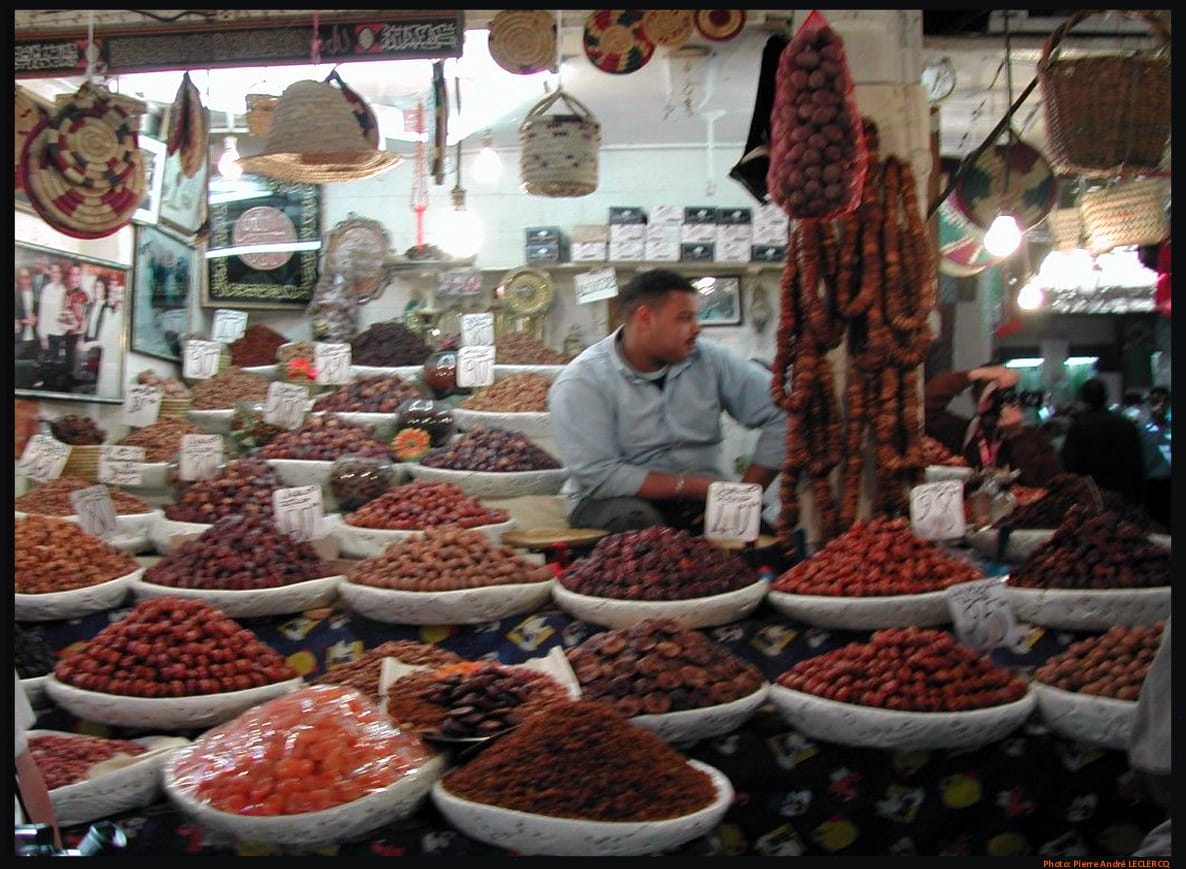
What are the souks of Marrakech?
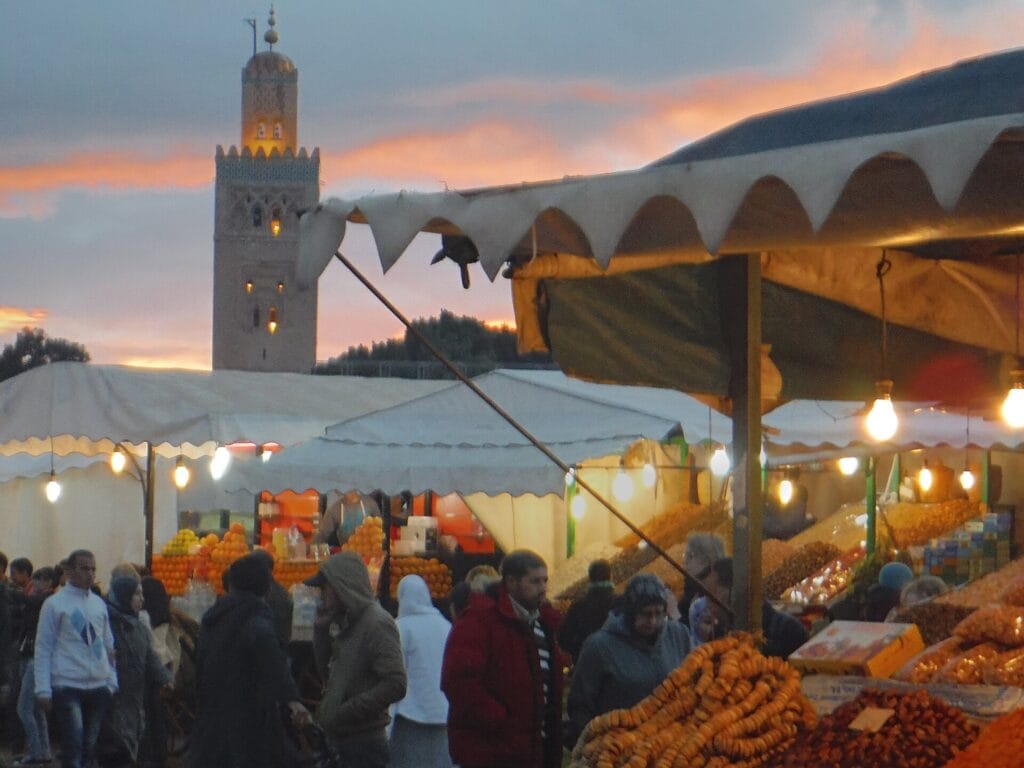
The word “souk” refers to a traditional market of the Arab-Muslim world. In Marrakech, it is not a single place but a genuine maze: dozens of narrow alleys, often covered with wooden slats or metal sheets that slice the light into rays, cross and intertwine north of the famous Jemaa el-Fna square. Together, these alleys form the commercial and artisanal heart of the medina, the historic centre of the “red city.”
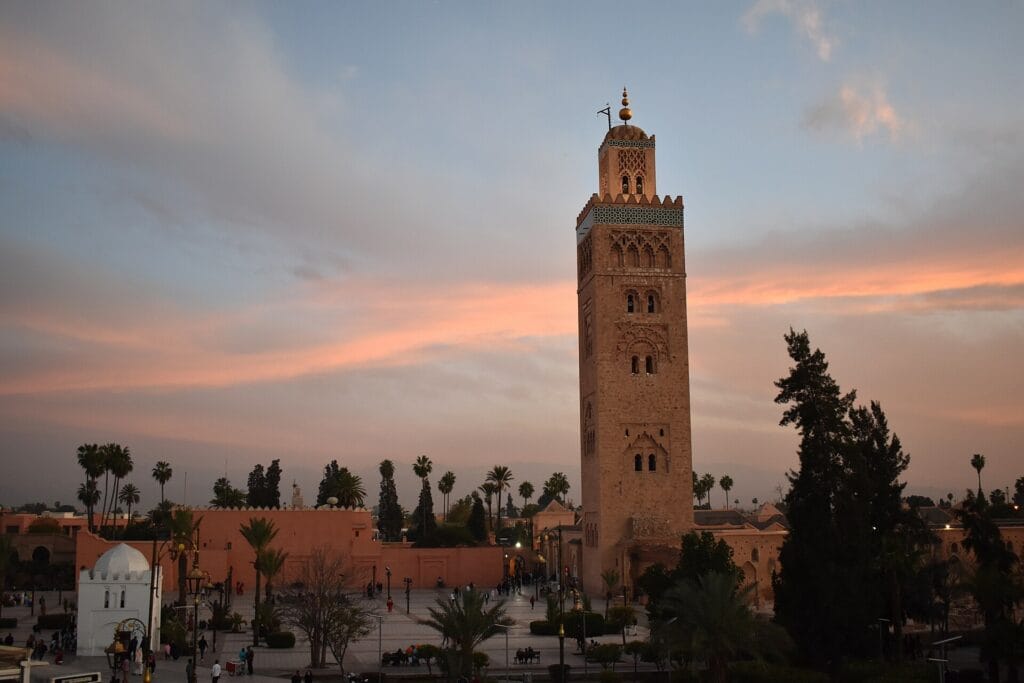
This medina has been inscribed since 1985 on the World Heritage list of UNESCO. It covers around 700 hectares and is a remarkable example of a still-living historic city, with its labyrinth of alleys, its houses, its fondouks (former caravanserais turned into workshops) and its traditional trades. Founded in the 11th century by the Almoravids, Marrakech was long a major stop on the trans-Saharan caravan routes, and its souks carry on this role as a merchant crossroads. For the full history of the city, the Wikipedia page on Marrakesh offers a good overview.
Visiting the souks is therefore not only about shopping: it is about walking through an open-air school of craftsmanship, where you can still see coppersmiths hammering copper, dyers plunging wool bare-handed into steaming vats and babouche-makers stitching leather in front of you. This guide is part of our broader feature on things to do in Marrakech, and pairs perfectly with our article on authentic souvenirs to bring back from Morocco.
How the souks are organised by guild: district by district
The great distinctive feature of the souks of Marrakech is their organisation by trade. As in most historic medinas, the craftsmen and merchants of a single product traditionally gather in the same street, which then takes the name of their guild. This logic, inherited from the Middle Ages, makes it easier to compare prices and quality — and it helps you when you know what you are looking for. Here are the main souks to know.
Souk Semmarine: the main artery
Souk Semmarine is the great covered street that extends Jemaa el-Fna square northwards. It is the central artery, the widest and busiest, the one you almost always enter through. You find a bit of everything there: textiles, scarves, djellabas, babouches, souvenirs, pottery, costume jewellery. As it is the most touristy passage, the opening prices are often the highest: use it to train your eye, but save your big purchases for the adjoining alleys, which are generally cheaper.
Rahba Kedima: the spice square
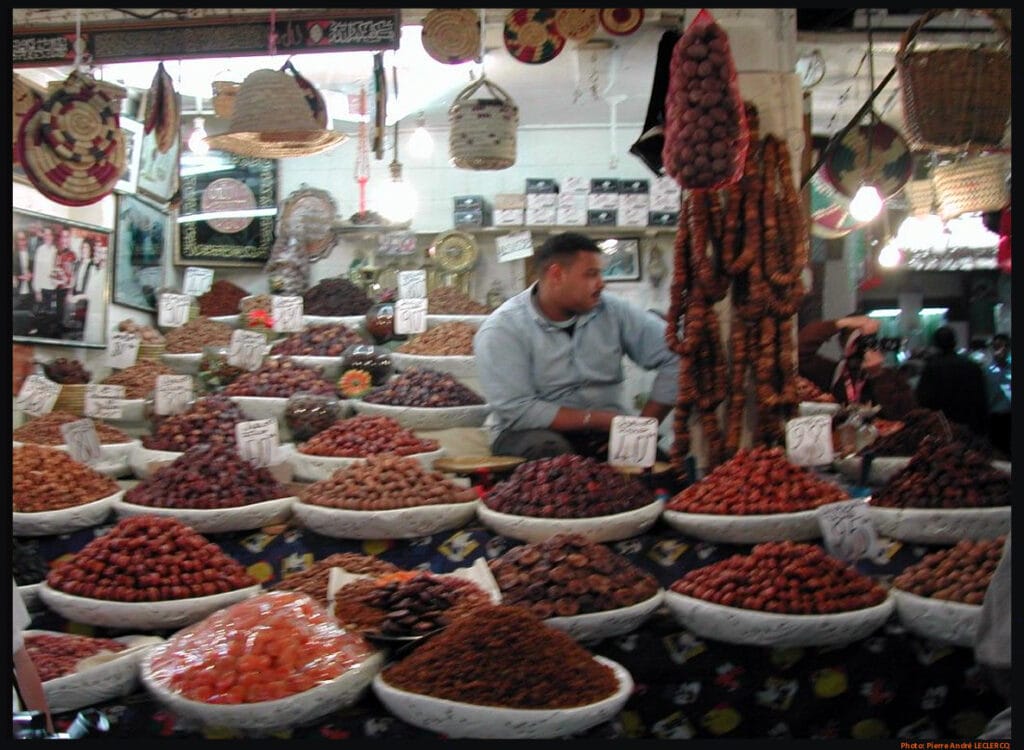
Off Semmarine opens the Rahba Kedima, nicknamed the “spice square.” It is a festival of colours and scents: pyramids of cumin, turmeric, paprika, cinnamon, ginger, not forgetting the famous ras el hanout, the emblematic blend of Moroccan cuisine that can bring together dozens of spices. Saffron is also sold here, along with medicinal herbs, products of the “Berber pharmacy” (black soap, alum stone, ghassoul clay, dried flowers) and, in the past, a few more unusual stalls. Haggle over the spices: the price by weight is negotiable, and saffron in particular calls for caution (see the scams section).
The Berber Auction (Souk Zrabia): rugs
From the Rahba Kedima, a passage leads to the rug souk, called Souk Zrabia or the “Berber Auction.” Historically it was the place for bidding. Even today, a traditional rug auction is held there in the late afternoon (often around 4pm, every day except Friday): the merchants stroll about calling out the prices, in a very particular atmosphere. It is the ideal spot for a hand-knotted Berber rug, a kilim or a boucherouite rug — but it is also where negotiation is the longest and most strategic, a rug possibly representing several hundred to several thousand dirhams.
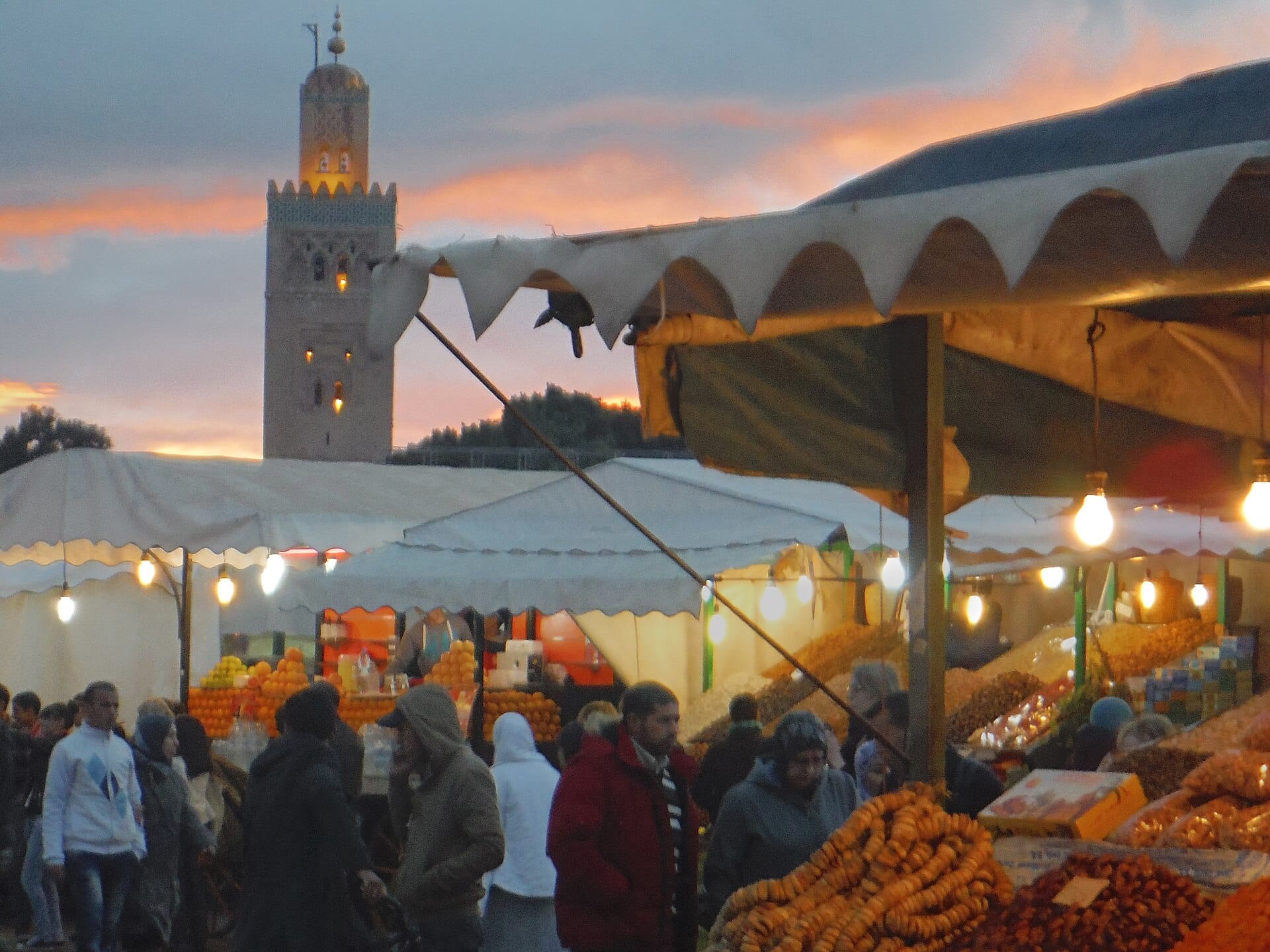
Souk Sebbaghine: the dyers
Souk Sebbaghine, that of the dyers, is one of the most photogenic in the whole medina. Skeins of freshly dyed wool and thread hang drying above the alley, forming a ceiling of vivid colours. You can watch the craftsmen plunge the fibres bare-handed into large dyeing vats. It is a place of spectacle more than of purchase, but you find fabrics, scarves and wool there. Beware: in the very “Instagrammable” alleys, you will sometimes be asked for a few dirhams to take a photo of a craftsman at work — a common practice, up to you.
Souk Smata (Semmata): the babouche slippers
Branching off from Semmarine, you come upon Souk Smata, the market of babouche slippers. Hundreds of pairs of these traditional leather slippers, with their pointed, upturned toes, line the walls in every imaginable colour. Saffron yellow, embroidered, in smooth leather or velvet, for men, women and children: it is one of the most popular souvenir purchases. Check the stitching and the suppleness of the leather, always try them on (Moroccan sizes differ), and negotiate by volume if you take several pairs.
Souk Haddadine: the ironworkers
Souk Haddadine is the domain of the ironworkers and blacksmiths. The sound of struck metal guides you there from afar. Openwork lanterns, tea-light holders, light fittings and wall lamps are made here, as well as grilles, locks and decorative wrought-iron objects. The famous Moroccan lanterns, which cast patterns of light on the walls, are a highly prized souvenir — but bear in mind their fragility and bulk for transport by plane.
Souk Cherratine and the leather souk
Souk Cherratine is devoted to leatherwork. Bags, belts, poufs, wallets, jackets and leather goods abound here. Marrakech leather is renowned, but its quality is very variable: smell it (real leather smells of leather, not of chemical glue), check the finishes and the stitching. Leather is one of the most counterfeited products, so be cautious with “branded” items.
Souk Chouari and Souk Nejjarine: wood
Souks Chouari and Nejjarine gather the carpenters and cabinetmakers. They work thuya wood (a Moroccan speciality with a characteristic scent) and cedar: inlaid boxes, trays, caskets, turned objects, small furniture. It is the ideal spot for a light, durable souvenir that is easy to carry. Along the alleys you will also come across Souk el-Attarine (perfumers and traditional drug-store products) and various coppersmithing workshops (hammered copper and brass).
What to bring back from the souks: the flagship products
- Berber rugs (hand-knotted, kilims, boucherouite): the star piece, but the most technical purchase.
- Babouche slippers in leather: the affordable classic, easy to carry.
- Leather goods and poufs: bags, belts, poufs to stuff yourself.
- Lanterns and metal objects: wrought iron, copper, brass.
- Spices and ras el hanout, saffron, tea, herbs.
- Argan oil (cosmetic or culinary) and natural cosmetics (black soap, ghassoul).
- Pottery and ceramics from Safi or Fez, decorative tagines, zellige.
- Thuya wood objects, Berber silver jewellery, textiles and blankets.
To go further on telling the authentic from the “made for tourists,” see our dedicated guide to authentic souvenirs to bring back from Morocco.
Haggling in Marrakech: the complete guide to negotiation
In the souks, the displayed price almost never exists. Haggling in Marrakech is not an option, it is the normal way commerce works, and even an expected social game. The seller announces a deliberately high first price; it is up to you to bring it down to a rate that suits both parties. Well handled, the negotiation is friendly, smiling, sometimes accompanied by a mint tea. Here is the method.
1. Scout the prices before buying
Start by strolling without buying anything. Ask the price of the same type of object from several merchants: you will get a range that will serve as your benchmark. This observation phase is the best protection against the “tourist price.”
2. Set yourself a target price and an opening counteroffer
Decide in advance on the maximum price you are willing to pay. Then, faced with the first price announced, propose a low counteroffer: the common rule is to start from a third to a half of the price asked, then to climb slowly in small steps to a middle ground. Never jump straight to your maximum price.
3. Stay smiling, patient and respectful
Good humour is your best asset. Be observant, patient, courteous but firm and determined. Haggling should remain a pleasant exchange, not an aggressive tug of war. A seller who likes you will give you a better price.
4. Use the “pretending to leave” move
This is the most effective technique: if the price sticks above your target, thank them politely and start to walk away. Very often, the “final price,” the real one, drops at that moment, called out as you move off. If the seller lets you leave without flinching, you were probably below their floor.
5. Negotiate at the end of the day and by volume
At the end of the day, as closing approaches, merchants who have not sold enough are often more inclined to lower their prices. Likewise, buying several items at the same stall gives you real leverage: “I’ll take all three if you do this price” works well. Finally, always have the exact amount in small notes: paying with a large note after negotiating a low price complicates the transaction.
Golden rule: never ask a price or start a negotiation if you have not the slightest intention of buying. Seriously beginning to haggle and then refusing the price you yourself proposed is considered disrespectful.
Hours, payment in dirhams and practical information
Opening hours
The souks of Marrakech are open every day, generally from 9am to 8pm, or even 9pm. The morning (around 10am–noon) is pleasant: soft light, moderate crowds. On Friday, the day of the great prayer, some stalls close between roughly 11am and 4pm. Expect reduced activity too during the month of Ramadan, with hours shifted towards the evening.
Payment: cash in dirhams
In the souks, there is only one reliable means of payment: cash in dirhams (MAD). Few stalls accept cards, and those that do often add fees. The dirham is a “closed” currency: you change it on site (exchange bureaus, banks, ATMs). Withdraw or change enough to last the day, spread out your money, and always keep small change so as not to spoil the effect of a successful negotiation. Haggle first, show the money afterwards.
Indicative price ranges
Prices vary enormously depending on the quality, the season and your bargaining talent; here are only orders of magnitude, to be checked on site. A pair of simple babouches often negotiates in a low-to-medium range of a few dozen to a hundred and fifty dirhams depending on the finish. Spices are sold by weight (for example ras el hanout at around a few dozen dirhams per 100 g). Authentic cosmetic argan oil costs more than a diluted counterfeit. Rugs, for their part, span a very wide scale, from a few hundred to several thousand dirhams depending on size, material and knotting. These figures are purely indicative and have no contractual value.
Finding your way in the labyrinth
The souks are a true labyrinth and it is normal to get lost — that is part of the experience. Download an offline map, note a few landmarks (Jemaa el-Fna square to the south, the Ben Youssef Mosque and Madrasa to the north) and don’t hesitate to ask your way from an established shopkeeper rather than a stranger who approaches you. Bring comfortable shoes and keep bags and phones close to your body in the crowd.
Scams in the souks: how to avoid them
The vast majority of merchants are honest and haggling is not a scam: it is the custom. But a few traps come up regularly, especially in the most touristy areas. Knowing them is enough to foil them.
- Fake guides. People spontaneously offer to “show you the way” or a “private workshop” / a “cooperative workshop.” They take a commission on your purchases, passed on through the prices. Politely but firmly refuse any unsolicited help and find your own way with a map.
- “The square is closed, follow me.” You are told that Jemaa el-Fna, the tannery or a street is closed in order to divert you towards a friendly shop. It is almost always false.
- Counterfeits. Argan, leather and saffron concentrate the most fakes. Argan oil is sometimes cut with other oils; “saffron” may be turmeric or safflower; “genuine” leather may be imitation. Learn to recognise the real thing (smell, texture, consistent price) before buying, and favour approved cooperatives for argan.
- The change sleight of hand. Always check the change you are given and the notes you hand over; count calmly.
- The “free” photo that becomes paid. Snake charmers, water sellers and some craftsmen demand a tip after a photo. Ask beforehand, or refrain.
- The “offered” tea that commits you. Accepting a tea obliges you to nothing, but some sellers use it as moral pressure to make you buy. Stay free to leave.
When in doubt, favour well-established shops, official cooperatives and craft complexes with sometimes fixed prices (useful for knowing a reference ceiling). And keep in mind that getting a little lost, refusing without guilt and smiling a lot are the best reflexes of the souk visitor.
Planning your souk visit within a stay in Marrakech
The souks are ideally visited in the late morning or late afternoon, then extended in the evening by the unique atmosphere of nearby Jemaa el-Fna square. Allow at least two to three hours for a first discovery, more if you plan to buy a rug. If you are planning a short stay, our Marrakech in 3 Days itinerary slots the souks into the right moment of the day. And for arrival, it all begins at Marrakech Menara Airport (RAK), about fifteen minutes from the medina.
One final piece of advice: enter the souks without a rigid list or a stopwatch. The true richness of the place lies in the encounters, the smells, the gestures of the craftsmen and that light filtered through the slats. Haggle for the pleasure as much as for the saving, and leave with an object that tells a story.
FAQ: your questions about the souks of Marrakech
Do you really have to haggle in the souks of Marrakech?
Yes. Haggling is the norm in the souks: the first price announced is deliberately inflated and no one expects you to pay it. First offer a third to a half of that price, climb in steps, stay smiling and don’t hesitate to pretend to leave to get the “real” rate.
What are the opening hours of the souks of Marrakech?
The souks open every day, roughly from 9am to 8pm or 9pm. On Friday, the day of prayer, some stalls close between 11am and 4pm. The morning is quieter and brighter, the end of the day more favourable to good deals.
Can you pay by card in the souks?
Rarely. Payment is made almost exclusively in cash, in Moroccan dirhams. Bring cash and plenty of small change; change or withdraw before your visit, as ATMs are scarce inside the labyrinth.
How are the souks organised?
They are organised by guilds, that is, by trade: Souk Semmarine (main artery, textiles and souvenirs), Rahba Kedima (spices), Souk Zrabia or Berber Auction (rugs), Souk Sebbaghine (dyers), Souk Smata (babouches), Souk Haddadine (ironworkers), Souk Cherratine (leather) and the wood souks (Chouari, Nejjarine).
Are the souks of Marrakech dangerous?
No, they are not dangerous: they are very lively and perfectly visitable on your own. The main annoyances are fake guides, persistent solicitations and a few counterfeits. Refuse unsolicited help, watch your belongings in the crowd and keep smiling: that is enough in the vast majority of cases.
What should you bring back from the souks as a priority?
The must-haves are babouche slippers, Berber rugs, leather goods and leather poufs, metal lanterns, spices and ras el hanout, argan oil, pottery and thuya wood objects. To properly distinguish the authentic from the mass-produced product, see our guide to souvenirs to bring back from Morocco.
Images under free licence via Wikimedia Commons: © Pierre André Leclercq (CC BY-SA 4.0); © Elgaard (CC BY-SA 4.0). Sources: UNESCO and Wikipedia.Photo credits
Image 1: alley of Souk Semmarine — [to be completed: author / source, royalty-free licence].
Image 2: Souk Sebbaghine dyers’ souk — [to be completed: author / source, royalty-free licence].
Image 3: spice stall at Rahba Kedima — [to be completed: author / source, royalty-free licence].
Disclaimer: the practical information (hours, prices, customs) is provided for guidance and may change. The price ranges in dirhams are orders of magnitude intended to help you prepare your negotiation and have no contractual value. Always check the conditions on site before any purchase.