Quick answer: the best time to visit Marrakech is spring (March to May) and autumn (September to November). These two seasons offer mild to warm days (22 to 30°C), clear skies and ideal light for strolling through the medina, without the crushing heat of summer or the marked night-time cool of winter. If you are wondering when to go to Marrakech, remember above all: avoid July–August (often more than 40°C) and favour April, May, October. Here is the detail, backed by the figures of the Marrakech climate.
In brief: when to go to Marrakech?
- Best times: March–May and September–November (ideal climate, reasonable crowds).
- Times to avoid for the heat: July and August (35 to 42°C during the day, sometimes more than 45°C).
- Best price/climate balance: May and October (splendid weather, crowds less dense than at Easter and Christmas).
- Winter (Dec.–Feb.): mild days (18 to 21°C) and sunny, but cool nights (5 to 8°C); ideal for a quiet city break.
- To watch out for: Ramadan (around 18 February to 19 March 2026) changes the mood of the city, especially during the day.
Understanding the Marrakech climate: semi-arid and very sunny
Marrakech, the “ochre city” at the foot of the Atlas Mountains, enjoys a hot semi-arid climate (type BSh in the Köppen classification). In practical terms, this means exceptional sunshine — more than 3,000 hours of sun a year, that is about 7 hours a day in winter and up to 11 hours in July — and rare rainfall, of the order of 250 to 280 mm a year only. The rain, when it falls, is concentrated in the period from October to May, with a slight peak in March; summer is almost dry.
The other key feature of this Marrakech climate is the strong temperature swing between day and night, typical of continental regions far from the sea. In winter, it is not unusual to go from 20°C in the middle of the day to 6°C in the early morning. So remember to pack layers of clothing, whatever the season. This swing is explained by the city’s position, in an inland plain at about 460 metres altitude, far from the tempering influence of the Atlantic Ocean.
The proximity of the High Atlas, whose peaks rise to more than 4,000 metres and are covered with snow in winter, plays a major role. These mountains partly shelter the city and offer, less than an hour’s drive away, a striking climatic contrast: you can go from a mild morning in Marrakech to a cool, windy afternoon at altitude. This proximity also explains the famous chergui, that hot, dry wind from the interior that pushes the thermometer up in summer. To delve deeper into the official climate data, you can consult the climate section of the Wikipedia page on Marrakesh.
Average temperatures in Marrakech: the month-by-month climate table
Here are the average temperatures of Marrakech (daytime highs and night-time lows) as well as indicative rainfall, month by month. These values are long-term averages: a given day can differ significantly, especially in summer.
| Month | Day high (°C) | Night low (°C) | Rain (mm) | Feel |
|---|---|---|---|---|
| January | 19 | 6 | ~30 | Mild by day, cool at night |
| February | 21 | 8 | ~28 | Pleasant, first mild spells |
| March | 24 | 10 | ~33 | Ideal spring, wettest month |
| April | 26 | 12 | ~30 | Excellent, highly recommended |
| May | 30 | 15 | ~15 | Warm and dry, superb |
| June | 34 | 18 | ~6 | Heat rising |
| July | 38 | 21 | ~2 | Very hot, sometimes >45°C |
| August | 37 | 21 | ~3 | Very hot and dry |
| September | 32 | 18 | ~9 | Heat easing, excellent |
| October | 28 | 15 | ~24 | Ideal autumn |
| November | 23 | 11 | ~30 | Mild, magnificent light |
| December | 20 | 7 | ~30 | Mild by day, cold nights |
Spring (March to May): the best time to visit Marrakech
If you had to remember only one answer to the question “when to go to Marrakech?”, it would be spring. From March to May, the city awakens: gardens in bloom, perfect temperatures and golden light. In March, expect around 24°C during the day; it is also statistically the wettest month, but the showers stay brief and spaced out. April (26°C) and May (30°C) are probably the most pleasant months of the year: comfortable warmth, mild evenings and a sky that is almost always clear.
It is the dream season to wander the souks, visit the Majorelle Garden, the Ben Youssef Madrasa or take an excursion to the Ouzoud Waterfalls and the Atlas, still green. To plan your stay, see our complete guide “Things to Do in Marrakech” and our Marrakech in 3 Days itinerary. One reservation: spring is very popular, with a peak around the Easter holidays. Book accommodation and activities in advance.
Autumn (September to November): the second ideal season
Autumn is the other great window for a successful stay. From mid-September, the summer furnace recedes: highs come back to around 32°C, then 28°C in October and 23°C in November. The nights become breathable again and the city picks up its rhythm after summer. October is often cited as the best compromise of the year: splendid weather, gentle warmth, first refreshing rains and crowds more measured than in spring.
It is also an excellent time to combine Marrakech with the desert or the Ourika Valley, the days being warm without being suffocating. Discover the best outings in our guide to excursions in Marrakech 2026 with prices. In November, the low-angled light and the very clear sky delight photographers, even if the evenings begin to cool.
Summer (June to August): very hot, for lovers of strong heat only
The Marrakech summer is intense. As early as June, the mercury climbs (34°C), then July and August settle in lastingly between 37 and 42°C, with peaks sometimes exceeding 45°C during episodes of chergui, that hot wind from the desert. The heat is dry, so a little more bearable than humid heat, but it imposes a precise rhythm: visits early in the morning and at the end of the day, long breaks in the shade or by the pool during the hottest hours, and constant hydration.
Summer nonetheless has two advantages: sometimes lower hotel rates (except riads with a pool, in high demand) and lively evenings. If you travel in July–August, favour air-conditioned accommodation with a pool and consider, why not, an escape to altitude in the Atlas or to the coast at Essaouira, distinctly cooler. On arrival as on departure, keep in mind the conditions at Marrakech Menara Airport (RAK), where the heat can be strong on the tarmac.
Winter (December to February): mild by day, cool at night
Contrary to a common belief, winter in Marrakech is very pleasant during the day: the sun is almost always present and the highs range between 19 and 21°C from December to February. It is perfect for sightseeing without sweating. On the other hand, the nights are cool, between 5 and 8°C, and many traditional riads are barely heated: pack jumpers, a scarf and something to cover up in the evening. You can also often glimpse the snow-capped peaks of the Atlas on the horizon, a magnificent sight.
Winter is ideal for a quiet cultural city break, with fewer people in the monuments — except for the year-end holidays, a period of very high attendance when prices soar. The medina, a World Heritage site, is then visited in soft light; to learn more about this jewel, see the UNESCO listing for the medina of Marrakech. Bring a light woolly and you will fully enjoy sunny days at often gentle prices (outside Christmas and New Year).
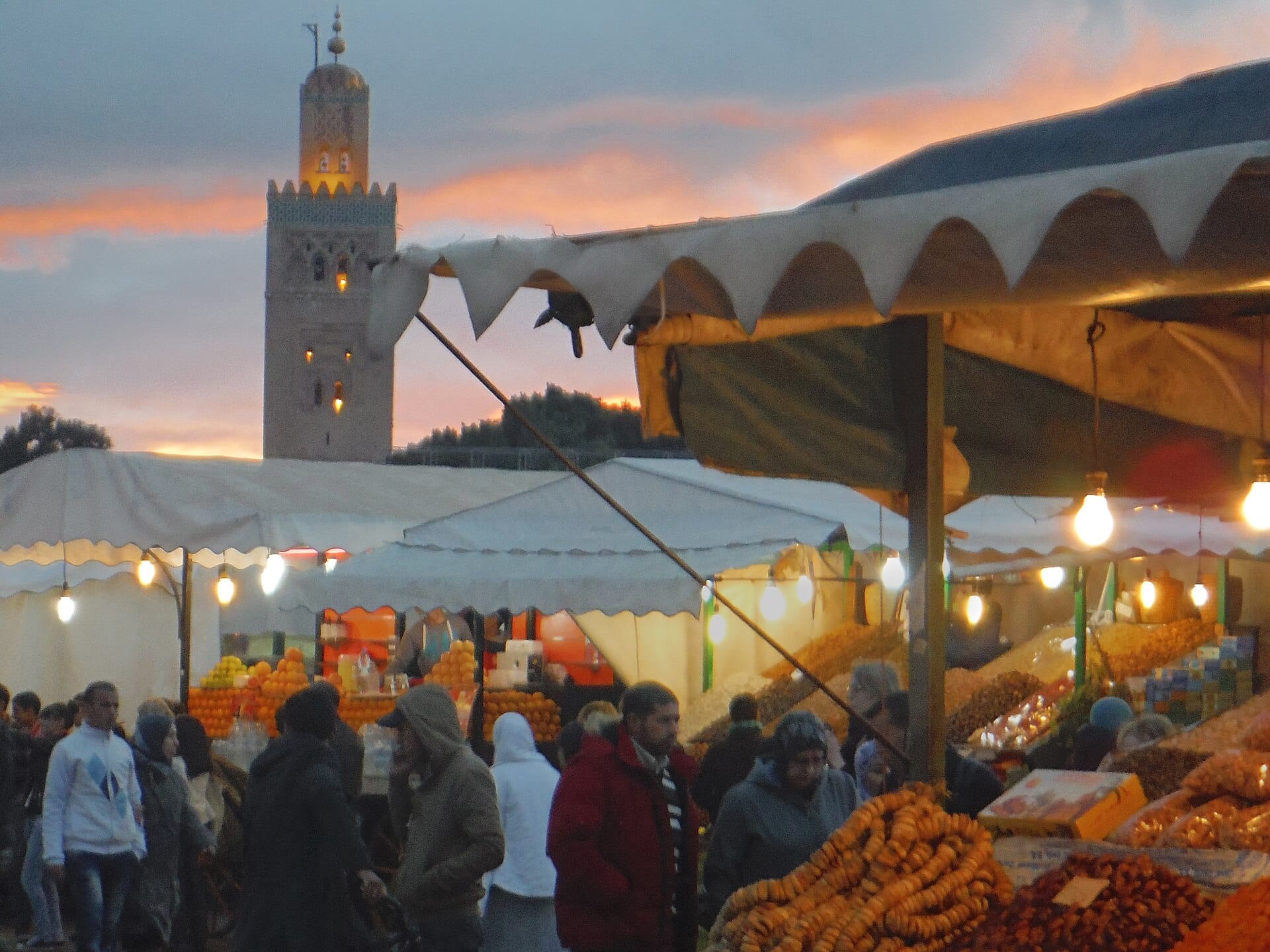
The Marrakech climate month by month, in detail
To help you decide, here is a finer overview of each month of the year. Keep in mind that these descriptions are based on climate normals: the actual weather of a given year can hold a few surprises, notably early heatwaves in spring or mild spells in the middle of winter.
- January: the coolest month, but bright. Around 19°C by day and 6°C at night. Ideal for cultural visits, with few people outside the holidays. Perfect for the marathon and hikes in the foothills of the Atlas.
- February: the first mild spells make themselves felt (21°C by day). The days lengthen, the almond trees blossom in the region. A good off-season month to enjoy the city at a reasonable price.
- March: spring settles in (24°C). It is statistically the wettest month, but the rains stay brief. The surrounding nature is green, ideal for excursions.
- April: one of the star months (26°C), very much in demand, notably around Easter. Comfortable warmth, mild evenings, clear skies: a flawless choice for discovering the city.
- May: warm and dry (30°C), with long sunny days. The weather is almost perfect before the arrival of the great heat. Excellent for combining city, mountain and desert.
- June: the heat rises sharply (34°C). Still bearable if you organise yourself, but the afternoons are already heavy. Rates often gentler than in April–May.
- July and August: the hottest months (37-38°C, sometimes more than 45°C). For lovers of strong heat only, with a pool and air conditioning essential. Lively nightlife.
- September: the heat recedes noticeably from mid-month (32°C). An excellent compromise, with pleasant evenings again and superb light.
- October: often the best month of autumn (28°C). Splendid weather, gentle warmth, crowds more measured than in spring. A very safe choice.
- November: mild (23°C) and magnificently bright, with evenings that cool down. The month of the International Film Festival. Ideal for a cultural stay.
- December: mild, sunny days (20°C), cold nights (7°C). Peaceful atmosphere, except during the year-end holidays when crowds and prices explode.
Which season to choose according to your traveller profile?
The best time also depends on your travel style and your priorities. Here are a few pointers to guide you:
- Couples and a romantic city break: aim for April, May, October or November, for mild evenings on a terrace and perfect light in the riads and gardens.
- Families with children: spring and autumn avoid the discomfort of summer heat. The spring school holidays are ideal weather-wise, but book early.
- Hikers and lovers of Atlas excursions: spring offers green mountains and generous waterfalls; autumn, stable, clear weather.
- Small budgets: June, September and winter outside the holidays often offer the best rates, while keeping decent weather (warm in June, mild in winter).
- Lovers of lazing and the pool: full summer lets you enjoy the riads and resorts with a pool, if the heat does not put you off.
Tourist crowds and prices by season
The Marrakech climate largely dictates the crowds. Generally you can distinguish:
- High season: April–May and October–November, plus the Easter, Christmas and New Year holidays. Ideal climate, but denser crowds and high rates — book early.
- Low season (heat): July–August. Fewer international tourists during the day, sometimes gentler hotel prices, but extreme heat.
- Favourable shoulder seasons: March, June, September and early December often offer the best balance between pleasant weather, availability and budget.
Budget tip: travelling on weekdays rather than at the weekend and avoiding European public-holiday long weekends often lets you notably reduce the cost of accommodation, even in peak ideal season.
Ramadan in Marrakech: what to know before you go
Ramadan is a factor to build into your choice of period. In 2026, it should take place from around 18 February to 19 March (the dates depend on the observation of the moon), with Eid al-Fitr around 20 March. During this holy month, the city lives to a different rhythm: quieter and sometimes slowed during the day, it comes intensely alive after the breaking of the fast (ftour), in a warm, family atmosphere.
In practical terms for the traveller: hotels, riads, tourist restaurants and visitor sites operate normally, but some cafés and small local restaurants close during the day, and nightlife (bars, clubs, pool parties) runs at a slower pace. Travelling during Ramadan can be a fine cultural experience, provided you show respect (avoid eating or drinking conspicuously in the street during the day). If you prefer a classic festive atmosphere, aim rather for April–May or October–November.
Events and festivals: a calendar to fine-tune your choice
The major cultural and sporting events may also motivate your travel dates:
- January: the Marrakech International Marathon, helped by the winter coolness.
- July: the National Festival of Popular Arts, a showcase of Morocco’s traditional music and dance.
- Year-end (Nov.–Dec.): the prestigious Marrakech International Film Festival, which draws stars and film lovers.
- Spring: contemporary art exhibitions and events give rhythm to the city and its galleries.
During these events, hotel demand climbs: book several weeks in advance if you plan your trip around one of them.
Living well with the Marrakech climate: practical tips
Whatever the period chosen, a few habits will let you get the best from the Marrakech climate and make your stay comfortable. The first concerns the rhythm of the day: the city is lived intensely in the morning and late afternoon, while the middle of the day, especially in summer and in the warm mid-season, invites you to slow down. Adopting the local rhythm — morning visits, a break in the shade or at the riad in the middle of the day, then resuming in the evening — changes everything, even in spring when the afternoons can already be hot.
Hydration is essential in this dry climate: drink regularly, even without feeling thirsty, and favour the shaded areas of the medina, naturally cooler thanks to the narrow alleys and thick walls. Traditional riads, built around a patio, remain remarkably cool in summer and make an ideal refuge. In winter, conversely, seek out sunny terraces and squares during the day to enjoy the warmth of the sun, then well-heated accommodation for the evening.
Also think of sun protection all year round: with more than 3,000 hours of sunshine a year, the Marrakech sun beats down hard, including in winter and in overcast weather. A hat, sunglasses and sunscreen are not superfluous, even in January. Finally, keep in mind the temperature gap between the city and the neighbouring Atlas: a mountain excursion, very pleasant for escaping the summer heat, can hold a cool wind and distinctly colder evenings. Bringing an extra layer always proves wise.
What to pack according to the season?
- Spring / autumn: light clothing for the day, a jacket or jumper for the evenings, comfortable walking shoes, sunglasses and sunscreen.
- Summer: very light, covering clothes (cotton, linen), a hat, high sun protection, a water bottle; favour air-conditioned accommodation with a pool.
- Winter: layering, a warm jumper, a jacket and scarf for the cool nights, but also sunglasses for the bright days.
Whatever the season, pack respectful attire for visiting places of worship and the traditional areas of the medina.
FAQ: best time to visit Marrakech
What is the best month to visit Marrakech?
April, May and October are generally considered the best months: pleasant temperatures (26 to 30°C by day), clear skies and mild nights. March and November are excellent alternatives, a little cooler.
Which period should you avoid in Marrakech?
July and August are the hardest because of the heat (often 38 to 42°C, sometimes more than 45°C). Sightseeing becomes gruelling in the middle of the day. If you have no choice, count on air-conditioned accommodation with a pool and outings early in the morning.
Is it cold in Marrakech in winter?
Winter days are mild and sunny (19 to 21°C), but the nights are cool (5 to 8°C). Many riads are barely heated: pack warm clothing for the evening.
When does it rain in Marrakech?
Rainfall is rare (250 to 280 mm/year) and concentrated from October to May, with a slight maximum in March and November. Summer (June to September) is almost dry. It never rains for very long.
Can you visit Marrakech during Ramadan?
Yes. Hotels, tourist restaurants and sites remain open. The city is quieter during the day and very lively in the evening. It is a rich cultural experience, provided you respect local customs (discretion when eating and drinking during the day). In 2026, Ramadan takes place around 18 February–19 March.
How many days to plan for Marrakech?
3 to 4 days are enough to discover the essentials of the city (medina, Jemaa el-Fna, Majorelle, palaces). Add 1 to 3 days if you wish to venture out to the Atlas, the Ouzoud Waterfalls or the desert. See our detailed Marrakech in 3 Days itinerary to optimise your stay.
In summary: when to book your trip to Marrakech
The best time to visit Marrakech remains spring (March–May) and autumn (September–November), for their mild to warm climate, their generous sunshine and their pleasant nights. Winter will suit lovers of quiet cultural stays who are well wrapped up for the evening, while summer is for those who can bear strong heat and are looking for a pool and lighter rates. By taking into account the climate, the crowds, Ramadan and the festivals, you will be able to choose when to go to Marrakech with confidence — and fully enjoy the ochre city.
Images under free licence via Wikimedia Commons: © Misa.stefanovic.07 (CC BY-SA 4.0); © A. van Achterberg / ASC Leiden (CC BY-SA 4.0); © Elgaard (CC BY-SA 4.0). Sources: UNESCO and Wikipedia.Photo credits
Images to be inserted from royalty-free image banks (Unsplash, Pexels, Wikimedia Commons). Please credit each author according to the licence indicated at the source. Disclaimer: the temperatures and rainfall mentioned are indicative climate averages (long-term normals) and may vary from one year to another; check the weather forecast before your departure. The dates of Ramadan 2026 are approximate and depend on the official lunar observation.