Marrakech in 7 days is the ideal format: a full week lets you do what no shorter trip allows — exploring the city in depth and stringing together two or three major excursions, including the famous grand loop through the Sahara Desert. In 1, 2 or 3 days, you race through the medina; in 4 or 5 days, you add one getaway. But it’s only from seven days onward that you can truly combine the city, the mountains, the desert and, if you wish, the Atlantic coast, without feeling like you’re skimming over everything.
Quick answer: devote 2 to 3 days to Marrakech itself (medina, monuments, gardens, souks), then set off on the grand desert loop to Merzouga (3 days / 2 nights, with a bivouac at the foot of the Erg Chebbi dunes), and keep one day to unwind in a natural setting (the Agafay Desert, the Ourika Valley) or to breathe the sea air of Essaouira. This guide offers you a ready-made 7-day Marrakech itinerary, day by day, with a “coast & mountains” variant for those who prefer the ocean and the peaks of the Atlas to the great Saharan south. We are an independent guide, not affiliated with ONDA or any tourism office: all prices are given purely as an indication.
In brief: a week in Marrakech, the essentials
- Ideal duration: 7 days / 6 nights, the best compromise between city and major excursions.
- The real advantage of 7 days: being able to do the grand desert loop (Merzouga) over 3 days, impossible to fit into a short stay.
- Recommended breakdown: Day 1-2 Marrakech in depth · Day 3 Atlas / Ourika Valley · Day 4-5-6 grand Merzouga desert loop · Day 7 relaxation (Agafay) or Essaouira.
- “Coast & mountains” variant: 2 days in Essaouira + 2 days in Imlil/Toubkal instead of the distant desert.
- Indicative budget: €550 to €1,100 per person excluding flights (7 days), depending on comfort level.
- Best season: March-May and September-November (the desert is best visited from October to April; summer there is scorching).
- Logistical base: sleep in Marrakech (medina or Guéliz) + 2 nights “on the road” for the desert.
Before getting into the details, a note on method: this article focuses on how to assemble a coherent week. For the full details of each excursion, we point you to our dedicated guides — no need to repeat everything here. If you’re hesitating between different durations, compare it with our Marrakech in 5 days itinerary or our 3-day itinerary: a full week isn’t “5 days + 2” but a different logic, built around one grand loop.
Marrakech in 7 days: the day-by-day itinerary
Here is the reference itinerary: two days to get to know the red city, one day to warm up in the Atlas, the grand desert loop over three days, and a final day to catch your breath. This is the backbone of a well-balanced week in Marrakech, neither too dense nor too idle.
Day 1 — The historic medina and Jemaa el-Fna square
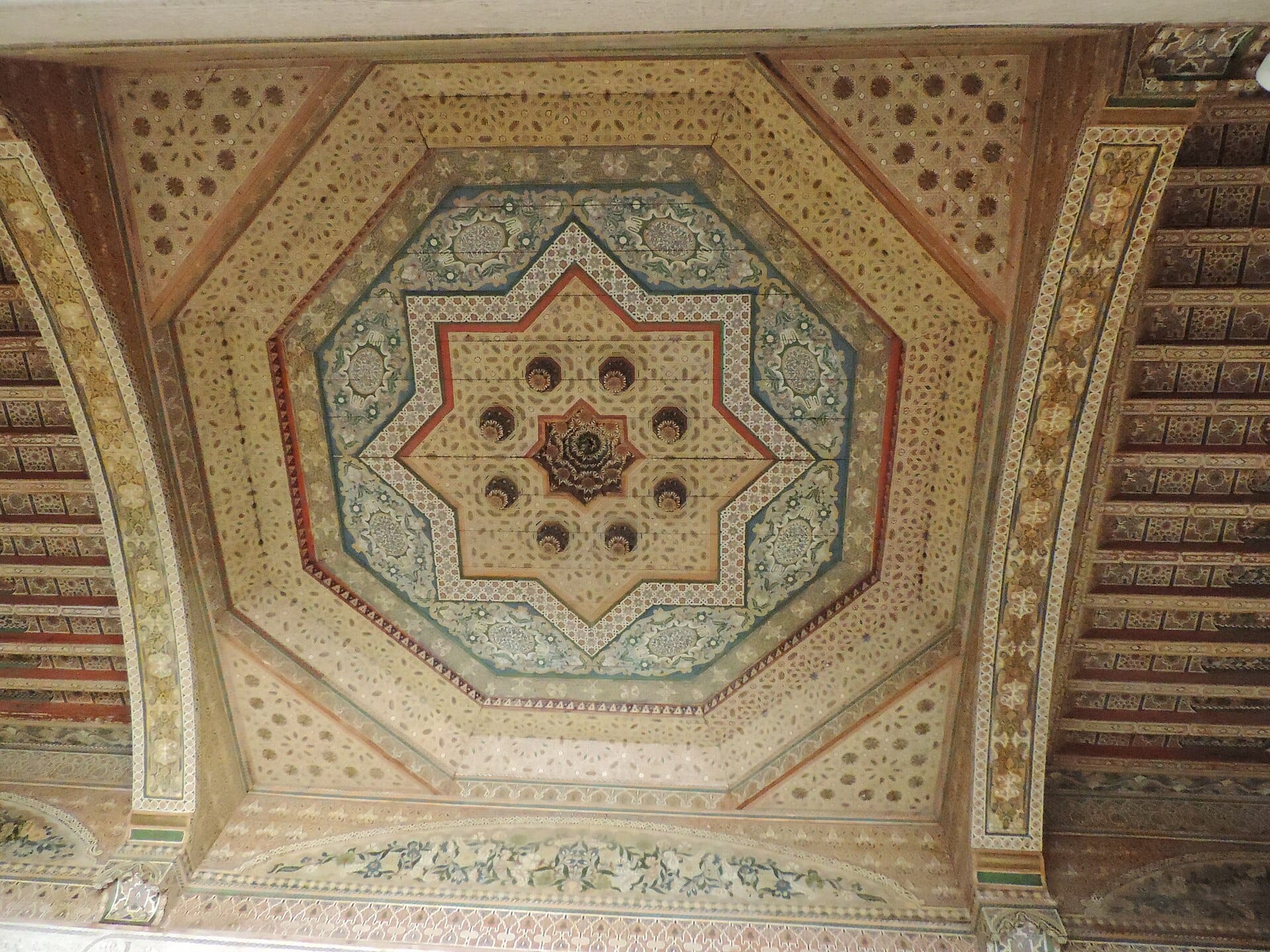
Start with the beating heart of the city. In the morning, dive into the medina, a UNESCO World Heritage site. Visit the Bahia Palace with its painted cedar ceilings and courtyards, then the Saadian Tombs, rediscovered in the 20th century. Take the time to get deliberately lost in the souks: babouche slippers, leather, lanterns, spices. At midday, a terrace overlooking the square offers a welcome break.
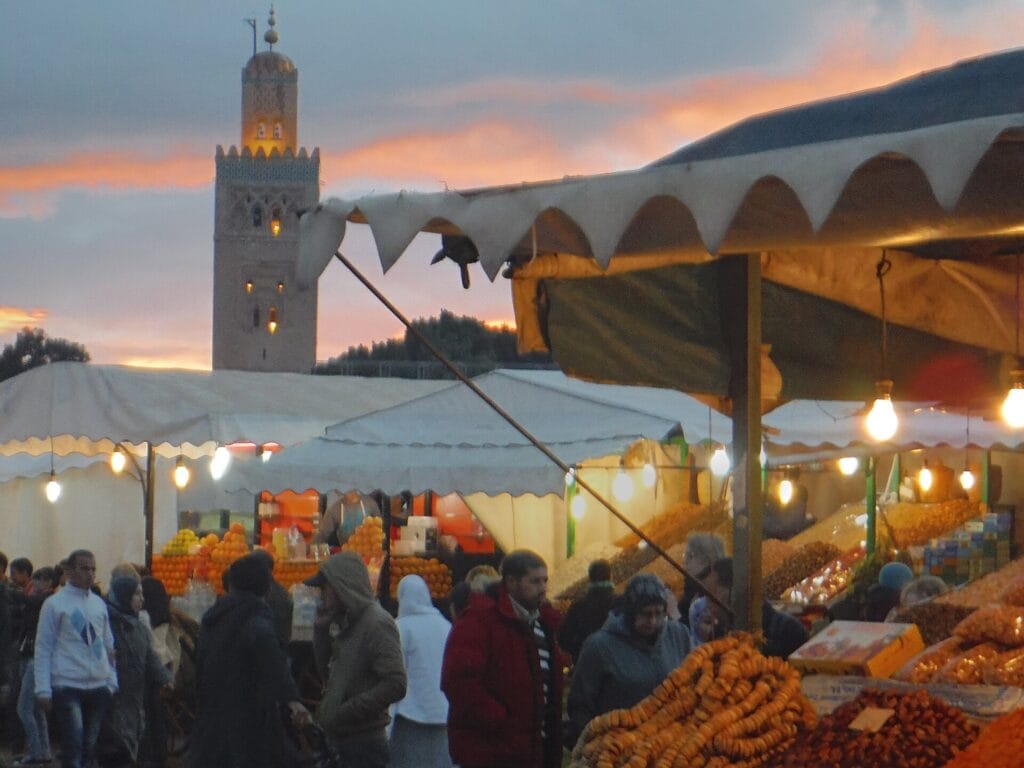
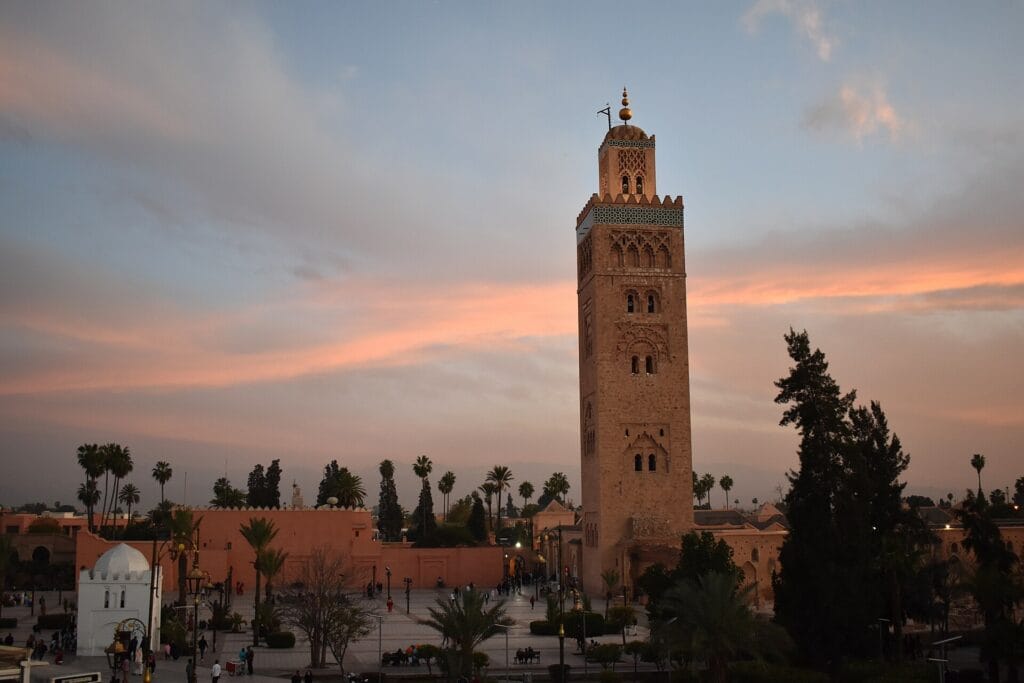
In the afternoon, push on to the Ben Youssef Madrasa, a former Quranic school with finely chiselled stucco, and the Koutoubia, whose 12th-century minaret dominates the city. At the end of the day, return to Jemaa el-Fna square at sunset: storytellers, Gnaoua musicians, orange-juice stalls and skewer stands turn the esplanade into an open-air theatre. It’s one of the most memorable moments of the entire trip.
Day 2 — Gardens, palaces and modern Marrakech
On the second day, change the pace. The morning is perfect for the gardens: the Majorelle Garden and its electric blue, the adjoining Yves Saint Laurent Museum, or the Secret Garden in the heart of the medina. Those seeking calm will prefer the palm grove or the Menara Gardens, an ancient basin facing mountains that are snow-capped in winter.
In the afternoon, discover the city’s contemporary face in the Guéliz district: art galleries, cafés, designer boutiques. Treat yourself to a traditional hammam followed by a black-soap ritual: after two days of walking, it’s pure bliss, and excellent preparation for the long roads ahead. This second day lets you tick off everything missing from very short itineraries. To make sure you forget nothing, keep our complete guide on what to do in Marrakech close at hand.
Day 3 — The Atlas and the Ourika Valley
After two urban days, the mountain air does you good. Just 30 km south of Marrakech, the Ourika Valley offers an instant change of scenery: a river, Berber villages, the Setti Fatma waterfalls reachable by a short hike, tea terraces at the water’s edge. It’s an easy day, ideal for warming up before the desert and for grasping just how close the High Atlas is to the city. Find all the practical details in our dedicated guide to the Ourika Valley from Marrakech.
Head back to Marrakech at the end of the day for a last night in the city before the big departure. Take the opportunity to pack a small two-night bag (the rest of your luggage can often stay at the hotel): in the desert, you travel light.
Days 4, 5 and 6 — The grand loop through the Merzouga desert
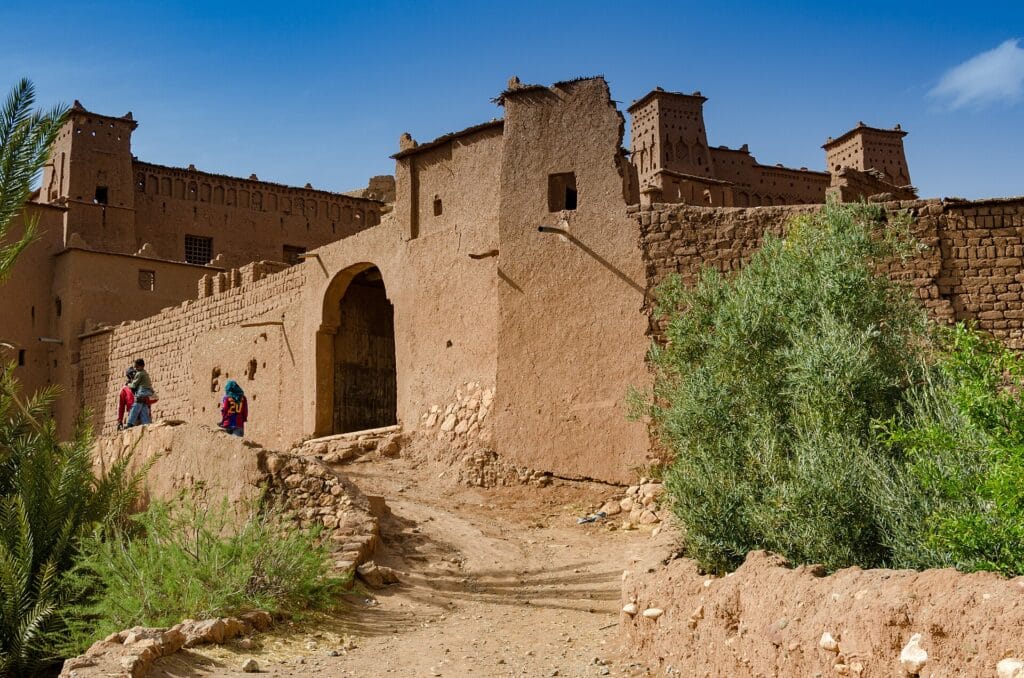
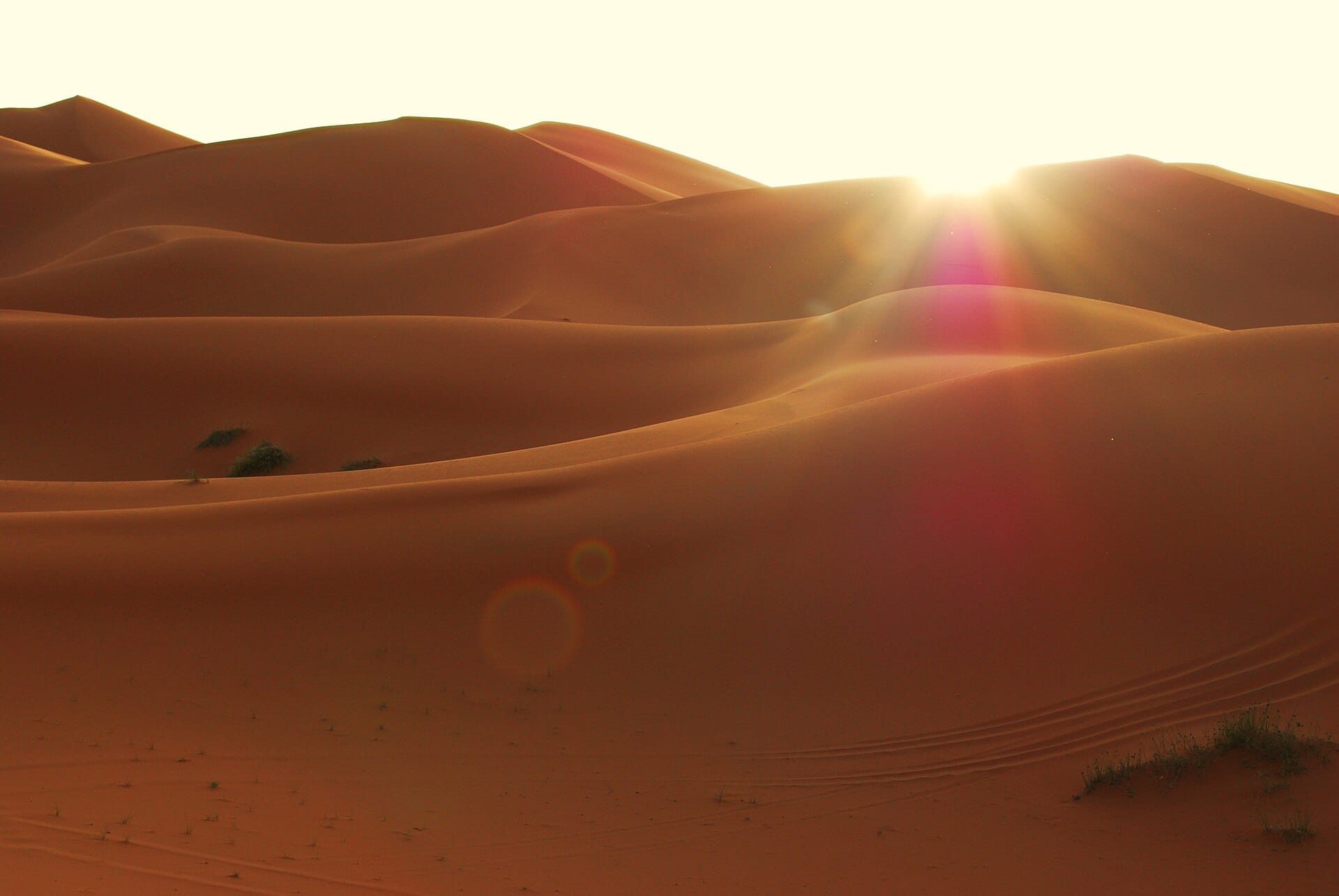
This is the heart of what Marrakech in 7 days makes possible. The grand loop to Merzouga and the Erg Chebbi dunes takes 3 days / 2 nights, a pace unthinkable for a three- or four-day stay. On the first day, the road crosses the spectacular Tizi n’Tichka pass (2,260 m) in the High Atlas, stops at the Aït Benhaddou kasbah — a fortified earthen village listed by UNESCO and the backdrop of many films — then at Ouarzazate, “the gateway to the desert,” before reaching the Dadès Valley for the night.
The second day crosses the Dadès Gorges, the Tinghir palm grove, the Todgha Gorges with their dizzying cliffs, then heads for Merzouga. In the late afternoon, you ride a camel into the dunes to reach the bivouac, enjoy a traditional dinner under the stars and spend the night at the foot of Erg Chebbi. The next morning, sunrise over the dunes — an unforgettable memory — before the long drive back to Marrakech via the Draa Valley.
As a rough guide, an organised 3-day excursion starts at around €80-120 per person in a group package, and climbs to €250-450 for a private tour with a charming bivouac. Bear in mind: these are long days of driving, but the passing landscapes — the Atlas, kasbahs, oases, stony then sandy desert — are strikingly varied. All the details of the loop are in our guide to the Merzouga and Zagora desert from Marrakech, and if you’re short on time, the kasbahs leg alone is described in our article Aït Benhaddou and Ouarzazate from Marrakech.
Day 7 — Relaxing in Agafay or a final stroll
After the grand loop, the seventh day is made for winding down. Two options are open to you. The first: the Agafay Desert, less than an hour from Marrakech, a lunar stony desert with views of the Atlas, perfect for a half-day of pool time, a lodge lunch and a sunset without a long drive back. See our guide to the Agafay Desert near Marrakech. The second: a final morning in the medina for your shopping, a relaxed lunch, then a transfer to the airport.
If your flight leaves late, you can even squeeze in a quick getaway. But avoid being too ambitious on the last day: it’s better to end on a gentle note than in the stress of a tightly timed return.
Which excursions to choose in 7 days?
The luxury of a week in Marrakech is being able to choose. Here’s how to decide based on your desires and your tolerance for driving:
- You dream of dunes and a bivouac: the grand Merzouga loop (3 days) is a must. It’s the week’s signature experience.
- You prefer the sea and the wind: replace the distant desert with 2 days in Essaouira, a port city listed as a World Heritage site.
- You love hiking: Imlil, at the foot of Toubkal (4,167 m, the highest peak in North Africa), offers hikes for all levels.
- You want desert without too much driving: Agafay, 40 minutes away, gives a Saharan foretaste in a half-day.
- You’re travelling with children or want little driving time: combine Ourika (easy mountains) + Agafay + Essaouira, all close to Marrakech.
One golden rule: don’t stack two long grand loops (Merzouga and a multi-day trek) into just seven days. You’d spend your whole week on the road. Choose one “major” excursion (2-3 days) and one or two “minor” ones (half-day to a full day) around your Marrakech base.
Combining desert, coast and mountains: the “full week” variant
For travellers who prefer the ocean and the peaks to the great south, here is a “coast & mountains” variant that is just as rich, with shorter journeys:
- Day 1-2: Marrakech in depth (medina, monuments, gardens) — identical to the main itinerary.
- Day 3: the Ourika Valley or a first taste of the Atlas.
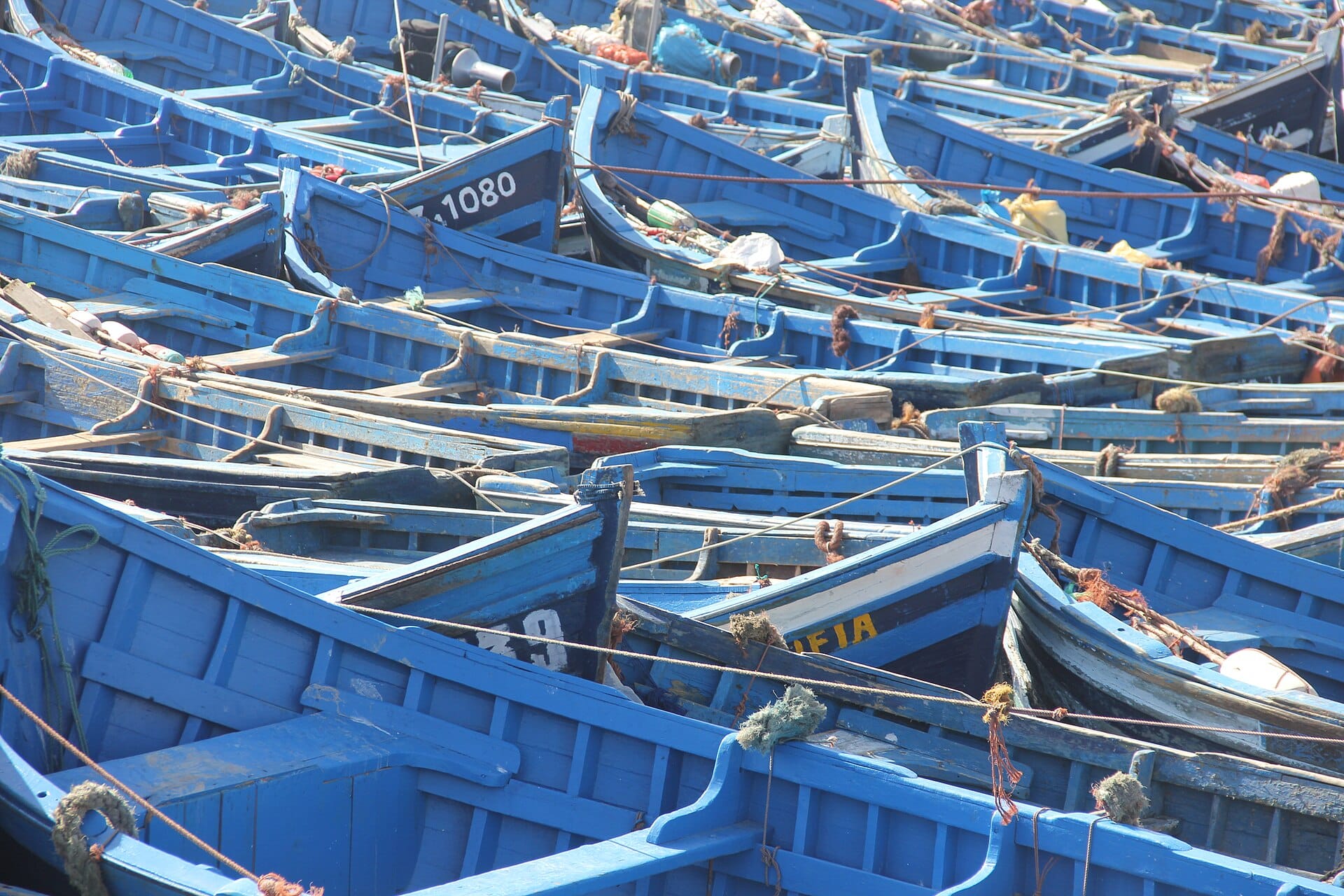
- Day 4-5: Essaouira. Reckon on about 175 km and 2 h 30 of driving. Two days let you wander the fortified medina, walk along the blue fishing port, taste grilled sardines, stroll the long beach swept by the trade winds and, for the active, try kitesurfing. Details in our guide Essaouira from Marrakech.
- Day 6-7: Imlil and the Toubkal massif. About 90 km (1 h 30) from Marrakech, this mountain village is the base camp for hikers. A night in a Berber guesthouse and a hike up to a high plateau or a refuge are enough to soak up the High Atlas. See Imlil and Toubkal from Marrakech.
This formula has one advantage: no journey exceeds 2 h 30, which makes it more restful than the desert loop. Its drawback: no dunes or Saharan bivouac. It’s up to you to choose your postcard — sea and ramparts, or sand and stars. Some very organised travellers even manage to combine both worlds: 3 days of desert, then 2 days on the coast, booking a single night in Marrakech in between. It’s intense, but it’s the kind of programme that Marrakech in 7 days allows and that a short stay makes impossible.
Where to stay during a week in Marrakech?
The logic of a seven-day stay is simple: keep a fixed base in Marrakech and add the “on the road” nights required by the major excursions. Here’s how to split it:
- Riad in the medina: the most authentic experience. Courtyards, terraces, calm behind the high walls, a stone’s throw from the souks. Ideal for your city nights (Day 1, 2, 3, 7).
- Hotel in Guéliz or Hivernage: more modern, handy for travellers who want a pool, parking and international restaurants.
- Nights on the road: for the desert, 1 night in a kasbah in the Dadès Valley + 1 night in a bivouac at Merzouga (often included in the excursion). For the coast/mountain variant, 2 nights in Essaouira + 1 night in a guesthouse in Imlil.
Tip: many riads will keep your luggage while you spend two days in the desert, and you get your room back on your return. This saves lugging everything around. To compare districts, styles and price ranges, see our guide on where to stay in Marrakech.
Budget for a week in Marrakech
How much does a week in Marrakech cost? It all depends on your comfort level. Here is an indicative estimate per person, excluding international flights, based on two travellers sharing a room (€1 ≈ 10.8 MAD, a fluctuating rate):
- Accommodation (6 nights): €150 to €500 — from a simple guesthouse room (approx. 250-350 MAD/night) to a charming riad (700-1,200 MAD/night).
- Major desert excursion (3 days): €80 to €450 depending on group or private.
- Small excursions (Ourika, Agafay): €15 to €60 per day (approx. 150-650 MAD).
- Meals: €70 to €210 for the week — from street food (20-40 MAD a dish) to a restaurant (150-300 MAD).
- Monument and garden entries: €30 to €60 in total (70-100 MAD per site on average).
- Local transfers, taxis, tips: €40 to €80.
In total, reckon on around €550 per person for a week in budget mode, €750 to €900 in mid-range comfort, and €1,100 and up for an upscale stay. These figures are given as an indication and vary with the season and the exchange rate. To fine-tune each item, see our Marrakech travel budget guide.
Rent a car or go with excursions?
This is the big logistical question of the week. Both options have their merits:
- Organised excursions: the simplest solution for the desert loop. Driver, itinerary, bivouac and meals included: you don’t have to worry about anything. Ideal if you dislike driving long mountain distances like the Tizi n’Tichka.
- Car rental: total freedom for Essaouira, Ourika or Agafay, where the roads are good and short. Reckon on €20 to €40 per day (200-450 MAD) excluding fuel. Watch out in the medina: dense traffic and awkward parking — there’s no point having a car for your city days.
The most common and most stress-free formula over seven days: no car for Marrakech itself, an organised excursion for the desert (long roads, safety), and possibly a one- or two-day rental for Essaouira or Ourika if you like independence. Driving to Merzouga yourself is possible but means nearly 1,000 km round trip: best kept for seasoned and motivated drivers.
Adapting the itinerary to the season
The climate of Marrakech and southern Morocco strongly influences a week’s programme:
- Spring (March-May): the best period. Mild days, a desert still comfortable to visit, gardens in bloom. Ideal for combining everything.
- Autumn (September-November): the second-best window. Heat subsided, the desert perfect, fewer crowds.
- Summer (June-August): Marrakech often tops 40°C and the desert is crushing during the day. Favour the coast (Essaouira, cool and breezy) and the mountains (Ourika, Imlil), and save city sightseeing for early morning and evening.
- Winter (December-February): pleasant days in the city, but cold nights in the desert (sometimes near 0°C in the tent) and snow-capped Atlas peaks. Pack warm clothes for the bivouac.
In short, the grand desert loop is best savoured from October to April. In high summer, switch without hesitation to the “coast & mountains” variant: it’s far more comfortable.
Mistakes to avoid on a 7-day Marrakech itinerary
- Trying to do everything: seven days isn’t unlimited. Two long grand excursions + the city = too much driving. Choose.
- Underestimating distances: Merzouga is nearly 500 km one way. It’s not a “day trip” but very much a 3-day loop.
- Neglecting the city: some head off on excursions from day one and “forget” Marrakech. Keep at least 2 full days for the city.
- Scheduling a major excursion on departure day: leave a margin on Day 7 to reach the airport stress-free.
- Ignoring the season: aiming for the desert in the middle of July is a classic comfort mistake.
- Overloading each day: Marrakech is also savoured in the pauses, the mint tea and the terraces.
Extending beyond 7 days
Have more than a week? Lucky you. With 9 or 10 days, you can string together the desert loop and two days in Essaouira without compromise, or add a multi-day trek in the High Atlas starting from Imlil. Ten days also let you head further south, toward the Draa Valley and its palm groves, or reach the Atlantic coast of Taghazout and Agadir to finish on the beaches. Two weeks open the door to a real Moroccan road trip — Marrakech, desert, Fez, Chefchaouen — but that’s another adventure.
For exactly seven days, stay faithful to the logic of this guide: a solid base in Marrakech, one signature excursion, one or two short getaways. That’s the recipe for a dense, varied and memorable week, without the exhaustion of an overloaded programme.
FAQ — Marrakech in 7 days
Are 7 days enough for Marrakech and the desert?
Yes, it’s actually the ideal duration. Seven days let you devote 2 to 3 days to the city and set off for 3 days in the Merzouga desert, with a day of margin. It’s the first format that makes the grand Sahara loop comfortable.
Is the Merzouga desert or Agafay better?
Merzouga offers the real sand dunes of Erg Chebbi and the Saharan bivouac, but it takes 3 days. Agafay is a stony desert 40 minutes from Marrakech, perfect for a half-day. In 7 days, you can do Merzouga; on a short stay, Agafay is the best compromise.
What budget should I plan for a week in Marrakech?
As an indication, reckon on around €550 per person in budget mode, €750 to €900 in mid-range comfort and €1,100 and up at the upper end, excluding international flights, based on two people sharing a room.
Can you combine desert, coast and mountains in 7 days?
Combining all three is possible but intense. The most realistic approach is to choose one strong axis — desert (Merzouga) or coast + mountains (Essaouira + Imlil) — and add a short getaway such as Ourika or Agafay. Stacking two long grand loops leaves too little time on the spot.
Do you need to rent a car for a week in Marrakech?
Not necessarily. In the city, a car is a handicap. For the desert, an organised excursion is better (long mountain roads). A one- or two-day rental can be useful for Essaouira or Ourika if you like independence.
What is the best season for this itinerary?
Spring (March-May) and autumn (September-November) are ideal: mild temperatures and a comfortable desert. In summer, swap the desert for the coast and the mountains. Winter remains pleasant in the city but pack warm clothes for the bivouac.
Images under free licence via Wikimedia Commons: © Vassia Atanassova – Spiritia (CC BY-SA 4.0); © Nomadz (CC BY-SA 3.0); © Elgaard (CC BY-SA 4.0). Sources: Wikimedia Commons.Photo credits: royalty-free illustrative images (Unsplash / Pexels). This article is published by an independent guide, not affiliated with ONDA or any tourism office; all prices are indicative and subject to change.