A delayed or cancelled flight in Morocco can quickly turn the start of a holiday or a business trip home into a headache, especially when you do not know which rights actually apply. The answer hinges on a point that is often misunderstood: where the flight departs from and the nationality of the airline. A flight leaving an airport in the European Union does not grant the same rights as one taking off from Casablanca, Marrakech or Rabat. This guide explains clearly, and with facts verified against official sources, when EU Regulation EC 261/2004 applies, how much compensation you can expect, what care the airline owes you, and how to claim effectively. The goal is simple: to help you enforce your rights without selling you false promises.
Disclaimer: the rules, thresholds and amounts quoted below are subject to change. This article is informative and does not constitute legal advice. Always verify the information with the official sources listed at the end of the article before acting.
In brief: the essentials of your rights
- The decisive test is geographic. EU Regulation EC 261/2004 protects every flight departing from an EU airport (whatever the airline) and every flight arriving in the EU operated by an EU airline.
- Casablanca → Paris on Royal Air Maroc is NOT covered by EC 261/2004 (departure outside the EU, non-EU carrier). By contrast, Paris → Casablanca is covered, because the flight leaves an EU airport.
- EU compensation: 250 €, 400 € or 600 € depending on distance, for a cancellation or a delay of 3 hours or more on arrival, when the airline is at fault.
- Right to care: meals, drinks, communications and, if necessary, accommodation, once the wait exceeds a certain threshold.
- Reimbursement or re-routing: in the event of cancellation, you choose between a refund of the ticket or an alternative flight.
- Flights departing from Morocco: no EC 261/2004-type regulation. Your rights rest on the airline’s conditions of carriage and national law.
- Always claim with the airline first, in writing, before turning to a third-party body.
Delayed or cancelled flight in Morocco: does EC 261/2004 apply to you?
The very first question to ask about a delayed or cancelled flight in Morocco is the scope of Regulation (EC) No 261/2004. This EU text is the most protective passenger-rights framework in the world, but it does not apply to every flight involving Morocco. Many travellers wrongly assume that a ticket bought from a major airline automatically guarantees compensation. It does not. The regulation reasons by point of departure and by the airline’s nationality, not by ticket price or the carrier’s reputation.
The two situations where EC 261/2004 applies
The regulation applies in two clearly defined cases. First, every flight departing from an airport located in the European Union (as well as Iceland, Norway and Switzerland) is covered, whatever the airline, including a non-EU carrier such as Royal Air Maroc. Second, every flight arriving at an EU airport, but only if it is operated by an EU airline (a “Community carrier” holding a licence issued by a Member State).
Applied to Morocco, this has very concrete consequences. A Paris–Charles-de-Gaulle → Casablanca flight leaves an EU airport: it is covered, whether you travel with Royal Air Maroc, Air France, Transavia or another airline. Conversely, a Casablanca → Paris flight operated by Royal Air Maroc is not covered by EC 261/2004, because it departs from an airport outside the EU and the airline is not European. That same Casablanca → Paris route, if operated by a European airline such as Air France or Transavia, does become covered, because the flight arrives in the EU and the carrier is a Community carrier. So remember the simple rule: departure from the EU = covered whatever the airline; arrival in the EU = covered only if the airline is European.
Concrete examples for Morocco-related flights
| Route | Airline | Covered by EC 261/2004? | Why |
|---|---|---|---|
| Paris → Casablanca | Royal Air Maroc | Yes | Departure from an EU airport |
| Paris → Marrakech | Transavia / easyJet | Yes | Departure from an EU airport |
| Casablanca → Paris | Royal Air Maroc | No | Departure outside EU + non-EU carrier |
| Casablanca → Paris | Air France / Transavia | Yes | Arrival in the EU + EU carrier |
| Marrakech → Madrid | Ryanair / Iberia | Yes | Arrival in the EU + EU carrier |
| Marrakech → London | Royal Air Maroc | No (post-Brexit, separate UK261 regime) | Check the equivalent UK scheme |
| Casablanca → Dubai | Emirates / RAM | No | No connection with an EU airport |
If you are planning a connecting flight, particularly a layover in Casablanca, note that the regulation is assessed across the whole journey booked under a single contract of carriage, based on the final destination and the initial departure airport. A single Paris → Casablanca → Agadir ticket is still assessed from its EU point of departure.
Compensation for a delayed or cancelled flight in Morocco: the EU amounts
When EC 261/2004 applies to your delayed or cancelled flight in Morocco, the fixed compensation depends on the flight distance. These amounts are set by the regulation and confirmed by the EU’s official “Your Europe” portal. They are independent of the price paid for the ticket: an 80 € ticket may entitle you to 400 € of compensation, and conversely compensation cannot exceed the scale even on an expensive ticket.
The 250 / 400 / 600 euro scale
| Flight distance | Compensation | Typical example departing the EU |
|---|---|---|
| 1,500 km or less | 250 € | Madrid → Marrakech |
| Between 1,500 and 3,500 km (and all intra-EU flights over 1,500 km) | 400 € | Paris → Casablanca, Brussels → Agadir |
| More than 3,500 km | 600 € | Long-haul flights linking the EU and a distant destination |
In practice, most direct routes between Europe and Morocco fall in the 400 € band, because the distance often exceeds 1,500 km without reaching 3,500 km (Paris–Casablanca, for example, is around 1,900 km). Shorter routes from southern Spain often fall in the 250 € band.
The conditions for receiving compensation
Compensation is not automatic. It requires several cumulative conditions:
- A delay of at least 3 hours on arrival at the final destination (not at departure). It is the arrival time when the doors open that counts, according to the case law of the EU Court of Justice.
- Or a cancellation notified less than 14 days before the scheduled departure, without re-routing offered close to the original schedule.
- Or denied boarding due to overbooking when you presented yourself on time.
- The absence of “extraordinary circumstances”. If the delay or cancellation results from events beyond the airline’s control (dangerous weather, air traffic control strike, political instability, security risk), the fixed compensation may not be due — but the care (meals, hotel) remains mandatory.
Note: an ordinary technical fault of the aircraft is generally not considered an extraordinary circumstance, according to EU case law. Airlines sometimes invoke this ground wrongly; do not hesitate to ask for a precise written justification.
The possible 50% reduction
In the event of cancellation with re-routing, the airline may reduce the compensation by 50% if the replacement flight gets you there with a limited delay (for example less than 3 or 4 hours depending on distance). This rule rewards prompt care. Always keep your boarding passes and the actual arrival time to check the calculation.
Care, reimbursement and re-routing
Beyond the fixed compensation, the regulation imposes an immediate duty of assistance, often more useful in the moment. This care is owed even in cases of extraordinary circumstances, because its purpose is to avoid leaving the passenger to fend for themselves.
The right to care (meals, hotel, communications)
Once the wait reaches a certain threshold (which varies with the flight distance), the airline must provide you, free of charge:
- meals and refreshments in reasonable quantity, proportionate to the waiting time;
- hotel accommodation if one or more nights become necessary, as well as transport between the airport and the hotel;
- the option to make two calls, emails or messages.
If the airline does not arrange this assistance and you pay for it yourself, be sure to keep all supporting documents and receipts: you can claim reimbursement, provided the expenses were necessary, reasonable and appropriate. Avoid lavish spending, which will not be reimbursed.
Reimbursement or re-routing in the event of cancellation
In the event of cancellation, or a very long delay (generally 5 hours or more), you have a choice between two options the airline must present to you:
- Reimbursement of the ticket for the part of the journey not made (and, where relevant, for the part already made if the flight no longer serves any purpose), within seven days;
- Re-routing to your final destination under comparable conditions, at the earliest opportunity or at a later date of your choice subject to availability.
These rights to reimbursement and re-routing can be combined with the fixed compensation when its conditions are met. In other words, being refunded for your ticket does not prevent you from also receiving the 250 to 600 € compensation.
To reduce the risk of a nasty surprise, remember to complete your Royal Air Maroc online check-in and to check your flight status the day before departure. This does not change your rights, but it lets you react faster if a disruption occurs.
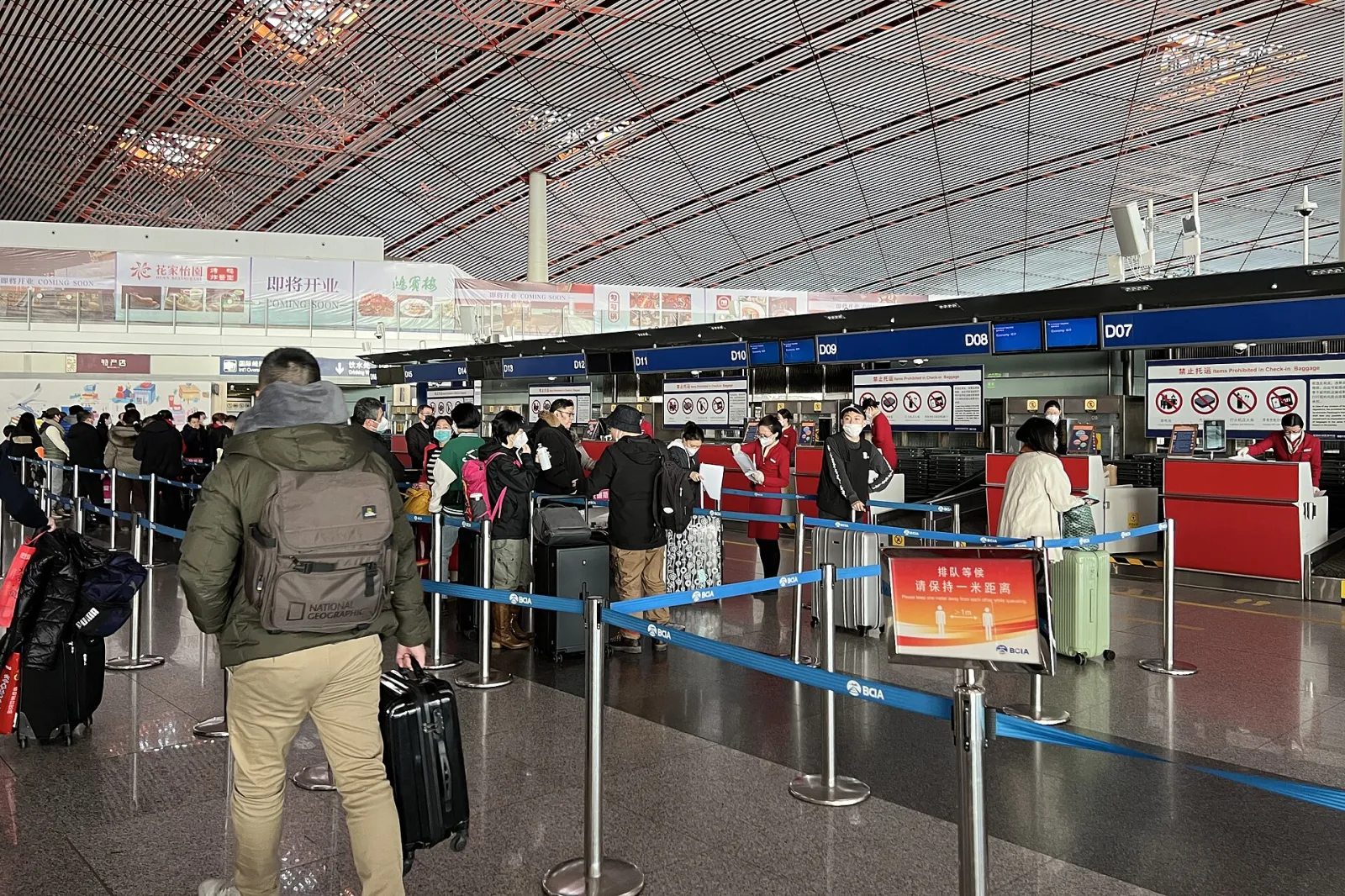
Flights departing from Morocco: what rights without EC 261/2004?
This is the trickiest situation. For a delayed or cancelled flight in Morocco that takes off from a Moroccan airport (Casablanca Mohammed V, Marrakech Menara, Agadir, Fez, Tangier, Rabat, etc.) on a non-EU airline, EC 261/2004 does not apply. Your rights then rest on two main foundations: the airline’s general conditions of carriage and Moroccan national law, along with international conventions.
The airline’s conditions of carriage
Every airline publishes its general conditions of carriage, which form the contract binding you to the carrier. They generally set out the arrangements for rebooking, refunds and assistance in the event of delay or cancellation. For a flight departing from Morocco, this document is your first reference. It is available on the airline’s official website. Reputable airlines often, in practice, offer care (meals, hotel) close to the European model, but this is not a legal obligation of the same nature as EC 261/2004.
National law and international conventions
Air transport in Morocco is governed by national regulations, under the authority of the ministry in charge of transport and the Directorate General of Civil Aviation. In addition, the Montreal Convention, to which Morocco is a party, governs carriers’ liability for damage linked to delay, up to ceilings expressed in special drawing rights (SDR). This convention allows, under conditions, compensation for the actual loss suffered and proven (costs incurred because of the delay), but it does not provide automatic fixed compensation like the European scale. You must demonstrate the loss and its amount.
In practice, for a flight departing from Morocco not covered by EC 261/2004: keep all your supporting documents, ask the airline for a delay or cancellation certificate, and send a written claim. Depending on the nature of your loss, a claim based on the Montreal Convention or on the conditions of carriage may be considered. If you have any doubt about your rights, contact a consumer association or a legal professional.
| Situation | Applicable framework | Fixed compensation? | Right to care? |
|---|---|---|---|
| Departure from an EU airport | EC 261/2004 | Yes (250–600 €) | Yes, mandatory |
| Arrival in EU, EU airline | EC 261/2004 | Yes (250–600 €) | Yes, mandatory |
| Departure from Morocco, non-EU airline | Conditions of carriage + Montreal Convention | No (loss must be proven) | Depends on the airline / good practice |
How to claim effectively, step by step
Whether or not your flight is covered by EC 261/2004, the claim process follows a common logic: start with the airline, document everything, then escalate if necessary. A well-built claim succeeds far more often than a simple call at the counter.
Step 1: gather the evidence
- Boarding passes, ticket and booking reference;
- screenshots of the delay or cancellation notifications;
- the actual arrival time (compared with the scheduled time);
- receipts for the expenses incurred (meals, hotel, transport);
- any written certificate given by the airline about the cause of the delay.
Step 2: claim with the airline first
Send a clear, dated written claim, via the airline’s official form or its customer service. State the flight number, the date, the route, the nature of the problem, the amount claimed and the legal basis (EC 261/2004 where relevant). Stay factual and courteous. Keep a copy of all exchanges. The airline is your mandatory point of contact before any escalation.
Step 3: escalate if no reply comes
If the airline does not reply or wrongly refuses, you can refer the matter to a competent body depending on the flight context:
- For a flight departing the EU: the national body responsible for enforcing EC 261/2004 in the country of departure (for example, in France, the Directorate General of Civil Aviation or the tourism and travel ombudsman).
- For a flight departing Morocco: the channels provided by the airline and, where relevant, the national civil aviation authority or consumer protection associations.
- Amicable or judicial remedy: mediation, then, as a last resort, action before the competent court.
Private companies offer to claim on your behalf in exchange for a commission (often 20 to 30% of the compensation). This service can save time, but it reduces the net amount you receive; for a simple, well-documented case, claiming directly with the airline is often enough and free.
Getting organised at the airport
In the event of a disruption, also plan the logistics on the ground. Check the options to reach your accommodation with our comparison of airport transfers in Morocco, and if you travel with several airlines, consult the list of airlines flying to Morocco to identify a re-routing solution. This practical information usefully complements your knowledge of your rights.
Frequently asked questions
Does a delayed Casablanca → Paris flight on Royal Air Maroc give a right to compensation?
No, not under EC 261/2004. This flight leaves an airport outside the EU and is operated by a non-EU airline: the two conditions for the regulation to apply are not met. Your rights then rest on the airline’s conditions of carriage and, where relevant, the Montreal Convention for a proven loss. The reverse route Paris → Casablanca, however, would be covered.
From how many hours of delay can I be compensated?
Under the EU regime, fixed compensation is due from 3 hours of delay on arrival at the final destination, if the airline is at fault. The threshold is measured on arrival, not at departure. Care (meals, drinks) starts earlier, depending on the flight distance.
What is an “extraordinary circumstance”?
It is an event beyond the airline’s actual control: dangerous weather, an external strike (air traffic control), political instability, security instructions, a bird strike, and so on. In such cases, the fixed compensation may not be due, but the care remains mandatory. Note: an ordinary technical fault is generally not recognised as an extraordinary circumstance.
Can I be both refunded AND compensated?
Yes, when the regulation applies. The ticket refund (or re-routing) and the fixed compensation of 250 to 600 € are two distinct rights that can be combined. The refund covers the price of the journey not made; the compensation makes up for the inconvenience of the delay or cancellation.
In the event of overbooking, what are my rights?
Under the EU regime, denied boarding due to overbooking, when you presented yourself on time, gives a right to the same fixed compensation (250 to 600 €), to care, and to the choice between reimbursement and re-routing. The airline must first look for volunteers willing to give up their seat in exchange for compensation before denying boarding to passengers.
How long do I have to claim?
Deadlines vary by country and legal basis. Under the EU regime, they depend on the national law of the competent country and are often counted in years. It is nevertheless strongly advised to claim as early as possible, while the evidence is fresh and available. Check the applicable deadline with the relevant national body.
Are low-cost flights departing Europe covered?
Yes. EC 261/2004 applies whatever the airline and whatever the ticket price, as long as the flight leaves an EU airport. A low-cost airline operating a Paris → Marrakech flight is therefore subject to the same obligations as a traditional airline.
Do I have to use a paid claims company?
It is not compulsory. These companies take a commission on the compensation obtained. For a clear, well-documented case, claiming directly with the airline, free of charge, often succeeds. Specialist companies can be useful for complex or disputed cases, or if you are short of time.
In summary
Faced with a delayed or cancelled flight in Morocco, the first thing to determine is the scope of EC 261/2004. Remember the geographic rule: a flight departing from an EU airport is covered whatever the airline; a flight arriving in the EU is covered only if it is operated by an EU airline. Thus Paris → Casablanca is protected, but Casablanca → Paris on Royal Air Maroc is not. When the regulation applies, you can claim compensation of 250, 400 or 600 € depending on distance (in the event of a delay of 3 hours or more, or a cancellation attributable to the airline), care (meals, hotel), and reimbursement or re-routing. For flights departing from Morocco that are not covered, your rights rest on the airline’s conditions of carriage and the Montreal Convention, which requires you to prove your loss. In all cases, document everything, claim first in writing with the airline, then escalate to the competent body if necessary. And bear in mind that the rules may change: always verify the up-to-date information with the official sources below.
Official sources
- Regulation (EC) No 261/2004 – full text (EUR-Lex)
- Air passenger rights – official “Your Europe” portal
- Royal Air Maroc – official website (conditions of carriage)
- National Airports Office (ONDA) – Morocco
- Ministry of Transport and Logistics of Morocco
Photo credit
Illustrations : « Flight departure board, Perth Airport » — Bahnfrend (CC BY-SA 4.0) ; « Cathay Pacific check-in counters » — N509FZ (CC BY-SA 4.0), via Wikimedia Commons.