The Zawiya of Moulay Idriss II is the shrine that holds the tomb of Idris II, the Idrisid ruler who made Fes his capital in 809: it is the holiest place in the city, a mausoleum-mosque open to Muslims only, which other visitors can approach up to its doors, walk around and observe from the neighbouring lanes and rooftops. You do not “visit” it the way you visit the Bou Inania Madrasa or the Nejjarine Museum; you discover it by walking along its edges, listening, and watching what people from Fes (also spelled Fez) do when they stop there. This page explains what lies behind the walls, what you can genuinely see from outside, and how to do it without disturbing anyone.
A word on names, because signs and guides vary: you will hear zawiya, mausoleum, shrine or the “horm” of Moulay Idriss. Moroccans often say Moulay Idriss Al Azhar, the epithet of Idris II, to distinguish him from his father Idris I, who is buried in Moulay Idriss Zerhoun near Volubilis. If a driver asks “Moulay Idriss”, check that he does not mean that small holy town some sixty kilometres away: it is not the same place.
At a glance
- The zawiya holds the tomb of Idris II (791-828), son of Idris I and founder, in 809, of the al-Aliya quarter on the left bank of the Fes River.
- The body attributed to Idris II was discovered on site in 1437, under the Marinid sultan Abd al-Haqq II; from then on the shrine became a major pilgrimage site.
- Most of today’s building, including the minaret and the tomb chamber, dates from the rebuilding ordered by Moulay Ismail between 1717 and 1720.
- The interior is reserved for Muslims; non-Muslims may approach the doors and walk around the shrine through the surrounding lanes.
- The shrine was fully restored from 2011 to 2014 at a cost of 52.5 million dirhams, over 2,548 m²; King Mohammed VI visited it on 7 November 2014.
- The annual moussem, with the procession of the kessoua (the embroidered cloth laid over the tomb), is the most important in Fes; in 2025 it ran from 9 to 16 October.
- There is no ticket and no visiting hours: the surroundings are freely accessible, 15 to 20 minutes’ walk from Bab Boujloud.
Who was Idris II, the patron saint of Fes?
Idris II was born in 791 in Walili, ancient Volubilis, a few months after the death of his father, Idris I, a descendant of the Prophet who had taken refuge in the Maghreb. He was raised under the guardianship of Rashid, his father’s freedman, and formally took power in 803. His reign, which lasted until his death in 828, firmly established the Idrisid dynasty, regarded as the first Muslim state centred on present-day Morocco.
Fes was founded in two stages, and that explains the devotion to him. Idris I laid out a first town, Madinat Fas, on the right bank of the river in 789. Twenty years later, in 809, Idris II founded a second settlement on the opposite bank, al-Aliya, and moved his capital there from Walili. He surrounded himself with Arab horsemen from Kairouan; shortly afterwards, around 817-818, Andalusi families expelled from Córdoba arrived. These two waves gave their names to the two banks: the bank of the Kairouanis (Qarawiyyin) and the bank of the Andalusians.
Near his residence, Dar al-Qaytun (“the house of the tent”), Idris II built a mosque known as al-Ashraf, the mosque of the shorfa. The shrine grew around this core, in the heart of today’s Fes el-Bali. For the people of Fes he is not just a ninth-century king: he is the founder, the protector of the city, a sharif whose baraka (blessing) remains attached to his tomb. People invoke him for a birth, an exam, a wedding, a new business.
A long-debated tomb
The story of the tomb is more complicated than the leaflets suggest. Most early sources place Idris II’s burial in the mosque he had built next to Dar al-Qaytun. Another tradition, reported by some authors, held that he was buried beside his father at Moulay Idriss Zerhoun. For several centuries, in fact, the cult of Idris II in Fes remained modest, and the city’s religious prestige rested mainly on the Qarawiyyin.
Everything changed in 1437. While works on the building were being prepared, under the Marinid sultan Abd al-Haqq II, a body was uncovered and recognised by the jurists of the time as that of Idris II. Accounts give a key role to the Wattasid vizier of the day. Modern historians treat some details of this “discovery” with caution, but its effect is beyond doubt: within a few decades the shrine became the most venerated place in Fes, and the Idrisid shorfa, descendants of Idris, gained considerable political weight.
History of the Zawiya of Moulay Idriss II, from Idrisid mosque to Alawi shrine
What you see today is the sum of successive rebuildings. Every dynasty that wanted to win over Fes and its shorfa put its hand to the shrine. The table below gathers the documented dates; where a source gives a range, we keep it as it is rather than invent precision.
| Date | Event | What remains |
|---|---|---|
| 809 | Idris II founds al-Aliya and builds a mosque near Dar al-Qaytun | The site and the name of Dar al-Qaytun, inside the horm |
| 828 | Death of Idris II in Fes | Venerated tomb in the funerary chamber |
| 1308 | Roof collapse and rebuilding of the mosque by descendants of Idris, under the Marinids | Nothing visible with certainty |
| 1437 | Discovery of a body identified as that of Idris II; the great pilgrimage begins | The status of a major shrine |
| 1557 | The Saadian sultan Muhammad al-Shaykh has the mausoleum roof rebuilt | Reused Saadian marble elements |
| 1603 | The Saadian emir Zaydan adds interior decoration | Decoration later reworked |
| 1717-1720 | Moulay Ismail has the whole zawiya rebuilt, including the minaret and tomb chamber | Most of the present building, the marble basin of the courtyard |
| 1824 | Sultan Moulay Abd al-Rahman builds a new adjoining mosque | The enlarged prayer hall |
| 1890 | Major renovations recorded by ArchNet | Not detailed in the sources consulted |
| 1956 | Renovation under Mohammed V | Not detailed in the sources consulted |
| 2011-2014 | Full restoration ordered in 2009, 52.5 million dirhams, royal visit on 7 November 2014 | Dome, courtyard, minaret and decoration restored |
Moulay Ismail and the shrine’s present face
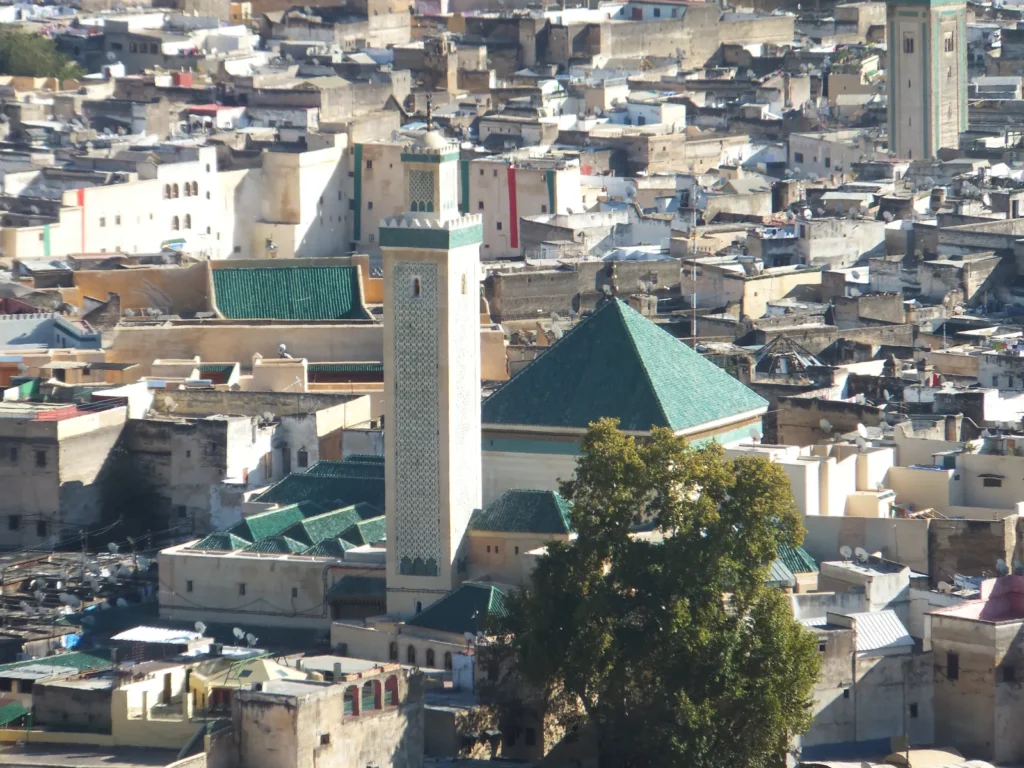
The guides’ usual line, “rebuilt by Moulay Ismail”, is accurate, with a nuance on dates. The Alawi sultan, who reigned from 1672 to 1727 and ruled from Meknes, had the whole complex rebuilt between 1717 and 1720. He is responsible for the minaret, the tomb chamber, its large pyramidal roof covered in green tiles, and the white marble basin in the centre of the courtyard. The Discover Islamic Art virtual museum places these changes within his reign without giving a more precise year; the two statements do not contradict each other.
The gesture was political too. Moulay Ismail had a difficult relationship with Fes, a rebellious city, and with its shorfa. Embellishing the founder’s tomb honoured the city while asserting that the sultan was its foremost protector. A century later, Moulay Abd al-Rahman repeated the gesture by adding a new mosque in 1824, which gave the shrine its dual nature as a Friday mosque and a mausoleum.
The major restoration of 2011-2014
In 2009, King Mohammed VI asked the Ministry of Habous and Islamic Affairs for a technical study to restore the mausoleum and its outbuildings in full. Work began in 2011 and lasted 36 months, with a budget of 52.5 million dirhams. According to the MAP news agency, it covered the consolidation and reconstruction of the great dome, the courtyard, the prayer hall, the minaret, the imam’s house, the Mkalka mosque (240 worshippers) and Dar al-Qaytun, a total of 2,548 m² of covered space. Foundations were reinforced, cracks treated, woodwork remade, and zellij, marble and carved plaster restored.
The project’s architect, Rachid Haloui, told the Moroccan press that the schedule had slipped because some occupants refused to leave the premises: a detail that shows this is not a museum piece but a space that is lived in and used every day. The King visited the restored shrine on 7 November 2014. If you look today at the south-eastern doors or the north portal, the fresh colours of the zellij and stucco date from that campaign.
Architecture of the Zawiya of Moulay Idriss II: what lies behind the walls
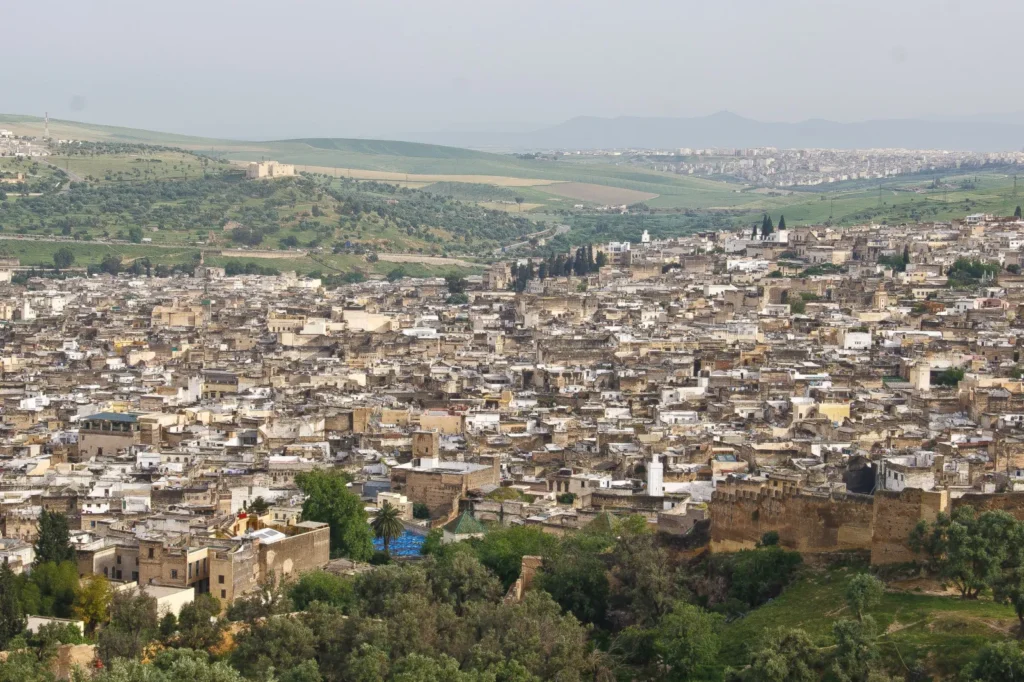
Even without going in, it helps to know how the building is laid out: it lets you understand what you glimpse through a half-open door, and why worshippers stop at one spot on the wall rather than another. The shrine forms an irregular block, wedged into the fabric of the medina, between the Kissaria (the old cloth market) to the east and the Nejjarine quarter to the west. It has no monumental façade in the European sense: its walls merge with the shops built against them.
The minaret, a landmark for the whole medina
Built between 1717 and 1720, the minaret is considered the tallest in Fes el-Bali. Its square tower is decorated with zellij panels and interlacing motifs, and it rises above the north portal. It will be your compass: from the medina rooftops, from the Marinid Tombs to the north or from the Borj Sud fort, you first spot this minaret and, right next to it, the green pyramid of the mausoleum. When you are lost in the souks, look up: if you can see it, the shrine is only a few lanes away.
The courtyard and prayer hall
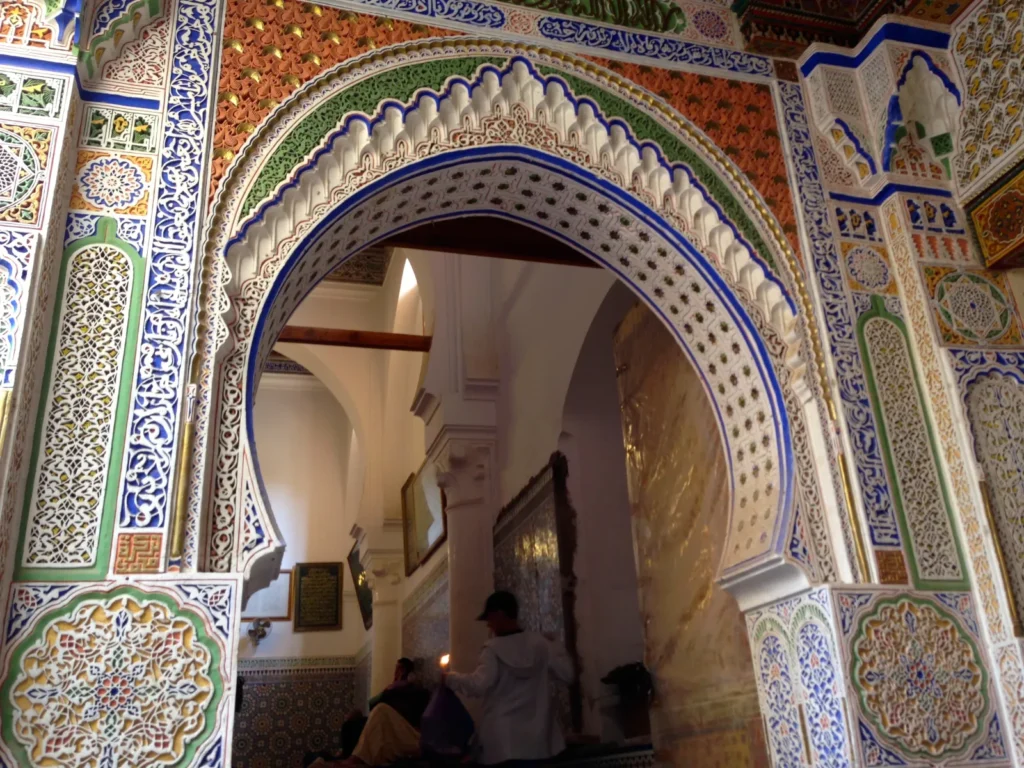
The north portal, at the foot of the minaret, opens onto the courtyard (sahn). In the centre stands a white marble basin from the time of Moulay Ismail; along the sides are wall fountains for ablutions. On the south wall of the courtyard is a large calligraphy of the name of God, created in the 19th century by the calligrapher Muhammad al-Qandusi, famous for his highly personal style of Maghrebi script. The prayer hall follows the pattern of Moroccan mosques: columns and arches, floors covered in mats and carpets, hanging chandeliers.
The tomb chamber
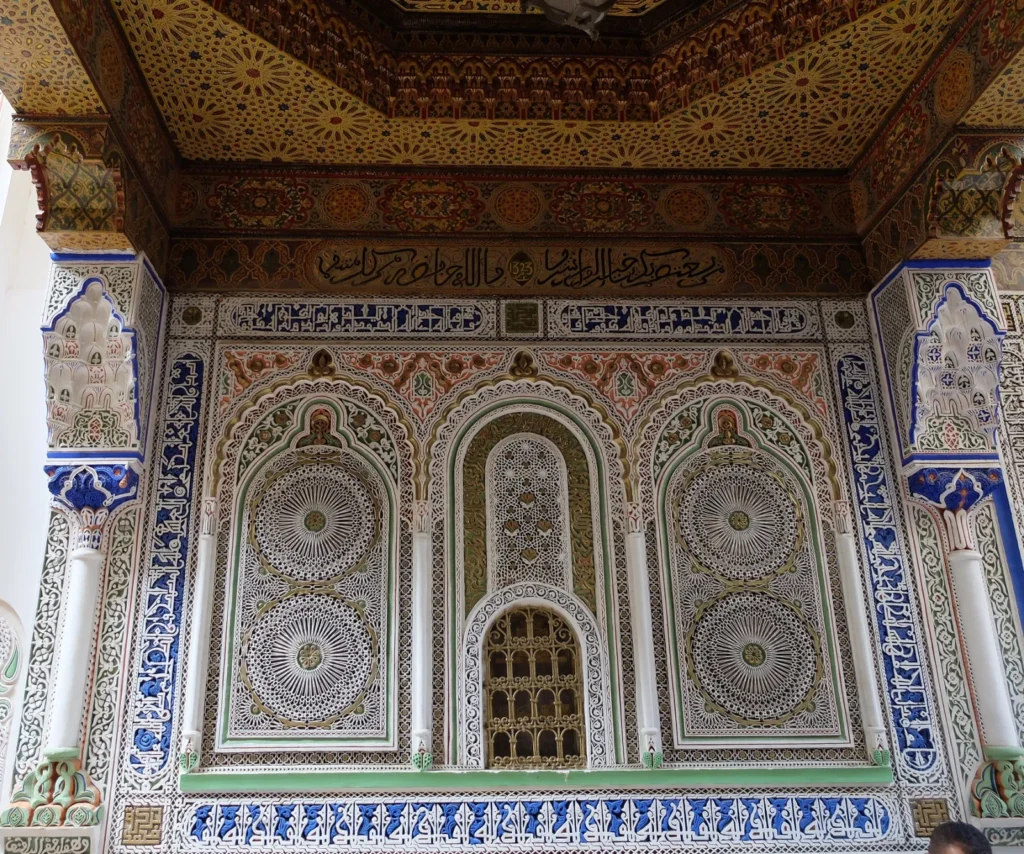
South of the courtyard, the tomb chamber holds the tomb of Idris II. It is topped by a wooden baldachin inlaid with gold and copper, covered with calligraphic inscriptions, and draped with the kessoua, the cloth embroidered with Qur’anic verses offered during the moussem. Above it, a large wooden dome assembled from a multitude of small pieces forms a star pattern; this is what the green pyramidal roof covers on the outside. Marble columns, zellij and carved stucco complete the decoration. The richly ornamented vestibule leading to it is described by Discover Islamic Art with its lamps, chandeliers and zellij floor.
You will sometimes read that pilgrims walk seven times around the tomb, or that women come specifically to pray for fertility. These practices appear in travel accounts, but we have not found them documented by an official source, so we prefer not to present them as rules. What is certain is that the shrine is visited by women as much as by men, often as families, and that many leave candles there.
The horm, a sacred quarter within the city
The zawiya is not an isolated building but the centre of a sacred precinct, the horm. Several lanes leading to it are barred at head height by a horizontal wooden beam that you have to duck under. Until the start of the French protectorate in 1912, non-Muslims and pack animals were not allowed past these bars. The horm also served as a sanctuary: nobody who had taken refuge there could be arrested. It includes the Mkalka mosque, linked to this right of asylum, Dar al-Qaytun, the khatib’s house and the tomb of Lalla Kenza.
The beams are still there. They no longer mean a ban on visitors passing, but they remain a threshold: muleteers unload before them, porters slow down, and many passers-by touch the wood or fall silent as they go under. If you have to bow your head, that is precisely the point.
Non-Muslims: what is allowed and what is not
The interior of the zawiya, meaning the courtyard, prayer hall and tomb chamber, is reserved for Muslims. This is not a rule posted for tourists; it is the practice at most Moroccan mosques and shrines, a custom generally traced back to the early protectorate and to the Resident-General Lyautey, who is said to have made it a rule for non-Muslims. Today in Morocco, the Hassan II Mosque in Casablanca is the main exception open to guided visits. In Fes the same rule applies to the Al Qarawiyyin mosque and university.
A non-Muslim may, however, walk up to the doors, pause there for a moment and circle the shrine through the lanes around it. Through an open door you can usually glimpse part of the courtyard or vestibule. This is perfectly acceptable, provided you stay on the threshold, do not block the way and do not photograph worshippers. Nobody will ask your religion; if there is any doubt about a door, a guard or a neighbouring shopkeeper will let you know, and you should simply respect that.
| Situation | Non-Muslim visitor | Advice |
|---|---|---|
| Passing under the horm beams | Allowed | Walk calmly and quietly |
| Looking through an open door | Accepted, from the threshold | A few seconds, without taking a single step inside |
| Entering the courtyard or mausoleum | Not allowed | Do not insist, even if the door is wide open |
| Photographing the portal, minaret and walls | Generally tolerated | No worshippers in the foreground, no flash |
| Photographing people praying or at the tomb window | Avoid | This is the mistake that causes most offence |
| Buying candles or nougat from the horm stalls | Allowed | Prices are modest; bargain lightly |
The tomb window on the south wall
This is the detail most visitors miss. In the lane running along the south side of the shrine, a grilled window opens in the outer wall, directly on the other side of the tomb chamber. Passers-by stop there for a short prayer, sometimes touch the grille, then move on. A little further along, a decorated slot lets people slip in alms for the shrine. Stop at a distance, without standing in front of the window, and watch: it is the best moment to understand what Moulay Idriss means to the people who live here.
Candles, nougat and incense: the shrine’s small souk
A trade entirely geared to pilgrims has grown up around the shrine. In the nearby shops you will find tall white or decorated candles, incense, orange-blossom water and prayer beads. The candles are offered to the shrine; the large ornate ones are mostly bought for special occasions such as a birth, a wedding or a wish granted.
The horm’s other speciality is sweet: nougat and so-called “Moulay Idriss” confectionery, stacked in colourful pyramids, made with almonds, peanuts or sesame and sold by weight at stalls just before the shrine. Families take some home as a keepsake of their visit, the way sugared almonds are brought home elsewhere. For a traveller, it is the most natural way to take part in the life of the place: buy a small amount, taste it, and ask the seller how long his family has run the stall. Prices are rarely displayed; they remain modest, and hard bargaining is out of place in this setting.
For other shopping, such as rugs, leather or copper, it is better to move away from the horm and follow our guide to the souks of Fes, which covers each craft street in detail.
The moussem of Moulay Idriss, the great festival of Fes
The moussem of Moulay Idriss Al Azhar is the main religious festival in Fes and one of the most important moussems in Morocco. For a week, the city honours its founder. The highlight is the procession of the kessoua, a large cloth embroidered with gold thread and Qur’anic verses, intended to cover the tomb. It crosses the lanes of the medina to the shrine, accompanied by Sufi chants, brotherhoods (Aissawa, Hamadsha, Gnawa), folk troupes and pupils from Qur’anic schools. The Idrisid shorfa, descendants of the saint, walk in the front row, with the ulema and the authorities.
Historically, each guild of craftsmen and merchants paraded to the mausoleum with its offering. The guild tradition is still visible, even though its form has changed. The programme also includes the closing of the reading of Sahih al-Bukhari and, in the evening, a large popular parade at Bab Boujloud.
The dates change from year to year and are announced only shortly beforehand. According to the Moroccan press, the moussem opened on Thursday 26 September in 2013, ran from 26 September to 3 October in 2019, then from Thursday 9 to Thursday 16 October in 2025. For 2026, no official date had been published at the time of writing: keep an eye on the MAP agency and the local press from September. If you are in Fes during the moussem, crowds make the medina slow and dense around the horm; it is a rare spectacle, but plan your movements accordingly.
Seeing the Zawiya of Moulay Idriss II: practical visiting tips
| Information | Details |
|---|---|
| Location | Heart of Fes el-Bali, between the Kissaria to the east and Place Nejjarine to the west, a few minutes from the Qarawiyyin |
| Access from Bab Boujloud | Via Tala’a Kebira then Souk el-Attarine, 15 to 20 minutes on foot depending on crowds |
| Price | None: the surroundings are free, and the interior is not a paid visit |
| Hours | No tourist hours; the lanes are busy from morning to evening, punctuated by prayer times |
| Interior | Reserved for Muslims |
| Dress | Shoulders and knees covered; headscarf advised for Muslim women who go in |
| Time needed | 20 to 40 minutes to walk around, observe and buy a few sweets |
| Best time | Mid-morning or late afternoon on weekdays; avoid Friday around the main midday prayer |
How to get there on foot
From Bab Boujloud, the blue gate, take Tala’a Kebira, one of the two main streets heading down. It slopes gently towards the heart of the medina and comes out at Souk el-Attarine, the old spice-sellers’ market. There, let the minaret guide you: the shrine is on your right, and several narrow lanes lead to it through the Kissaria. The north portal, at the foot of the minaret, is reached from this area. If you are coming from Place Seffarine, walk up towards the Qarawiyyin and then to Place Nejjarine: the zawiya is a few steps away. For the overall layout of the old city and its landmarks, see our page on the Fes el-Bali medina.
Map apps work only very approximately in these covered lanes. Download the offline map before you set out and rely on the minaret and the names of the souks. Unofficial guides offering to “show you Moulay Idriss” are common around the Kissaria; a firm, smiling “no thank you” is enough. If you want someone to accompany you, hire an official guide, recognisable by his badge.
Dress and behaviour
- Cover shoulders and knees, men included; shorts and a vest go down badly in the horm.
- Speak quietly near the doors and the tomb window.
- Do not sit on the steps or thresholds: worshippers use them to come and go.
- During the call to prayer, step away from the doors to let people in.
- Do not try to photograph the interior with a zoom lens from a doorway: it is felt as an intrusion.
- Give a small coin if someone helped you find your way, but pay nobody to “get in”.
The best viewpoints over the shrine
The green roof and the minaret are best seen from above. Three options work: the Marinid Tombs north of the city, from where you take in the whole medina with the green pyramid at its centre (loveliest at the end of the day); the Borj Sud on the other side; and the café or riad rooftops around Place Nejjarine and the Kissaria, some of which almost overlook the mausoleum. Shop terraces offering a “view” in exchange for a purchase are common: ask clearly whether you are obliged to buy before you go up.
Mistakes to avoid
- Confusing the zawiya in Fes with the town of Moulay Idriss Zerhoun, where Idris I lies.
- Stepping over a threshold because the door is open and nobody seems to be watching.
- Pointing your phone at the tomb window while someone is praying.
- Coming on a Friday around noon and being surprised you cannot get through.
- Paying a stranger a “visiting fee”: there is none.
- Walking through the horm in the middle of a phone call or with a speaker playing.
Around the Zawiya of Moulay Idriss II
The shrine sits at the centre of a five-minute-walk quadrilateral that concentrates many of Fes’s major sites. Plan your morning as a loop rather than a there-and-back.
- Place Nejjarine: its zellij fountain, the carpenters’ fondouk turned into a museum of wooden arts, and the Moulay Idriss hammam, historically associated with the saint’s tomb.
- The Kissaria: the old central market for cloth and luxury goods, pressed against the east side of the zawiya, now devoted to fabrics, babouches and festive clothing.
- The Qarawiyyin: founded in the mid-ninth century (857 or 859 depending on the source), a few minutes to the east; as with the zawiya, you glimpse it from its doors.
- The Al Attarine Madrasa: a Marinid masterpiece open to visitors, at the end of Souk el-Attarine, ideal for seeing the inside of a religious building in Fes.
- Place Seffarine: the coppersmiths’ square, ten minutes away, for the sound of hammers on copper.
If you are planning your whole stay, our guide to things to do in Fes suggests a complete medina itinerary, and if you are still torn between two imperial cities, read our comparison Marrakech or Fes.
Arriving in Fes by air
Fes-Saiss Airport lies south of the city. A taxi or transfer will drop you at Bab Boujloud or at a gate close to your riad, because no cars circulate in the heart of the medina: the last kilometre to the shrine is always on foot. Our guide to Fes-Saiss Airport details the transport options and fares.
FAQ about the Zawiya of Moulay Idriss II
Can a non-Muslim enter the Zawiya of Moulay Idriss II?
No. The interior is reserved for Muslims, as at most mosques and shrines in Morocco. A non-Muslim can nevertheless approach the doors, look in from the threshold and walk around the shrine through the lanes that border it.
Who is buried in the Zawiya of Moulay Idriss II?
The shrine holds the tomb of Idris II (791-828), the second Idrisid ruler, who founded the al-Aliya quarter in 809 and made Fes his capital. The venerated body was discovered and identified in 1437; some details of that discovery are debated by historians.
Is there an entrance fee?
No. The surroundings of the shrine are freely accessible and there is no ticket. Be wary of anyone who asks for an entrance fee or offers to get you inside for money.
Was the shrine built by Moulay Ismail?
It was rebuilt by him. Its origins go back to the 9th century, but Moulay Ismail had the entire zawiya rebuilt between 1717 and 1720, including the minaret and the tomb chamber. Moulay Abd al-Rahman added a mosque in 1824, and a full restoration took place from 2011 to 2014.
What are the wooden beams across the lanes?
They mark the entrance to the horm, the shrine’s sacred precinct. Until 1912, non-Muslims and pack animals could not pass them. Today everyone can go under them, but they remain a threshold that calls for calm.
When is the moussem of Moulay Idriss held?
It is held every year, usually between late September and October, for about a week. In 2025 it took place from 9 to 16 October. The dates are announced shortly beforehand by the local authorities; check them before booking.
Can you photograph the Zawiya of Moulay Idriss II?
The minaret, the portal and the outer walls can be photographed discreetly. Avoid photographing the interior from the doorways and, above all, people at prayer, especially at the tomb window on the south wall.
How much time should I allow?
Allow 20 to 40 minutes to walk around the horm, find the tomb window and buy some nougat, then another hour if you continue to nearby Place Nejjarine and the Al Attarine Madrasa.
In summary
The Zawiya of Moulay Idriss II is not a monument to tick off: it is the spiritual heart of Fes, where the ruler who founded al-Aliya in 809 lies, rebuilt by Moulay Ismail between 1717 and 1720 and restored from top to bottom from 2011 to 2014. If you are not Muslim you will not cross the threshold, and that is as it should be. But by passing under the horm beams, walking along the south wall to the tomb window, buying a little nougat from the stalls and looking up at the minaret, you will have seen far more of this place than most hurried visitors. Come on a weekday, mid-morning, dressed modestly, and take your time.
Official sources
- UNESCO: Medina of Fez, World Heritage
- ArchNet: Zawiya Mulay Idris II
- Discover Islamic Art (Museum With No Frontiers): Moulay Idriss Mausoleum
- MAP: royal visit to the mausoleum after its restoration (2014, in French)
- Ministry of Habous and Islamic Affairs
Informational article, updated in September 2026. Access rules, moussem dates and conditions for getting around the medina may change: check them on site or with the local authorities before your visit.
Photo credits
Images: featured image « File:Zawiya of Moulay Idris II 2.jpg » — Casual Builder (CC BY-SA 4.0); « File:Fes Morocco Moulay Idriss Zawiya – Sept 2014 – 1 (15736376819).jpg » — Andrew Nash (CC BY-SA 2.0); « File:Window to tomb of Moulay Idriss II.jpg » — Casual Builder (CC BY-SA 4.0), via Wikimedia Commons.