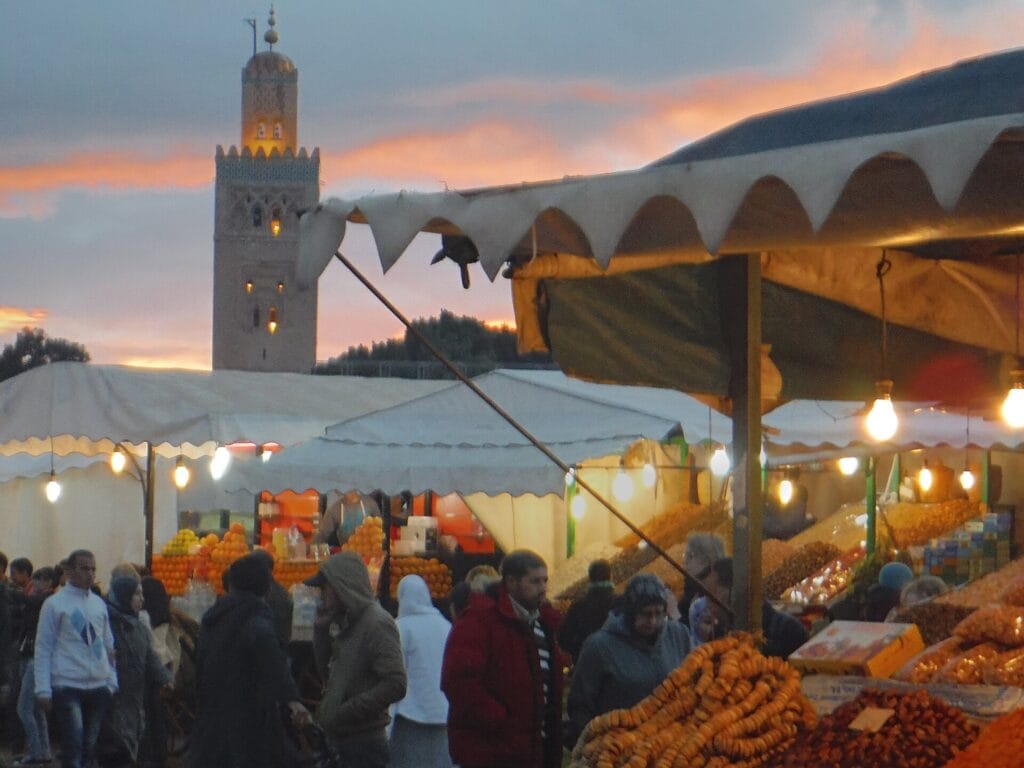
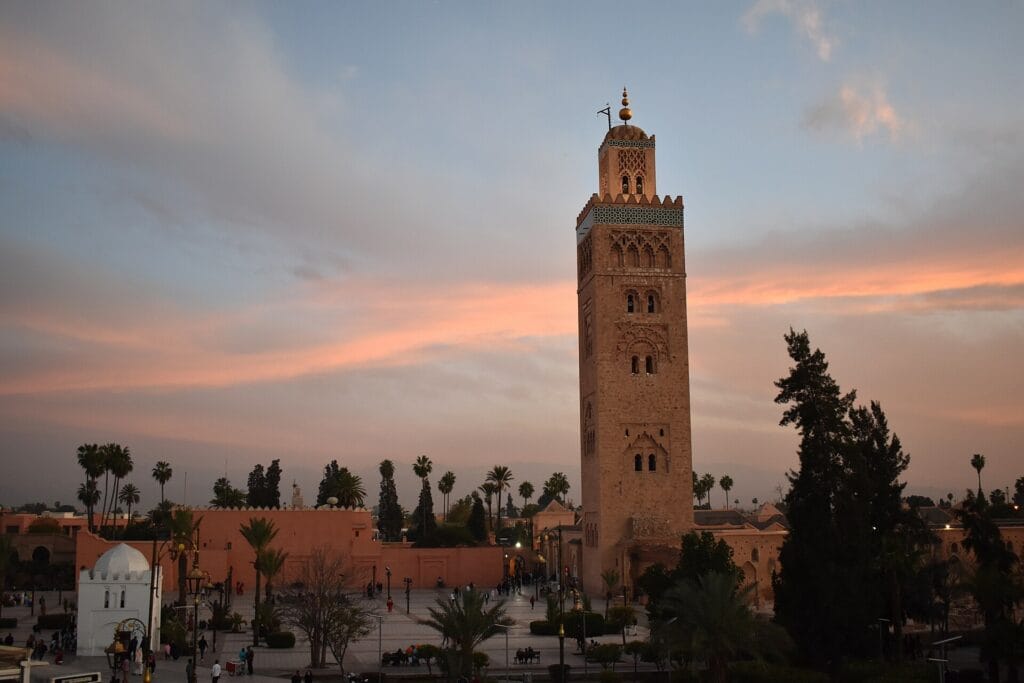
The Koutoubia Mosque is the most iconic landmark in Marrakech: its 77-metre pink sandstone minaret has towered over the medina for more than eight centuries and serves as a beacon visible for miles around. Built by the Almohad dynasty in the 12th century, just a short walk from Jemaa el-Fna square, the Koutoubia is a masterpiece of medieval Islamic art that inspired the Giralda in Seville and the Hassan Tower in Rabat. One thing to know right away: the prayer hall itself is reserved for Muslim worshippers, but anyone is free to admire the minaret and stroll through the surrounding gardens. This guide tells you everything: history, architecture, the meaning of the name, indicative opening hours, how to get there and tips for visiting.
The Koutoubia at a glance
- Name: Koutoubia (from the Arabic al-Koutoubiyyin, “the mosque of the booksellers”)
- Period: 12th century, Almohad dynasty (first mosque around 1147-1157, minaret completed under Yaqub al-Mansour around 1195-1199)
- Minaret: 77 metres tall, square base 12.80 m on each side, built of Gueliz sandstone
- Prayer hall: about 90 × 60 m, 17 naves, up to 20,000 worshippers
- Location: heart of the medina, about 200 m southwest of Jemaa el-Fna square
- Access: interior reserved for Muslims; minaret and gardens visible and open to all, free entry
- Heritage: located within the medina of Marrakech, a UNESCO World Heritage Site since 1985
What is the Koutoubia Mosque?
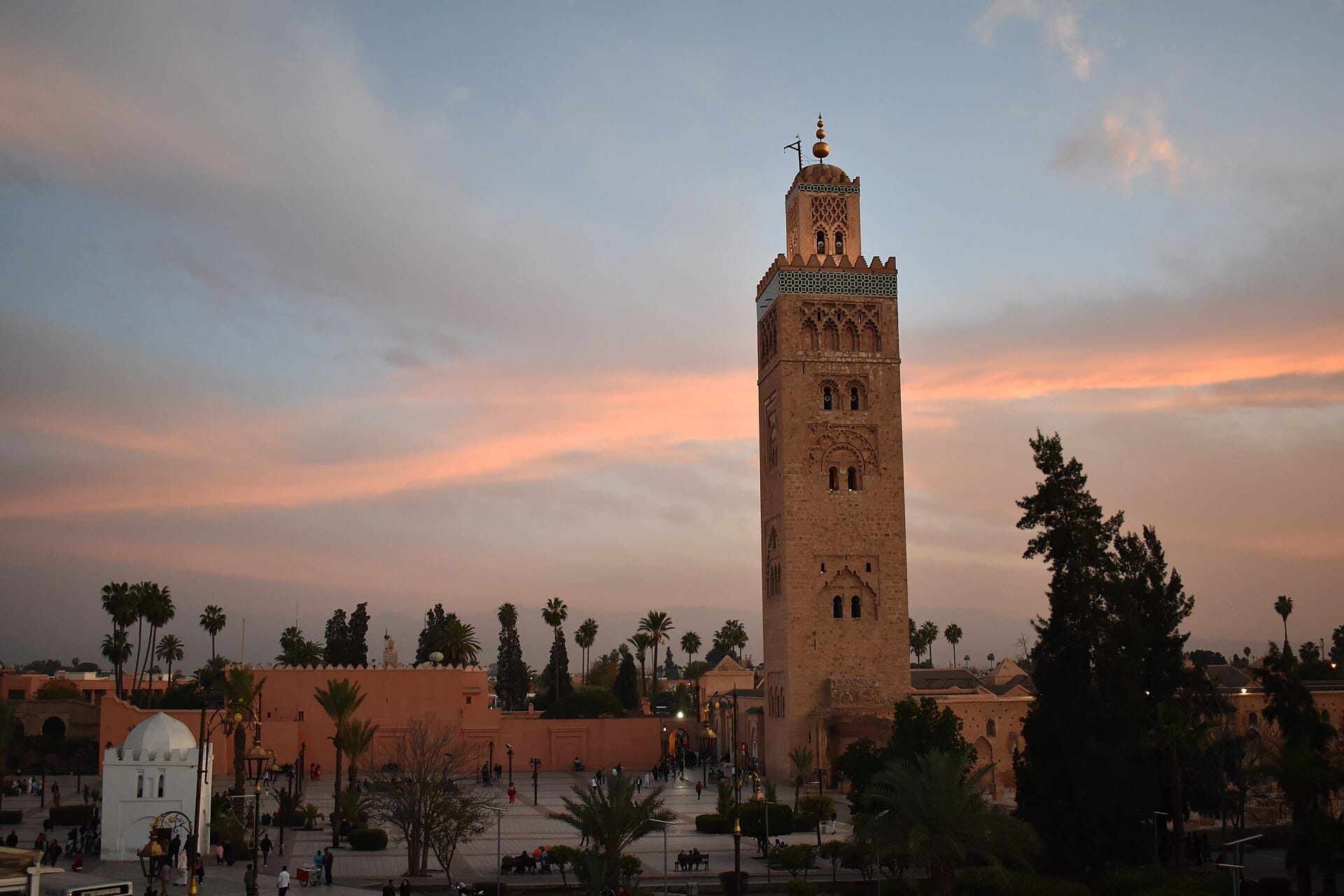
The Koutoubia Mosque in Marrakech is the largest mosque in the city and one of the most important religious monuments in Morocco. It consists of two inseparable parts: a vast hypostyle prayer hall, plain and austere as Almohad doctrine required, and a monumental minaret that has become the very symbol of Marrakech, the “red city”. This Koutoubia minaret is the oldest of the three great Almohad minarets still standing in the world, alongside the Giralda in Seville and the Hassan Tower in Rabat.
Since its construction, an unwritten but scrupulously respected planning rule has held that no building in the medina may rise higher than its minaret. That is why the skyline of Marrakech remains horizontal, punctuated by this single vertical line of pink sandstone that catches the light at sunrise and sunset. The Koutoubia is not only a place of worship: it is a landmark, a spiritual reference point and the historic heart of the city.
The history of the Koutoubia: an Almohad mosque
The history of the Koutoubia begins in the mid-12th century, shortly after the Almohads captured Marrakech in 1147. The caliph Abd al-Mumin (Abdelmoumen), founder of the dynasty, had a first mosque built on the site of a former Almoravid palace, that of the Ben Youssef. This first Koutoubia was functional around 1157.
A problem with the orientation, however, led to a rebuilding. The mihrab, the niche that indicates the direction of Mecca (the qibla), is said not to have been correctly aligned. A second mosque was therefore begun in 1158, immediately adjacent to the first, with a slightly corrected axis. The remains of the first prayer hall, uncovered by archaeologists, are still visible next to the current building: together they form a unique ensemble where, right there on the ground, you can read the story of this double construction.
The Koutoubia minaret itself was completed later, under the reign of caliph Yaqub al-Mansour (1184-1199), the peak of Almohad power. Its upper section, the lantern crowned with gilded spheres, was finished in the years 1195-1199. It is this tower that would serve as an architectural model for the entire Muslim West.
Why is it called “Koutoubia”?
The name “Koutoubia” comes from the Arabic al-Koutoubiyyin, which can be translated as “the mosque of the booksellers” or “of the book merchants”. In the Middle Ages, an important market of manuscripts and books was indeed held around the building. The kutubiyyin, these booksellers and copyists, sold their works at the foot of the mosque’s walls, turning the district into a genuine city of the book. The monument’s name thus preserves the memory of the intellectual and commercial buzz of medieval Marrakech. You sometimes come across other spellings of the same name, such as “Koutoubiya” or “Kutubiyya”, but they all refer to the same iconic monument.
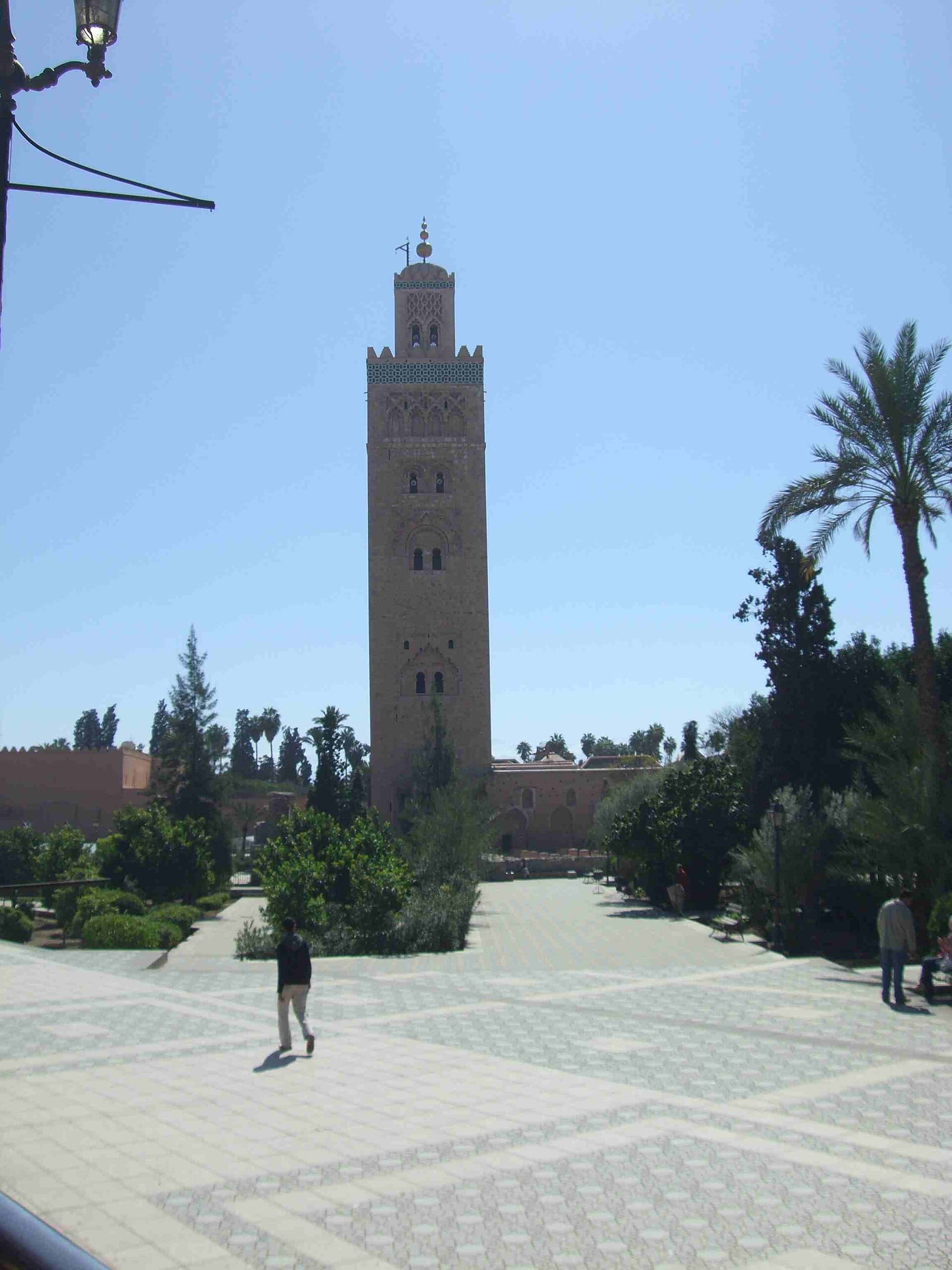
The architecture of the minaret: an Almohad model
The Koutoubia minaret is 77 metres tall and rests on a square base measuring 12.80 metres on each side, with walls 2.50 metres thick. It is built of pinkish sandstone from the Gueliz quarries, which gives it its characteristically warm hue. The tower proper rises to about 69 metres, topped by a lantern that brings the total to 77 metres.
True to Almohad aesthetics, the decoration remains plain and rigorous. Each face of the minaret is adorned with a different geometric motif: multi-lobed interlacing, networks of lozenges, scalloped arches. Beneath the cornice runs a broad frieze of turquoise faience, the only concession to colour on this mineral monument. Inside, Almohad ingenuity is revealed: instead of a staircase, a gently sloping ramp winds around a central core made up of six superimposed rooms, once allowing the muezzin to ride to the top on horseback to call to prayer.
The three golden spheres and their legend
At the top of the lantern, three gilded copper balls of decreasing size are threaded onto a spire. According to one widespread interpretation, they symbolise the great holy cities of Islam. A persistent and delightful local legend, meanwhile, tells that these spheres were originally made of pure gold: they are said to have been offered by the wife of Yaqub al-Mansour as penance for breaking the Ramadan fast, her jewels having been melted down to make them. Other tales add that jinn watch over them to protect them from thieves. These stories belong to folklore rather than documented history, but they are an integral part of the monument’s aura.
The prayer hall
The prayer hall of the Koutoubia is a vast hypostyle space of about 90 metres by 60, organised into 17 naves perpendicular to the qibla wall. It can hold up to 20,000 worshippers. Its horseshoe arches, its muqarnas domes (carved plaster stalactites) and its richly decorated mihrab reveal a refinement that the plain exterior does not hint at. As access to this interior is reserved for Muslims, most visitors discover its magnificence through accounts, archival photographs and historical descriptions.
A far-reaching influence: the Giralda and the Hassan Tower
The Koutoubia minaret is not only the symbol of Marrakech: it is the prototype of an entire architectural family. The Almohad architects reproduced its proportions and decorative vocabulary in two other great minarets, today just as famous.
- The Giralda in Seville (Spain), the former minaret of the great Almohad mosque, completed at the end of the 12th century and turned into the cathedral’s bell tower after the Reconquista.
- The Hassan Tower in Rabat, a minaret left unfinished at the death of Yaqub al-Mansour, whose truncated silhouette still dominates the Moroccan capital.
These three towers share the same grammar: a square plan, an elevation in registers of distinct geometric motifs, and a crowning lantern. Comparing the Koutoubia to its two “sisters” gives a sense of the scale of the Almohad artistic programme, which extended on both sides of the Strait of Gibraltar. At a time when the Almohad empire unified the Maghreb and al-Andalus, these minarets also played a political role: they asserted, in the skies of the great capitals, the power and unity of a dynasty at its zenith. The Koutoubia, the first to be built, was the founding prototype.
A central role in the life of Marrakech
Beyond its religious function, the Koutoubia has always shaped the life of the city. Five times a day, the call to prayer launched from its minaret sets the rhythm of daily life and spreads across the whole medina. Historically, the mosque was also a hub of learning: around it revolved the booksellers, but also scholars and students, in the wake of the city’s great religious institutions. Even today, the Koutoubia remains the most frequented Friday mosque in Marrakech and the spiritual landmark around which the old city is organised.
Visiting the Koutoubia: what you need to know
An essential point to understand before your visit: the interior of the mosque is closed to non-Muslims, like most working mosques in Morocco. There is therefore no “entry ticket” for the prayer hall. On the other hand, admiring the minaret and strolling through the gardens that surround it is completely free and open at any time of day.
The Koutoubia gardens and Lalla Hasna park
At the foot of the minaret stretch beautiful gardens laid out in the 20th century: shaded paths, date palms, bitter orange trees, rose bushes, fountains and flower beds. This is the ideal spot to photograph the monument, rest in the shade after the bustle of the souks, or wait for the sunset that sets the pink stone ablaze. The Lalla Hasna park, right next door, extends this green space and offers a peaceful break in the heart of the city centre. Access to the gardens is free and usually possible every day; the hours often given run from around 8 a.m. to 8 p.m. (indicative information, subject to change).
When to admire the Koutoubia?
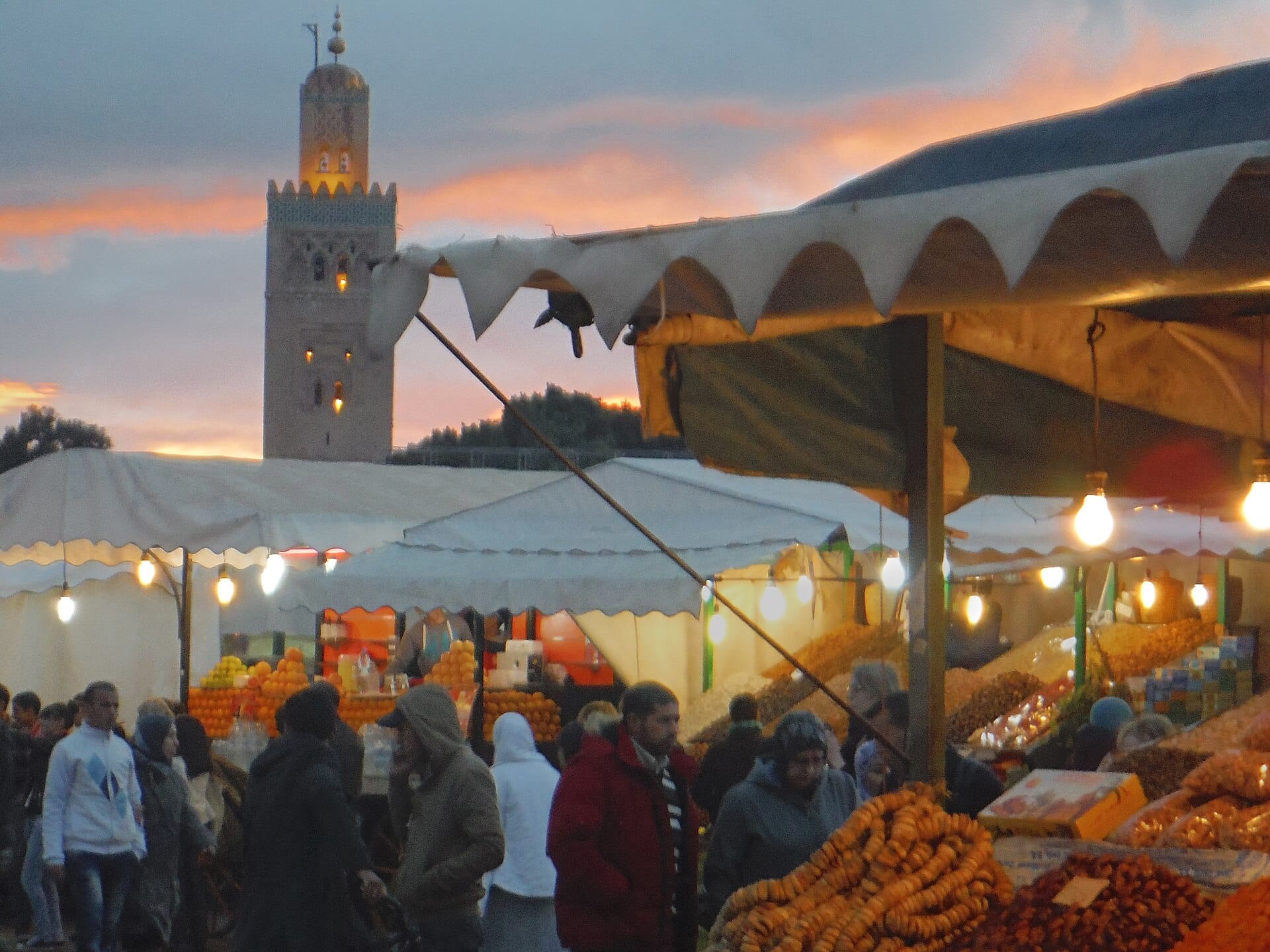
The monument can be enjoyed at any hour, but two moments are particularly magical: sunrise, when the low light picks out the relief of the facade, and above all sunset, when the sandstone takes on ochre tones and the call to prayer echoes over the city. As night falls, the minaret is enhanced by golden lighting that makes it one of the finest nocturnal sights in Marrakech, just steps from Jemaa el-Fna square. To plan your stay, take a look too at our ultimate guide to Jemaa el-Fna square, the mosque’s immediate neighbour.
Practical tips for your visit
- Respectful dress: even if you stay outside, appropriate attire is expected around a place of worship.
- Photography: photographing the minaret and the gardens is allowed; avoid photographing worshippers during prayer.
- Duration: allow 30 to 45 minutes to walk around the monument and wander through the gardens.
- Combine: the Koutoubia is easily visited in half a day together with Jemaa el-Fna square and the nearby souks.
- Prices: access to the exterior and the gardens is free; any price or timing information remains indicative and should be checked on site.
What to see around the Koutoubia?
The central position of the Koutoubia makes it an excellent starting point for exploring the treasures of the medina. A few minutes on foot will take you to several must-see monuments:
- Jemaa el-Fna square, the beating heart of Marrakech, with its storytellers, musicians and evening food stalls.
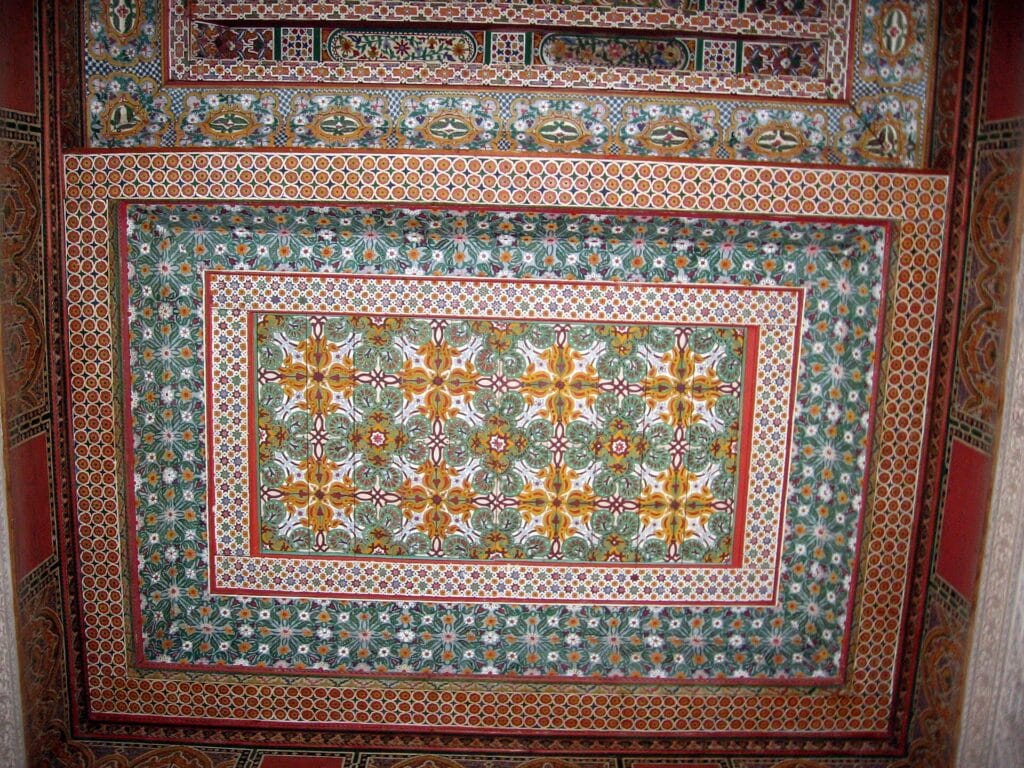
- The Bahia Palace, a sumptuous 19th-century residence with chiselled patios and ceilings.
- The Saadian Tombs, a royal necropolis with marble and zellige decoration.
- The El Badi Palace and the Ben Youssef Madrasa, jewels of Merinid and Saadian art.
- The souks of the medina, a labyrinth of crafts, spices and leather.
To plan a complete itinerary, discover our complete guide to things to do in Marrakech, which brings together the monuments, districts and experiences not to be missed in the red city.
How to get to the Koutoubia?
The Koutoubia Mosque stands in the centre of Marrakech, at the southwestern end of Jemaa el-Fna square, at the intersection of Avenue Mohammed V and the medina. From the square, you simply walk about 200 metres to reach it. It is therefore accessible on foot from almost all the riads of the medina.
If you arrive by plane, Marrakech-Menara Airport (RAK) is just 5 to 6 kilometres from the centre, or about 15 to 20 minutes by car depending on traffic. Taxis, private transfers and shuttles easily serve the medina. For everything about transport and arrival, see our page dedicated to Marrakech-Menara Airport (RAK).
A jewel of world heritage
The Koutoubia is part of an exceptional ensemble: the medina of Marrakech, a UNESCO World Heritage Site since 1985. This recognition honours the universal value of the Almohad, Saadian and Alaouite city, of which the mosque is one of the major landmarks. To visit the Koutoubia is therefore to step straight into eight centuries of Moroccan history, between spirituality, art and urban planning. You can delve deeper into the subject on the Wikipedia page on the Kutubiyya Mosque and on the official page of the medina of Marrakech listed by UNESCO.
The Koutoubia in art: Churchill’s famous painting
Few Moroccan monuments can claim to have inspired one of the most expensive works in the history of British art. In January 1943, at the close of the Casablanca Conference, Winston Churchill persuaded US President Franklin D. Roosevelt to make a detour to Marrakech to, in his words, admire the sunset over the city and the Atlas. A passionate amateur painter, Churchill set up his easel and produced Tower of the Koutoubia Mosque, an oil on canvas depicting the Koutoubia minaret bathed in the golden light of evening, with the mountains as a backdrop.
This painting is considered to be the only painting Churchill made during the Second World War. The statesman gave it to Roosevelt as a memento of their stay. The work then went on a journey worthy of a novel: it belonged for a time to the actress Angelina Jolie, before being put up for auction at Christie’s in London in March 2021. There it reached a record sum of nearly 8.3 million pounds sterling (over 11 million dollars), shattering the previous record for a Churchill canvas.
Beyond the historical anecdote, this episode illustrates the evocative power of the minaret. The Koutoubia has captivated countless Orientalist painters, photographers and filmmakers, all fascinated by its pink sandstone silhouette that changes colour throughout the day. When you contemplate the monument at dusk, you share exactly the vantage point that, in 1943, prompted a British Prime Minister to immortalise Marrakech on canvas.
The Arsat Moulay Abdeslam cyberpark, a garden next to the Koutoubia
A few steps from the Koutoubia, along Avenue Mohammed V, lies one of the oldest gardens in Marrakech: the Arsat Moulay Abdeslam cyberpark. This vast green space of about eight hectares is a former princely garden founded in the 18th century by Prince Moulay Abdeslam, under the reign of Sultan Sidi Mohammed Ben Abdallah (1710-1790). Originally, it was not a mere ornamental garden but an arsat, a productive plot planted with fruit trees and market crops, irrigated by the traditional khettara system.
Restored and reopened to the public in the mid-2000s, the park has the distinction of combining heritage and modernity: it was equipped with a Wi-Fi network covering the whole site and with interactive terminals, hence its nickname of “cyberpark”. You will find beautiful shaded paths, olive trees, palms and centuries-old species, as well as educational areas dedicated to biodiversity and sustainable development. It is a welcome cool stop after visiting the Koutoubia and the bustle of the souks.
Easy to reach from the Koutoubia esplanade, towards Avenue Mohammed V, the garden is free and generally open during the day. It ideally complements the gardens surrounding the minaret and lets you extend a peaceful stroll right in the heart of the city. For families as well as travellers in search of calm, the Arsat Moulay Abdeslam cyberpark is a green stop far too often overlooked, to combine without hesitation with a visit to the Koutoubia.
FAQ: your questions about the Koutoubia Mosque
Can you go inside the Koutoubia Mosque?
No, the interior of the prayer hall is reserved for Muslim worshippers, like most working mosques in Morocco. Non-Muslim visitors can, however, freely admire the minaret and stroll through the surrounding gardens, without restriction and free of charge.
How tall is the Koutoubia minaret?
The Koutoubia minaret is 77 metres tall, including the lantern, on a square base measuring 12.80 metres on each side. It is the highest point of the medina: by tradition, no other building in the old city may rise above it.
Who built the Koutoubia Mosque and when?
It was built by the Almohad dynasty. The first mosque was launched by caliph Abd al-Mumin shortly after 1147 and was functional around 1157; a second, better-oriented mosque was built from 1158. The minaret was completed under the reign of Yaqub al-Mansour, around 1195-1199.
What does the name “Koutoubia” mean?
The name comes from the Arabic al-Koutoubiyyin, “the mosque of the booksellers”. It recalls the market of manuscripts and books once held around the building, where the kutubiyyin (booksellers and copyists) sold their works.
Is the Koutoubia linked to the Giralda in Seville?
Yes. The Koutoubia minaret served as a model for the Almohad architects who later built the Giralda in Seville and the Hassan Tower in Rabat. These three towers share the same square plan, the same elevation in registers of geometric motifs and the same crowning lantern.
How long does it take to visit the Koutoubia?
Allow about 30 to 45 minutes to walk around the monument, admire the minaret from different angles and wander through the gardens. The Koutoubia combines easily with the nearby Jemaa el-Fna square for a lovely half-day in the medina.
Photo credits
Images under free licence via Wikimedia Commons: Koutoubia © Misa.stefanovic.07 (CC BY-SA 4.0); esplanade © Tonkie (CC BY-SA 3.0); Jemaa el-Fna © Elgaard (CC BY-SA 4.0). Sources: UNESCO and Wikipedia.
Independent guide: this website is not affiliated with any official body or with the management of the monument. Information on prices, opening hours and access is provided for guidance only and may change; we invite you to check it on site before your visit.