Marrakech is a paradise for photographers. Between the electric blue of the Jardin Majorelle, the hypnotic zellige tilework of the palaces, the ochre alleys of the medina and the sunsets over the Koutoubia, the red city offers a density of photo spots in Marrakech rarely matched anywhere in the world. Whether you are an amateur with a smartphone or a photographer equipped with a DSLR, you will find enough here to fill your memory card and your Instagram feed in just a few days.
Quick answer: the most iconic photo spots in Marrakech are the Jardin Majorelle (the famous Majorelle blue), the Secret Garden, Jemaa el-Fna square, the colorful souks, the Bahia Palace and the Ben Youssef Madrasa for zellige, the El Badi Palace and its storks, the ochre gates such as Bab Agnaou, and the rooftops facing the Koutoubia at sunset. In this guide, we walk through each location, with concrete tips on light, timing and respecting locals so you can nail your photos without missing a beat.
In brief: the best photo spots in Marrakech
- Absolute blue: the Jardin Majorelle and its cobalt-blue villa.
- The hidden garden: the Secret Garden and its geometric patios.
- Raw color: the souks and the alleys of the medina.
- Architecture: the Bahia Palace and the Ben Youssef Madrasa for zellige and carved ceilings.
- Romance: the El Badi Palace, its majestic ruins and its storks.
- Golden hour: the rooftops facing the minaret of the Koutoubia.
- Atmosphere: Jemaa el-Fna square at dusk.
- Wide open spaces: the Palmeraie and the Agafay desert.
Independent guide: this site is not affiliated with the ONDA or any official body. The prices mentioned are indicative and may change; always check on site or on the official websites before your visit.
The Jardin Majorelle: the blue that makes Marrakech Instagram-worthy
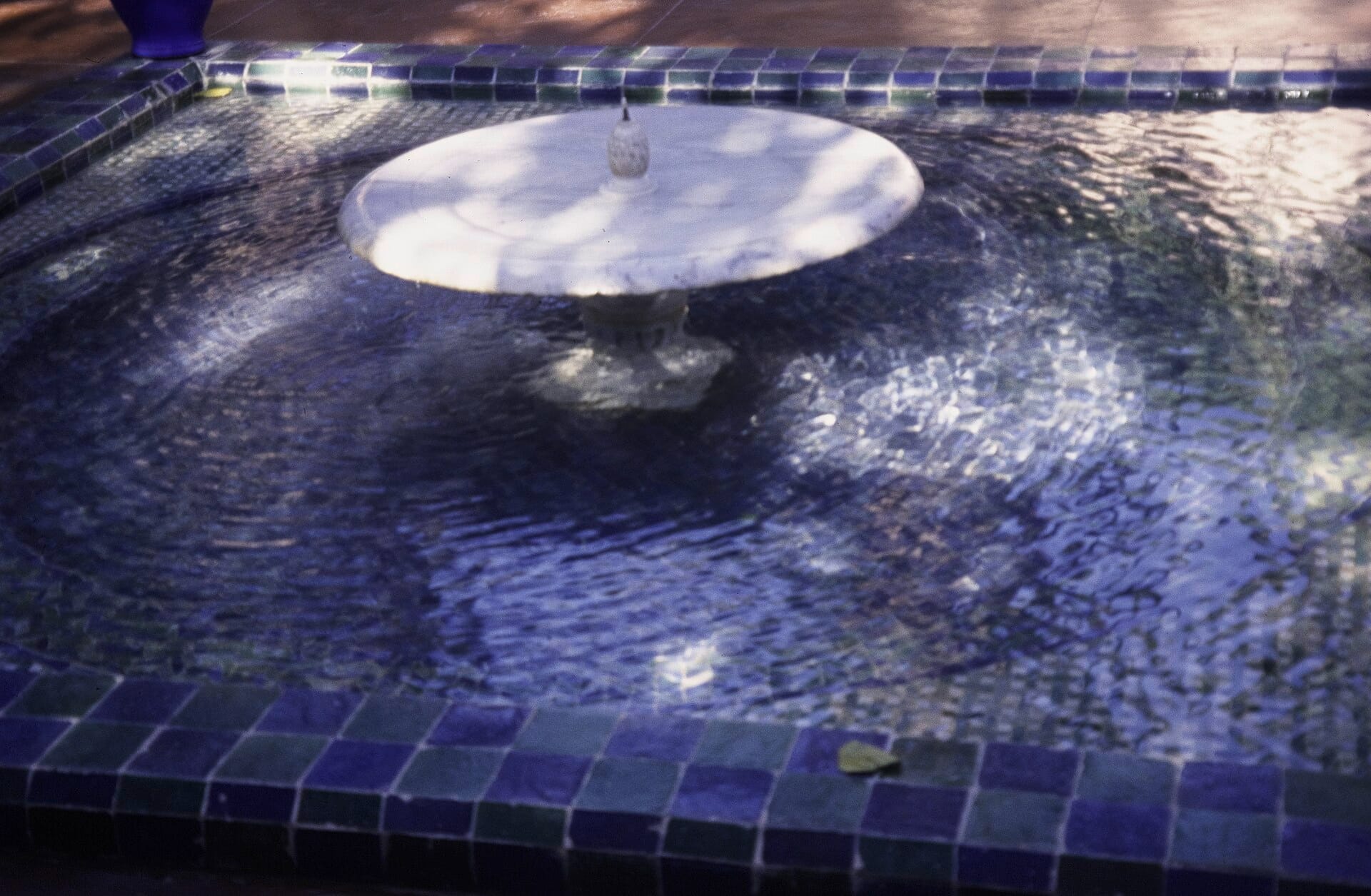
It is impossible to talk about photo spots in Marrakech without starting with the Jardin Majorelle. Created by the French painter Jacques Majorelle in the 1920s and later saved by Yves Saint Laurent and Pierre Bergé, this botanical garden owes its worldwide fame to a single color: “Majorelle blue,” an intense, luminous cobalt blue that covers the studio-villa, the pots, the fountains and the trellises. This contrast between the electric blue, the yellow of the pottery and the green of the cacti and bamboo creates images of immediate visual power.
It is probably the most photographed place in the city, which has a downside: the crowds. To nail your photos, arrive right at opening (the garden opens around 8 a.m.). The morning light is soft and, above all, the main path and the blue villa are still relatively empty. The garden entrance fee is roughly 150 dirhams as a guide, with combined tickets available for the neighboring Yves Saint Laurent Museum. Bring some patience around the blue villa: this is THE wall everyone wants to pose in front of. The bamboo alleys and the small pools offer quieter alternatives that are just as photogenic.
Composition tip: play with the vertical lines of the cacti and the blue columns, and look for reflections in the water basins. Learn more about the city’s gardens in our guide to the Menara Gardens, another major photo spot with its pavilion reflected in the large basin facing the snow-capped Atlas.
The Secret Garden: geometry and serenity in the heart of the medina
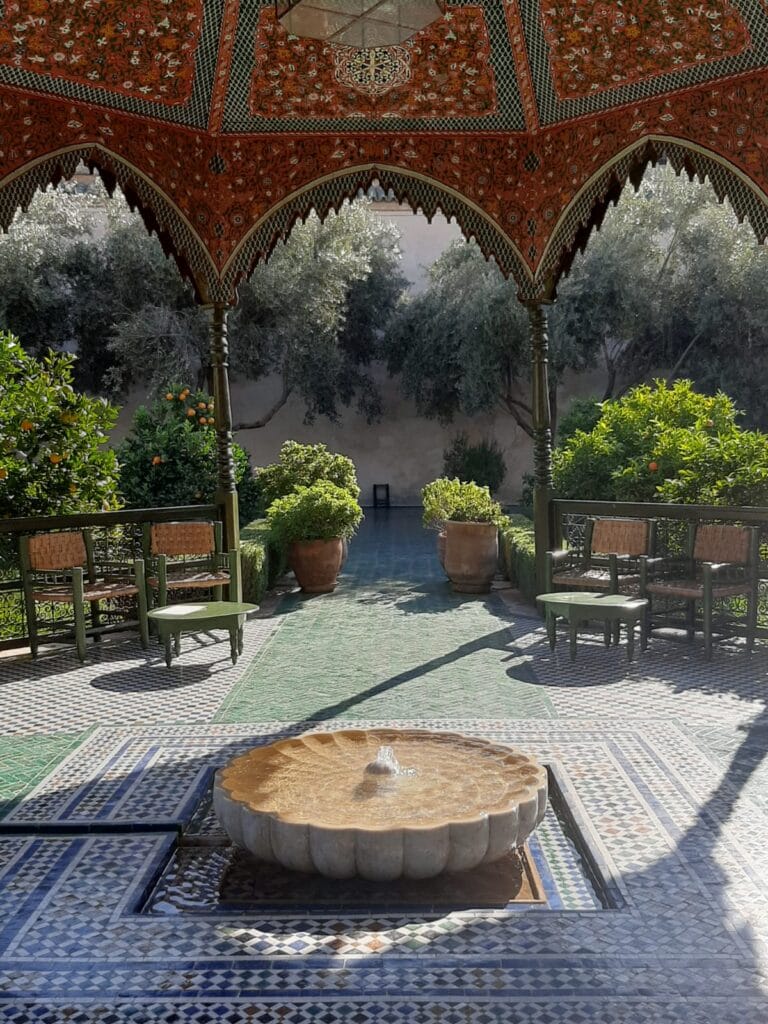
Less famous than the Majorelle but just as photogenic, the Secret Garden is tucked away in the very heart of the medina, inside a restored former palace. It is made up of two gardens: an Islamic garden organized around water channels in a perfectly geometric layout (the famous four-part “chahar bagh”), and an exotic garden. The symmetries, the straight paths lined with plants and the pavilions with painted ceilings make it an ideal playground for composition.
The highlight of the spot: the panoramic tower, which offers one of the finest views over the rooftops of the medina and the minarets, with a Moroccan flag fluttering in the foreground. Climb up in late afternoon for warm light. To learn everything about this place, see our dedicated guide to the Secret Garden of Marrakech. It is one of the most beautiful places in Marrakech for photography when you are looking for calm and symmetry away from the crowds.
The medina and the colorful souks: the beating heart of street photography
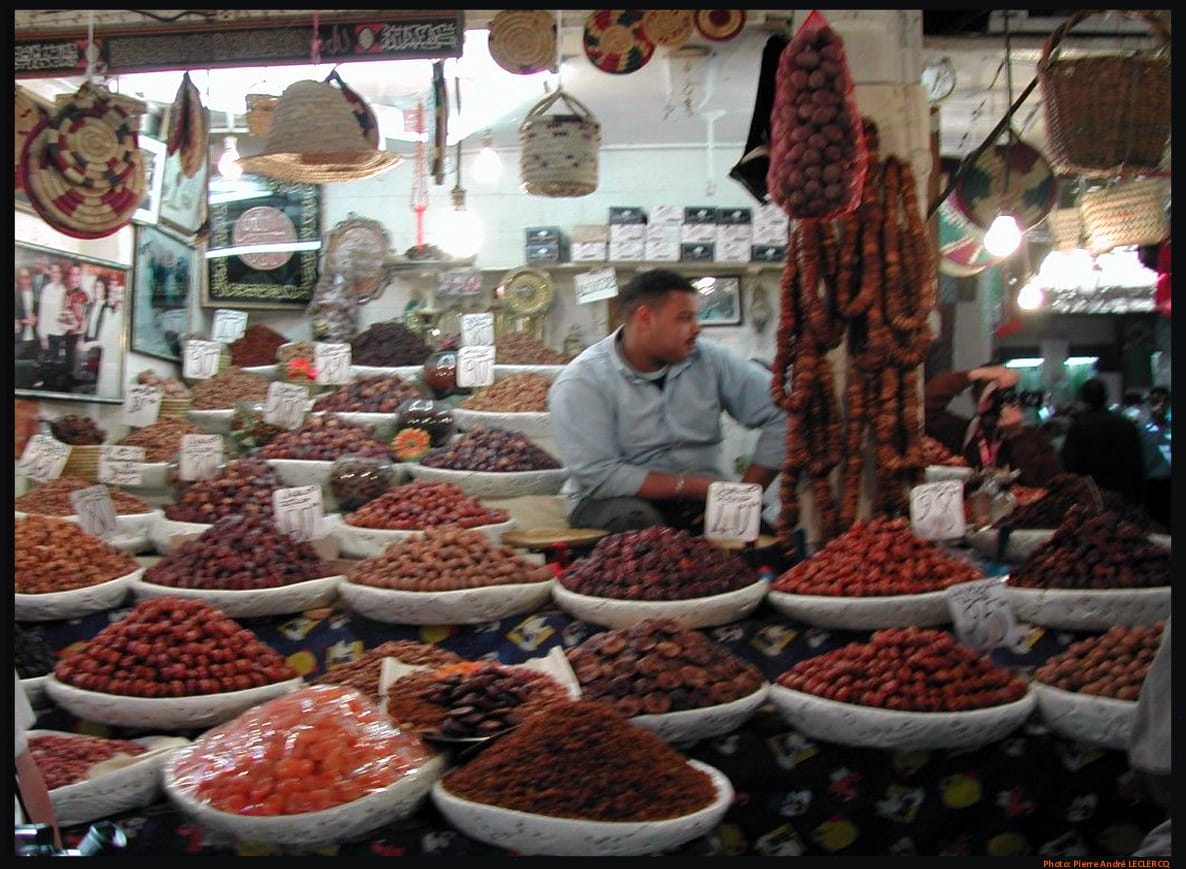
If you are wondering where to take photos in Marrakech to capture the soul of the city, the answer is simple: the medina. Its labyrinthine alleys with ochre and pink walls, its studded doors, its hanging carpets and its shafts of light filtering through the reed roofs form natural backdrops of endless richness. Every turn holds a scene: an artisan at work, a moped weaving through, a cascade of multicolored babouche slippers.
The souks are a paradise of color: pyramids of saffron and paprika spices, mountains of yellow and red babouches, chiseled metal lamps casting patterns onto the walls, dyed wool hanging in the dyers’ souk (Souk Sebbaghine). The light there is a challenge: highly contrasted, with zones of deep shadow and bright shafts of sun. Look for those beams of light piercing the roof for dramatic shots, and raise your ISO in the dark passages.
One imperative: respect the shopkeepers and the artisans. Many dislike being photographed without permission, and some ask for a small tip in exchange for a pose. Always ask with a gesture or a word before framing a face. To prepare your exploration, read our guides to the souks of Marrakech and the medina of Marrakech, a UNESCO World Heritage Site.
The palaces and the zellige: Bahia and Ben Youssef
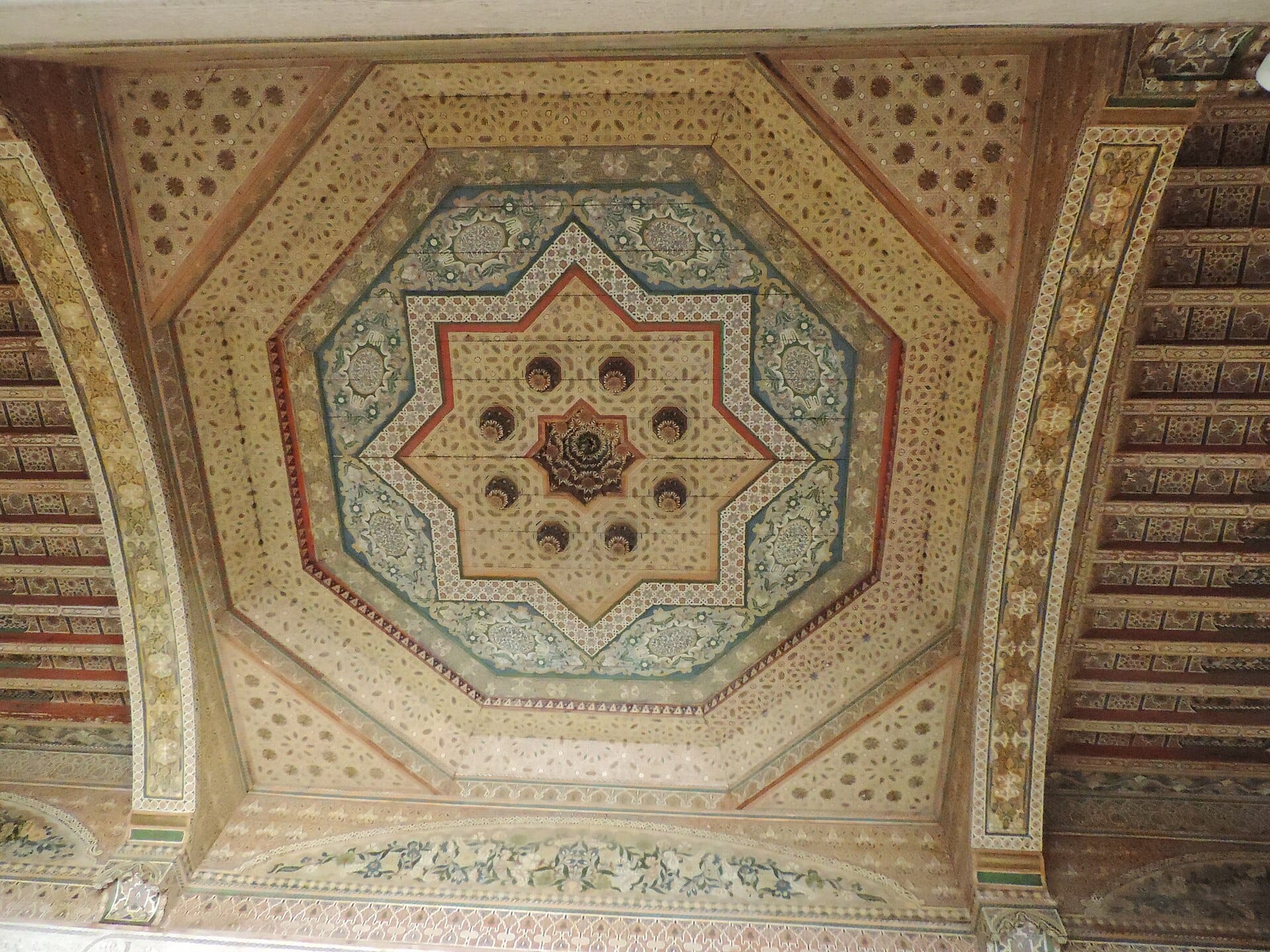
For lovers of architecture and patterns, two places are unmissable. The Bahia Palace, built at the end of the 19th century, unfolds a succession of patios, painted cedar ceilings (the “zouaks”), openwork stucco windows and zellige floors. The symmetry of the courtyards, the doorways aligned in perspective and the ceilings seen from below make for splendid compositions. Frame upward to capture the polychrome ceilings, and use the doorways as natural frames to create depth. Our full article on the Bahia Palace details the best rooms to photograph.
The Ben Youssef Madrasa is arguably the most beautiful architectural spot in the city. This former Quranic school, the largest in Morocco, completed in 1565, is organized around a magnificent central patio with a marble basin. The walls are a festival of colorful zellige, lace-like carved stucco, engraved cedar wood and calligraphy. The central basin acts as a mirror: position yourself at ground level to capture the perfect reflection of the facade and the arches. Here again, arrive early to avoid the groups. Find all the tips in our guide to the Ben Youssef Madrasa.
Zellige tip: zellige rewards tight framing. Do not hesitate to isolate a mosaic detail, a fragment of ceiling or a door for graphic, abstract photos that are very popular on Instagram.
The El Badi Palace: majestic ruins and storks
A total contrast with the Bahia: the El Badi Palace, once one of the most sumptuous in the world in the Saadian era, is now just a vast set of open-air ruins. Its high walls of ochre earth, its basins, its orange groves below and its bare perspectives offer clean, graphic framing very different from the rest of the city. At the top of the ramparts, the panoramic view over the medina and the Atlas is superb.
The detail that gives the place all its charm: the stork nests perched on the walls. These large birds, symbols of Marrakech, nest at the top of the ramparts and delight photographers, especially with a telephoto lens and backlit at sunset. Our guide to the El Badi Palace shows you the best angles. This site ranks among the favorite photo spots in Marrakech for those who love mineral, timeless atmospheres.
The ochre gates and ramparts: Bab Agnaou and the walls
Marrakech is the “red city,” and its ramparts of ochre-earth pisé are its emblem. Stretching for several kilometers, they take on a blazing hue at sunset, shifting from pink to orange-red. The monumental gates are subjects in their own right. The finest is unquestionably Bab Agnaou, a finely carved 12th-century Almohad gate, whose concentric motifs framing the arch offer perfect symmetry for photography.
The other gates such as Bab el-Khemis or Bab Doukkala, as well as the long sections of ramparts lined with palm trees, are ideal at the end of the day when the raking light reveals the texture of the earth. Add a foreground (a horse-drawn carriage, a palm tree, a silhouette) to give a sense of scale. To dig deeper, see our article on the ramparts and gates of Marrakech. These ochre walls are among the most beautiful places in Marrakech for photography at golden hour.
The rooftops at sunset facing the Koutoubia
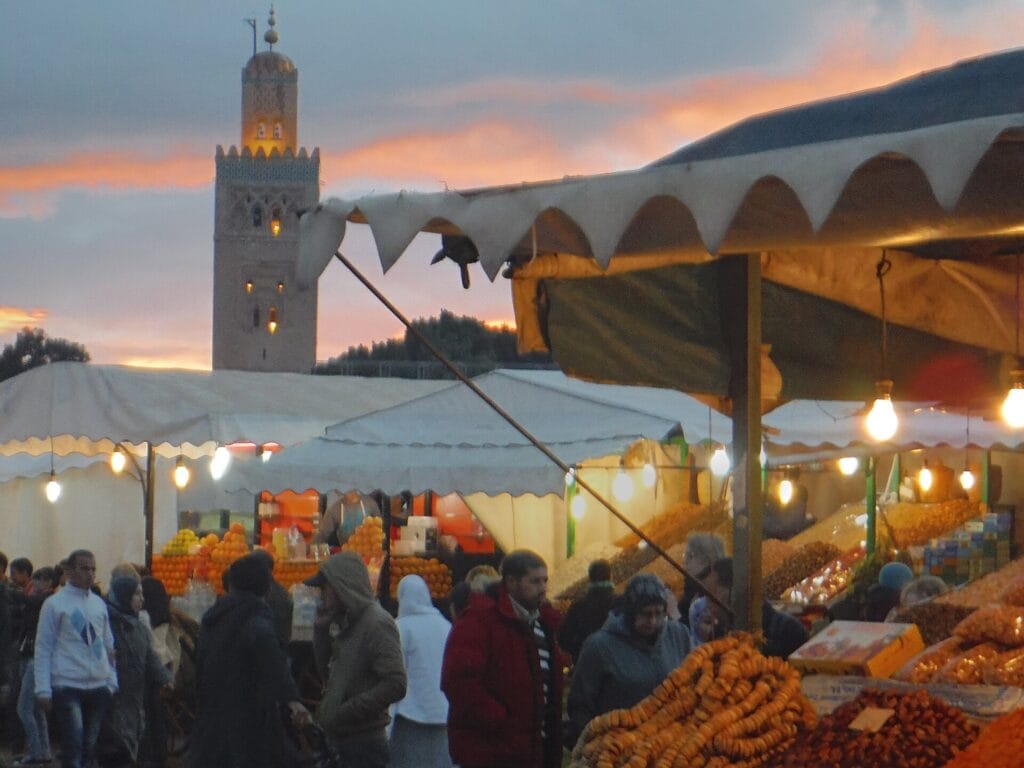
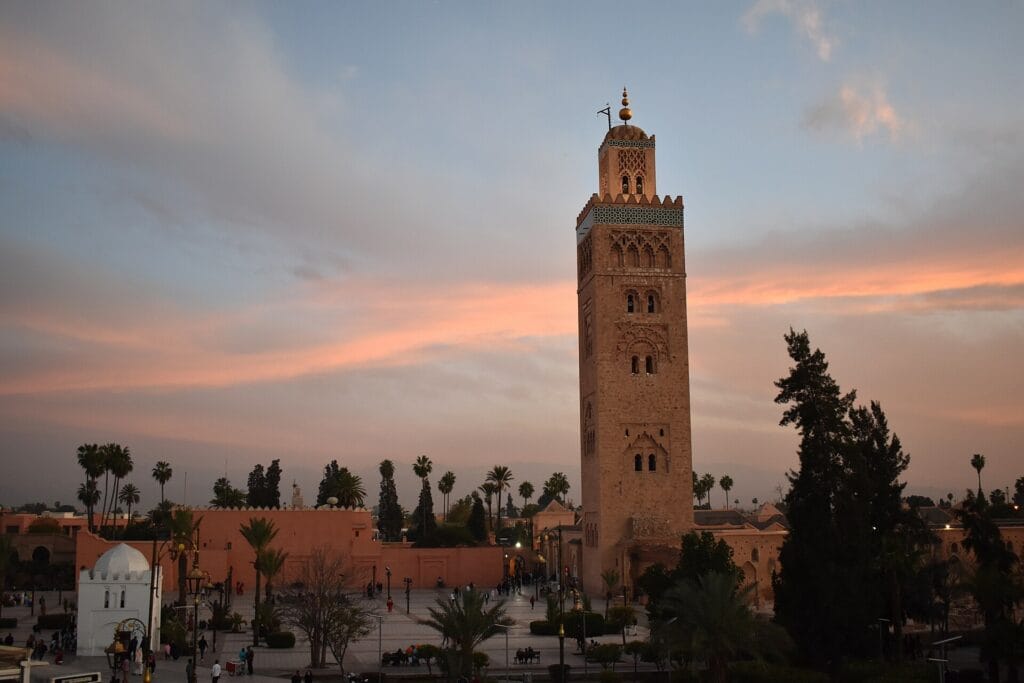
The rooftop terraces are one of the great secrets of photography in Marrakech. From a well-placed rooftop, you look out over the ocean of ochre rooftops of the medina, with the minaret of the Koutoubia, the city’s tallest monument, as the focal point. At sunset, the sky catches fire and the minaret stands out in silhouette: it is one of the most iconic images of Marrakech on Instagram.
Many cafés and restaurants with terraces around Jemaa el-Fna and in the medina let you immortalize this panorama, often for the simple price of a mint tea. Arrive at least 30 to 45 minutes before sunset to capture the “golden hour” and then the “blue hour,” when the city lights come on. Our guide to the nightlife and rooftops of Marrakech lists the best panoramic spots. Consider a small tabletop tripod for night photos.
Jemaa el-Fna square: the city’s living theater
Listed as part of the oral heritage of humanity, Jemaa el-Fna square is the beating heart of Marrakech and an extraordinary photo spot, especially at dusk. As night falls, dozens of food stalls light up, the smoke from the grills rises through the lights, and storytellers, Gnaoua musicians and orange-juice sellers bring the square to life. From an elevated terrace, the plunging view over this luminous, smoky chaos is spectacular.
Beware, however: on the square itself, the snake charmers, monkey handlers, water carriers (“guerrab”) in colorful costumes and henna tattoo artists systematically demand money if you photograph them, even from afar. Be upfront, negotiate a small tip in advance, or favor general atmosphere shots from a rooftop. On an ethical note, avoid photographing the exploited animals, whose conditions are problematic. Find all the activities in the area in our complete guide to what to do in Marrakech.
The Palmeraie and the Agafay desert: wide open spaces
To change scale and escape the alleys, two destinations on the edge of the city offer spectacular photo spots. The Palmeraie, a vast palm oasis north of Marrakech, lends itself to photos of camel rides, quad bikes or buggies, with its rows of palm trees and its play of shadows. The morning or late-afternoon light is the most flattering there.
About 40 minutes from the city, the Agafay desert is a stone desert of bare hills, with the snow-capped Atlas as a backdrop for much of the year. It is the dream spot for photos of luxury camps under the stars, camels at sunset and starry skies at night (ideal for astrophotography far from light pollution). Sunrise and sunset there are magical. Discover our dedicated guide to the Agafay desert to organize your outing.
Photogenic riads: patios, zellige and rose petals
We do not always think of our accommodation as a photo spot, and yet: the traditional riads of Marrakech are among the most “instagrammable” settings in the city. These houses organized around a central patio offer perfect symmetry, fountains decorated with rose petals, colorful zellige, metal lanterns and sublime plays of light when the sun strikes the patio vertically, around noon.
Many riads carefully style their decor precisely for photography: photogenic breakfasts, tea trays, zellige staircases, flower-filled terraces. Some famous boutique riads and cafés charge for access or reserve their spaces for their guests: check before showing up camera in hand. The colorful staircases and columned patios are absolute classics of Marrakech on Instagram.
Photo tips: light, respect and permissions
The light. In Marrakech, the sun is powerful and the contrast very strong in the middle of the day. Favor the “golden hour” (the first hour after sunrise and the last before sunset) for warm, flattering light, ideal on the ochre ramparts and the rooftops. In the medina, midday light creates spectacular shafts through the roofs of the souks. For gardens and patios, early morning offers softness and tranquility.
Respect for people. This is the golden rule. Never photograph a person (shopkeeper, artisan, woman, child) without their consent. A smile, a gesture toward the camera, a word is often enough to get a “yes”… or a “no” that must be respected. On Jemaa el-Fna and in the souks, photographing street performers generally involves a tip: it is better to negotiate it beforehand.
Permissions and restrictions. Some places charge admission (Majorelle, Bahia, Ben Youssef, Secret Garden, El Badi) and the ticket includes the right to photograph for personal use; professional or commercial shoots (weddings, fashion shoots) often require a permit and a specific fee. Inside working mosques, access and therefore photography are forbidden to non-Muslims (you can only photograph the Koutoubia from the outside). Finally, the use of drones is strictly regulated and effectively banned without official authorization in Morocco: do not count on filming the medina from the air, at the risk of having your equipment seized.
Smart gear. A wide-angle lens for patios and narrow alleys, a small telephoto lens for zellige details and storks, a cloth for the ever-present dust, and a spare battery. A recent smartphone is more than enough for most spots; what matters is the eye and the time of day. Also think about protecting your equipment: the dust and sand of the medina and Agafay get in everywhere, so a simple waterproof bag or a cover makes the difference.
Attire and attitude. Dress respectfully and discreetly, especially in the medina: it makes contact easier and opens the doors to a beautiful scene more readily. Take the time to observe before photographing, strike up a conversation, buy a tea or an item from an artisan: this human connection often yields the finest portraits and the most sincere permissions. In Marrakech, the best photo almost always comes from an exchange, not a theft.
Best time to photograph Marrakech
The best time of day depends on the spot. Early morning (8–10 a.m.): the gardens, the Ben Youssef Madrasa and the Jardin Majorelle, for soft light and no crowds. Midday: the riad patios and the souks, when the sun plunges vertically. Late afternoon and sunset: the ochre ramparts, the gates, the rooftops facing the Koutoubia and the Agafay desert. At night: Jemaa el-Fna lit up and the starry skies of Agafay.
As for seasons, spring (March to May) and autumn (September to November) offer the best light and an often clear sky that reveals the snow-capped Atlas in the background, a magnificent bonus from the heights and the Menara. Summer is very hot and the light harsher; winter delivers spectacular sunsets and crisp mornings. Wherever you point your lens, Marrakech reveals itself as one of the most photogenic cities in the world.
FAQ: photo spots and Instagram in Marrakech
What is the most famous photo spot in Marrakech?
The Jardin Majorelle and its cobalt-blue villa (the “Majorelle blue”) are by far the most photographed and most emblematic place in Marrakech on Instagram. Arrive right at opening to avoid the crowd in front of the blue villa.
Can you photograph people in the souks?
Yes, but only with their consent. Many shopkeepers and artisans do not appreciate being photographed without permission. Always ask before framing a face; on Jemaa el-Fna, street performers generally demand a tip.
Are drones allowed in Marrakech?
No. Drone use is strictly regulated in Morocco and banned without official authorization. Equipment can be confiscated. So do not count on filming the medina from the air without prior administrative procedures.
Where is the best sunset for photography?
From a rooftop facing the minaret of the Koutoubia, or from the top of the ramparts and the El Badi Palace, where the sun sets the ochre city ablaze. The Agafay desert also offers spectacular sunsets with the Atlas as a backdrop.
Which place is best for architecture and zellige photos?
The Ben Youssef Madrasa, with its basin patio and its walls of zellige and carved stucco, is the best architectural spot. The Bahia Palace rounds out the experience with its painted cedar ceilings and symmetrical courtyards.
Do you have to pay to photograph in these places?
Most major sites charge admission (indicative prices), and this fee includes photography for personal use. Professional or commercial shoots, on the other hand, often require a specific permit and an additional fee.
Ready to fill your feed? Round out your reading with our complete guide to what to do in Marrakech and explore the Marrakech Wikipedia page for the history of the monuments. Happy image-hunting in the red city!
Images under free license via Wikimedia Commons: © Angeline A. van Achterberg (CC BY-SA 4.0); © Vassia Atanassova – Spiritia (CC BY-SA 4.0); © Pierre André Leclercq (CC BY-SA 4.0). Sources: Wikimedia Commons.Photo credits: royalty-free illustrative images (Unsplash / Pexels). Please credit the authors of the visuals used. This guide is independent and not affiliated with the ONDA or any official body.