Quick answer: the Saadian Tombs of Marrakech are a royal necropolis from the 16th century, laid out by the Saadian dynasty in the Kasbah district, next to the Kasbah Mosque (Moulay El Yazid). They shelter around sixty marble tombs and nearly a hundred graves decorated with zellige tilework, including that of Sultan Ahmad al-Mansur, at the centre of the famous Hall of Twelve Columns. Walled up in the 17th century by the Alaouite sultan Moulay Ismail, they lay forgotten until their official rediscovery in 1917, under the French Protectorate. Open every day (roughly 9am–5pm), the entrance fee is modest (indicative price around 100 dirhams for foreign visitors). They are one of the most visited monuments in the medina, a UNESCO World Heritage site.
In brief: the essentials on the Saadian Tombs
- Nature: necropolis (royal mausoleum) of the Saadian dynasty.
- Period: late 16th century, under the reigns of Abdallah al-Ghalib and then Ahmad al-Mansur.
- Location: Kasbah district, medina of Marrakech, beside the Moulay El Yazid Mosque.
- What to see: the Hall of Twelve Columns, the Hall of the Mihrab, the mausoleum of Lalla Messaouda, the garden of zellige graves.
- Rediscovery: 1917, by the Fine Arts Department under the French Protectorate.
- Indicative hours: every day, roughly 9am–5pm (reduced hours during Ramadan).
- Indicative price: around 100 dirhams for foreigners, reduced rate for Moroccans and residents (to be confirmed on site).
- Visit length: 30 to 45 minutes is enough, not counting queuing time.
Tucked away behind a wall of the Kasbah, the Saadian Tombs of Marrakech rank among the most moving treasures in Morocco. Where other monuments impress by their size, this necropolis captivates through the extreme finesse of its decoration: Carrara marble, chiselled stucco, carved cedar wood and multicoloured zellige come together to form a funerary jewel of rare elegance. This complete guide retraces their history, describes each hall, identifies the figures who rest there, and gathers all the practical tips to plan your visit.
What are the Saadian Tombs of Marrakech?
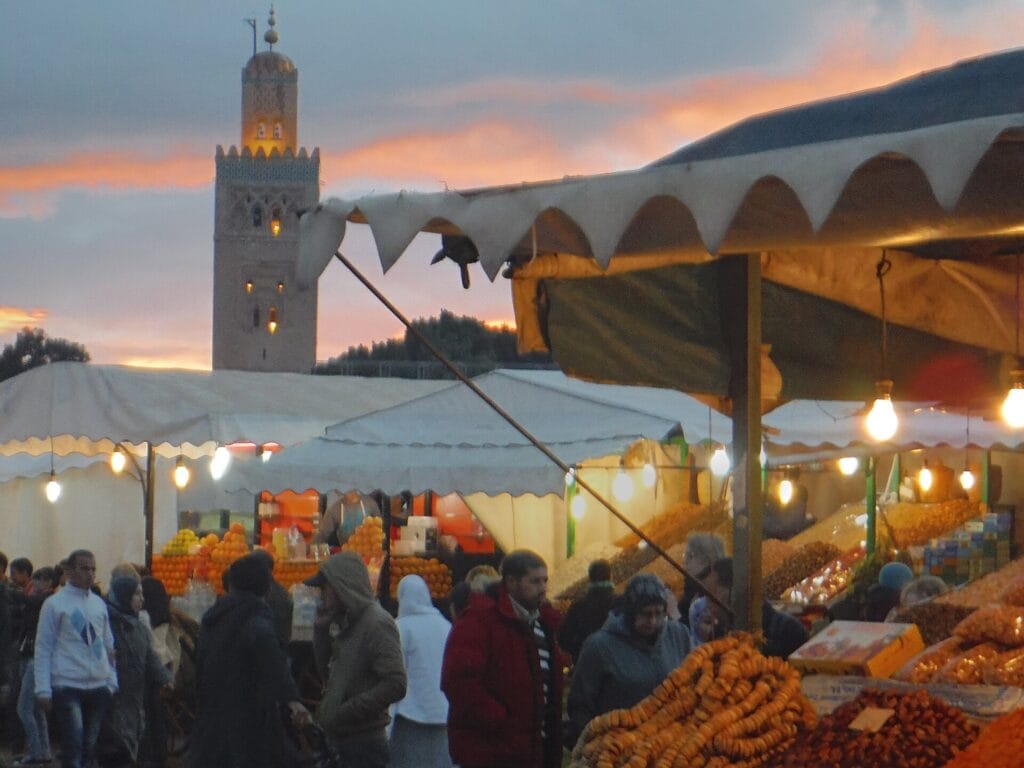
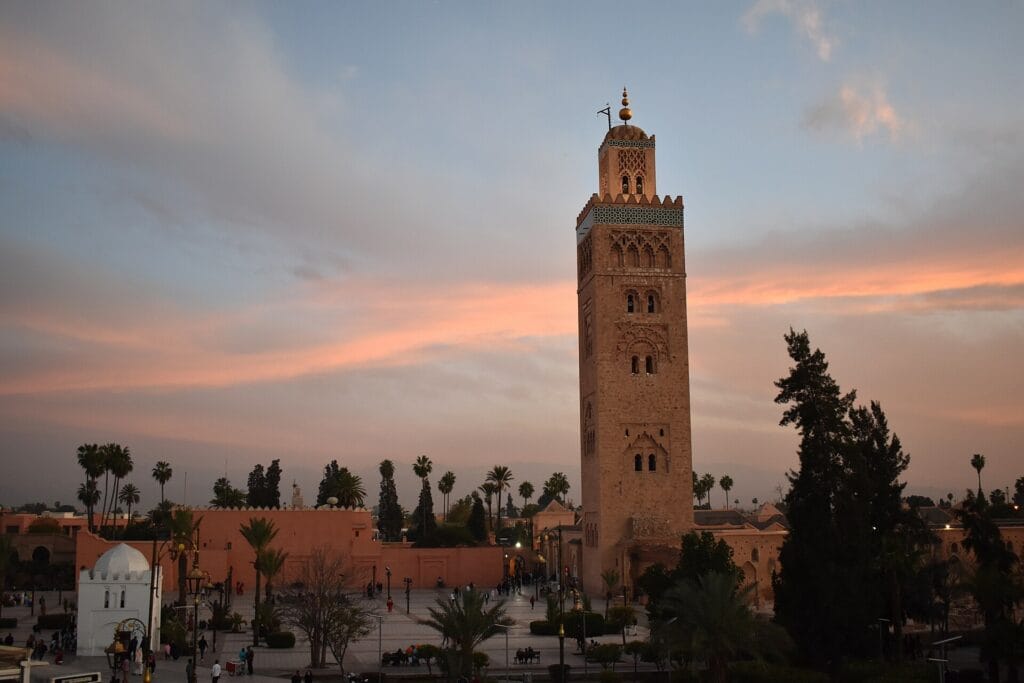
The Saadian Tombs form a royal necropolis, that is, a group of mausoleums intended to hold the graves of a single dynasty. They stand in the Kasbah district, in the southern part of the Marrakech medina, adjoining the Kasbah Mosque (also called the Moulay El Yazid Mosque). Access today is through a narrow corridor built in the early 20th century, which opens onto a peaceful garden framed by two main funerary buildings.
The site brings together around sixty marble gravestones, called mqabriya, and nearly a hundred additional graves marked on the ground by colourful zellige patterns. Sultans, princes, royal wives, children and relatives of the Saadian dynasty rest here, along with a few figures buried after the fall of this ruling family. It is at once a princely cemetery and a masterpiece of Hispano-Moorish funerary architecture.
Unlike other monuments in the city, the Saadian Tombs were never a lived-in palace or a place of spectacle: it is a space of contemplation, designed for eternity. This purpose explains the plainness of the exterior and, by contrast, the incredible richness of the interior decoration, reserved for honouring the royal dead.
History of the Saadian Tombs and the Saadian dynasty
The Saadian dynasty, Marrakech’s golden age
The Saadian dynasty ruled Morocco from roughly 1554 to 1659. Coming from the south of the country, in the Draa Valley, this sharifian family claimed descent from the Prophet. It seized power by unifying Morocco against the Portuguese and Ottoman threats, and chose Marrakech as its capital. Under its rule, the city experienced a true golden age: the sugar and gold trade across the Sahara, the embellishment of the medina and the construction of prestigious monuments such as the El Badi Palace.
The founder of the dynasty, Mohammed ash-Sheikh, laid the foundations of this power. But it was his grandson, Sultan Ahmad al-Mansur, nicknamed “adh-Dhahabi” (“the Golden” or “the Victorious”), who brought the kingdom to its height at the end of the 16th century. Enriched notably by the conquest of the Songhai Empire and access to the gold resources of the Sudan, he transformed Marrakech into a radiant capital, on a par with the great Mediterranean cities of his time.
The building of the royal necropolis
The funerary site already existed before the Saadian peak: it adjoins the Kasbah Mosque, built in the Almohad era in the 12th century, and served as a place of burial. The first great mausoleum, to the east of the garden, was laid out by Sultan Abdallah al-Ghalib between roughly 1557 and 1574, notably to honour the memory of his father Mohammed ash-Sheikh, founder of the dynasty.
It was then Ahmad al-Mansur who gave the Saadian Tombs their definitive splendour. Late in his reign, he had the second mausoleum built, to the west, where he intended to rest himself. There he had the most precious materials of the age deployed: the white Carrara marble, imported from Italy, was said, according to tradition, to have been paid for by its weight in Moroccan sugar, a commodity then extremely sought after in Europe. This western mausoleum houses the famous Hall of Twelve Columns, considered the pinnacle of Saadian funerary art.
Ahmad al-Mansur died of the plague in 1603. After him, the dynasty declined rapidly, undermined by succession struggles, but the necropolis continued to receive members of the royal family for several decades. Each grave added enriched the whole, gradually turning the site into a true pantheon of the Saadian house, where the hierarchy of the court could be read through the placement and richness of the tombs.
One must imagine what such an undertaking represented at the end of the 16th century: mobilising the finest master craftsmen of the kingdom, the maalem specialists in zellige, stucco and wood, shipping Italian marble to the Atlantic ports, then hauling it by caravan all the way to Marrakech. This lavish expenditure of resources reflected a political intent: to assert, even in death, the prestige of a dynasty that saw itself as the equal of the greatest powers of the Mediterranean.
Moulay Ismail’s wall and two centuries of oblivion
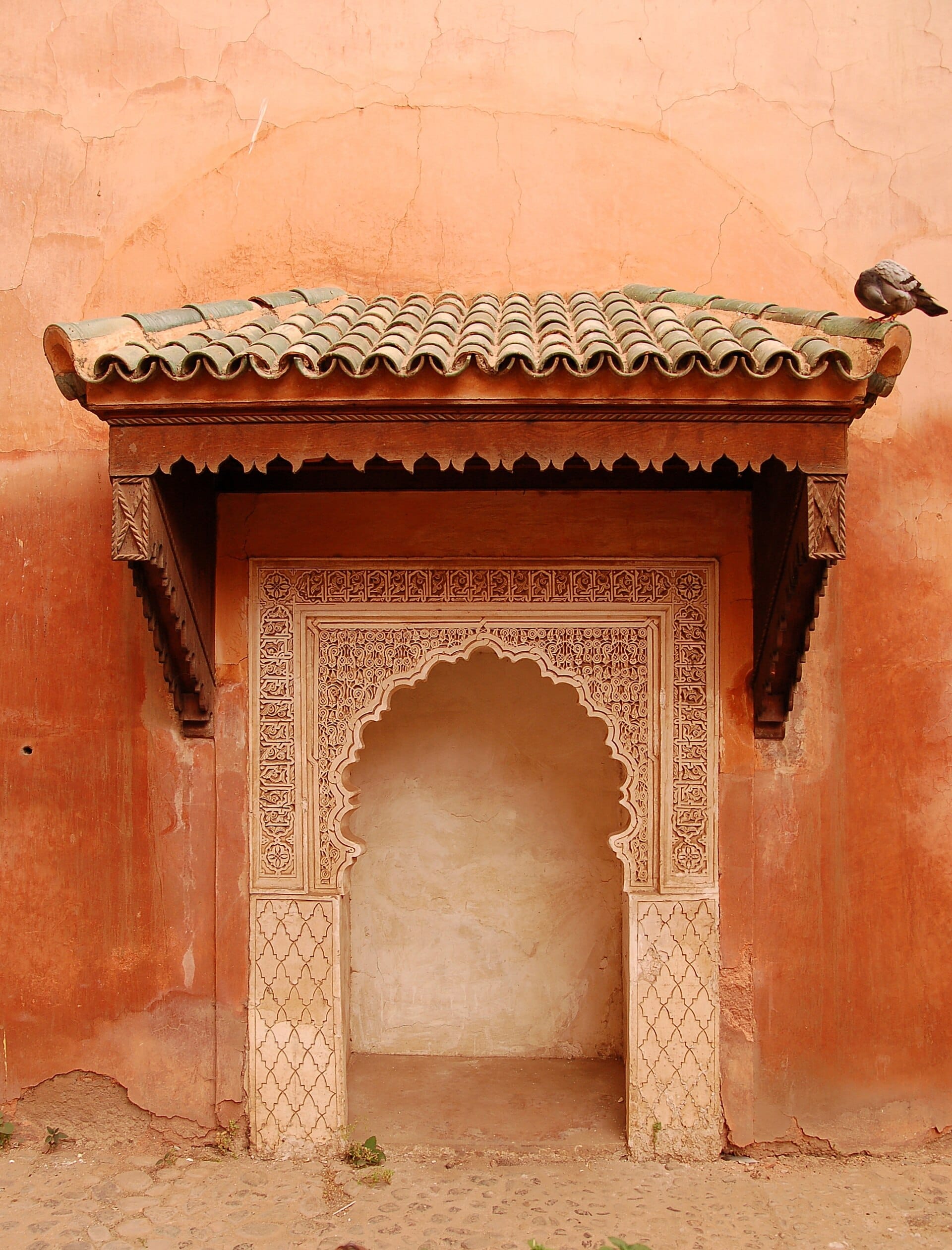
In the 17th century, the Alaouite dynasty succeeded the Saadians. Sultan Moulay Ismail, known for making Meknes his capital, set out to destroy the symbols of Saadian power: he notably had the sumptuous El Badi Palace dismantled. Yet, out of religious respect for these graves — desecrating tombs being a strong prohibition in Islam — he chose not to destroy the necropolis. He had most of the entrances walled up, leaving only a discreet passage through the neighbouring mosque.
Cut off from the world, the Saadian Tombs then fell into deep oblivion. For more than two centuries, only a few initiates could still pray there, passing through the interior of the mosque, which was forbidden to non-Muslims. Vegetation overtook the garden, and the memory of the place slowly faded from the public life of the city.
The 1917 rediscovery
It was not until 1917, at the start of the French Protectorate, that the Saadian Tombs came back into the light. Spotted notably thanks to aerial photographs that revealed the buildings hidden behind the Kasbah, they were studied and restored by the Department of Fine Arts, Antiquities and Historic Monuments, created in 1912. An access corridor was cut through so as to open the site to the public without going through the mosque.
The restoration work, carried out meticulously, relied on the surviving original elements to rebuild the damaged parts, respecting the period patterns and materials. Thanks to these efforts, the Saadian Tombs have come down to us today in a remarkable state of preservation, offering an exceptional testimony to the art and refinement of Marrakech’s golden age.
Architecture and decoration: touring the Saadian Tombs
The necropolis is arranged around a central garden, framed by two main mausoleums. Each hall has its own atmosphere and its decorative treasures. Here is what you will discover as you explore the site.
The Hall of Twelve Columns, jewel of the Saadian Tombs
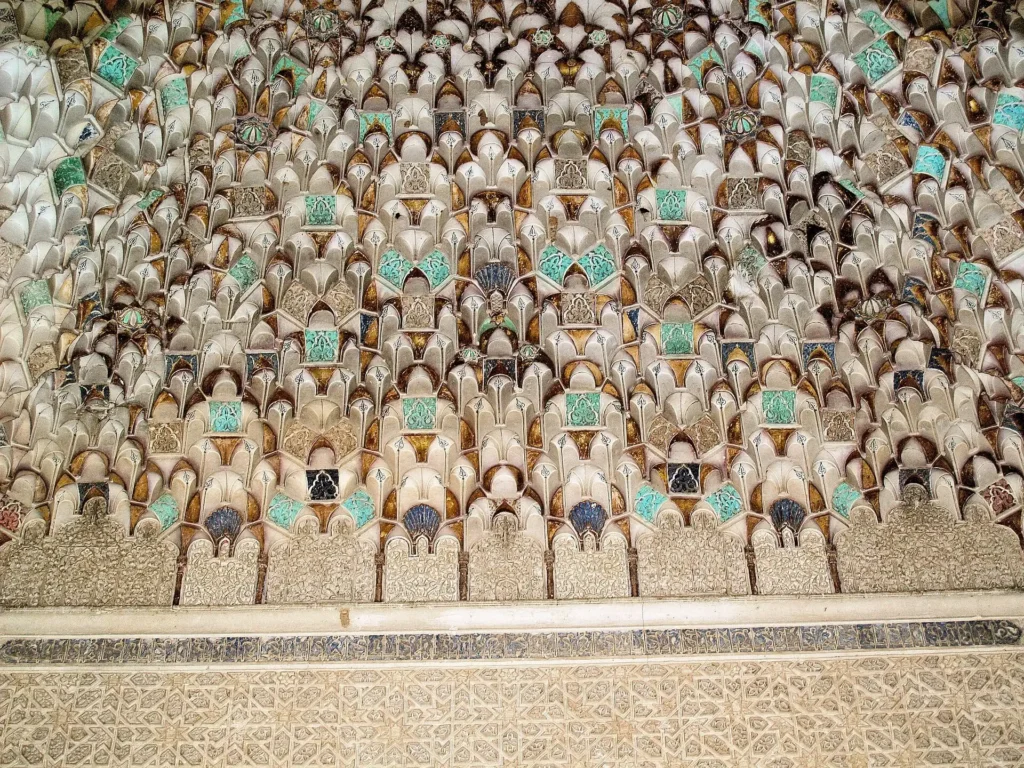
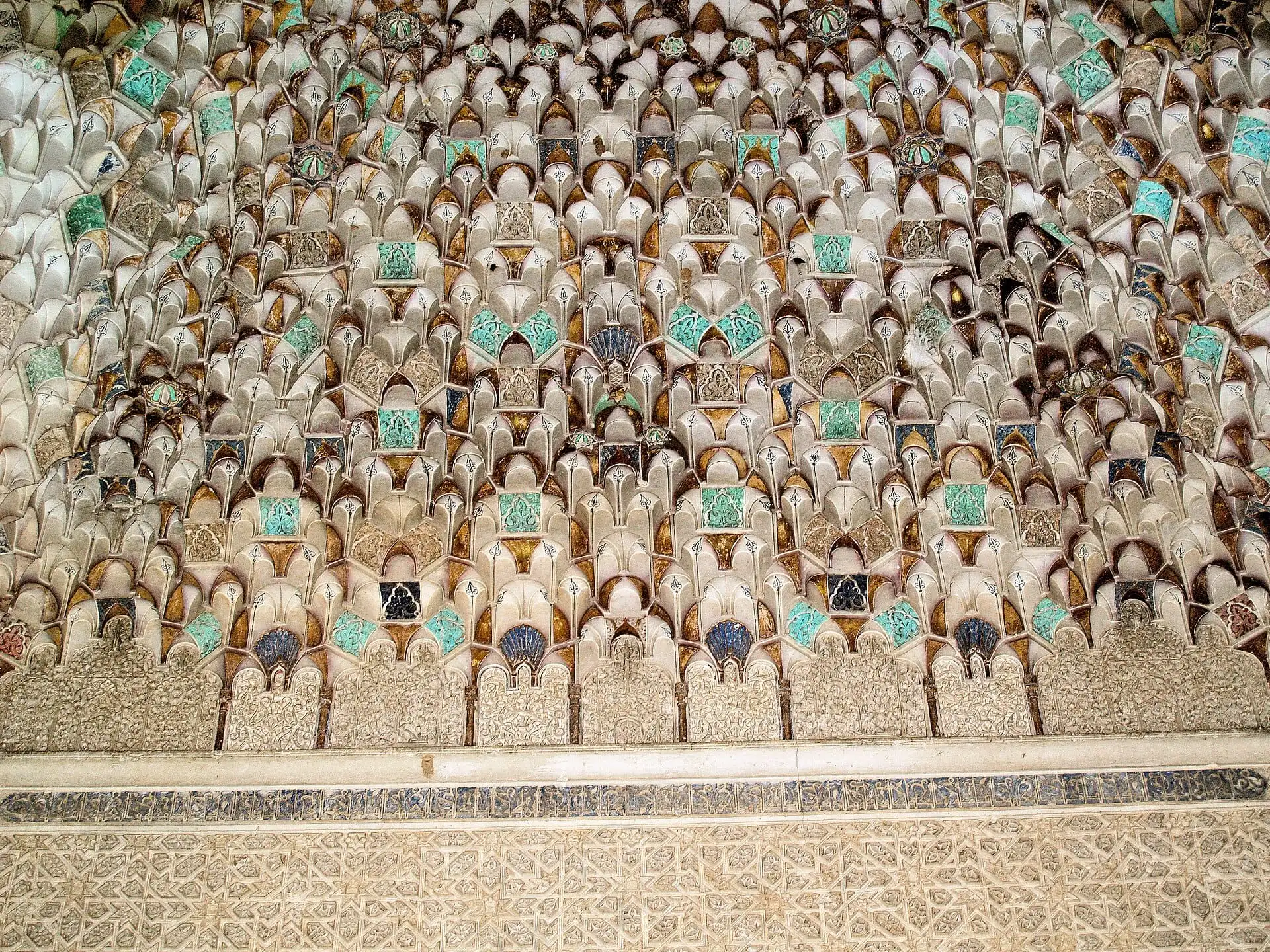
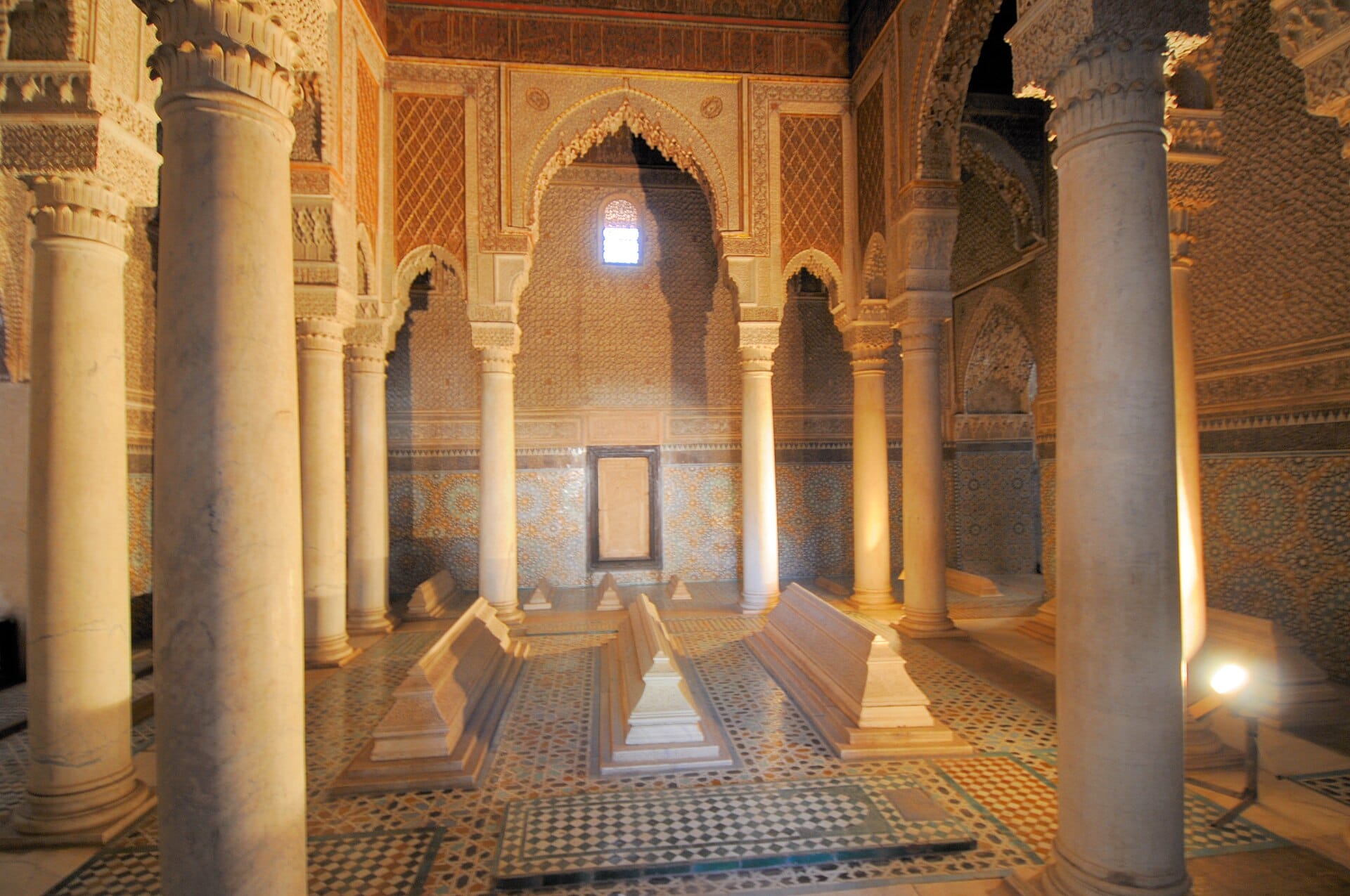
This is the most famous and most richly decorated room in the whole complex. At its centre it holds the tomb of Sultan Ahmad al-Mansur, surrounded by those of his sons and successors. Its name comes from the twelve columns of white Carrara marble that punctuate the space and support a majestic dome of carved cedar wood, decorated with star-shaped motifs. The walls are covered with brightly coloured zellige, finely chiselled stucco and calligraphic inscriptions drawn from the Quran.
The play of light filtering through the openings, the depth of the muqarnas — those honeycomb sculptures — and the whiteness of the marble create an atmosphere of striking solemnity. Since the restoration, access to the interior of this hall has been limited: visitors most often admire it from the thresholds and openings, which preserves the monument while offering a full view of its decoration. Take the time to observe the friezes of inscriptions running along the top of the walls: they combine Quranic verses, blessing formulas and praise of the dead, in calligraphy of remarkable virtuosity.
The Hall of the Mihrab
In the same western mausoleum, the Hall of the Mihrab takes its name from the prayer niche oriented towards Mecca that defines it. Originally designed as a prayer space (oratory), it features fine arcades, stucco decoration and columns that recall the architecture of mosques. This hall illustrates the close link, in the Muslim world, between funerary space and space of devotion.
The mausoleum of Lalla Messaouda and the hall of three niches
The second building, to the east of the garden, is the oldest mausoleum. It includes the chamber of Lalla Messaouda (Lalla Mas’uda), wife of Mohammed ash-Sheikh and mother of Ahmad al-Mansur, a highly respected figure of the dynasty. This hall, crowned by a fine muqarnas dome, connects to a large chamber with a carved wooden ceiling and to a room known as the “hall of three niches.” Here too rests Mohammed ash-Sheikh, founder of the Saadian line.
The garden and the zellige graves
Between the two mausoleums, a planted garden holds a multitude of graves laid directly on the ground, covered with colourful zellige. Most of these belong to soldiers, servants and members of the court who were not entitled to the covered halls reserved for princes. This contrast between the sumptuous mausoleums and the open-air graves, plain yet elegant, sums up the whole hierarchy of Saadian royal society.
This garden also plays a soothing role: in Islamic tradition, greenery and water evoke the paradise promised to the dead. Walking through it, one better understands the spiritual dimension of the place, conceived not as a mere cemetery but as a space of serenity where the memory of the dead lives on in the beauty of the decoration and the calm of nature.
Materials and craftsmanship
- Carrara marble: imported from Italy, it provides the most prestigious columns and gravestones.
- Zellige: a mosaic of glazed ceramic tiles cut by hand, forming geometric compositions.
- Chiselled stucco: plaster carved with arabesques, plant motifs and Quranic inscriptions.
- Cedar wood: used for domes, ceilings and doors, often carved with star-shaped motifs.
- Muqarnas: “honeycomb” vaults that give the ceilings their characteristic depth.
Who is buried in the Saadian Tombs?
The necropolis brings together several generations of the Saadian dynasty. Among the most notable figures resting here are:
- Ahmad al-Mansur (died 1603), the most powerful sultan of the dynasty, at the centre of the Hall of Twelve Columns.
- Mohammed ash-Sheikh, founder of the Saadian dynasty.
- Lalla Messaouda, wife of Mohammed ash-Sheikh and mother of Ahmad al-Mansur.
- Moulay Zidan, son and successor of Ahmad al-Mansur.
- Numerous princes, princesses and royal children, as well as wives of the court.
In all, there are around sixty marble graves in the covered halls, to which are added nearly a hundred zellige graves in the garden. After the fall of the Saadians, a few Alaouite figures were also buried here, so the site preserves the memory of more than a century of Moroccan royal history.
Practical information for visiting the Saadian Tombs
Where are the Saadian Tombs located?
The site sits on Rue de la Kasbah, in the southern part of the Marrakech medina, right next to the Kasbah Mosque (Moulay El Yazid). From Jemaa el-Fna square, allow about 15 minutes on foot, passing through the Bab Agnaou gate, one of the most beautiful historic gates in the city. You can also reach the district by petit taxi or by horse-drawn carriage.
Hours and prices (indicative)
The Saadian Tombs are open every day, generally from 9am to 5pm (the last admission is shortly before closing). During the month of Ramadan, the hours are reduced, often from 10am to 4pm. The entrance fee for foreign visitors is around 100 dirhams, with reductions for children, Moroccan citizens and foreign residents in Morocco. These hours and prices are given for guidance only and may change: always check the official information before your visit.
Tips for a great visit
- Arrive early: the site is small and very busy; coming right at opening avoids the long queues in front of the Hall of Twelve Columns.
- Allow 30 to 45 minutes: the visit is short but deserves that you take the time to observe the details.
- Combine with the district: the Kasbah holds other treasures such as the El Badi Palace and the Bab Agnaou gate, worth visiting the same day.
- Dress appropriately: the place is a necropolis; respectful attire is expected.
- A guide can enrich the visit: the story of the place is best when told, especially to understand the decoration and the figures.
What to see around the Saadian Tombs in Marrakech?
The great asset of the Saadian Tombs is their location, at the heart of a district rich in monuments. To plan your stay, rely on our reference guide Things to Do in Marrakech: the complete guide, which lists the city’s must-sees. A few steps from the Kasbah, don’t miss the Bahia Palace, a magnificent 19th-century residence with painted ceilings and flower-filled patios.
Heading back towards the centre of the medina, the silhouette of the Koutoubia Mosque and its Almohad minaret dominates the city: it is the emblematic landmark of Marrakech. If you have little time, our Marrakech in 3 Days itinerary helps you efficiently combine the Saadian Tombs, palaces and souks. Finally, to prepare your arrival or departure, see our practical guide to Marrakech Menara Airport (RAK).
The medina of Marrakech, within which the Saadian Tombs stand, is a UNESCO World Heritage site. You can consult the official UNESCO listing for the medina of Marrakech to better understand the exceptional value of this site.
Why are the Saadian Tombs worth the detour?
The Saadian Tombs are not the largest of Marrakech’s monuments, but they are among the most intense. Their story — that of a glorious dynasty, of two centuries of oblivion behind a wall, then of a spectacular rediscovery in 1917 — gives them a uniquely novelistic aura. Their decoration, where Carrara marble converses with zellige, stucco and cedar, embodies the peak of Hispano-Moorish art applied to funerary architecture.
Visiting the Saadian Tombs therefore means treating yourself to a vivid immersion in Marrakech’s golden age, meeting the sultans who made Morocco great. Despite their popularity and the crowds, they remain a place of memory of rare beauty, absolutely not to be missed during a stay in the ochre city. To delve deeper into the history of the site, the detailed article on Wikipedia devoted to the Saadian Tombs is an excellent additional resource.
Frequently asked questions (FAQ) about the Saadian Tombs
Who built the Saadian Tombs of Marrakech?
The necropolis was laid out by the Saadian dynasty in the 16th century. The first mausoleum is attributed to Sultan Abdallah al-Ghalib, while Sultan Ahmad al-Mansur had the western mausoleum and its famous Hall of Twelve Columns built late in his reign, where he rests.
Why were the Saadian Tombs forgotten?
In the 17th century, the Alaouite sultan Moulay Ismail had the entrances of the necropolis walled up rather than destroying it, out of religious respect for the graves. Cut off from the world, the site fell into oblivion for more than two centuries, until its rediscovery in 1917.
How were the Saadian Tombs rediscovered?
They were officially rediscovered in 1917, at the start of the French Protectorate, notably thanks to aerial photographs that revealed the hidden buildings. The Fine Arts Department restored them and cut through an access corridor to open them to the public.
How much does entry to the Saadian Tombs cost?
The indicative price for foreign visitors is around 100 dirhams, with reductions for children, Moroccan citizens and residents. As prices may change, it is advisable to check the official information before your visit.
What are the opening hours of the Saadian Tombs?
The site is generally open every day from 9am to 5pm, with a last admission shortly before closing. During Ramadan, the hours are reduced, often from 10am to 4pm. These hours remain indicative and may vary.
How long does it take to visit the Saadian Tombs?
Allow about 30 to 45 minutes to explore the necropolis and admire the main halls. As the site is small and very busy, the wait in front of the Hall of Twelve Columns can lengthen the visit: coming early in the morning is the best way to avoid it.
Photo credits
Images under free licence via Wikimedia Commons: © Miguel Hermoso Cuesta(retouched and slightly cropped by Robert Prazeres) (CC BY-SA 4.0); © Luc Viatour (CC BY-SA 3.0); © Viault (CC BY-SA 4.0). Sources: UNESCO and Wikipedia.
Disclaimer: this guide is independently published and is not affiliated with any official body managing the site. The hours, prices and access conditions are given purely for guidance and may change without notice; we invite you to check the official information before your visit.