The Ben Youssef Madrasa is the largest former Quranic college in Morocco and one of the most spectacular monuments in Marrakech. Founded in the 14th century by the Marinid sultan Abu al-Hasan, then entirely rebuilt in the 16th century by the Saadian sultan Abdallah al-Ghalib (completed in 1564-1565), it welcomed generations of students of theology and Islamic law. After nearly four years of painstaking restoration, the Ben Youssef Madrasa of Marrakech reopened to the public in April 2022. Today you can admire a sumptuous courtyard, a domed prayer hall, and more than 130 former student rooms decorated with zellige, carved stucco and cedar wood. Allow around 50 dirhams for entry (foreign visitors) and a visit of one hour to an hour and a half.
In brief: the essentials on the Ben Youssef Madrasa
- What is it? A former Quranic college (madrasa) from the 14th-16th century, the largest in Morocco.
- Where? In the medina, near Ben Youssef square and the Marrakech Museum, in the historic heart of the city.
- Hours: every day from 9:00am to 7:00pm (9:00am to 4:30pm during Ramadan).
- Indicative prices: around 50 MAD (foreign adults), 20 MAD (Moroccan adults), 10 MAD (children under 12), 30 MAD (groups of more than 20 people).
- Visit length: allow 1h to 1h30 to take everything in without rushing.
- Not to be missed: the great courtyard and its pool, the domed prayer hall, and the student rooms upstairs.
The Ben Youssef Madrasa is not just a monument to tick off a list: it is a genuine lesson in architecture, a distillation of the skill of Moroccan master craftsmen and a place charged with spirituality. In this complete guide, we take you to discover its eventful history, its dazzling decoration and all the practical tips to plan your visit. The madrasa is an integral part of the must-sees described in our complete guide to things to do in Marrakech.
What is a madrasa and why is the Ben Youssef Madrasa so famous?
The word “madrasa” (sometimes spelled medersa) refers, in the Muslim world, to an institution of higher learning. It is not merely a Quranic school where one learns to recite the Quran, but a true college where theology, Islamic law (fiqh), Arabic grammar, logic, mathematics and astronomy were studied. The madrasa combined two functions: a place of teaching and a boarding house where students lodged, coming from all over Morocco, and sometimes from much farther afield, to follow the teaching of the city’s masters.
The Ben Youssef Madrasa holds a special place: with an area of several thousand square metres and a capacity that, according to some sources, could reach up to 900 students, it was the largest establishment of its kind in Morocco. It takes its name from the neighbouring mosque, known as the Ben Youssef Mosque, itself named in tribute to the Almoravid sultan Ali Ben Youssef, who reigned in the 12th century and to whom Marrakech owes much of its development. The madrasa and the mosque form, together with the nearby Almoravid Koubba, one of the densest historic ensembles in the medina.
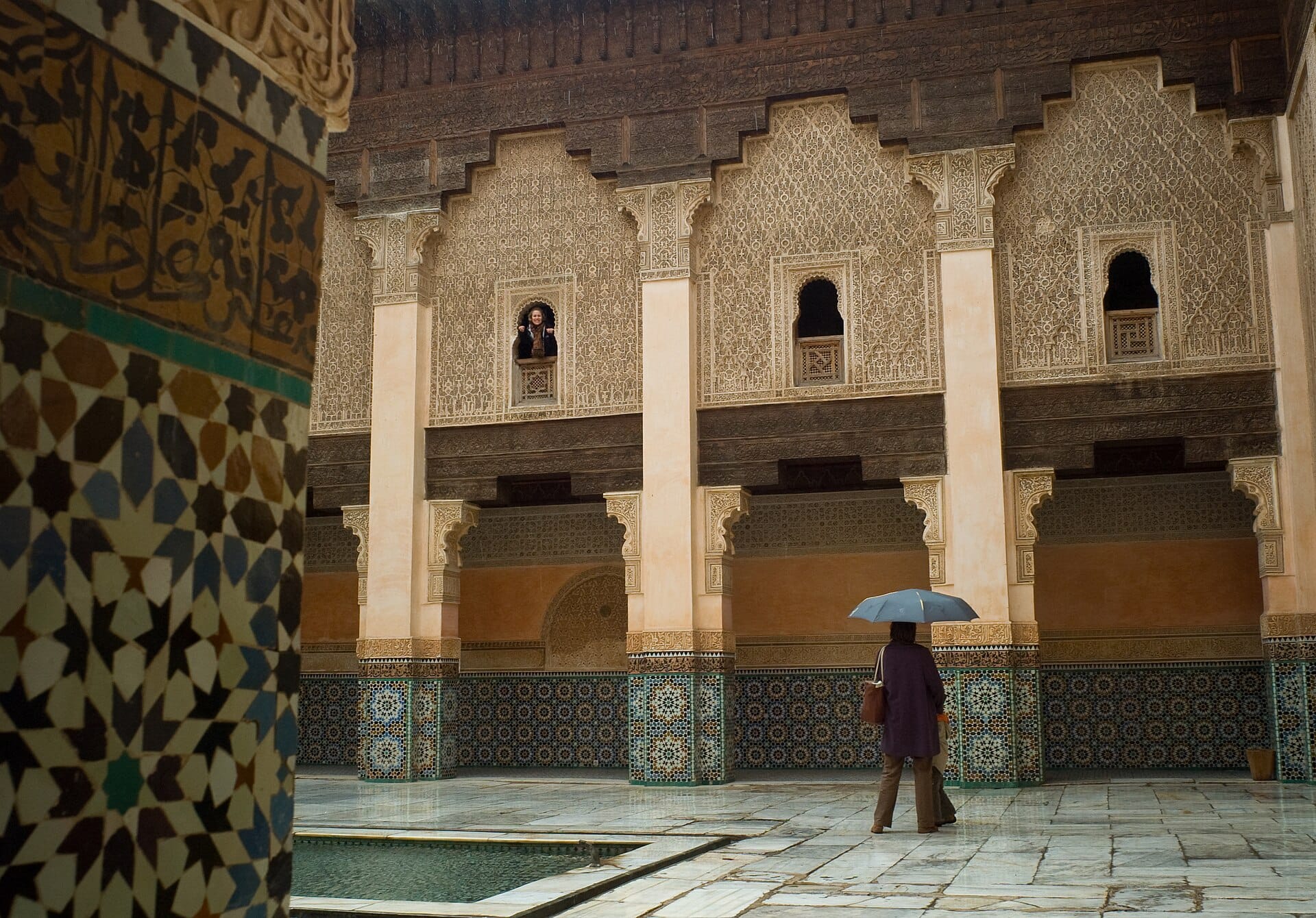
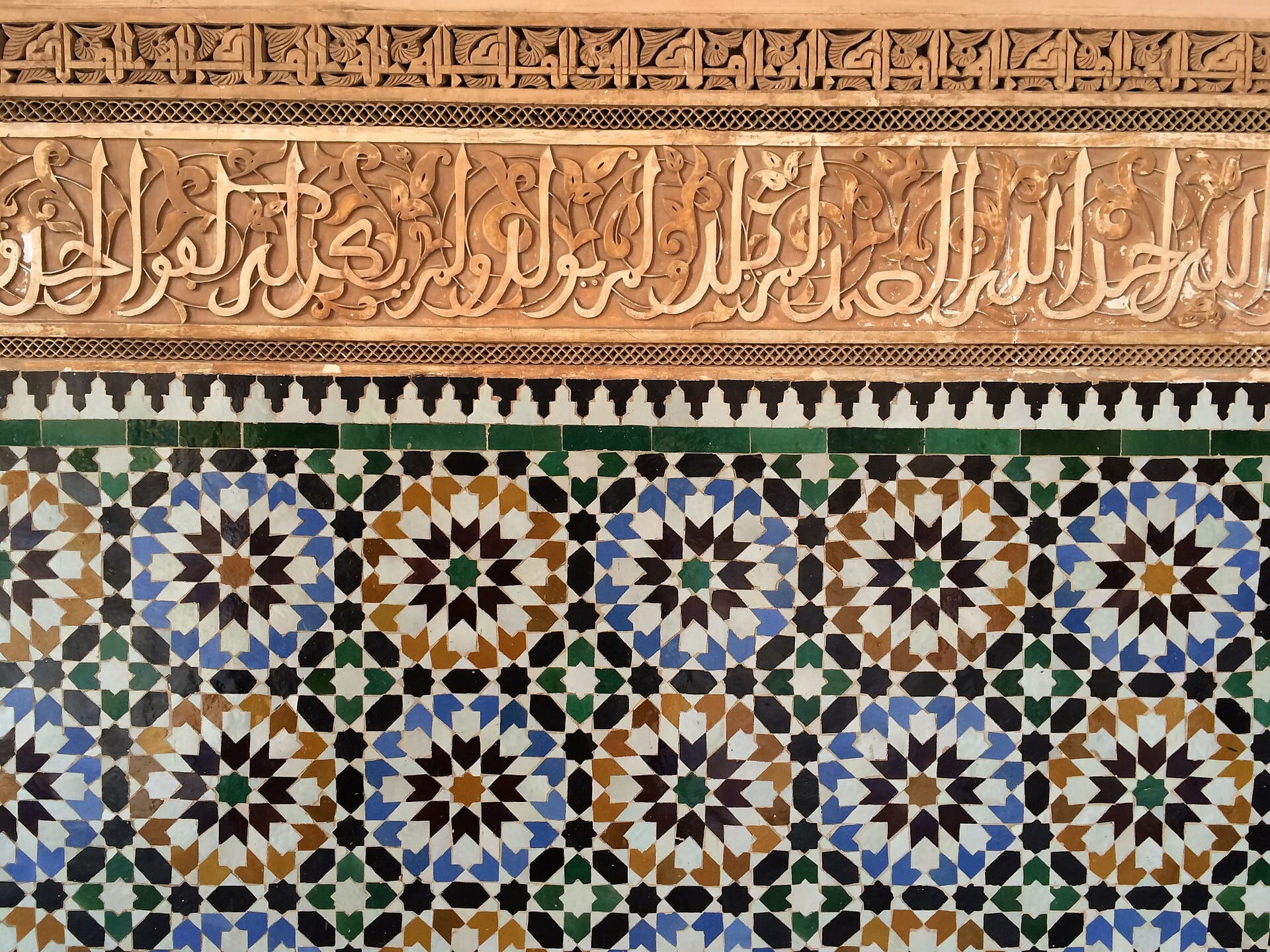
What makes the monument so famous is the absolutely extraordinary richness of its decoration. Almost every square centimetre is worked: the walls are covered with zellige in endless geometric patterns, the carved stucco forms lacework of plaster, the cedar wood is chiselled with calligraphy and arabesques, and marble clads the floors and columns. The Ben Youssef Madrasa is thus regarded as one of the pinnacles of Hispano-Moorish art and an absolute masterpiece of Moroccan craftsmanship.
The history of the Ben Youssef Madrasa: from the 14th century to the 2022 restoration
A Marinid foundation in the 14th century
The origins of the madrasa go back to the 14th century. It was the Marinid sultan Abu al-Hasan ibn Uthman, often nicknamed the “Black Sultan,” who had a first college built on this spot around 1350. The Marinids, the dynasty then ruling Morocco from Fez, were great builders of madrasas: to them we owe the finest madrasas of Fez, such as the Bou Inania Madrasa or the al-Attarine Madrasa. Building a college of importance in Marrakech was part of this policy of spreading knowledge and royal authority.
The Saadian rebuilding by Abdallah al-Ghalib (1564-1565)
The madrasa we visit today, however, is not the original Marinid building. In the 16th century, the Saadian dynasty seized power and made Marrakech its prestigious capital. The Saadian sultan Abdallah al-Ghalib then decided to rebuild the madrasa entirely in a style of unprecedented sumptuousness. The work was completed in 1564-1565, that is, the year 972 of the Hegira. An inscription carved in the madrasa itself preserves the memory of this date, through a poetic formula evoking the years elapsed since the Hegira.
It is this Saadian rebuilding that gives the monument its present face: a vast square plan arranged around a central courtyard, a richly decorated prayer hall, and a network of small inner courtyards serving the student rooms. The Saadians brought in noble materials, such as Carrara marble imported from Italy, and mobilised the finest craftsmen to cover every surface with decoration.
Four centuries of teaching, then silence
For more than four centuries, the Ben Youssef Madrasa remained a living centre of learning. The students, called tolba, lodged in the small rooms spread over two levels, studied in the galleries and prayed in the prayer hall. The madrasa functioned like a small city within the city, with its rules, its rhythms of prayer and study, and its atmosphere of studious contemplation. It was only in the 20th century, in the 1960s, that teaching ceased for good, the establishment no longer being able to meet the demands of modern education.
The monument was, however, recognised very early for its heritage value: it was listed as a national historic monument as early as 1916. Later, in 1985, it was inscribed, together with the whole medina of Marrakech, as a UNESCO World Heritage Site. You can consult the official listing of the medina of Marrakech on the UNESCO website to understand the context of this international recognition.
The great restoration and the 2022 reopening
After decades of wear and intense tourist traffic, the madrasa was in great need of repair. Following a royal visit to the old medina in January 2017, a vast programme of restoration and rehabilitation was launched under the aegis of the Ministry of Habous and Islamic Affairs. With an overall cost of around 61 million dirhams, this programme aimed to preserve the historic heritage of the old city.
The restoration, carried out over nearly four years, sought to scrupulously respect the traditional techniques of Moroccan craftsmanship: hand-cutting of zellige, sculpting of stucco, working of cedar wood according to age-old methods. The aim was not to make everything anew, but to consolidate, clean and faithfully restore the original decoration. The Ben Youssef Madrasa reopened to the public in April 2022, offering visitors a monument as if regenerated, its colours and reliefs regaining all their brilliance.
Architecture and decoration: an immersion in Moroccan art
The strength of the Ben Youssef Madrasa lies in the coherence of its architecture and the infinite richness of its decoration. Let us discover together the spaces you will pass through in the course of the visit.
The great central courtyard and its pool
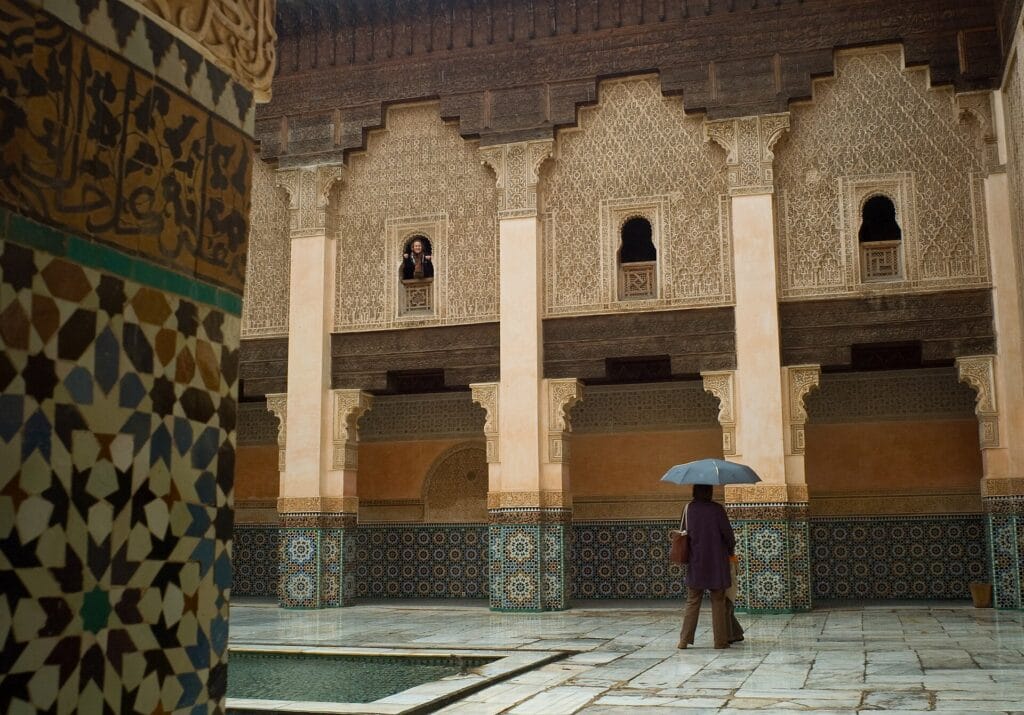
The heart of the madrasa is its vast open-air courtyard, paved with marble, at the centre of which stretches a rectangular pool. This pool served for ritual ablutions, but it also plays a major aesthetic role: it reflects the decorated façades and the changing light of the Marrakech sky, creating a striking mirror effect. Around the courtyard, the walls stack decorative registers: a base of zellige with geometric patterns, a wide band of openwork carved stucco, then a crowning of finely worked cedar wood. It is here that the most famous photographs of the monument are taken.
The prayer hall and its dome
Beyond the courtyard lies the prayer hall, one of the most refined spaces in the madrasa. It is arranged in three naves separated by columns of pink marble that support arches. Above, a central dome is pierced with small windows that let in a soft, filtered light. The far wall holds the mihrab, the niche that indicates the direction of Mecca, itself framed by stucco decoration and Quranic inscriptions of great finesse. The atmosphere here is one of silence and contemplation.
The student rooms: more than 130 cells
This is perhaps the most moving part of the visit. The madrasa has more than 130 student rooms, spread over two levels and served by several small inner courtyards that bring light and air to the cells. These rooms, often tiny, housed the tolba during their years of study. Climbing to the upper floor by the narrow staircases, you discover these alcoves of wood and plaster, some of which open onto delicate mashrabiya windows overlooking the great courtyard. It is easy to imagine the daily life, made of study, prayer and frugality, that animated these places.
Zellige, stucco and cedar: the trio of Moroccan craftsmanship
To fully appreciate the madrasa, you need to know how to recognise its three great decorative materials, each the fruit of a specialised craft:
- Zellige: these mosaics of glazed terracotta tiles, cut by hand and assembled into complex geometric patterns, line the lower parts of the walls and the floor. The combinations of shapes and colours are endless and follow a sophisticated geometry.
- Carved stucco (gebs): the plaster is worked directly on the wall, while still fresh, by craftsmen who carve arabesques, floral motifs and calligraphic inscriptions into it. The result evokes true lacework of plaster.
- Cedar wood: from the forests of the Middle Atlas, it crowns the walls, forms the lintels, the canopies and the mashrabiyas. It is carved and sometimes painted with geometric motifs and calligraphy.
- Marble: used for the paving, the columns and the surround of the pool, it includes notably Carrara marble imported from Italy, a sign of the wealth of the Saadian patrons.
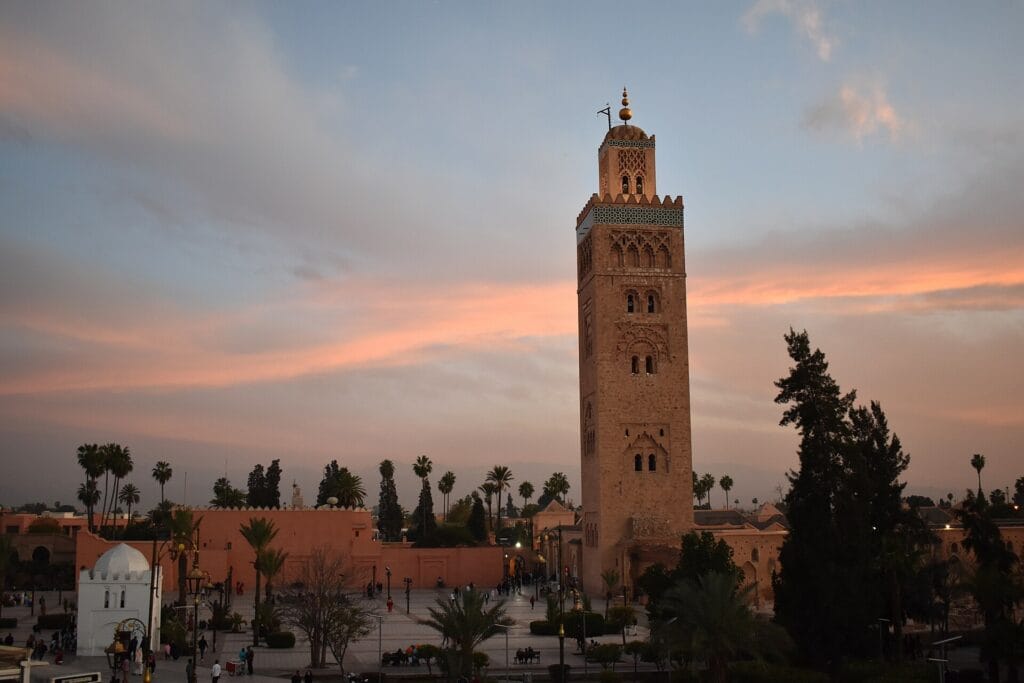
One detail strikes attentive visitors: the decoration never includes any human or animal representation, in keeping with the tradition of Islamic art. All the beauty rests on geometry, the stylised plant motif and calligraphy, which turn writing itself into art. To continue this discovery of Moroccan art, don’t miss the Koutoubia Mosque of Marrakech and its emblematic minaret, another masterpiece of the city.
Visiting the Ben Youssef Madrasa: hours, prices and tickets
Here is all the practical information to plan your visit. Note that the hours and prices are given for guidance and may change; it is wise to check the up-to-date information before setting out.
Opening hours
The madrasa is open every day of the week, from 9:00am to 7:00pm in normal times. During the month of Ramadan, the hours are reduced: it opens from 9:00am to 4:30pm. There is in principle no weekly closing day, but the hours may be adjusted on certain religious holidays.
Entry prices (indicative)
- Foreign adult visitors: around 50 MAD.
- Moroccan adult visitors: around 20 MAD (on presentation of an ID).
- Children under 12: around 10 MAD.
- Groups of more than 20 people: around 30 MAD per person.
Tickets are generally bought on site, at the entrance to the monument. An online ticketing system exists but may be temporarily unavailable; enquire in advance if you wish to book. Bring cash or a card depending on the payment methods accepted on the day of your visit.
How much time to allow?
A complete, unhurried visit takes between one hour and an hour and a half. If you love photography or architecture, you could easily spend more time there, notably to enjoy the light and avoid the groups. The madrasa is not huge, but the density of detail invites you to slow your pace and look up: every ceiling, every lintel holds a surprise.
How to get to the Ben Youssef Madrasa?
The madrasa lies in the heart of the Marrakech medina, in the Ben Youssef district, a few minutes’ walk from the famous Jemaa el-Fna square. The monument is next to the Marrakech Museum and the Almoravid Koubba, which makes it easy to group several visits into the same morning. As everywhere in the medina, access is on foot: the alleys are narrow and often pedestrian, and it is pointless to try to move around by car.
From Jemaa el-Fna square, allow about fifteen minutes on foot through the souks. It is very easy to get lost in the maze of alleys, but that is also the whole charm of the medina; don’t hesitate to ask your way or to follow the signs indicating the main monuments. If you are arriving from the airport, see our guide to Marrakech Menara Airport (RAK) to organise your transfer to the city centre in the best conditions.
Practical tips for a successful visit
- Come early in the morning: at opening, around 9am, the light is soft and the crowds still moderate. It is the best time to photograph the courtyard without the crowd.
- Take your time upstairs: many visitors settle for the central courtyard and forget to go up to see the student rooms, which nonetheless offer superb views looking down.
- Dress respectfully: even though the madrasa is no longer an active place of worship, it is a monument with a strong spiritual dimension. Attire covering the shoulders and knees is appreciated.
- Combine your visits: take advantage of the proximity of the Marrakech Museum and the Almoravid Koubba to discover the whole district in half a day.
- Bring water: Marrakech can be very hot, especially from May to September. A water bottle and a hat are welcome.
- Respect the silence: the charm of the place owes much to its peaceful atmosphere. Avoid speaking loudly and let everyone enjoy the serenity of the place.
Fitting the Ben Youssef Madrasa into your stay in Marrakech
The Ben Youssef Madrasa pairs perfectly with other jewels of the medina. A few alleys away, the Bahia Palace in Marrakech offers another facet of Moroccan art, later and more palatial, with its gardens, its painted ceilings and its courtyards. In a single day, it is quite possible to combine the madrasa, the Bahia Palace and a stroll through the souks, before finishing with a sunset over Jemaa el-Fna square.
If you have little time, note that the madrasa features prominently in our itinerary to visit Marrakech in 3 days. It fits naturally into a morning devoted to the historic medina, to combine afterwards with the Majorelle Garden, the Secret Garden or an escape into the palm grove. The madrasa is a cultural must-see that gives historical depth to any Marrakech stay.
Finally, keep in mind that Marrakech is not only its monuments: it is also an atmosphere, a light, the scents of spices and an art of living. The Ben Youssef Madrasa is one of its most beautiful witnesses, a place where history, spirituality and art come together in perfect harmony.
Frequently asked questions about the Ben Youssef Madrasa
Is the Ben Youssef Madrasa open to visitors at the moment?
Yes. After a major restoration, the madrasa reopened to the public in April 2022. It can be visited every day, generally from 9:00am to 7:00pm, with reduced hours during Ramadan (9:00am to 4:30pm). Check the up-to-date hours before your visit, as they may vary on public holidays.
What is the entry price for the Ben Youssef Madrasa in Marrakech?
The indicative price is around 50 dirhams for an adult foreign visitor. Moroccan visitors benefit from a reduced rate of around 20 dirhams on presentation of an ID, children under 12 pay around 10 dirhams, and groups of more than 20 people benefit from a rate of around 30 dirhams per person. These prices may change.
How long does it take to visit the madrasa?
Allow on average one hour to an hour and a half for a complete visit. Lovers of photography or architecture can easily spend more time there, notably to enjoy the morning light and quietly explore the student rooms upstairs.
Who built the Ben Youssef Madrasa?
The madrasa was founded in the 14th century by the Marinid sultan Abu al-Hasan, then entirely rebuilt in the 16th century by the Saadian sultan Abdallah al-Ghalib, with the work completed in 1564-1565. It owes its name to the neighbouring mosque, itself named in tribute to the Almoravid sultan Ali Ben Youssef.
How many rooms does the Ben Youssef Madrasa have?
The madrasa has more than 130 student rooms, spread over two levels and organised around several small inner courtyards. According to some sources, the establishment could accommodate up to 900 students, which made it the largest Quranic college in Morocco.
Is the Ben Youssef Madrasa a World Heritage Site?
The madrasa has been listed as a national historic monument since 1916. It is also part of the medina of Marrakech, inscribed as a UNESCO World Heritage Site since 1985. It therefore enjoys a double recognition, national and international, of its exceptional heritage value.
Photo credits
Images under free licence via Wikimedia Commons: © Lars Plougmann from United States (CC BY-SA 2.0); © Elena Tatiana Chis (CC BY-SA 4.0). Sources: UNESCO and Wikipedia.The images used in this article come from royalty-free image banks (such as Unsplash, Pexels, Wikimedia Commons) and are credited to their respective authors. Disclaimer: the photographs are shown for illustrative purposes. The hours, prices and practical information mentioned are given for guidance and may change; we invite you to check these details with the official sources before your visit.
Sources: Ben Youssef Madrasa — Wikipedia and Medina of Marrakech — UNESCO.