The Marrakech Museum, housed in the sumptuous Dar Menebhi Palace at the heart of the medina, is one of the most accessible and photogenic cultural visits in the Red City. In under an hour, you discover both a masterpiece of early 20th-century Hispano-Moorish architecture and rich collections of traditional and contemporary Moroccan art. Set on Ben Youssef Square, right next to the famous madrasa and the Almoravid Koubba, it forms with them an ideal ensemble to explore in a single morning. Here is everything you need to know to plan your visit: history, architecture, collections, opening hours, indicative prices and practical tips.
In brief: the essentials on the Marrakech Museum
- A palace turned museum: the Dar Menebhi, built around 1900, opened to the public as a museum in 1997.
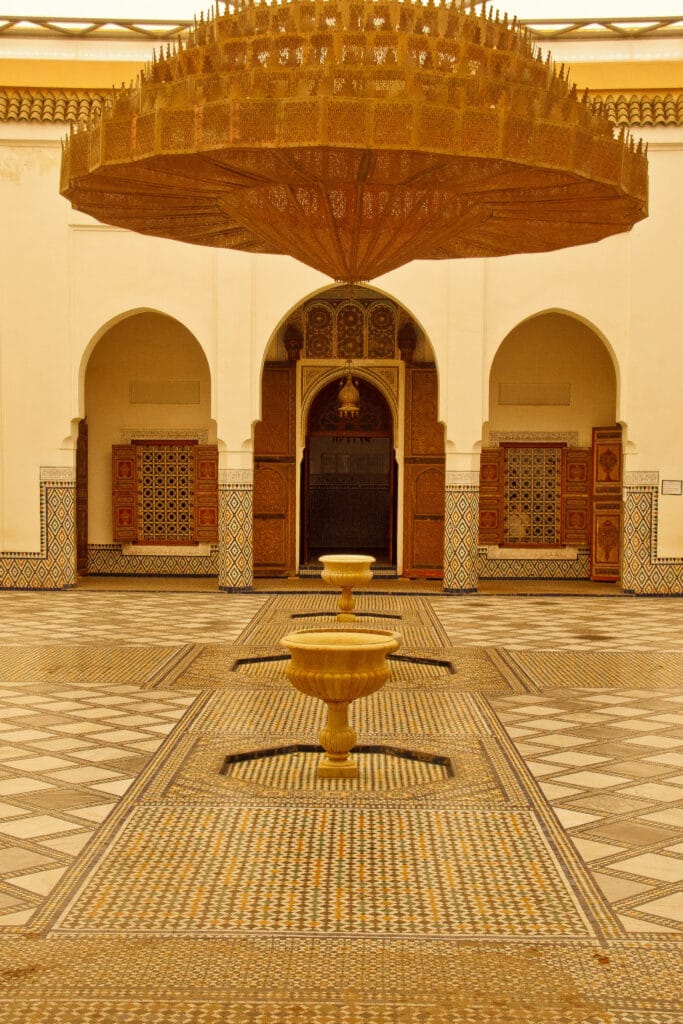
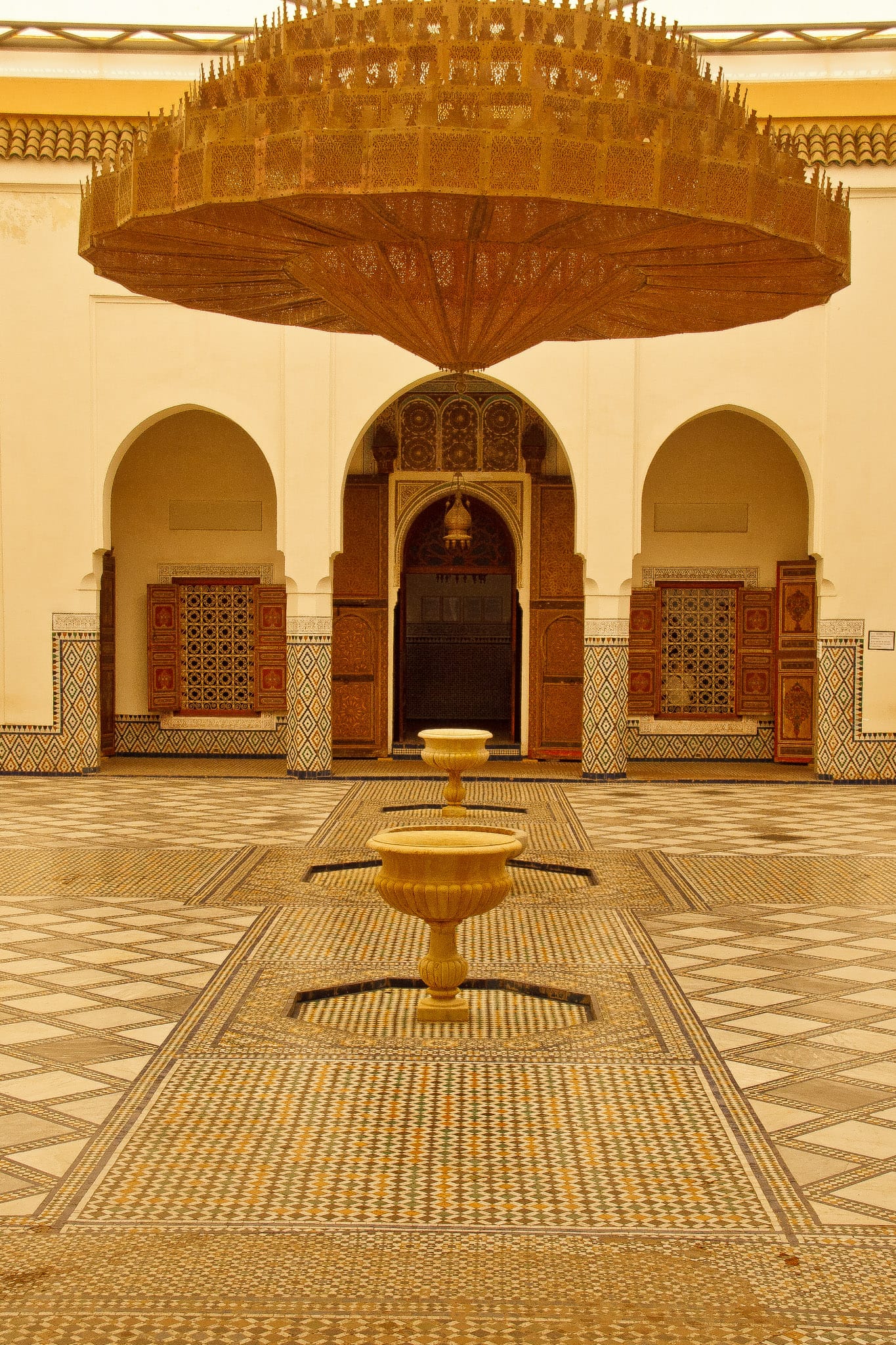
- A spectacular courtyard covered by a vast glass roof and adorned with a monumental chandelier of chased metal.
- Collections of Moroccan art: contemporary art, calligraphy, ceramics, jewellery, weapons, textiles, coins and Judaica.
- An ideal location: Ben Youssef Square, in the medina, next to the Ben Youssef Madrasa and the Almoravid Koubba.
- A short visit: allow roughly 45 minutes to 1 hour.
- An affordable indicative entrance fee, with the option of a combined ticket (museum + madrasa + Koubba).
The history of the Dar Menebhi Palace and Mehdi Menebhi
Before it became a museum, the site was first a prestigious residence. The Dar Menebhi Palace was built at the very start of the 20th century, around 1900, for Mehdi Menebhi, one of the most influential figures in the Morocco of his day. Minister of Defence and later grand vizier to Sultan Moulay Abdelaziz, Menebhi was a man of power and diplomacy, in contact with the European powers at a moment when Morocco was entering a period of profound political change.
As was customary for great dignitaries, Mehdi Menebhi had a residence built to match his rank. The palace was designed according to the canons of traditional Moroccan architecture: an organisation around a vast central courtyard, richly decorated reception halls, a private hammam and a kitchen, the whole conceived to welcome distinguished guests and delegations. This refinement bears witness to the know-how of the Marrakech maâlems (master craftsmen), enlisted to carve the plaster, cut the zellige and paint the cedar.
The historical context gives this palace all its importance. At the turn of the 19th and 20th centuries, the Morocco of Sultan Moulay Abdelaziz was coveted by the European powers and shot through with internal tensions. Mehdi Menebhi, the sultan’s trusted man, played a leading diplomatic role, took part in missions abroad and mingled with the representatives of the great nations. His Marrakech residence reflected this status: it was not merely a place to live, but an instrument of representation, where guests were received, where negotiations took place and where the owner’s power was displayed.
Over the course of the 20th century, the residence went through several uses and changed hands, like many palaces in the medina. For a time it served as a public building, which contributed to the deterioration of some of its original décor. It is this heritage, precious but weakened, that was to be saved a few decades later thanks to a vast restoration campaign. The story of the Dar Menebhi thus illustrates the fate of many Marrakech palaces: built for the glory of a dignitary, they crossed the eras by adapting, until the luckiest among them found a second, cultural life open to the public.
From palace to museum: the restoration of the Dar Menebhi
The palace’s revival is the work of the Omar Benjelloun Foundation, named after the Moroccan patron and collector who set out to restore this heritage to the city. After a careful restoration, respectful of the original techniques and materials, the Marrakech Museum Dar Menebhi opened its doors to the public in 1997.
This project had a twofold aim: to restore the palace to its former splendour and to give it a new cultural purpose. The craftsmen restored the zellige, consolidated the carved stuccowork, revived the painted cedar ceilings and reworked the former service rooms to house artworks. The great inner courtyard, once open to the sky, was covered with a glass roof allowing the collections to be displayed and protected while preserving the natural light so characteristic of Moroccan architecture.
This approach is part of a wider movement to enhance the built heritage of the medina, where several palaces and riads have been rescued from neglect and converted into museums, guesthouses or cultural venues. By opening the Dar Menebhi to the public, the foundation not only preserved a monument but also made accessible to all an art of building long reserved for the elites.
The result is a place where the setting matters as much as what it holds: visitors admire the artworks, but also the walls, ceilings and floors surrounding them. This dual reading is what makes the museum so singular and explains why it ranks among the must-sees of the medina, listed as a UNESCO World Heritage Site.
The architecture: courtyard, glass roof, zellige and painted cedar
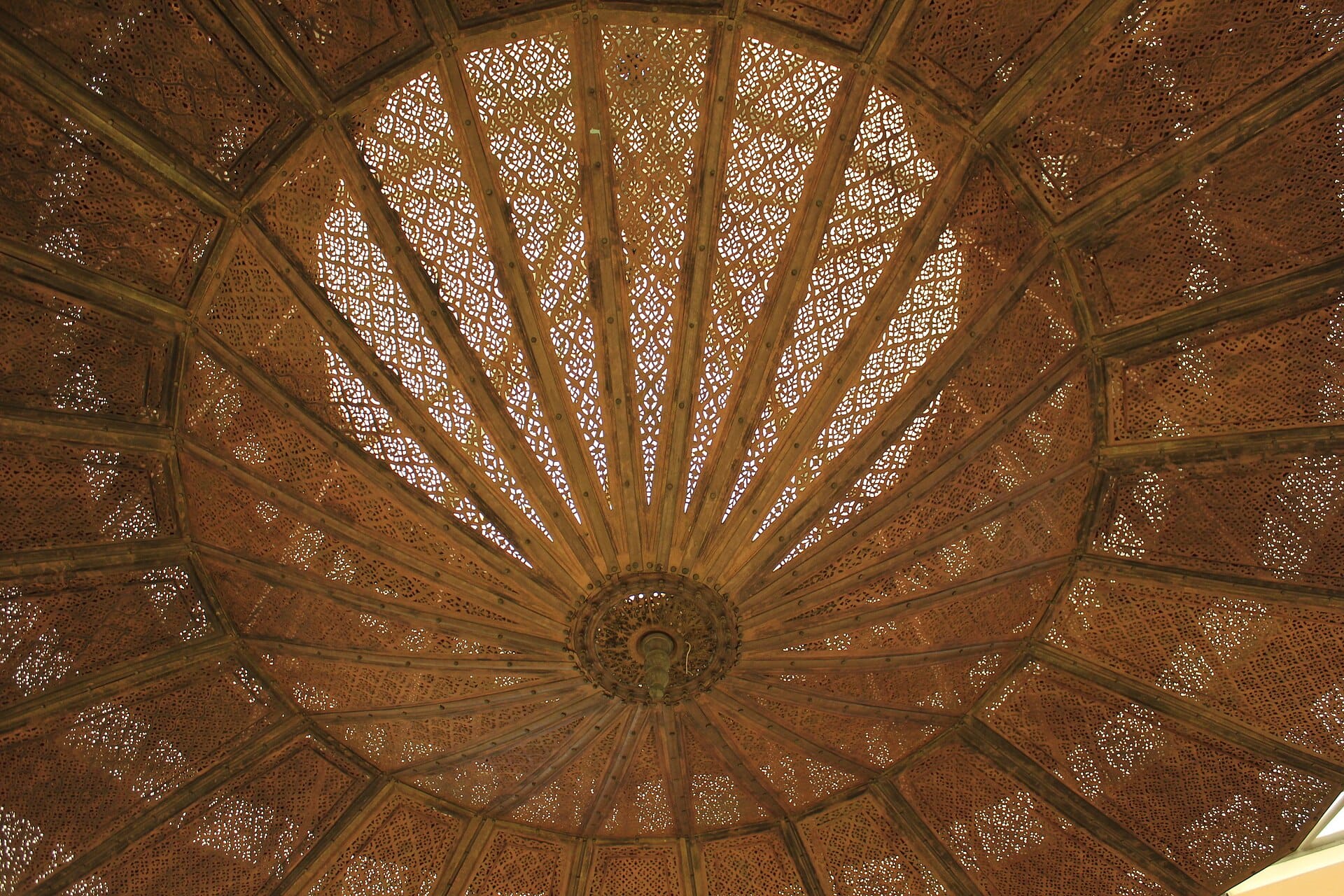
The heart of the Marrakech Museum is without question its grand central courtyard. This space, once an open-air court, is today covered by a vast glass roof that floods the hall with soft, shifting light. At its centre, a monumental chandelier of chased metal immediately draws the eye: a true piece of metalwork, it has become the museum’s emblem and one of the most photographed subjects in the medina.
All around, the ornamentation unfolds the classic vocabulary of Hispano-Moorish art:
- Zellige: these mosaics of glazed earthenware, with their endless geometric patterns, clothe the lower walls and part of the floors, in a palette dominated by green, blue, ochre and white.
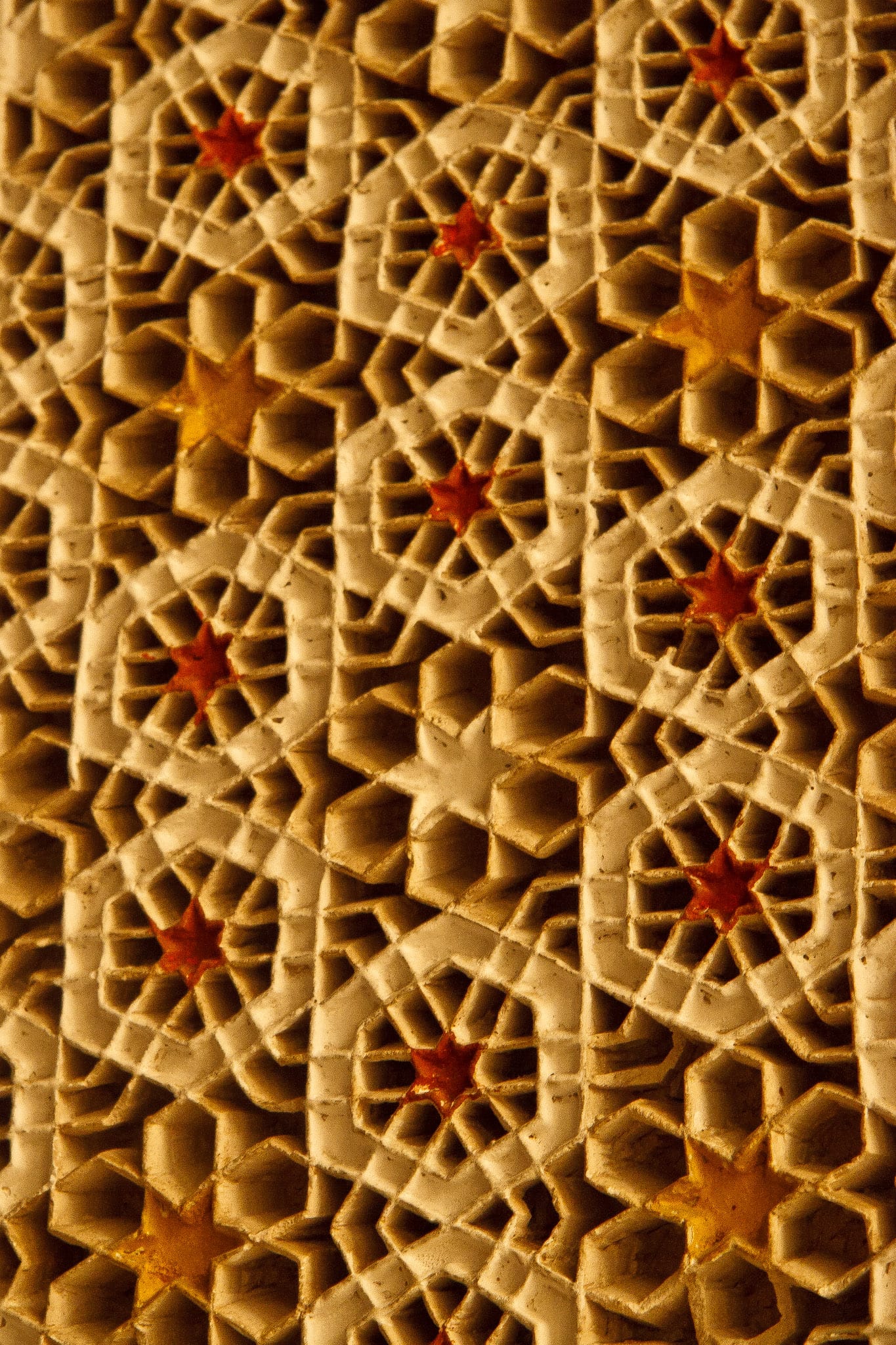
- Carved stucco (gebs): the upper walls are chiselled with lace-like plaster, plant arabesques and calligraphic inscriptions, all carved by hand.
- Painted cedar wood (zouaq): the ceilings and some doors display meticulous polychrome décor, an art typical of the great Moroccan residences.
These three techniques — zellige, gebs and zouaq — together form the signature of Moroccan decorative art. They are never placed at random: each register has its own height and function. The zellige protects the base of the walls from wear and damp, the stucco dresses the middle zone with a mineral lacework, and the painted wood crowns the whole at ceiling level. This ascending hierarchy naturally draws the eye upward and creates that enveloping feeling characteristic of the great residences of the medina.
The visit also lets you discover the original domestic spaces, notably the former hammam and the douiria (the palace’s outbuildings and kitchen). These more intimate rooms offer a striking contrast with the majesty of the courtyard and give an insight into daily life in a great Marrakech household of the early 20th century. The hammam, with its succession of hot and warm rooms, recalls the importance of bathing in Moroccan culture, at once a hygienic ritual and a moment of sociability. The douiria, for its part, evokes the intense activity that went on behind the scenes to keep a household of this rank running.
The permanent collections of the Marrakech Museum
The museum presents a panorama of Moroccan art that blends periods and registers. You will find contemporary works, traditional creations and heritage objects side by side, displayed in the central courtyard and in the side rooms arranged within the palace’s former chambers.
Among the major groupings visitors can discover:
- Calligraphy and the arts of the book, where Arabic script becomes an art in its own right.
- Ceramics, with the celebrated productions of Fez (blue and white) and Safi.
- Jewellery, both Berber and urban, in silver, coral and enamel.
- Antique weapons and ceremonial pieces, testaments to the craft of metalwork.
- Textiles and costumes, carpets and embroidery with regional motifs.
- Coins of old, tracing the country’s economic history.
- Judaica, which recalls the historic place of the Moroccan Jewish community and the richness of a shared heritage.
Presenting works within a historic setting profoundly changes the experience. Unlike a museum of white, neutral rooms, here each object converses with the architecture surrounding it: a Fez ceramic set near a zellige wall, a piece of calligraphy beneath a painted cedar ceiling. This staging, where the container echoes the contents, makes the visit especially immersive and helps you grasp the aesthetic coherence of Moroccan art, in which the beautiful and the useful are so often one and the same.
This diversity makes the museum an excellent gateway to understanding Moroccan material culture before plunging into the bustle of the Marrakech souks, where many of these crafts are still very much alive. Having admired antique jewellery or collector’s carpets at the museum, you will more easily spot, in the artisans’ stalls, the gestures and motifs inherited from these age-old traditions.
Temporary exhibitions
Beyond its permanent collections, the Marrakech Museum regularly hosts temporary exhibitions. These shows, often devoted to contemporary Moroccan and Mediterranean art, bring a breath of fresh air and give even those who have already visited the palace a reason to return. Painting, photography, graphic arts or installations: the programme varies throughout the year.
The dialogue between the historic setting and contemporary works often produces striking effects. A modern installation placed beneath the courtyard’s glass roof, or a photographic series hung in a room of century-old stuccowork, creates a fertile tension between the eras. This is one of the reasons the museum appeals to such a varied audience, from lovers of traditional heritage to those curious about today’s art.
These exhibitions place the museum within Marrakech’s living art scene, alongside the city’s other cultural institutions. They are a reminder that the Dar Menebhi is not only a place of memory but also a space of creation and of dialogue between heritage and modernity. Ask at the entrance or on site to find out about the current exhibition.
Combined ticket: museum, Ben Youssef Madrasa and Almoravid Koubba
One of the museum’s great assets is its immediate proximity to two other major monuments of the medina. On the same Ben Youssef Square, you can string together three complementary visits within a few steps:
- The Ben Youssef Madrasa, a former Quranic school and an absolute jewel of Moroccan Islamic art.
- The Almoravid Koubba (Koubba Ba’adiyn), a small 12th-century structure and a rare vestige of Almoravid architecture in Marrakech.
- The Marrakech Museum Dar Menebhi itself, with its collections and its courtyard.
A combined ticket is generally offered to visit several of these sites at an advantageous price. It is a practical option if you wish to concentrate your heritage discovery around Ben Youssef Square. As terms and prices may change, check the exact conditions of the combined ticket directly at the ticket desks on site.
Opening hours, prices and access within the medina
The Marrakech Museum is open every day, which makes it a safe bet whatever the length of your stay. The entrance fee remains affordable and reaching it on foot from the medina’s main points is simple. Here is a summary of the practical information, to be treated as indicative and confirmed on site.
| Information | Detail (indicative) |
|---|---|
| Address | Ben Youssef Square, Marrakech medina |
| Opening days | Every day |
| Hours | Daytime, continuous (to be checked on site) |
| Length of visit | About 45 min to 1 hr |
| Entrance fee | Affordable; combined ticket possible with the madrasa and the Koubba |
| Immediate neighbours | Ben Youssef Madrasa, Almoravid Koubba |
| Landmarks | About 10-15 min on foot from Jemaa el-Fna square |
To reach the museum, the simplest route is to set off from Jemaa el-Fna square and head north through the medina, towards the Ben Youssef quarter. As the alleys are labyrinthine, don’t hesitate to follow the signposts or use a navigation app; Ben Youssef Square is well signposted once you draw near.
Since the quarter cannot be reached by car right up to the museum’s door, plan to finish the journey on foot. If you arrive by taxi or horse-drawn carriage, the driver will drop you at the nearest of the medina’s gates, from where a few minutes’ walk is enough. This final stretch on foot, through the lively alleys, is part of the experience and puts you in the mood before you even cross the palace’s threshold.
What to see around Ben Youssef Square
The museum’s appeal also lies in its quarter. The Ben Youssef district is one of the richest in heritage in the whole medina and lends itself perfectly to a half-day of discovery on foot. After the museum, you can extend the stroll:
- Move on to the Ben Youssef Madrasa, a few metres away, for its courtyard and breathtaking décor.
- Take in the Almoravid Koubba, discreet but historically essential.
- Lose yourself in the neighbouring souks, amid metalwork, leather, carpets and spices.
- Head back down towards Jemaa el-Fna for a mint tea break.
This play of comparisons is, in fact, one of the pleasures of a stay in Marrakech. The Dar Menebhi, an early 20th-century dignitary’s palace, reads differently once you have walked through the larger Bahia Palace, or the majestic, older ruins of El Badi. Each monument tells one facet of the history of the city and its dynasties, and the Marrakech Museum offers, through its human scale, an ideal gateway to begin deciphering this architectural vocabulary.
If you have more time in Marrakech, this circuit in the north of the medina is ideally rounded out by visiting the great palaces to the south, such as the Bahia Palace and the El Badi Palace, for a full picture of the Marrakech art of living and building. Find all our visit ideas in our complete guide to what to do in Marrakech.
Visiting tips and photography
To make the most of the Marrakech Museum, a few simple recommendations:
- Come early in the morning: the light passing through the courtyard’s glass roof is particularly beautiful then, and the crowds are thinner.
- Plan the combined visit: set aside half a day to string together museum, madrasa and Koubba without rushing.
- Photograph the chandelier and courtyard from several angles: it is the signature shot of the place. Check for any photography restrictions in the exhibition rooms.
- Look up: the painted cedar ceilings and stuccowork are worth raising your head for, often more spectacular than what you notice at first glance.
- Wear comfortable clothing: the medina is explored on foot, over floors that are sometimes uneven.
A final word on the sound and light of the place. The covered courtyard creates a hushed acoustic that contrasts with the din of the alleys: crossing the museum’s threshold means passing in an instant from the bustle of the medina to the calm of a palace. This shift is part of the charm of the visit and explains why so many travellers describe the Dar Menebhi as a soothing interlude in the middle of an intense day of exploration.
Finally, if you are looking for a base from which to reach this quarter easily, see our suggestions for where to stay in Marrakech: staying in a medina riad lets you reach the museum in a few minutes on foot.
Accessibility
Like many historic monuments set in former palaces, the Marrakech Museum has the constraints inherent to period buildings: cobbled alleys to reach it, thresholds, steps and changes of level between rooms. Visitors with reduced mobility will be able to enjoy the central courtyard, which is on one level and easily accessible, but some outbuildings such as the former hammam or the douiria may be less convenient. If you have specific needs, it is best to enquire at the museum reception before your visit to plan your route as well as possible.
Editorial independence note: this article is published for informational purposes and has no commercial ties with the museum. Opening hours, prices and combined-ticket terms are given for guidance only and may change; we recommend checking them with the museum before your visit.
Frequently asked questions
Where is the Marrakech Museum located?
The Marrakech Museum stands on Ben Youssef Square, in the north of the medina, right next to the Ben Youssef Madrasa and the Almoravid Koubba. It can be reached on foot from Jemaa el-Fna square in about ten minutes.
What is the Dar Menebhi Palace?
The Dar Menebhi is the early 20th-century palace (around 1900) that houses the museum. It was built for Mehdi Menebhi, minister and later grand vizier to Sultan Moulay Abdelaziz, before being restored by the Omar Benjelloun Foundation and turned into a museum in 1997.
What can you see at the Marrakech Museum?
You can admire the palace’s architecture (grand courtyard covered by a glass roof, monumental chandelier, zellige, stucco, painted cedar, former hammam) and collections of Moroccan art: calligraphy, ceramics, jewellery, weapons, textiles, coins and Judaica, as well as temporary exhibitions.
How much time do you need for the visit?
Allow roughly 45 minutes to 1 hour to visit the museum at a comfortable pace. Combined with the neighbouring Ben Youssef Madrasa and Almoravid Koubba, plan on a half-day instead.
Is there a combined ticket?
Yes, a combined ticket is generally offered to visit the museum together with the Ben Youssef Madrasa and the Almoravid Koubba, located on the same square. As prices and terms are liable to change, check them at the ticket desks on site.
Is the museum open every day?
The Marrakech Museum is open every day, during daytime hours. As the exact hours can vary by season, it is advisable to confirm them before setting out.
Conclusion
Compact, central and spectacular, the Marrakech Museum brings together in one place an exceptional palace and a fine introduction to Moroccan art. Its covered courtyard and monumental chandelier make it one of the most memorable settings in the medina, while its position on Ben Youssef Square allows it to be paired easily with the madrasa and the Almoravid Koubba. Whether you are a lover of architecture, curious about history or simply a traveller seeking a moment of calm amid the city’s bustle, the Dar Menebhi deserves a place in your Marrakech itinerary. To go further, see the entry for the Marrakech Museum and the profile of the city of Marrakesh on Wikipedia.
Images under free licence via Wikimedia Commons: © Mike Prince from Bangalore, India (CC BY 2.0); © Mike Prince from Bangalore, India (CC BY 2.0); © Christine und Hagen Graf from Fitou, France (CC BY 2.0). Sources: UNESCO and Wikipedia.