Marrakech is often imagined as a city where money slips through your fingers: entrance tickets for palaces, guide fees, hefty bills on touristy terraces. The reality is far more nuanced. The Red City reveals itself largely for free, as long as you know where to look and where to wander. The question of the best free things to do in Marrakech has a simple, reassuring answer: an enormous amount. The permanent spectacle of Jemaa el-Fna square, the theatre of the souks, the shade of the great historic gardens, the beauty of the ochre ramparts at sunset… none of it costs a thing, or next to nothing.
This article gathers 20 ideas for free things to do in Marrakech (or for just a few dirhams), designed for travellers who love to walk, observe and soak up the atmosphere rather than rack up tickets. We honestly point out what is truly free and what still costs money, with indicative prices in dirhams (MAD) and euros to help you plan a Marrakech on a budget trip. The good news: the most memorable experiences in the medina are precisely the ones you don’t pay for.
In short: a free Marrakech is possible
- 100% free: strolling across Jemaa el-Fna, getting lost in the souks, the exterior of the Koutoubia, the Menara gardens, the Cyber Parc, the ramparts and historic gates such as Bab Agnaou.
- A few dirhams: a mint tea (10-20 MAD), a fresh orange juice on the square (5-15 MAD), a traditional loaf of bread, a coin for a musician.
- Paid (budget separately): the Bahia Palace, the Saadian Tombs, the Ben Youssef Madrasa, the Majorelle Garden. Expect 70 to 170 MAD depending on the site.
- Best free moment: sunset, when the light transforms the city with no ticket required.
Independent guide: this information website is neither affiliated with nor operated by ONDA (the National Airports Office) or any official body; prices are indicative and change over time, so check on site.
Strolling across Jemaa el-Fna: the greatest free show in Marrakech
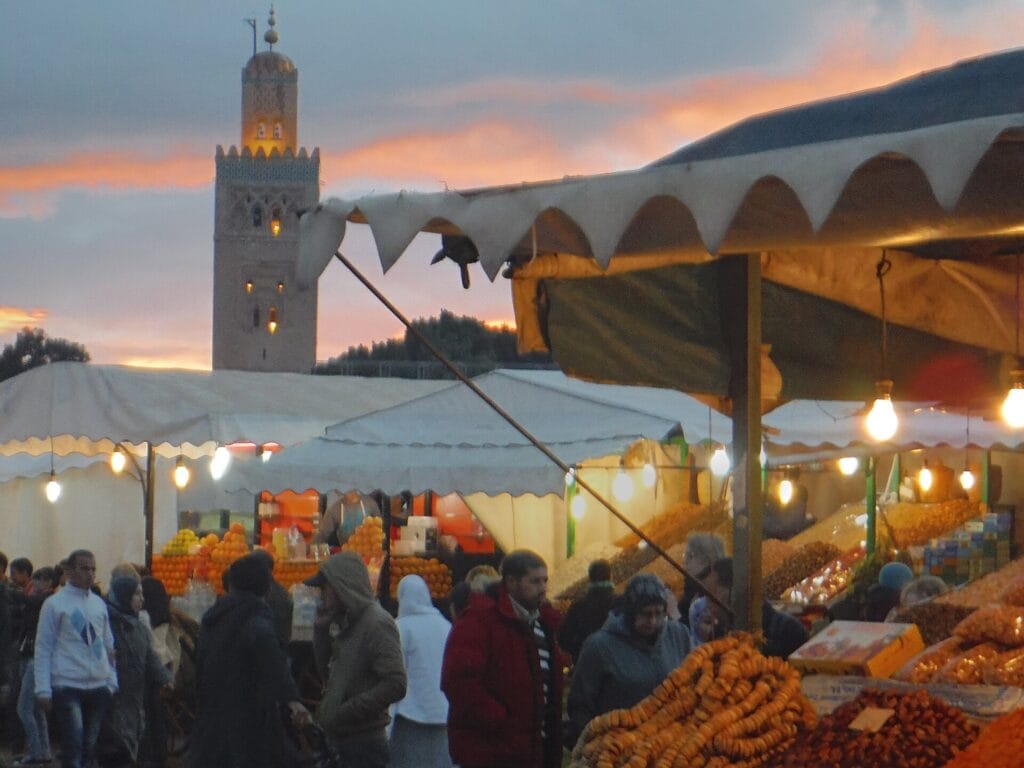
If there were only one answer to the question of what free things to do in Marrakech, it would be this: spend time on Jemaa el-Fna square. This vast space, the beating heart of the medina for nearly a thousand years, is inscribed on UNESCO’s list of the intangible cultural heritage of humanity. And the best part is that this open-air theatre asks for no entrance ticket. You step into it as you step into a dream: by surprise, at the turn of an alley, when the immense square suddenly opens up in front of you.
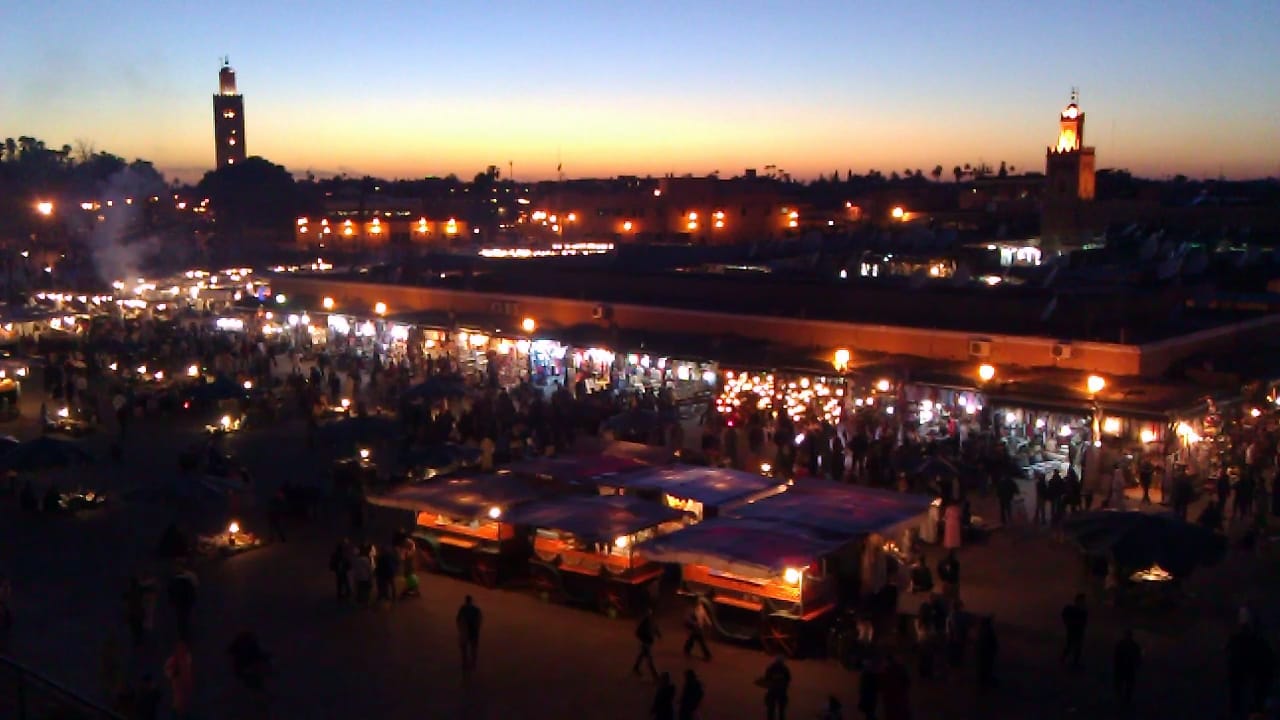
In the morning the square is calm, almost peaceful: orange-juice sellers setting up their carts, trainers preparing their acts, the first tourists crossing toward the souks. It is the perfect time to take photos without the crowds and watch the square wake up. In the late afternoon the magic happens: the halka (circles of spectators) form around the storytellers, snake charmers, Gnaoua musicians, acrobats and monkey handlers. After dark, dozens of food stalls set up in a cloud of fragrant smoke, and the square becomes an immense open-air restaurant paired with a never-ending show.
Watching costs zero dirhams. That said, two honest caveats: if you photograph a snake charmer, a costumed water-seller or a trainer up close, you will be asked for a small contribution (expect 10-20 MAD, roughly 1-2 €). Those are the rules of the game, so it’s best to accept it or photograph from a distance. Likewise, a freshly squeezed orange juice costs 5 to 15 MAD, a trifle for a very real pleasure. To understand how this district works and avoid the classic pitfalls, our guide to the Marrakech medina details the history and layout of this fascinating labyrinth.
Budget tip: the cafés bordering the square offer terraces with a bird’s-eye view over Jemaa el-Fna. A single drink (a mint tea for around 15-25 MAD) buys you the best vantage point in the city for the price of a beverage. It is one of the most unbeatable value-for-money deals in Marrakech.
Getting lost in the souks: looking is completely free
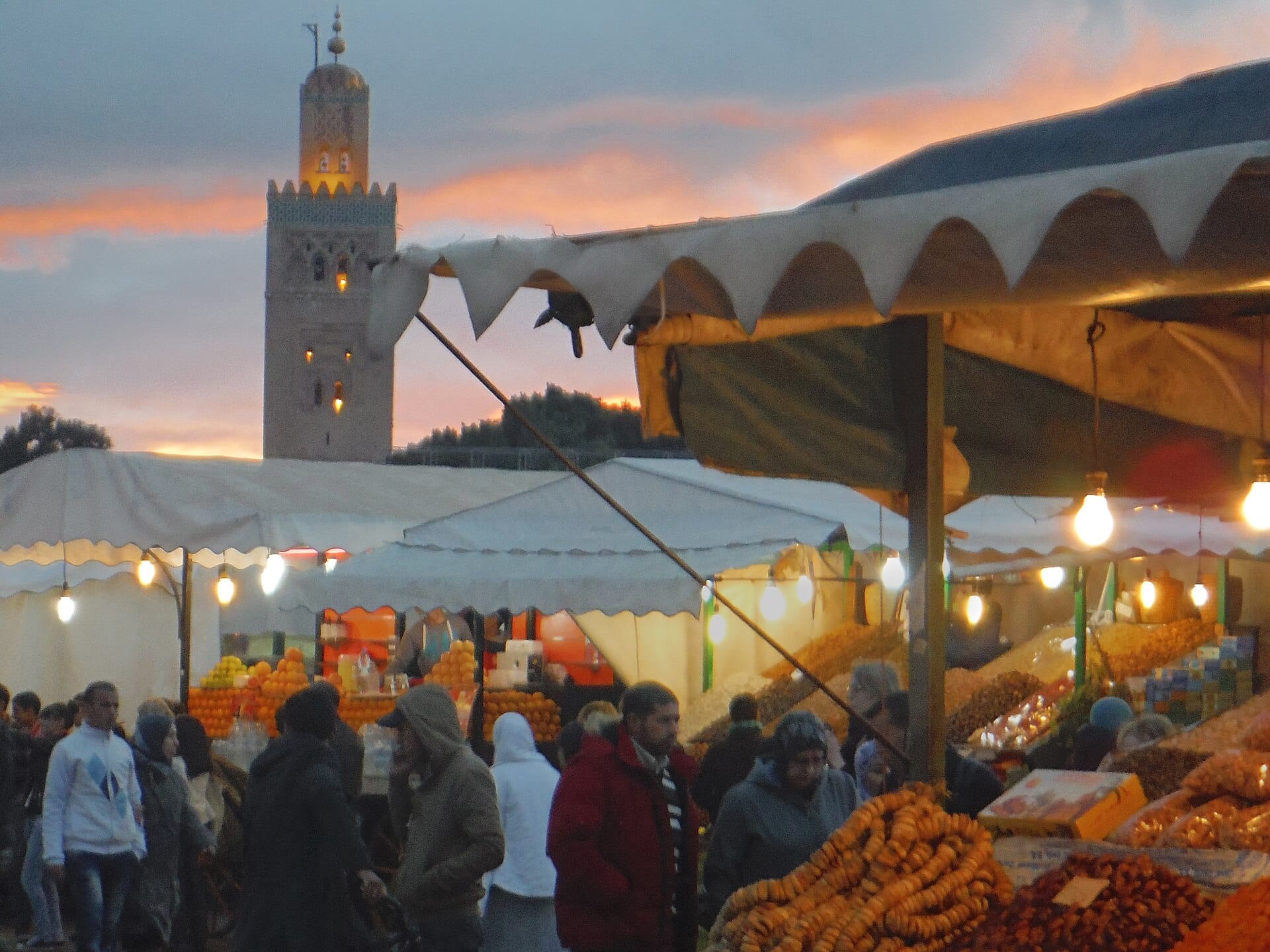
Just north of Jemaa el-Fna begins the maze of the Marrakech souks, one of the largest traditional markets in the Arab world. And here is a liberating truth: looking costs nothing. You can spend hours wandering the covered alleys, admiring the pyramids of saffron and paprika spices, the babouche slippers lined up by colour, the chiselled metal lanterns casting lacework shadows, the hanging carpets, the hammered copper, the leather and the fabrics. It is a permanent feast for the eyes, and entry is free.
Each souk has its own speciality, inherited from the craftsmen’s guilds. Souk Semmarine, the main artery, is the busiest; the dyers’ souk (Souk Sebbaghine) displays skeins of multicoloured wool drying above the alleys; Souk Haddadine rings with the sound of blacksmiths; Souk Cherratine is devoted to leather. You will hear the hammers, smell the cedar and leather, and see gestures passed down over generations. None of it costs anything to take in.
Of course, the temptation to buy is real, and haggling is part of the folklore. But nothing forces you to open your wallet. A polite, smiling “I’m just looking, thank you” (“ghir kanchouf” in Darija) is usually enough. If you do want to buy, know that the first price quoted is often two to three times the real price: negotiate without aggression, with a smile. To master the art of haggling and learn fair prices, see our complete guide to the Marrakech souks. And to wander with peace of mind, our article on safety and scams in Marrakech will help you steer clear of fake guides and nasty surprises.
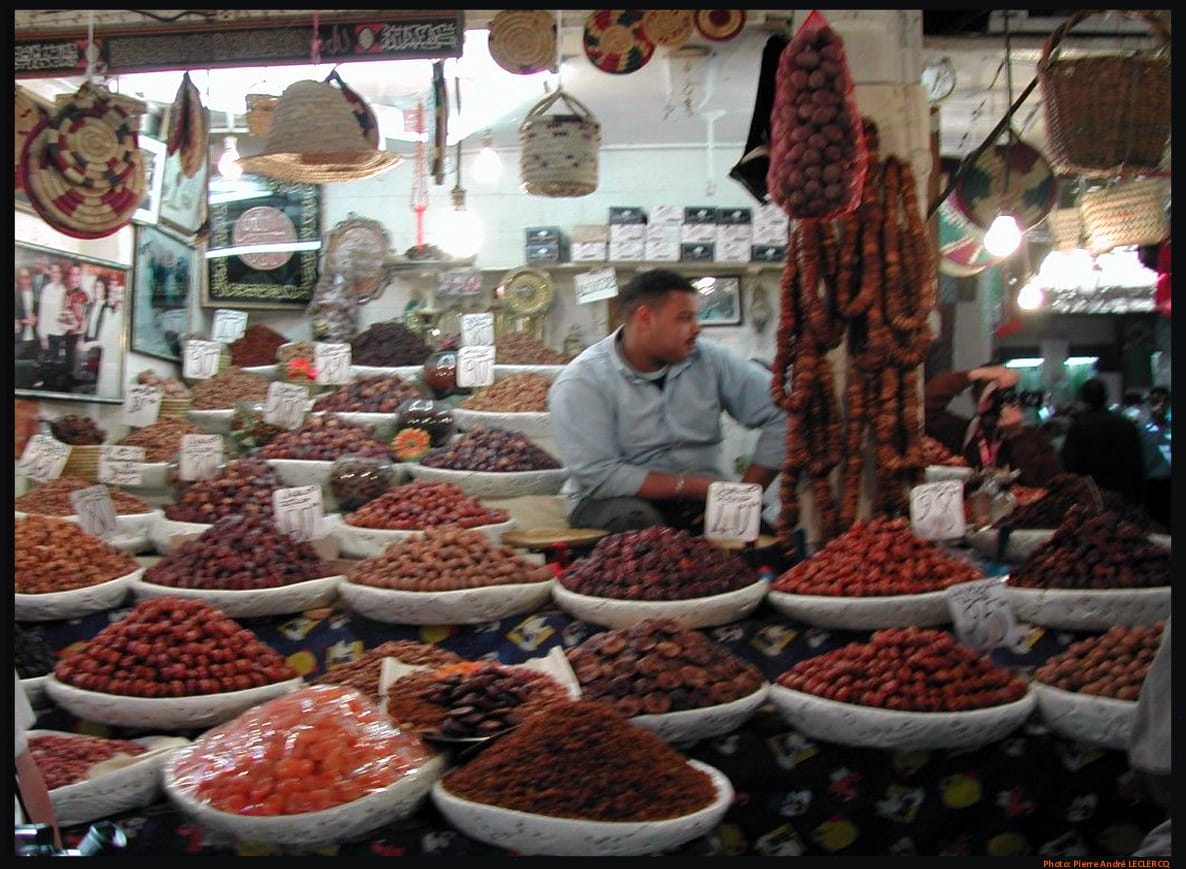
A tip for budget explorers: don’t try too hard to follow a set route. The souks are made for getting lost. Accept going around in circles, let yourself drift, and you will always end up back on a familiar alley or on the square. It is this free wandering, with no goal of buying, that offers the finest memories, and it is entirely free.
Gardens that are free or nearly so: Menara, Cyber Parc and Koutoubia
Marrakech is a city of gardens, and several of them are open free of charge, offering welcome oases of coolness when the heat rises. It is one of the best cards to play for a Marrakech on a budget trip.
The Menara gardens: free and iconic
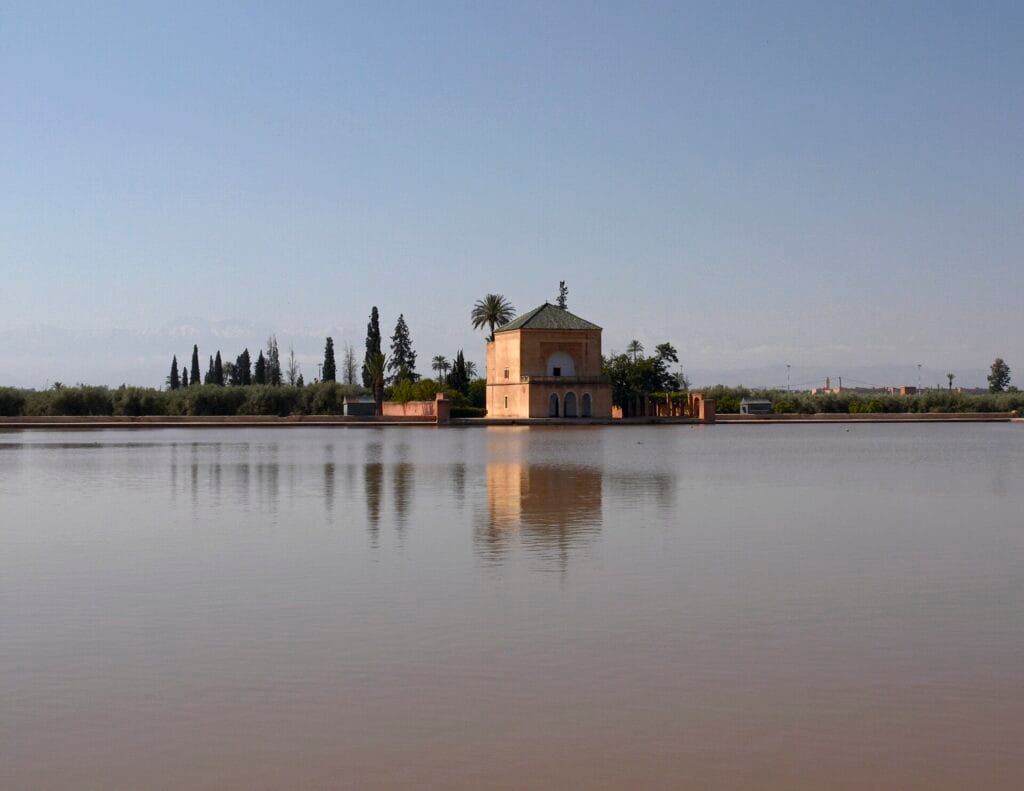
West of the city, the Menara gardens are among the most famous images of Morocco: a large rectangular basin, a Saadian pavilion with a green pyramidal roof, a centuries-old olive grove and, in the background on a clear day, the snowy peaks of the Atlas. Access to the park and its immense basin is free. People come to picnic, walk among the olive trees and, above all, admire the reflection of the pavilion in the water, particularly photogenic at the end of the day.
One honest detail: while the garden itself is free, entry inside the pavilion (to climb upstairs and enjoy the view over the basin from the balcony) is paid, for a symbolic sum of around 10 to 30 MAD (roughly 1-3 €). Nothing compulsory: the view from the edges of the basin is already magnificent and completely free. To learn everything about this site and how to get there cheaply, our guide to the Menara gardens gives you all the practical details.
The Cyber Parc (Arsat Moulay Abdeslam): free and surprising
Right in the centre, between the medina and the modern Guéliz district, the Cyber Parc Arsat Moulay Abdeslam is a gem too often overlooked by visitors. This eight-hectare historic garden, whose origins date back to the 18th century, was restored in 2005. Entry is entirely free, and the park is open every day, generally from 7am to 7.30pm. You’ll find shaded avenues of orange trees and palms, rose gardens, benches for reading or resting, and a small telecommunications museum, also free.
Its quirk? The park blends heritage and modernity, with digital terminals and connected spaces that earned it the nickname “Cyber Parc”. It is a perfect spot to catch your breath between two visits, without spending a single dirham, sheltered from the bustle of the medina.
The Koutoubia gardens: free, at the foot of the minaret
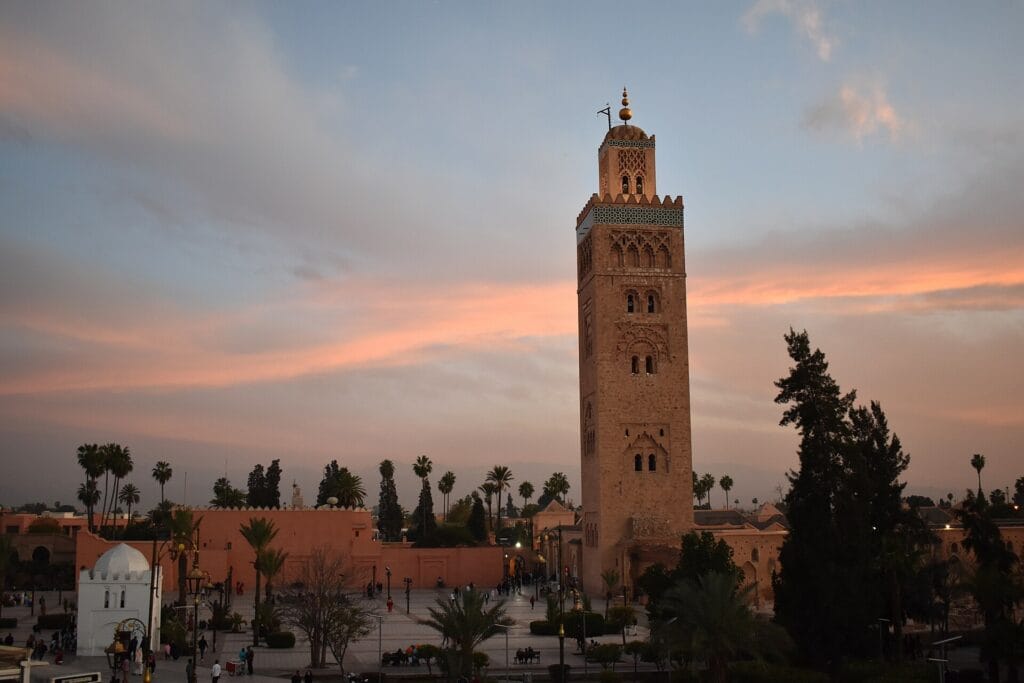
At the foot of the famous mosque, the Koutoubia gardens form a public green space, free of charge, where palm trees, rose bushes and flower beds frame avenues perfect for a stroll. It is the ideal place to admire the minaret from every angle, especially at sunset when the ochre stone catches fire. Here too, there is no entrance fee.
Worth knowing: other famous gardens are, by contrast, paid. The Majorelle Garden and the Secret Garden charge around 150-170 MAD and 100 MAD respectively (roughly 14-16 € and 9 €). Superb, but to be budgeted separately. For the completely free version, Menara, Cyber Parc and Koutoubia make an unbeatable trio.
Admiring the architecture from the outside: minaret, gates and ramparts
A good part of Marrakech’s monumental heritage can be admired… from the street. No need to pay to be dazzled, and it’s an excellent strategy for budget travellers.
The Koutoubia Mosque: free silhouette, interior off-limits
The Koutoubia is the most iconic monument in Marrakech, its 12th-century Almohad minaret rising to 77 metres and serving as a landmark for the whole city. As with all working places of worship in Morocco, the interior of the mosque is closed to non-Muslims. But the exterior can be admired freely at any hour of the day or night, at no cost. From the surrounding gardens, the silhouette of the minaret topped with its golden orbs is a spectacle in itself, especially when illuminated at nightfall. Our guide to the Koutoubia Mosque tells the story of this masterpiece and the best viewpoints.
Bab Agnaou and the gates of the medina
Bab Agnaou is arguably the most beautiful gate in Marrakech. Built in the 12th century under the Almohads, adorned with geometric carvings and Quranic inscriptions in ochre stone, it marks the entrance to the Kasbah district. Passing through it is entirely free, and admiring it offers a distillation of Almohad art. It is one of the nineteen historic gates cut into the ramparts.
Around the medina, the red rammed-earth ramparts stretch for nearly 19 kilometres. Walking along these walls, especially at sunset when they take on a pink-orange hue, is a free and unforgettable stroll. Other gates are worth a look: Bab Doukkala, Bab er-Robb, or Bab el-Khemis. A horse-drawn carriage (calèche) can take you along the ramparts for about 100-150 MAD a ride, but on foot it’s free and often more authentic.
The Kasbah district and the Mellah: a plunge into history, ticket-free
Beyond Bab Agnaou, you enter the Kasbah district, the former fortified city of power. Walking around it is free and open. You can admire the exterior of the Kasbah Mosque and its minaret with turquoise zellij tilework that, so the story goes, inspired the Koutoubia’s. The alleys here are a little quieter than in the heart of the medina, making for a pleasant wander. Our guide to the Kasbah district details the points of interest and the route to follow.
To be honest: the Saadian Tombs, funerary jewels from the 16th century located in this district, are paid (entry around 70-100 MAD, or 7-9 €). Magnificent, but not free. The pleasure of wandering the Kasbah’s alleys and admiring its façades, however, costs nothing.
Right next door lies the Mellah, the old Jewish quarter of Marrakech, one of the oldest in Morocco. Strolling through its narrow alleys, discovering its ornate balconies (rare in the Muslim medina), passing the Slat al-Azama synagogue and its patio, or crossing the Mellah spice market, all of it is free. The district tells the city’s multicultural history, and that living history lesson costs nothing.
The atmosphere of squares, terraces and fountains
Beyond Jemaa el-Fna, Marrakech has other places where you can soak up the local atmosphere without spending. The Place des Ferblantiers, near the Mellah, is a charming example: surrounded by metalworkers’ workshops where craftsmen hammer brass and make lanterns, it offers a permanent, free artisan spectacle. You can sit down, watch the craftsmen at work and listen to the characteristic ringing of worked metal.
The historic fountains, such as the Mouassine fountain or the Chrob ou Chouf fountain, are old public water points richly decorated with carved cedar wood. Spotting them along your walks turns the medina into a free treasure hunt. Likewise, the fondouks (former caravanserais with open courtyards, often now converted into artisans’ workshops) are open to visit freely for the most part: you push the door, step into the courtyard, watch leather or wood being worked. A simple, respectful hello is enough.
Finally, having a mint tea (10-20 MAD) on a terrace is the quintessential little Marrakech pleasure. For the price of a drink, you buy yourself a view, some shade and some time. It isn’t free in the strict sense, but it is one of the most rewarding expenses of the trip.
Markets and local life in Guéliz: the real everyday Marrakech
For a change of scene and to see how Marrakchis really live, head to Guéliz, the modern district created during the protectorate era. Here there are no touristy souks but wide avenues, cafés frequented by locals, art galleries (often free to enter), and discreet Art Deco architecture to discover for free as you walk.
The Guéliz central market (municipal market) is an immersion in local daily life: fruit and vegetable stalls, florists, fishmongers, olives and spices. Wandering there costs nothing and lets you, if you wish, buy picnic supplies for next to nothing. It’s also a chance to observe “local” prices, far removed from the tourist rates of the medina, which helps you calibrate your haggling elsewhere.
Art lovers will appreciate the Guéliz galleries, which showcase the Moroccan contemporary scene free of charge. To organise a full trip that intelligently blends free and paid, our Marrakech travel budget guide helps you allocate your spending as wisely as possible.
Free sunsets: the luxury that costs nothing
In Marrakech, the finest show of the day is perhaps also the most free: the sunset. The golden light setting the ramparts ablaze, the sky turning pink behind the Koutoubia minaret, the call to prayer echoing at dusk… these moments are priceless, quite literally.
Several spots offer free or almost-free viewpoints over the setting sun: the edges of the Menara basin (with the pavilion reflected in the water), the Koutoubia gardens, the top of the ramparts, or simply Jemaa el-Fna square, which comes alive at this hour. For an elevated view, the café terraces around the square offer, for the price of a tea (15-25 MAD), one of the finest panoramas in the city over the sunset and the square as it lights up.
If you’re after a more polished rooftop for sunset drinks, you’ll need to budget for a slightly higher spend. Our article on Marrakech nightlife and rooftops lists the best terraces by budget. But remember: the sunset itself, wherever you are, remains entirely free.
What you can see without paying vs what costs money: the honest recap
To fully answer the question of what free things to do in Marrakech, you also have to be clear about what isn’t free. Here is a reference table with indicative prices (subject to change).
- Free: Jemaa el-Fna square, souks (browsing), Menara gardens (the park), Cyber Parc, Koutoubia gardens, exterior of the Koutoubia, Bab Agnaou and the gates, ramparts, Kasbah district (alleys), Mellah, Place des Ferblantiers, historic fountains, Guéliz market, Guéliz art galleries, sunsets.
- A few dirhams: mint tea (10-20 MAD), orange juice (5-15 MAD), Menara pavilion (~10-30 MAD), public toilets (2-5 MAD), a photo with a street performer (10-20 MAD).
- Paid (to budget for): Bahia Palace (~70-100 MAD / 7-9 €), Saadian Tombs (~70-100 MAD), Ben Youssef Madrasa (~50-100 MAD), Majorelle Garden and YSL Museum (~150-170 MAD / 14-16 €), Secret Garden (~100 MAD), El Badi Palace (~70-100 MAD).
The lesson is simple: you can spend two or three thrilling days in Marrakech paying only for your meals and a few teas, while reserving one or two “must-see” paid visits (often the Bahia or the Saadian Tombs) to round things off. That is the best recipe for a rich trip on a small budget. For a complete overview of the highlights, free and paid, our complete guide to things to do in Marrakech covers all the city’s experiences.
Budget tips: water, haggling and transport
Making the most of the free things to do in Marrakech also means keeping a few side expenses under control. Here are the habits that make the difference on a tight budget.
Water and food. Bring a reusable bottle and fill it at your riad or hotel rather than buying bottles on every street corner. To eat, avoid the terraces right on Jemaa el-Fna (pricier) and seek out the little eateries frequented by locals: a bowl of harira (traditional soup) costs 5-10 MAD, a sandwich 15-25 MAD, and the square’s evening stalls stay affordable if you ask the price first. Traditional bread, dates and market olives make delicious picnics for a handful of dirhams.
Haggling. In the souks, negotiating isn’t optional, it’s the norm. Announce a price well below the first one offered, keep smiling, and be ready to walk away: that’s often the best bargaining lever. But remember that the finest souk experience, browsing, is already free. You are never obliged to buy.
Transport. Marrakech within the walls is mostly covered on foot, and that’s free. For longer distances (Menara, Guéliz, the station), the beige petit taxis are cheap provided you insist on the meter (“compteur, s’il vous plaît“): a ride across town usually costs 15-40 MAD. The city buses (Alsa) serve the city for about 4-6 MAD a trip, unbeatable. Avoid taking a carriage or taxi without fixing the price in advance. To fully understand costs on the ground, our Marrakech budget guide details the price ranges item by item.
Staying alert. A budget trip can be ruined by a scam. Beware of “fake guides” who offer to take you somewhere then demand money, deliberately wrong directions, or “free” tanneries that end in pressure to buy. A firm, smiling “no thank you” remains your best tool. Our safety and scams in Marrakech guide reviews all the classic traps and how to sidestep them calmly.
FAQ: free things to do in Marrakech
Can you really visit Marrakech for free?
Yes, largely. The most iconic experiences (Jemaa el-Fna square, the souks, the exterior of the Koutoubia, the Menara gardens, the Cyber Parc, the ramparts, the historic gates, the Kasbah district, the Mellah) are entirely free. You can spend several thrilling days paying only for your meals, a few teas and transport. Only the palaces and museums (Bahia, Saadian Tombs, Majorelle) are paid, to be budgeted separately.
Are the Menara gardens free?
Yes, access to the park and its large basin is free. Only entry inside the Saadian pavilion (to climb upstairs) is paid, for a symbolic sum of around 10 to 30 MAD (roughly 1-3 €). The finest view, the reflection of the pavilion in the basin, can be admired freely from the water’s edge.
Can you enter the Koutoubia Mosque for free?
The interior of the Koutoubia, like that of all working mosques in Morocco, is closed to non-Muslims. However, the exterior of the minaret and the gardens surrounding it can be admired for free at any hour. It is one of the finest free viewpoints in the city, especially at sunset.
How much do the “few dirhams” activities cost?
Expect around 10-20 MAD (1-2 €) for a mint tea, 5-15 MAD for a fresh orange juice on Jemaa el-Fna, 10-30 MAD for the Menara pavilion, and 10-20 MAD if you photograph a street performer up close. These are symbolic sums that won’t dent a tight budget while letting you fully enjoy the atmosphere.
Which paid visits are worth it if my budget is limited?
If you have to choose only one or two paid visits, the Bahia Palace and the Saadian Tombs (around 70-100 MAD each) offer excellent value for discovering the art and history of Marrakech. The Ben Youssef Madrasa is also remarkable. The Majorelle Garden is pricier (~150-170 MAD) and very busy: worth booking if aesthetics matter to you.
Is it dangerous to walk freely in the medina?
No, Marrakech is generally safe for walkers. The main nuisances are fake guides and pushy vendors, more tiresome than dangerous. Keep your belongings close in the crowds, politely decline unsolicited offers, and always fix prices in advance (taxi, carriage). Getting lost in the souks is part of the charm and poses no particular risk.
Conclusion: Marrakech can be savoured without breaking the bank
Marrakech is living proof that the finest travel memories aren’t necessarily the ones that cost the most. The bewitching hubbub of Jemaa el-Fna at nightfall, the smell of spices in the souks, the raking light on the ramparts, the coolness of an olive grove at the Menara: all of it is offered to you for free, as long as you take the time to walk, observe and listen. To answer the question of what free things to do in Marrakech is ultimately to rediscover that travel is, above all, a matter of how you look.
With these 20 ideas for free things to do in Marrakech (or for just a few dirhams), a Marrakech on a budget trip is no second-best: it is often the most authentic way to experience the Red City. Round out this free foundation with one or two favourite paid visits, savour a tea on a terrace at sunset, and you’ll leave with the feeling of having truly met Marrakech, without having emptied your wallet. To go further, explore our complete guide to things to do in Marrakech and our guide to the medina.
To delve deeper into the history and heritage listing of the site, see the entry for Jemaa el-Fna square on Wikipedia or the record of the Medina of Marrakech on the UNESCO World Heritage list.
Images under free licence via Wikimedia Commons: © Elgaard (CC BY-SA 4.0); © Pierre André Leclercq (CC BY-SA 4.0); © YoTuT (CC BY 2.0). Sources: Wikimedia Commons.Photo credits: illustrative images of Marrakech (Jemaa el-Fna square, souks, Menara gardens). Replace these markers with your own royalty-free or properly credited visuals according to their licence.