Travelling to a wheelchair accessible Marrakech is a question that comes up often, and the honest answer fits in a single sentence: it’s difficult, but doable with good preparation. The red city was not designed for people with reduced mobility. The medina, its listed historic heart, is a maze of narrow cobbled lanes, thresholds, steps and dense crowds that make getting around on wheels genuinely demanding. And yet, every year, travellers with disabilities discover Marrakech and come home delighted — provided they planned their stay in advance and chose the right neighbourhoods, the right accommodation and the right providers.
The key is to tell two Marrakechs apart. On one side, the labyrinthine medina, authentic but tough to cover on wheels. On the other, the new city (Guéliz, Hivernage, Agdal) with its wide avenues, its (sometimes) passable pavements, its modern hotels fitted with lifts and its large flat gardens. By building your trip around these more accessible areas, booking suitable accommodation and a transfer with a spacious vehicle ahead of time, you turn a challenge into a pleasant stay. This independent guide takes stock, without overselling, of what is genuinely practicable and of the concrete solutions for a successful reduced-mobility trip to Marrakech.
In brief: Marrakech in a wheelchair
- Overall difficulty: high in the medina, moderate in the new city.
- Medina: uneven cobbles, narrow lanes, thresholds, scooters, crowds — a companion is all but essential.
- New city (Guéliz, Hivernage): wide avenues, hotels with lifts, step-free cafés — clearly more practicable.
- Ménara Airport: assistance for reduced-mobility passengers available, ambulift (not always), adapted toilets — to be requested 48 hours before the flight.
- Transfers: private spacious van recommended; public transport not adapted.
- To book in advance: adapted accommodation, transfer, and possibly an all-terrain rental wheelchair.
- Assistance/transfer budget: from 250–400 MAD (about £20–£32) for a private transfer, indicative.
Is Marrakech wheelchair accessible? An honest overview
Let’s be clear: Marrakech is not an “easy” destination for a traveller in a wheelchair. Morocco has made progress on accessibility regulations, but enforcement remains very uneven, particularly in a thousand-year-old old town whose urban fabric never anticipated wheels. Pavements, where they exist, are rarely dropped at pedestrian crossings; they are often high, cracked and cluttered with stalls, parked motorbikes or roadworks. The standards you may know from Europe (gentle ramps, lifts everywhere, accessible toilets throughout) are not the norm.
That said, two things offset these physical obstacles. First, the new city offers a far more practicable experience than the medina: this is where the international hotels, step-free restaurants and large green spaces are concentrated. Second, mutual help is a strong cultural reality in Morocco. Locals spontaneously offer to help you clear a step, carry a wheelchair a few metres or point out an easier route. That is obviously not an accessibility solution in itself, but it is a factor that makes many situations manageable. In short, a fully wheelchair accessible Marrakech does not yet exist in a uniform way, but a well-planned stay remains entirely feasible.
The right mindset is to accept giving up certain very “picture-postcard” experiences (getting lost for hours in the narrowest souks, for instance) in favour of others that are just as beautiful and far more comfortable. This flexibility is the real secret of a successful accessible Marrakech trip.
The medina: the most complicated part
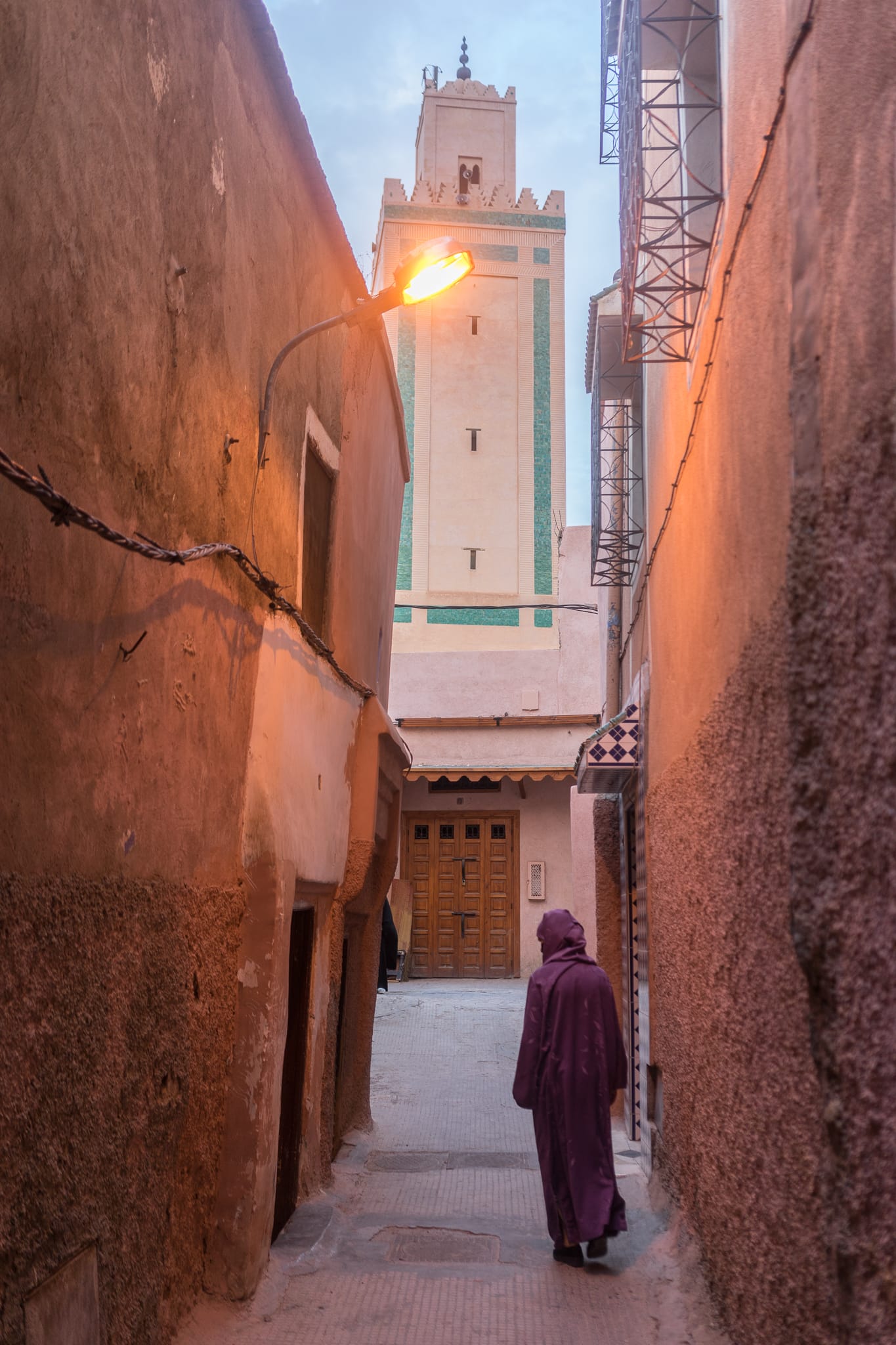
The Marrakech medina is magnificent, and it is also the area most hostile to a wheelchair. Understanding why helps you plan ahead. The surfaces alternate between uneven cobbles, loose paving slabs, packed earth and, at times, plain potholes. These surfaces cause constant jolting and easily catch the small front casters of a standard manual wheelchair. The souk lanes can narrow to less than a metre in places, which is incompatible with most wheelchairs once the stalls spill onto the passage.
On top of this come three major difficulties. The thresholds and steps: many shops, riads and restaurants have a step at the entrance and are cramped inside. The crowds: in the late afternoon, the density of pedestrians slows everything down and makes manoeuvring tricky. Finally, the scooters: they weave at speed through the lanes without stopping. The survival rule is to keep to the right to let them pass and to stay very alert.
Does that mean giving up on the medina altogether? No, but you have to approach it in a targeted way. Favour the main thoroughfares, which are wider and often in better condition, rather than the maze of tiny lanes. Visit in the morning if you can, when the crowds are thinner. Plan on having a companion: in a wheelchair in Marrakech, the medina is almost always experienced as a pair. And accept doing there-and-back trips rather than long loops, to keep control of your route. To prepare your forays, our guide to the Marrakech medina details the main landmarks and access points.
The monuments: accessible or not?
Marrakech’s historic monuments pose a recurring challenge: they are old buildings, with high thresholds, staircases, uneven floors and rarely any ramps. Here is a realistic overview, to be checked case by case as facilities change.
- Bahia Palace: partly practicable on the ground floor thanks to its vast step-free courtyards and patios, but old thresholds and floors complicate some passages.
- Saadian Tombs: narrow access and uneven ground; difficult in a wheelchair, as the queue and tight passages are poorly suited.
- El Badi Palace: vast open spaces but packed-earth floors, changes of level and no ramps to the lower levels.
- Ben Youssef Madrasa: superb but with thresholds and staircases; the ground floor remains the most manageable.
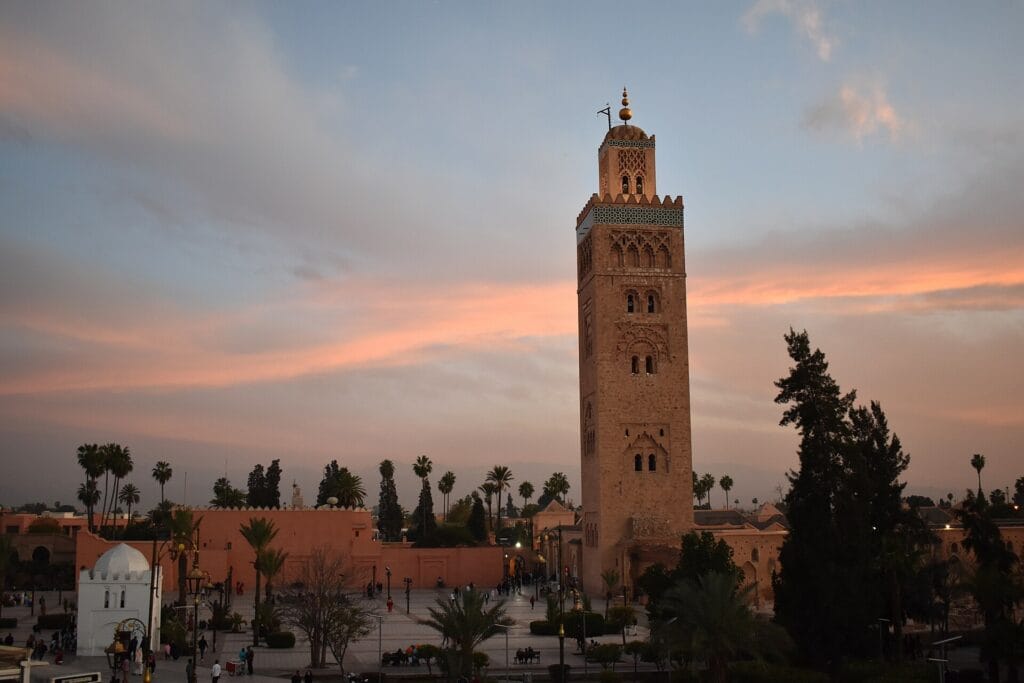
- Koutoubia (exterior): the mosque cannot be visited, but its neighbouring gardens, flat and well maintained, are pleasant and practicable.
Good news for a wheelchair Marrakech stay: several garden-type or modern-museum sites are markedly easier. The Majorelle Garden, for example, is covered on hard-surfaced paths around the ponds; entry there is often free for the wheelchair user and their companion (to be confirmed on site). Recent or renovated museums sometimes offer step-free access and lifts. Before setting out, it is always best to phone the site to check for an adapted entrance. For a full overview of things to see, browse our selection of things to do in Marrakech.
Where to stay: adapted hotels and riads
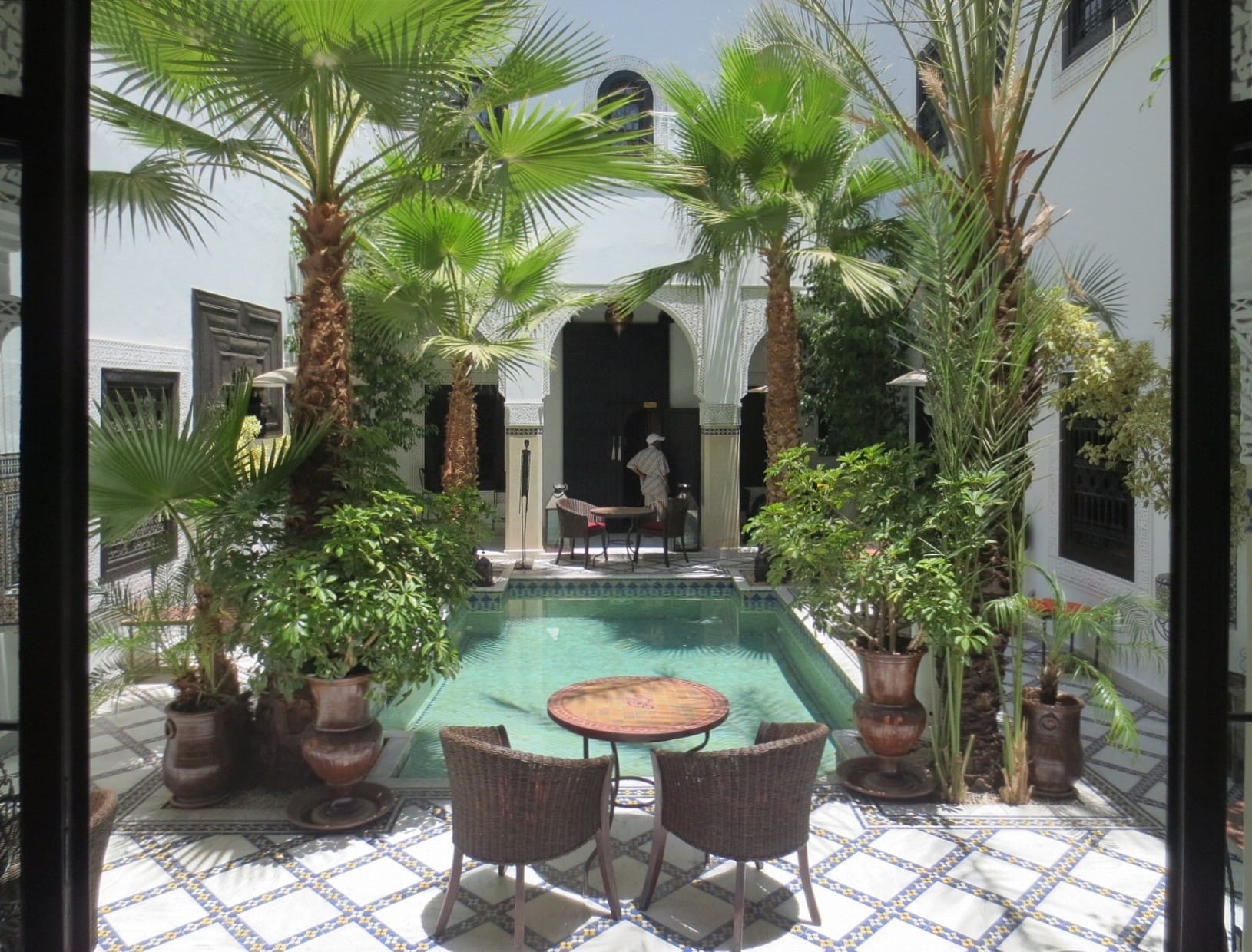
Choosing your accommodation is probably the single most decisive decision of your whole trip. In a wheelchair, it shapes your daily comfort and your independence. The golden rule: favour a modern hotel with a lift in the new city (Guéliz, Hivernage) or on the outskirts. These establishments offer step-free or lift-served rooms, more spacious bathrooms and, for some, genuinely “accessible” rooms with a walk-in shower and grab bars.
Traditional riads, on the other hand, call for particular caution. Many are superb old houses arranged around a central patio, but with staircases, steps up to the rooms and no lift. A riad is not automatically inaccessible: some, often larger or renovated, have a step-free room opening onto the patio and adapted fittings. There are even a few inside the medina with an accessible room and a practicable garden. But such addresses are rare: they must be booked well in advance and verified precisely.
- Ask for photos of the room, the bathroom and, above all, the access route from the entrance.
- Check the width of the doorways, whether there is a lift (and its dimensions), and whether step-free access exists.
- Confirm the type of shower (walk-in or bathtub) and the presence of grab bars.
- Ask the establishment about access from the street: a single step or threshold at the entrance can change everything.
Never rely on the “accessible” label of a booking site alone: it is often filled in optimistically. A direct exchange by email or phone, with precise questions, remains the best guarantee. To compare neighbourhoods and accommodation styles, our guide on where to stay in Marrakech will help you target the area best suited to your mobility.
Getting around: taxis, adapted transfers and horse-drawn carriage
Marrakech’s public transport (buses) is not suited to wheelchairs, and there is no tram in the city. Your travel will therefore rely essentially on taxis and private transfers. The petits taxis (beige) are cheap but cramped: they mainly suit someone who can transfer onto the seat, with the folding wheelchair stowed in the boot. The grands taxis (often saloons) offer more room but remain unsuitable for a wheelchair that does not fold.
The most comfortable solution is a private transfer in a spacious van, booked in advance. A people carrier or minibus makes it easier to load a wheelchair (even a non-folding one, depending on the vehicle) and to seat the passenger comfortably. Some providers offer vehicles genuinely fitted for reduced mobility with a ramp or platform, but they are rare in Marrakech: book well ahead. As an indication, a private airport–centre transfer often costs between 250 and 400 MAD (about £20–£32), and a day with a driver can be negotiated as a flat rate. To compare arrival options, see our comparison of airport transfers in Morocco as well as our guide to getting around Marrakech.
And the horse-drawn carriage? It is a popular tourist experience, but frankly poorly suited: boarding involves one or two high steps, with no ramp, and the wheelchair has to be hoisted up and stowed. For many travellers with reduced mobility, the transfer is too acrobatic and the ride uncomfortable over the cobbles. If you are set on it, plan on having a strong companion and clear negotiation before you board. In most cases, a tour in an air-conditioned van remains more restful and safer.
Ménara Airport and your arrival
Marrakech-Ménara Airport (RAK) is the entry point for most travellers, and that is rather good news: it is a modern terminal, better equipped than the medina. You will find ramps, lifts and dedicated assistance for reduced-mobility passengers. Adapted toilets are available, including before you clear customs. For boarding and disembarking, the airport has an ambulift (an elevating-platform vehicle) that avoids the airstairs of the jet bridge; it is not always available, however, which can involve a wait.
The most important point: request assistance in advance. The usual rule is to make the request at least 48 hours before the flight, through your airline, which passes the information to the departure and arrival airports. Specify your needs precisely (manual or powered wheelchair, whether you can walk a few steps or not, powered-wheelchair battery to be declared). Wheelchairs, including powered ones, are generally returned quickly on arrival, and an assistance agent guides the passenger to the exit. This guide is independent and affiliated with neither ONDA nor any airport; always check official information with your airline and the airport before departure.
At the exit, avoid improvising. The arrivals hall is often busy with touts and drivers, an unpleasant situation when you are also handling a wheelchair and luggage. A private transfer booked in advance, with a driver waiting for you by name, spares you this stressful step and drops you right at the door of your accommodation.
Accessible things to do in Marrakech
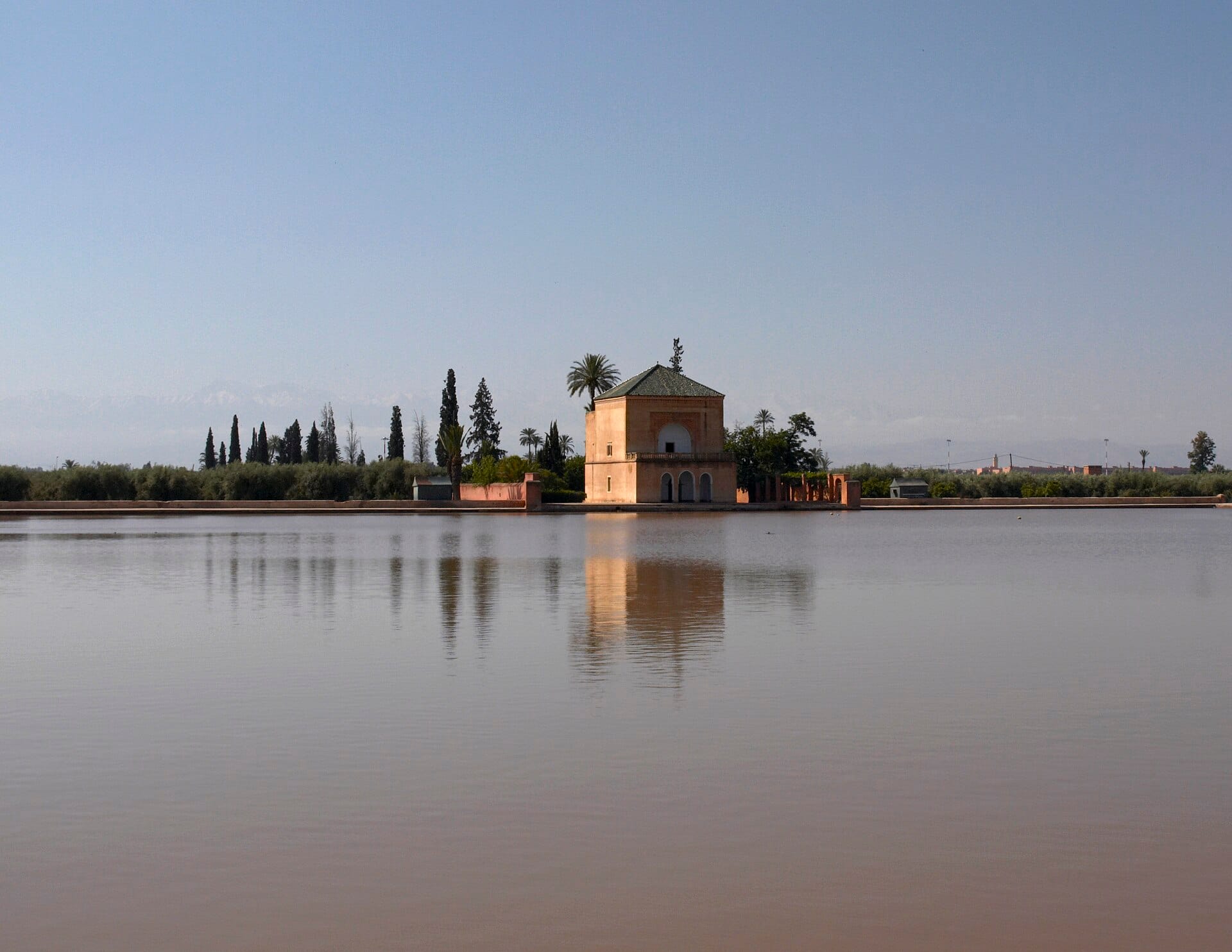
This is where Marrakech reveals a far more reassuring side. Away from the maze of the medina, the city offers plenty of experiences practicable in a wheelchair, often among the most beautiful. The gardens are your best ally: flat, hard-surfaced or laid out with well-kept paths, they allow a relaxed stroll.
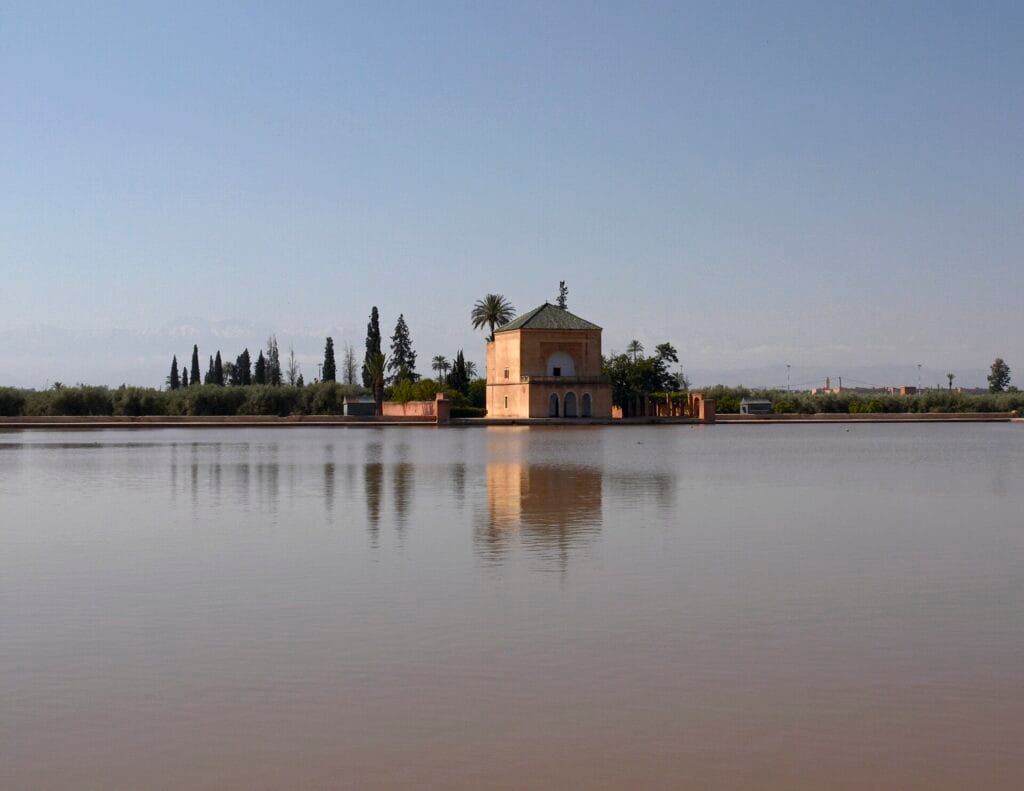
- Menara Gardens: a vast basin, an olive grove and wide paths — an emblematic spot, peaceful and broadly flat. See our guide to the Menara gardens.
- Majorelle Garden: hard-surfaced paths around the ponds, iconic blue atmosphere; entry often free for the wheelchair user and companion.
- Koutoubia Gardens: orange trees, palms and fountains, practicable and central.
- Cafés and terraces in the new city: Guéliz is full of step-free spots, ideal for a break.
- Modern museums: several offer adapted access; to be checked before you set out.
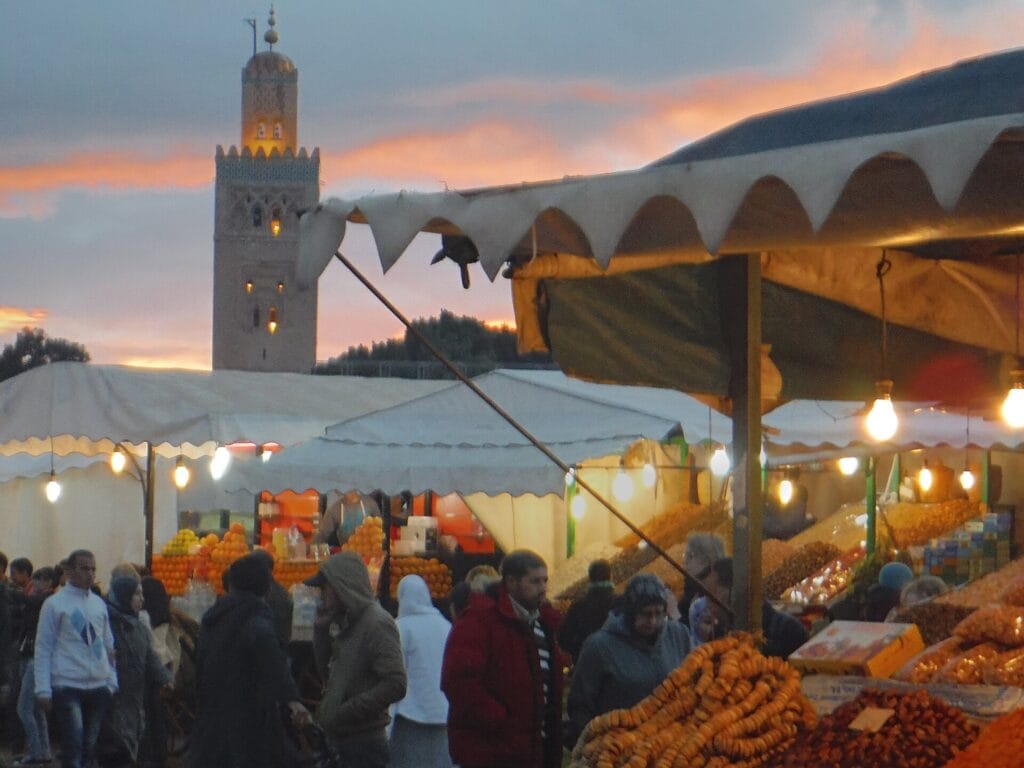
Jemaa el-Fna square, for its part, is a special case. Vast and broadly flat, it is in theory crossable, but the evening crowd, the stalls and the buzz can make it demanding at times. Visiting in the late morning or early afternoon, when it is calmer, offers a good compromise. Think too of wellness experiences: some upmarket hammams and spas in Marrakech, inside modern hotels, offer step-free facilities that are far more comfortable than the traditional neighbourhood hammams. If you are travelling with children, our guide to Marrakech with the family lists activities suited to a gentle pace.
Travelling with support or a companion
Let’s be pragmatic: in Marrakech, a companion is not a luxury, it is most often a necessity, especially once you leave the main thoroughfares of the new city. Clearing a high kerb, getting over a step at a restaurant entrance, securing a passage against the scooters, stowing a wheelchair in a boot: all these are done far more easily as a pair. If you are travelling alone, consider hiring a local companion for the duration of the stay or for the most demanding days.
Several agencies specialising in accessible travel offer Marrakech stays with human assistance, a suitable vehicle and itineraries designed for the wheelchair. It is a reassuring option for a first trip, even if it comes at a cost. Failing that, a private driver who accompanies you by the day can play a valuable role: he knows the access points, helps with transfers and adapts the programme. Finally, do not hesitate to accept the spontaneous help of locals for small obstacles — it is frequent and sincere, provided you keep an eye on your belongings in the very touristy areas.
Practical tips for a successful trip
Good preparation radically transforms the experience. Here are the recommendations that make the difference for a reduced-mobility trip to Marrakech.
- Suitable wheelchair: if you can, travel with a sturdy large-wheeled chair, or rent an all-terrain wheelchair (thick wheels, reinforced frame) that absorbs cobbles and uneven ground far better than the small wheels of a city chair.
- Book everything in advance: adapted accommodation, private transfer, possible equipment rental and airport assistance. Genuinely accessible addresses are few and go quickly.
- Choose the right season: avoid the crushing summer heat, which is more tiring when manoeuvring a wheelchair. Spring and autumn are ideal; see the best time to visit Marrakech.
- Logistics base in the new city: staying in Guéliz or Hivernage makes your daily outings and returns to the hotel easier.
- Repair kit: pack inner tubes, patches and tools; specific parts are hard to find locally.
- Medication and equipment: plan your supplies for the whole stay, in your cabin bag, with prescriptions translated into English if possible.
- Travel insurance: take out cover that includes repatriation assistance and coverage for medical equipment.
- Digital scouting: use online maps to identify wide streets and step-free access in advance, and keep useful numbers offline.
Mistakes to avoid
Certain mistakes come up often and needlessly spoil the stay. Knowing them is already avoiding them.
- Trusting the “accessible” label without checking: always ask for photos and precise measurements, especially for the entrance and the bathroom.
- Booking a riad in the heart of the medina without scouting the access: even a lovely step-free room becomes a headache if the path from the street is riddled with steps and narrow lanes.
- Relying on ordinary taxis: they are too cramped for many wheelchairs; a private van transfer is far more reliable.
- Trying to do everything: an overloaded programme wears you out; better fewer visits, but well chosen and accessible.
- Forgetting the airport assistance request: without the 48 hours’ notice, assistance can be slower or incomplete.
- Underestimating the heat: in high summer, long outings become difficult; adapt your timing and hydration.
- Travelling without a companion for a first time: to discover Marrakech in a wheelchair, human support changes everything.
FAQ: wheelchair accessible Marrakech
Can you visit Marrakech in a wheelchair?
Yes, it is possible, but it takes preparation. The medina is difficult because of the cobbles, the thresholds, the narrowness and the crowds, whereas the new city (Guéliz, Hivernage) and the large flat gardens are markedly more practicable. By choosing adapted accommodation, a private transfer and accessible visits, a wheelchair accessible Marrakech stay remains entirely realistic.
Is the medina practicable in a wheelchair?
Partly. The main thoroughfares are wider and often in better condition than the small souk lanes, where uneven cobbles, thresholds and scooters complicate movement. Visit in the morning if you can, keep to the right to let the two-wheelers pass and plan on having a companion. It is realistic to make a few targeted forays there rather than long wanderings.
What accommodation is suitable for reduced-mobility travellers?
Modern hotels in the new city, fitted with lifts and sometimes with genuinely accessible rooms, are the safest choice. Some riads, often large or renovated, offer a step-free room on the patio, but these addresses are rare and must be booked well in advance. In every case, ask for photos and confirm access from the street before booking.
How do you get around Marrakech in a wheelchair?
The most comfortable option is a private transfer in a spacious van, booked in advance. Petits taxis are fine if you can transfer onto the seat with a folding wheelchair, but the buses are not adapted. Vehicles genuinely fitted for reduced mobility (ramp, platform) do exist but remain rare: book ahead.
Does Marrakech Airport offer assistance for reduced-mobility passengers?
Yes. Ménara Airport has ramps, lifts, adapted toilets and reduced-mobility assistance, with an ambulift for boarding (not always available). Make the assistance request through your airline at least 48 hours before the flight and declare the battery if you have a powered wheelchair.
What is the best time for a reduced-mobility trip to Marrakech?
Spring (March to May) and autumn (September to November) are ideal: pleasant temperatures and less tiring outings. Summer is not advised for long wheelchair strolls, as the heat can be crushing. In that case, adapt your timing to the cooler hours and remember to stay well hydrated.
Ultimately, Marrakech has to be earned when you travel in a wheelchair, but it opens up to those who prepare well. By betting on the new city, flat gardens, verified accommodation, an adapted transfer and, ideally, a companion, you will enjoy the essence of the red city — its colours, its scents, its light — without wearing yourself out. The destination is not perfectly accessible Marrakech, but with method it becomes a memorable trip. To go further, lean on our practical guides and don’t hesitate to contact hotels, sites and providers directly: it is the best way to validate every step. Read more about the city on Wikipedia.
Images under free licence via Wikimedia Commons: © Omalihy (CC BY-SA 4.0); © Ymblanter (CC BY-SA 4.0); © Arnaud 25 (CC BY-SA 3.0). Sources: Wikimedia Commons.Photo credits: illustrative images. Please credit the authors of the visuals used (royalty-free image banks or photographers) when publishing.