Packing your Morocco cabin baggage correctly means avoiding stress at the desk, last-minute fees and having items confiscated at the security checkpoint. Whether you fly with Royal Air Maroc, Air Arabia Maroc or a low-cost carrier such as Ryanair, Transavia or easyJet, each airline sets its own permitted cabin dimensions and weight. On top of that come shared aviation security rules: the well-known 100 ml liquids limit, the ban on sharp objects, and the requirement to carry lithium batteries and power banks in the cabin only. This guide breaks down, airline by airline, exactly what you can take on board a flight to or from Morocco.
Disclaimer: dimensions, weights, fees and security rules change regularly and vary from one airline and airport to another. The information below is indicative and accurate at the time of writing. Always check the exact conditions on your airline’s official website and on the National Airports Office (ONDA) site before you travel.
In brief: the essentials of cabin baggage in Morocco
- Variable dimensions: each airline sets its own sizes. Royal Air Maroc allows 55 x 40 x 25 cm, Air Arabia Maroc 55 x 40 x 20 cm, and low-cost carriers often grant only a small free bag under the seat.
- Weight: most often 10 kg for the main cabin bag (12 kg in Business Class on RAM).
- One personal item: most airlines also allow a small bag (handbag, laptop bag) to place under the seat.
- Liquids: containers of 100 ml maximum, grouped in a single transparent one-litre plastic bag.
- Lithium batteries and power banks: allowed in the cabin only, never in the hold.
- Sharp objects: knives, long-bladed scissors and box cutters are banned from the cabin.
- Price tip: sticking exactly to the free dimensions helps you avoid fees that sometimes exceed the ticket price.
Cabin baggage in Morocco: understanding the framework
Before the numbers, it helps to separate two notions that are often confused. The cabin bag is the main suitcase or bag you take on board and place in the overhead locker above the seats. The personal item is a smaller object — handbag, slim backpack, laptop bag — that must fit under the seat in front of you. Most airlines serving Morocco allow both at once, but some very-low-cost carriers limit the cheapest fare to the personal item alone.
Who sets the cabin baggage rules?
Two logics overlap. On one hand, each airline freely defines the commercial dimensions and weight of its cabin bag: that is why a suitcase that passes on Royal Air Maroc may be refused on Ryanair. On the other hand, aviation security rules — liquids, prohibited items, batteries — follow international standards applied in every airport, including in Morocco through the National Airports Office (ONDA). In short, the size of your suitcase depends on your ticket, but what you put inside depends on common safety rules.
To prepare your trip well, it is also useful to know the hold baggage rules and which airlines fly to Morocco, since allowances vary enormously from one carrier to another.
Cabin baggage dimensions and weight by airline
Here is the most important point of this guide: each airline has its own cabin baggage dimensions, and you must check them before you travel. The table below summarises the indicative rules of the main carriers on routes to Morocco. The figures always include handles, wheels and outer pockets.
| Airline | Main cabin bag | Weight | Personal item |
|---|---|---|---|
| Royal Air Maroc (Economy) | 55 x 40 x 25 cm | 10 kg | 40 x 30 x 15 cm, max 2 kg |
| Royal Air Maroc (Business) | 55 x 40 x 25 cm | 12 kg | 40 x 30 x 15 cm, max 2 kg |
| Air Arabia Maroc | 55 x 40 x 20 cm | 10 kg | Small bag under the seat |
| Transavia (basic fare) | 40 x 30 x 20 cm (under seat) | 10 kg (total on board) | Included in the 10 kg |
| Ryanair (basic fare) | 40 x 30 x 20 cm (under seat) | Not specified / lift it yourself | Small bag only |
| easyJet (standard fare) | 45 x 36 x 20 cm (under seat) | Up to 15 kg | Included (one small bag) |
Royal Air Maroc and Air Arabia Maroc
On Royal Air Maroc, the national carrier, Economy Class entitles you to a cabin bag of 55 x 40 x 25 cm weighing up to 10 kg, plus a personal item of 40 x 30 x 15 cm limited to 2 kg. Business Class rises to 12 kg for the main bag. Duty-free purchases are generally added to this allowance. For the hold portion, see our dedicated guide to the Royal Air Maroc baggage allowance.
Air Arabia Maroc, a low-cost carrier, allows a cabin bag of 55 x 40 x 20 cm up to 10 kg, plus a small personal item stowed under the seat. The 5 cm difference in depth compared with RAM can be enough to have a rigid suitcase refused: it is best to measure precisely.
Ryanair, Transavia and easyJet: watch the basic fare
On very-low-cost carriers, the cheapest ticket often includes only a small free bag to place under the seat. On Ryanair, this free bag measures 40 x 30 x 20 cm; to take a 55 x 40 x 20 cm cabin case (10 kg) into the overhead locker you must add priority boarding or the cabin bag option. On Transavia, the basic fare includes a 40 x 30 x 20 cm bag, with the total on board not exceeding 10 kg; the 55 x 40 x 25 cm trolley case is included in higher fares or charged extra on the basic fare.
easyJet stands out by offering all passengers, including on the standard fare, a more generous free small cabin bag of 45 x 36 x 20 cm, to stow under the seat. The large cabin bag (56 x 45 x 25 cm) in the overhead locker remains chargeable unless you buy an option or a fare that includes it. These differences explain why comparing only the ticket price can be misleading: a “cheap” flight becomes expensive as soon as you add a bag.
How to measure and weigh your cabin bag
Measure your suitcase full, wheels and handles included, because that is how it will be checked in the sizer box at the boarding gate. Weigh it with a hand luggage scale. Keep a margin: an “expandable” case filled to the brim can exceed the permitted depth. If it exceeds the limit at the desk or the gate, the bag goes to the hold for an extra fee, often much higher than if the option had been bought online in advance.
The liquids rule: 100 ml and a one-litre transparent bag
The best-known security rule concerns liquids, aerosols and gels (sometimes abbreviated LAGs). In your cabin bag, each container must not exceed 100 ml, even if it is only partly filled. All containers must fit inside a single transparent, resealable plastic bag of about one litre (roughly 20 x 20 cm). Only one bag per passenger is allowed, and it must be presented separately at the security checkpoint.
This covers water and drinks, perfumes, creams, shower gels, toothpaste, liquid mascara, yoghurts and other paste-like or liquid products. Above 100 ml, these products must travel in the hold. In recent years, some airports fitted with new-generation scanners have relaxed this limit, but enforcement remains uneven: assume the 100 ml rule applies everywhere unless local signage says otherwise.
Medication, baby food and special cases
There are important exceptions. Medication needed during the flight, including above 100 ml, is allowed in the cabin: keep the prescription or a medical justification, as the security officer may ask for it. Baby food and milk in a reasonable quantity for the journey are also tolerated outside the one-litre bag, but must be presented separately and may be inspected. Products bought in duty-free shops after the security checkpoint remain allowed, in their sealed bag with the receipt visible.
The case of powders
Royal Air Maroc specifies that powder-like substances in large quantities (from 350 ml in volume) must travel in the hold: this concerns powder cosmetics, powdered milk, ground coffee or spices in particular. Below this threshold, powders remain accepted in the cabin. Here too, the final decision rests with the security officer.
Items banned from the cabin and items for the hold
Security logic distinguishes two categories: items banned from the cabin but allowed in the hold (such as sharp objects), and conversely items banned from the hold but allowed — or even required — in the cabin (such as lithium batteries). The following table sums up the most common cases for cabin baggage in Morocco.
| Item | In the cabin | In the hold |
|---|---|---|
| Power banks, spare lithium batteries | Yes, required | Banned |
| Electronic devices (phone, laptop) | Yes | Tolerated but not advised |
| Knives, box cutters, long-bladed scissors | Banned | Yes |
| Small round-tipped scissors, nail clippers, tweezers | Generally yes | Yes |
| Liquids > 100 ml | Banned | Yes |
| Lighter | One, on your person (rules vary) | Banned |
| Medication (with proof) | Yes | Yes |
Lithium batteries and power banks: cabin only
This is an essential safety rule: spare lithium batteries and power banks are banned from the hold and must travel exclusively in the cabin. The reason is the risk of thermal runaway: a fire detected in the cabin can be controlled by the crew, which is not the case in the hold. Batteries up to 100 Wh are generally accepted without formalities; above that (100 to 160 Wh), the airline’s prior approval is often required. Protect the terminals against short circuits (cap, tape or pouch). Recent regulations tend to limit the number of power banks per passenger and to ban their use during the flight: check the IATA and airline guidelines.
If you travel with a bulkier device, such as a drone, the battery rules apply too, on top of the specific customs formalities detailed in our article on drone rules in Morocco.
Sharp and blunt objects
Knives (including pocket knives), box cutters, unguarded razor blades and long-bladed scissors are banned from the cabin and must go in the hold. At Moroccan airports, ONDA reminds travellers that any sharp, blunt or weapon-like object is confiscated at the checkpoint, without compensation. Small round-tipped scissors, nail clippers, tweezers and files, on the other hand, are generally tolerated. The final decision always rests with the security officer.
Lighters and matches
Lighters and matches can never travel in the hold. In the cabin, the general rule tolerates at most one lighter, carried on your person and not in the bag, but practices vary by country and airport. Blue-flame torch lighters are banned everywhere. When in doubt, leave the lighter at home.
Security checks at Moroccan airports
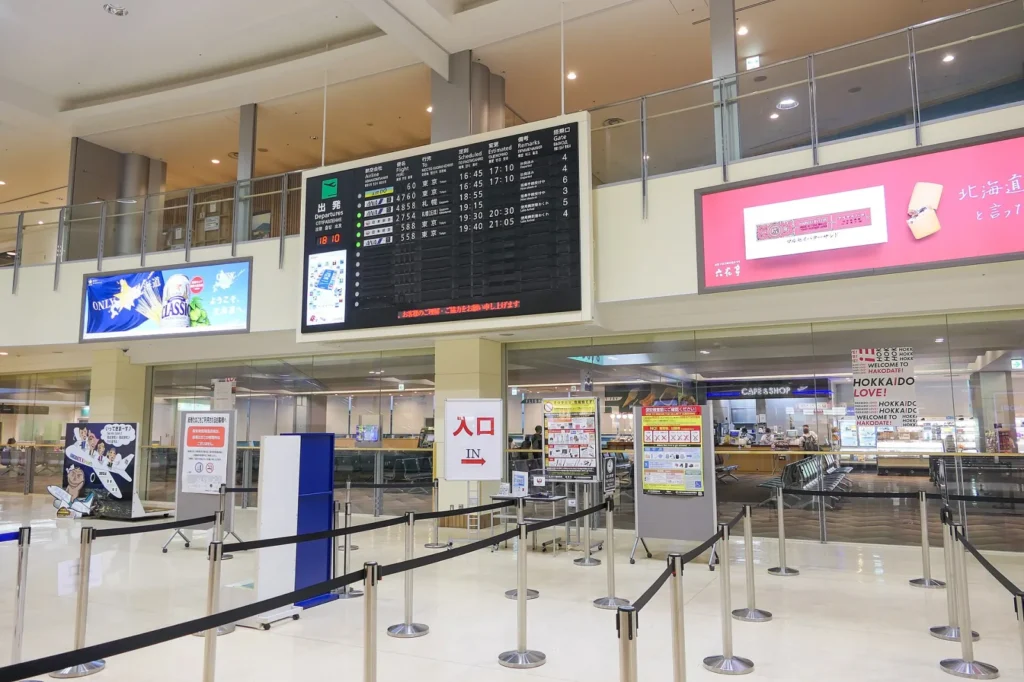
At all airports managed by ONDA (Casablanca Mohammed V, Marrakech Menara, Agadir, Tangier, Fez, Rabat-Salé and others), cabin baggage goes through an X-ray scanner and may be subject to a manual search. Prepare your passage to save time: take out the one-litre bag of liquids, remove bulky electronic devices (laptop, tablet) from their case, and empty your pockets into the tray. Prohibited items spotted at the checkpoint are confiscated on the spot.
Also anticipate delays: arrive early enough, especially at peak times. Once through security, check that you have time to reach the gate. If you land in Morocco, remember to organise your airport transfer in advance to avoid stress on arrival.
Special cases: families, sport and fragile items
Some situations call for specific preparation. Families, athletes and travellers carrying valuables should anticipate extra rules, often specific to each airline.
Travelling with a baby or young children
Most airlines allow, on top of the usual allowance, a folding stroller and sometimes a car seat, usually checked free of charge at the foot of the aircraft. In the cabin, you can carry the food and milk your baby needs outside the one-litre bag. Check before departure whether a changing bag counts as your personal item or is added to the allowance: the rule varies by carrier.
Valuables, fragile and electronic items
Valuables — jewellery, cameras, laptops, important documents — must always travel in the cabin, never in the hold. The same applies to essential medication and keys. Keep these items in your personal item, within reach at the security checkpoint. For bulky fragile items that do not fit in the cabin, ask about the reinforced packaging offered by the airline.
A short checklist before closing your case
- Check your airline’s exact dimensions and weight on its official site.
- Prepare the transparent one-litre bag for liquids.
- Put power banks and spare batteries in the cabin, terminals protected.
- Move knives, long-bladed scissors and box cutters to the hold.
- Keep medication, documents and valuables within reach.
- Weigh your case full, wheels and handles included.
Tips for a cheap flight: avoiding baggage surcharges
On low-cost carriers, the baggage surcharge can cost more than the ticket itself. Here is how to optimise your cabin baggage with no nasty surprises.
- Read the allowance before buying: a “cheap” ticket without a hold bag may cost more than a higher all-inclusive fare.
- Buy the baggage option online: at the boarding gate the price is almost always higher.
- Respect the exact dimensions: invest in a cabin case matching the strictest airline you use.
- Wear the heavy clothes: a coat and bulky shoes do not count towards the bag’s weight.
- Spread the weight: put dense items in the personal item if it is not weighed.
- Travel light: for a short trip, a single well-organised cabin bag is often enough.
Also think about entry formalities before departure: depending on your nationality, a Morocco visa or entry requirements may apply, and some products are subject to customs rules worth knowing before packing.
Frequently asked questions about cabin baggage in Morocco
What cabin bag size is allowed in Morocco?
There is no single size: it depends on the airline. Royal Air Maroc allows 55 x 40 x 25 cm, Air Arabia Maroc 55 x 40 x 20 cm, while low-cost carriers often limit the basic fare to a small bag under the seat (for example 40 x 30 x 20 cm). Always check your carrier’s official page.
What is the maximum weight for a cabin bag?
Most often 10 kg for the main cabin bag, and up to 12 kg in Business Class on Royal Air Maroc. Some airlines, such as Transavia, count a maximum total of 10 kg for everything you take on board. Confirm the exact figure on the airline’s website.
Can I take a power bank in my cabin bag?
Yes, and it is in fact required: power banks and spare lithium batteries are banned from the hold and must travel in the cabin. Those up to 100 Wh are generally accepted; above that, the airline’s approval may be needed. Protect the terminals against any short circuit.
How much liquid can I take in the cabin?
Each container must not exceed 100 ml, and all must fit inside a single transparent one-litre plastic bag. Medication and baby food needed for the flight are exceptions, but must be presented at the checkpoint and justified if required.
Are scissors allowed in the cabin?
Long-bladed scissors are banned from the cabin and must go in the hold. Small round-tipped scissors, like nail clippers and tweezers, are generally tolerated. When in doubt, put them in the hold to avoid confiscation.
Can I take a lighter on the plane?
Lighters are banned from the hold. In the cabin, the general rule tolerates at most one ordinary lighter carried on your person, but practices vary by airport. Torch lighters are banned everywhere. When in doubt, do not take it.
What happens if my cabin bag exceeds the allowed dimensions?
At the desk or the boarding gate, a bag that is too big or too heavy is moved to the hold for an extra fee, usually higher than the option bought online in advance. Hence the value of respecting your airline’s exact measurements.
Are the rules the same on departure and arrival in Morocco?
Security rules (liquids, prohibited items, batteries) follow international standards applied everywhere. Commercial dimensions and weights depend on the airline, not the airport: they are therefore the same in either direction, as long as you travel with the same carrier.
In summary
Preparing your Morocco cabin baggage well rests on three simple habits. First, check your airline’s exact dimensions and weight, because they change from one carrier to another: 55 x 40 x 25 cm on Royal Air Maroc, 55 x 40 x 20 cm on Air Arabia Maroc, and often just a small bag under the seat on the basic low-cost fare. Second, respect the shared security rules: liquids in 100 ml containers inside a one-litre bag, sharp objects in the hold, lithium batteries and power banks in the cabin only. Finally, plan ahead to avoid surcharges, buying baggage options online and weighing your case before you leave. When in doubt about a figure or a rule, always check the official source: regulations change regularly.
Official sources
- Royal Air Maroc — Carry-on baggage (official rules)
- Air Arabia — Hand baggage
- IATA — Safe travel with lithium batteries
- European Union — Luggage and liquids restrictions
- ONDA — National Airports Office (Morocco)
Photo credit
Illustrations : « Hakodate Airport security check » — MaedaAkihiko (CC0) ; « Cathay Pacific check-in counters » — N509FZ (CC BY-SA 4.0), via Wikimedia Commons.