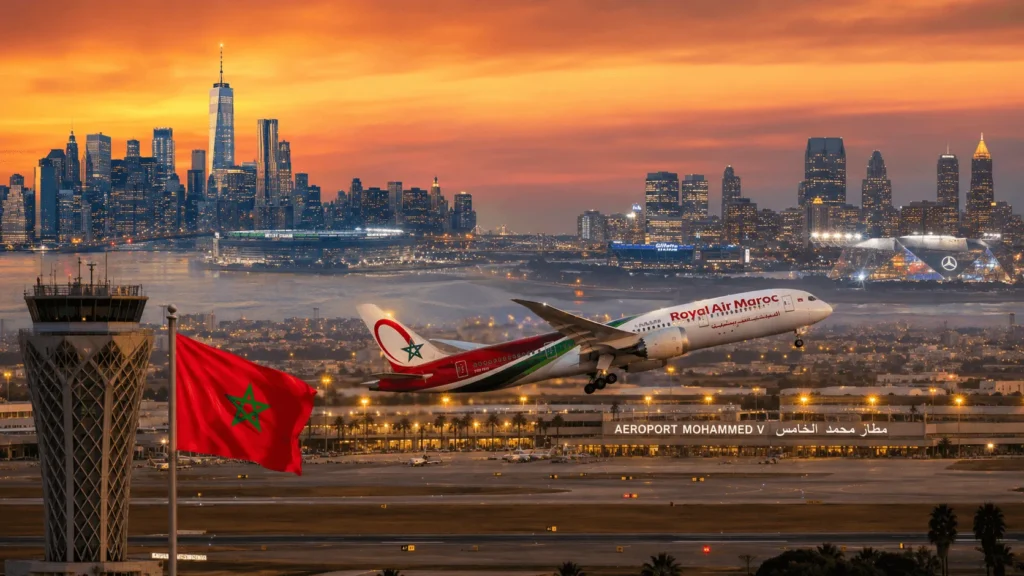
On 7 June 2026, Royal Air Maroc opened a direct service between Casablanca and Los Angeles, and in doing so created the first non-stop air link between Africa and the west coast of the United States. That single route changed what Casablanca is: no longer only a gateway to Morocco but a working transatlantic hub with coverage from the Atlantic seaboard to California. This guide sets out the current North American network, how connecting through Casablanca actually works, what the Moroccan airport system can now handle, and the entry rules that apply in each direction.
In brief
- Casablanca to Los Angeles launched on 7 June 2026, three times a week on Tuesdays, Fridays and Sundays, operated by Boeing 787 Dreamliner. It is the first direct link between Africa and the US west coast.
- The North American network also covers New York, Washington, Miami, Atlanta, Montreal and Toronto.
- Atlanta is a new destination for the airline, which had never served it before 2026.
- Royal Air Maroc is a member of the Oneworld alliance, which governs where you check in at US airports and how connections are protected.
- Casablanca Mohammed V passed 11 million passengers in 2025, rising from 10.5 to 11.5 million over the year, a 9.3 per cent increase. The stated target is 12.5 million in 2026 and more than 20 million by 2030.
- Moroccan airports handled 36.3 million passengers in 2025, up 11 per cent, and traffic with the Americas rose 27.2 per cent in the first quarter of 2026.
- Entry rules differ sharply by passport. Nationals of visa-waiver countries need an ESTA, which costs 21 dollars and can take up to 72 hours. Moroccan nationals need a B1/B2 visitor visa, with a 185-dollar fee.
- A valid US visa unlocks the rest of the continent: it removes the Mexican visa requirement and eases a Canadian electronic travel authorisation.
Casablanca to Los Angeles: why this route matters
Until June 2026, reaching the western United States from anywhere in Africa meant two flights and a European or east-coast connection. Royal Air Maroc’s Casablanca to Los Angeles service removed that for the first time. The airline’s chief executive, Hamid Addou, described the launch as a milestone in the history of Royal Air Maroc and of African aviation, and on the specific point of geography that is accurate rather than promotional: no carrier had previously flown non-stop between the African continent and the US Pacific coast.
The service operates three times a week, on Tuesdays, Fridays and Sundays, with Boeing 787 Dreamliner equipment and a premium cabin. Its commercial logic runs in three directions at once: Moroccan and wider African travellers heading west, American leisure travellers heading to Morocco, and business traffic between California and the African markets that Casablanca connects to. For a traveller based in Los Angeles, it also turns Morocco from a two-connection trip into a single flight, which changes the calculus for a one-week holiday considerably.
Frequencies on a new long-haul route are routinely adjusted after the first seasons, so treat three weekly as the launch pattern rather than a permanent timetable, and check the airline’s own schedule for the dates you want.
The full North American network
Los Angeles joined a network that already reached the east coast, the south and eastern Canada. The table below sets out the picture as it stands, with the practical note that matters for each.
| Destination | Airport | Worth knowing |
|---|---|---|
| New York | JFK | The historic anchor of the network. Royal Air Maroc uses Terminal 8 as a Oneworld member, which simplifies connections onto partner airlines |
| Los Angeles | LAX | Opened 7 June 2026, three weekly, Boeing 787. The first non-stop service between Africa and the US west coast |
| Washington | IAD | The institutional and diplomatic route, useful for onward US domestic connections |
| Miami | MIA | The southern gateway, and the natural connecting point for Latin America |
| Atlanta | ATL | A genuinely new destination for the airline, added in 2026. ATL is the busiest airport in the world, so onward domestic options are extensive |
| Montreal | YUL | Long-standing route serving a large francophone Moroccan community |
| Toronto | YYZ | The second Canadian gateway, with wide onward connectivity |
Who else flies these corridors, and on which days, is covered in our overview of airlines flying to Morocco. One structural point is worth stating plainly: for most of Morocco, Royal Air Maroc via Casablanca is the only single-ticket option to North America. There are no long-haul services from Marrakech, Fes, Agadir or Tangier, so a trip from those cities to the United States is a domestic or short-haul feed into Casablanca followed by the transatlantic leg.
Connecting through Casablanca: how it works in practice
Casablanca Mohammed V is the point where this network either works for you or does not, and the difference is almost always how the ticket was bought.
One ticket, not two
A single through ticket from, say, Marrakech to New York protects your baggage to the final destination and makes the airline responsible if the first leg is late and you miss the second. Two separately bought tickets do neither: if the feeder flight is delayed, the transatlantic carrier owes you nothing and you buy a new ticket. This is the single most expensive mistake on this route, and it is entirely avoidable.
Allow more time than the minimum
At Moroccan airports, bags and passengers are screened at the terminal entrance, before check-in, which adds a queue that travellers arriving from Europe or North America do not expect. On departure, allow two hours as a minimum for an international flight and two and a half to three hours in summer. For a connection in Casablanca, the published minimum connecting time is a floor rather than a recommendation; if you have the choice, take the longer option. Our Casablanca layover guide covers what to do with the gap, and our guide to the airport itself covers the terminals and the services.
Baggage and check-in
Transatlantic allowances differ from the intra-European ones many travellers are used to, and they differ by cabin and fare. Check them before you pack rather than at the desk: our guide to the Royal Air Maroc baggage allowance sets out the current rules, and online check-in is worth doing before you leave for the airport given the extra entrance screening. If you are travelling with a tight connection or in a group, our guide to fast track at Moroccan airports explains where it genuinely saves time and where it does not.
What the 2026 World Cup revealed about capacity
The expansion described above did not happen in the abstract. The 2026 World Cup, co-hosted by the United States, Mexico and Canada from 11 June to 19 July 2026, was the first to run with 48 teams and 104 matches across 16 host cities, eleven of them in the United States, and it produced a surge in demand from Morocco that the airline met with an exceptional programme. That tournament is over, but what it demonstrated about the network is not, and it is the reason the route map looks as it does now.
For the group stage, Royal Air Maroc operated 32 additional flights between 13 and 27 June 2026 with wide-body aircraft, adding more than 8,800 seats to New York, Boston and Atlanta on top of the scheduled services, at a flat economy fare of 10,000 dirhams including taxes on fixed, non-refundable dates. Frequency on Casablanca to New York was doubled to two flights a day for the period. Atlanta, served for the first time, has remained on the map since.
Two conclusions follow for a traveller planning now. The first is that the airline can and does mount large temporary capacity increases on this corridor for major events, so an apparently full route is worth rechecking closer to the date. The second is more durable: Morocco co-hosts the 2030 World Cup with Spain and Portugal, and the infrastructure programme described below is being built against that deadline.
The Moroccan airport system behind the network
A transatlantic hub needs an airport that can absorb the connecting traffic, and the figures published by the national airports office, ONDA, show where that stands.
| Indicator | Figure | Period |
|---|---|---|
| Casablanca Mohammed V passengers | 11.5 million, up from 10.5 million, a 9.3 per cent rise | 2025 |
| Casablanca target | 12.5 million, then more than 20 million | 2026, then 2030 |
| All Moroccan airports | 36.3 million passengers, up 11 per cent | 2025 |
| Tangier Ibn Battouta | 2,812,029 passengers, up more than 17 per cent | 2025 |
| Tangier Ibn Battouta | Up more than 19 per cent | January 2026 |
| Traffic with the Americas | Up 27.2 per cent | First quarter 2026 |
The 27.2 per cent growth in traffic with the Americas is the number that explains the route map: this is the fastest-growing part of the Moroccan network, and the Los Angeles launch and the Atlanta addition are responses to it rather than bets against it. Casablanca crossing 11 million passengers in 2025 was helped by the 2025 Africa Cup of Nations, which is a reminder that single events move these figures, but the underlying trend across the whole network was 11 per cent growth.
All of this sits inside ONDA’s Airports 2030 strategy, which covers modernising the infrastructure, improving the passenger experience and building capacity ahead of the 2030 World Cup. The practical consequence for anyone flying through Casablanca over the next few years is construction: expect temporary routings, relocated desks and changed car parks, and follow the signage rather than your memory of a previous trip. Passenger figures airport by airport are tracked on our page covering Moroccan airport passenger numbers, and the full list of platforms is on our page on airports in Morocco.
Entry rules in both directions
This corridor connects two very different visa regimes, and which one applies to you depends entirely on your passport rather than on your itinerary.
Travelling to the United States
Nationals of the 42 countries in the US Visa Waiver Program, including France, Spain, Germany and the United Kingdom, travel on an ESTA: an electronic authorisation valid for two years and stays under 90 days. It costs 21 dollars and approval can take up to 72 hours, so it is not something to leave to the airport. Morocco is not in the programme, so Moroccan nationals need a B1/B2 visitor visa obtained before departure. The procedure is the DS-160 form online, a visa fee of 185 dollars, an interview appointment at the embassy in Rabat or the consulate in Casablanca, and the interview itself with supporting documents. Appointment waits vary considerably, and no special arrangement for any sporting event replaces the visa requirement.
Canada and Mexico
For Canada, Moroccan nationals have two routes. A visitor visa, or TRV, is the standard option. An electronic travel authorisation, or eTA, costing 7 Canadian dollars and applied for online, is available to Moroccan citizens only if they have held a Canadian visa in the previous ten years or hold a valid US visa. For Mexico, no Mexican visa is required if you hold a valid visa or permanent residence for the United States, Canada, the United Kingdom or the Schengen area; otherwise a standard visa applies. The practical upshot is that a valid multiple-entry US visa functions as a key to the whole continent.
Travelling to Morocco
In the other direction it is far simpler. US, Canadian, British, Australian and European Union nationals need no visa for a tourist stay under 90 days, and the binding requirement is a passport valid at least six months beyond your planned departure from Morocco. The detail, including the cases that are not straightforward, is in our guide to Morocco visa and entry requirements.
Getting into town at the North American end
The part of a transatlantic trip that most often goes wrong is the last hour, not the eight before it. Each of these gateways has a rail or bus option that beats a taxi on both cost and, at peak times, on speed. The figures below are the ones published for the three airports where Royal Air Maroc added capacity in 2026; at the other gateways the arrangements differ and are worth checking before you land rather than at the kerb.
| Airport | Best option into town | Time and cost |
|---|---|---|
| New York JFK | AirTrain JFK to the subway or the Long Island Rail Road | About 45 to 60 minutes to Manhattan, around 15 dollars. A taxi runs on a flat fare of 70 dollars to Manhattan, before the tip |
| Boston Logan | The Silver Line bus to South Station | About 15 minutes, and free from the airport. A taxi is around 30 dollars |
| Atlanta Hartsfield-Jackson | The MARTA red line to Peachtree Center | About 20 minutes for 3 dollars, comfortably the fastest and cheapest of the three |
Two notes that apply across all of them. Atlanta Hartsfield-Jackson is the busiest airport in the world, which cuts both ways: onward domestic connections are unusually good, and the walk between concourses is longer than you will estimate from the map. And New York has a second gateway at Newark, often cheaper and well connected, which is worth comparing if you are booking the domestic or European leg separately from the Casablanca flight.
How the Oneworld membership changes your options
Royal Air Maroc’s membership of Oneworld is more than a loyalty detail, and it is the single biggest reason this network reaches further than seven destinations. At JFK the airline operates from Terminal 8, which is the Oneworld terminal, so a connection onto a partner carrier happens inside one building rather than across an airport transfer with a fresh security queue. Booked on one ticket, that connection is protected: if the Casablanca flight is late, the onward leg is the airline’s problem rather than yours.
The practical consequence is that a city with no direct Moroccan service — Chicago, Dallas, Seattle, Vancouver — is often reachable on a single itinerary through New York or through one of the other gateways, at a fare that compares with routing through Europe and with one fewer time zone of jet lag. It also means alliance status and baggage allowances generally carry across the whole journey, which matters more on a long-haul trip with a domestic leg at the end than on a short hop.
Which Moroccan airport should you fly into?
Travellers coming the other way, from North America to Morocco, face a decision the network partly makes for them. Because the long-haul services all operate from Casablanca, your real choice is whether to stop there or to continue.
- Casablanca, and stay. The right answer if your trip is business, if you are heading north to Rabat, Tangier or Fes, or if you want to sleep off the flight before moving on. The city has the country’s widest business hotel stock, and hotels near the airport make an early onward flight manageable.
- Casablanca, then onward to Marrakech. The standard choice for a first trip, and the one most itineraries take. Book it as one ticket; the domestic leg is short and frequent.
- Casablanca, then onward to Agadir. For a beach-led trip, particularly in winter when the Atlantic coast is the warmest part of the country by day.
- Casablanca, then the train. Underrated. The rail network links Casablanca to Rabat, Tangier, Meknes, Fes and Marrakech comfortably, and for the northern cities it is often better than a second flight once you count the airport time at both ends.
The one combination to avoid is a tight self-assembled connection in Casablanca onto a separately booked domestic flight, for the reason set out above. If the schedule forces it, build in a night: a hotel costs less than a replacement ticket, and you will want the sleep regardless after eight hours in the air.
Practical advice for the transatlantic leg
- Book the through ticket. Worth repeating because it is the difference between an inconvenience and buying a second ticket.
- Check the day of the week. Three weekly on Los Angeles means your return options are Tuesday, Friday and Sunday, which shapes the whole trip rather than just the flight.
- Use the alliance. As a Oneworld member, Royal Air Maroc connects onto partner airlines at JFK Terminal 8, which widens your onward US options considerably compared with booking a separate domestic ticket.
- Allow for the entrance screening at Moroccan airports, which comes before check-in and surprises almost every first-time visitor.
- Carry no local currency expectations. The dirham cannot be bought outside Morocco, so arriving passengers need the cash machines in the arrivals hall before the taxi rank.
- If dates are flexible, our guide to the cheapest time to fly to Morocco will move the fare far more than any booking trick.
One further point for travellers continuing beyond Casablanca: there is no rail link into the deep south, so if your final destination is Ouarzazate, Merzouga or the Atlas, plan the domestic leg as part of the same booking. Our guide to getting around Morocco compares the options, and our Morocco travel guide covers the practical layer once you land.
Frequently asked questions
Does Royal Air Maroc fly to Los Angeles?
Yes. The Casablanca to Los Angeles service opened on 7 June 2026 and operates three times a week, on Tuesdays, Fridays and Sundays, with Boeing 787 Dreamliner aircraft. It is the first non-stop air service between Africa and the west coast of the United States. Frequencies on new long-haul routes do change after the first seasons, so confirm the current pattern with the airline for your dates.
Which US cities does Royal Air Maroc serve?
New York, Washington, Miami, Atlanta and Los Angeles, plus Montreal and Toronto in Canada. Atlanta is the most recent addition, served for the first time in 2026. All of these operate from Casablanca, because there are no long-haul services from Marrakech, Fes, Agadir or Tangier.
Can you fly from Marrakech to New York directly?
No. There is no long-haul service from Marrakech, so the journey is a short domestic leg to Casablanca followed by the transatlantic flight. Book it as a single through ticket: with two separate tickets, a delay on the Marrakech leg leaves the transatlantic carrier with no obligation to you and you pay for a new seat.
How long should you allow for a connection in Casablanca?
More than the published minimum connecting time, which is a floor rather than a recommendation. The reason is specific to Moroccan airports: passengers and bags are screened at the terminal entrance before check-in, so queues form earlier in the process than travellers expect. If the schedule offers a longer connection for the same fare, take it.
Do Americans need a visa for Morocco?
No, not for a tourist stay under 90 days. The requirement that catches people out is the passport itself, which must be valid for at least six months beyond your planned departure from Morocco. Check the expiry month rather than trusting your memory of it, because a renewal takes weeks and the rule is applied at check-in.
Do Moroccan nationals need a visa for the United States?
Yes. Morocco is not part of the US Visa Waiver Program, so a B1/B2 visitor visa is required before departure: the DS-160 form online, a 185-dollar fee, an interview appointment in Rabat or Casablanca, and the interview with supporting documents. A valid US visa also removes the Mexican visa requirement and makes a Canadian eTA available, so it is worth more than the single trip.
How busy is Casablanca airport?
It handled 11.5 million passengers in 2025, up from 10.5 million, a rise of 9.3 per cent, and crossed the 11 million mark for the first time that year. The published target is 12.5 million in 2026 and more than 20 million by 2030. Across all Moroccan airports, 2025 traffic reached 36.3 million passengers, an increase of 11 per cent.
Will there be more North American routes?
The direction of travel is clear rather than confirmed. Traffic with the Americas grew 27.2 per cent in the first quarter of 2026, making it the fastest-growing part of the Moroccan network, and the infrastructure programme is being built towards the 2030 World Cup that Morocco co-hosts with Spain and Portugal. New routes are announced each IATA season, in late March and late October, so that is when to look.
In summary
Casablanca has become a genuine transatlantic hub rather than simply the airport you land at for Morocco. Seven North American destinations, a west coast route that did not exist in Africa before June 2026, an airport crossing 11 million passengers, and traffic with the Americas growing at more than a quarter a year make that a statement of fact rather than ambition. For a traveller the practical consequences reduce to three: buy one through ticket rather than two, allow more connecting time in Casablanca than the minimum because of the screening at the terminal entrance, and settle the visa or ESTA question weeks ahead, because it is the only part of this journey that cannot be fixed at the airport.
Sources
- Royal Air Maroc for routes, schedules, aircraft and the Los Angeles launch, and the airline’s statements on the 2026 programme.
- ONDA, Office National Des Aéroports for passenger figures, the Airports 2030 strategy and terminal information.
- FIFA for the 2026 tournament format and dates, and the 2030 hosting arrangement.
- US Department of State for visa categories and fees, and Immigration, Refugees and Citizenship Canada for the eTA.
Informational guide, reviewed in November 2026. Schedules, frequencies, fares, visa fees and processing times change without notice: confirm them with the airline and with the relevant consulate before booking. This guide is independent and not affiliated with Royal Air Maroc, ONDA, FIFA or any government agency.