Getting around with taxis and Uber in Morocco comes down to one rule worth knowing before you land: Uber left the country in 2018, then returned in November 2025, but only in Casablanca and Marrakech and only through licensed vehicles. Everywhere else in the kingdom, the famous petit taxis (metered city cabs, a different colour in each city) and grand taxis (shared inter-city cars with a flat fare) remain the most reliable and cheapest way to travel. This guide explains which taxi to take, how much to pay, which apps actually work in 2026, and how to avoid the most common scams.
Whether you are flying in from London, New York, Paris or Frankfurt, understanding how the Moroccan taxi system works will save you money and, above all, stress the moment you step out of the airport. Fares are low compared with Europe or the United States, but the system is different: the meter is rarely switched on for tourists, rides are shared, and negotiation is part of the deal. Here is everything you need to know, backed by real figures.
In short: the essentials on taxis and ride-hailing in Morocco
- Petit taxi: city trips, metered (required by law), 3 passengers maximum, a colour unique to each city.
- Grand taxi: inter-city trips, usually shared with 6 passengers, no meter, a flat fare agreed before departure.
- Uber: left Morocco in 2018, back since November 2025 in Casablanca and Marrakech only, using licensed transport vehicles.
- Other apps: Careem, inDrive, Heetch/Toogo, Bolt, Yango and Roby exist depending on the city, but their legal status still varies. Check availability once you arrive.
- Indicative fare: a petit taxi ride across town often costs 15 to 30 MAD by day; add roughly 50% at night.
- Anti-scam: insist on the meter or agree the price before getting in, and carry small change.
Petit taxi or grand taxi in Morocco: what is the difference?
Morocco officially separates taxis into two categories with clearly defined roles. The petit taxi operates within a single city and cannot cross municipal boundaries. The grand taxi links cities together and serves areas the petit taxi does not cover, including some airports located outside the urban area. Understanding this difference prevents a lot of confusion.
The petit taxi: the metered city cab
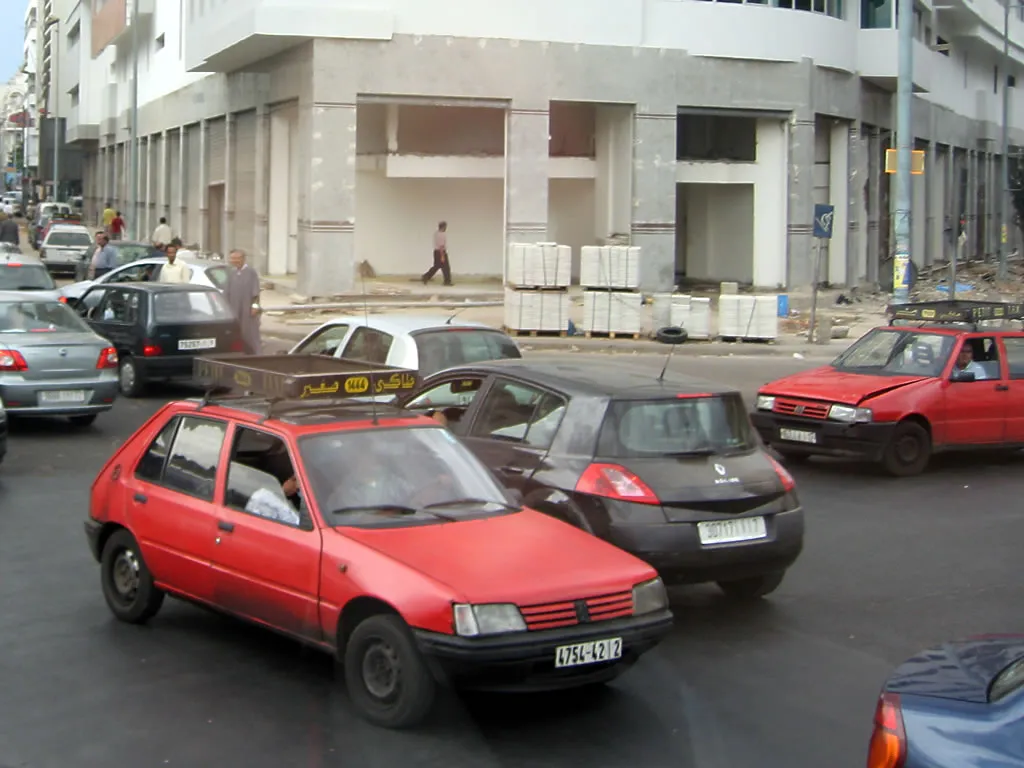
The petit taxi is a small sedan (often a Dacia, Fiat or Peugeot) reserved for trips within the city. The law requires the use of the meter (taximeter): the flag fare starts at around 2 MAD, with a minimum charge of about 7.5 MAD per ride. In practice, the meter is unfortunately not always switched on, especially with tourists. A petit taxi carries a maximum of 3 passengers (1 in front, 2 in the back); beyond that, you need two cars.
Important point: a petit taxi can be shared. The driver may pick up other passengers along the way if they are heading the same direction, each paying their share on the meter. This is not a scam, it is how the system normally works. If you prefer the car to yourself, say so at the start.
The grand taxi: the shared inter-city cab
The grand taxi is traditionally an old cream-coloured Mercedes 240, now often replaced by a Dacia Logan. It links towns and villages and usually runs in collective mode: it leaves once its 6 seats are full (2 in front alongside the driver, 4 in the back). Each passenger pays a standardised per-seat fare for the route. There is no meter: the price is fixed and well known to regulars.
You can also privatise a grand taxi by booking all the seats, which is called a “course” (private hire). In that case, always agree the total price before setting off. It is a convenient and comfortable option for an airport run, an excursion or a trip between two nearby cities, provided you negotiate calmly.
| Criterion | Petit taxi | Grand taxi |
|---|---|---|
| Zone | Urban (single city) | Inter-city (between cities) |
| Meter | Yes (required by law) | No (flat fare) |
| Passengers | 3 maximum | 6 when shared |
| Pricing | By meter, night surcharge | Per seat or private “course” |
| Vehicle | Small sedan, city colour | Cream Mercedes/Dacia with stripe |
Petit taxi colours by city
One of the most useful things to know: every Moroccan city has its own petit taxi colour. Spotting the right shade helps you identify an official taxi at a glance and avoid getting into a vehicle that is not one. Here are the main colours by city.
| City | Petit taxi colour |
|---|---|
| Casablanca | Red |
| Marrakech | Ochre / beige |
| Rabat | Blue |
| Tangier | Turquoise |
| Agadir | Red / orange |
| Fez | Red (varies) |
If you are unsure of the local colour, look for the “TAXI” sign on the roof and the professional plate. A genuine petit taxi always displays its meter on the dashboard. When in doubt outside an airport, head for the official taxi rank rather than a tout who approaches you in the hall.
How much does a taxi cost in Morocco? Indicative 2026 fares
Fares for taxis in Morocco are set by local decree, so they vary slightly from one city to another. The figures below are indicative and may change; always check the official display in the car and prefer the meter.
Petit taxi fares (day and night)
For a petit taxi, the flag fare starts around 2 MAD, with a minimum charge of about 7.5 MAD. The meter then runs by the kilometre travelled. At night, a surcharge of around 50% applies, generally between 8 pm and 6 am in winter (9 pm to 5 am in summer). In practice, a short ride across the city centre often comes to 15-30 MAD by day, and a longer crossing to 30-50 MAD. After 8 pm, add roughly half again.
Grand taxi fares (inter-city)
The grand taxi charges per seat, at a flat fare based on distance. As an example seen in 2026, expect roughly 70 to 90 MAD per seat for Marrakech-Essaouira, or 35 to 45 MAD for Tangier-Tetouan. To privatise the whole vehicle (a “course”), multiply roughly by the number of available seats, then negotiate an agreed lump sum before setting off.
| Type of ride | Indicative range (MAD) |
|---|---|
| Petit taxi, short city trip (day) | 15 – 30 |
| Petit taxi, longer crossing (day) | 30 – 50 |
| Night surcharge (petit taxi) | approx. + 50% |
| Grand taxi, per seat (e.g. Marrakech-Essaouira) | 70 – 90 |
| Grand taxi, per seat (e.g. Tangier-Tetouan) | 35 – 45 |
For reference, 100 MAD is worth roughly £8 / $10 / €9 depending on the day’s exchange rate. Payment is almost always in cash: bring small notes, as drivers rarely give change for a large bill. For everything about currency, exchange and withdrawals, see our money in Morocco guide.
Is Uber back in Morocco? The state of ride-hailing apps
Yes, Uber is available again in Morocco as of November 2025, but in a tightly controlled way. After arriving in 2015 and then suspending operations in 2018 for lack of a clear legal framework and under pressure from traditional taxis, the service returned to Casablanca and Marrakech only. The relaunch is limited to the UberX and UberXL categories, and access to the platform is reserved for companies that already hold a transport licence: private drivers are excluded, and there is no integration with classic taxis.
The regulatory framework for ride-hailing nonetheless remains incomplete in Morocco: several apps operate in a grey area, and the landscape changes fast. So do not assume Uber will be everywhere: in most cities and for any trip outside Casablanca and Marrakech, the taxi is still the reference.
The other taxi and ride-hailing apps
Several apps coexist, with widely varying coverage and status:
- Careem: present in some large cities (Casablanca, Rabat, Tangier). Its merger with Uber has not yet been approved by the Competition Council.
- Heetch / Toogo: operates by working with licensed taxis, which places it within a legal ride-matching framework.
- Roby: a Moroccan app that works exclusively with registered official taxis, present in Marrakech, Casablanca, Agadir and Rabat.
- inDrive: popular in several cities, with a price-negotiation model, but its regulatory status is contested.
- Bolt and Yango: active notably in Casablanca and Rabat, but likewise in an uncertain regulatory position.
This information may change quickly. The best move: install one or two apps before you leave, then test their real availability once you are on the ground, in the city concerned. For everything about overall travel safety, read our dedicated analysis: is Morocco safe?
| App | Main cities | Key point |
|---|---|---|
| Uber | Casablanca, Marrakech | Returned in 2025, licensed vehicles |
| Careem | Casablanca, Rabat, Tangier | Variable coverage |
| Heetch / Toogo | Casablanca, Rabat | Matching with licensed taxis |
| Roby | Marrakech, Casablanca, Agadir, Rabat | Registered official taxis |
| inDrive | Several cities | Negotiated price, contested status |
| Bolt / Yango | Casablanca, Rabat | Availability and status to check |
How to avoid taxi scams in Morocco
The vast majority of drivers are honest, but a few simple habits are enough to avoid unpleasant surprises, especially around airports and tourist sites. Here are the tips that work.
- Insist on the meter in a petit taxi: get in and simply say “on the meter, please”. If the driver refuses, take the next taxi.
- Agree the price before leaving if the meter is not used (grand taxi, private hire). The price is negotiated before getting in, never on arrival.
- Check the normal fare with your hotel before heading out: you will know instantly whether the quoted price is reasonable.
- Carry small change: keep small notes, as “I have no change” is a classic line.
- Avoid touts in airport halls and join the official taxi rank.
- Use an app when one is available: the price is set in advance and the trip is tracked, which limits disputes.
- Give a known landmark (monument, neighbourhood, main avenue) rather than a precise address: drivers navigate mainly by landmarks.
From the airport: taxi, grand taxi or ride-hailing?
On arrival at Casablanca-Mohammed V, Marrakech-Menara or Agadir, several options coexist. Airports often apply an official flat fare to the city centre, displayed at the taxi rank: ask for it and insist on it. The grand taxi can be worthwhile to reach another city directly, while ride-hailing apps (where they work) offer a price known in advance and payment without haggling.
Your choice depends on your budget, arrival time and amount of luggage. To compare all airport transfer options in detail, see our airport transfers in Morocco comparison. And if you land in the economic capital, our guide to where to stay in Casablanca will help you choose a neighbourhood well served by taxis.
Using a ride-hailing app well in Morocco
When an app works in your city, it offers real convenience: an estimated price before you order, a tracked trip, no argument over the fare. But you still need to use it properly. Here are the key points to avoid unpleasant surprises and travel with peace of mind.
Payment and displayed fare
Depending on the app, you can pay in cash or by card saved in the app. In Morocco, many rides are still paid in cash, even through an app: so always keep small change on hand. Check the estimated price before confirming, and watch out for surge pricing during high demand (rush hours, rain, evenings). The amount can then climb: compare with a metered petit taxi if the gap becomes significant.
Safety during the ride
Before getting in, check that the number plate and vehicle model match what the app shows. Share your trip in real time with someone close via the dedicated feature, sit in the back and keep your phone charged. These habits apply everywhere in the world and remain the best guarantee of a calm ride. If you have doubts about a driver’s reliability, cancel and order another car: it is better to wait a few extra minutes.
Grand taxi, train or bus: which inter-city option to choose?
To link two cities, the grand taxi is not your only option. Morocco has a rail network (ONCF), with the Al Boraq high-speed line between Tangier and Casablanca, and long-distance bus companies such as CTM and Supratours. Each solution has its advantages depending on the route, budget and timetable.
The grand taxi is the fastest to find and leaves as soon as it is full, with no fixed timetable: ideal for short distances or areas poorly served by rail. The train is comfortable and punctual on the main lines (Tangier, Rabat, Casablanca, Marrakech, Fez). The bus covers a very wide network, including small towns, with tickets bookable in advance. Here is a quick guide.
| Mode | Strengths | Good to know |
|---|---|---|
| Grand taxi | Fast to find, leaves when full | No timetable, variable comfort |
| Train (ONCF / Al Boraq) | Comfort, punctuality, main lines | Network limited to certain cities |
| Bus (CTM / Supratours) | Very wide network, booking | Slower, fixed timetables |
For an airport located out of the way, a private “course” grand taxi or a private transfer is often the simplest with luggage. Remember to check the official ONCF or bus company timetables before choosing, as they change with the season.
Tipping, language and taxi etiquette
Tipping is not compulsory in a taxi in Morocco, but it is appreciated: rounding up to the next dirham or leaving a few coins for a fair ride is a common and well-received practice. For a privatised grand taxi or a driver who helps with your luggage, a small gesture always goes down well.
On language, French is widely understood in the cities, and a few words of Moroccan Arabic (Darija) make contact easier. “On the meter” is “bil-contour”, “how much?” is “bch-hal?”, and “thank you” is “choukran”. A calm, courteous tone defuses most tensions. Finally, give your destination with a known landmark, and confirm the price or the meter before setting off: clarity at the start avoids any misunderstanding on arrival.
FAQ: taxis and Uber in Morocco
Does Uber work in Morocco in 2026?
Yes, Uber returned to Morocco in November 2025, but only in Casablanca and Marrakech, using licensed transport vehicles and the UberX and UberXL categories. Elsewhere in the country it is not available: use taxis or other apps depending on the city.
What is the difference between a petit taxi and a grand taxi?
The petit taxi operates only within the city, on the meter, with a maximum of 3 passengers. The grand taxi links cities together, has no meter, and is usually shared with 6 passengers at a flat per-seat fare.
Is the meter mandatory in a petit taxi?
Yes, the law requires the meter in petit taxis. In practice, it is not always switched on with tourists. Clearly say “on the meter, please” when you get in, or agree the price before departure.
How much does a taxi ride in the city cost?
As a guide, a short petit taxi ride often costs 15 to 30 MAD by day, and 30 to 50 MAD for a longer trip. At night, a surcharge of around 50% applies. Fares vary by city and may change.
Can you pay a taxi by card in Morocco?
In a classic taxi, payment is almost always in cash (dirhams). Some ride-hailing apps allow cashless payment depending on the option chosen. Always carry change, as drivers rarely have change for a large bill.
Which taxi app should I install before leaving?
It depends on your destination. In Casablanca and Marrakech, Uber, Careem or Roby can be useful; elsewhere, test real availability on the ground. As the framework changes fast, install one or two apps and check they offer rides in your city.
How do I recognise a genuine petit taxi?
Look for the city’s official colour (red in Casablanca, ochre in Marrakech, blue in Rabat, turquoise in Tangier…), the “TAXI” sign on the roof and the meter visible on the dashboard. At the airport, always use the official rank rather than a driver who approaches you.
Is it safe to take a taxi in the evening in Morocco?
Taking a taxi in the evening is common and generally trouble-free in the big cities. Prefer official petit taxis or an app where available, agree the night fare before getting in (surcharge of around 50%), and share your trip with someone close. As anywhere, stay aware of your belongings and trust your instinct: when in doubt, wait for the next taxi.
In summary
In Morocco, the taxi remains the most practical and cheapest way to travel for most journeys. Keep the logic in mind: petit taxi in the city, on the meter, in the local colour; grand taxi to travel between cities, at a flat fare. On the app side, Uber is back since 2025 but limited to Casablanca and Marrakech, while Careem, Roby, Heetch/Toogo, inDrive, Bolt and Yango cover other cities with a still-shifting legal status. Insist on the meter or agree the price in advance, keep small change, and you will travel with peace of mind. As this information may change, always check fares and app availability once you are there.
Official sources
- Office National Des Aéroports (ONDA) – Morocco’s airports
- Ministry of Equipment and Water – road transport
- Office des Changes – currency and exchange
- UK FCDO – Morocco travel advice
Photo credit
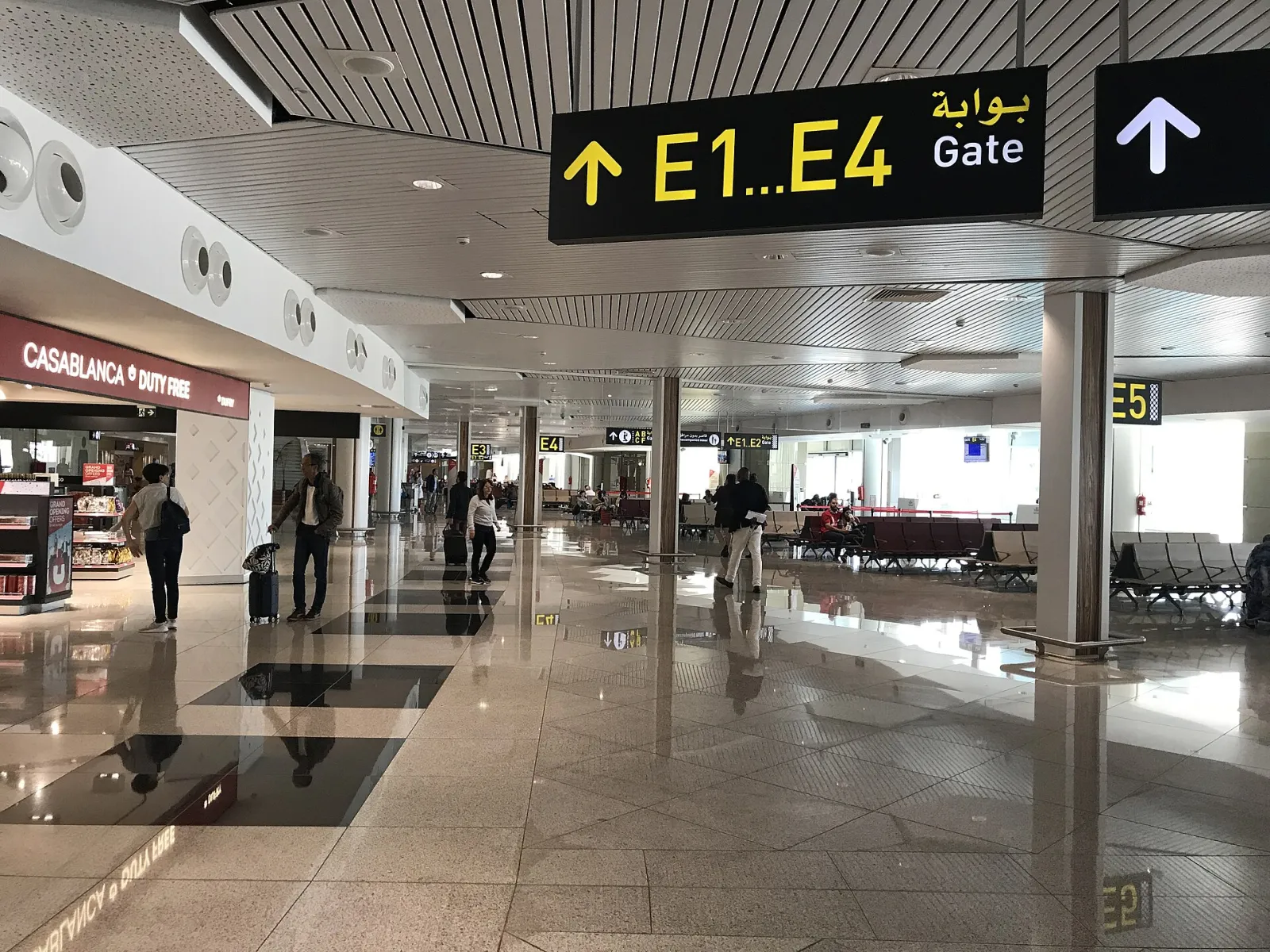
Illustrations : « Petit taxis in Casablanca » — Goose (CC BY-SA 3.0) ; « Mohammed V International Airport – Terminal 1 » — Hamza Izourane (CC BY-SA 4.0), via Wikimedia Commons.