Money in Morocco runs on the Moroccan dirham (MAD or DH), a closed currency you cannot freely buy or exchange abroad: in practice you arrive with euros, pounds or dollars, then convert on the ground, staying within the 2,000 DH limit you are legally allowed to carry in and out. Visa and Mastercard work fine in city hotels, big chains and restaurants, but cash is king in the medinas, souks, small cafés, taxis and the countryside. This complete guide explains where to change money at the best rate, which cards to use, how much ATM withdrawals cost, how to tip correctly, and what daily budget to plan for.
In short: money in Morocco in 8 points
- Currency: the Moroccan dirham (MAD / DH), divided into 100 centimes. It is a closed currency, not freely convertible outside Morocco.
- Legal limit: you may carry a maximum of 2,000 DH in and out of the country (Office des Changes rule).
- Exchange: change on the spot (licensed exchange bureaus, banks, ATMs), not before you leave. Rates are regulated, so fairly uniform.
- Cards: Visa and Mastercard widely accepted in cities (hotels, supermarkets, restaurants, petrol stations); American Express is rarer.
- Cash is king: always keep cash for souks, taxis, cafés, small shops and rural areas.
- ATMs: plentiful in cities; fees possible on both the Moroccan bank’s side and your home bank’s side. Decline conversion into your own currency (DCC).
- Tipping: common but modest, always in dirhams (a few DH in a café, ~10% at a restaurant, 10-20 DH for a porter).
- Indicative budget: from 300-500 DH/day as a backpacker to 1,500 DH/day and up in comfort, accommodation included.
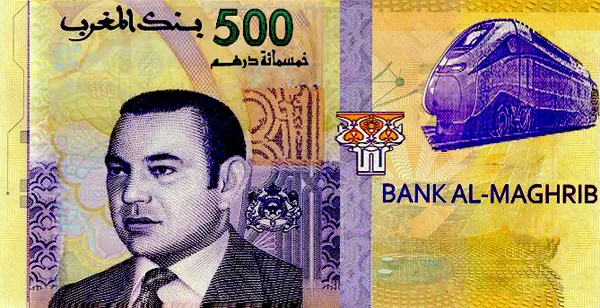
The Moroccan dirham (MAD), a closed currency
The official currency is the Moroccan dirham, international code MAD, often shortened to “DH” or “Dhs”. One dirham divides into 100 centimes. Banknotes in circulation range from 20 to 200 DH (20, 50, 100 and 200 DH) and coins from 1 centime to 10 DH, the most useful in daily life being the 1, 2, 5 and 10 DH coins. The Kingdom’s central bank, Bank Al-Maghrib, issues the currency, while the Office des Changes oversees all exchange operations and publishes the regulatory framework that applies to travellers.
As a rough guide, to be checked before you travel, one euro is worth about 10 to 11 dirhams, one pound sterling about 12 to 13 dirhams and one US dollar about 9 to 10 dirhams. These values fluctuate: check Bank Al-Maghrib’s official rate on the day you exchange rather than relying on an estimate. Because the dirham is relatively stable, you don’t need to watch the market hour by hour as you would with a volatile currency.
What is a “closed currency” and why does it change everything?
The dirham is what’s called a closed currency: it is not freely convertible for capital movements and is not normally traded on international markets. In practice this means you won’t find dirhams (or only with great difficulty, and at a poor rate) at an exchange bureau in France, the UK, the US or Germany. So there’s no point ordering your DH before you go: you’ll change on arrival. This is a defining rule for organising your money in Morocco.
The 2,000-dirham rule on entry and exit
The direct consequence of the closed-currency status: you may physically carry a maximum of 2,000 DH in banknotes both into and out of Moroccan territory. Exceeding this threshold is a foreign-exchange offence, liable to penalties. In concrete terms, don’t leave with a thick wad of dirhams: spend or reconvert your surplus cash before the airport. We detail this rule, along with the declaration of foreign currency, in our guide Morocco customs: what you can bring.
As for foreign currency (euros, pounds, dollars), entry is not capped, but any large sum in foreign currency — above the equivalent of 100,000 DH — must be declared on arrival if you want to be able to re-export it. For a normal tourist trip you are far below these amounts: this obligation mainly concerns travellers carrying exceptional sums. If in doubt, check with the Office des Changes or Moroccan customs, as this information may change.
Where to change money in Morocco at the best rate
Good news: because exchange is regulated by the Office des Changes, rates vary little from one place to another. You won’t lose much changing here rather than there, unlike in some other countries. What matters is choosing the most convenient channel and avoiding hidden fees. Here are the options for handling your money in Morocco.
Exchange bureaus, banks and hotels
- Licensed exchange bureaus: recognisable by their official signage, they are fast, usually commission-free, and display the day’s rate. A safe bet in tourist cities (Marrakech, Fes, Casablanca, Agadir).
- Banks: fair rates, but limited hours (early closing, weekends) and queues. Useful for larger amounts.
- Hotels: convenient but generally the least favourable rate. Keep for emergencies.
- ATMs: often the simplest way to get dirhams at the interbank rate, subject to possible withdrawal fees (see below).
Should you change money at the airport?
The airports run by ONDA (Casablanca-Mohammed V, Marrakech-Menara, Agadir, Fes, Tangier, Rabat and others) have exchange bureaus and ATMs. The airport rate is sometimes slightly less favourable than in town, but the gap stays limited because of the regulation. The smart strategy: change a small amount on arrival (enough for the taxi, a meal and your first purchases), then top up in town or at an ATM. That way you avoid changing everything at the airport rate while still having cash the moment you step off the plane. To reach your hotel, compare the options in our Morocco airport transfers comparison.
Keep your receipts to reconvert your dirhams
Always keep the exchange receipts issued during your transactions. At the end of your trip they let you reconvert your surplus dirhams into foreign currency before you clear customs, within the limit set by the regulation. Without proof, reconversion can be refused or capped. It’s also the best way to avoid getting stuck with dirhams you can’t spend once home, since the currency is closed.
| Where to change | Rate | Commission | Convenience | Best for |
|---|---|---|---|---|
| Licensed exchange bureau (city) | Good | Often none | Fast, wide hours | Most of your exchanges |
| Bank | Fair | Low | Limited hours, queues | Large amounts |
| ATM | Interbank | Possible withdrawal fees | Very convenient, 24/7 | Getting cash quickly |
| Airport bureau | Slightly worse | Often none | Right on arrival | Small emergency amount |
| Hotel | The worst | Variable | On site | Emergencies only |
Paying by card in Morocco: Visa, Mastercard and cash-is-king
To handle your money in Morocco, the golden rule is simple: card in the city, cash everywhere else. Visa and Mastercard are widely accepted in hotels, tourist restaurants, supermarkets (Marjane, Carrefour, Aswak Assalam), big chains, petrol stations and modern shops in the larger cities. American Express and Diners Club are accepted much more sparingly.
Where cards work and where you need cash
As soon as you leave the “modern” circuits, cash becomes essential again. In the medinas and souks, at small traders, in local cafés, taxis, family-run riads, markets and rural areas, you pay in cash. Many small businesses have no card terminal, or add a small surcharge when you pay by card. So always keep a stash of dirhams in small denominations: traders don’t always have change for a 200 DH note.
Also remember to tell your bank about your trip to avoid your card being blocked for an “unusual transaction abroad”, and if possible carry two cards from different banks stored separately, in case one is lost, swallowed by an ATM or declined. For getting around day to day, our guide Taxis and Uber in Morocco explains how to pay for your ride and avoid nasty surprises.
Withdrawing at ATMs: fees and best practices
Cash machines are plentiful in every city and most mid-sized towns (banks such as Attijariwafa Bank, Banque Populaire, BMCE Bank of Africa, CIH Bank, Société Générale Maroc and others). It’s often the simplest way to get dirhams at the interbank rate. Watch out, though, for fees that can pile up.
- Moroccan bank fees: some ATMs apply a fixed commission per withdrawal to foreign cards. It’s displayed on screen before you confirm; you can cancel if it seems high.
- Home bank fees: your own bank may charge a foreign withdrawal fee and a currency conversion commission. Check your terms before you leave; some travel cards limit or waive these fees.
- Limits: the maximum per withdrawal is often capped (frequently between 2,000 and 4,000 DH). Withdrawing a larger sum at once, where possible, reduces the number of fixed fees.
Always decline conversion into your own currency (DCC)
At the ATM as in shops, the machine will sometimes offer to “pay in euros” (or pounds, or dollars) rather than in dirhams: this is dynamic currency conversion (DCC). Always decline it and choose to pay in dirhams (MAD). The conversion offered by the terminal almost always applies a worse rate than your bank’s. Paying in the local currency is the simple rule for not wasting money in Morocco.
A few safety reflexes: favour ATMs attached to a bank branch and in daylight, shield your PIN, check there’s no suspicious device on the card slot, and take your card and cash straight away. In case of a problem (card swallowed, debit with no cash dispensed), note the date, time and place, and contact your bank.
Mobile and contactless payment in Morocco
Contactless payment is growing: in the big cities, many terminals accept contactless by card, and sometimes Apple Pay or Google Pay in modern chains and some hotels. The country is also developing its own local mobile payment solutions, but these often rely on a Moroccan account or phone number and are therefore not designed for the passing traveller.
For a tourist, the most reliable combination remains: an international card (with contactless enabled) for payments in the city, and cash for everything else. Don’t rely on your phone alone to pay in souks or taxis. Check with your bank that contactless and overseas payment are properly enabled on your card before you leave.
Tipping in Morocco: how much to give?
Tipping (colloquially called “bakchich” in Moroccan Arabic) is part of the culture. It’s never compulsory, but it is appreciated and often a genuine income supplement for many service jobs. Golden rule: always give in dirhams and in cash, and match the amount to the quality of service. The ranges below are common practice, not fixed charges.
| Service | Customary tip | Notes |
|---|---|---|
| Café / drink | 1 to 5 DH | Round up, leave the small change |
| Restaurant | ~10% (5-10% local) | Check whether “service included” is on the bill |
| Taxi | Round up to nearest 5 DH | Not expected; locals only round up |
| Porter / bellhop | 10 to 20 DH per bag | On arrival at the hotel |
| Housekeeping | 20 to 50 DH per stay | Leave at the end of the stay |
| Guide (half day) | 50 to 100 DH / person | Depending on group size |
| Guide (full day) | 100 to 200 DH / person | For a private guide |
| Parking / toilet attendant | 2 to 5 DH | Common practice |
Two useful clarifications. First, at a restaurant, if “service included” appears on the bill, an extra tip is optional — you may leave a few dirhams for excellent service. Second, if you pay by card, the tip may not reach the waiter: leave it in cash on the table instead. Finally, always keep a few 1, 2 and 5 DH coins on you: that’s the ideal “tipping change” for daily life.
What daily budget should you plan for Morocco?
Morocco remains a good-value destination for travellers from France, the UK, the US or Germany. Your budget depends mostly on your style of accommodation, how you get around and your activities. The ranges below are indicative, per person per day, accommodation included, and may vary with the season, the city and the exchange rate.
| Profile | Budget/day (indicative) | Approx. equivalent | What it covers |
|---|---|---|---|
| Backpacker / low budget | 300 – 500 DH | ~£25-45 / $30-50 | Simple hostel/riad, street food, shared taxis, free sights |
| Mid-range comfort | 800 – 1,500 DH | ~£65-130 / $80-150 | Charming hotel/riad, restaurants, a few excursions |
| Upscale | 2,000 DH and up | ~£165 / $200 and up | 4-5* hotel, private guide, private transfers, spa |
To give you everyday orders of magnitude: a coffee often costs 10 to 20 DH, a tagine in a local restaurant 40 to 80 DH, a dish in a tourist restaurant 90 to 150 DH, a small urban taxi ride 15 to 40 DH, and a bottle of water 5 to 10 DH. These amounts vary from city to city (Marrakech and Casablanca are pricier than mid-sized towns) and are given as a guide only.
Practical tips for handling your money safely in Morocco
- Split your money: don’t keep everything in one place. A little cash on you, the rest and a second card in the hotel safe.
- Small denominations: ask for change whenever you can; 200 DH notes are hard to use for small purchases.
- Bargain in the souks: haggling is the norm in the souk (not in fixed-price shops or supermarkets). Stay friendly and set yourself a maximum price.
- Check your change: always count your change, especially at night or in a taxi.
- Official exchange only: avoid street “corner” exchange, which is illegal and risky.
- Keep an emergency reserve: a hidden foreign-currency note (euro/pound/dollar) can bail you out if cards and ATMs fail.
Morocco is generally a safe destination when it comes to money, provided you apply the common-sense precautions valid everywhere. For a broader picture of safety on the ground, see our article Is Morocco safe?.
FAQ: your questions about money in Morocco
Can I buy dirhams before I leave?
In practice no, or only with great difficulty and at a poor rate. The dirham is a closed currency, not freely convertible outside Morocco. It’s best to arrive with euros, pounds or dollars and change on the spot, or withdraw directly at an ATM at the airport.
How many dirhams can I carry in or out?
A maximum of 2,000 DH in notes, both into and out of the country. Beyond that you are breaching foreign-exchange rules. Spend or reconvert your surplus cash before heading to the airport.
Is it better to pay by cash or card in Morocco?
Both: the card (Visa/Mastercard) for hotels, supermarkets and city restaurants; cash for souks, taxis, cafés and rural areas. Always keep cash on you, since many small businesses don’t take cards.
Are there fees at Moroccan ATMs?
Often yes: a fixed commission may apply on the Moroccan bank’s side (shown before you confirm), on top of any fees from your own bank. Always decline conversion into your currency (DCC) and pay in dirhams. Check your card’s fees before you leave.
Should I change money at the airport?
Only a small emergency amount. The airport rate is sometimes slightly worse than in town, though the gap stays limited because rates are regulated. Change enough for the taxi and first expenses, then top up in town or at an ATM.
Is tipping compulsory in Morocco?
No, it’s never compulsory, but it’s common and appreciated. Reckon on a few dirhams in a café, about 10% at a restaurant, 10 to 20 DH per bag, always in cash and in dirhams. Adjust to the quality of service.
Can I reconvert my dirhams at the end of the trip?
Yes, within the limit set by the regulation and on presentation of your exchange receipts. That’s why you should keep those receipts. As the currency is closed, it’s better not to go home with too many dirhams you can’t spend.
How much cash should I plan per day?
As a guide, reckon on 300 to 500 DH/day for budget travel and 800 to 1,500 DH/day in comfort, accommodation included. Always keep a small cash reserve beyond that, for taxis, tips and spontaneous purchases that can’t go on a card.
In summary
Handling your money in Morocco comes down to a few reflexes: arrive with foreign currency (the dirham being closed), change on the spot at an exchange bureau or ATM, don’t carry more than 2,000 DH across the borders, and keep your receipts to reconvert. Use Visa or Mastercard in the city, but always keep cash in small denominations for the souks, taxis and countryside. Decline conversion into your currency at ATMs, tip in dirhams, and set your budget between 300 and 1,500 DH a day depending on your travel style. This information may change: always check the current rules with the official sources below.
Official sources
- Office des Changes (Morocco) — exchange and currency-transfer regulations.
- Bank Al-Maghrib — central bank, official dirham exchange rates.
- ONDA — National Airports Office — services (exchange, ATMs) at Moroccan airports.
- Moroccan National Tourist Office (visitmorocco.com) — practical information for travellers.
Photo credit
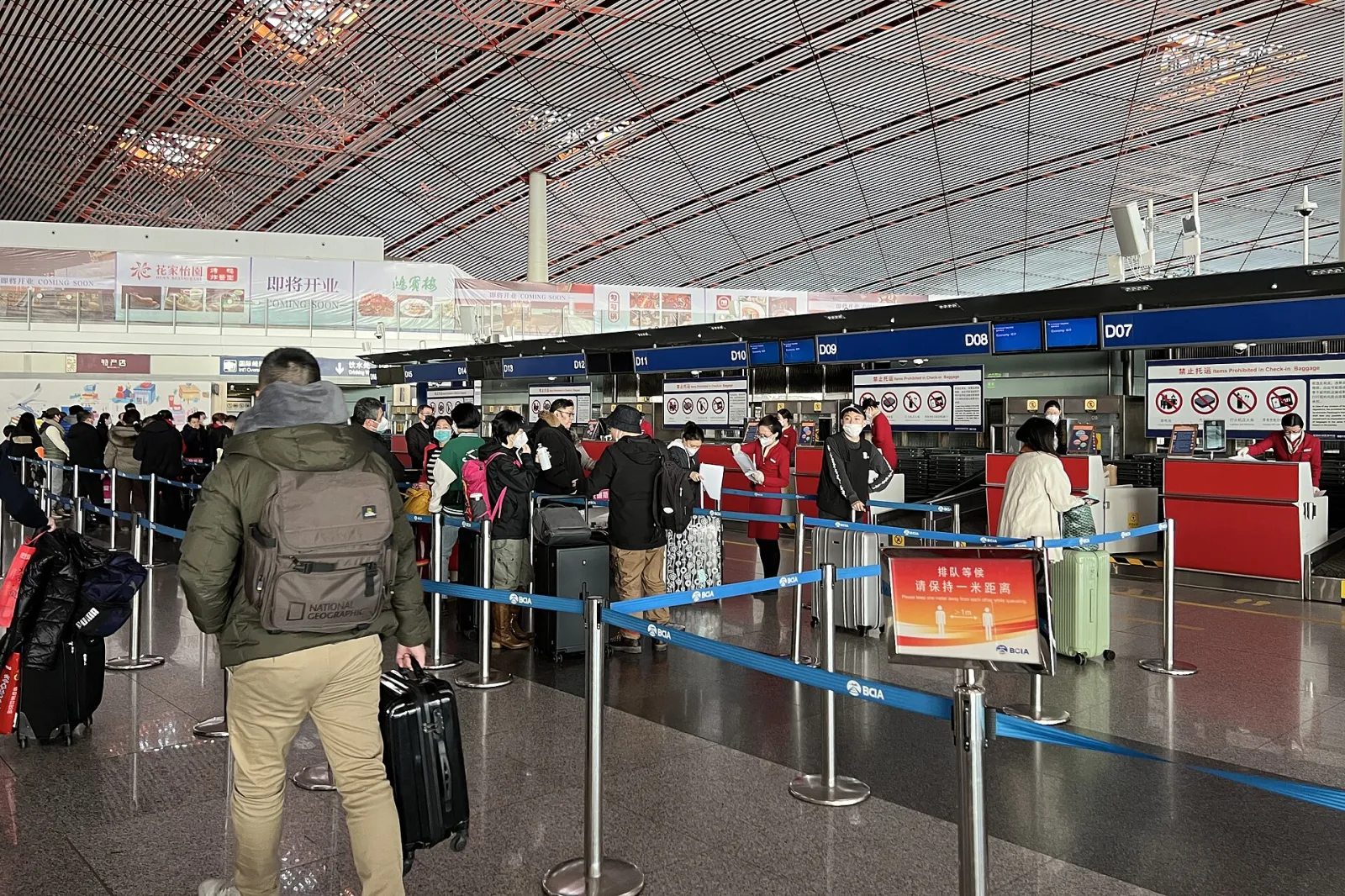
Illustrations : « 500 dirham 2022 » — Radak-ledba (CC BY-SA 4.0) ; « Cathay Pacific check-in counters » — N509FZ (CC BY-SA 4.0), via Wikimedia Commons.