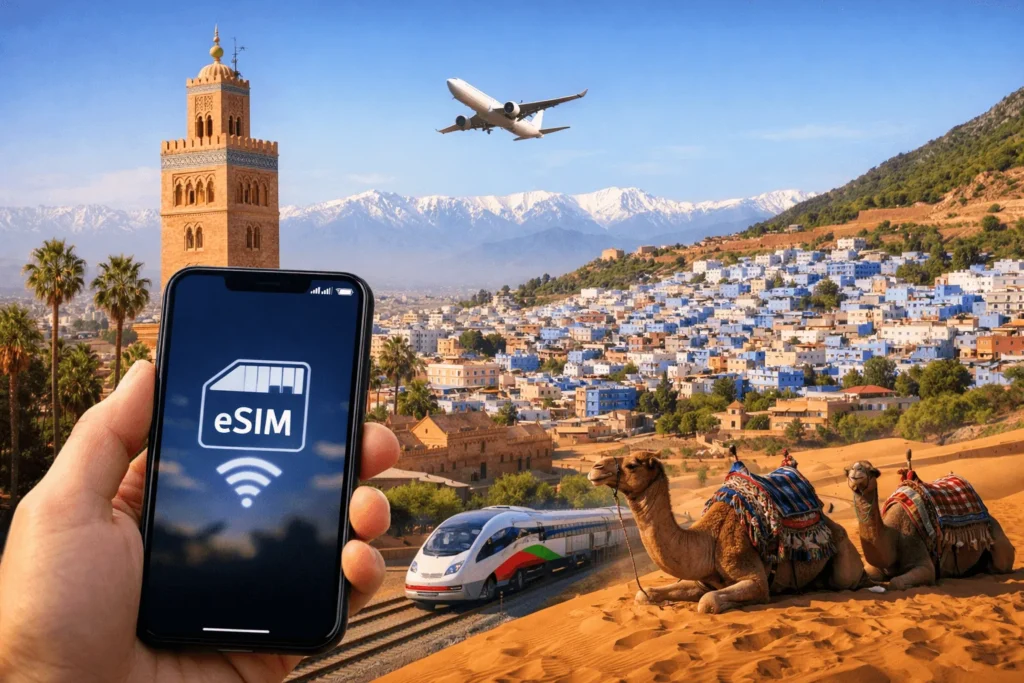
Roaming in Morocco is not covered by the EU “roam like at home” rule: because Morocco sits outside the European Union and the European Economic Area, your French, British, German or other European plan switches to international pricing there, with potentially high costs if you do not check anything first. The good news: a few minutes before departure is enough to avoid a shock bill. This article spells out why roaming is expensive in Morocco, how to check your plan, and which alternatives (local SIM, eSIM, wifi) to choose so you stay connected without unpleasant surprises.
In brief
- Morocco is outside the EU/EEA: the “roam at national rates” rule does not apply. Your data may be billed at international rates.
- Check your plan BEFORE you leave: some operators include Morocco in a “World” add-on or offer a travel pass. Nothing is automatic.
- Three alternatives: a local SIM (Maroc Telecom/IAM, Orange Morocco, Inwi), an eSIM (local or international), and hotel/café wifi.
- Local SIM = passport required: registration in the holder’s name is mandatory in Morocco, free and quick (a few minutes).
- eSIM: the most convenient way to be connected on landing, set up before departure, with no physical card swap.
- Morocco’s regulator is the ANRT; exact prices should be checked on the operators’ official websites.
Morocco is outside the EU: what that changes for your roaming
Since 15 June 2017, the EU roaming regulation (“Roam Like At Home”) has required operators in the European Union to apply national rates when their subscribers travel to another EU or EEA country (the EU plus Iceland, Liechtenstein and Norway). In practice, a French subscriber using their plan in Spain, Italy or Portugal pays as at home, within a fair-use limit.
Roaming in Morocco falls entirely outside this framework. Morocco is a third country, located outside the EU and the EEA. European operators classify it among “international” or “rest of world” destinations, a zone where roaming rates rest on bilateral agreements between operators and remain markedly higher than within Europe. Crossing the Mediterranean therefore changes the picture: what is free or included in Andalusia can become billed per minute or per megabyte once you reach Tangier or Marrakech.
Why “roam like at home” does not apply
The EU rule is geographic: it only covers travel within the EU/EEA. Morocco is not part of it, whatever your home operator. This applies to travellers from France, but also to visitors from the United Kingdom (which has left the EU, and whose operators have partly reintroduced roaming fees in Europe) and the United States, whose plans were never subject to EU regulation. A German traveller enjoys the same European framework as a French one inside the EU, but in Morocco they all end up on international rates.
In other words, there is no automatic “shield”. Without any action on your part, your phone connects to the Moroccan network of a partner operator and bills according to your home operator’s international grid. This is especially true for mobile data (internet), where costs run up fastest: a few videos, an app update or GPS navigation can consume a lot in a short time.
The risk of the shock bill
The main danger is not the headline price but unconscious usage. A smartphone left with mobile data on keeps syncing emails, photo backups, social media and updates, even in your pocket. In an international zone, this background activity can turn into extra charges. European operators have set alert thresholds and a default billing cap for data used outside the EU (often around €50 excl. tax, adjustable), but this cap protects you from a runaway bill, not from a genuinely high cost. Moreover, calls received in Morocco may also be billed, unlike within the EU.
The golden rule: never rely on chance. Pricing information changes and differs by operator and by plan. Always check your personal situation with your operator before departure.
Check your plan before you leave
Before even thinking about a local SIM, the first step for roaming in Morocco is to ask your own operator. More and more “premium” plans or travel add-ons include Morocco, either continuously or as daily or weekly “passes” to activate. Others bill roaming by usage. Only your contract is authoritative: two subscribers of the same operator can have different terms depending on their offer.
Questions to ask your operator
- Is Morocco included in my plan, in a “World/International” add-on, or entirely out of plan?
- If an add-on exists, what is its price, validity period and data allowance?
- Are calls and texts made AND received in Morocco billed? At what rate?
- Is there a “travel pass” (day/week) to activate before or during the trip?
- What is the default out-of-EU data cap, and can I change it?
- How do I turn off data roaming if I prefer another solution?
“World” add-ons: included or paid
Some high-end plans include a data allowance usable in a list of countries that covers Morocco, often capped (a few gigabytes per month outside the Europe zone). Others offer a daily pass that “opens” your plan abroad for a fixed amount. These formulas can be attractive for a short stay or for those who want to keep their number active without any fiddling. For a longer stay or heavy data needs, a local SIM or eSIM is generally more economical. Always compare the price per gigabyte and the validity period before deciding.
Alternatives for staying connected in Morocco
If your operator’s roaming is expensive or unsuitable, three solutions let you stay connected in Morocco at lower cost. Each has its advantages depending on the length of your stay, your data needs and your technical comfort.
The local SIM (Maroc Telecom, Orange Morocco, Inwi)
Morocco’s mobile market is built around three operators licensed by the ANRT: Maroc Telecom (IAM), the historic leader with the widest coverage, notably in rural and mountain areas; Orange Morocco, known for its data offers and eSIM support; and Inwi, often positioned on generous data plans. All three offer prepaid “tourist” cards with a block of data, available in official stores, many retail points, and at the 24/7 kiosks of Casablanca and Marrakech international airports.
The local SIM offers the best data-per-price ratio for a stay of several days or weeks, with a Moroccan number that is handy for booking a taxi, a riad or a transfer. Its downsides: you need an unlocked phone (not tied to an operator), you must show your passport for registration, and you physically swap the SIM (temporarily losing your usual number, unless you have a dual-SIM phone).
The eSIM (local or international)
An eSIM is a digital SIM built into recent smartphones. It activates by simply scanning a QR code, with no physical card, and coexists with your usual SIM on compatible phones. It is the most convenient solution for being connected on landing: you buy and set up your data plan before departure, then activate it on arrival. In 2026, Maroc Telecom, Orange and Inwi sell their own eSIMs; international providers (such as Airalo, Holafly, Nomad) also cover Morocco, generally via the Maroc Telecom network.
Note one important nuance: activating a local eSIM issued by a Moroccan operator requires, as with a physical SIM, passport identification, often in store. International tourist eSIMs, by contrast, are bought and activated entirely online before the trip, without a store visit, which explains their popularity with travellers in a hurry. Check that your phone is eSIM-compatible before buying. To prepare your connection in advance, see our dedicated Morocco eSIM guide.
Wifi: a backup without a data plan
Wifi remains an effective, free fallback. Hotels, riads, cafés, restaurants and many airports offer wifi access. It lets you message, call via apps (WhatsApp, internet calls) and check emails without using roaming data. For a lightly connected traveller, wifi plus disabled mobile data is sometimes enough. Its limits: coverage stops at the venue’s walls, the security of public networks is variable (avoid sensitive operations without protection), and you are not reachable on the move. Wifi complements a SIM/eSIM rather than fully replacing it.
Roaming vs local SIM vs eSIM: the comparison
| Criterion | Roaming (home plan) | Moroccan local SIM | eSIM (international) |
|---|---|---|---|
| Setup | No handling, but check the add-on | Purchase on site + passport | Buy and activate online before departure |
| Keep your number | Yes (your usual number) | No (Moroccan number) | Yes, in parallel on a compatible phone |
| Connected on landing | Yes, if activated | After purchase/registration | Yes, immediate |
| Data cost | High without add-on; varies with pass/add-on | Usually cheapest per GB | Competitive, fixed price known in advance |
| Unlocked phone required | No | Yes | Yes + eSIM compatibility |
| Best for | Very short stay, low usage | Long stay, heavy data, local number | Simplicity, instant connection, short/medium stay |
Buying a local SIM or eSIM: the steps
In Morocco, every SIM (physical or local eSIM) is registered in the holder’s name: the seller scans or photocopies your passport at the counter. Registration is free, mandatory and takes a few minutes. So bring your passport, an unlocked phone, and check eSIM compatibility where relevant. Official stores, city retail points and the kiosks at Casablanca (Mohammed V) and Marrakech (Menara) airports let you get equipped quickly on arrival.
| Operator (ANRT) | Frequently cited strengths | eSIM | Where to buy |
|---|---|---|---|
| Maroc Telecom (IAM) | Widest coverage, including rural and mountain areas | Yes (passport registration) | Stores, airport kiosks, retail points |
| Orange Morocco | Data offers, good eSIM support, international calls | Yes (passport registration) | Stores, airport kiosks, retail points |
| Inwi | Often generous data plans | Yes (passport registration) | Stores, retail points |
On the network side, Morocco launched 5G on 7 November 2025, with coverage extending to more than one hundred cities including Casablanca, Marrakech, Rabat, Tangier and Agadir. The ANRT is targeting 45% of the population covered by 5G by the end of 2026 and 85% by 2030. 4G remains widely available across the country, including in many tourist and rural areas.
How much data to plan for your stay
Sizing your data allowance well avoids both paying for unused volume and running out of connection. Your needs depend on real usage: a traveller who sticks to messaging and light browsing consumes far less than one who streams video or tethers a laptop. As a guide, here are orders of magnitude of consumption per activity, useful for estimating the data plan suited to your roaming in Morocco or your local SIM/eSIM.
| Activity | Approximate consumption | Per 1 GB, that is roughly |
|---|---|---|
| Messaging and emails (text) | Very low | Thousands of messages |
| Web browsing, online maps | Low to moderate | Several hours of use |
| Social media (feed, photos) | Moderate | A few hours depending on videos |
| App-based calls (voice) | Moderate | Several hours of calls |
| Video streaming (SD/HD) | High | About 1 to 3 hours |
In practice, for a short stay focused on browsing, maps and messaging, a small allowance is often enough. For a one- to two-week stay with regular social media, GPS and app-based calls, plan a more comfortable reserve. If you intend to stream video or tether a computer, aim considerably higher, or lean on wifi for those data-hungry uses. Set video quality to “data saver” in your apps to extend the life of your plan.
Roaming in Morocco by your country of departure
The logic is the same everywhere — Morocco is outside the EU/EEA — but the practical details vary by home market. Here are the points to watch for travellers from France, the United Kingdom, the United States and Germany.
From France
Direct flights from Paris, Lyon, Marseille or Toulouse serve Casablanca, Marrakech, Rabat, Fez, Agadir or Tangier. On mobile, the main French operators bill Morocco outside the Europe zone; some premium plans include it in a world allowance, others offer passes. Check your exact offer: two plans from the same operator can differ. Since the Moroccan dirham (MAD) is not freely convertible abroad, pay for SIMs and top-ups on site, in cash or by card depending on the outlet.
From the United Kingdom
Since Brexit, UK operators are no longer bound by EU regulation: several have reintroduced roaming fees, including within Europe, and place Morocco in the international zone at the highest rate. Travellers leaving from London, Manchester or Edinburgh therefore have every interest in comparing a travel pass, an international eSIM or a local SIM. Keep the time difference in mind (Morocco may be on the same time as the UK or offset depending on the period) and think in pounds sterling (£) to compare prices.
From the United States
US plans were never subject to EU regulation. Some operators include international coverage at reduced speed, others charge daily passes. Check whether your phone is compatible with Moroccan frequency bands and whether it is unlocked. For a trip from New York, Washington or other cities, an international eSIM is often the simplest solution, with a fixed price in dollars ($) known in advance and an instant connection on arrival.
From Germany
A German traveller enjoys EU roaming within the EU/EEA, but in Morocco they switch, like everyone else, to international pricing. Flights from Frankfurt, Munich, Berlin or Düsseldorf reach the major Moroccan airports. Ask your operator whether a world add-on or pass exists, compare the price per gigabyte in euros (€), and bear in mind that a local SIM or eSIM often remains the most economical for a longer stay.
Practical tips to control your data in Morocco
- Before you leave: call your operator or check your account to know exactly your terms in Morocco.
- Turn off data roaming by default, and only re-enable it if your plan/add-on covers it without extra charge.
- Disable automatic updates (apps, photo/cloud backups) and auto-play videos on social media.
- Download in advance your offline maps, routes and travel documents over the hotel wifi.
- Favour wifi for large downloads and app-based calls.
- Monitor your usage from your phone settings or your operator’s app.
- Keep a backup option: an activated roaming plan can help if there is a problem with the local SIM.
Staying connected is part of a successful trip, just like managing your budget. To prepare your stay with peace of mind, also see our guide to money in Morocco, our analysis of whether Morocco is a safe destination, our comparison of airport transfers and our advice on the best time to visit Morocco.
FAQ: roaming and mobile connectivity in Morocco
Does EU roaming work in Morocco?
No. Morocco is outside the EU and the EEA: the “roam at national rates” rule does not apply. Your plan switches to international pricing, potentially costly. Check your add-on with your operator before departure.
How much does roaming cost in Morocco?
It depends entirely on your operator and plan: some include Morocco in a “World” add-on, others bill by usage or via a daily pass. No rate is universal. Check your contract and your operator’s official website for the exact price.
Do I need a passport to buy a SIM in Morocco?
Yes. Every SIM is registered in the holder’s name; the seller scans or photocopies your passport. Registration is free, mandatory and takes a few minutes, including for a local eSIM.
eSIM or physical SIM: which to choose?
The international eSIM is the simplest (buy and activate online before departure, instant connection on arrival, your number kept in parallel). The local physical SIM often offers the best price per gigabyte and a Moroccan number, but requires an on-site purchase with passport and an unlocked phone.
Can I buy a SIM at the airport in Morocco?
Yes. Casablanca (Mohammed V) and Marrakech (Menara) international airports have 24/7 kiosks where you can buy and register a local operator SIM, on presentation of your passport.
Is there 4G and 5G in Morocco?
Yes. 4G is widely available. 5G was launched on 7 November 2025 and covers more than a hundred cities (Casablanca, Marrakech, Rabat, Tangier, Agadir and more). The ANRT targets 45% of the population covered by 5G by the end of 2026.
How do I avoid a shock bill in Morocco?
Turn off data roaming by default, disable automatic updates, favour wifi, and choose a suitable option in advance (travel pass, local SIM or eSIM). Monitor your usage via your operator’s app.
Does my phone need to be unlocked for a local SIM?
Yes. To insert a Moroccan operator’s SIM, your phone must be unlocked (not locked to your home operator). For an eSIM, it must also be eSIM-compatible. If in doubt, ask your operator before the trip.
In summary
Roaming in Morocco requires a minimum of preparation, because the country is outside the EU/EEA and escapes the “roam like at home” rule. Without checking, your plan can switch to international pricing. The winning approach comes in three steps: ask your operator before departure, turn off data roaming by default, then choose the solution suited to your stay — a “World” add-on if it is included, a local SIM for the best price per gigabyte, or an eSIM for simplicity and an instant connection on arrival. As pricing information changes regularly, always check current terms with your operator and the official Moroccan operators (Maroc Telecom, Orange Morocco, Inwi) and the regulator ANRT.
Official sources
- ANRT — National Telecommunications Regulatory Agency (Morocco)
- Maroc Telecom (IAM) — official site
- Orange Morocco — official site
- Inwi — official site
- European Commission — roaming regulation
Photo credit
Illustrations : « SIM card » — WrS.tm.pl (CC0) ; « Electronic boarding pass on a smartphone » — Diao Zihao (CC BY-SA 4.0), via Wikimedia Commons.