The Bou Inania Madrasa is the religious college that the Marinid sultan Abu Inan Faris built in Fes (often spelled Fez) between December 1350 and 1355, on Tala’a Kebira street, a short walk from Bab Bou Jeloud: it is the only madrasa in Morocco that also served as a Friday mosque, complete with its own minaret, and one of the few religious buildings in the medina that a non-Muslim visitor can enter. Few people spend more than an hour inside, but it is the densest hour Fes offers anyone who wants to understand Marinid art: a marble courtyard crossed by a water channel, walls covered from floor to eaves in zellij, stucco and carved cedar, and, directly opposite, the puzzling façade of a water clock completed in 1357.
This page brings together what is reliably known about the monument, what you actually see once you step over the threshold, and the practical details that stop you from finding a locked door at prayer time. To fit the visit into a longer stay, our complete guide to things to do in Fes gives the big picture.
At a glance
- Foundation: work began on 28 December 1350 (28 Ramadan 751 AH) according to the inscription in the prayer hall, and was completed in 1355.
- Patron: Abu Inan Faris, Marinid sultan proclaimed in 1348 who died in 1358; the madrasa bears his name.
- What makes it unique: the only Moroccan madrasa that was also a Friday mosque, hence its minaret and its original minbar, now kept at the Dar Batha Museum.
- Size: roughly 34.65 × 38.95 m overall, with a marble-paved courtyard of about 19.95 × 17.70 m.
- Opposite: Dar al-Magana, a water clock with twelve windows completed in 1357 and silent for generations.
- Visiting: paid entry (20 dirhams according to recent reports), closed during prayers and, as a rule, on Fridays; the prayer hall is viewed from the courtyard.
- Access: a few minutes on foot from Bab Bou Jeloud, walking down Tala’a Kebira.
History of the Bou Inania Madrasa: a sultan in a hurry
Abu Inan Faris: ten years on the throne and boundless ambition
To understand why this madrasa looks like no other, start with its founder. Abu Inan Faris was the son of Abu al-Hasan, the Marinid sultan who had pushed the dynasty to its greatest extent, as far as Tunis. In 1348, while his father was suffering setbacks in Ifriqiya, Abu Inan proclaimed himself sultan. He reigned for about ten years, until he was assassinated in January 1358 at the instigation of his vizier. A short reign, seized from a father who was still alive: a ruler in that position needs to display piety and legitimacy, and in the fourteenth century nothing did that better than a great religious foundation in the heart of the capital.
The Marinids had already scattered madrasas across Fes: Seffarine, Sahrij, Attarine, Mesbahiya. All of them stand in the commercial and scholarly heart of Fes el-Bali, near the Qarawiyyin or, in the case of Sahrij, near the Andalusian Mosque. Abu Inan chose a different site, on the western side of the old city, close to the Kasbah of Bou Jeloud, on the route linking the medina to Fes el-Jdid, the palace city founded by his dynasty. The choice was deliberate: the madrasa rises where Marinid power and the old city meet.
A madrasa that is also a Friday mosque
In medieval Morocco a madrasa was above all a boarding school: rooms for students from the countryside or other cities, a modest prayer room, classrooms, an ablution fountain. Congregational Friday prayer, with its sermon (khutba), took place elsewhere, in the great mosques. Bou Inania broke with that model. It was granted the status of a congregational mosque, which gave it the right to host the Friday sermon. Hence two features the other madrasas lack, or lack at this scale: a real minaret, visible from afar, and a minbar, the stepped pulpit from which the preacher speaks.
That status had lasting effects: the prayer hall of Bou Inania is still used for worship, which explains the closures at prayer times and why non-Muslims cannot enter it. As a centre of learning, however, Abu Inan’s foundation never dethroned the Qarawiyyin. After a couple of centuries, higher education in Fes had effectively gravitated back to the great mosque, and Bou Inania remained first and foremost a place of prayer and residence.
The account book thrown into the river
Every guide in the medina will tell you this story, often right at the door: when the nervous site supervisors presented the sultan with the total cost of the works, Abu Inan is said to have torn up the ledger and thrown it into the river, declaring that what is beautiful is never expensive, whatever the price. No document allows us to verify the scene, and it belongs to tradition more than to history. Yet it says something true: the decoration of Bou Inania is the most lavish and complete the Marinids left in Fes, and one look is enough to see that nobody was counting.
| Date | Event |
|---|---|
| 1348 | Abu Inan Faris proclaims himself sultan while his father Abu al-Hasan is still alive. |
| 28 December 1350 | Construction begins, according to the foundation inscription in the prayer hall. |
| 1355 (end of Sha’ban 756 AH) | The madrasa is completed. |
| 6 May 1357 | Completion of Dar al-Magana, the water clock opposite, recorded by the chronicler al-Djaznai. |
| January 1358 | Abu Inan Faris is assassinated. |
| 17th century | Restoration after a damaging earthquake. |
| 1792-1822 | Under the Alaouite sultan Moulay Slimane, entire sections of wall are rebuilt. |
| 1981 | The Medina of Fes, including the madrasa, is inscribed on the UNESCO World Heritage List. |
| Late 1990s – early 2000s | Major restoration of the decoration; the façade of Dar al-Magana is restored in the early 2000s. |
What you see inside the Bou Inania Madrasa, step by step
The plan is a slightly irregular rectangle, squeezed onto a tight plot between two streets, Tala’a Kebira to the north and Tala’a Seghira to the south. The figures given by the Qantara database, which documents Mediterranean heritage, set the proportions: about 34.65 × 38.95 m overall, a prayer hall of roughly 17.10 × 9.65 m, and a courtyard of about 19.95 × 17.70 m. Once inside, the space feels larger than that, because everything converges on the open-air courtyard.
The Tala’a Kebira entrance and its vestibule
The main door opens onto Tala’a Kebira, the great shopping street that runs down from Bab Bou Jeloud towards the centre of the medina. It is a horseshoe arch framed in stucco under a wooden canopy. A detail you only notice once inside: this entrance lines up with the mihrab, the niche indicating the direction of Mecca, on the far side of the courtyard. The vestibule has a cedar ceiling carved in muqarnas, honeycomb cells stacked so they hang from the ceiling like stalactites. Look up before you walk through: this is the first showpiece, and many visitors miss it as they rush towards the light of the courtyard.
Right next to it is a second door, Bab al-Hafa, the “door of the barefoot”. It led straight to the student rooms and the ablutions room without crossing the courtyard. Its vestibule is barrel-vaulted and covered in stucco with a star-shaped geometric pattern. Depending on the period, visitors are let in through one or the other. A third entrance at the back opens onto Tala’a Seghira; a Qur’anic school for children used to operate on that side.
The marble courtyard and the Oued Lemtiyyin channel
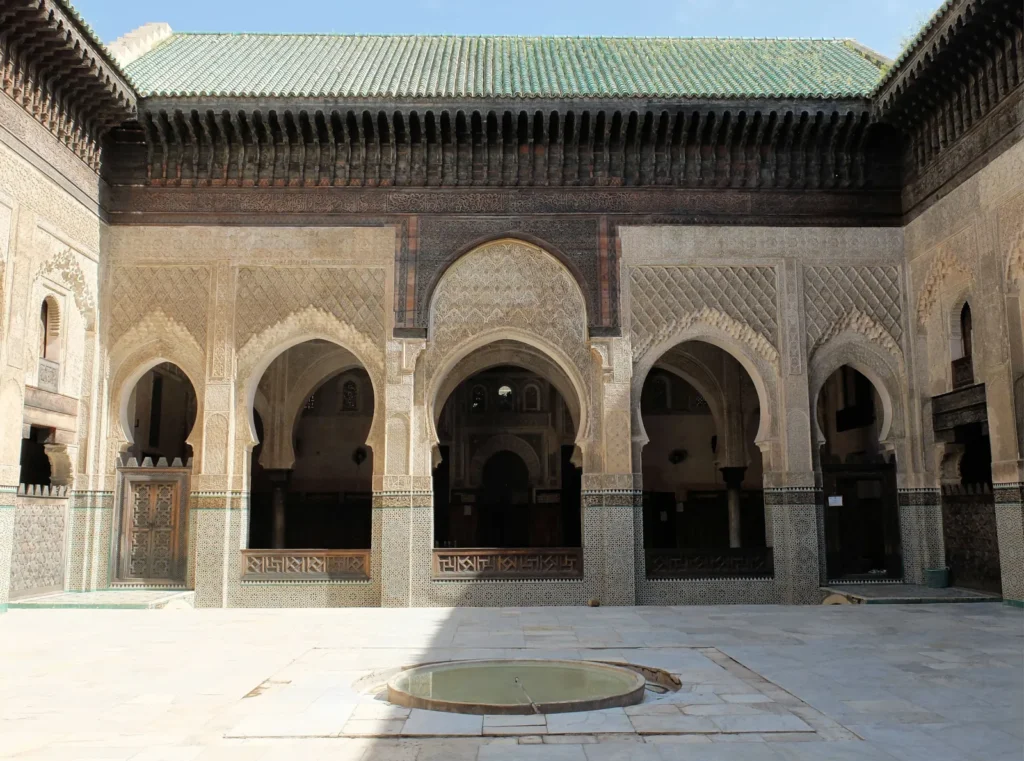
The courtyard is paved in marble, with a basin and an ablution fountain at its centre. Along three sides run galleries on pillars, partly screened by wooden latticework between the supports; behind them are the student rooms. The fourth side, facing the prayer hall, is edged by a small channel carrying water drawn from the Oued Lemtiyyin, one of the branches of the Oued Fes that irrigate the medina. Two little bridges at the corners of the courtyard let you cross it.
This channel is the most singular detail of Bou Inania. It serves for ablutions, of course, but it also marks a boundary: on one side the courtyard, a space for passing through and studying; on the other the prayer hall, a sacred space. This line of water is exactly where non-Muslim visitors stop. You cross it with your eyes, never with your feet. Listen to it: a few metres from the din of Tala’a Kebira, the sound of the water is enough to change the atmosphere.
Reading a Bou Inania wall: zellij, stucco, cedar
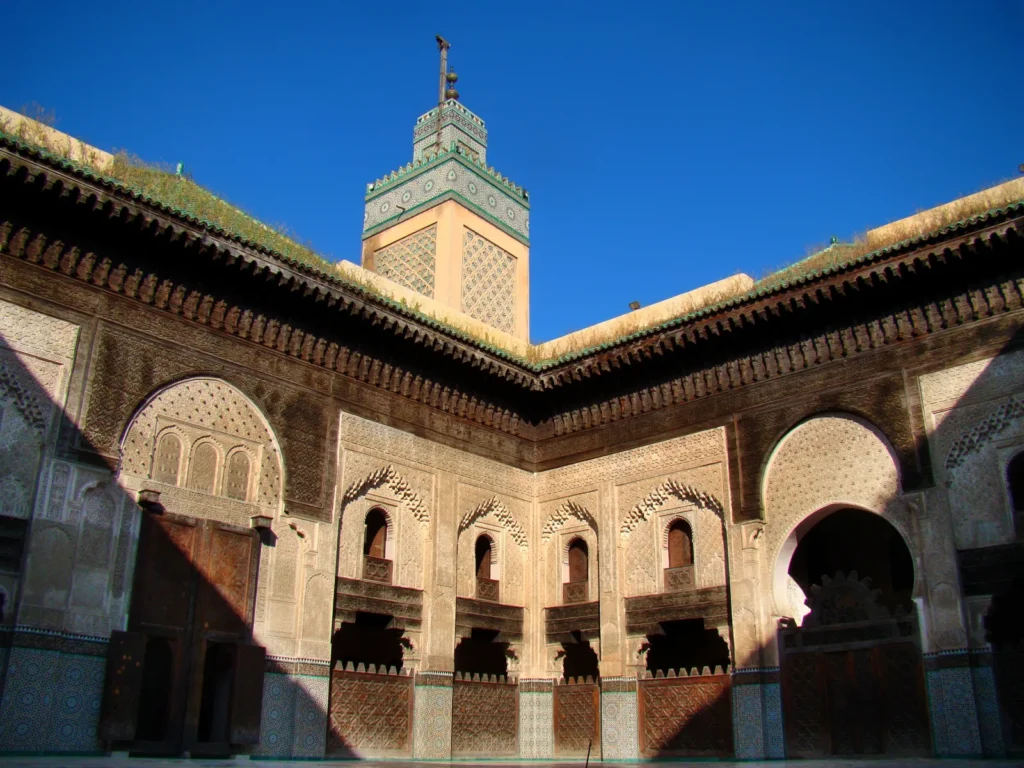
The decoration of the courtyard façades follows a strict order in three registers, from the ground to the sky, and spotting it transforms the visit. At the bottom, up to shoulder height, zellij: a mosaic of small glazed ceramic pieces cut one by one and assembled into geometric interlace, with eight-, twelve- or sixteen-pointed stars depending on the panel. Above it runs a frieze of epigraphic tiles in which the lettering is obtained by scraping away the glaze around the letters, a technique known as excavation or sgraffito. Higher still comes carved stucco, worked with a knife in fresh plaster: plant arabesques, inscriptions in cursive and Kufic script, lozenge networks, and muqarnas in the arches.
At the very top, Atlas cedar takes over: lintels and friezes carved with inscriptions and arabesques, then a broad canopy carried on corbels that protects the stucco from rain. ArchNet sums up what is at stake: the Marinids transposed the materials and techniques of the Nasrid palaces of Andalusia into a religious building. If you have seen the Alhambra in Granada, the kinship is obvious; it is even easier to read here, because the building is smaller and you can take it all in with one glance.
A tip for reading the space: stand in the middle of the courtyard with your back to the entrance and turn slowly through a full circle. Then walk up to a pillar and look closely at a single zellij panel. Every tile piece was cut by hand to fit its exact place in the pattern. Restorations have replaced some of the pieces; you can sometimes spot slightly brighter shades, a sign of a recent repair.
The prayer hall, seen from the threshold
The prayer hall opens onto the courtyard through a continuation of the gallery arches. It is divided by a transverse row of arches resting on marble and onyx columns, running parallel to the qibla wall. At the far end, the mihrab is entirely carved in stucco. The upper walls are pierced by windows closed with stucco grilles set with coloured glass, which filter a soft light in the late morning. The ceiling is a sloping timber roof known as berchla, as in many Moroccan mosques. At the western end, a small retreat room (bayt al-i’tikaf) opens through a double-arched window.
For a non-Muslim, all this is viewed from the courtyard, across the channel. That is no great loss: the hall was designed to be seen from the courtyard, since its arches stand open. Just bring a way to zoom if you are taking photos, and be respectful of any worshippers. The original minbar is no longer here: a masterpiece of marquetry in precious woods and ivory made between 1350 and 1355, it is now kept at the Dar Batha Museum, a few minutes’ walk away. Seeing it the same day rounds off the visit neatly.
The two side halls and the student rooms
To the east and west of the courtyard open two square halls about five metres per side, which served as classrooms. Their entrance arches have muqarnas-carved intrados, and they are closed by tall cedar doors carved with interlacing star patterns. Inside, each has a wooden dome with radiating ribs. When the doors are open, this is where you best appreciate Marinid woodwork at eye level.
The student rooms are spread over two levels, reached by staircases at the corners of the courtyard and by narrow corridors. They are tiny and bare, lit by small openings. The contrast with the courtyard is intentional: luxury is collective, private life is ascetic. Access to the upper floor is not guaranteed; it has varied with the period and with building works. If the staircase is open, go up: the view down onto the courtyard and the cedar canopy is worth the climb on its own.
The minaret, landmark of the western medina
The brick minaret rises at one end of the façade. It is a square tower topped by a small lantern with a cupola and a metal finial with spheres. Its four faces carry the Marinid motif known as darj wa ktaf, a raised lozenge network filled with zellij, and a band of ceramic runs around the top of the shaft. You see it better from outside than from within: from the courtyard it is too close. The best viewpoint is Bab Bou Jeloud, where it appears framed by the arch of the gate, next to the minaret of the Sidi Lazzaz Mosque. This minaret is the building’s signature: the other madrasas of Fes have none, or only a modest one, as at Seffarine.
Dar al-Magana, the water clock opposite the madrasa
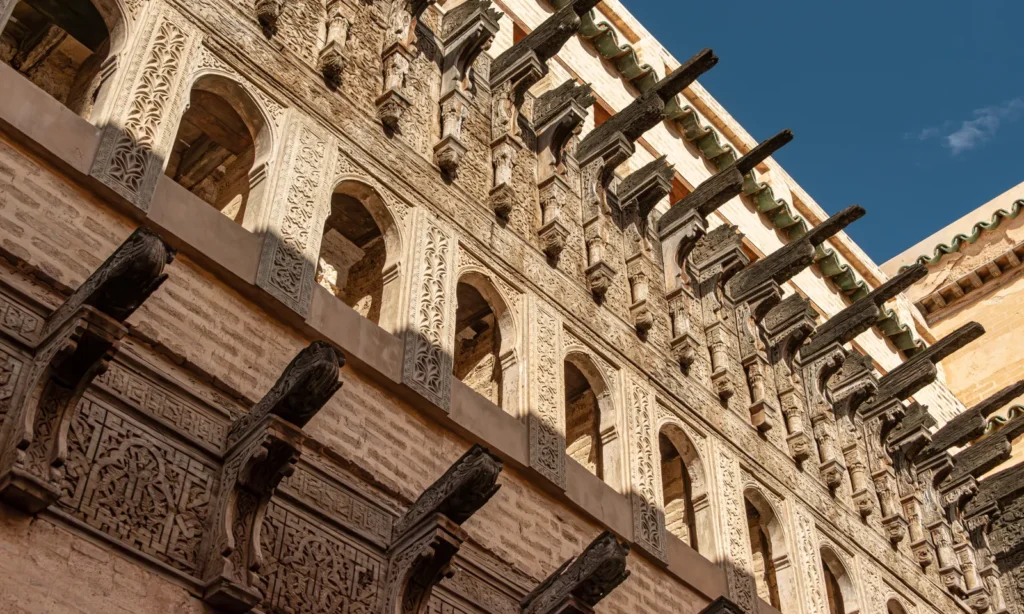
Step out of the madrasa and turn to face the other side of Tala’a Kebira. Above the shops, a façade of wood and stucco carries a row of twelve small windows, underlined by finely carved cedar corbels with panels of arabesques and stylised Kufic script set between them. This is Dar al-Magana, the “house of the clock”. According to the chronicler al-Djaznai, it was completed on 6 May 1357, two years after the madrasa, to regulate the prayer times of Abu Inan’s mosque. Its design is attributed to a muwaqqit, an astronomer in charge of timekeeping, named Abu al-Hasan ibn Ali ibn Ahmad al-Tilimsani.
How did the clock work?
The general principle is known; the details of the mechanism have been lost. Beneath the windows, cedar corbels held bronze bowls. Every hour, a ball or weight dropped into one of the bowls with a ringing sound while the shutter of the corresponding window opened. The power came from water: according to the most widely cited reconstruction, a small cart ran behind the windows, pulled on one side by a hanging counterweight and held on the other by a float resting on the surface of a reservoir drained at a steady rate. The clock has been out of action for generations. The bronze bowls, no longer in place, were taken down for study with a view to restoring the mechanism, so far without success, and the façade was restored in the early 2000s.
A popular tradition, often repeated on the spot, claims the house was once the home of the Jewish philosopher Maimonides, who lived in Fes in the twelfth century, long before the clock was built. Nothing supports it. The interior of Dar al-Magana is not an organised visitor site; you simply admire the façade, which photographs best if you step back a few paces down the street, avoiding the rush hours when Tala’a Kebira is packed.
Dar al-Wudu, the sultan’s public latrines
Also facing the madrasa’s main door stands Dar al-Wudu, the ablutions house, likewise commissioned by Abu Inan. It served both the madrasa and the public, with plenty of running water to flush the latrines. It keeps remnants of Marinid decoration in stucco and cedar. Few visitors pay it any attention, yet it is a rare example of the urban amenities of a great fourteenth-century foundation, in which public hygiene was part of the programme alongside prayer and study.
Restorations: what is original and what is not
A building nearly seven centuries old, made of rammed earth, brick, marble, plaster and wood, does not reach us intact. Bou Inania was repaired in the seventeenth century after an earthquake, then extensively rebuilt in places under Moulay Slimane, between 1792 and 1822. In the twentieth century, successive campaigns focused on the decoration. The last major restoration, carried out in the late 1990s and early 2000s, accounts for the current brilliance of the stucco and woodwork; several local sources date the reopening to 2004, a date we could not confirm in an official source.
So what is actually Marinid? The plan, the structure, the foundation inscription, a large share of the stucco and woodwork, and the onyx columns. Some zellij panels and sections of stucco have been redone, identically or nearly so, by Fes craftsmen trained in the same techniques. Is that a pity? No: Fes is one of the few cities where these crafts are still handed down, and restoration here belongs to a living tradition rather than to copying. Just don’t take every bright patch of colour for a fourteenth-century original.
The Bou Inania Madrasa compared with the other madrasas of Fes
If you only have time for one madrasa, which should it be? They are less alike than people think. The table below sums up the differences that matter to a visitor; each has its own detailed page in our series.
| Criterion | Bou Inania | Al-Attarine | Sahrij |
|---|---|---|---|
| Period | 1350-1355, Abu Inan Faris | 1323-1325, Abu Said Uthman | 1321-1323, Abu al-Hasan, then a prince |
| Location | Tala’a Kebira, near Bab Bou Jeloud | Next to the Qarawiyyin, in the heart of the medina | Andalusian quarter, right bank |
| Size | The largest Marinid madrasa in Fes | Small and very vertical | Medium, large central pool |
| Minaret and Friday sermon | Yes, the only Moroccan madrasa with this status | No | No |
| Highlight | A complete ensemble: courtyard, channel, minaret, clock opposite | Finesse of decoration in a tight space | The pool that gives the place its name, a calm atmosphere |
| Best for | A first visit and an overview of Marinid art | Detail lovers, combined with the Qarawiyyin | Visitors exploring the Andalusian bank |
Our view: Bou Inania first, because it gives you the complete vocabulary of Marinid architecture and it sits at the entrance to the medina. Then the Al-Attarine Madrasa, smaller but with an almost more concentrated refinement, reached at the bottom of Tala’a Kebira. If you like water and calm, the Sahrij Madrasa, on the other side of the river, completes the trio.
Watch out for a common mix-up in online searches: there is another Bou Inania Madrasa in Meknes, also attributed to Abu Inan. Photos often circulate under the same name. The one in Fes is recognisable by its minaret and by the channel in front of the prayer hall; the Meknes madrasa has neither in this configuration.
Visiting the Bou Inania Madrasa: practical information
| Item | Details |
|---|---|
| Address | Tala’a Kebira street, Fes el-Bali, a few minutes’ walk from Bab Bou Jeloud |
| Opening hours | Generally about 9 am to 6 pm, with a break of around two hours in the middle of the day; not officially published online, check on site |
| Closures | During each prayer; on Fridays closed to visitors according to most reports (at the very least around the midday prayer) |
| Ticket | 20 dirhams per person according to recent reports, check at the ticket desk; bring cash |
| Time needed | 30 to 45 minutes; an hour if you linger over the decoration |
| Access for non-Muslims | Courtyard, galleries and side halls; the prayer hall is viewed from the courtyard |
| Dress | Shoulders and knees covered; a headscarf is not usually required of women in the courtyard |
| Best time | First thing in the morning or mid-afternoon, avoiding Fridays and Ramadan if possible |
Getting there from Bab Bou Jeloud, the station or the airport
Your landmark is Bab Bou Jeloud, the Blue Gate. Before you even walk through it, look for the minaret decorated with green ceramic framed in its arch: that is the madrasa’s. Go through the gate, walk a few dozen metres and take the street sloping down to the left, Tala’a Kebira (the street on the right is Tala’a Seghira). The madrasa comes up shortly afterwards on your right, roughly 150 to 200 metres from the gate by our estimate; the Dar al-Magana clock is opposite, above the shops, on your left. It takes two or three minutes and you won’t get lost, which is rare in Fes.
From the new town or the ONCF railway station, a red petit taxi will drop you at Place Bou Jeloud (also called Place el-Baghdadi); allow 10 to 20 minutes depending on traffic, with the meter running. If you are flying in, Fes-Saïss Airport is about fifteen kilometres south of the city: a grand taxi or a transfer will take you as close to Bab Bou Jeloud as possible, since vehicles cannot enter the medina. If your riad is inside, arrange for someone from the property to meet you at the gate.
Hours, prayers and Fridays: how to avoid a closed door
Because the prayer hall is still an active mosque, the madrasa closes to visitors during each prayer, for a variable length of time, often fifteen minutes to half an hour. Prayer times shift with the seasons: the midday prayer (dhuhr) falls around 1.30 pm in summer, Moroccan legal time, and earlier in winter, while the afternoon prayer (asr) comes between about 3.30 and 5 pm depending on the season. The simplest approach is to arrive at opening time in the morning, or to time your visit just after the call to asr prayer, which you will hear from the minaret itself.
On Fridays, the day of the main congregational prayer, most recent reports mention closure to visitors, at least during the morning and the midday prayer. During Ramadan, hours are shorter and shifted. As no official schedule is published online by the monument’s administration, check with your accommodation the day before.
Dress and behaviour
Cover your shoulders and knees: that is the minimum respect in a place of worship, and the medina of Fes is more conservative than Marrakech. Never cross the channel towards the prayer hall, even if it looks empty, and do not sit on the edge of the ablution basin. Photos are allowed in the courtyard; avoid close-up shots of people praying and switch off your flash. Keep your voice down: the courtyard carries sound, and that is all its charm when it is quiet.
Best time and photography tips
In the morning, soon after opening, the courtyard is still calm and a slanting light grazes the stucco on the western side. By mid-afternoon the sun comes in more directly and makes the marble shine. Avoid late morning, when guided groups arrive one after another. For an overall shot, stand in the entrance gallery on the axis of the mihrab: courtyard, channel and prayer hall line up. A wide-angle lens is useful; so is a short telephoto for the stucco inscriptions high up.
Mistakes to avoid
- Turning up at midday prayer time on a Friday: the combination guaranteed to find the door shut.
- Following a self-appointed “guide” who approaches you at Bab Bou Jeloud claiming the madrasa is closed and offering another route: check for yourself, it is two minutes away.
- Confusing it with the Bou Inania Madrasa in Meknes when planning your visit from online photos.
- Forgetting to look up in the vestibule and at the cedar canopy: half the decoration is above three metres.
- Walking past Dar al-Magana without seeing it, because it sits above the shops.
- Arriving without small change: card payment is not guaranteed at the ticket desk.
Around the Bou Inania Madrasa
The madrasa sits in the most accessible part of the medina, and you can build a whole half-day around it without walking more than ten minutes between stops.
- Bab Bou Jeloud and Place Bou Jeloud: the monumental gate of 1913 and, right beside it, the more discreet old bent gate; the starting point of any visit.
- Dar Batha Museum: a late nineteenth-century palace turned museum, reopened in February 2025 after renovation as the Al Batha Museum of Islamic Arts; it holds the Bou Inania minbar, and its Andalusian garden offers a shady break.
- Tala’a Kebira: carrying on down the street past the madrasa takes you through the souks to the heart of the medina, towards Attarine and the Qarawiyyin, in twenty to thirty minutes of non-stop walking.
- Tala’a Seghira: the parallel street, slightly less crowded, which passes behind the madrasa and joins Tala’a Kebira further down.
- Sidi Lazzaz Mosque: its minaret appears alongside Bou Inania’s in the arch of Bab Bou Jeloud; a place of worship not open to non-Muslims.
- Jnan Sbil gardens: a large public park between the medina and Fes el-Jdid, about fifteen minutes on foot, for a breather after the crowds.
Around Place Bou Jeloud, café terraces let you sit facing the gate; some, on upper floors, look out onto the madrasa’s minaret, which is particularly pleasant late in the day when the stone takes on a warm tone.
FAQ about the Bou Inania Madrasa in Fes
Who built the Bou Inania Madrasa?
The Marinid sultan Abu Inan Faris, who reigned from 1348 to 1358. Construction began on 28 December 1350, according to the foundation inscription in the prayer hall, and was completed in 1355. The name “Bou Inania” comes directly from his.
Can non-Muslims visit the Bou Inania Madrasa?
Yes, it is one of the few religious sites in Fes open to everyone. Non-Muslims visit the courtyard, galleries and side halls, but do not enter the prayer hall, which is still an active place of worship; it is viewed from the courtyard, across the water channel.
How much is the entrance fee?
Recent visitor reports give 20 dirhams per person. No official price is published online and it may change: bring cash and check at the ticket desk.
Is the madrasa open on Fridays?
As a rule, no, or at least not during the morning and the main midday prayer, because the prayer hall hosts Friday worship. Plan your visit for another day and check with your accommodation the evening before.
What is the water clock opposite the madrasa?
It is Dar al-Magana, completed in 1357 to regulate prayer times. Twelve windows opened in turn while a ball dropped into a bronze bowl every hour, thanks to a water-driven mechanism. It has not worked for generations, and its exact mechanism remains unknown.
How much time should I allow?
Allow 30 to 45 minutes for the madrasa, plus a few minutes to look at Dar al-Magana from the street. Add the nearby Dar Batha Museum and Bab Bou Jeloud and your morning is well filled.
Do I need a guide to visit Bou Inania?
Not to get there, since it is two minutes from Bab Bou Jeloud along the main street. An official guide, recognisable by a badge, can however help you read the inscriptions and decoration. Turn down unofficial companions who approach you at the gate.
How is it different from the Bou Inania Madrasa in Meknes?
They are two separate buildings with the same name, both linked to Abu Inan. The one in Fes is larger and the only one to have held the status of a Friday mosque, with a minaret and a minbar. Check the city when you look at photos or reviews online.
Summary
The Bou Inania Madrasa is the Marinids’ most ambitious foundation in Fes: a student college built between 1350 and 1355 by Abu Inan Faris, with a minaret and the right to the Friday sermon, which no other Moroccan madrasa possesses. People come for the marble courtyard cut by the Oued Lemtiyyin channel, for the flawless layering of zellij, stucco and cedar, and for the façade of Dar al-Magana across the street. The visit is short, cheap and easy to reach from Bab Bou Jeloud; all you need to do is avoid prayer times and Fridays, dress appropriately and take the time to look up.
Official sources
- UNESCO World Heritage Centre: Medina of Fes
- ArchNet: Madrasa al-Bu’inaniya, Fes
- Qantara, Mediterranean heritage: Madrasa Bû ‘Inâniya
- Qantara: courtyard façades, prayer hall and minaret of the Bû ‘Inâniya
This article is for information only and is based on cross-checked historical sources. Prices, opening hours and access conditions at the Bou Inania Madrasa may change, especially during Ramadan or while works are under way: check them on site before your visit. Last updated: September 2026.
Photo credits
Images: featured image « File:Bou Inania Madrasa 2011.jpg » — Bjørn Christian Tørrissen (CC BY-SA 3.0); « File:Bou inania DSCF4610.jpg » — Robert Prazeres (CC BY-SA 4.0); « File:Fez Dar al-Magana (54252219356).jpg » — Jorge Franganillo (CC BY 2.0), via Wikimedia Commons.