What are the best things to do in Fes? Start by losing yourself in the Fes el-Bali medina, a UNESCO World Heritage Site since 1981, to see the Al-Qarawiyyin mosque-university, the Marinid madrasas of Bou Inania and Al-Attarine, the Chouara tannery and the Nejjarine museum; then move on to Fes el-Jdid for the gates of the Royal Palace, the Mellah and the Jnan Sbil garden, and end the day on the hill of the Marinid tombs. Add a hammam, a Fassi meal, a morning in the souks and, if you stay three days or more, a day trip to Volubilis, Meknes or Ifrane.
This guide works as a master map of Fes, also spelled Fez: it places each site, tells you what it is really worth, how long to give it and in what order to link it with the others. Each major monument has its own dedicated article that goes further. Here the aim is simpler and more useful on arrival: to understand how the city is built, so you do not spend two days going round in circles in its supposed 9,000 alleys, a figure nobody has ever checked but every guidebook repeats.
In brief
- The Medina of Fez has been on the UNESCO World Heritage List since 1981; the property covers Fes el-Bali (founded from 789 onwards) and Fes el-Jdid (founded in 1276 by the Marinids).
- Fes el-Bali is one of the largest car-free urban areas in the world: you get around on foot, and goods still travel by donkey or mule.
- The Al-Qarawiyyin mosque, founded in 857-859 and attributed to Fatima al-Fihri, and the Zawiya of Moulay Idriss II cannot be entered by non-Muslims.
- The Bou Inania (1350-1355) and Al-Attarine (1323-1325) madrasas are the two Marinid monuments to see first; their courtyards are open to the public.
- The Al Batha Museum reopened on 26 February 2025 after restoration and is now a museum of Islamic arts run by the National Museums Foundation.
- Allow at least two full days for the city alone, three or four with a trip to Volubilis or Meknes.
- Fes-Saiss Airport (code FEZ) lies about fifteen kilometres from the centre.
Understanding Fes before you visit: three cities in one
Fes is not one city but three cities set side by side, each born in a different era. Until you have that map in your head, the medina looks chaotic. Once you do, everything becomes readable.
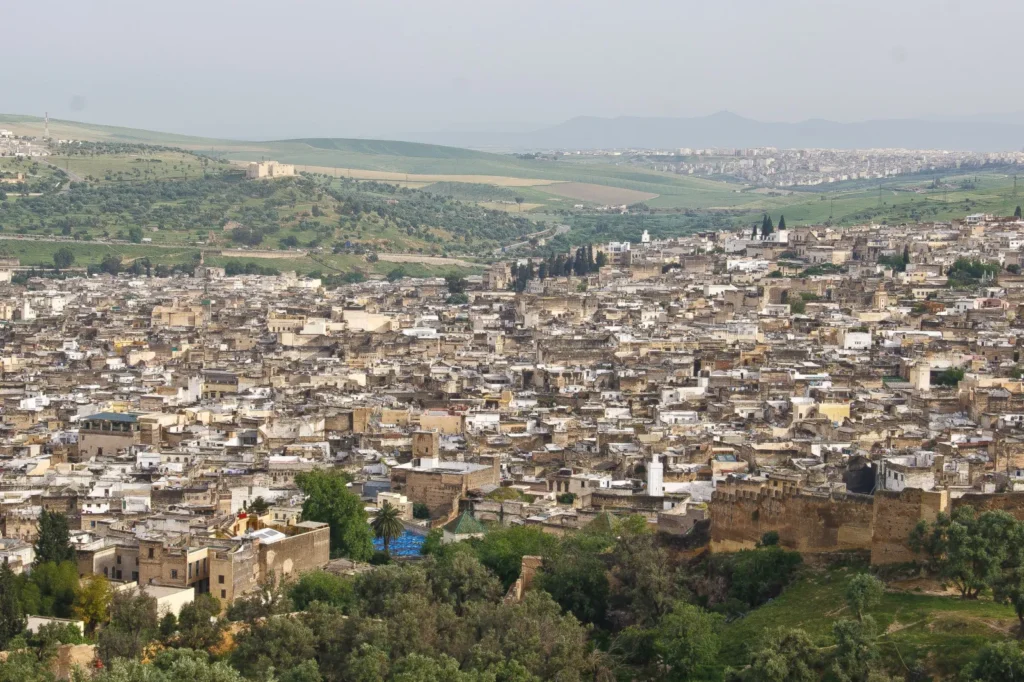
Fes el-Bali, “Old Fes”, fills the hollow of the Oued Fes valley. Idris I founded a first town on the right bank in 789; his son Idris II created a second one opposite, on the left bank, in 809. The two settlements, long rivals separated by the river, were only unified around 1070, under the Almoravids. The names still carry the memory: the Andalusian bank to the east keeps the Andalusian Mosque; the Kairouanese bank to the west holds the Qarawiyyin.
Fes el-Jdid, “New Fes”, is a royal city built in one go in 1276 by the Marinid sultan Abu Yusuf Yaqub, west of the old one. It gathers the palace, the barracks, the gardens and, later, the Mellah, the Jewish quarter. Finally the Ville Nouvelle, laid out under the French protectorate from the 1910s, spreads further south-west around Avenue Hassan II: this is where you find the railway station, most banks and the chain hotels.
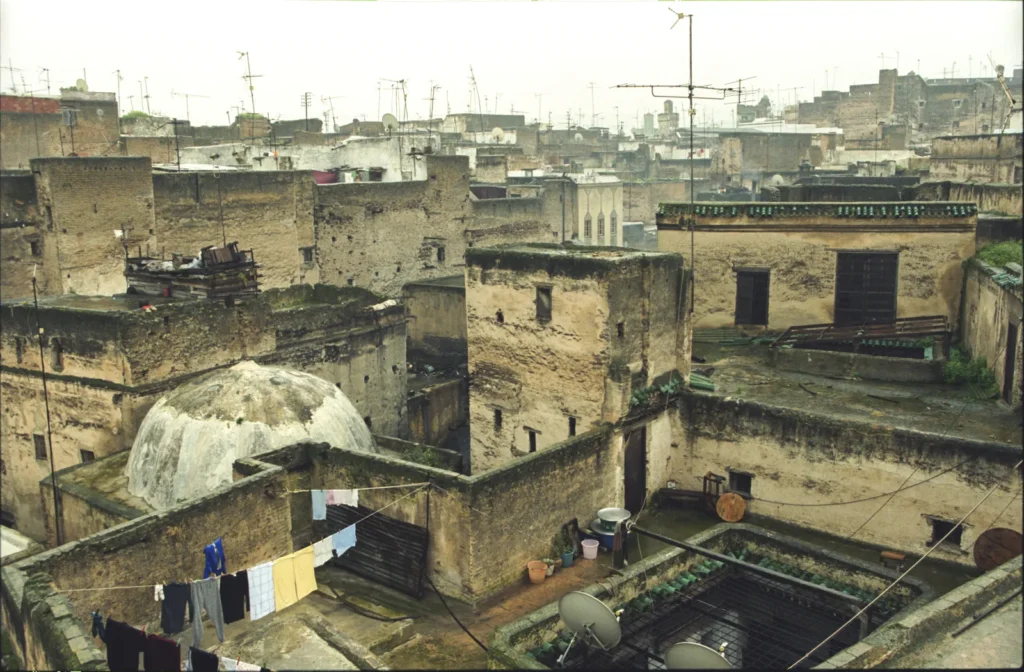
When UNESCO inscribed the “Medina of Fez” on the World Heritage List in 1981, it included Fes el-Bali and Fes el-Jdid, but not the Ville Nouvelle. This is the twelve-century-old ensemble that this guide covers. For the layout of the lanes, the quarters and how to find your way, our article on the Fes el-Bali medina goes into detail.
| Date | Event | What you can still see |
|---|---|---|
| 789 | Idris I founds a first town on the right bank of the Oued Fes | The street pattern of the Andalusian quarter |
| 809 | Idris II founds the town on the left bank | The zawiya that bears his name |
| 857-859 | Founding of the Al-Qarawiyyin mosque | The mosque, enlarged over the centuries |
| c. 1070 | The two banks are unified under the Almoravids | A single medina, Fes el-Bali |
| 1134-1143 | Major enlargement of the Qarawiyyin under Ali ibn Yusuf | The Almoravid aisles and domes |
| 1276 | The Marinids found Fes el-Jdid | The Royal Palace and its walls |
| 1323-1325 | Construction of the Al-Attarine madrasa | The restored madrasa |
| 1350-1355 | Construction of the Bou Inania madrasa | The madrasa and its water clock |
| 14th century | Necropolis of the Marinid sultans on the northern hill | The Marinid tombs, in ruins |
| 1582 | The Saadian sultan Ahmad al-Mansur builds Borj Nord | The fortress, now an arms museum |
| 1717-1720 | Moulay Ismail rebuilds the shrine of Moulay Idriss II | The minaret and the green pyramidal roof |
| 1886-1907 | Construction of the Dar Batha palace | The Al Batha Museum |
| 1913 | Construction of the present Bab Bou Jeloud | The blue and green gate |
| 1969-1971 | New gates of the Royal Palace, Place des Alaouites | The gilded bronze doors |
| 1981 | The medina is inscribed on the World Heritage List | Fes el-Bali and Fes el-Jdid together |
| 2025 | Reopening of the Al Batha Museum of Islamic Arts | The museum and its garden |
Things to do in Fes el-Bali: the monuments of the old medina
Most visitors enter Fes el-Bali from the west, at Bab Bou Jeloud, and walk down to the heart of the medina around the Qarawiyyin along one of the two main parallel streets, Tala’a Kebira and Tala’a Seghira. The slope never lets up: going down is easy, coming back up leaves you out of breath. Many travellers walk down and leave through a lower gate such as Bab Rcif to catch a petit taxi. Here are the stops in the logical order of that descent.
Bab Bou Jeloud, the way in
The most photographed gate in Fes is also one of the most recent: the protectorate administration built it in 1913 to replace a medieval gate with a bent entrance. Its outer face is covered with mainly blue tiles, its inner face with green ones. Stand on the outside: the central arch frames the minarets of the Bou Inania madrasa and the Sidi Lezzaz mosque. The small square behind the gate is the medina’s natural meeting point, with its cafés, kebab stalls and guides who come up to you.
The Bou Inania madrasa
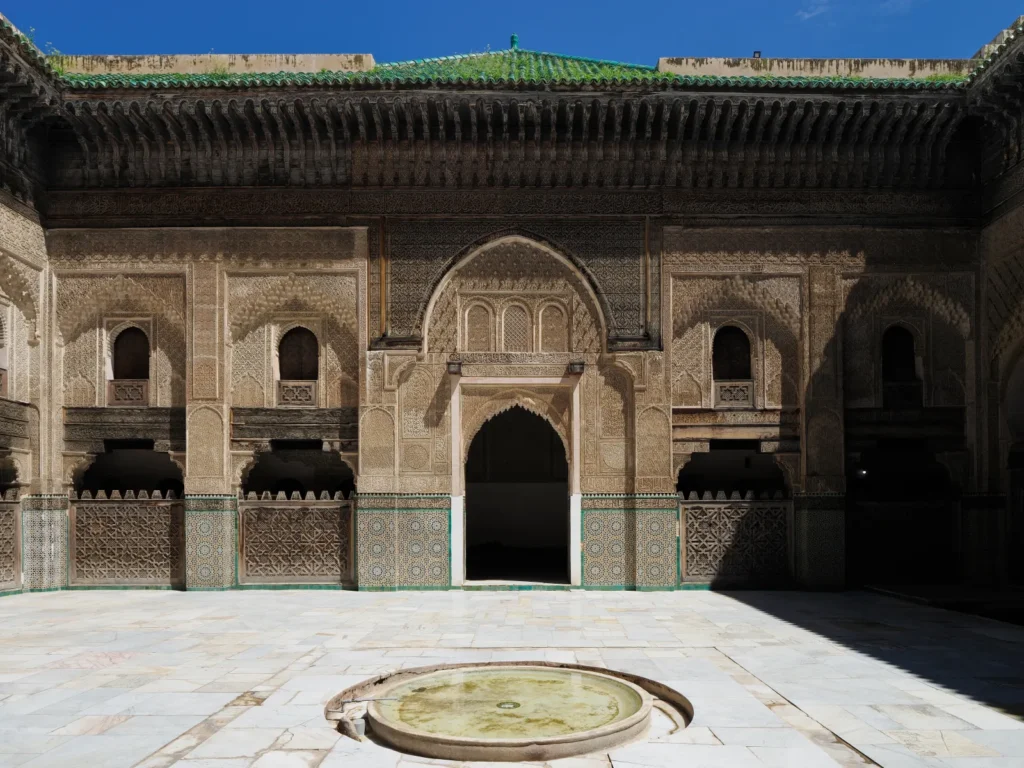
A few minutes’ walk downhill from Bab Bou Jeloud, on Tala’a Kebira, the Bou Inania madrasa is the first great monument on the route and, for many, the most beautiful. The Marinid sultan Abu Inan Faris had it built between 1350 and 1355. A rare feature: it also served as a Friday mosque, which explains its minaret, almost unique for a Moroccan madrasa. Everything is there in the courtyard: zellij below, carved stucco in the middle, cedar above, and a small canal fed by a branch of the river running along one side. Opposite the entrance, across the street, look at the facade of the Dar al-Magana, the water clock whose bronze bowls are still in place. The prayer hall is closed to non-Muslims, but you can see it from the courtyard. The full visit is covered in our dedicated article on the Bou Inania madrasa.
The Al-Qarawiyyin mosque-university
Everything leads to it. Founded in 857-859 and traditionally attributed to Fatima al-Fihri, who came from Kairouan, the Qarawiyyin is cited by UNESCO and Guinness World Records as the oldest continuously operating institution of higher learning. The mosque holds around 22,000 worshippers and, by one count, has eighteen gates. Non-Muslims do not go in, but several open doors reveal the great courtyard and its fountains: the best-known view is from the door near the Al-Attarine madrasa. Stay on the threshold and do not photograph worshippers. The history of the institution, its library and what you can actually glimpse is told in our article on the Al-Qarawiyyin mosque-university.
The Al-Attarine madrasa
Pressed against the north side of the Qarawiyyin, at the end of the spice and perfume souk that gives it its name, the Al-Attarine madrasa is smaller than Bou Inania, and that is exactly its appeal. Built between 1323 and 1325 under Sultan Abu Sa’id Uthman II, it housed fifty to sixty students, mostly from north-western Morocco. Its narrow courtyard concentrates the decoration in a small space: marble columns, carved capitals, and a stucco frieze of a delicacy unmatched anywhere else in the city. If you only have time for one madrasa, choose Bou Inania for its scale; if you see two, Attarine will show you what Marinid craftsmen could do in a few square metres. Go upstairs if access is open: you will see the students’ cells and, from some windows, the roof of the Qarawiyyin.
The Zawiya of Moulay Idriss II
The city’s founder lies in one of the most revered shrines in Morocco. In 1437 a body found on the site was recognised by the ulema as that of Idris II; the shrine then grew in importance, and Moulay Ismail gave it its present form between 1717 and 1720. You spot it from afar by its pyramidal roof of green tiles and its minaret, the tallest in the old city. A wooden beam once blocked the access lanes to mark the horm, the sacred zone that neither non-Muslims nor pack animals could enter. Today non-Muslims may approach the doors and look inside from the threshold, without going in. Around it, stalls sell candles, nougat and incense to pilgrims: it is one of the most distinctive atmospheres in Fes.
Nejjarine square and museum
A stone’s throw from the zawiya, little Nejjarine square gathers three sights in one: a public fountain covered in zellij and carved wood, the carpenters’ souk where you can hear the saws, and the Nejjarine fondouk. This former caravanserai, built in the early 18th century (1711 according to local sources) to lodge merchants and their goods, has housed the Museum of Wooden Arts and Crafts since 1998. On three floors around a courtyard you see carved doors, chests, musical instruments and carpenters’ tools. The real bonus is the rooftop, with a café and an open view over the medina’s roofs. The posted price is around 20 dirhams according to available information; check on site.
Seffarine square
Just south-east of the Qarawiyyin, Seffarine square belongs to the coppersmiths: copper and brass are hammered here in a constant din, in the shade of a large tree. Wedding cauldrons, trays, basins: everything is made before your eyes. On one side of the square stands the Seffarine madrasa, the first madrasa the Marinids founded in Fes, in 1271, and far plainer than its younger sisters. It is also an excellent landmark: from Seffarine square the Chouara tannery is only a few minutes away, and the Andalusian Mosque lies on the other side of the river.
The Chouara tannery
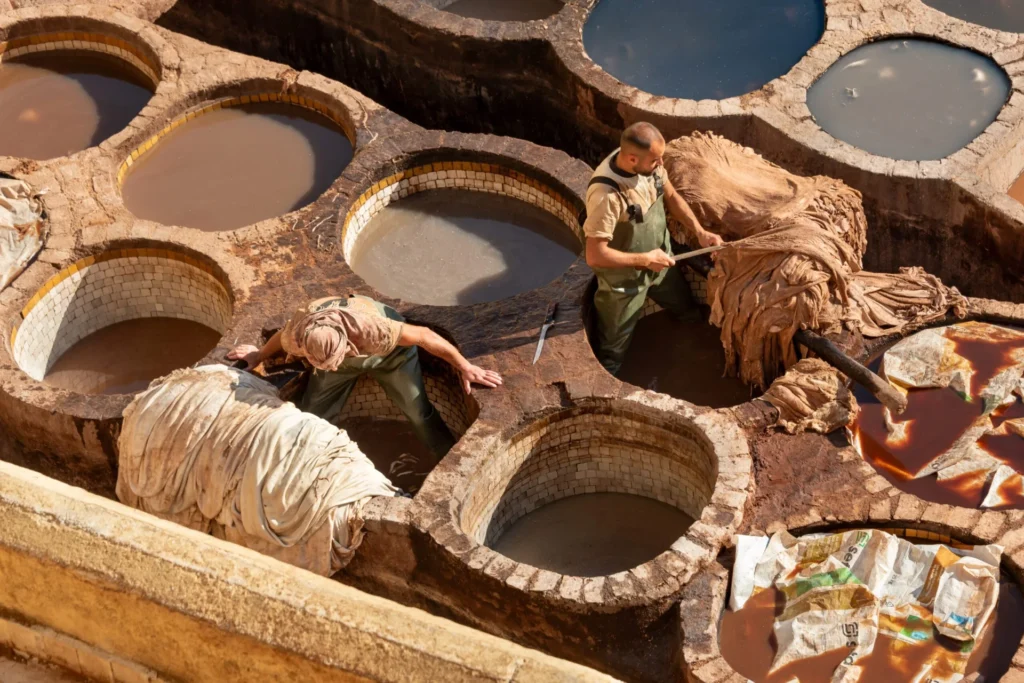
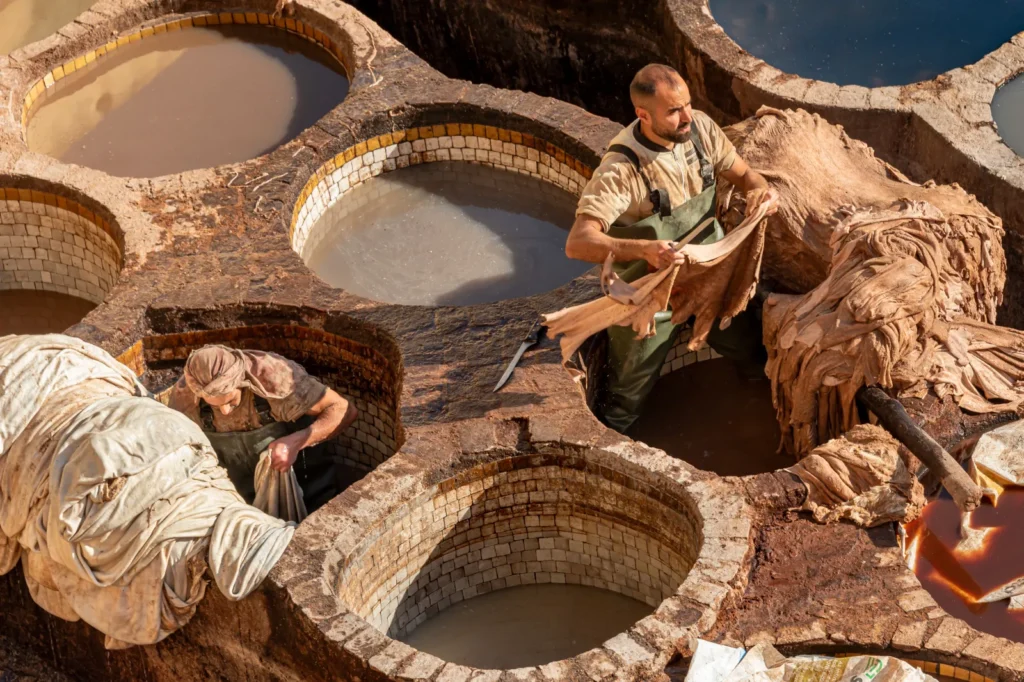
The largest tannery in Fes works along the river, in the tanners’ quarter, north-east of the Qarawiyyin. Dozens of stone vats are filled with whitish baths, where hides are softened with quicklime, salt and pigeon droppings, and with dye baths. Everything is done by hand. The site was extensively renovated as part of the medina rehabilitation programme, with much of the work completed in 2016. You do not walk down among the vats: you watch from the terraces of the leather shops that surround the tannery. Entry is in principle free, but the seller expects you to look at his goods in return; a small tip is customary if you buy nothing. Come in the morning, when activity is at its peak, and keep the sprig of mint you are handed. To understand the tanners’ work and choose your terrace, read our article on the Chouara tannery.
The Al Batha Museum of Islamic Arts
On the west side of the medina, very close to Bab Bou Jeloud, the Dar Batha palace was built between 1886 and 1907 under Moulay Hassan I and then Moulay Abdelaziz, and became a museum as early as 1915. After works launched in 2019, it reopened on 26 February 2025 as the Al Batha Museum of Islamic Arts. It holds Qur’anic manuscripts, carpets, ceramics in the famous Fes blue, chased metalwork, Idrisid-era architectural fragments and the 14th-century minbar of the Bou Inania madrasa. The Andalusian garden, designed in the protectorate era by landscape architect Jean-Claude Nicolas Forestier, takes up more than half the grounds, around a large holm oak. According to the National Museums Foundation, the museum is open from 10 am to 6 pm except on Tuesdays, and admission is 60 dirhams for foreigners, 30 dirhams for Moroccans and 15 dirhams for children. It is the best possible introduction to the art you then see in the madrasas.
Fes el-Jdid: the Royal Palace, the Mellah and Jnan Sbil
You step into another world: wider streets, ochre ramparts, less insistent vendors. Fes el-Jdid takes half a day, on foot from Bab Bou Jeloud (about twenty minutes through the Jnan Sbil garden) or by petit taxi.
The Royal Palace of Fes
Dar el-Makhzen, founded with Fes el-Jdid in 1276, covers about 80 hectares and is still a residence of the King: it cannot be visited. What you come to see are its monumental gates, built between 1969 and 1971 on Place des Alaouites, with their gilded bronze doors, zellij and carved cedar. Come early in the morning or late in the afternoon to avoid groups. The guards tolerate photos of the gates but not of themselves; stay on the square.
The Mellah
Right next to the palace, the Mellah is the former Jewish quarter of Fes, created in the 15th century, probably in stages. Its architecture is surprising: the houses have wooden and wrought-iron balconies open to the street, whereas the traditional Fassi house turns its back on the street. Two places justify the detour: the Ibn Danan synagogue, dated to the 17th century and generally open to visitors with a caretaker (check on site), and the vast Jewish cemetery with its whitewashed tombs on the edge of the quarter. Very few members of the Jewish community remain in Fes; the quarter is now home to Muslim families.
The Jnan Sbil garden
Between Fes el-Jdid and Fes el-Bali, this garden of about 7.5 hectares was created under Moulay Hassan I in the 19th century and opened to the public in 1917. Restored between 2006 and 2010, it reopened in 2011: pools, bamboo avenues, an Andalusian garden, water wheels. It is where the people of Fes come to breathe and the best walking link between the two medinas. It is usually closed on Mondays; entry is free according to available information, to be checked.
The heights: the Marinid tombs and Borj Nord
Once on the hill north of the medina, you understand Fes at a single glance. The Marinid tombs, raised in the 14th century, are now ruins: two large rectangular mausoleums with horseshoe arches and a small dome, with a few traces of stucco. Several sultans were buried here, including Abu Salim Ibrahim (died 1361) and Abd al-Haqq II, the last Marinid ruler (died 1465). People come up mostly for the view: the whole medina spreads out below, and at the evening prayer the calls of the muezzins rise from everywhere at once. The conservation agency ADER-Fès announced a restoration project in 2024. Go up by petit taxi, stay in a group and come down before full darkness: the site is isolated.
A little further west, Borj Nord is a fortress built in 1582 by the Saadian sultan Ahmad al-Mansur to watch over the city rather than defend it. In 1963 it became Morocco’s first museum devoted to arms, long displaying some 5,000 pieces from 35 countries, including a Saadian cannon nearly 5 metres long. The museum has closed for works in the past and its opening hours are not officially published online. Ask locally before going up specially.
Summary table: things to do in Fes and how long to spend
| Site | Quarter | Suggested time | Type | Access for non-Muslims |
|---|---|---|---|---|
| Bab Bou Jeloud | Fes el-Bali (west) | 15 min | Monumental gate | Yes |
| Bou Inania madrasa | Fes el-Bali, Tala’a Kebira | 45 min | Marinid monument | Courtyard yes, prayer hall no |
| Al Batha Museum | Fes el-Bali (west) | 1 h 30 | Museum | Yes |
| Qarawiyyin | Fes el-Bali (centre) | 10 min (from the doors) | Mosque-university | No, view from the threshold |
| Al-Attarine madrasa | Fes el-Bali (centre) | 30 min | Marinid monument | Yes |
| Zawiya of Moulay Idriss II | Fes el-Bali (centre) | 15 min | Shrine | No, view from the threshold |
| Nejjarine Museum | Fes el-Bali (centre) | 1 h | Museum and fondouk | Yes |
| Seffarine square | Fes el-Bali (centre) | 20 min | Crafts | Yes |
| Chouara tannery | Fes el-Bali (north-east) | 30 min | Crafts | Yes |
| Royal Palace | Fes el-Jdid | 20 min | Monumental gates | Outside only |
| Mellah | Fes el-Jdid | 1 h 30 | Historic quarter | Yes |
| Jnan Sbil garden | Between the two medinas | 45 min | Garden | Yes |
| Marinid tombs | Northern hill | 45 min | Ruins and viewpoint | Yes |
| Borj Nord | Northern hill | 1 h | Fortress and museum | Yes, if open |
Experiences: souks, hammam, food and crafts
The souks
In Fes the souk is not a tourist market tucked away in a corner: it is the city itself, organised by trade for centuries. Around the Qarawiyyin you pass the Attarine souk (spices, perfumes), the babouche sellers, the weavers, the coppersmiths of Seffarine, the carpenters of Nejjarine, the henna sellers. On Tala’a Kebira food stalls dominate: dates, olives, cooked snails, sometimes sheep’s heads. The best advice: do not try to buy everything on day one. Look around, compare prices in two or three shops, and bargain calmly. A seller who walks you to the door with a smile is not offended; he is preparing your return.
The hammam
Every quarter of the medina has its hammam, often near a mosque or a bread oven. There are two options: the neighbourhood hammam, very cheap, where you bring your black soap, kessa glove and towel, and where hours are split between men and women; or the riad or spa hammam, more expensive but designed for visitors. If you try the neighbourhood hammam, ask your host which one they recommend and at what time to go: it is the best way to avoid turning up at the wrong session.
Fassi cuisine
Fes claims one of the most refined cuisines in the country, and it has good arguments. Try pastilla, flaky, sweet and savoury, with pigeon or chicken; bessara, a thick broad-bean soup drizzled with olive oil and cumin, served in the morning in the medina’s small eateries; khlii, dried meat preserved in its own fat, which flavours breakfast eggs; and harira in the evening. To eat among locals, trust the small stalls where you can see what is cooking. For a big meal, the guesthouses of the medina often serve dinner on reservation. A cooking class with a market visit is one of the activities most recommended by travellers who have done one.
Crafts
Leather from Chouara, copper from Seffarine, wood from Nejjarine: the whole medina is a workshop. Add Fes blue ceramics and zellij, made mostly in the potters’ quarter of Ain Nokbi, outside the walls near Bab Ftouh, where some workshops welcome visitors. If you are taken to “see a cooperative” without having asked, know that the guide earns a commission. It is not a scandal, but it should be your choice.
Around Fes: Volubilis, Meknes and Ifrane
Volubilis and Moulay Idriss Zerhoun. About 70 to 90 km from Fes depending on the route, or 1 h 15 to 1 h 30 by road, Volubilis is the best-preserved Roman town in Morocco, a World Heritage Site since 1997. You walk between the Arch of Caracalla (AD 217), the basilica, the Capitol and houses with mosaics still in place, such as the House of Orpheus. About 5 km away, the holy town of Moulay Idriss Zerhoun, where Idris I is buried, clings to its hill; the mausoleum is closed to non-Muslims. There is no shade on the site: set off early. Prices and hours should be checked with the site’s conservation office. To plan the day, see our article Volubilis and Moulay Idriss from Fes.
Meknes. The former capital of Moulay Ismail (reigned 1672-1727), a World Heritage Site since 1996, lies about sixty kilometres away. It is the easiest trip: ONCF trains link the two cities in roughly 35 to 45 minutes, with frequent departures. There, the Bab Mansour gate, completed in 1732 by Moulay Abdallah, Place el-Hedim and Moulay Ismail’s granaries and pools are enough to fill a day. Volubilis and Meknes are often combined in one outing by car with a driver.
Ifrane and the cedars. About 65 to 70 km south by road, Ifrane is a mountain town created in 1929 by the French administration, at over 1,650 m, with chalets and steep roofs that earned it the nickname “Little Switzerland”. The real interest lies around it: the Middle Atlas cedar forests, home to Barbary macaques, an endangered species. Do not feed them, even if someone sells you peanuts for that purpose. Snow is common in winter.
Practical information for visiting Fes
Getting there and getting around
Fes-Saiss Airport is about 13 to 15 km from the centre. Taxis wait at the terminal exit, with a flat fare into the city of about 150 dirhams according to available information (confirm before getting in); a bus line, number 16, also links the airport with the railway station. The ONCF station, in the Ville Nouvelle, serves Meknes, Rabat, Casablanca and Tangier. In the medina you walk: no car enters Fes el-Bali. To move between quarters, the red petits taxis are plentiful and cheap; insist on the meter.
Guide or no guide?
On a first visit, an official guide carrying a card issued by the authorities saves a great deal of time on day one. Book through your accommodation rather than accepting the “guides” who approach you at Bab Bou Jeloud. On day two, head off alone: offline mapping apps work better and better in the medina, and the coloured signs installed at the main junctions mark the main circuits. If a young man tells you “it’s closed that way” or that the tannery is “on the other side”, there is a good chance it is not true.
Dress, opening hours and the best time
Fes is a conservative city: covered shoulders and knees are a mark of respect, especially around the shrines. Wear good closed shoes, as the cobbles are slippery and you share the lanes with mules. On Fridays many medina shops close in the late morning for the main prayer, and some monuments change their hours; plan museums for that day instead. The best seasons are spring and autumn. Summer is hot, with average highs close to 35°C in July; winter is cool and sometimes rainy. The Fes Festival of World Sacred Music is usually held between late May and early June, notably at Bab Makina; check the dates of the current edition.
| Site | Indicative hours | Indicative price | Note |
|---|---|---|---|
| Al Batha Museum | 10 am – 6 pm, closed Tuesdays | 60 MAD foreigners, 30 MAD Moroccans, 15 MAD children | National Museums Foundation data |
| Bou Inania madrasa | Daytime, with breaks for prayers; mornings only on Fridays | Around 20 MAD | Check on site |
| Al-Attarine madrasa | Daytime, possible breaks during prayers | Around 20 MAD | Check on site |
| Nejjarine Museum | Around 10 am – 5 pm | Around 20 MAD | Check on site |
| Chouara tannery | Daytime, busiest in the morning | Free from the shops; tip customary | View from the terraces |
| Jnan Sbil garden | Daytime, usually closed Mondays | Free entry | Check on site |
| Marinid tombs | Open access | Free | Avoid after dark |
| Volubilis | From 8:30 am until late afternoon | Not officially published online | Ask the site’s conservation office |
Things to do in Fes in two or three days: a realistic itinerary
Day 1, walking down through Fes el-Bali. Al Batha Museum at opening time, Bab Bou Jeloud, the Bou Inania madrasa, then Tala’a Kebira to the heart of the medina. A simple lunch. In the afternoon: the Zawiya of Moulay Idriss II from its doors, Nejjarine square and museum, the Al-Attarine madrasa, the doors of the Qarawiyyin, Seffarine square. Exit through Bab Rcif and take a taxi.
Day 2, tannery and Fes el-Jdid. The Chouara tannery early in the morning, then an aimless wander through the souks. In the afternoon, a taxi to Place des Alaouites and the Royal Palace, a visit to the Mellah and the Ibn Danan synagogue, and a walk back through the Jnan Sbil garden. At the end of the day, a taxi to the Marinid tombs for sunset.
Day 3, out of town. Volubilis and Moulay Idriss in the morning, Meknes in the afternoon; or, in summer, the cool air of Ifrane and the cedars. If you only have one day on the spot, our itinerary Fes in one day makes the hard choices for you.
Mistakes that spoil a visit to Fes
- Trying to see everything in one day: you leave exhausted, having looked at nothing. Two days is the minimum.
- Following a stranger who offers to show you the way: the walk almost always ends in a shop.
- Trying to enter the Qarawiyyin or the Zawiya of Moulay Idriss II if you are not Muslim: stay on the threshold.
- Photographing people without asking, especially women, craftsmen and tanners.
- Arriving at the tannery at noon: the light is harsh and work slows down.
- Forgetting that Friday changes the rhythm of the medina.
- Changing money in the medina at a poor rate: use bank ATMs.
FAQ: things to do in Fes
How many days do you need to visit Fes?
Two full days let you see the essentials of Fes el-Bali and Fes el-Jdid without rushing. Allow three or four days if you want to add a trip to Volubilis, Meknes or Ifrane, or simply take your time in the souks and at a hammam.
Can you visit the Al-Qarawiyyin mosque?
Not inside if you are not Muslim. However, several of its doors stay open and reveal the courtyard and its fountains. To see architecture of the same period from the inside, visit the Al-Attarine and Bou Inania madrasas.
What is the most beautiful monument in Fes?
For most visitors it is the Bou Inania madrasa, large, complete and open to the public. Lovers of detail often prefer the Al-Attarine madrasa, smaller but more densely decorated.
Do you need a guide to visit the Fes medina?
It is not compulsory, but an official guide booked through your accommodation is very useful on the first day to understand how the medina is organised. After that you can explore alone with an offline map.
Do you have to pay to see the Chouara tannery?
The view is from the terraces of the leather shops, in principle without a ticket. The seller hopes you will look around his shop; if you buy nothing, a small tip is customary.
What is the best time of year to go to Fes?
Spring and autumn offer pleasant temperatures for walking. Summer is hot during the day, with average highs close to 35°C in July, and winter can be cool and rainy.
What can you do in Fes on a Friday?
On Fridays many medina shops close around noon for the main prayer and some monuments shorten their hours. It is a good day for the Al Batha Museum, the Jnan Sbil garden, Fes el-Jdid or a day trip.
Is Fes safe for visitors?
The medina is lively and the most common annoyances are fake guides and pushy selling. The usual precautions are enough: a closed bag, a polite but firm refusal, and no solitary walk to the Marinid tombs after nightfall.
Summary
Fes is visited in three stages: the descent through Fes el-Bali, from Bab Bou Jeloud to the Qarawiyyin, with the madrasas, museums and tannery; the royal city of Fes el-Jdid, with the palace, the Mellah and Jnan Sbil; and the panorama from the Marinid tombs. Give it at least two days, respect the holy places that can only be seen from the threshold, and keep a day for Volubilis or Meknes. Everything else, the souks, the hammam, the food, comes as you walk.
Official sources
- UNESCO World Heritage Centre: Medina of Fez
- UNESCO World Heritage Centre: Archaeological Site of Volubilis
- National Museums Foundation: Al Batha Museum of Islamic Arts
- ONDA, Airports of Morocco
- ONCF, Moroccan National Railways
This article is for information only. Prices, opening hours and access conditions for the monuments and museums of Fes may change; they were checked in September 2026 and should be confirmed on site before your visit.
Photo credits
Images: featured image « File:View of Fez Medina (4783674098).jpg » — Mike Prince from Bangalore, India (CC BY 2.0); « File:Main courtyard of Bou Inania Madrasa, Fez, Marocco.jpg » — Petar Milošević (CC BY-SA 4.0); « File:Fez Chouara Tannery (54238811596).jpg » — Jorge Franganillo (CC BY 2.0), via Wikimedia Commons.