Cyber Parc Moulay Abdeslam is a free, eight-hectare historic garden in central Marrakesh, running along Avenue Mohammed V between the Koutoubia Mosque and the Bab Nkob gate. You will see it written several ways: Arsat Moulay Abdeslam, عرصة مولاي عبد السلام in Arabic, Cyber Park Arsat Moulay Abdeslam on the signs at the main gate, or simply “the cyberpark” among locals; the city itself is spelled Marrakech in French. The word arsat, in Moroccan Arabic, means a walled irrigated orchard: this ground was not laid out in the 18th century to look pretty, but to grow fruit and vegetables for a princely household.
Information verified in September 2026
In brief
- Admission is free, with no ticket and no queue, which makes it one of the very few large gardens in the city you can enter without spending a dirham.
- The park covers eight hectares according to the Mohammed VI Foundation for the Protection of the Environment, which has run the site since its rehabilitation.
- The garden dates from the 18th century: it is said to have been given by the Alaouite sultan Sidi Mohammed ben Abdallah to his son, Prince Moulay Abdeslam, as a wedding gift.
- It reopened on 12 February 2005 under the new name of cyberpark, on the initiative of Princess Lalla Hasnaa and with sponsorship from Maroc Telecom, pairing a heritage garden with digital facilities.
- Wi-Fi is free across the whole park, eleven interactive terminals line the paths, and there is a cyber space room plus an open-air amphitheatre seating more than 200.
- The Telecommunications Museum, in the main entrance hall, opened on 24 September 2001 and is described as the first technical museum in Morocco.
- Allow 45 minutes to 1 hour 30, less than a ten-minute walk from the Koutoubia and about a quarter of an hour from Jemaa el-Fna square.
Cyber Parc Moulay Abdeslam: practical information
Cyber Parc Moulay Abdeslam can be visited freely, with no ticket, on the edge of Avenue Mohammed V, at the hinge point between the medina and the modern Guéliz district. A full loop of the paths takes about an hour, the museum adds twenty minutes or so, and there is no dress code beyond common sense.
| Item | Information |
|---|---|
| District | Along Avenue Mohammed V, between the Koutoubia and Bab Nkob, beside the medina ramparts and at the edge of Guéliz |
| Getting there from a landmark | About 8 to 10 minutes on foot from the Koutoubia Mosque; about 15 minutes from Jemaa el-Fna square, walking up Avenue Mohammed V |
| Opening hours | Open daily; published hours range from 7am to 7pm depending on the source, with seasonal variation — check on site |
| Admission | Free for the garden. The Telecommunications Museum is also described as free, but its own hours should be checked on site |
| Suggested duration | 45 minutes for a break; 1 hour 30 including the museum and a proper stop in the shade |
| Best time | Early morning from May to September, mid-afternoon from October to April; the central basin is floodlit at dusk |
| Dress | No religious requirement: this is not a place of worship. Closed shoes are advisable, the paths are compacted red earth |
| Accessibility | Brought up to standard during the 2016 works: paths, amphitheatre, toilets, museum and terminals are advertised as accessible to visitors with reduced mobility |
| Wi-Fi | Free across the whole site, with interactive terminals and a cyber space room |
What does “arsat” mean and who owned this garden?
An arsat is a walled, irrigated orchard of the kind laid out around Marrakshi residences. Arsat Moulay Abdeslam carries the name of an Alaouite prince, a son of Sultan Sidi Mohammed ben Abdallah, who reigned from 1757 to 1790. The land is said to have been given to him on the occasion of his marriage: that is the version carried by Moroccan sources and encyclopaedic entries. The Mohammed VI Foundation for the Protection of the Environment is more cautious, writing only that the garden was established by the Alaouite prince Moulay Abdeslam roughly three centuries ago, without mentioning a wedding. Treat the 18th century and the princely origin as settled, and the wedding gift as a well-attested tradition rather than a documented deed.
A wedding gift from Sultan Sidi Mohammed ben Abdallah
Sultan Sidi Mohammed ben Abdallah, also known as Mohammed III, is the ruler who founded Essaouira and reopened Morocco to Atlantic trade. In Marrakesh he had a habit: when one of his sons married, he granted him a residence outside the kasbah, surrounded by orchards. That is how Moulay Abdeslam received this arsat, and how his brother Moulay Mamoun received his own a few hundred metres away. Moulay Mamoun’s orchard became the site of a hotel project launched in 1923 by the Moroccan railway company and entrusted to the architects Henri Prost and Antoine Marchisio; the hotel opened in 1929 and is known today as La Mamounia. The two gardens are twins by origin and opposites by fate: one became one of the best-known palace hotels in the country, the other a completely free public park.
Moroccan sources describe Prince Moulay Abdeslam as a diplomat, a poet and a man of letters. His garden was not an ornamental park with parterres and vistas; it was a working estate. Bitter oranges, olives, lucerne, vegetables. Water came from the traditional khettaras, the underground drainage galleries that tapped the Haouz water table and supplied the city, and was then distributed across the planting beds by the sekkaia, the open irrigation channel. This is not decorative trivia: that network is the reason an eight-hectare orchard could survive at the gate of a city on an arid plain.
From princely orchard to neglected public park
The estate passed into public hands in the early 20th century, when Avenue Mohammed V was cut through and Guéliz — the European quarter created under the French protectorate, now the modern city centre — began to grow. The garden ended up wedged between the new avenue and the medina walls, and gradually lost its agricultural layout. For decades it was what many Moroccan urban parks were at the time: a tired green space, poorly lit, avoided after dark, and absent from the guidebooks.
| Period | What happened |
|---|---|
| Reign of Sidi Mohammed ben Abdallah (1757-1790) | The arsat is created and given to Prince Moulay Abdeslam; an orchard irrigated by khettaras and sekkaia |
| Early 20th century | The estate becomes public as Avenue Mohammed V opens and Guéliz is built; the agricultural layout fades |
| 24 September 2001 | The Marrakesh Telecommunications Museum opens in the main entrance hall |
| 2002-2003 | Studies and rehabilitation works begin under the Mohammed VI Foundation for the Protection of the Environment |
| 12 February 2005 | Official reopening by Princess Lalla Hasnaa, president of the Foundation; the site takes the name cyberpark |
| 2016 | Second round of works: new planting, LED lighting, interactive terminals, extended Wi-Fi, accessibility upgrades |
How the garden became Cyber Parc Moulay Abdeslam
The transformation dates from the early 2000s. The Mohammed VI Foundation for the Protection of the Environment, chaired by Princess Lalla Hasnaa, launched the rehabilitation of the site with sponsorship from Maroc Telecom. The park reopened on 12 February 2005 under a name nobody had used before, cyberpark, meant to marry a heritage garden with information technology.
The project deserves a second look, because it was shrewder than it sounds. In 2003 home internet access was still rare in Morocco: offering free public access in a city-centre garden was not a tourist gimmick, it was digital inclusion policy dressed up as a stroll. The works covered the rebuilding of the irrigation network, replanting, lighting and the burying of utilities. The Foundation states that the aim was to bring the site closer to the appearance it had three centuries earlier, while grafting on fibre optics, Wi-Fi and multimedia terminals.
Maroc Telecom was the lead sponsor, but the Foundation lists around fifteen companies associated with the project, among them Alcatel, Ericsson, Fujitsu Siemens, Hewlett-Packard Maroc, IBM Maroc, Motorola, Nokia, Philips, Samsung and Siemens. That roll call is a very dated snapshot of the 2000s telecom industry, and it is a useful key to reading the park: what you see today is the sediment of two technological waves, one from 2005 and one from 2016.
The second life of 2016
Eleven years after reopening, a second campaign brought the park back up to standard. The published figures mention more than 13,000 shrubs and 225 new trees planted, more than 300 LED floodlights installed, eleven interactive totems fitted with 55-inch screens and fed by fibre, and Wi-Fi coverage delivered by around twenty access points across the eight hectares. Three discreetly integrated relay antennas provide mobile coverage.
The environmental dimension is not window dressing. Two photovoltaic plants were installed, one of roughly 39 kWp on the museum building and one of roughly 11 kWp on the cyber building. Drip irrigation replaced gravity watering, while a demonstration sekkaia was kept running in parallel to show the old technique. Composting bins process green waste on site. For a foundation whose core business is environmental education, the park is as much a showcase as a garden.
What you actually see as you walk around
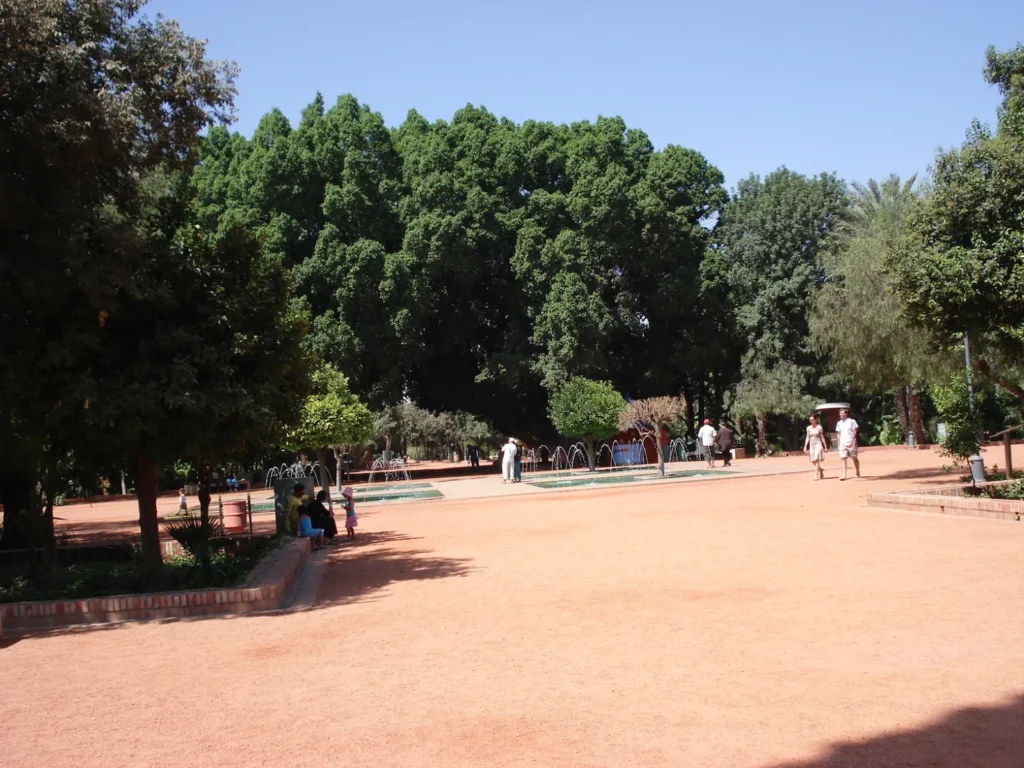
Cyber Parc Moulay Abdeslam is organised around a long esplanade of compacted red earth, a central basin with water jets, and paths lined with bitter orange trees. The buildings are low, painted Maroc Telecom green for the newest ones and ochre for the rest. The oldest trees form a dense canopy in the northern part of the site.
The central basin and the esplanade
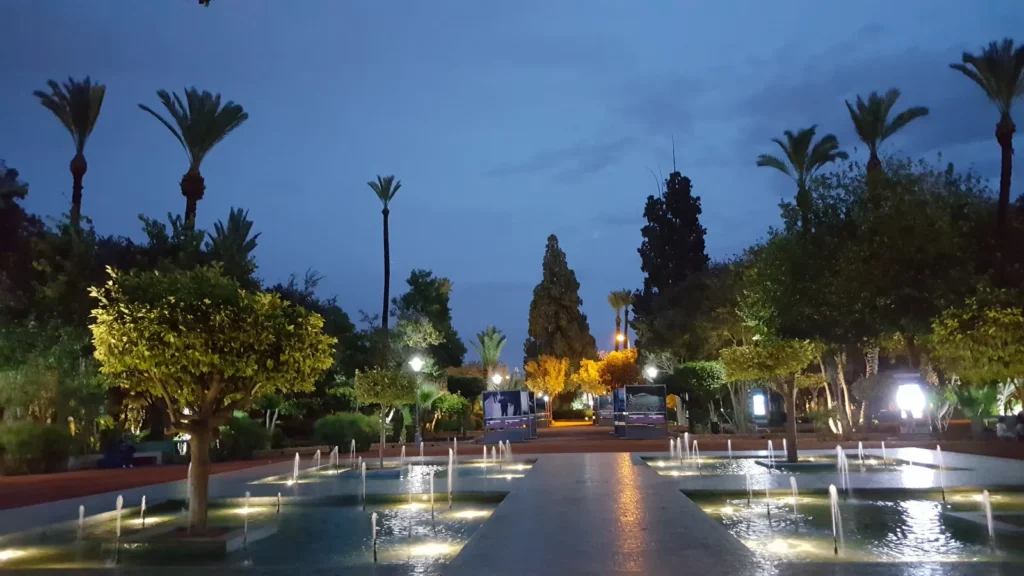
The heart of the park is a rectangular square dominated by a long basin set flush with the ground, animated by vertical jets and flanked by two small islands of clipped shrubs. The esplanade is surfaced in stabilised red earth, the colour that gives Marrakesh its visual unity. This is the natural meeting point: Marrakshi families in the late afternoon, students with laptops, Guéliz office workers on their lunch break. In the evening, the LED lighting installed in 2016 picks out the jets and transforms the place — the only moment when the park is photogenic in the strict sense.
An open-air amphitheatre seating more than 200, with tiered benches, grass, a projection wall and a stage, occupies another sector. It hosts screenings and cultural events, often tied to environmental education. The programme is not published regularly online: if you are hoping to catch an event, ask at the gate on the day.
The trees: bitter orange, olive, palm
The planting stays faithful to the spirit of the original orchard, which clearly sets this park apart from the Majorelle Garden and its cacti and exotics. What grows here belongs to the Haouz plain and the Mediterranean basin. The inventory published after the 2016 works gives a useful sense of scale.
| Item | Reported quantity |
|---|---|
| Oleanders | About 1,175 plants |
| Phoenix palms | About 535 specimens |
| Bitter orange trees | About 500 trees |
| Olive trees | About 459 trees |
| Shrubs planted in 2016 | More than 13,000 |
| Trees added in 2016 | 225 |
| Interactive terminals | 11 totems with 55-inch screens |
| Wi-Fi access points | Around twenty, across 8 hectares |
| LED lighting | More than 300 floodlights |
| Solar generation | Two photovoltaic plants, about 39 kWp and 11 kWp |
In practice that means deep shade under the older specimens, and a very recognisable smell in spring when the bitter oranges flower: orange blossom, the source of orange flower water. If you are in the city in March or April, that flowering alone is reason enough to walk in.
The Telecommunications Museum at the park entrance
The Marrakesh Telecommunications Museum occupies the main entrance hall of the park, on the Avenue Mohammed V side. It opened on 24 September 2001, covers roughly 400 square metres, is presented as the first technical museum in Morocco, and has been a member of the International Council of Museums since January 2002. It is run by Maroc Telecom.
The route through it is chronological and technical. A first room deals with the arrival of the telegraph and the telephone, with a collection of original handsets and a replica of Alexander Graham Bell’s telephone. A technology hall brings together the main switching systems used on the Moroccan network: manual switching, then electromechanical and electronic automatic switching. There are also sections on terrestrial and submarine transmission, radio, satellite links and mobile telephony.
Two dates anchor the Moroccan story: the telephone arriving in Tangier in 1883, and broadcasting starting in 1928. A corridor devoted to the future closes the visit with a staged view of services to come. It is a corporate museum, so necessarily partial, but it is honest about that and it displays objects you will not see anywhere else in Morocco. Allow twenty to thirty minutes.
One useful detail: the museum opened in 2001, four years before the renovated park reopened. The museum came first, which helps explain why Maroc Telecom was already present on the site when the Foundation launched the rehabilitation. The museum’s own hours and any weekly closures are not the subject of stable official publication: check at the gate.
Does the Wi-Fi at Cyber Parc Moulay Abdeslam still work?
The free Wi-Fi at Cyber Parc Moulay Abdeslam is still working and covers all eight hectares through around twenty access points. The eleven interactive terminals, by contrast, are ageing: visitors regularly report dark screens or frozen content. Treat the connection as the real asset and the totems as an uncertain bonus.
Context matters here. In 2005, sitting on a bench in Marrakesh with a connected laptop was close to a miracle. In 2026, almost every foreign visitor arrives with an eSIM or a roaming plan, and most Guéliz cafés offer Wi-Fi. The park’s comparative advantage has shifted: it is no longer the connection, it is being able to work seated, in the shade, in quiet, for nothing, ten minutes from the Koutoubia. For a travelling remote worker that combination is rare in this city.
The cyber space, signposted with green arrows along the paths, offers connected workstations indoors. The service is designed first for a local audience that may not own a computer at home. Do not turn up expecting a coworking space: there are no banks of sockets, no desks and no coffee service.
How do you get to Cyber Parc Moulay Abdeslam from Jemaa el-Fna?
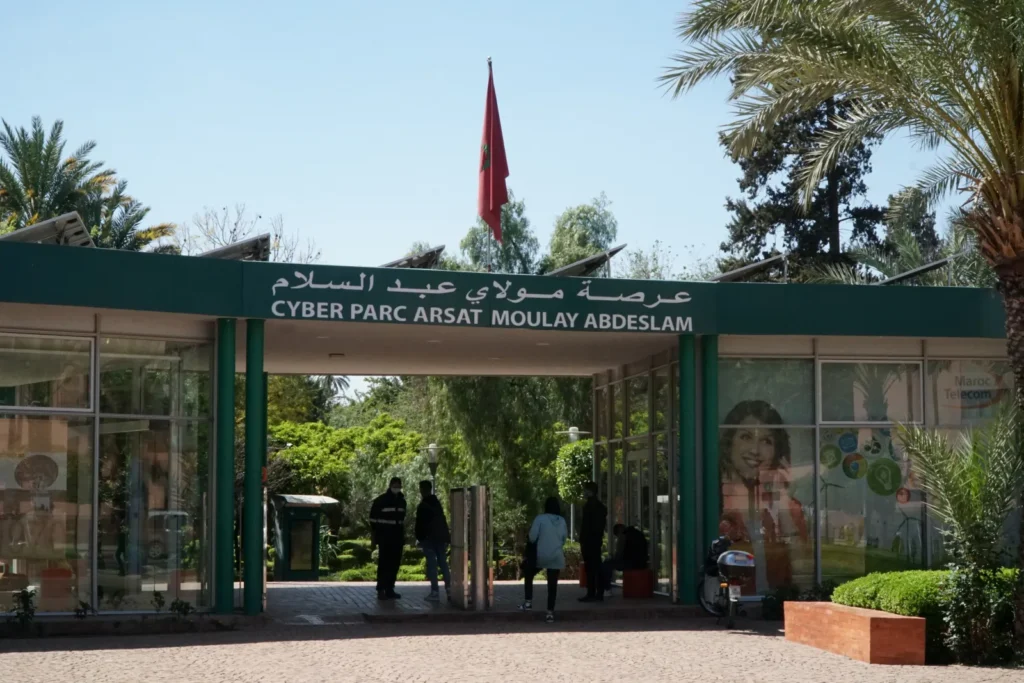
From Jemaa el-Fna square, walk to the Koutoubia, then head north-west up Avenue Mohammed V towards Guéliz: the main entrance to Cyber Parc Moulay Abdeslam is on your right, about 700 metres further on, behind an esplanade and a green portico. Allow a quarter of an hour on foot, with no navigation difficulty at all.
On foot from the Koutoubia
This is the simplest route in the city. From the minaret of the Koutoubia Mosque, take Avenue Mohammed V heading north-west. You pass the Koutoubia gardens, then the ramparts, and the park appears on your right before the big Bab Nkob junction. Eight to ten minutes, with a wide pavement shaded for most of the way. It is the natural extension of a morning spent in the Marrakesh medina, and an excellent way to break the heat before heading back into the Marrakesh souks.
By taxi, by bus, or from the airport
A petit taxi is the fastest option from the medina or from Guéliz: ask for “le cyberparc” or “Arsat Moulay Abdeslam” and every driver will know it. Insist on the meter; over these distances the fare stays very small. The city bus routes linking Jemaa el-Fna to Guéliz run along Avenue Mohammed V and stop close to the park, but check the exact stop locally, as the network has been reorganised in recent years.
From Marrakesh Menara Airport the park is about ten minutes by car in normal traffic: the terminal sits roughly 5 to 6 kilometres from the centre. If you land early and your room is not ready, this is a smart stop after dropping bags at the hotel. To choose between official taxi, shuttle and private transfer, our comparison of airport transfers in Morocco sets out the fares and the traps.
Opening hours, price, dress and the best time to go
The park is open daily and entry is free. Published hours differ from one source to another: some say 7am to 6pm, others 7.30am to 6.30pm, others 7am to 7pm in summer. Work on the safe assumption of an early morning opening and a closure around dusk, and check on the day of your visit.
The best time depends on the season, and the gap is enormous in Marrakesh. From June to September the afternoon is unusable: come before 10am, when the earth is still cool and the jets are running. From October to April the reverse applies: the park is pleasant between 3pm and closing, and the lit basin at the end of the day is worth the detour. The bitter orange blossom in March and April is the peak of the year.
As for dress, there is no constraint: this is neither a mosque nor a madrasa — the traditional Quranic school where access is sometimes regulated. Shorts and a T-shirt will cause no problem, but bear in mind that the park is heavily used by Marrakshi families, and covered shoulders and knees remain the socially easiest option. Bring water: there is no café-restaurant inside, only occasional kiosks depending on the period.
Mistakes to avoid at the Cyber Park
The main mistake is arriving at the Cyber Park expecting a spectacular garden of the Majorelle or Menara type: it is a different register entirely. This is a city park, used by residents, whose interest lies in being free, shaded and historically grounded. Here are the concrete traps.
- Going in the middle of a summer afternoon. Between 1pm and 5pm in July and August the red earth radiates heat and the shade is no longer enough. The park empties, and for good reason.
- Relying on the interactive terminals. Several are out of service or show outdated content. The Wi-Fi does work: download your offline map before you go, not on site.
- Looking for a café inside. There is no proper food terrace in the park. The cafés are on Avenue Mohammed V and on the Guéliz side.
- Confusing it with the Koutoubia gardens. Both sit on Avenue Mohammed V, a few hundred metres apart; the Koutoubia gardens are smaller and have no museum, no Wi-Fi and no amphitheatre.
- Blocking out half a day. Forty-five minutes to an hour and a half is plenty. Beyond that you are going in circles.
- Following a “guide” who approaches you at the gate. The park is free and needs no escort. There is a map at the entrance and the layout is simple.
- Arriving without cash. Even though entry is free, toilets and small purchases are paid in cash, in dirhams.
What to see nearby
The Cyber Park sits on a hinge: the medina begins on the other side of the ramparts, Guéliz begins at the end of the avenue. Walk out and you are less than a quarter of an hour from three very different versions of the city, which makes it an excellent pivot point in a day of sightseeing.
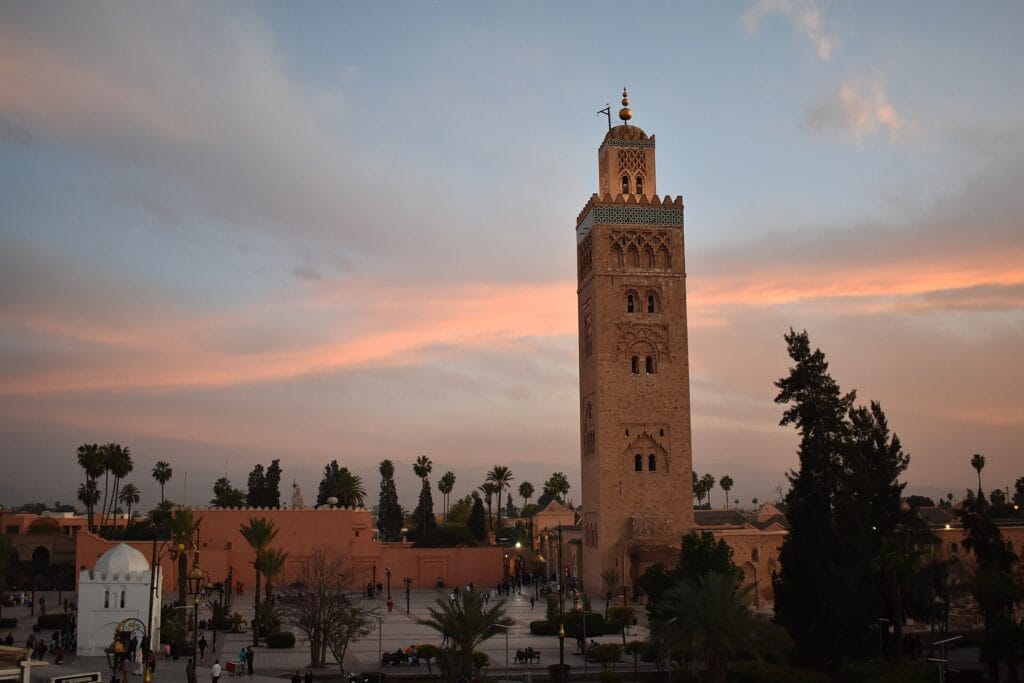
- The Koutoubia Mosque and its gardens, eight minutes’ walk to the south-east. The 12th-century Almohad minaret is the visual reference point of the whole city; the mosque interior is not open to non-Muslims, but the gardens are.
- Jemaa el-Fna square, a quarter of an hour away, inscribed by UNESCO on the list of the intangible cultural heritage of humanity.
- Bab Nkob and the ramparts, immediately north. One detail that avoids a common mistake: Bab Nkob is not a medieval gate but a breach cut through the wall in the 20th century, under the protectorate, to link the medina with the new Guéliz district. The ramparts it passes through do go back to the Almoravid period. It is a good starting point for a calèche ride along the walls.
- Guéliz, ten minutes away: cafés, bookshops, galleries and the municipal market, for a contemporary Marrakesh the medina never shows you.
- The mellah quarter and the Bahia Palace, further south-east, to carry the day on into the historic medina. The mellah is the city’s old Jewish quarter, laid out in the 16th century beside the royal kasbah.
If you are still deciding how to structure your Moroccan trip, our comparison Marrakesh or Fez: which to choose helps split the days between the two imperial cities.
FAQ about Cyber Parc Moulay Abdeslam
These are the questions travellers ask most often before visiting Cyber Parc Arsat Moulay Abdeslam, answered from the information published by the Mohammed VI Foundation for the Protection of the Environment and the Moroccan reference sources available in September 2026.
Is the Cyber Park in Marrakesh free?
Yes, admission to Cyber Parc Arsat Moulay Abdeslam is free, with no ticket and no booking. It is one of the very few large gardens in the city that charges nothing, unlike the Majorelle Garden or Le Jardin Secret. The Wi-Fi is free too. Only occasional services inside may be paid: carry a few dirhams in cash.
What are the opening hours of Cyber Parc Moulay Abdeslam?
The park opens daily, from morning until dusk. Published hours vary between 7am and 7pm depending on the source, with seasonal adjustments, and no stable official publication fixes them. The safest approach is to arrive between 9am and 5pm, a window in which the park is open under every published version, and to confirm at the gate.
How long do you need to visit the Cyber Park?
Allow 45 minutes to walk the paths and sit by the central basin. Add 20 to 30 minutes if you go into the Telecommunications Museum. An hour and a half comfortably covers everything. The park is eight hectares, but the layout is simple and you can see it all without missing anything essential.
Where exactly is the Cyber Park in Marrakesh?
The park borders Avenue Mohammed V, between the Koutoubia Mosque to the south-east and the Bab Nkob junction to the north-west, running alongside the medina ramparts. It marks the transition between the old city and the Guéliz district. The main entrance, recognisable by its green portico and forecourt, opens directly onto the avenue.
Is the Wi-Fi at the Cyber Park really free?
Yes, the Wi-Fi is free and covers all eight hectares thanks to around twenty access points installed during the 2016 renovation. It is the equipment that works best on site. The eleven interactive screen terminals, by contrast, are unevenly maintained and several may be out of service depending on the period.
Is the Telecommunications Museum open to visitors?
Yes, the museum occupies the main entrance hall and can be visited. It opened on 24 September 2001, covers roughly 400 square metres and has been a member of the International Council of Museums since 2002. Its own hours are not published officially on a regular basis and occasional closures are possible: check on site before counting on it.
Is the Cyber Park suitable for children and pushchairs?
Yes. The paths are wide, flat and stabilised, and the site was brought up to accessibility standards during the 2016 works, including toilets, the amphitheatre and the museum. The water jets in the central basin are a hit with children and a play area is signposted. The red earth marks light-coloured shoes, so plan accordingly.
Is there a dress code to enter the park?
No, no dress code applies: the Cyber Park is a public space, not a place of worship. Covered shoulders and knees are nonetheless more comfortable in a park heavily used by Marrakshi families. A hat and a bottle of water matter far more than clothing rules, particularly between June and September.
In summary
Cyber Parc Arsat Moulay Abdeslam offers some of the best value in Marrakesh, because it is free and it delivers what it promises: eight hectares of shade, a basin, an amphitheatre, Wi-Fi that works and a technical museum unique in Morocco, ten minutes from the Koutoubia. It is not a postcard garden, it is a city garden carrying a precise history — an 18th-century princely orchard rescued from oblivion by an environmental foundation and a telecom operator.
Use it well: slot it between two paid attractions, early in the morning in summer or late in the afternoon in winter, walk twenty minutes under the bitter oranges, sit by the water jets, drop into the museum, then head back to the medina or on to Guéliz. Do not ask it to be Majorelle; it is not and does not try to be. Ask it for shade, quiet and a little history, and on those three counts it delivers.
Official sources
- Mohammed VI Foundation for the Protection of the Environment – Arsat Moulay Abdeslam programme
- Mohammed VI Foundation for the Protection of the Environment
- UNESCO – Medina of Marrakesh, World Heritage
- Moroccan National Tourist Office
- Maroc Telecom, operator of the Telecommunications Museum
- ONDA – National Airports Office
Informational article. Prices, opening hours and access conditions may change: check them on site or with the site managers before your visit.
Photo credit
Images: featured image « File:Cyber parc in Marrakech (2844923691).jpg » — mwanasimba from La Réunion (CC BY-SA 2.0); « File:Fontaine Cyber Parc Arsat Moulay Abdeslam.jpg » — Kamalcontwiki (CC BY-SA 4.0); « File:Cyber Parc Arsat Moulay Abdessalam 03.jpg » — Adam Harangozó (CC BY-SA 4.0), via Wikimedia Commons.