Dar El Bacha, now the Museum of Confluences, is the palace that Thami El Glaoui, pasha of Marrakesh, had built in 1910 inside the medina, and it has been open to the public as a state museum run by the Fondation nationale des musées since 9 July 2017. You will also see it written Dar el Bacha, Dar al-Basha, or دار الباشا in Arabic, literally “the house of the pasha”; the city itself is spelled Marrakech in French. The site is two things at once, which is what confuses most visitors: a sequence of decorated reception rooms covered by the museum ticket, and, in a separate wing, the Bacha Coffee room, which generates a queue of its own every day. This page explains what is actually behind the door, what the ticket does and does not include, and how to plan the visit without losing a morning to it.
Information verified in September 2026
In brief
- Private palace built in 1910 for Thami El Glaoui, pasha of Marrakesh from 1912 until 1956, in the Dar El Bacha quarter in the north-west of the medina.
- Managed by the Fondation nationale des musées since July 2015, and inaugurated as the Museum of Confluences by King Mohammed VI on 9 July 2017.
- Official prices published by the Fondation nationale des musées: 60 dirhams for foreign visitors, 25 dirhams for Moroccan citizens, 15 dirhams for Moroccan residents under 18.
- Official hours: Tuesday to Sunday, 10:00 to 18:00; closed on Monday.
- Damaged by the Al Haouz earthquake of 8 September 2023, closed for structural consolidation, and reopened to the public on 23 November 2023.
- The Bacha Coffee room occupies part of the palace and takes no bookings; it is a separate experience from the museum, with its own waiting line.
- The surrounding medina of Marrakesh has been a UNESCO World Heritage site since 1985.
Dar El Bacha at a glance
| Item | Information |
|---|---|
| Quarter | Dar El Bacha / Riad Laarous, medina of Marrakesh, between Bab Doukkala and Mouassine |
| Official address | 65-69 Riad Laârous, route Dar El Bacha, Marrakesh (Fondation nationale des musées) |
| Getting there from Jemaa el-Fna | About 1 km on foot via Rue Mouassine then Rue Dar El Bacha, roughly 15 to 20 minutes depending on how busy the souks are |
| Opening hours | Tuesday to Sunday, 10:00–18:00; closed Monday (reduced hours possible during Ramadan, to be checked locally) |
| Admission | 60 MAD foreign visitors; 25 MAD Moroccan citizens; 15 MAD Moroccan residents under 18 |
| Suggested duration | 45 minutes to 1 hour 15 for the museum alone; add 1 to 2 hours if you also want the coffee room |
| Best time | At opening, around 10:00, or late afternoon after 16:30 |
| Dress | No religious requirement: this is a museum, not a place of worship. Covered shoulders are simply local courtesy; wear comfortable shoes for the derbs |
| Accessibility | Mostly single-level around the courtyard, but thresholds, steps and old paving; wheelchair access to be confirmed with the museum |
| Telephone | +212 5 24 38 17 63 |
What do you actually see at Dar El Bacha, Museum of Confluences?
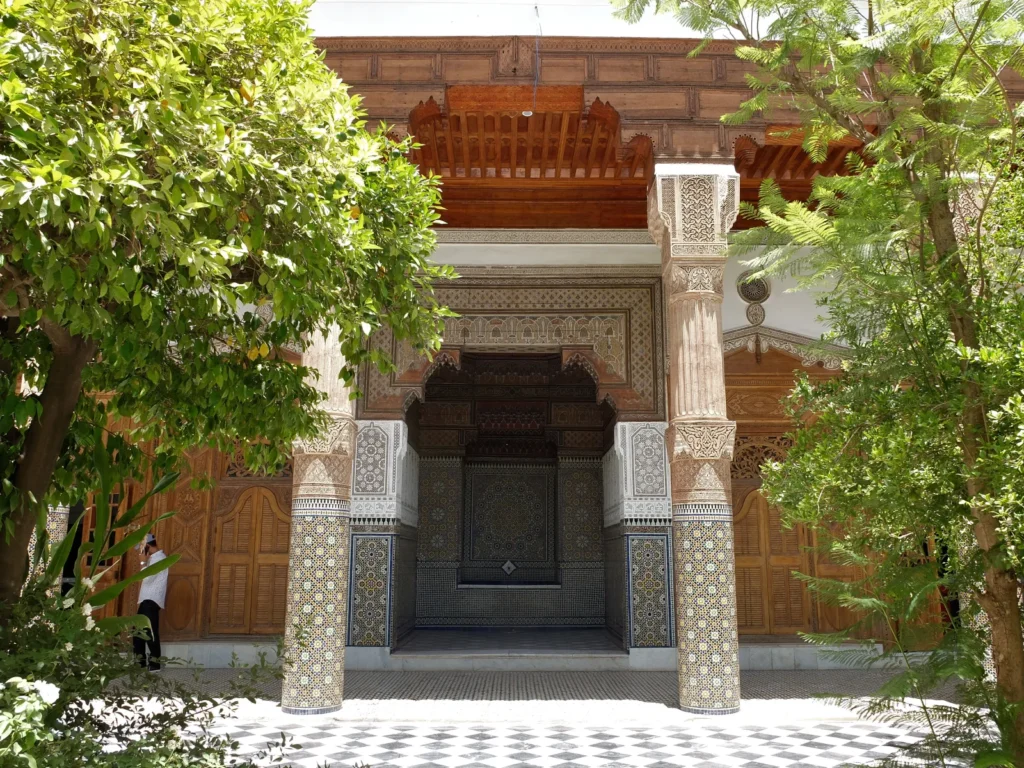
You visit a restored section of the 1910 palace: one large rectangular courtyard planted as a riad garden, four porticoed reception rooms around it, walls of zellij mosaic, painted cedar ceilings, a wall fountain set in an alcove, and two or three temporary exhibition rooms. The route is short, dense, and stays on a single level throughout.
One misunderstanding needs clearing up first. Dar El Bacha is not a museum with a vast permanent collection like the Mohammed VI Museum in Rabat. It is a house, magnificently decorated, whose architecture is the main exhibit, and inside which the Fondation nationale des musées stages shows that rotate. What is on display in February will not be what someone sees in October. The courtyard, the porticoes and the ceilings, on the other hand, never change: they are the reason to come.
The courtyard and the riad garden
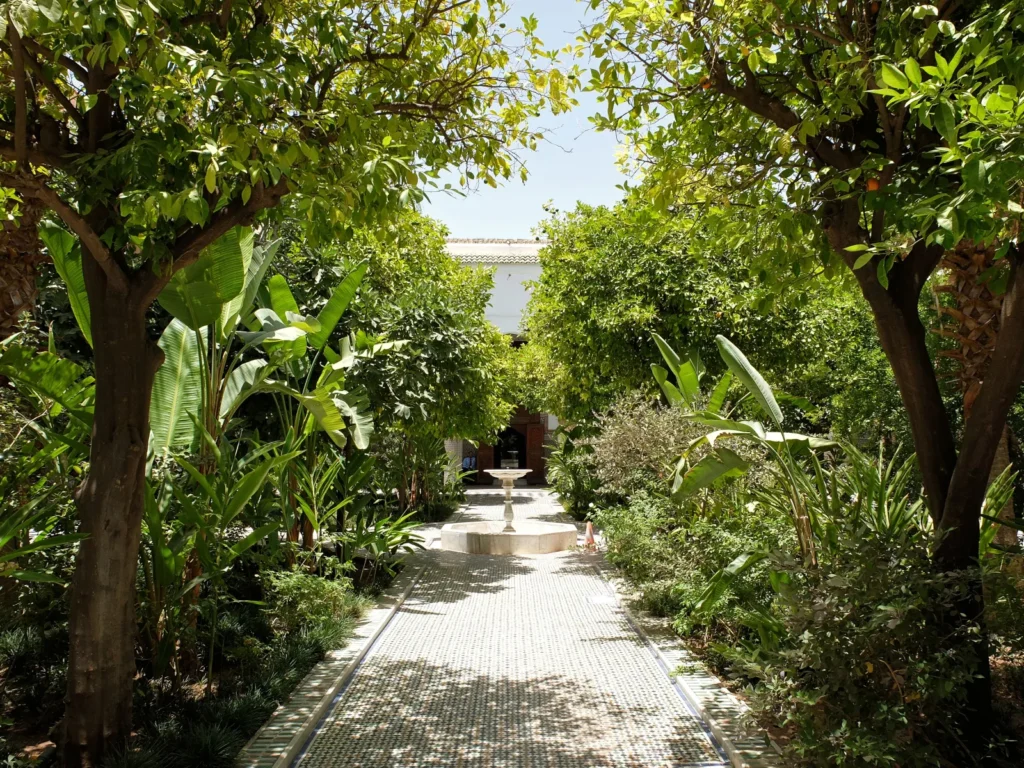
A riad, in the strict architectural sense, is not a guesthouse: it is an interior garden cut into four beds by two crossing paths, with a basin or fountain at the centre. The one at Dar El Bacha is a textbook example. The paths are paved in small tiles, the beds are sunk below them, planted with orange trees and banana plants whose leaves lean far out over the walkway. At the centre sits a low, very plain stone basin that deliberately contrasts with the decorative density of the walls.
That contrast is the point. In the traditional Moroccan house, the street façade is blank and the wealth is turned inwards. You arrive through a derb, a medina lane that is often a dead end, push through an unremarkable door, and the courtyard opens all at once. That is the effect El Glaoui wanted on his guests, and it still works.
The salons, the zellij and the cedar ceilings
The four salons open onto the courtyard through columned porticoes. Look closely at the columns: they are sheathed in zellij, glazed terracotta mosaic cut tile by tile and assembled face down in a bed of mortar. The zellij registers rise to about head height, then give way to carved plaster, known as gebs, and then to wood.
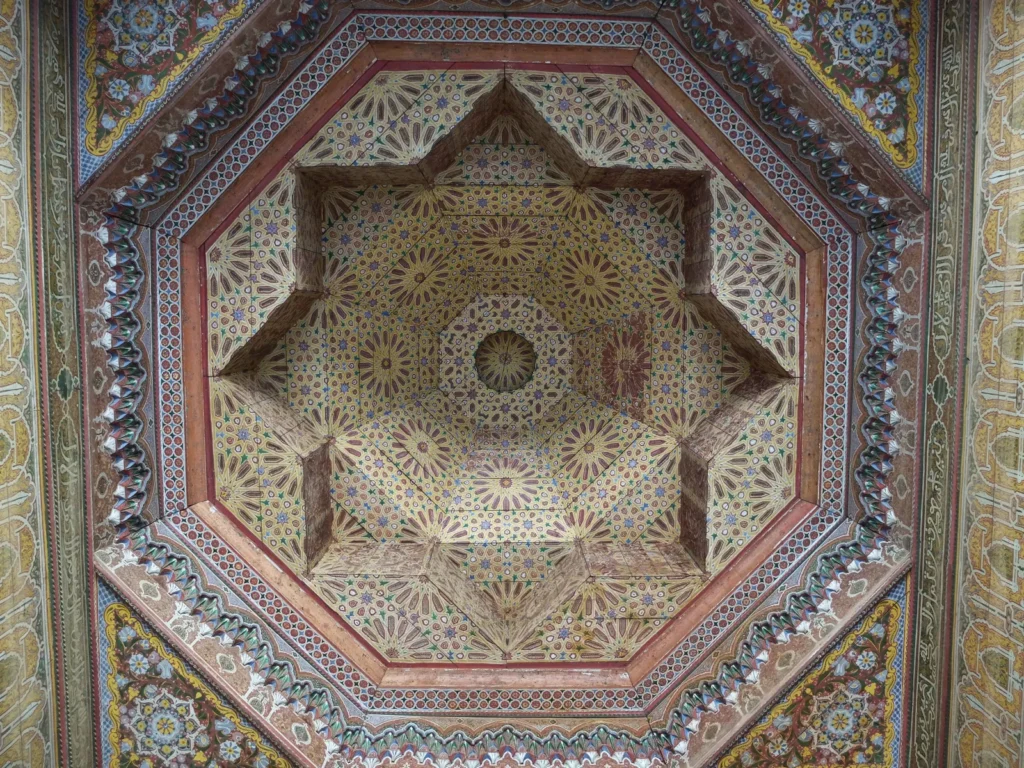
Wood is the strongest feature of the house. The doors are carved Atlas cedar, the lintels and eaves are painted, and some ceilings are octagonal painted wooden domes with star patterns in which the original pigments are still visible under the patina. This is not factory work: these are hand-assembled, hand-painted panels in the zouaq tradition of ornamental painting on wood. Look up in every room, or you will miss half the palace.
Some passages are floored in black and white marble chequerboard, an openly European touch. Dar El Bacha dates from the first years of the French protectorate, and its owner cultivated exactly that mix: traditional Moroccan decoration with Western comfort and references. That is precisely what the word “confluences” in the museum’s current name is pointing at.
The hammam, the douiria and what you will not see
The complete palace contained far more than the current route: a private hammam, a douiria — the small reception apartment, almost a house within the house, where visitors were received without entering the family’s private quarters — and the family rooms themselves. Only part of the complex has been restored and opened. If a door is shut, it is not an oversight: it marks the edge of the museum perimeter. Do not expect to see everything described in architecture books.
The history of Dar El Bacha and Thami El Glaoui
Dar El Bacha was built in 1910 for Thami El Glaoui, head of the Glaoua family of the High Atlas, who received the title of pasha of Marrakesh in 1912 and held it until his death in January 1956. The palace was conceived as a political instrument as much as a residence: to entertain there was to display power.
One caveat about the date, which few pages flag: encyclopaedic entries and architectural histories agree on 1910, but the museum’s own listing published by the Fondation nationale des musées describes a magnificent 18th-century palace. That earlier dating stands alone and is not repeated by any other consultable source; it most likely refers to an older core reused in the pasha’s building. Take 1910 as the date of the palace you are visiting, and do not be surprised to read the 18th century elsewhere.
| Date | Event |
|---|---|
| 1070-1072 | Marrakesh founded by the Almoravids, according to UNESCO |
| Around 1879 | Birth of Thami El Glaoui at Telouet, in the High Atlas |
| 1910 | Construction of Dar El Bacha, the house of the pasha |
| 1912 | Thami El Glaoui receives the title of pasha of Marrakesh; the French protectorate begins |
| 1930s-1950s | The palace receives visiting guests; guidebooks and local tradition name Colette, Maurice Ravel, Josephine Baker, Charlie Chaplin and Winston Churchill, although no public archive documents these stays |
| January 1956 | Death of Thami El Glaoui, weeks before Moroccan independence |
| 1985 | The medina of Marrakesh is inscribed on the UNESCO World Heritage List |
| July 2015 | The building passes to the Fondation nationale des musées |
| 9 July 2017 | The Museum of Confluences is inaugurated by King Mohammed VI |
| 2019 | The historic coffee room reopens under the Bacha Coffee name |
| 8 September 2023 | Al Haouz earthquake; the palace is damaged and closes |
| 23 November 2023 | Reopening after consolidation work, with two temporary exhibitions |
Who was Thami El Glaoui?
Thami El Glaoui remains a contested figure in Morocco, and it helps to know that before you walk in. Born into a family of Berber chiefs of the High Atlas whose stronghold was the kasbah of Telouet on the Tizi n’Tichka road, he became under the French protectorate the dominant political figure of the Moroccan south. His fortune came from control of the mountain passes, the mines and the farmland.
The end of his career is another matter. He played a central role in the deposition of Sultan Mohammed V in 1953, then reversed course in 1955. He died in January 1956, the year of independence, largely discredited. The museum is not a tribute to the man: it preserves his house as a document about a period. The distinction matters, and it explains why the displays talk a great deal about architecture and very little about politics.
From private palace to public museum
After independence the building lost its function and spent decades in administrative limbo. The turning point came in July 2015, when the Fondation nationale des musées took over its management and launched a restoration campaign. Two years later, on 9 July 2017, King Mohammed VI inaugurated “Dar El Bacha – Museum of Confluences”. The site joined a national network that includes the Mohammed VI Museum of Modern and Contemporary Art in Rabat and the Museum of Intangible Heritage, itself in Marrakesh on Jemaa el-Fna.
In 2018, one of the museum’s exhibitions brought together objects from places of worship of the three monotheistic religions, setting out the intellectual programme of the place from the start. Since then the calendar has alternated between material heritage, craft traditions and contemporary Moroccan art.
Why “Museum of Confluences” and not simply Dar El Bacha?
The subtitle refers to the curatorial project of the Fondation nationale des musées: to present Moroccan identity as a meeting point of Arab, Amazigh, Andalusian, African, Jewish and Mediterranean contributions. “Confluences” describes that crossing, not one particular exhibition theme.
Beware of a common confusion: there is another Musée des Confluences, in Lyon, France, devoted to science and society. The two have no connection whatsoever. When searching online, always add “Dar El Bacha” or “Marrakesh”, or you will land on the French institution.
This positioning also explains the nature of the shows. At the November 2023 reopening two exhibitions were presented: “Un art façonné par le temps: le bois dans toutes ses formes”, on woodworking skills in Moroccan architecture and furniture, and “L’univers de Fatna Gbouri”, devoted to the work of that Moroccan painter. The programme changes several times a year: check the exhibitions section of the Fondation nationale des musées before you come if the current show is what decides your visit.
How much does Dar El Bacha cost and what are the opening hours?
According to the Fondation nationale des musées, admission is 60 dirhams for foreign visitors, 25 dirhams for Moroccan citizens and 15 dirhams for Moroccan residents under 18. The museum opens Tuesday to Sunday from 10:00 to 18:00 and closes on Monday. Tickets are bought on site, at the desk just inside the entrance.
| Category | Published price |
|---|---|
| Foreign visitor | 60 MAD |
| Moroccan citizen | 25 MAD |
| Moroccan resident under 18 | 15 MAD |
| Coffee room order | Not included, billed separately |
| Payment methods | Not officially stated; carry dirhams in cash |
Two practical notes. First, there is no official combined ticket linking Dar El Bacha to the other museums of Marrakesh: each site is paid for separately. Second, during Ramadan the hours of medina institutions are frequently adjusted, and the coffee room in particular may open only in the evening. If your stay falls in that period, telephone the museum the day before.
How do you get to Dar El Bacha from Jemaa el-Fna?
On foot, allow about one kilometre and 15 to 20 minutes from Jemaa el-Fna. The simplest route follows Rue Mouassine north-west, then turns left onto Rue Dar El Bacha, a street that is unusually wide and straight for the medina and recognisable by its scooter traffic. The palace is on the right-hand side as you come from Mouassine.
- From the Koutoubia: about 1.2 km, roughly twenty minutes, via Jemaa el-Fna then Mouassine.
- From the Ben Youssef Madrasa: about 600 to 800 m through the souks, though the route is a maze; pairing the two in one morning works very well.
- From Bab Doukkala: under 500 m, the fastest approach if you arrive by taxi, since the gate is reachable by vehicle.
- From Gueliz: 3 to 4 km; take a petit taxi to Bab Doukkala and finish on foot, as cars cannot enter the derbs.
The tip that saves time: tell the driver “Bab Doukkala”, not “Dar El Bacha”. Petit taxis cannot approach the museum door and will drop you at a medina gate anyway. From Marrakesh Menara Airport it is roughly ten kilometres to this north-western edge of the medina of Marrakesh; our comparison of airport transfers in Morocco sets out the options and their costs.
Bacha Coffee at Dar El Bacha: what to know before you queue
Bacha Coffee occupies the palace’s former coffee room, in a wing separate from the museum route. The brand traces its origin to 1910, the year Dar El Bacha was built, and the room reopened under that name in 2019 after being taken on by the V3 Gourmet group led by Taha Bouqdib. The house advertises more than 200 single-origin arabica coffees.
Here is the point that trips everyone up: it is not the same thing as the museum. Your museum ticket does not get you a table, and a table does not get you the museum. The two are handled separately at the entrance, and the coffee room takes no reservations, seating strictly in order of arrival. At peak hours, in high season and at weekends, the wait is real and is regularly reported by visitors.
- State clearly at the gate whether you are there for the museum, the coffee room, or both: the queues are not the same.
- If the coffee room matters to you, turn up at opening, around 10:00. After 11:00 the wait lengthens noticeably.
- The most efficient order is to put your name down for the coffee room, then visit the museum while you wait, if staff allow it that day.
- The menu is expensive by Moroccan standards: coffee here is a luxury product, not a neighbourhood café. There is a boutique if you only want to leave with a packet.
- During Ramadan, service is generally shifted to the evening.
Do not confuse this room with the Bacha Coffee counter found in airport terminals either: same brand, completely different setting. Here the palace interior is as much of the attraction as the cup.
Mistakes to avoid at Dar El Bacha
Failed visits to Dar El Bacha all look alike: people turn up on a Monday, assume the ticket includes the café, stay twenty minutes and leave without ever looking up. These are the costliest mistakes, all avoidable in advance.
- Coming on a Monday. The museum is closed that day. It is the leading cause of disappointment, and no exceptions are announced.
- Assuming the ticket includes Bacha Coffee. It does not. Two desks, two queues, two payments.
- Arriving in the middle of the day in high season. Between 12:00 and 15:00 the courtyard is saturated and photographs are impossible to frame without crowds.
- Not looking at the ceilings. They are the most remarkable part of the palace and the part visitors miss most consistently.
- Expecting a permanent collection. The museum works through temporary exhibitions; check what is hanging if that is your main motivation.
- Planning a wheelchair visit without calling first. The old building has thresholds and steps; confirm access conditions in advance.
- Relying on cards for small purchases nearby. In the surrounding derbs, cash remains the norm.
What is around Dar El Bacha?
Dar El Bacha sits in one of the densest heritage sectors of the medina: the Ben Youssef Madrasa, the Museum of Marrakesh, the Maison de la Photographie and the Mouassine Mosque are all within a ten-minute walk, and the souk district begins immediately east of the palace.
- The Ben Youssef Madrasa, to the east: a madrasa is a Quranic college where students lived on site. This is the most spectacular in Morocco for sheer decoration. See our dedicated page on the Ben Youssef Madrasa.
- The Mouassine fountain and its fondouk: a fondouk is a former caravanserai built around a central court, with storage below and rooms above. Several have been converted into artisans’ workshops.
- Bab Doukkala and its mosque, to the west: a historic medina gate, useful as a taxi drop-off point.
- The souks: a few minutes away via Rue Mouassine, including the dyers’ and metalworkers’ sections.
- The Yves Saint Laurent Museum and Jardin Majorelle, in Gueliz: a different, more contemporary register, best kept for another half-day. See our article on the Yves Saint Laurent Museum.
A morning itinerary that works well: Dar El Bacha at opening, then the Ben Youssef Madrasa, lunch around Mouassine, and back towards Jemaa el-Fna through the souks in late afternoon. If you are still weighing up which imperial city to base yourself in, our comparison of Marrakesh or Fez lays out the criteria.
FAQ about Dar El Bacha
Is Dar El Bacha open on Mondays?
No. The Dar El Bacha Museum of Confluences is closed on Mondays. The official hours published by the Fondation nationale des musées are Tuesday to Sunday, 10:00 to 18:00. This weekly closure is the single biggest cause of wasted journeys. During Ramadan and on national public holidays the schedule may be adjusted, so call the museum the day before to confirm.
How long should I allow for the visit?
Allow 45 minutes to 1 hour 15 for the museum on its own. The route is short, on one level, and concentrated around the courtyard and a handful of salons. If you also want coffee in the Bacha Coffee room, add one to two hours to account for the wait, which can be long in high season and at weekends.
Do I need to book a ticket in advance?
No, museum tickets are bought on site at the desk, and the Fondation nationale des musées does not announce a compulsory online booking system for this site. The coffee room takes no reservations at all and seats strictly in order of arrival. Carry dirhams in cash: the payment methods accepted are not officially stated.
Does the museum ticket include Bacha Coffee?
No, these are two separate offerings. The admission ticket covers the museum route and the temporary exhibitions, not a table in the coffee room. Equally, ordering at Bacha Coffee does not exempt you from buying a ticket to see the museum. Say which you want at the entrance so you are directed to the right queue.
Can you take photographs inside?
Personal photography is generally tolerated in the courtyard and the architectural spaces, but rules can differ depending on the temporary exhibition, as some loans forbid photography. Conditions for tripods and professional shoots are not officially published: ask at reception before getting equipment out.
Did the museum reopen after the 2023 earthquake?
Yes. Damaged by the Al Haouz earthquake of 8 September 2023, Dar El Bacha closed for consolidation work and reopened to the public on 23 November 2023 with two temporary exhibitions. The building is accessible again within its usual perimeter. If you read that it is closed, check the date of the source: many pages have not been updated since 2023.
Is Dar El Bacha worth it compared with other Marrakesh palaces?
Yes, provided you know what you are coming for. Dar El Bacha is smaller and more intimate than the Bahia Palace, and it is twentieth century rather than nineteenth. You come for the quality of the decoration in a compact space, for the painted cedar ceilings and for a temporary exhibition. Treat it as a one-hour stop, not a half-day.
Is the museum accessible for visitors with reduced mobility?
Partly. The route runs largely on one level around the courtyard, which helps, but the 1910 building has thresholds, a few steps and uneven historic paving, and the lanes leading to it are narrow. The Fondation nationale des musées does not publish a detailed accessibility sheet for this site, so contact the museum in advance to arrange the visit.
Summary
Dar El Bacha is a short, strong visit: an hour is enough, but it is an hour that shows what early twentieth-century Moroccan craftsmanship could do better than many far larger monuments. Come at opening, on any day but Monday, with dirhams in your pocket and the intention to study the ceilings as carefully as the display cases.
Decide in advance how you feel about the coffee, too. If Bacha Coffee is part of your plan, it will shape the whole morning and you have to accept that. If it does not interest you, you can chain Dar El Bacha, the Ben Youssef Madrasa and the Mouassine souks into one comfortable morning and keep the afternoon for Gueliz. Either way, check the current exhibition before you set off: that is what makes the difference between two visits to the same palace.
Official sources
- Fondation nationale des musées – Musée des Confluences Dar El Bacha
- Fondation nationale des musées – Current exhibitions
- UNESCO – Medina of Marrakesh, World Heritage List
- Moroccan National Tourist Office – Visit Morocco
- Office National des Aéroports (ONDA), Morocco
This article is informational. Prices, opening hours and access conditions may change without notice: check with the museum or the Fondation nationale des musées before your visit.
Photo credit
Images: featured image « File:Dar al Bacha Marrakesh DSCF8691.jpg » — R Prazeres (CC BY-SA 4.0); « File:Dar al Bacha Marrakesh DSCF8510.jpg » — R Prazeres (CC BY-SA 4.0); « File:Dar al Bacha Marrakesh DSCF8802.jpg » — R Prazeres (CC BY-SA 4.0), via Wikimedia Commons.