The Tiskiwin Museum, the house-museum built by Dutch collector Bert Flint at 8 Rue de la Bahia in Marrakesh, no longer receives visitors: Cadi Ayyad University, which has owned the property since 2006, states on its portal that the museum is closed for maintenance, and the collection reopened in June 2026 in another house in the medina under the name Marrakesh-Timbuktu. You will also see the place written Maison Tiskiwin, Bert Flint Museum, musée Tiskiwin in French (the city itself is spelled Marrakech in French) and دار تيسكيوين in Arabic. This page sets out what can still be seen, where, at what price, and why this collection is one of the most original in Morocco.
Information verified in September 2026
In brief: what to know about the Tiskiwin Museum
- The historic house-museum stands at 8 Rue de la Bahia, about a hundred metres from the Bahia Palace, inside the medina of Marrakesh.
- It was created by Bert Flint (1931-2022), a Dutchman who settled in Marrakesh in 1957, a self-taught anthropologist and collector of rural art.
- Flint gave the buildings and the collection to Cadi Ayyad University in Marrakesh in 2006; the university portal now lists the museum as “closed for maintenance”.
- The Al Haouz earthquake of 8 September 2023 damaged the house; the museum had already stopped operating regularly after Bert Flint’s death in November 2022.
- The collection has been on show again since June 2026 in another medina house, under the name Marrakesh-Timbuktu, a seven-minute walk from Café de France on Jemaa el-Fna square.
- The display recreates a caravan route in nine stages, from Marrakesh to Timbuktu and back by the western road.
- Admission announced by the new venue: 100 dirhams full price, 40 dirhams for Moroccan citizens on presentation of ID, free for children under 12.
Practical fact sheet: Tiskiwin Museum and the Bert Flint collection
Two addresses coexist in guidebooks and mapping apps: the old house-museum, now closed, and the new space that has been showing the same collection since June 2026. The table below separates the two clearly, using only information published by the organisations involved or marked as to be checked on site.
| Item | Maison Tiskiwin (historic site) | Marrakesh-Timbuktu (Bert Flint collection today) |
|---|---|---|
| District and address | 8 Rue de la Bahia, medina, Bahia Palace quarter | Hay Quenaria, Derb Boutouil no. 33b, medina |
| Access from a landmark | About 3 minutes on foot from the Bahia Palace entrance | 7 minutes on foot from Café de France (Jemaa el-Fna), 10 minutes from the Bahia Palace |
| Status | Closed (“closed for maintenance”, per Cadi Ayyad University) | Open since June 2026 |
| Opening hours | Not applicable | Daily 10:00 to 19:00, last admission 30 minutes before closing |
| Admission | Not applicable (symbolic entrance fee until closure) | 100 MAD full price; 40 MAD Moroccan citizens (ID required); free under 12 |
| Suggested duration | Not applicable | 1 hour to 1 hour 30 for the nine stages |
| Best time | Not applicable | Opening time or late afternoon, when the derbs are quieter |
| Dress | Not applicable | Shoulders and knees covered, closed shoes for the stairs |
| Accessibility | Not applicable | Ground floor wheelchair accessible; no lift in the old house |
| Text languages | Labels in French, room sheets lent in several languages before closure | Panel texts in English and French |
Is the Tiskiwin Museum open in 2026?
No. The house-museum at 8 Rue de la Bahia remains closed to the public in September 2026. The portal of Cadi Ayyad University, owner of the building and the collection since 2006, carries the line “the museum is currently closed for maintenance”, with no reopening date announced. No tickets are sold there.
Three events explain the closure, and they are worth separating because online guides mix them up. First, the death of Bert Flint on 1 November 2022, in the very house he had turned into a museum: without him the place lost its daily presence, the man who greeted visitors and explained each object. Second, the Al Haouz earthquake of 8 September 2023, magnitude 6.8 according to the United States Geological Survey, with an epicentre about 70 kilometres south-west of Marrakesh: the medina was affected, rammed-earth walls and terraces gave way, and the old house on Rue de la Bahia was damaged. Third, the legal and financial question: the collection belongs to a public university, and restoring an old building inside a World Heritage perimeter is not decided in a few months.
In practice, if you still see “Tiskiwin Museum, open 9:30 to 12:30 and 15:00 to 18:00, 20 dirhams” on a blog or an aggregator page, that information predates 2022. It keeps circulating because nobody updates it. Do not build your morning around a visit to that address.
Where can you see the Tiskiwin Museum collection today?
The collection assembled by Bert Flint has been on display again since June 2026 in an old house in the medina of Marrakesh, at Derb Boutouil no. 33b, Hay Quenaria district, under the name Marrakesh-Timbuktu. A derb is a private lane in the medina, often a dead end. The venue presents itself as continuing the legacy of Bert Flint and of his former Tiskiwin Museum.
The project is run by Joost Flint, the collector’s nephew, manager of the company Speaking Objects, with a local team. The stated aim is straightforward: rather than wait for a hypothetical restoration on Rue de la Bahia, rebuild the route elsewhere so that the objects keep being seen. The display design is new — cases and tables by the Younes Duret studio, caravan-route maps by geographer Eric Ross, illustrations by Emilie Verbanck — which makes the hang easier to read than the charming but dense pile-up of the old house.
One point deserves to be stated plainly: the legal relationship between this new exhibition and Cadi Ayyad University, to which Bert Flint gave his collection and his walls in 2006, is not publicly spelled out by either side. The university still presents “Muséum Dar Tiskiwin” as its museum, closed for maintenance; Marrakesh-Timbuktu presents the Flint collection without detailing the point. If it matters to you, ask at the desk rather than trust a guidebook.
What is on show in the new space
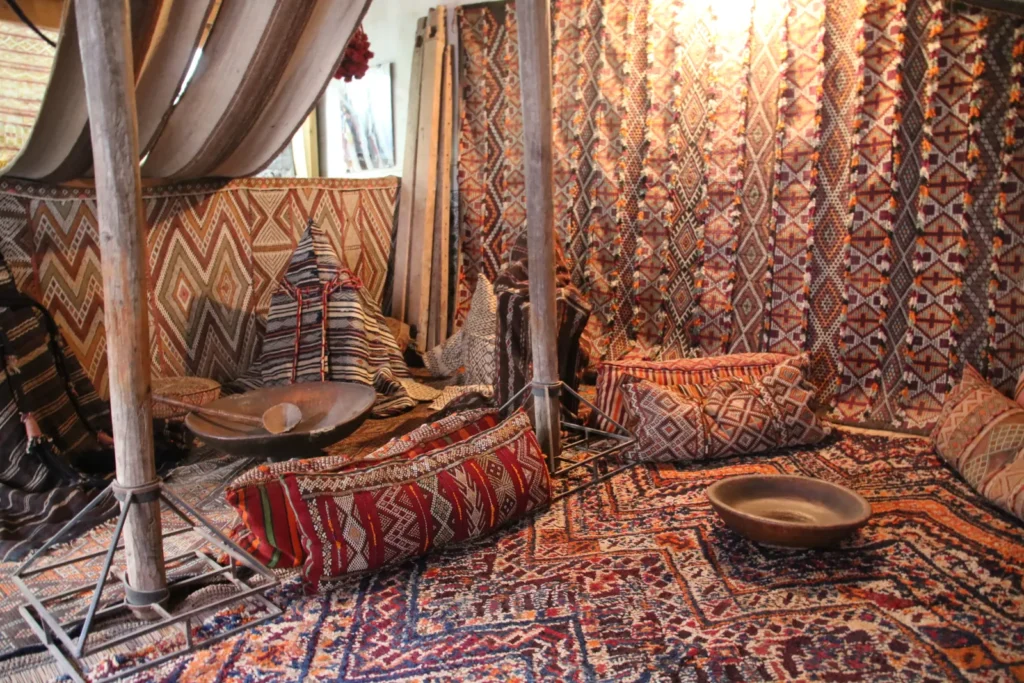
The route unfolds through a courtyard house on several levels and ends on a roof terrace where a tent from southern Morocco is pitched. You will find textiles and carpets, Tuareg silver jewellery, pottery, basketry, leatherwork, healing amulets, Neolithic beads, West African masks and statues, carved wooden doors and panels, and painted ceilings dismantled and reassembled. One room is devoted to Timbuktu and the sub-Saharan holdings.
A temporary exhibition of photographs of southern Morocco taken in the 1960s and 1970s by the doctor Boris Witjas accompanies the opening, announced from 12 June to 31 December 2026. Panel texts are written in English and French; the venue’s website adds German, Italian, Dutch and Spanish.
Who was Bert Flint, founder of the Tiskiwin Museum?
Bert Flint was a Dutchman born on 24 May 1931, trained as a Hispanist, who became through practice one of the finest connoisseurs of the rural arts of Morocco and the Sahara. He first came to Morocco in 1954, settled in Marrakesh in 1957, and lived there until his death on 1 November 2022, aged 91.
His intellectual path is more interesting than the standard European collector biography. Flint studied Spanish language and literature at the University of Utrecht. A visit to the Alhambra in Granada turned him towards the Andalusi world, and his first trip to Morocco in 1954 showed him that Moroccan architecture and ornament extended that tradition. So he moved to Marrakesh to study urban art of Hispano-Moorish inspiration. Then he changed direction, and this is where his work becomes singular: he gradually turned away from urban refinement towards the countryside, the Souss valleys, the pre-Saharan oases, the nomads. He ended up defending a thesis few people pressed so hard at the time: Moroccan material culture cannot be understood through al-Andalus and the East alone, it is also anchored in the Sahara and West Africa.
His way of collecting was closer to visual fieldwork than to buying prestige pieces. He put it himself: intrigued by a shape or a pattern, he would buy an object, then discover another that resembled it — and the series thus built up ended by drawing a map. That is precisely what the museum route stages: modest, often domestic objects, lined up to reveal continuities between the Middle Atlas, the central Sahara and the Niger Bend.
Flint did not keep his holdings to himself. He had taken part in 1990 in founding the municipal Amazigh Heritage Museum in Agadir, which acquired part of his collection in 2000. In 2015 he made a donation to the Berber Museum at Jardin Majorelle, renamed the Musée Pierre Bergé des Arts Berbères in 2020; the Fondation Jardin Majorelle states that the gift covers more than six hundred pieces — textiles, jewellery, carpets, pottery. From 21 October 2020 to 1 August 2021 the Yves Saint Laurent Museum Marrakech devoted a monographic exhibition to him, extended because of its success. And in 2006, aged 75, he had given house and collection to Cadi Ayyad University in Marrakesh.
What does the name “Tiskiwin” mean?
Tiskiwin is an Amazigh word referring to horns. According to the explanation given by Bert Flint himself and repeated by the online museum he founded, the name comes from a High Atlas dance in which men wear horns — “tiskt” — evoking the mountain goat of the heights. The word first served as a shop sign.
The detail is not trivial: it says what Flint was after. Not a museum of Moroccan fine arts, but a place devoted to rural and ritual practices, often older than Islamisation and sometimes still alive. Some French-language notices suggest that Tiskiwin means “a Moorish dance”: the wording is vague and drags the meaning towards the Andalusi imagination, the exact opposite of the collection’s Amazigh and Saharan argument.
History of the house-museum, from the 1980 shop to the donation
The Tiskiwin Museum was not founded in one go: it grew in stages, following Bert Flint’s property purchases on Rue de la Bahia between 1976 and 1990. A riad — a house built around an interior courtyard, usually planted — became a shop, then an exhibition space, then a public museum, then university property.
| Year | Step |
|---|---|
| 1931 | Bert Flint born in the Netherlands on 24 May |
| 1954 | First trip to Morocco, after a visit to the Alhambra in Granada |
| 1957 | Settles permanently in Marrakesh |
| 1976 | Buys the first house on Rue de la Bahia |
| 1980 | Opens the “Tiskiwin” clothing shop |
| 1987 | Buys the adjoining house to enlarge the exhibition space |
| 1990 | Opens to the public according to the online museum founded by Flint (French sources give 1996) |
| 1990 | Takes part in founding the municipal Amazigh Heritage Museum in Agadir |
| 2000 | The Agadir museum acquires part of the collection |
| 2006 | Buildings and collection donated to Cadi Ayyad University |
| 2014 | An online version of the museum is launched |
| 2015 | Donation of more than six hundred pieces to the Berber Museum at Jardin Majorelle |
| 2020-2021 | Monographic exhibition at the Yves Saint Laurent Museum Marrakech (21 October 2020 – 1 August 2021) |
| 1 November 2022 | Bert Flint dies in Marrakesh |
| 8 September 2023 | Al Haouz earthquake; the house is damaged |
| June 2026 | The collection reopens in the medina as Marrakesh-Timbuktu |
A word on the opening date, since sources differ: the online museum created by Flint gives a public opening in 1990, while several French-language notices, Wikipedia among them, give 1996. Both dates can be defended if you separate the informal opening of the display from recognition of the place as a museum. With no published official record, it is better to write “opened to the public during the 1990s” than to pick one at random.
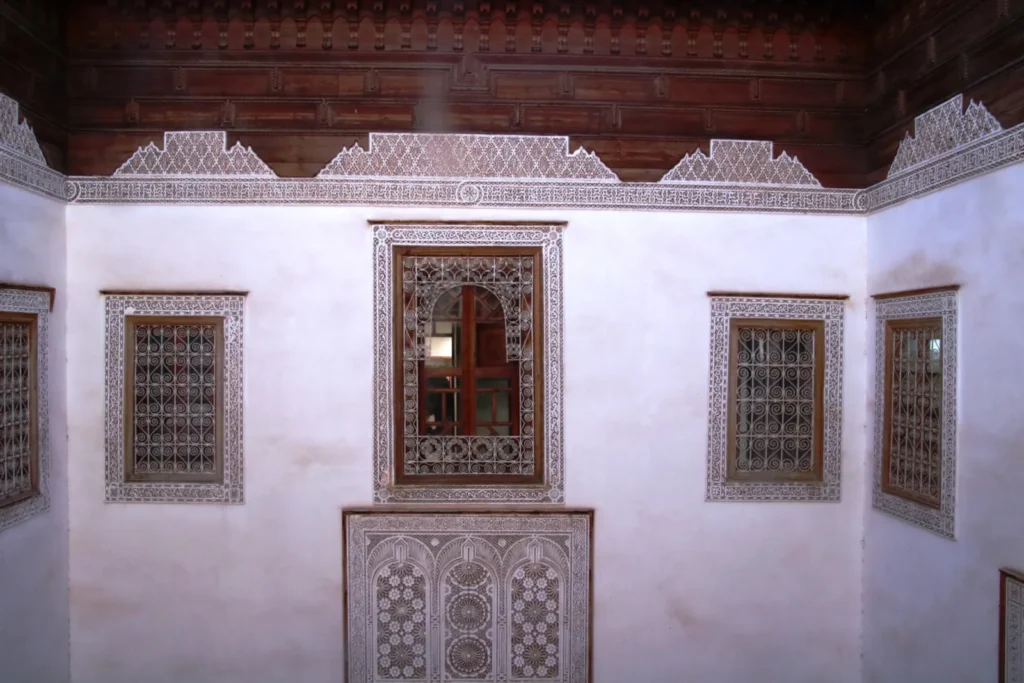
The house itself deserves a mention. It is a medina dwelling built around a patio, with colonnaded galleries, carved cedar ceilings, gebs — chiselled plaster — framing the windows, and wrought-iron grilles in spirals. This domestic architecture is not a neutral backdrop: it explains why the visit went room by room, up narrow staircases, climbing towards the terrace. You were visiting a house inhabited by a collection, not a white gallery.
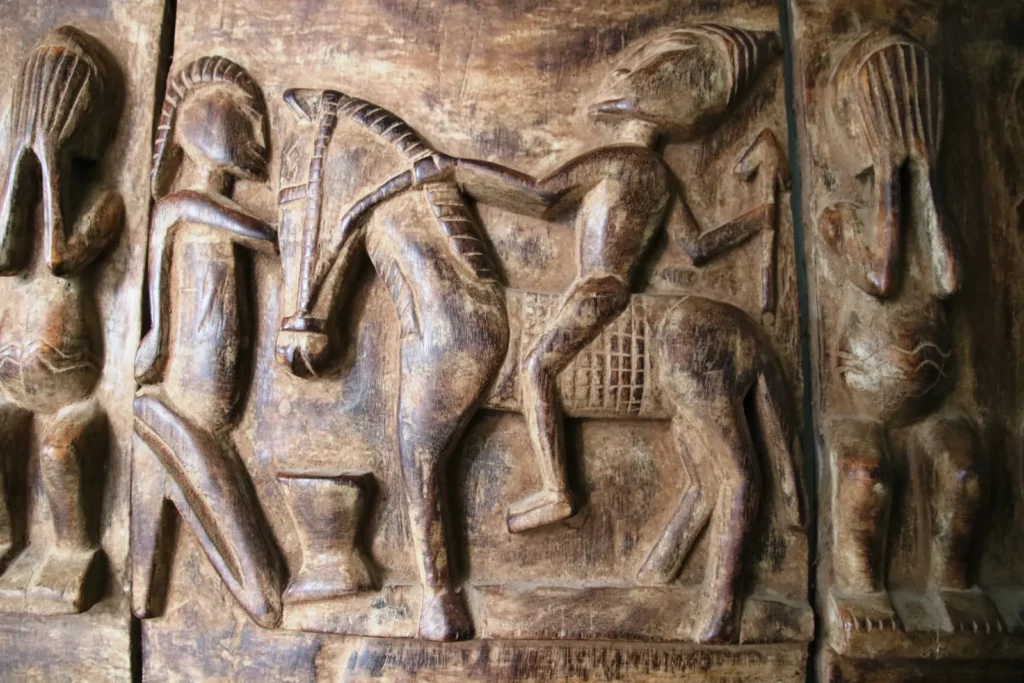
The nine stages of the route, from Marrakesh to Timbuktu
Bert Flint’s great idea was to turn a collection into an itinerary. The display does not sort objects by material or period: it follows an imaginary caravan road that leaves Marrakesh, drops into the Sahara, reaches Timbuktu, then climbs back by the west to the Western High Atlas, in nine stages.
One useful precision if you compare sources: the nine-stage division is the new display’s, as published by Marrakesh-Timbuktu. The online museum created by Bert Flint, still available, presents the same itinerary in twelve stages, up to Lemtouni Tric. The objects and the logic are the same; only the grouping of rooms changes.
| Stage | Leg | What you see |
|---|---|---|
| 1 | Marrakesh → Fez (Middle Atlas) | Rural crafts, pottery and weaving of the Middle Atlas tribes |
| 2 | Fez → Imilchil (Eastern High Atlas) | Weaving traditions of the semi-nomads of the high valleys |
| 3 | Imilchil → Timimoun (pre-Saharan oases) | Oasis cultures, silver jewellery, objects from the ksour |
| 4 | Timimoun → Agadez (central Sahara) | The Tuareg world: leatherwork, saddles, chests, ornaments |
| 5 | Agadez → Déou (Niger Bend) | Sahelian communities and river Tuareg |
| 6 | Déou → Timbuktu (Burkina Faso and Mali) | West African farming societies, masks and statues, carved doors |
| 7 | Timbuktu → Kiffa (Mauritania) | Desert herders, Moorish beads and textiles |
| 8 | Kiffa → Akka (western route) | Trans-Saharan trade and the circulation of forms |
| 9 | Akka → Marrakesh (Western High Atlas) | Geometric art of the Souss and contemporary echoes |
The route opens with a section on the “Green Sahara”, the Neolithic period when the Sahara was grassland crossed by herders. This preamble is not decoration: it states the thesis of the whole collection, an ancient cultural continuity between the Maghreb and the Sahel, of which the geometric patterns of Atlas carpets would be one visible legacy.
For a visitor who has already seen the city’s grand houses — the Bahia Palace with its painted ceilings, or the Marrakesh Museum in Dar Menebhi — the contrast is sharp. There is no court display here: these are objects of work, celebration, healing and protection, made by village craftspeople and often by women.
How do you get to the Tiskiwin Museum from Jemaa el-Fna or the Bahia Palace?
From Jemaa el-Fna square, allow about seven minutes on foot to the new space: start at Café de France, walk into the medina towards Derb Boutouil, and look for the Corne de Gazelle pastry shop — you pass under an arch beside it, then turn right; the entrance is one minute away.
From the Bahia Palace, allow around ten minutes’ walk north-west. This is where a common confusion becomes clear: the old Tiskiwin house stood right beside the palace, on Rue de la Bahia; the new space is closer to the main square. If you ask a passer-by for “Tiskiwin”, you will probably be sent to Rue de la Bahia, that is, to a locked door. Ask for “Marrakesh-Timbuktu”, or show the address written in Arabic.
No taxi will drop you at the door: the derbs of the medina of Marrakesh, a UNESCO World Heritage site since 1985, are too narrow for cars. A petit taxi will leave you at Jemaa el-Fna, Bab Agnaou or Place des Ferblantiers, and the rest is on foot. Consumer navigation apps regularly lose signal in the covered lanes; the pastry shop landmark is more reliable than GPS.
Coming from the airport
Marrakesh-Menara airport lies a few kilometres south-west of the medina. The drive to the edge of Jemaa el-Fna usually takes between fifteen and thirty minutes depending on traffic. If you are weighing taxi, shuttle and private transfer, our comparison of airport transfers in Morocco sets out the options and typical prices.
How much does entry cost and what are the opening hours?
The venue that now shows the Tiskiwin Museum collection announces 100 dirhams full price, 40 dirhams for Moroccan citizens on presentation of ID and free entry for children under 12. It opens every day from 10:00 to 19:00, with last admission thirty minutes before closing. These figures are the ones published by the venue itself.
The jump in price compared with the old museum is real and worth explaining. The house on Rue de la Bahia charged a symbolic fee, a few dirhams, regularly quoted at 15 to 20 dirhams in pre-2022 guides: it was a private collection opened by its owner, with little staff and no costly display design. The new space is a professional exhibition, with fit-out, translation, invigilation and the upkeep of an old house. Compared with other private museums in the medina, the price sits at the upper end but not outside the norm.
Allow an hour to an hour and a half. This is a place that has to be read: cross the nine stages in twenty minutes without reading the labels and you will see carpets and pots without understanding why they are there. For payment, keep cash in dirhams; small medina venues do not all take cards, and exchange rates are better in town than on arrival.
Mistakes to avoid around the Tiskiwin Museum
The main mistake is to head for 8 Rue de la Bahia on the strength of an out-of-date listing, then conclude that the collection has vanished. It still exists and can be seen, but elsewhere. Here are the traps that apply specifically to this place.
- Mixing up the two addresses. The old house is next to the Bahia Palace; the new space is near Jemaa el-Fna. Different lanes, different quarter.
- Trusting the old hours. “9:30-12:30 and 15:00-18:00” describes how the place worked before 2022. Current hours are continuous, 10:00 to 19:00.
- Arriving at 18:45. Last admission is thirty minutes before closing, and the route cannot be done in fifteen minutes.
- Coming in a wheelchair without checking. Only the ground floor is accessible: a medina courtyard house has no lift or ramps, and the stairs are steep and narrow.
- Accepting an improvised “guide” in the derb. In this quarter as elsewhere in the medina, unofficial escorts offer to walk you there and then ask for payment. The walk is short and marked by simple landmarks.
- Photographing without asking. Photography rules differ from one private venue to another, especially for old textiles sensitive to flash. One question at the desk avoids a telling-off.
- Turning up without cash. The medina still runs largely on cash, and there is no ATM at the corner of the derb.
What to see nearby
The quarter concentrates several of the memory sites of Marrakesh, all within a quarter of an hour on foot. Combining the Flint collection with one or two of these visits gives you a coherent half-day on the housing, ornament and craft skills of the city, without taking a single taxi.
- The Bahia Palace: the great late nineteenth-century residence, its painted ceilings and planted courtyards, immediate neighbour of the old Tiskiwin house.
- Dar Si Said: now the National Museum of Weaving and Carpets, it extends Flint’s argument about rural textiles exactly. Its opening status has varied in recent years; check with the National Foundation of Museums before going.
- The mellah: the former Jewish quarter, created in the sixteenth century, with its Slat al-Azama synagogue and its cemetery, a few minutes south.
- Place des Ferblantiers and El Badi Palace: the ruins of the Saadian palace, its terraces and its storks, ten minutes’ walk away.
- Jemaa el-Fna square: the heart of the medina, whose cultural space is inscribed by UNESCO on the list of intangible heritage of humanity.
If you are planning a first trip to Morocco and still hesitating between the two great imperial cities of the centre and the north, our comparison Marrakesh or Fez sets out what each offers in museums and craftsmanship.
Why this collection matters, beyond the Tiskiwin Museum
What Bert Flint gathered is not a pile of picturesque objects: it is a demonstration. By lining up High Atlas carpets, Tuareg leatherwork and Malian doors, the collection makes visible a circulation of forms, techniques and patterns along the Saharan tracks, over centuries.
This African reading of Moroccan heritage looks almost obvious today; it was not when Flint began. The dominant narrative, well into the 1980s, valued the Andalusi legacy, the art of cities, the dynasties. Rural objects belonged to ethnography, not heritage. By showing them in a medina house, with plain labels and a geographical order, Flint gave them the status of works and a context. Moroccan institutional museums have since taken up the approach, from the Amazigh Heritage Museum in Agadir to the Pierre Bergé Museum of Berber Arts.
One legitimate worry remains, and it would be dishonest to pass over it: a collection split between a closed house, a private exhibition and several institutions is more fragile than a holding kept in one piece. The June 2026 reopening makes the objects visible again; it does not settle the question of their long-term conservation, which rests with the owning university and the cultural authorities.
FAQ about the Tiskiwin Museum in Marrakesh
Is the Tiskiwin Museum closed for good?
Nothing points to a permanent closure, but no reopening date has been published. Cadi Ayyad University, the owner since 2006, states that the museum is closed for maintenance. The house at 8 Rue de la Bahia was damaged by the earthquake of 8 September 2023 and had already stopped operating regularly after Bert Flint’s death in November 2022.
Can you still see the Bert Flint collection in Marrakesh?
Yes. Since June 2026 the collection has been shown in an old medina house at Derb Boutouil no. 33b, Hay Quenaria district, under the name Marrakesh-Timbuktu, a seven-minute walk from Café de France. The route follows the caravan itinerary in nine stages from Marrakesh to Timbuktu, with textiles, jewellery, leatherwork, pottery and West African objects.
How much does the visit cost?
One hundred dirhams full price. Moroccan citizens pay 40 dirhams on presentation of ID, and entry is free for children under 12, according to information published by the venue. The old museum on Rue de la Bahia charged a symbolic fee, often quoted at 15 to 20 dirhams before 2022. Bring cash: cards are not accepted everywhere in the medina.
What are the opening hours?
Every day from 10:00 to 19:00, without a midday break, with last admission thirty minutes before closing. The split hours still found online, such as 9:30-12:30 and 15:00-18:00, describe the old house-museum before 2022. Hours may vary during Ramadan and on public holidays.
How long should you allow?
An hour to an hour and a half is enough to walk the nine stages and read the labels. Allow more if you are interested in textiles or if a temporary exhibition is on, such as the photographs of southern Morocco by Boris Witjas announced until the end of 2026. The route finishes on a roof terrace.
Is the venue accessible for people with reduced mobility?
Partly: only the ground floor is wheelchair accessible. The old house that holds the collection has no lift, and its stairs are narrow and steep, as in most riads in the medina. Say so on arrival: the team can adapt the visit to the downstairs rooms.
Do you need to book in advance?
No, no booking is required for an individual visit. The venue is small and rarely crowded, unlike the Bahia Palace. For a group, a specific slot or a guided visit, it is better to write or phone ahead; contact details are published on the exhibition’s official website.
Is the Tiskiwin Museum still worth it compared with other Marrakesh museums?
Yes, for a specific audience. If you want palaces and urban ornament, the Bahia Palace or Dar Menebhi will serve you better. If you want to understand the links between Morocco, the Sahara and West Africa through everyday objects, no other collection in the city does it as clearly.
In summary
The Tiskiwin Museum as generations of travellers knew it — a house on Rue de la Bahia crammed with objects, run by a Dutchman in his eighties — no longer exists in that form. Bert Flint died in 2022, the house suffered in the 2023 earthquake, and Cadi Ayyad University keeps it closed for maintenance.
The collection, though, has survived and can be visited since June 2026 at Derb Boutouil, under the name Marrakesh-Timbuktu, every day from 10:00 to 19:00, for 100 dirhams. The nine-stage route from Marrakesh to Timbuktu remains the best introduction the city offers to Morocco’s Saharan links. Check the hours before you set out, carry cash, and do not knock on the door on Rue de la Bahia.
Official sources
- Cadi Ayyad University — Dar Tiskiwin Museum
- Marrakesh-Timbuktu — visitor information and tickets
- Yves Saint Laurent Museum Marrakech — Bert Flint exhibition
- UNESCO — Medina of Marrakesh, World Heritage
- National Foundation of Museums of Morocco
- ONDA — Moroccan airports authority
Informative article: prices, opening hours and access conditions are subject to change. Check with the venues before your visit.
Photo credit
Images: featured image « File:Museums in Marrakech Tiskiwin Museum 04.jpg » — Werner100359 (CC BY-SA 4.0); « File:Museums in Marrakech Tiskiwin Museum 01.jpg » — Werner100359 (CC BY-SA 4.0); « File:Museums in Marrakech Tiskiwin Museum 05.jpg » — Werner100359 (CC BY-SA 4.0), via Wikimedia Commons.