Morocco in December behaves like two different months stuck together: until the 19th it is one of the quietest and cheapest stretches of the year, with mild days in Marrakech and along the coast; from the 20th, year-end holiday demand jumps and both flight and accommodation prices follow. Choosing the right half of the month usually weighs more on a trip budget than the choice of city itself.
December 2026 has one more particularity: it falls entirely inside the 2026-2027 winter flight season, which runs from 25 October 2026 to 28 March 2027. This winter, the low-cost flight offer to Morocco is the largest ever announced on this market: 5.3 million seats, according to the Ryanair press release of 6 August 2026. That means more direct routes from Europe, new departure airports and an extra base in Rabat. Here is what this month really changes, region by region and airport by airport.
In brief: Morocco in December
- Two very different periods: from 1 to 19 December, classic low season; from 20 December to 4 January, strong demand on Marrakech and Agadir.
- Marrakech in December sits at around 20 °C by day, 7 °C at night and close to 30 mm of rain over the month.
- Fès is cooler and wetter: 17.2 °C average high, 5.2 °C average low, 62.0 mm of rain and 198 hours of sunshine.
- On the upmarket riads of Marrakech, the price pressure of late December sometimes exceeds that of August.
- 2026-2027 winter flight season: 5.3 million seats, 156 routes including 17 new ones, 16 aircraft based in Morocco, 13 airports served, according to the Ryanair press release of 6 August 2026.
- Rabat becomes Ryanair’s fifth Moroccan base with two extra aircraft, and gains routes such as Stockholm and Krakow.
- On the rail side, ONCF has been running a new timetable plan since 14 September 2026: schedules must be checked before every journey.
- December packing is all about layers: mild in the daytime, properly cold at night, rain possible in the north and on the coast.
Quick facts: Morocco in December at a glance
December is a low-season month until the 19th, then a high-price month until 4 January. The table below sums up what to keep in mind before going into detail. The temperature and rainfall figures come from readings already published on this site for Marrakech and Fès; the flight figures come from the Ryanair press release of 6 August 2026.
| Item | What to know for December |
|---|---|
| Tourist season | Low season from 1 to 19 December, peak from 20 December to 4 January |
| Benchmark temperature | Marrakech: 20 °C by day, 7 °C at night. Fès: 17.2 °C average high, 5.2 °C average low |
| Rain | Around 30 mm over the month in Marrakech, 62.0 mm and 6.5 rainy days in Fès |
| Sunshine | 198 hours of sunshine in Fès over the month; short days everywhere |
| Price level | Low then very high: average demand, then very high at the end of the month |
| Flight season | IATA winter 2026-2027, from 25 October 2026 to 28 March 2027 |
| Low-cost flight offer | 5.3 million Ryanair seats, 156 routes including 17 new ones, 13 Moroccan airports served |
| Busiest airports | Marrakech-Menara and Agadir-Al Massira over the year-end window |
| Nearby civil public holidays | 1 January (New Year) and 11 January (Proclamation of Independence) |
| Train | New ONCF timetable plan since 14 September 2026, schedules to be checked |
| Mountains | Snow possible in the High Atlas; the Oukaïmeden resort operates from December to March |
Weather: what is Morocco like in December?
In December, Morocco is mild in the daytime on the coast and in Marrakech, and clearly colder at night and inland. In Marrakech, the readings published on this site give around 20 °C by day, 7 °C at night and close to 30 mm of rain across the whole month. That thirteen-degree gap between midday and night is the most useful figure of the month: it explains why a traveller can have lunch in a tee-shirt on a terrace and be shivering two hours after sunset, especially in a riad whose patios are unheated.
Fès is noticeably cooler and wetter than Marrakech. The readings published on this site show 17.2 °C average high, 5.2 °C average low, 62.0 mm of rain spread over 6.5 days and 198 hours of sunshine for the month. In other words: it does not rain often, but when it rains it rains seriously, and the paved lanes of the medina turn slippery. Those 198 hours of sunshine remain a comfortable figure for a winter month, but they are packed into short days, which means starting your sightseeing early.
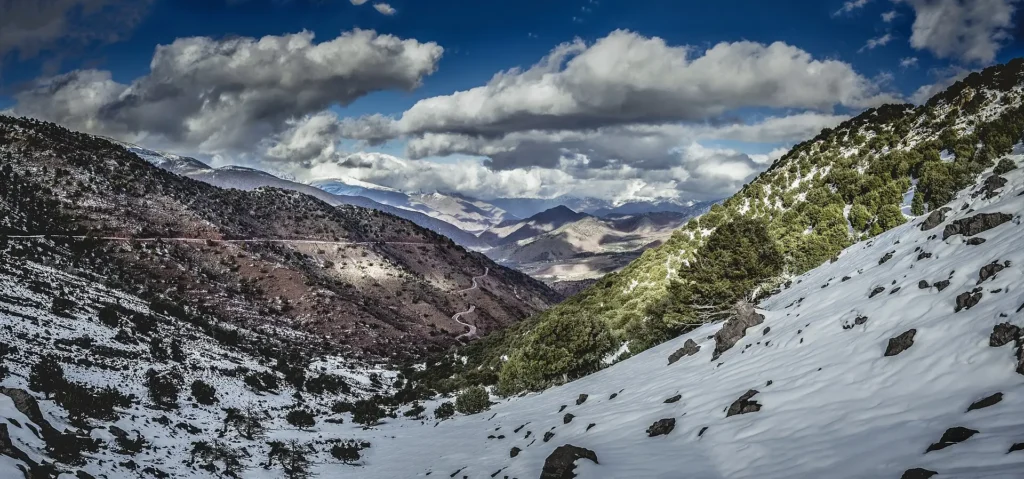
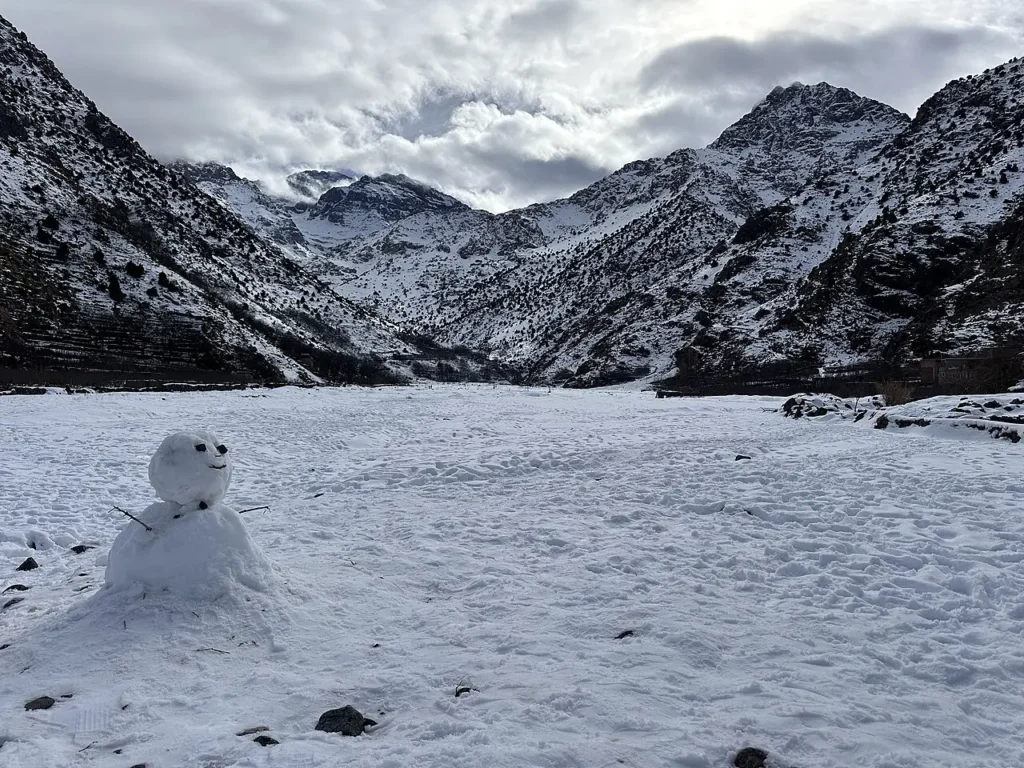
On the Atlantic coast, from Casablanca to Essaouira and down to Agadir, December stays mild in the daytime. Detailed readings for these cities are not published on this site as of this article, so no figures are given here: what matters is the principle, namely a smaller day-night swing than inland, wind that is often present and a sea too cool for most swimmers. At altitude the situation changes completely: snow is possible in the High Atlas and the Oukaïmeden resort operates from December to March. In the desert, the days are pleasant but the nights are cold, and that is the point travellers underestimate most often.
| Area | Daytime | Night | Rain | What it changes |
|---|---|---|---|---|
| Marrakech | Around 20 °C | Around 7 °C | Around 30 mm over the month | Comfortable sightseeing; cover up in the evening |
| Fès | 17.2 °C average high | 5.2 °C average low | 62.0 mm over 6.5 days | Grippy soles, waterproof jacket |
| Atlantic coast (Casablanca, Essaouira, Agadir) | Mild | Cooler | Figures not published on this site as of this article | Frequent wind, swimming for the determined only |
| High Atlas | Cold | Cold | Snow possible | Oukaïmeden operates from December to March |
| Desert (Merzouga, Zagora) | Pleasant | Cold nights | Figures not published on this site as of this article | Book a camp with warm bedding |
To place December within the full year and compare it with the other months, the detailed guide to the best time to visit Marrakech gives the month-by-month readings as well as the periods when the city is busiest.
Crowds and prices: the two Decembers of Morocco
There are two Decembers in Morocco, separated by a sharp line around the 19th or 20th of the month. From 1 to 19 December, the country is in classic low season: days are short, crowd levels are comparable to early October, and both accommodation and flights go for low rates. From 20 December to 4 January, demand turns strong on Marrakech and Agadir, with price pressure that sometimes exceeds August on the upmarket riads, a point already published in this site’s guide to Morocco in October.
This switch is anything but a detail for a budget. The same riad, the same flight and the same transfer can move into a different price bracket one week apart. Travellers who are flexible on dates therefore have a simple trade-off to make: leave before 19 December to pay low-season rates in almost identical weather, or accept the premium of the year-end window for the atmosphere and for the European school holidays. The weather itself barely changes between 10 and 27 December; only demand changes.
This site has already summed December up in a simple formula: demand “average, then very high”, prices “low then very high”, with a spike over Christmas and New Year. For a stay in the peak window, think in weeks ahead rather than days. For a stay before the 19th, rooms are often still available at reasonable rates two or three weeks before departure, though that is no guarantee.
| Period | Demand level | Price level | What to do |
|---|---|---|---|
| 1 to 19 December | Low season, crowd levels comparable to early October | Low | Book calmly; favour heated riads and hotels |
| 20 to 26 December | Strong demand on Marrakech and Agadir | High | Lock in flight and accommodation well ahead |
| 27 December to 4 January | Maximum peak of the year-end window | Very high, sometimes above August at the top end | Book flight, accommodation, transfer and excursions before you leave |
| After 4 January | Back to quiet | Falling | Good window for anyone who wants winter without the crowds |
The previous month follows a similar logic, with a less abrupt switch: the guide to Morocco in October details that shift from autumn into winter and makes a useful benchmark for anyone still choosing between the two months.
Winter flight season: what changes for flights to Morocco in December
December 2026 falls entirely within the 2026-2027 winter flight season, which runs from 25 October 2026 to 28 March 2027, following the IATA convention of the last Sunday in October to the last Saturday in March. This is the season that determines which routes exist, how often they fly and from which European airports. A trip in December therefore gets the benefit of the full winter programme, including routes launched in late October.
According to the official Ryanair press release published on 6 August 2026, the airline is offering 5.3 million low-fare seats to Morocco this winter, on 156 routes including 17 new ones, which amounts to 580,000 extra seats and a 12 % increase on the previous winter. The same release announces 16 aircraft based in Morocco, including 2 new aircraft in Rabat, 13 Moroccan airports served and a total investment of 1.6 billion dollars for those 16 aircraft, of which 200 million dollars for the two new Rabat aircraft. Eddie Wilson, the airline’s chief executive, states in it that “Morocco has become one of Ryanair’s fastest growing and most important markets.”
One point deserves to be stated plainly, because a lot of loose information is going around on the subject: the full list of the 17 new routes has not been published as of this article, and the detailed frequencies have not been published either. The press release of 6 August 2026 names only some of the additions. The routes actually named are Rabat-Stockholm, Rabat-Krakow, Marrakech-Wrocław, Agadir-Milan, Agadir-Nuremberg, Agadir-Bratislava and Agadir-Gdańsk. For the rest, you have to check the airlines’ own search engines directly: any list claiming to give all 17 routes goes beyond what has been communicated.
On the breakdown by airport, the Moroccan National Tourism Office, as relayed by the press, indicates that Rabat gains 7 routes, Marrakech 5 and Agadir 5, for a total of 14 European countries connected. This breakdown is to be attributed to the ONMT via the press and not to the airline’s press release. Separately, the specialist press reports two new direct routes from Germany to Agadir and Fès, launched in late October 2026 for the winter season; this information is not confirmed by any press release consulted and must therefore be verified with the airline before building an itinerary around it.
| Winter 2026-2027 figure | Number | Source |
|---|---|---|
| Low-fare seats to Morocco | 5.3 million | Ryanair press release, 6 August 2026 |
| Total routes | 156, including 17 new ones | Ryanair press release, 6 August 2026 |
| Extra seats | +580,000, or +12 % | Ryanair press release, 6 August 2026 |
| Aircraft based in Morocco | 16, including 2 new ones in Rabat | Ryanair press release, 6 August 2026 |
| Moroccan airports served | 13 | Ryanair press release, 6 August 2026 |
| Announced investment | 1.6 billion dollars in total, of which 200 million for Rabat | Ryanair press release, 6 August 2026 |
| Breakdown of the new routes | Rabat 7, Marrakech 5, Agadir 5 | ONMT, relayed by the press |
| European countries connected | 14 | ONMT, relayed by the press |
| Full list of the 17 new routes | Not published as of this article | Observation from reading the press release |
This growth in capacity comes on top of an already very strong tourism year. According to the Moroccan business press citing Ministry of Tourism figures, the country welcomed 14.1 million tourists by the end of August 2026, around 608,000 more than a year earlier, with August 2026 alone passing 2 million arrivals for the first time, up 3 %. Tourism receipts reached 97.92 billion dirhams by the end of August 2026, a rise of 9.7 %. A December traveller does not read these numbers like an economist, but the effect is very concrete: longer queues at controls, accommodation filling up earlier, transfers that need booking ahead.
More capacity does not automatically mean lower prices in the year-end window, because demand is rising too. The right way to use this information is strategic: the new routes open up departure airports that did not exist last winter, and that is often where the interesting fares are. The general timing rules are set out in the practical guide on when to book a flight to Morocco.
Airport by airport: what actually changes
The effects of the winter season are not spread evenly: Rabat is the big winner in number of new routes, Agadir is the one opening the most new European markets, and Marrakech remains the airport under the most strain in the year-end window. Here is what that means for each one.
Marrakech-Menara is the airport that concentrates the December peak. It gains 5 new routes according to the ONMT as relayed by the press, including Marrakech-Wrocław, which is named in the Ryanair press release of 6 August 2026. It is also the airport where arriving between 20 December and 4 January calls for the most planning, particularly for transfers to the medina and for excursions. Evening arrivals cluster into a few slots there, which lengthens the wait at taxi ranks and rental counters.
Agadir-Al Massira is the real story of this winter when it comes to new markets. The airport gains 5 routes according to the ONMT as relayed by the press, and the Ryanair press release of 6 August 2026 names four of them: Milan, Nuremberg, Bratislava and Gdańsk. For a traveller from central Europe, that means a direct flight to the southern coast where you previously had to go through Marrakech or Casablanca. The specialist press also reports an additional German route to Agadir, not confirmed by any press release consulted.
Rabat-Salé moves up a league. According to the Ryanair press release of 6 August 2026, Rabat becomes the airline’s fifth Moroccan base, with 2 new based aircraft and an announced investment of 200 million dollars for them. The ONMT, as relayed by the press, credits the capital with 7 new routes, the biggest gain in the country; the press release names Stockholm and Krakow. In parallel, ONDA’s “Airports 2030” plan provides for a new 69,000 m² terminal at Rabat-Salé, taking capacity from 1.5 to more than 4 million passengers a year. For a December trip, Rabat therefore becomes a credible gateway to the north of the country.
Fès-Saïs remains a mid-sized airport, but the specialist press reports a new direct route from Germany launched in late October 2026 for the winter season. This information is not confirmed by any press release consulted. Fès is, in climate terms, the most wintry city in this guide: 17.2 °C average high and 62.0 mm of rain in December according to the readings published on this site. Casablanca Mohammed V, finally, keeps its role as the main hub for connections and long-haul flights; the “Airports 2030” plan provides for a new terminal there aiming at 35 million passengers, with entry into service announced for 2029. The stated national target is to go from 38 to 80 million passengers of annual capacity.
| Airport | Code | What changes this winter | What to plan for in December |
|---|---|---|---|
| Marrakech-Menara | RAK | 5 new routes according to the ONMT via the press, including Wrocław | Peak from 20 December to 4 January: book transfers and excursions |
| Agadir-Al Massira | AGA | 5 new routes: Milan, Nuremberg, Bratislava, Gdańsk | Direct flights from central Europe; strong demand late in the month |
| Rabat-Salé | RBA | 5th Ryanair base, 2 based aircraft, 7 routes gained, including Stockholm and Krakow | New gateway to the north; 69,000 m² terminal planned |
| Fès-Saïs | FEZ | German route reported by the specialist press, not confirmed by any press release | Coldest and wettest city in the guide: pack accordingly |
| Casablanca Mohammed V | CMN | Connections hub; new terminal aiming at 35 million passengers for 2029 | Leave comfortable connection margins in busy periods |
For an overview of the country’s airports, their codes and their services, the reference page on the airports in Morocco brings together the profiles airport by airport.
What to book now, and in what order
For a departure between 20 December and 4 January, the order in which you book matters as much as booking early. The rule is simple: lock in first what is scarce and cannot be substituted, then what is plentiful. Flights and accommodation are scarce in this window; restaurants and self-guided visits are far less so.
In practice, the flight comes first, because it sets the dates and because it swings the most in price at the end of December. Accommodation comes straight after, and here one precise criterion deserves checking before you pay: whether the room has working heating. With 7 °C at night in Marrakech and 5.2 °C in Fès, a beautiful but unheated riad turns evenings into an ordeal. Then come the airport transfer, then the capacity-limited excursions such as desert camp nights, and only then restaurant bookings.
| Order | What to book | Why now |
|---|---|---|
| 1 | The flight | It sets the dates and rises the most in the year-end window |
| 2 | Accommodation, with heating checked | Limited supply at the peak; nights are cold everywhere |
| 3 | The airport transfer | Clustered and sometimes late arrivals at Marrakech and Agadir |
| 4 | Capacity-limited excursions | Desert camps and mountain trips fill up fast |
| 5 | Train journeys | New ONCF timetable plan since 14 September 2026 |
| 6 | Restaurants | Less constrained, but worth it on the evenings of the 24th, 25th and 31st |
A useful clarification about the year-end holidays in Morocco: they play out above all as a tourist season. Demand comes largely from European visitors on holiday, which concentrates arrivals into a fortnight and pushes prices up. Tourist establishments in the big cities and the seaside resorts operate normally over this period, and many run special evenings, but you should not conclude that the rest of the country shuts down: everyday life, markets and transport keep their usual rhythm. On the civil holiday front, 1 January is a public holiday in Morocco, as is 11 January, Proclamation of Independence.
On the budget side, finally, it is simpler to think in terms of the total cost of the trip than the price of the flight. In the peak window, the line item that most often overruns is not the flight but the accommodation, because the cheapest categories go first and all that is left at the end are rooms above the original budget.
Getting to and around Morocco in December
Getting around Morocco in December poses no particular difficulty, with one caveat: train timetables have changed and the days are short. ONCF has been running a new timetable plan since 14 September 2026, in connection with the Kénitra-Marrakech high-speed line works. Timetable adjustments and longer journey times have been announced on certain trains. The only reliable instruction is therefore to check schedules on the ONCF app or website before every journey, and not to rely on a table found on a blog. The high-speed line works are more than 30 % complete, for a delivery announced in September 2029.
For airport transfers, December calls for extra care in the peak window. Low-cost flights often land in the evening, and night falls early: a transfer booked in advance saves you negotiating a fare in the dark after a four-hour flight. In Marrakech as in Agadir, arrivals cluster into a few slots, which lengthens the wait at car rental counters and taxi ranks.
Taxis remain the most practical way to get around town. Two habits are enough: agree on the price or on using the meter before getting in, and carry small change in dirhams, particularly in the evening. For intercity journeys, the road is often faster than the train on non-electrified corridors, but short days argue against long night legs, especially on mountain roads where snow is possible in the High Atlas.
What to pack for Morocco in December
December packing is built around a single idea: layers. The gap between 20 °C in the middle of the day in Marrakech and 7 °C at night means adding and removing layers several times a day, and the classic mistake is to bring either a summer wardrobe or a winter coat, instead of three adjustable layers.
The useful base comes down to a few pieces: tee-shirts and long-sleeved shirts for the day, a jumper or fleece for the evening, a windproof and water-repellent jacket for the rain, and a light scarf that also works against coastal wind and desert sand. Fès’s 62.0 mm of rain and the 6.5 rainy days recorded over the month justify a waterproof jacket rather than a mere umbrella, which is awkward in narrow lanes. Closed shoes with grippy soles beat sandals: the wet paving of the medinas is slippery.
Three situations call for extra kit. A night in the desert demands a proper jumper and a hat: nights there are cold, even after a pleasant day. A trip to altitude in the High Atlas, and all the more so to Oukaïmeden, whose resort operates from December to March, is a matter of winter mountain gear. Finally, a traditional unheated guesthouse justifies packing warm socks and comfortable indoor clothing. The principle in every case is the same: judge the layers by the night-time figure, not the daytime one.
Where to go in Morocco in December, by traveller type
December rewards short itineraries and cities where the day is comfortably walkable. Grand loops of six cities in eight days work badly, because the days are short and part of the time goes into transport. If you are also weighing up other months, the guide to the best time to visit Morocco region by region compares the seasons for each part of the country. Here are the combinations that hold up best by type of traveller.
First time in Morocco: Marrakech and around
Marrakech is the safest choice for a first visit in December, with around 20 °C in the daytime and a very dense direct flight offer from Europe. The city is explored on foot, which suits a month when the afternoon temperature is pleasant without being crushing. A base of four or five nights in Marrakech, rounded out with one or two day trips, makes a coherent stay with no wasted travel.
Sun and open air: Agadir and the southern coast
Agadir is the December destination for anyone after mild weather and days outdoors rather than monuments. Agadir-Al Massira airport gains direct routes from Milan, Nuremberg, Bratislava and Gdańsk this winter according to the Ryanair press release of 6 August 2026, which cuts the journey sharply for part of Europe. The sea is cool in December, so the programme is better built around walks, day trips and lazing in the sun. It is also a sensible choice for a stay with young children, because distances on the ground stay short and days can be organised without long transfers.
Heritage without the crowds: Fès and the north
Fès in December offers a quality-to-crowds ratio that is hard to beat, provided you accept the climate: 17.2 °C average high, 5.2 °C average low and 62.0 mm of rain according to the readings published on this site. With 198 hours of sunshine over the month, dry days are plentiful, but you need the right kit. The medina can be walked without the visitor density of spring, and accommodation there is considerably more affordable than in Marrakech over the same period.
Desert and wide open spaces: Merzouga, Zagora, Ouarzazate
The desert in December is a very good idea for the days and a nasty surprise for unprepared nights. The days are pleasant, without the heat that makes walking painful in summer, but the nights are cold and a poorly equipped camp spoils the experience. So check precisely what bedding is provided, how many blankets, and whether the tent is heated, before you book. Itineraries, journey times and tour options are set out in detail in the guide to the Sahara desert from Marrakech.
Mountains and snow: the High Atlas
December is the start of the season at altitude: snow is possible in the High Atlas and the Oukaïmeden resort operates from December to March. This is the one type of stay for which genuinely wintry gear is essential in Morocco in December. The main appeal is proximity: the mountains are reached from Marrakech on a day trip, which lets you alternate medina and altitude without changing base.
Small budget and a low-key year-end: Rabat, Essaouira, Tangier
For anyone who wants to travel around 31 December without paying peak rates, the cities less exposed to international year-end demand are a serious option. Rabat is particularly interesting this winter: the capital gains 7 new routes according to the ONMT as relayed by the press, and becomes Ryanair’s fifth Moroccan base according to the press release of 6 August 2026. Essaouira and Tangier offer the same kind of trade-off, with a mild coastal climate in the daytime and more measured visitor numbers than Marrakech.
Mistakes to avoid on a trip to Morocco in December
Most bad December experiences come down to five identifiable mistakes, all of them avoidable at the booking stage.
- Booking accommodation without checking the heating. With 7 °C at night in Marrakech and a 5.2 °C average low in Fès, an unheated riad is uncomfortable. This is the most common mistake and the easiest to avoid: ask the question in writing before you pay.
- Taking dates from 20 December to 4 January without needing to. If your dates are flexible, leaving before the 19th gives you almost identical weather at a low rather than a very high price level. Plenty of travellers pay peak rates without being obliged to.
- Building a summer programme onto winter days. The days are short in December: three spread-out visits in a big city hold up, six do not. Better to cut the number of stops than the time spent at each.
- Relying on train times found online. ONCF has been running a new timetable plan since 14 September 2026, with timetable adjustments and longer journey times on certain trains. Schedules should be checked at source, before every journey.
- Believing the complete lists of the 17 new routes. The Ryanair press release of 6 August 2026 published neither the full list of the 17 new routes nor the detailed frequencies. Any exhaustive list circulating online is adding information that was never communicated.
- Heading into the desert without warm clothing. Nights there are cold in December, however mild the day has been. A jumper, a hat and warm socks completely change a night at camp.
FAQ: Morocco in December
Is it cold in Morocco in December?
It is mild in the daytime and cold at night. In Marrakech, the readings published on this site give around 20 °C by day and 7 °C at night; in Fès, 17.2 °C average high and 5.2 °C average low. How it feels therefore depends a great deal on the time and the place: a sunny terrace at midday is pleasant, an unheated riad courtyard after 7 pm is not.
Is December a good time to visit Morocco?
Yes, provided you pick the right half of the month. From 1 to 19 December it is a comfortable low season, with crowd levels comparable to early October and low prices. From 20 December to 4 January, demand is strong on Marrakech and Agadir and prices climb markedly, sometimes above August on the upmarket riads. The weather itself is identical across both periods.
When in December is the cheapest time to go?
The first half, and above all the days just before 19 December. That is the window where demand stays average while the weather is already what it will be at the end of the month. After 20 December, flight and accommodation prices enter the year-end regime and only come back down after 4 January.
Can you go into the Moroccan desert in December?
Yes, and the days there are actually more pleasant than in summer. The only thing to watch is the night: nights in the desert are cold in December. So check the camp’s bedding before booking and bring a proper jumper, a hat and warm socks.
Is there snow in Morocco in December?
Snow is possible in the High Atlas in December, and the Oukaïmeden resort operates from December to March. It does not, however, snow in lowland cities such as Marrakech, Casablanca or Agadir. A trip to altitude from Marrakech lets you see snow on a day excursion.
Are hotels and restaurants open over the year-end holidays?
Tourist establishments in the big cities and the seaside resorts operate normally over this period, which is precisely their busiest, and many run special evenings around 24, 25 and 31 December. On the civil holiday front, 1 January is a public holiday in Morocco, as is 11 January, Proclamation of Independence. Evening bookings should be made in advance on those dates.
Do you need to book your flight far ahead for December?
For a departure between 20 December and 4 January, yes: think in weeks ahead, as the flight is the most volatile line item in that window. For the first half of the month, the offer is wide and seats are often still available two or three weeks before departure, with no guarantee. Overall capacity is historically high this winter, with 5.3 million low-fare seats according to the Ryanair press release of 6 August 2026, but that abundance does not offset demand on the year-end dates.
The bottom line
Morocco in December comes down to a calendar trade-off. Until the 19th, the country offers a comfortable low season: around 20 °C in the daytime in Marrakech, 17.2 °C in Fès, moderate crowds and low prices. From the 20th through to 4 January, year-end holiday demand pushes flight and accommodation rates up, sometimes beyond August at the top end, without the weather changing. On the transport side, winter 2026-2027 is the richest ever announced for Morocco, with 5.3 million low-fare seats, 156 routes including 17 new ones and a fifth base opened in Rabat according to the Ryanair press release of 6 August 2026. Three habits are enough to get this month right: check the heating in your accommodation, pack layers rather than one thick one, and check train times at source given the new ONCF plan of 14 September 2026.
Sources
- Ryanair Corporate, press release on the Morocco winter schedule of 6 August 2026: seats, routes, based aircraft, airports served, investment, named new routes.
- ONDA, the National Airports Office: information on Moroccan airports and the airport development plan.
- ONCF, the National Railways Office: train times to be checked since the new timetable plan of 14 September 2026.
- Moroccan National Tourism Office: breakdown of the new routes by airport and number of European countries connected, relayed by the press.
- Climate readings for Marrakech and Fès already published and verified on moroccoairport.com, in the guides on the best time to visit each of these two cities.
- Moroccan business press citing Ministry of Tourism figures, September and October 2026: tourist arrivals and receipts to the end of August 2026.
- Photographs: “High Atlas Mountains Taroudant Marrakesh” by Ayman Abdelilah (CC BY-SA 4.0) and “High Atlas Snow Day” by Graham1250 (CC BY 4.0), via Wikimedia Commons.
Information verified in October 2026. Schedules, fares and flight programmes change: check with the airlines and airports before you travel.