Morocco in October 2026 works differently from any October the country has known before: since 20 September 2026 the kingdom has been on GMT all year round, while Europe stays on summer time until Sunday 25 October. The time difference therefore changes twice in five weeks, and a flight booked for late October shows an arrival time that looks wrong. Add two weeks of synchronised European school holidays, the switch to the winter flying season, and desert nights that turn genuinely cold, and you get a month that rewards preparation. Morocco (المغرب, Maroc), with Marrakech (مراكش, Marrakesh), Agadir (أكادير), Essaouira (الصويرة, the former Mogador) and Fes (فاس, Fès), is not the same country on 5 October and on 30 October.
Information verified in September 2026
In brief
- Morocco has been permanently on GMT (UTC+0) since 20 September 2026, under decree no. 2.26.530 published in Official Bulletin no. 7521 of 29 June 2026.
- From 1 to 24 October 2026, France, Spain, Germany and Belgium are two hours ahead of Morocco; from Sunday 25 October, only one hour.
- The United Kingdom, Ireland and Portugal are one hour ahead until 24 October, then on exactly the same time as Morocco.
- The sun sets in Marrakech at about 18:16 on 1 October and about 17:42 on 31 October, one clock hour earlier than in October 2025.
- French autumn school holidays run from Saturday 17 October to Monday 2 November 2026 for all three zones at once: the most expensive fortnight of the month.
- The winter flying season begins on Sunday 25 October 2026; easyJet opens Bordeaux–Agadir that day and Nantes–Essaouira on 27 October.
- The sea averages about 20.1 °C at Agadir and 18.9 °C at Essaouira in October, while Saharan nights fall towards 14 °C.
Quick reference: Morocco in October 2026 at a glance
| Item | Value in October 2026 |
|---|---|
| Morocco’s time zone | GMT (UTC+0) all month, no clock change |
| Difference with France | 2 h from 1 to 24 October, 1 h from 25 to 31 October |
| European changeover | Sunday 25 October 2026 at 03:00 Central European Summer Time |
| Sunrise / sunset in Marrakech | About 06:26 / 18:16 on the 1st; 06:48 / 17:42 on the 31st |
| Sea (monthly average) | Agadir 20.1 °C; Essaouira 18.9 °C |
| Desert (Merzouga) | Days around 26–29 °C, nights around 14 °C |
| Peak crowding | 17 October – 2 November (European school holidays) |
| Moroccan public holiday | Saturday 31 October, Unity Day (Aïd Al Wahda) |
| Flying season | Winter season starts Sunday 25 October 2026 |
| What to wear | Light layers by day, fleece or light down in the evening; shoulders and knees covered in the medina |
| Suggested trip length | 8 to 10 days to combine an imperial city, a southern valley and the coast |
| Accessibility | Main airports equipped; medinas and kasbahs often difficult by wheelchair (check locally) |
What is the time difference with Morocco in October 2026?
Morocco stays on GMT (UTC+0) throughout October 2026 and no longer changes its clocks. France, Spain, Germany, Belgium and the Netherlands remain two hours ahead until Saturday 24 October inclusive, then one hour ahead from Sunday 25 October, the day Europe switches to winter time.
Why Moroccan time changed in September 2026
For eight years Morocco lived on GMT+1 all year, with a temporary return to GMT during the month of Ramadan. That arrangement is over. Decree no. 2.26.530, adopted by the Council of Government on 25 June 2026 and published in Official Bulletin no. 7521 of 29 June 2026, moved legal time back to GMT at 02:00 on Sunday 20 September 2026: clocks returned to 01:00. The same text repeals decree no. 2.18.855 of 26 October 2018, which had introduced the permanent extra hour. This is not one more seasonal adjustment: unless a new regulation says otherwise, Morocco will stay on GMT 365 days a year, Ramadan included.
For European travellers this overturns a well-established habit. Until 2025 you arrived in Morocco in winter without touching your watch, because the country and France shared the same time from November to March. That window has closed. In October 2026 there is not a single week when Moroccan time matches French time.
The week-by-week difference with France, Spain, Germany and the United Kingdom
| Period | France, Spain, Germany, Belgium | United Kingdom, Ireland, Portugal | Time in Morocco when it is noon in Paris |
|---|---|---|---|
| Thursday 1 – Sunday 4 October | +2 h on Morocco | +1 h on Morocco | 10:00 |
| Monday 5 – Sunday 11 October | +2 h | +1 h | 10:00 |
| Monday 12 – Sunday 18 October | +2 h | +1 h | 10:00 |
| Monday 19 – Saturday 24 October | +2 h | +1 h | 10:00 |
| Sunday 25 – Saturday 31 October | +1 h | 0 h (same time) | 11:00 |
The European changeover falls during the night of Saturday 24 to Sunday 25 October 2026: at 03:00 it becomes 02:00 again. That is the earliest a last Sunday in October can fall, which lengthens the two-hour window and shortens the one-hour window. Out of the month’s thirty-one days, twenty-four run on a two-hour gap and only seven on a one-hour gap.
The flight-timetable trap around 25 October
Airlines always publish schedules in the local time of each airport. The same flight, with the same cruise time, therefore shows a different arrival time depending on whether it operates before or after 25 October. Take a Paris-Orly to Marrakech-Ménara service with 3 h 15 of flying time, departing at 10:00.
- Friday 23 October: departs 10:00 from Paris (UTC+2), shows an arrival of 11:15 in Marrakech. On paper the flight looks like 1 h 15.
- Friday 30 October: departs 10:00 from Paris (UTC+1), shows an arrival of 12:15. The same flight now looks like 2 h 15.
- On the way back, a 16:00 departure from Marrakech lands at Orly around 21:25 before 25 October, but around 20:25 after. Your onward train or last suburban service does not work out the same way.
These durations are illustrative: only your airline’s own timetable is authoritative. The useful reflex is to think in flying time, not in displayed clock difference. If you have booked a private transfer, a taxi or a tour by setting the pick-up at “arrival time minus thirty minutes”, check that the operator used Moroccan time and not the time on your phone at departure. To compare ground options from each airport, our comparison of Moroccan airport transfers sets out the choices and price ranges.
Check the time shown by your phone and your laptop
A national time-zone change only works if your devices’ time-zone database is up to date. Microsoft included the new Moroccan rule in its security update of 8 September 2026; a PC that has not been updated shows Moroccan time one hour fast. The same risk applies to an older smartphone, a smartwatch, a car satnav or a hotel alarm clock set by hand.
On landing, compare your phone with an airport clock or the departures board, and switch off any manual time-zone setting. If your device still offers “GMT+1” for Casablanca, force “GMT” or pick an equivalent zone. Before you leave, update your SIM settings and your apps; our guide to mobile roaming in Morocco explains how to stay reachable without a shock on your bill.
Shorter evenings: what the move to GMT changes on the ground
Moving to GMT does not change how long the day lasts, but it shifts it an hour on the clock. In Marrakech the sun rises around 06:26 and sets around 18:16 on 1 October 2026, then around 06:48 and 17:42 on 31 October. Mornings are bright very early, and evenings fall into darkness far sooner than before.
The consequences are practical. A day trip to the Ourika valley or to Aït Benhaddou that used to start back “around 17:00” now finishes after dark on poorly lit mountain roads. Arriving at the dunes of Erg Chebbi — an erg is an expanse of sand dunes — has to be brought forward an hour if you want the sunset from the crest. Conversely, the bustle of Jemaa el-Fna square in Marrakech follows local life rather than the sun, so it does not start earlier: expect a dead hour between nightfall and the moment the food stalls open.
- Plan High Atlas hikes to be back at the refuge or the village before 17:15 late in the month.
- For photographers, golden hour now falls between 17:00 and 17:45 at the end of October: reach the site 45 minutes earlier.
- Long drives (Marrakech–Merzouga, Fes–Chefchaouen) should start earlier, which at least makes sunrise easy to catch.
- Open-air sites usually close in the late afternoon: anywhere advertised as “open until sunset” now closes earlier than in October 2025.
Crowds: when is Morocco in October 2026 busiest?
October 2026 splits in two. From the 1st to the 16th, visitor numbers stay moderate and availability is wide. From Saturday 17 October, French, German and British school holidays overlap until 2 November: that fortnight is the tightest of the autumn in Marrakech, Agadir and Essaouira.
The exact European school holiday dates
| Country | Autumn 2026 holidays | Effect on prices |
|---|---|---|
| France (zones A, B and C) | Saturday 17 October to Monday 2 November, identical dates for all three zones | Sharp peak: every family travels in the same fortnight |
| Germany – Hesse, Rhineland-Palatinate, Saarland | 5 to 17 October in Hesse; 5 to 16 October in Rhineland-Palatinate and Saarland | First wave, noticeable in Agadir and Marrakech |
| Germany – Bremen, Lower Saxony, Saxony, Schleswig-Holstein, Thuringia, Mecklenburg-Vorpommern | 12 to 24 October, except Mecklenburg-Vorpommern 15 to 24 October | Gradual build-up |
| Germany – North Rhine-Westphalia | 17 to 31 October | Two full weeks, the most populous state |
| Germany – Berlin, Brandenburg, Hamburg, Saxony-Anhalt | 19 to 31 October in Berlin; 19 to 30 October in the other three | Busy end of month |
| Germany – Baden-Württemberg and Bavaria | 26 to 30 October in Baden-Württemberg; 2 to 6 November in Bavaria | Part of the demand shifts into early November |
| United Kingdom (England, most local councils) | Monday 26 to Friday 30 October | Peak in the final week, strong on Marrakech and Agadir |
| Spain | No general autumn break, but a three-day weekend from 10 to 12 October (National Day on Monday the 12th) and 1 November moved to Monday the 2nd in several regions | Two short spikes, mainly on Tangier, Tetouan and Marrakech |
The French dates come from the order of 22 October 2025 setting the school calendar for 2026-2027, published in the Journal officiel on 23 October 2025. The notable point this year is that all three zones break at once, with no staggering. There is therefore no “good zone” to exploit, unlike the winter or spring holidays.
What the traffic figures say
The wider context is a destination in sustained growth. According to the National Airports Office (ONDA), Moroccan airports handled 36.3 million passengers in 2025, up 11 % year on year, including 32.4 million international passengers; Marrakech-Ménara passed 10 million annual passengers for the first time. On arrivals, the Ministry of Tourism reported 14.1 million visitors to the end of August 2026, up 4.5 % year on year, after a record 19.8 million in 2025.
In practice, booking for 20 October with a fortnight’s notice is nothing like booking for 6 October on the same terms. If your dates are flexible, the first half of the month offers the same climate under far less pricing pressure. If they are not, book early — our guide on when to book a flight to Morocco sets out the most favourable booking windows by season.
Winter flying season: what opens and closes on 25 October 2026
Sunday 25 October 2026 marks the start of the winter scheduling season, which runs to the last Saturday in March 2027. On that day, summer seasonal routes vanish from search engines and winter routes appear. Booking a late-October trip without allowing for this switch often means missing a direct service that exists on only one side of the date.
For winter 2026-2027, Ryanair announced in August 2026 a Moroccan programme of 5.3 million seats on 156 routes, 17 of them new, meaning 580,000 more seats than the previous winter (+12 %), with a fifth Moroccan base at Rabat. Royal Air Maroc, for its part, is bringing forward to winter 2026-2027 long-haul increases originally planned for spring 2027, including a fifth weekly flight to São Paulo-Guarulhos from 28 October 2026.
From France, the Moroccan National Tourist Office (ONMT) announces ten additional scheduled routes between French and Moroccan airports for the 2026-2027 winter season, operated by Air Corsica, easyJet, Royal Air Maroc, Transavia France and TUI fly Belgium.
| New route | Announced launch date | Announced frequency |
|---|---|---|
| Bordeaux – Agadir (easyJet) | 25 October 2026 | 2 flights a week, Airbus A320 |
| Nantes – Essaouira (easyJet) | 27 October 2026 | 2 flights a week, Airbus A320 |
| Prague – Marrakech (easyJet) | 25 October 2026 | 2 flights a week, Airbus A319 |
| Zurich – Marrakech (easyJet) | 28 October 2026 | 2 flights a week, Airbus A319 |
| Birmingham – Agadir (easyJet) | 27 October 2026 | 2 flights a week, Airbus A320 |
| Newcastle – Marrakech (easyJet) | 3 November 2026 | 2 flights a week |
| Bastia – Casablanca, Strasbourg – Marrakech, Lille – Marrakech, Lille – Casablanca, Paris – Tetouan, Nantes – Tangier, Lyon – Fes, Paris – Oujda | Winter season 2026-2027, dates not released route by route | Depending on the airline |
Two conclusions follow directly. First, if you travel out in the week of 19 October and return after the 25th, check that your return flight actually exists in the winter programme: some summer routes stop on the 24th. Second, the very first rotations on a new route are often lightly booked and sometimes cheaper, but they are also the most exposed to schedule changes. To see who flies where, read our overview of airlines flying to Morocco.
Sea, desert and mountains: the conditions specific to October
October is the month when Morocco stops being a uniformly hot country. The Atlantic stays cool, the desert keeps summer days but gains cold nights, and the Atlas can drop below zero at altitude. The daily temperature swing, far more than the monthly average, is the figure that shapes both your suitcase and your itinerary.
How warm is the sea in Morocco in October?
| Location | October average | Recorded range | Swimming without a wetsuit |
|---|---|---|---|
| Agadir | 20.1 °C | 17.2 to 22.8 °C | Fine for most swimmers |
| Taghazout | About 20.1 °C | Not published | Possible, but significant swell |
| El Jadida | About 20.5 °C | Not published | Possible |
| Essaouira | 18.9 °C | 15.9 to 22.2 °C | Uncomfortable for many; wetsuit advised |
The reason is oceanographic rather than seasonal: the Canary Current runs down the Moroccan coast from north to south and brings cold water to the surface. That is why the Moroccan Atlantic never warms up like the Mediterranean, even after a very hot summer. If swimming is the point, aim for Agadir or the coast south of Essaouira rather than Essaouira itself, where the trade wind adds a chill as you leave the water. For surfing, on the other hand, October is one of the best months: the first autumn swells arrive and the crowds have not.
Cold nights in the desert and the High Atlas
At Merzouga, at the edge of Erg Chebbi, October days routinely reach 26 to 29 °C while nights drop towards 14 °C, a swing of twelve to fifteen degrees within twenty-four hours. Many travellers set off for a desert camp with a T-shirt and a shirt, and spend an unpleasant night. A bivouac is a temporary tented camp, usually pitched at the foot of the dunes.
In the mountains the arithmetic is harsher still. Temperature falls by roughly 6 °C per thousand metres of altitude, so an Atlas village at 1,800 metres is far colder at night than Marrakech, which sits at about 460 metres. In October, nights can approach zero in the high villages, and the first snowfalls on the summits are not unusual late in the month. Not all refuges are heated, and many valley guesthouses offer only a brazier.
Storms and flash floods in the southern valleys: the official guidance
Autumn is the season when thunderstorms can trigger sudden floods in the wadis of the south. A wadi (oued) is a seasonal watercourse, dry for most of the year, that can fill within minutes after a storm tens of kilometres upstream. The danger does not necessarily come from the sky above your head.
The Direction Générale de la Météorologie (DGM), part of the Ministry of Equipment and Water, publishes a vigilance map at least three times a day, at 06:00, 10:00 and 16:00, and updates it at any time if conditions change. It uses four levels: green (no particular risk), yellow (usual phenomena that may be locally dangerous), orange (significant risk from dangerous phenomena) and red (extreme risk from phenomena of exceptional intensity). Specific bulletins accompany orange and red levels and give the track, intensity and duration of the event.
- Check the DGM vigilance map on the morning of each southern driving day, not the evening before.
- Never cross a ford with water running through it, however shallow, and never camp in a wadi bed, even a dry and comfortable one.
- If an orange or red warning covers a province on your route, postpone the stage or stay on main roads rather than tracks.
- Local operators sometimes cancel excursions for this reason: suitable travel insurance for Morocco covers a forced postponement far more readily than a change of mind.
What to pack for Morocco in October 2026
October calls for a layered suitcase, not a summer one. You need to move from 30 °C in Marrakech in early afternoon to 12 °C in an Atlas valley three hours later, then to a cold night under canvas. The total volume stays modest: what matters is the range of thicknesses, not the quantity.
- One packable warm layer: a thin fleece or a down gilet. You will use it every evening from 18:00, not only in the desert.
- A windproof jacket for the Atlantic coast, where the trade winds blow late into the day at Essaouira.
- Covering clothes: shoulders and knees covered is the norm in medinas, souks and villages. Light trousers and a long-sleeved shirt also shield you from midday sun, which is still strong.
- Closed shoes: medina alleys and Atlas tracks are unforgiving on flip-flops. Bring a light pair for the beach as well.
- A light hat and warm socks if you sleep in the desert or at altitude: head and feet are what make a cold night miserable.
- A wetsuit or shorty if you plan to swim at Essaouira or Taghazout; local shops rent them, to check locally.
- A head torch: with sunset around 17:45 late in the month, hikes and camps end in the dark.
- A filter bottle or purification tablets to cut down on plastic bottles on southern stages.
As for luggage, cabin rules do not change with the season, but low-cost carriers check more often at busy times: check the permitted dimensions and weight on your airline’s own site before you leave, especially if you travel with a sleeping bag or hiking gear.
Budget: Morocco in October 2026 compared with August and December
October is structurally cheaper than August and than the last week of December, but the real difference lies inside the month. The first fortnight sits at the bottom of the annual range in Marrakech and Agadir, while 17 October to 2 November approaches summer rates without quite reaching their peak.
| Period | Demand drivers | Pressure on prices | What to do |
|---|---|---|---|
| August 2026 | European summer holidays and the return of the Moroccan community abroad; maximum inland heat | Highest on the coast, strong in the imperial cities | Avoid if you want value for money |
| 1–16 October 2026 | No major school break apart from three German states and the Spanish weekend of the 12th | The lowest of the quarter | Book here if your dates are free |
| 17 October – 2 November 2026 | French autumn break (all three zones together), German Herbstferien, British half-term | High, especially in Marrakech, Agadir and Essaouira | Book early, aim for midweek |
| December 2026 (outside the festive period) | Classic low season, very short days | Low, comparable with early October | A good alternative if you accept cold nights |
| 20 December 2026 – 4 January 2027 | Christmas and New Year, heavy demand on Marrakech and Agadir | Very high, sometimes above August in upmarket riads | Book several months ahead |
One factor works in the traveller’s favour this autumn: seat supply is rising. The 580,000 extra seats announced by Ryanair for the Moroccan winter, plus the ten new France–Morocco routes listed by the ONMT, bring competition to routes previously held by a single carrier. Visitor growth, meanwhile, is more moderate: the Ministry of Tourism recorded 4.5 % more arrivals to the end of August 2026, while travel receipts rose 13.4 % to the end of July 2026 according to figures published at that date. In other words, visitors are spending more rather than arriving in far greater numbers: the pressure falls on quality accommodation, not on general availability.
On the ground the currency is the Moroccan dirham (MAD), which is not convertible outside the country. Bank Al-Maghrib publishes its reference rates every working day on bkam.ma: that is the only reliable benchmark for judging whether an exchange office is fair. Rules on exchange, withdrawals and tipping are set out in our guide to money in Morocco.
Events and the public holiday in October 2026
October 2026 contains one Moroccan national public holiday plus a few sporting and agricultural fixtures. None of them blocks a trip, but each can affect access to an office, occupancy in a stopover town, or availability in a specific rural area.
- Saturday 31 October: Unity Day (Aïd Al Wahda). This national holiday was added to the list of non-working days by two decrees adopted in the government council on 15 January 2026: decree no. 2.26.14 for the private and agricultural sectors and decree no. 2.25.1140 for public administrations. As it falls on a Saturday in 2026, the effect on shops and transport is limited, but government offices and most bank branches are closed.
- 28 September to 3 October: Rallye du Maroc. Round four of the World Rally-Raid Championship, starting in Agadir and finishing in Zagora, then looping around Zagora. Accommodation in Agadir and the Drâa valley is partly taken up during that window.
- Late October: the Erfoud date moussem. A moussem is an annual traditional festival, often tied to a harvest or a shrine. The 2026 edition is announced locally for about 23 to 25 October, with a date market, tbourida — a traditional equestrian display performed by a line of riders — and camel races. These dates are not confirmed by an official source: check with the province of Errachidia or your accommodation before making it a reason to travel.
- All month: the olive harvest. Around Meknes, in the Rif and in the Souss, the presses are running. It is the best time of year to buy new olive oil straight from a cooperative.
- For the record, the Taliouine saffron festival is not held in October but in November: the crocus flowering only begins at the end of the month.
Two further public holidays follow soon after: the anniversary of the Green March on Friday 6 November and Independence Day on Wednesday 18 November 2026. If your trip spills into November and involves any administrative task, plan around them.
Where to go in Morocco in October: the regions that work best this month
October is one of only two months a year when almost every Moroccan region is comfortable at the same time. The imperial cities have lost the crushing summer heat, the desert is bearable by day, the mountains are not yet under snow, and the coast is still sunny. The choice comes down to preference rather than constraint.
Marrakech and its region
In October Marrakech averages highs around 30 °C and average lows around 15 to 20 °C, with light rainfall of roughly twenty millimetres over the month. It is the ideal logistics base: Marrakech-Ménara airport passed 10 million passengers for the first time in 2025 according to ONDA and puts the Atlas, the Ourika, Essaouira and Ouarzazate within one to four hours by road. A riad — a traditional house built around a courtyard — becomes pleasant in October, whereas it could be stifling in August. At Marrakech-Ménara airport, agree the taxi fare before getting in and use the official ranks.
The far south and the valleys
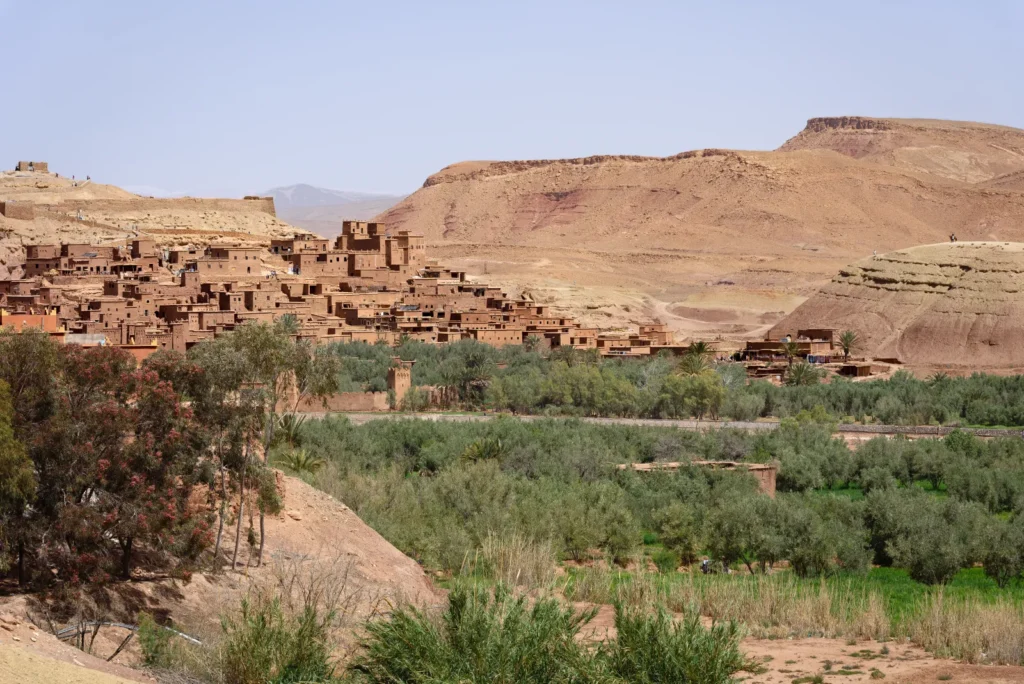
Ouarzazate, Aït Benhaddou, the Drâa valley, the Dadès and Todgha gorges, then Merzouga: that is the classic itinerary, and October is one of its two best months alongside April. A ksar is a fortified mud-brick village; a kasbah is a fortified residence. Allow at least three days from Marrakech so you do not spend the trip in a car. Pack for the night and watch the weather warnings, as explained above.
The Atlantic coast
Agadir keeps average highs around 26 to 29 °C in October and a sea averaging 20 °C: it is the safest beach choice of the month. Essaouira is cooler and windier, which is exactly what makes it a well-known kitesurfing spot. Taghazout and Imsouane take the first autumn swells. From 27 October, Essaouira gains a direct link with Nantes, which makes short coastal breaks easier.
The north and the imperial cities
Fes, Meknes, Rabat, Tangier, Tetouan and Chefchaouen are at their best in October: the heat has broken, the light is low, and the medinas are less saturated than in spring. The Rif does get more rain than the south at this time of year, and a grey day in Chefchaouen is nothing unusual. It is also a good moment for a rail trip, since the ONCF network links Tangier, Rabat, Casablanca, Meknes, Fes and Marrakech without a hire car.
Mistakes to avoid in October 2026
Most of the unpleasant surprises of October 2026 come from the calendar rather than the climate. The Moroccan time change in September, the European switch on 25 October and the overlapping school holidays create three traps that ten minutes of checking will avoid.
- Assuming Morocco and France will be on the same time at the end of October. That was true until 2025. It is not any more: one hour of difference remains even after 25 October.
- Working out a connection by subtracting displayed times. Always think in flying time, especially for a flight crossing the night of 24 to 25 October.
- Not updating your devices. A computer or phone whose time-zone database predates September 2026 will show Moroccan time one hour fast.
- Heading into the desert with a summer suitcase. Fourteen degrees under canvas, with wind, feels far colder than fourteen degrees in town.
- Planning visits as you would in September. The sun sets an hour earlier on the clock: a site “open until dusk” closes sooner than expected.
- Booking the second fortnight late. All three French school zones break together, with no staggering, and British half-term falls in the same week.
- Ignoring weather warnings in the south. A blue sky overhead tells you nothing about what is falling fifty kilometres upstream in the wadi.
- Forgetting the paperwork. Passport and entry conditions do not change with the season, but immigration queues lengthen during school holidays: check your passport validity and entry conditions with the consulate of the Kingdom of Morocco.
FAQ — Morocco in October 2026
What time is it in Morocco when it is noon in Paris in October 2026?
It is 10:00 in Morocco from 1 to 24 October 2026, and 11:00 from 25 to 31 October. Morocco has stayed on GMT all year since 20 September 2026, while France moves from summer to winter time during the night of 24 to 25 October. The gap therefore falls from two hours to one hour partway through the month.
Does Morocco change its clocks in October 2026?
No. Morocco does not change its clocks in October 2026, or at any other point in the year. Decree no. 2.26.530, published in Official Bulletin no. 7521 of 29 June 2026, set legal time at GMT from 20 September 2026 and repealed the GMT+1 regime introduced in 2018. Only European countries change, on Sunday 25 October 2026.
Can you swim in Morocco in October?
Yes, mainly at Agadir and along the Souss coast, where the sea averages about 20.1 °C in October according to satellite readings published by seatemperature.info. Essaouira is cooler, around 18.9 °C, and the wind makes getting out of the water unpleasant without a wetsuit. Riad pools, rarely heated, are often too cold in the morning.
Is it cold at night in the Moroccan desert in October?
Yes. At Merzouga, October nights fall on average towards 14 °C while days reach 26 to 29 °C. That twelve to fifteen degree swing surprises travellers who packed for summer. One packable warm layer, socks and a light hat are enough to make a night under canvas comfortable. Camps normally supply blankets, worth confirming when you book.
When is the cheapest time to travel to Morocco in October 2026?
From 1 to 16 October 2026. No major French, British or Spanish school break falls in that fortnight, apart from the Spanish weekend of 10 to 12 October and holidays in three German states. From 17 October, the French autumn break, the German Herbstferien and British half-term overlap until 2 November.
Is there a public holiday in Morocco in October 2026?
Yes, Saturday 31 October 2026, Unity Day (Aïd Al Wahda). This national holiday now appears in the list of non-working days for public administrations. Because it falls on a Saturday, tourist life is not disrupted, but government offices and most banks are closed. The next public holidays are 6 and 18 November 2026.
Should you expect rain in Morocco in October?
Rarely over a long period, but locally yes. Marrakech receives around twenty millimetres over the month and Merzouga between fourteen and twenty-three millimetres depending on the reference station, which is low. The risk lies in thunderstorms that swell the southern wadis within minutes. The Direction Générale de la Météorologie publishes a four-level vigilance map at least three times a day, worth checking before each stage.
Could my late-October flight be dropped because of the season change?
It may disappear from the programme, which is not the same as a last-minute cancellation. Summer seasonal routes end no later than Saturday 24 October 2026 and winter routes begin on Sunday the 25th. Check on the airline’s official website that your return flight exists in the winter programme before committing to non-refundable accommodation.
In summary
October 2026 is the first October in eight years in which Morocco lives on GMT, and the only one this decade in which the gap with France drops from two hours to one halfway through the month. That is the fact to hold on to above all others: it governs flight times, transfers, appointments and the hour at which the sun goes down over the dunes. Add two weeks of synchronised European school holidays, a winter flying season that redraws direct routes on 25 October, and a fifteen-degree swing between midday in Marrakech and midnight at Merzouga, and you get a rich month that nonetheless has to be planned. For the wider question — which season to choose across the year, which city in which month — see our guide to the best time to visit Morocco, which handles it month by month. What this article gives you is what is true only this year, and only in October.
Official sources
- General Secretariat of the Government of the Kingdom of Morocco — Official Bulletin
- Direction Générale de la Météorologie — weather vigilance map
- National Airports Office (ONDA) — traffic and airport information
- French Ministry of Education — official school calendar
- France Diplomatie — travel advice, Morocco
- Bank Al-Maghrib — reference exchange rates
Informational article. Prices, opening hours, flight programmes and entry conditions are subject to change: only the official sources cited are authoritative at the time of your trip.
Photo credit
Images: featured image « File:Aït Benhaddou Ksar, Morocco.jpg » — Mustang Joe (CC0); « File:Merzouga Dunes 2011.jpg » — Bjørn Christian Tørrissen (CC BY-SA 3.0); « File:Beach and surfers, Essaouira, Morocco.jpg » — Goldfinchshuffle (CC BY-SA 4.0), via Wikimedia Commons.