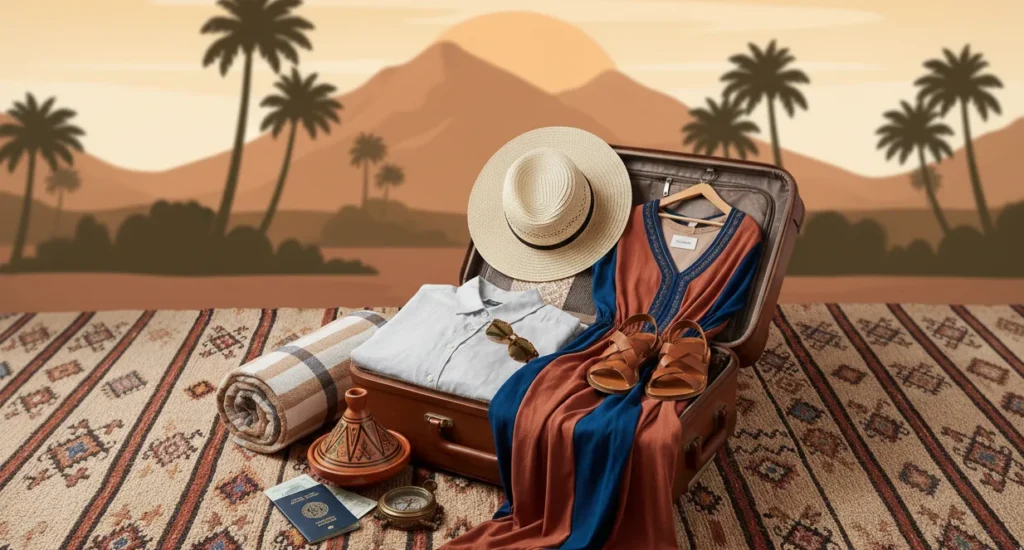
Building a Morocco packing list is far more than ticking boxes on a checklist. Done well, it buys you a calm, comfortable trip in which nothing distracts you from the country itself. Morocco packs an unusual range of landscapes and weather into one place: from the Mediterranean climate of the north to the dry heat of the Sahara, taking in the cool Atlantic coast and the Atlas mountains on the way. A badly planned suitcase turns into dead weight very quickly.
Travelling calmly also means sorting out the practical side, from money, cards and your daily budget to staying online from the moment you land. Whether you need Google Maps, want to book a transfer, contact your riad or simply reassure family back home, a reliable connection changes the whole trip. To avoid roaming charges and the hassle that local SIM cards sometimes involve, many travellers choose portable Wi-Fi router rental in Morocco through Rent a phone, an option that works especially well for groups, families and road trips.
This article is meant to be your complete reference. It goes well beyond a list of clothes. You will find the right wash bag, the electronics you genuinely need, the practical accessories most people forget, and the specialist gear for activities such as desert trekking or mountain hiking. We also cover what is better left at home, along with packing tricks for travelling light and travelling smart. Finally, a section on local customs will help you pick outfits that fit in comfortably wherever you go.
Part 1: Understanding Morocco’s climate to make the right choices
The first rule of a well-packed suitcase is knowing what waits for you on the ground. Morocco does not have one single climate. Your exact destination and the time of year will shape what goes into your bag more than anything else.
A country with several climates at once
Morocco breaks down into four main climate zones, and each one sets its own clothing and practical needs for travellers.
- The Mediterranean and Atlantic coast: cities such as Tangier, Essaouira and Agadir enjoy a temperate climate. Summers are hot without being stifling, thanks to the sea breeze, and winters are mild but can turn wet and windy. A windbreaker or a light waterproof jacket is essential even in summer, for evenings and for the windy days (the famous “Alizé” in Essaouira).
- The interior and the imperial cities: Marrakech, Fez and Meknes have a continental climate. Summers there are very hot and dry, with temperatures that easily climb past 35°C. Winters, by contrast, are cool and even cold at night. The gap between daytime and night-time temperatures is wide, especially in spring and autumn. The answer is layering.
- The Atlas mountains: whether you are heading out on a trek or simply crossing the Tichka pass, expect mountain weather. Summer days are sunny and pleasant, but the nights are cool. In winter the cold bites and snow is common above 2,000 metres. A warm jacket, a down jacket for example, and hiking boots are genuinely necessary.
- The Sahara region: Morocco’s desert, around Merzouga and M’Hamid, is a land of extremes. By day the sun is relentless and temperatures are scorching. At night they drop dramatically, whatever the season. In winter the nights are freezing. Pack properly warm clothes for evenings and early mornings, plus a wide-brimmed hat to keep the midday sun off you.
Season by season: what goes in the suitcase
- Spring (March to May): often considered the best time to visit Morocco. Temperatures are pleasant across the country. Plan light outfits for the daytime, but do not leave out a warm jumper, a fleece and even a windbreaker for cool evenings, desert nights or trips into the mountains. Showers are possible, especially in early spring.
- Summer (June to August): the heat is everywhere, above all inland. Clothes that are light, loose and made from natural fabrics (cotton, linen) are the way to go. Do not forget your swimsuit for riad pools and the beaches. Even in summer, a light cardigan earns its place in air-conditioned rooms and on bus journeys.
- Autumn (September to November): much like spring, autumn offers excellent conditions. Your suitcase will look similar too: summer outfits for the day and warmer layers for the evening. It is the perfect season for the desert, where the daytime heat is less intense.
- Winter (December to February): your suitcase needs to lean towards the cold. In the cities, a warm coat, jumpers and jeans are what you want. For the desert and the mountains, go technical: thermal base layers, a hat, gloves and a scarf are essential against night-time temperatures that can approach freezing.
Part 2: The ideal Morocco packing list – clothes and accessories
This section goes item by item through the clothes and accessories that will leave you ready for anything, while fitting in with how people dress locally.
The ground rules for packing for Morocco
Before the detailed list, keep three guiding principles in mind, because they will make your life easier:
- Fitting in with local dress habits: outside the big beach resorts, people in Morocco tend to dress fairly covered up. Clothes that cover the shoulders and knees, and the chest for women, read as courteous and will also spare you lingering looks in the souks and in rural villages.
- Comfort above all: you will walk a lot, whether exploring the medinas or out on the trail. Favour loose clothes and comfortable shoes. Leave the high heels and the synthetic fabrics that do not breathe at home.
- Layering: this is the key to coping with wide temperature swings. Several thin layers (a T-shirt, a light shirt, a cardigan) beat one thick jumper. That way you can adjust what you are wearing as the day goes on.
The essential clothes (for women and men)
To get the most outfits out of the fewest items, stick to a neutral palette of colours that work together.
For women:
- Tops: pack long, loose tunics, short-sleeved or three-quarter-sleeved T-shirts and light blouses. Skip plunging necklines and very tight tops. Having at least one long-sleeved top is useful both for sun protection and for fitting in locally.
- Bottoms: light linen or cotton trousers, a pair of jeans (comfortable for long days) and a long or midi skirt (avoid miniskirts) are safe bets. A sarong is the magic accessory: it works as a skirt, a scarf, a shawl for covering your shoulders at historic monuments, and even a beach mat.
- Dresses: maxi dresses are perfect for dinners and for wandering. Choose them in flowing fabrics, with sleeves or a top that covers the shoulders.
- Warm layers: a light cardigan or a denim jacket for summer evenings, and a warm jumper in merino wool or a fleece for the cooler seasons and the desert.
For men:
- Tops: T-shirts, polo shirts and cotton shirts. Light long-sleeved shirts are excellent for keeping the sun off.
- Bottoms: canvas trousers (cargo style) or jeans are the most practical. Shorts are fine in the beach resorts, but trousers are more appropriate for more traditional places and for anything official.
- Warm layers: a hoodie or a fleece, topped with a waterproof windbreaker if you are travelling outside the summer months.
Choosing your shoes, the decision that matters most
Shoes are probably the single biggest factor in how comfortable your trip feels. Three pairs maximum:
- One pair of comfortable closed walking shoes: essential for the paved, uneven lanes of the medinas and for hiking. Good trainers or light hiking shoes are perfect.
- One pair of open, breathable sandals: for relaxing at the hotel, for the beach or for shared showers in some places to stay.
- One pair of smarter sandals or flat dress shoes (for women): for slightly more formal occasions or dinners in good restaurants.
The accessories you should not skip
- Sunglasses: the sunshine is intense. Choose a pair with a high UV protection rating.
- A wide-brimmed hat or a cap: non-negotiable protection against sunstroke, especially in the desert.
- A light, sturdy backpack: for day trips, to carry your water bottle, your sunscreen and your camera.
- A scarf or a neck wrap: extremely useful. It shields you from the sun, from the dust in the desert and from the chill in the evening. Women can also use it to cover their head when they want to.
- A money belt or a small travel pouch: to keep your cash and your documents safe under your clothes, above all in very busy places.
Part 3: Toiletries and health on your Morocco packing list
Putting real thought into your wash bag and your first-aid kit is what keeps small annoyances from eating into your trip.
Wash bag essentials
- Sun protection: a sunscreen with a high protection factor (SPF 50+) is essential. The Moroccan sun can catch you out even through haze. Think about a lip balm with SPF too.
- Basic toiletries: you can find most products locally, but it is easier to bring your own brands: shampoo, shower gel, toothpaste, deodorant.
- Insect repellent: mosquitoes do turn up, mainly in the evening near water. An effective repellent is recommended.
- Hand sanitiser or disinfectant wipes: perfect for cleaning your hands before a picnic or after a walk through the souk, when soap and water are not within reach.
- Toilet paper or tissues: public toilets rarely have paper. Always keep a small packet of tissues on you.
The travel first-aid kit
Prevention beats cure. Our full guide to health and vaccines for Morocco goes into more depth; here is a selection of items for the small health annoyances:
- Something for stomach trouble: traveller’s diarrhoea can hit anyone. Pack an anti-diarrhoeal, an antispasmodic and a probiotic to help your gut flora settle again.
- A local antiseptic and plasters: to clean and cover small cuts or blisters.
- Painkillers and something for fever: paracetamol or ibuprofen.
- Something for colds and sore throats: lozenges, nasal spray and so on.
- Your own medication: if you are on a course of treatment, bring enough of it, along with the prescription.
One important note: if you are trekking in remote areas, it is strongly recommended to put together a fuller first-aid kit and to see your doctor before you leave to discuss vaccines and any specific precautions.
Part 4: Electronics and practical gadgets to pack
Even on holiday, some electronics have become hard to do without, whether to capture the trip or to stay connected in Morocco.
The basic electronics
- Smartphone and charger: your main tool for navigation, translation, photos and keeping in touch. Remember to charge it the night before an excursion.
- Camera: if photography is your thing, do not forget the body, your lenses, spare batteries and memory cards. Moroccan landscapes are breathtaking.
- Plug adapter: Morocco uses type C and E sockets, which take two round pins. The voltage is 220V. A universal adapter is a good investment.
- Power bank: essential for topping up your phone or your camera mid-day, especially on long bus journeys or out in the desert.
The tech accessories worth having
- A head torch or a small flashlight: very useful for nights at a desert camp, for moving around an unlit campsite after dark, or for exploring the dim lanes of a medina in the evening.
- Earphones or noise-cancelling headphones: to enjoy music or podcasts on the move, and to shut out noisy surroundings.
- A small waterproof bag: to protect your electronics from the fine desert sand, from dust and from splashes.
Part 5: Luggage, last checks and your final Morocco packing list
The last few preparations matter just as much for a stress-free trip.
The final checklist
Before you close the suitcase, check that you have:
- Your passport (valid for at least 6 months beyond your return date) and a visa if you need one.
- Your flight tickets (digital and printed).
- Photocopies of your important documents (passport, tickets, ID card, travel insurance), kept apart from the originals.
- A credit card and a little cash in local currency (dirhams) for your first expenses.
- An address list: the details of your accommodation, plus those of your country’s embassy or consulate in Morocco.
Tricks for a well-organised bag
- Roll your clothes instead of folding them. It saves space and cuts down on creases.
- Use packing cubes to sort your suitcase by category (underwear, tops, bottoms, first-aid kit). The time and order you gain are worth a lot.
- Weigh your suitcase before you leave for the airport, so there are no nasty surprises or excess baggage fees.
- In your hand luggage, carry your valuables, your essential medication, a change of clothes and anything you might need during the flight.
Final thoughts
Packing carefully for Morocco is the first step towards a trip that works and stays with you. Follow the advice set out in this guide and you will be ready to make the most of the cultural depth and the sheer variety of landscapes this country has to offer, calmly and in step with local customs. Have a great trip and enjoy every discovery.