Booking a private transfer from Marrakech with a private driver is almost never about crossing the city: it is about leaving it. Real searches show it plainly — people look for “private driver Marrakech Essaouira”, “private transfer Marrakech Agadir”, “private transport Marrakech Rabat”, “minibus with driver Marrakech”. In other words city-to-city runs, from 30 to 560 km, on roads that have nothing in common with each other: dual-carriageway motorway towards Casablanca, mountainside trunk road towards Ouarzazate, windswept plain road towards Essaouira.
This page covers those intercity journeys, not getting around inside Marrakech and not organised excursions. You will find the road distances as the sources state them, with their discrepancies where they contradict each other, realistic driving times and what makes them slip, the Moroccan framework that decides which vehicle may carry passengers between two cities, the question of tolls — where published amounts vary by a factor of two — and the one constraint almost everybody underestimates when choosing a vehicle: boot volume, not the number of seats.
In brief
- Marrakech is the southern terminus of the ONCF passenger network: neither Essaouira, nor Agadir, nor Ouarzazate, nor Merzouga is served by train. Beyond Marrakech it is the road or the plane.
- Road-based tourist transport is governed by order no. 50-73 of 25 January 1973, amended several times, which sorts vehicles into three series: coaches of 26 to 50 seats, minicoaches of 10 to 25 seats, and vehicles of fewer than 10 seats (grande remise and special light vehicles).
- A grande remise vehicle cannot legally be hired by the seat, nor fitted with a time-and-distance meter, under that same order: it is hired whole. That is the basis of the per-vehicle price.
- Grands taxis come under a different text: dahir no. 1-63-260 of 12 November 1963 excludes them from the definition of public passenger transport services, and their licences are issued locally.
- On the Casablanca – Marrakech axis, the toll amounts published online range from about 77 to 140 dirhams for a private car depending on the source and the entry plaza. Only the ADM schedule is authoritative.
- The distances quoted for one and the same journey vary by 10 to 20%, because the sources do not start from the same point: airport, city centre, or outskirts.
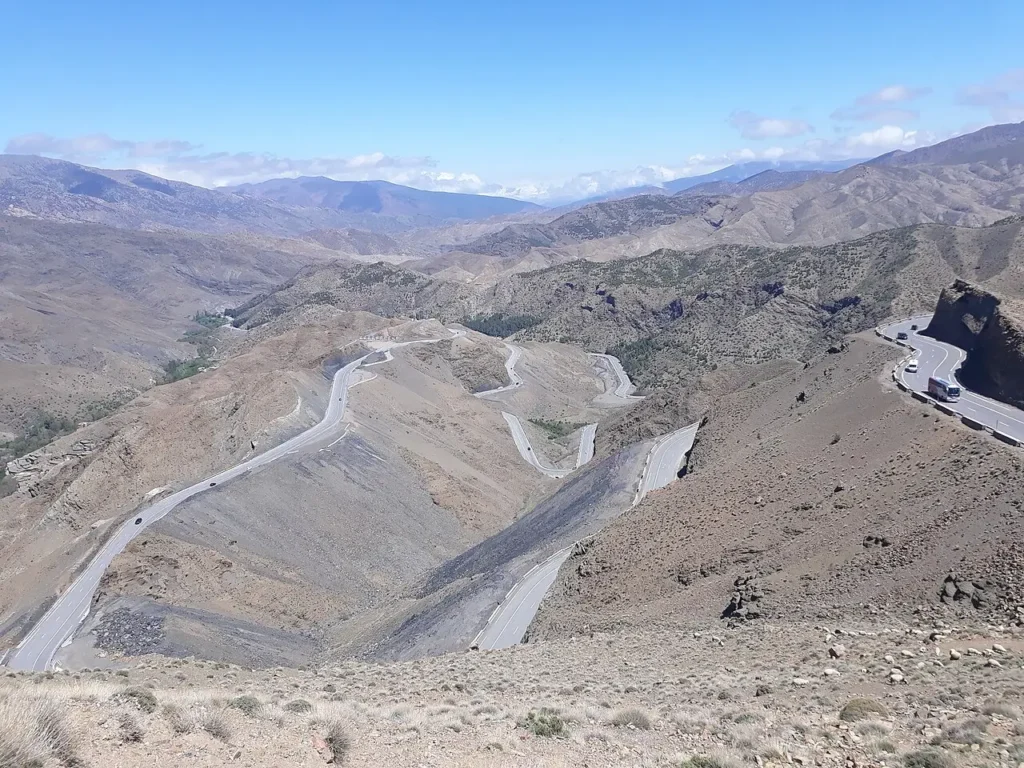
- The Tizi n’Tichka pass, on the N9 towards Ouarzazate, peaks at around 2,260 m and can be closed by snow between December and April. No theoretical travel time holds if the pass is blocked.
- The private transfer loses its point on one axis only: Marrakech – Casablanca – Rabat for two people, where the train exists and runs.
Private driver, grand taxi, ride-hailing app, chauffeur hire: what really sets them apart
The difference is not the comfort of the vehicle, it is its administrative status, and in Morocco that status is written down in precise texts. Decree no. 2-63-363 of 4 December 1963 on the coordination of rail and road transport divides the vehicles authorised to carry passengers into four categories. The fourth covers vehicles assigned to tourist transport, and it is order no. 50-73 of 25 January 1973 — published in Official Bulletin no. 3175 of 5 September 1973, amended in particular by order no. 343-14 of 5 February 2014 — that sets their characteristics.
That order defines three series. First series T, tourist coaches, 26 to 50 seats, up to 58 seats for raised bodywork with a lowered driving position. Second series T, minicoaches, 10 to 25 seats. Third series T, vehicles of fewer than 10 seats, which splits into grande remise vehicles and special light vehicles. It is in this third series that the saloon or the van you book for Essaouira or Ouarzazate belongs.
The most useful detail in that text, and the one you will read nowhere on a commercial page, concerns the grande remise. The order requires a four-door saloon body, 4 to 7 seats, less than 8 years old, with a minimum rating of 9 CV on petrol or 8 CV on diesel, and it explicitly excludes estate cars and commercial vehicles. It also states that these vehicles may not be hired by the seat and may not be fitted with a time-and-distance meter. The consequence is direct: a grande remise vehicle is hired as a whole, at an agreed price, and not by the seat or by the metered kilometre. The per-vehicle price model is therefore not a sales trick, it is the shape the framework imposes.
Even visual identification is standardised. Still under order no. 50-73, a grande remise vehicle carries at the front a yellow elliptical plate of 18 cm by 12 cm, on a horizontal axis, with 2 cm black lettering: the authorisation number at the top, the words “grande remise” in the middle, the name of the home locality at the bottom. If you want to know in thirty seconds whether the vehicle waiting for you really comes under that regime, that is where to look, not at the bodywork.
Grands taxis follow an entirely different logic. Dahir no. 1-63-260 of 12 November 1963 on road transport by motor vehicle excludes taxis and urban services from the definition of public passenger transport services: they come under local regulations. In practice, licences are issued by walis and governors, while the professional driver’s card comes under the ministry responsible for transport. A grand taxi runs between two cities on an almost fixed itinerary, leaving from a rank, and it can also be hired whole at a price agreed before departure. For fares, meters and haggling in practice, the subject is covered in detail in our guide to taxis and Uber in Morocco, and we will not go over it again here.
A point of honesty: the public sources available do not allow anyone to state categorically, text in hand, what a grand taxi is and is not allowed to do in every possible case of carrying tourists between two cities. The specification document for road-based tourist transport, in its 2014 version circulated by the supervising ministry, states that the tourist transport licence is granted by the National Transport Commission and that it covers the vehicles in the fourth category of the 1963 decree. What can be written without risk of error is therefore this: intercity tourist transport is a regime of its own, subject to licensing and to imposed vehicle characteristics, and a grand taxi does not come under that regime. For anything beyond that, the reference is the Official Bulletin, not a comparison page.
| Criterion | Private transfer (tourist transport vehicle) | Grand taxi | Ride-hailing app | Chauffeur hire |
|---|---|---|---|---|
| Governing text | Decree no. 2-63-363 (4th category) and order no. 50-73 | Dahir no. 1-63-260, local regulations | Legal framework still under discussion in Morocco | Grande remise regime, order no. 50-73 |
| Who issues the authorisation | National Transport Commission, after review | Walis and governors | Not established by a dedicated, verifiable text | Grande remise authorisation, number shown on the plate |
| Hiring arrangement | Whole vehicle, price agreed in advance | By the seat or whole vehicle, negotiated | Ride by ride through the app | Whole vehicle; hiring by the seat prohibited |
| Maximum vehicle age | 12 years for coaches and minicoaches | Not set by this regime | Varies by operator | Under 8 years for the grande remise |
| City-to-city journey | Yes, that is what it exists for | Yes, on an almost fixed itinerary from a rank | Limited and uneven intercity coverage | Yes, by the day or by the journey |
| What is normally included | Driver, fuel, tolls, pick-up at your address | The ride, nothing else | The fare charged by the app | Driver and vehicle, the rest to be agreed |
The most requested routes by private transfer from Marrakech
Eight destinations account for most of the demand out of Marrakech, and their road profiles are nothing alike. Before the table, one precaution that competing pages nearly always skip: the distances quoted for the same journey vary by 10 to 20% from one source to another. For Marrakech – Essaouira, a route planner gives 189 km for 2 h 33 of driving, a booking platform quotes about 168 km for 3 h, a transfer operator measuring from the airport gives 177 km for 2 h 42, and a travel guide settles on 170 km. All four figures are probably right: they do not start from the same place and do not necessarily follow the same road. So read the table as a planning range, not as a measurement.
| Destination | Quoted road distance | Realistic driving time | Type of road |
|---|---|---|---|
| Agafay desert | 30 to 40 km depending on the source | 40 to 60 min one way | Secondary road towards Amizmiz, the last kilometre often unsurfaced |
| Essaouira | 168 to 189 km depending on the source | 2 h 40 to 3 h 15 | Motorway as far as Chichaoua, then the N8 trunk road (formerly R207) across the plain |
| Casablanca (city centre) | About 210 km of motorway on the Casablanca – Marrakech axis | 2 h 30 to 3 h 15 | Motorway throughout, tolled, dual carriageway |
| Casablanca Mohammed V airport | 227 km according to the distance list published by TMC Conciergerie | 2 h 40 to 3 h | Motorway, dedicated exit before Casablanca |
| Rabat | 324 to 325 km according to two route planners | 3 h 10 to 4 h | Motorway, crossing or bypassing the Casablanca conurbation |
| Agadir | 245 km according to TMC Conciergerie; about 250 km according to the route planners | 2 h 55 to 3 h 30 | Motorway, Marrakech – Agadir section of 180.5 km opened in June 2010 |
| Ouarzazate | About 177 km of the N9 trunk road | 4 h to 5 h, excluding stops | Mountain trunk road, Tizi n’Tichka pass at about 2,260 m |
| Fes | 526 to 531 km according to three route planners | 6 h to 7 h 30 with breaks | Motorway via Casablanca and Rabat; no direct motorway route via Beni Mellal |
| Merzouga | 549 to 560 km depending on the source | 8 h to 9 h of actual driving | N9 over Tizi n’Tichka, then pre-Saharan valleys and plateaus |
Two of these destinations are not handled as a simple transfer. The Agafay desert near Marrakech is visited on a half-day or an evening and the logistics are specific; Ouarzazate and Aït Benhaddou are most often done in a single day, a format we set out in the guide to the Aït Benhaddou and Ouarzazate day trip from Marrakech. For those two, the question is not the vehicle but the programme.
The roads themselves: what really changes the driving time
The travel time an app quotes assumes a clear road, in daylight, with no roadworks and no lorry in front of you: on three of the axes out of Marrakech, that assumption does not hold. Here is what the four main routes are really worth.
Towards Casablanca and towards Agadir: the motorway axis, and a numbering muddle. The motorway linking Casablanca to Marrakech and then to Agadir is designated A3 in the list of motorways in Morocco, where it is described as linking Casablanca, Mohammed V airport, Berrechid, Settat, Ben Guerir, Marrakech, Chichaoua and Agadir, over 429 km. In that same list, A7 designates something quite different: the 28 km between Tetouan and Fnideq, in the north of the country. Many travel guides and toll calculators nevertheless call the Marrakech – Agadir section “A7”. Both labels are in circulation, and that is one of the reasons why the information found online about this axis contradicts itself so often. On the construction figures: Casablanca – Settat is 52 km, Settat – Marrakech about 158 km, and the Marrakech – Agadir section was completed in June 2010 over 180.5 km of main carriageway. Since 27 November 2025, a Tit Mellil – Berrechid motorway of around thirty kilometres has also made it possible to avoid congested sections on the approach to Casablanca.
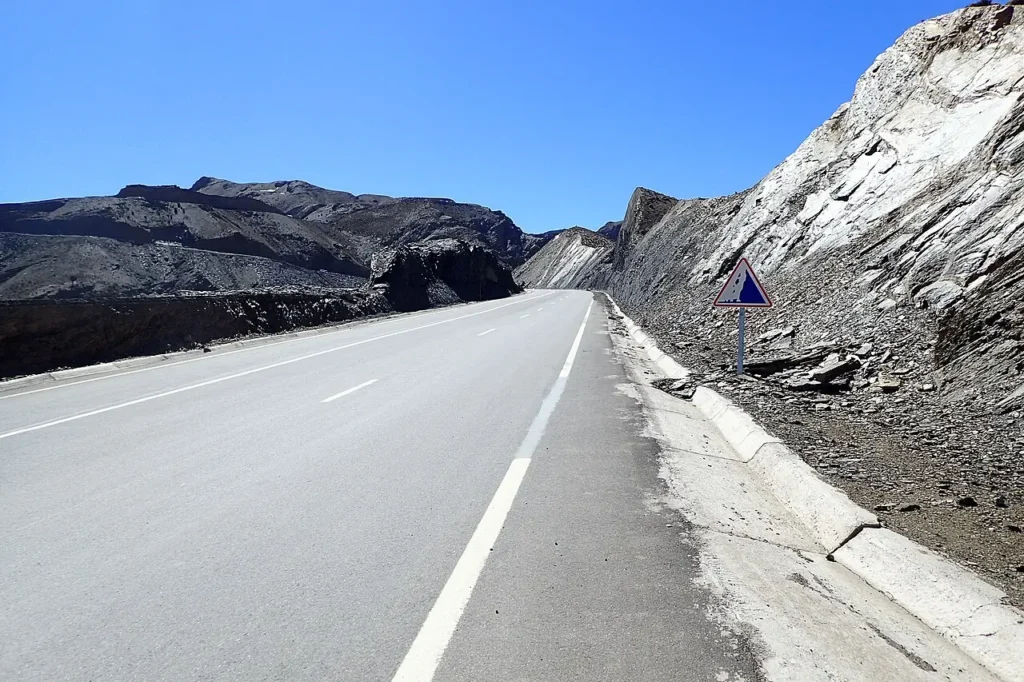
Towards Ouarzazate: the N9 and the Tizi n’Tichka pass. This is the only one of the main axes out of Marrakech where the terrain dictates everything. The Tizi n’Tichka pass peaks at around 2,260 m, a figure most sources agree on, even though you also find 2,200 m here and 2,600 m there — the latter looking plainly wrong. Several sources present it as the highest road pass in Morocco. The N9 covers about 177 km between Marrakech and Ouarzazate and has been the subject, since 2014, of an upgrade programme split into eight sections: widening, strengthening, realignment and the creation of a third lane for heavy goods vehicles on the steep gradients. That programme has had stoppages, and in January 2021 the ministry stated that the section from the Tichka pass towards Amerzgane was halted and that the contract would be retendered. A tunnel project is under study; in November 2020 the Ourika alignment was chosen rather than the Tichka one, and the studies mention a saving of about 80 minutes for light vehicles. In the meantime, allow 4 to 5 hours and assume that snow can block the pass between December and April, the gendarmerie being able to close it when the road is judged too dangerous.
Towards Essaouira: plain, wind and a road that changed its name. The route takes the motorway axis as far as Chichaoua, about 80 km from Marrakech, then a trunk road to the coast. A detail almost nobody mentions: that last section carried the number R207 before the renumbering of the Moroccan road network begun in 2018, and it now belongs to the N8. If you consult a paper map or an old guide, you will still read R207 Essaouira – Chichaoua. The road flows well but it is a two-lane trunk road, with villages to drive through, carts and coaches, and the last kilometres towards Essaouira are frequently exposed to a steady crosswind, which weighs more on a tall van than on a saloon.
Towards Fes: the straight line does not exist. The route planners give 526 to 531 km for a little over 5 h 30 of driving, but they calculate by motorway, that is, going back up towards Casablanca and Rabat before coming down again to Fes. The direct axis via Beni Mellal and Khenifra is not a motorway: it is a project of about 420 km whose preliminary studies have been launched, at an estimated cost of around 28 billion dirhams. With a lunch break and a comfort stop, a Marrakech – Fes run by road is planned on 6 h 30 to 7 h 30, not on 5 h 30.
On general driving conditions, two official sources are useful and consistent with each other. The British travel advice for Morocco, on the UK government’s country page, notes that poor lighting makes driving dangerous at night, that secondary and mountain roads are particularly dangerous in bad weather, that you should beware of overloaded lorries and of heavy goods vehicles overtaking where there is no hard shoulder, and that heavy rain can cause flash floods. For its part, the Morocco page of the French ministry for Europe and foreign affairs describes the trunk roads as generally well maintained but sometimes narrow, and reports, citing the Moroccan agency NARSA, that pedestrians account for 25% of road deaths. That last figure explains why an experienced driver slows right down through villages, where an app keeps counting at cruising speed.
| What lengthens the journey | Concrete effect | Where it mostly happens |
|---|---|---|
| Terrain and steep gradients | Average speed halved; overtaking rare | N9, Tizi n’Tichka pass |
| Heavy goods vehicles and slow convoys | Queuing behind a lorry for several kilometres | N9, N8 towards Essaouira, mountain roads |
| Roadworks | Single-lane shuttle working, unmapped diversions | N9, eight-section upgrade programme since 2014 |
| Driving through villages | Speed humps, pedestrians, animals, coach stops | The whole trunk road network |
| Night | Poor lighting, reduced visibility of obstacles | Secondary and trunk roads, according to the British page |
| Rain and flash floods | Flooded stretches, degraded surface | Mountains and riverbanks, especially in winter |
| Snow | Pass closed, very long alternative route | Tizi n’Tichka, from December to April |
| Actual starting point | 20 to 40 min more from the medina at delivery times | Marrakech inside the walls |
Tolls: who pays, how much, and why the sources disagree
In a private transfer, the toll is normally built into the agreed price: you pay nothing at the toll plaza, the driver takes care of it. In a hire car or in a grand taxi hired for the run, it is the other way round, and you need dirhams in cash. But if you are trying to find out what the Marrakech – Casablanca toll really costs, brace yourself: the amounts published online differ sharply, and we write that rather than picking a figure at random.
| Type of source | Amount quoted for Casablanca – Marrakech, private car | What the source specifies |
|---|---|---|
| Car hire guide, 2026 edition | 83 to 89 dirhams in class 1 | The spread depends on the plaza used to join the motorway; the entry near Nouaceur airport is said to be the cheapest |
| Moroccan business news site | 92 dirhams, up from 76 dirhams | Reports a general tariff revision on 1 April 2026, the first since 2018 |
| International toll calculator | 120 to 140 dirhams in class 1 | Markedly higher than the other sources, with no stated method |
| Private transfer platform | About 77 dirhams | Does not specify which entry / exit pair was used |
Three factors explain these gaps. First, the Moroccan system charges by entry plaza / exit plaza pair, and on the Casablanca – Marrakech – Agadir axis the barriers mentioned include Nouaceur, Berrechid and Amskroud: entering at Nouaceur or in central Casablanca does not give the same amount. Then the vehicle class: a saloon and a minibus do not pay the same thing, and most pages that quote an amount do not say which class they are talking about. Finally the date: the sources do not even agree on when the last tariff revision took place, one putting it on 1 April 2026, the other in May 2025. The only authoritative reference is the schedule published by the national motorway company, available on ADM’s official site, or the tariff displayed at the toll plaza itself. For regulars, the Jawaz electronic pass allows you to go through dedicated lanes without stopping; its price was raised in September 2024.
Which vehicle for how many people and how much luggage
The trap, when choosing a vehicle, is not the number of seats: it is the boot. A van advertised for 8 passengers was designed for 8 passengers and their weekend bags, not for 8 checked suitcases of 23 kg plus the hand luggage. On a 3-hour transfer to Essaouira or Agadir, the difference between a decent journey and a miserable one comes down to that detail: if the boot overflows, the suitcases end up on the back seat or between people’s legs, and nobody sleeps.
The official framework at least gives reliable benchmarks on capacity. Order no. 50-73 sets the three series already mentioned, and imposes minimum dimensions per seat for coaches and minicoaches: free back-to-back space of 0.80 m in Luxe class against 0.76 m in Tourisme class for coaches, free width per seat of 0.50 m minimum in Luxe against 0.45 m in Tourisme, interior height of 1.90 m for coaches and 1.80 m for minicoaches, and an aisle width of 0.40 m in Luxe against 0.25 m in Tourisme. It bans folding seats in these two classes, requires air conditioning for coaches, requires a retarder for minicoaches above 15 seats, and caps vehicle age at 12 years. These figures are not sales arguments: they are regulatory minimums, and they explain why a Luxe class coach looks so different from a bottom-of-the-range minicoach on the same journey.
| Type of vehicle | Capacity under the Moroccan framework | Realistic luggage | Who it is the right choice for |
|---|---|---|---|
| Saloon (grande remise) | 4 to 7 seats, 4-door saloon body, vehicle less than 8 years old | 2 large suitcases and 2 pieces of hand luggage, no more | A couple or a threesome with normal luggage, on the motorway |
| Van | Fewer than 10 seats: special light vehicle or grande remise depending on the configuration | 4 to 6 large suitcases if the back row stays free | A family of 4 to 6, or 4 people with a lot of luggage |
| Minicoach (minibus) | 10 to 25 seats under order no. 50-73; retarder required above 15 seats | Side or rear hold; capacity varies, to be confirmed | A group of 8 to 20, weddings, conferences |
| Tourist coach | 26 to 50 seats, up to 58 with raised bodywork; air conditioning mandatory | Hold sized for one suitcase per passenger | A group of more than 25 over a long distance |
Three cases call for an explicit check before booking. An 8-seat van carrying 8 adults with 8 checked suitcases: you almost always have to move up a size, or accept leaving the back row free and travelling 6. Oversized equipment — a surfboard for Essaouira, a golf bag, a double buggy, a musical instrument, a wheelchair: that is said at the booking stage, not in front of the boot. And a long run such as Marrakech – Merzouga or Marrakech – Fes: over 8 hours, a van with 4 passengers and room to spare will always be preferable to a saloon packed to the roof, even if both “fit” on paper. That is exactly what a per-vehicle price model allows: you pay for the vehicle, and the choice of size becomes a comfort decision rather than an arithmetic one. Local operators work this way and offer a private transfer from Marrakech at a fixed price per vehicle, quoted before booking for the whole group.
When a private transfer from Marrakech is worth it, and when it is not
The private transfer is not the right answer to every journey, and saying so honestly is more useful than a sales pitch. The decisive point is whether or not a rail alternative exists: Marrakech is the southern terminus of the passenger network. Northwards — Casablanca, Rabat, Kenitra, Tangier, Fes — the train exists. Westwards, southwards and eastwards — Essaouira, Agadir, Ouarzazate, Merzouga — it does not, and it will not any time soon: the high-speed line under construction links Kenitra to Marrakech over about 430 km, not Marrakech to Agadir, and its commercial opening is announced for the end of 2029.
Two important caveats about the train, to check before deciding. Since 14 September 2026 the ONCF has been applying a new timetable plan tied to the progress of the Kenitra – Marrakech high-speed line works: it provides for revised schedules, changes to some itineraries and shortened runs for several trains. In April 2026, Marrakech station was even inaccessible for several days, with trains stopping at Sidi Brahim and a bus shuttle laid on. In other words, the train remains the best choice on the northern axis, but you need to check the state of the service on the ONCF website when you book, rather than trusting a timetable found in an old guide.
On the coach side, the long-distance companies cover most of the axes out of Marrakech, with tiered comfort ranges — the list published by CTM distinguishes Premium, Confort Plus and Confort, for instance, with reclining seats, wifi and a USB socket advertised on board. It is the cheapest option for one or two people with no timing constraint. Its limits are known: a fixed departure, a coach station to reach at each end, and a baggage allowance to check with the company.
| Your situation | Best option | Why |
|---|---|---|
| Two people, Marrakech to Casablanca or Rabat, light luggage | Train | Direct rail axis; the private transfer does not add enough to justify the price gap |
| Two people, small budget, Marrakech to Essaouira or Agadir | Long-distance coach | No train south of Marrakech, and the coach stays very cheap for two |
| Family of 4 to 6 with children and checked suitcases | Private transfer | Door to door, child seats possible, no change of vehicle at a coach station |
| Late arrival at Marrakech Menara then road to another city | Private transfer booked in advance | Flight tracking and waiting in case of delay; an option almost absent from the other modes |
| A single traveller, short journey, no luggage | Grand taxi from the rank | The cheapest, provided you accept leaving when the vehicle is full |
| A touring trip over several days, several stops | Hire car or chauffeur hire | Complete freedom over the programme; one-off transfers quickly become more expensive |
| Marrakech to Merzouga or Fes, in a single day | Private transfer, or an intermediate stop | 8 to 9 hours of driving: a dedicated driver changes the nature of the journey |
| A group of more than 25 people | Licensed tourist coach | The only size the regulations provide for above 25 seats |
What to check before booking a private transfer from Marrakech
Seven points decide the quality of a transfer, and none of them appears on a standard booking page: you have to ask. First point, the child seat. Law no. 52-05 on the highway code requires, in its article 48, seat belts at the front and rear seats of any vehicle whose gross laden weight does not exceed 3.5 tonnes, and failing to wear one is, under article 185, an offence punishable by a fine of 500 to 1,000 dirhams. We did not, on the other hand, find any reliable Moroccan source setting an age or height threshold for the mandatory use of a child seat: we are not going to invent one. In practice, ask explicitly for a seat suited to the child’s age and weight, have its presence confirmed in writing, and check it at pick-up.
Second point, oversized luggage, already mentioned: surfboard, golf bag, buggy, instrument, medical equipment. Third point, stops. A photo stop at the Tizi n’Tichka pass or on the road to Essaouira has to be announced: some operators include it, others charge for the waiting time. Fourth point, and the most important when you land: waiting in case of delay. Ask whether the flight is tracked, how much free waiting time is allowed after landing and from what moment it is charged. A transfer booked in advance that does not track the flight has no advantage over a taxi taken on the spot.
Fifth point, the driver’s language. On a journey of 3 to 8 hours this is not a comfort detail but a practical matter: explaining a change of address, asking for a stop, saying that someone feels unwell. Ask which language is spoken, not which language the website is in. Sixth point, cancellation: from when it is charged, what happens if your flight is cancelled, and whether the quoted price really is the one for the whole vehicle for the whole group. Seventh point, the exact destination. An address in the medina is not reachable by van, and a camp in the Agafay often ends on a track. Check where the vehicle actually drops you.
One last useful habit: check that your destination really is in the area the operator serves, and what it calls it. Operators based in Marrakech build their offer around the city, which means every journey starts from Marrakech or comes back to it; some publish the full list, as TMC Conciergerie does in setting out the destinations served from Marrakech, from Essaouira and Casablanca through to Ouarzazate, Agadir or the Agafay desert. An operator that displays no coverage list is an operator whose experience of your route you will never know.
Leaving from the airport or from central Marrakech is not the same thing
A departure from Marrakech Menara airport and a departure from the medina have neither the same meeting point, nor the same approach time, nor the same vehicle constraints. The airport is about 7 km from the centre, that is 15 to 20 minutes by road according to the distances published by local operators: pick-up there is simple, the vehicle reaches the forecourt, the boot is loaded without blocking traffic. From the medina it is the opposite: narrow streets, restricted access, deliveries in the morning, and a van that often cannot get within several hundred metres of your riad. Allow 20 to 40 minutes of margin, and have the exact meeting point spelled out, including the name of the gate or the square.
Both situations are already covered in detail on the site and there would be no point rewriting them here: for the arrival, the terminals, the services and the ways out, see our guide to Marrakech Menara airport; for everything to do with getting around inside the city, petits taxis, buses and caleches, see our guide to getting around Marrakech. Official information on Moroccan airports, schedules and services comes from the National Airports Office (ONDA), whose site onda.ma remains the reference to consult.
Night journeys and long distances: what a private driver changes
At night, the ranking of transport modes out of Marrakech changes completely, and not only as a matter of comfort. The British government’s travel advice is explicit: poor lighting makes driving dangerous at night, and extra care is needed around other vehicles, pedestrians and animals. The French page adds that the trunk roads are sometimes narrow. On a mountain trunk road such as the N9, those two observations compound each other: unlit bends, slow lorries, and a carriageway that narrows where there are structures.
Three practical consequences. First, a night journey to Ouarzazate, Merzouga or Agafay is planned differently from a daytime one: the times the apps give are often optimistic, not pessimistic, because they do not factor in the drop in speed that poor visibility imposes. Second, on a night departure from the airport, the real criterion is not speed but certainty: a booked vehicle that is waiting, with the driver’s name and phone number, is worth more than a negotiation at one in the morning outside the terminal. Third, over very long distances, the limiting factor is the driver, not the road. Marrakech – Merzouga represents 8 to 9 hours of actual driving, and the Merzouga or Zagora desert from Marrakech is reasonably done over two days with an overnight stop, not as a day return. A private driver who knows the route knows where the open filling stations and the safe stopping points are: on that axis, that is most of the added value.
Six mistakes to avoid
- Taking an app’s travel time for granted on the N9. Between the steep gradients, the lorries and a roadworks programme in eight sections begun in 2014, Marrakech – Ouarzazate is planned on 4 to 5 hours, not on the figure a route planner displays.
- Choosing the vehicle on the number of seats. Eight seats does not mean eight checked suitcases. Count the luggage before counting the passengers, and declare oversized equipment at the booking stage.
- Believing a toll amount found online. On Casablanca – Marrakech, the published sources range from about 77 to 140 dirhams depending on the entry plaza, the vehicle class and the revision date used. Refer to the ADM schedule.
- Planning a Marrakech – Ouarzazate run in January with no plan B. The Tizi n’Tichka pass, at around 2,260 m, can be closed by snow between December and April, on a decision by the gendarmerie when the road is judged too dangerous.
- Booking a transfer for a flight arrival without checking the included waiting time. With no flight tracking and no written waiting allowance, a booked transfer loses its main advantage over a taxi taken on the spot.
- Trusting a train timetable found in an old guide. A new ONCF timetable plan has applied since 14 September 2026, with revised schedules and shortened runs on several trains linked to the high-speed line works.
FAQ
How long does it take to get from Marrakech to Essaouira with a private driver?
Allow 2 h 40 to 3 h 15 door to door. The sources give between 168 and 189 km depending on the starting point used, with estimates of 2 h 33 from a route planner and 2 h 42 from an operator measuring from the airport. The route takes the motorway axis as far as Chichaoua, then the N8 trunk road — the former R207 before the 2018 renumbering — to the coast.
Is a private transfer Marrakech – Casablanca better than the train?
Not for two people with normal luggage: it is the only axis where the train is the best choice out of Marrakech. The private transfer takes the advantage back in three cases, a family with children and checked suitcases, an arrival at or a departure from Mohammed V airport, and a period of disruption to the rail service. The ONCF has been applying a new timetable plan since 14 September 2026: check the state of the service before deciding.
Can you book a minibus with driver from Marrakech?
Yes, and it is a regulatory category in its own right: order no. 50-73 defines minicoaches as vehicles of 10 to 25 seats, with minimum dimensions per seat, a ban on folding seats, a retarder required above 15 seats and a maximum age of 12 years. Above 25 passengers you have to move up to the tourist coach, 26 to 50 seats, up to 58 with raised bodywork.
What is the difference between a private transfer and a grand taxi for getting from Marrakech to Agadir?
The status of the vehicle and the hiring arrangement. A tourist transport vehicle comes under the fourth category of decree no. 2-63-363 and the characteristics of order no. 50-73, is hired whole at an agreed price and cannot be fitted with a time-and-distance meter if it is a grande remise. A grand taxi comes under dahir no. 1-63-260 and local regulations, leaves from a rank on an almost fixed itinerary, and is either shared by the seat or hired whole after negotiation.
How much is the toll between Marrakech and Casablanca?
The published sources differ sharply: a 2026 guide quotes 83 to 89 dirhams in class 1, a Moroccan business outlet 92 dirhams after a revision on 1 April 2026, an international calculator 120 to 140 dirhams, and a transfer platform about 77 dirhams. The spread comes from the entry plaza / exit plaza pair, the vehicle class and the date used. Only the official ADM schedule or the tariff displayed at the toll plaza is authoritative. In a private transfer, the toll is normally included in the agreed price.
Is there a train from Marrakech to Essaouira, Agadir or Ouarzazate?
No. Marrakech is the southern terminus of the ONCF passenger network: none of those three cities is served by rail. The high-speed line under construction links Kenitra to Marrakech, over about 430 km for an announced commercial speed of 320 km/h, with opening planned for the end of 2029 — it does not extend the network towards the south-west. Beyond Marrakech, the options are the coach, the grand taxi, the car and the private transfer.
Do you need to arrange a child seat for a private transfer in Morocco?
Ask for one every time and have it confirmed in writing. Law no. 52-05 requires, in its article 48, seat belts at the front and rear seats of vehicles of less than 3.5 tonnes, and article 185 punishes failure to wear one with a fine of 500 to 1,000 dirhams. We did not, on the other hand, find any reliable Moroccan source setting an age or height threshold that makes a child seat mandatory, and we prefer to say so rather than put forward an unverified figure: give the operator the child’s age and weight and check the seat before departure.
In summary
A private transfer from Marrakech is judged on three questions, in this order. Is there a train? If your destination is Casablanca or Rabat and there are two of you with light luggage, rail remains the best choice, subject to checking the service after the new timetable plan of 14 September 2026. What kind of road is it? Motorway towards Casablanca and Agadir, plain trunk road towards Essaouira, mountain trunk road at 2,260 m towards Ouarzazate: three different worlds, and the last two justify a driver who knows the route. How much luggage? It is the boot, not the number of seats, that determines the right size.
Two final habits. Do not trust a distance, travel time or toll figure found on a commercial page without knowing where it starts from: on each of those three subjects, the published sources contradict each other, sometimes by a factor of two. And when you book, the questions that count are the ones that are not on the form: child seat, oversized luggage, waiting in case of a delayed flight, the driver’s language, cancellation terms and the exact meeting point.
Sources
- Order no. 50-73 of 25 January 1973 setting the characteristics and fitting-out conditions of vehicles assigned to tourist transport, Official Bulletin no. 3175 of 5 September 1973, amended in particular by order no. 343-14 of 5 February 2014 (Official Bulletin no. 6274 of 17 July 2014): vehicle series, number of seats, dimensions per seat, maximum age, grande remise regime and signage.
- Decree no. 2-63-363 of 4 December 1963 on the coordination of rail and road transport: division of passenger transport vehicles into four categories.
- Dahir no. 1-63-260 of 12 November 1963 on road transport by motor vehicle: exclusion of taxis and urban services from the scope of public passenger transport services.
- Specification document for road-based tourist transport, 2014 version, circulated by the supervising ministry: licence issued by the National Transport Commission, vehicles in the fourth category.
- Law no. 52-05 enacting the highway code, articles 48 and 185: mandatory fitting of seat belts and penalty for failing to wear one.
- Société Nationale des Autoroutes du Maroc (ADM): toll tariff schedule and Jawaz pass, the only reference that can be relied on for amounts.
- ONCF: timetable plan applicable since 14 September 2026, works on the Kenitra – Marrakech high-speed line.
- National Airports Office (ONDA): official information on Moroccan airports.
- UK government travel advice, Morocco page, safety section: driving at night, mountain roads, heavy goods vehicles, flash floods.
- French ministry for Europe and foreign affairs, Morocco page, updated 16 April 2026: condition of the trunk roads and share of pedestrians in road deaths according to the Moroccan agency NARSA.
- List of motorways in Morocco: A3 designation of the Casablanca – Marrakech – Agadir axis and section lengths.
- TMC Conciergerie: published distances between Marrakech and the airports of Casablanca Mohammed V and Agadir Al Massira, and list of destinations served.
- Photographs: “Col Tizi n’Tichka Mai 2018” by Demonius42 and “Road N9 (Morocco)” by Krzysztof Ziarnek, Kenraiz (CC BY-SA 4.0), via Wikimedia Commons.
Information verified in October 2026. Travel times, public tariffs and road conditions change: check before you travel.