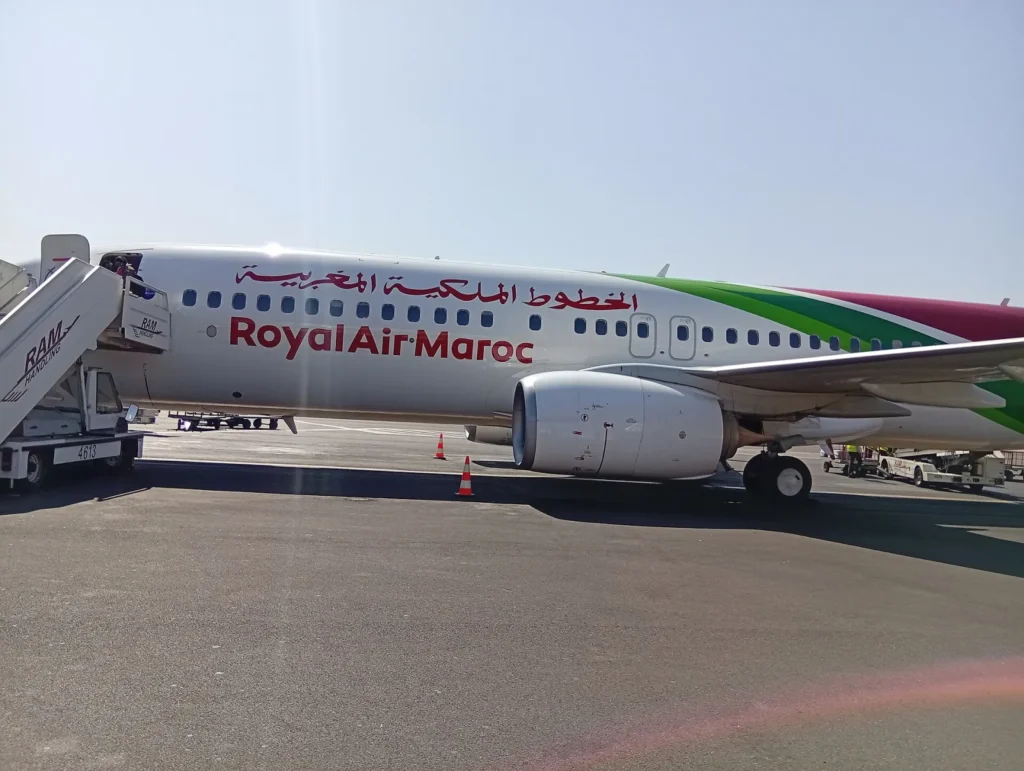
Rotterdam The Hague Airport is the smallest of the major Dutch airports, and at the same time the best connected in the country to northern and eastern Morocco. Six Moroccan destinations, four carriers, and two routes that do not exist from Schiphol: Oujda and Al Hoceima. Anyone with family in the Rif or in the eastern provinces travels more directly from Rotterdam than via Amsterdam.
In short: what you need to know
- Six Moroccan destinations: Tangier, Fez, Agadir, Nador, Oujda and Al Hoceima.
- Four carriers: Transavia, Royal Air Maroc, TUI fly Belgium and Corendon.
- Transavia serves all six; the other three add targeted capacity towards the north.
- Two routes Schiphol does not have: Oujda, and Al Hoceima with Transavia.
- Nador is the densest route, with four carriers from Rotterdam.
- No service to Marrakech or Casablanca: for those you depart from Schiphol or Eindhoven.
- Compact terminal: one building, short walking distances, a single security filter.
Every Moroccan route from Rotterdam
The network is narrow in breadth and deep towards the north. The table below shows which carriers operate each route.
| Destination | Carriers from Rotterdam | Region in Morocco |
|---|---|---|
| Nador Al Aroui (NDR) | Transavia, Royal Air Maroc, TUI fly Belgium, Corendon | East, Rif |
| Tangier Ibn Battouta (TNG) | Transavia, Royal Air Maroc | North, Strait of Gibraltar |
| Oujda-Angads (OUD) | Transavia, Royal Air Maroc | East, Algerian border |
| Al Hoceima (AHU) | Transavia, Corendon Dutch Airlines | Central Rif |
| Fez-Saiss (FEZ) | Transavia | Interior, imperial city |
| Agadir Al Massira (AGA) | Transavia | South, Atlantic coast |
Why Rotterdam leans so heavily towards the north
The explanation is demographic, not commercial. A large part of the Moroccan community in the Netherlands has its roots in the Rif and in the eastern provinces: the area around Nador, Oujda and Al Hoceima. The routes from Rotterdam follow that origin, not tourist demand. You therefore see the reverse of the Schiphol picture: Nador is more densely served than Marrakech, which is not served at all.
That has two practical consequences. First, traffic shifts strongly with the holiday periods: capacity rises in July and August and around the public holidays, and contracts in winter. Second, load factors are high during those peaks, which means booking late on these routes is dearer than on a leisure route.
Nador from Rotterdam: the densest route
With four carriers, Nador is the best served destination from Rotterdam. Transavia and Royal Air Maroc operate it as scheduled carriers, TUI fly Belgium and Corendon as leisure carriers. That mix is rare: on most Moroccan routes from the Netherlands one or two carriers hold the line.
In practice this means a cancelled service on this route is more often recoverable than elsewhere. It also means pricing is sharper, since four operators serve the same traveller. We describe the airport in detail on our page covering Nador Al Aroui airport, with current departures and arrivals and the food outlets in Nador airport restaurants.
Al Hoceima: Rotterdam and Maastricht, nothing else
Al Hoceima is the clearest illustration of what sets Rotterdam apart. The central Rif airport has three Dutch departure points: Rotterdam with Transavia and Corendon Dutch Airlines, Maastricht with Corendon Dutch Airlines, and Amsterdam with Royal Air Maroc. From Belgium there is a single route, out of Brussels.
For anyone heading into the central Rif, the alternative is a service to Nador or Tangier followed by a two to three hour drive over mountain roads. The gap between a direct route and a detour is therefore larger here than the map suggests. We describe the airport on our page covering Al Hoceima Cherif Al Idrissi airport, with current departures and arrivals.

The six destinations, one by one
Nador Al Aroui: the largest route
With over a million passengers a year, Nador is a mid-sized airport with a pronounced diaspora profile. It is the gateway to the eastern Rif and to the Marchica lagoon. Four carriers from Rotterdam make it the most flexible route at this airport.
Tangier Ibn Battouta: the north and the strait
Tangier has the widest European network in the north, with over one and a half million passengers a year. From Rotterdam, Transavia and Royal Air Maroc serve it. It is also the logical gateway for Chefchaouen and for the coast along the Strait of Gibraltar.
Oujda-Angads: the east
Oujda lies in the far east, close to the Algerian border, and exceeds a million passengers a year. Its profile is also diaspora. From Rotterdam, Transavia and Royal Air Maroc serve it; Schiphol has no Oujda route, which makes Rotterdam the Dutch departure point for this destination.
Al Hoceima: the central Rif
The smallest of the six, with a single terminal and a strictly diaspora profile. Transavia and Corendon Dutch Airlines serve it from Rotterdam. The airport covers a mountainous area whose road links are slow, which raises the value of a direct service here.
Fez-Saiss: the imperial city
Fez is the only one of the six with a cultural profile, at over one and a half million passengers a year. From Rotterdam, only Transavia serves it. It is the gateway to the oldest medina in Morocco and to Meknes and Volubilis.
Agadir Al Massira: the south
The only southern destination from Rotterdam, and with over three million passengers a year the largest of the six. Its profile is leisure: beach, surf and the Souss valley. Here too only Transavia holds the route from Rotterdam.
What Rotterdam does not have
Two major destinations are missing. There is no route to Marrakech and none to Casablanca. For Marrakech you depart from Schiphol with Transavia or from Eindhoven with Ryanair or Transavia; for Casablanca, Amsterdam is the only Dutch departure point. Rabat is also absent from Rotterdam: that route is operated only from Amsterdam, by Transavia.
Rotterdam also lacks what Schiphol offers: a connecting network. If your service is cancelled and no other carrier operates the same route that day, there is no workaround via a third city. On a route like Nador, with four carriers, that risk is small; on Fez or Agadir, with one, it is real.
Rotterdam compared with the other Dutch airports
| Airport | Moroccan destinations | Strength |
|---|---|---|
| Amsterdam Schiphol | 8 | Breadth, south and interior, connections |
| Rotterdam The Hague Airport | 6 | North and east, four carriers on Nador |
| Eindhoven Airport | 5 | Low-cost carriers, southern location |
| Maastricht Aachen Airport | 1 | Direct route to Al Hoceima |
The full Dutch picture, with every carrier by destination, is in flights from the Netherlands to Morocco. If you live in the south of the country, flights from Belgium to Morocco is also a real trade-off, since Charleroi has more Moroccan destinations than any Dutch airport.
European or Moroccan carrier: what changes
Across the four carriers serving Morocco from Rotterdam the split is sharp. European passenger rights in cases of delay, cancellation and denied boarding always apply to a service departing the European Union, whichever carrier operates it. On the return out of Morocco they apply only if the carrier is European.
| Carrier | European? | Rights on the return out of Morocco |
|---|---|---|
| Transavia | Yes | European rights apply |
| TUI fly Belgium | Yes | European rights apply |
| Corendon Dutch Airlines | Yes | European rights apply |
| Royal Air Maroc | No | In principle not; the carrier’s own conditions apply |
On Fez and Agadir, where only Transavia flies, you are therefore covered both ways. On Nador and Tangier it depends which carrier you choose for the return. The remedies are in our article on flight delay and cancellation rights in Morocco, with the carrier-by-carrier detail in our guide to the airlines flying to Morocco.
The holiday peak on the diaspora routes
Four of the six destinations from Rotterdam carry a diaspora profile in our data: Nador, Tangier, Oujda and Al Hoceima. That changes the booking logic you should apply. On a leisure route, fares often ease in the weeks after the peak; on a diaspora route, load factors stay high for as long as the school holidays last, because travellers go as families and cannot shift their dates.
- Book the summer early. On these routes, booking late in July and August is structurally dearer, not occasionally so.
- Expect more checked baggage around you. Families visiting relatives travel heavier, and baggage reclaim takes longer.
- Allow more time at the airport. During peak weeks the Moroccan routes coincide with the Spanish and Turkish ones.
- Look at the shoulder seasons. April, May, September and October are quieter and climatically kinder, as set out in our guide to the best time to visit Morocco.
Getting to Rotterdam The Hague Airport
The airport lies on the north side of Rotterdam and has no railway station of its own. You reach it by city bus from Rotterdam Centraal, by car via the ring road, or by taxi. For travellers from The Hague and the Dordrecht area the journey is shorter than to Schiphol; for those from the north or east of the country the opposite is true.
The compact layout brings an advantage worth factoring into your travel time: from the entrance to the gate is a short walk, and there is only one security filter. In quiet periods you can therefore arrive later than you would dare at Schiphol. During the peak summer weeks that advantage largely disappears, since that single filter has to process the whole airport.
Bear in mind too that the airport operates within a restricted night regime, which means the late evening departures you find at Schiphol do not exist here. That limits the choice of departure times on the Moroccan routes, particularly outside peak season.
Arrival, baggage, time difference and entry rules
On baggage, the carriers at this airport apply two different models. Transavia and Royal Air Maroc operate as scheduled carriers, TUI fly Belgium and Corendon as leisure carriers with package conditions. What the European reform changes, and on which services it applies, is detailed in our article on the EU cabin bag rules on flights to Morocco.
Morocco keeps GMT all year: it is one hour earlier than the Netherlands in winter and two hours in summer. On arrival you clear passport control, at a growing number of airports through the biometric e-gates. A passport is mandatory, an identity card is not enough, and no visa is required for stays of up to ninety days: the detail is in our guide to Morocco visa and entry requirements.
Official sources
- The airports — the Moroccan airports authority publishes operational information per airport at onda.ma.
- Entry rules — Dutch government travel advice is published at nederlandwereldwijd.nl.
- Your flight — the carrier itself remains the only reliable source for its current programme.
FAQ — From Rotterdam to Morocco
Which Moroccan destinations does Rotterdam The Hague Airport serve?
Six: Nador, Tangier, Oujda, Al Hoceima, Fez and Agadir. Marrakech, Casablanca and Rabat are not served from Rotterdam.
Can I fly from Rotterdam to Marrakech?
No, there is no direct route. For Marrakech you depart from Amsterdam Schiphol with Transavia or from Eindhoven with Ryanair or Transavia.
Why is Nador better served than Marrakech from Rotterdam?
Because the routes from Rotterdam follow the regions of origin of the Moroccan community in the Netherlands, largely the Rif and the eastern provinces, rather than tourist demand.
Which carrier has the widest network from Rotterdam?
Transavia, with all six destinations. Royal Air Maroc serves three, while TUI fly Belgium and Corendon add capacity on Nador and Al Hoceima.
Rotterdam or Maastricht for Al Hoceima?
Rotterdam has two carriers on Al Hoceima, Maastricht one. Maastricht is considerably closer, though, for travellers from Limburg and the neighbouring German border region.
Does Rotterdam The Hague Airport have a railway station?
No. You reach it by city bus from Rotterdam Centraal, by car or by taxi. The walk inside the terminal is short, however, with a single security filter.
Are there domestic connections from these airports?
Yes. Nador, Tangier, Oujda and Al Hoceima are all linked to Casablanca by Royal Air Maroc Express, which opens the domestic network towards the south. These routes have few frequencies, so allow wider margins than you would in Europe if you are connecting.
Is Rotterdam cheaper than Schiphol for Morocco?
It depends on the route and the date, but there is a structural difference worth knowing: on Nador four carriers compete from Rotterdam, while Schiphol has two. More operators on the same route generally means sharper pricing.
In summary
Rotterdam The Hague Airport is not the airport with the most destinations, but it is the right choice for northern and eastern Morocco. For Nador, Oujda and Al Hoceima this departure point is better connected than Schiphol; for Marrakech, Casablanca and Rabat you have to board elsewhere. Let your destination decide the airport, not the reflex.
Image credits
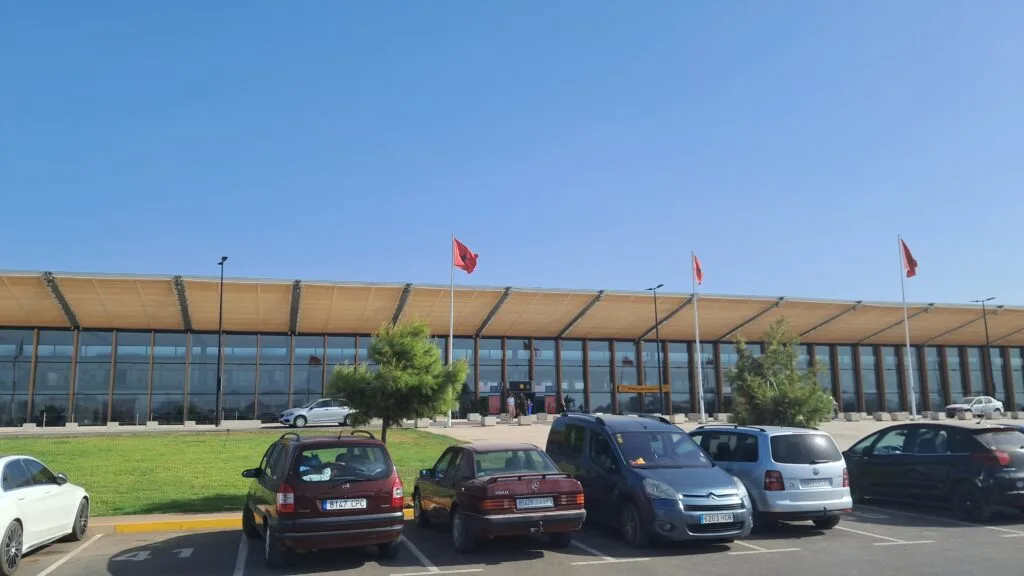
Images: featured image and illustration « Nador – El Aroui Airport » — Visma17 (CC BY 4.0) ; « Al Hoceima beach Down » — Simo El H (CC BY-SA 4.0), via Wikimedia Commons.