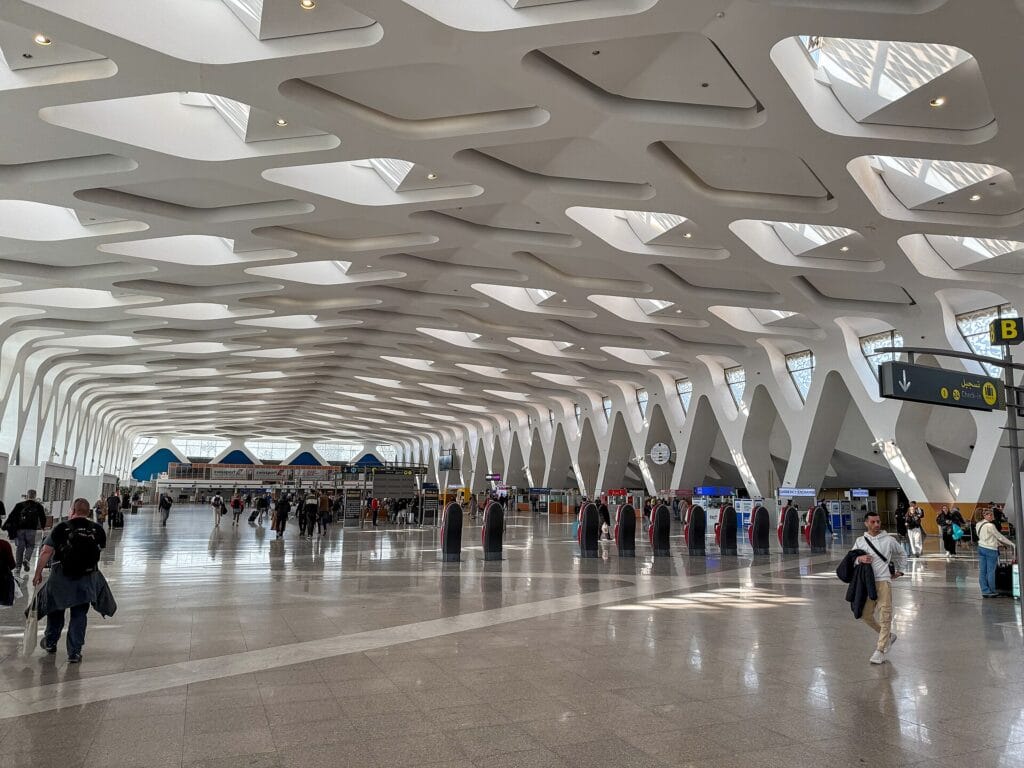
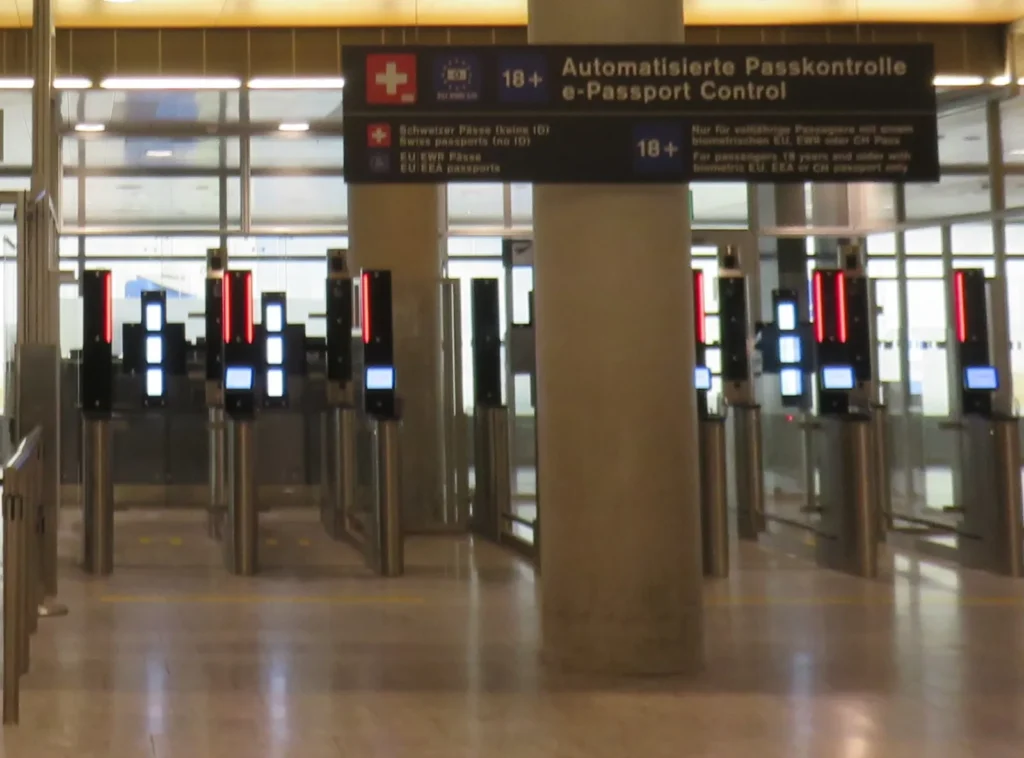
Biometric e-gates at Morocco’s airports are transforming the most dreaded moment of any trip: the queue at passport control. Casablanca has already scrapped its notorious double passport check, and five airports across the Kingdom are moving to automated border control. In practice, a step that used to take several minutes now takes about fifteen seconds. Here is how it works, who it applies to, what has been officially confirmed and what has not.
In short: six things to know
- Five airports are named for automated border-control gates: Casablanca Mohammed V, Marrakesh Menara, Agadir Al Massira, Fez-Saïss and Rabat-Salé.
- The double passport check is gone at Casablanca: you no longer present your document a second time after the stamp.
- The process rests on three actions: reading the passport chip, capturing your face, comparing the two.
- A normal crossing takes under fifteen seconds.
- The scheme is run jointly by the national security directorate, the immigration and border services and the airport operator.
- Detailed eligibility rules (nationalities, minimum age, residents) have not been published: follow the signage on site.
This is not a cosmetic project. Over the first seven months of 2026, Moroccan airports handled more than 22.28 million passengers, up 8.77 % year on year. Casablanca peaked at 46,439 passengers in twenty-four hours. Without automation, volumes like that translate directly into endless border queues.
What actually changes at passport control
The end of the double check in Casablanca
Until recently, the route through Mohammed V airport contained an oddity every regular traveller knew about: after having the passport stamped at the desk, international passengers had to show it again a few metres further on, to an officer verifying that the stamp had indeed been applied. Two queues, two waits, for a single check.
That second check has been removed and replaced by automatic gates. The announcement came from the airport operator, which describes a “faster and more secure” crossing. For travellers the gain is immediate: one step fewer, and above all the disappearance of a bottleneck that formed reliably at peak times, when several long-haul flights landed together.
The airports concerned
The rollout follows volume: equip the busiest queues first, then generalise. Two different systems coexist, and it helps not to confuse them.
| Airport | Code | Announced system |
|---|---|---|
| Casablanca Mohammed V | CMN | Automatic gates already in service, double check removed |
| Marrakesh Menara | RAK | Biometric border-control gates |
| Agadir Al Massira | AGA | Biometric border-control gates |
| Fez-Saïss | FEZ | Biometric border-control gates |
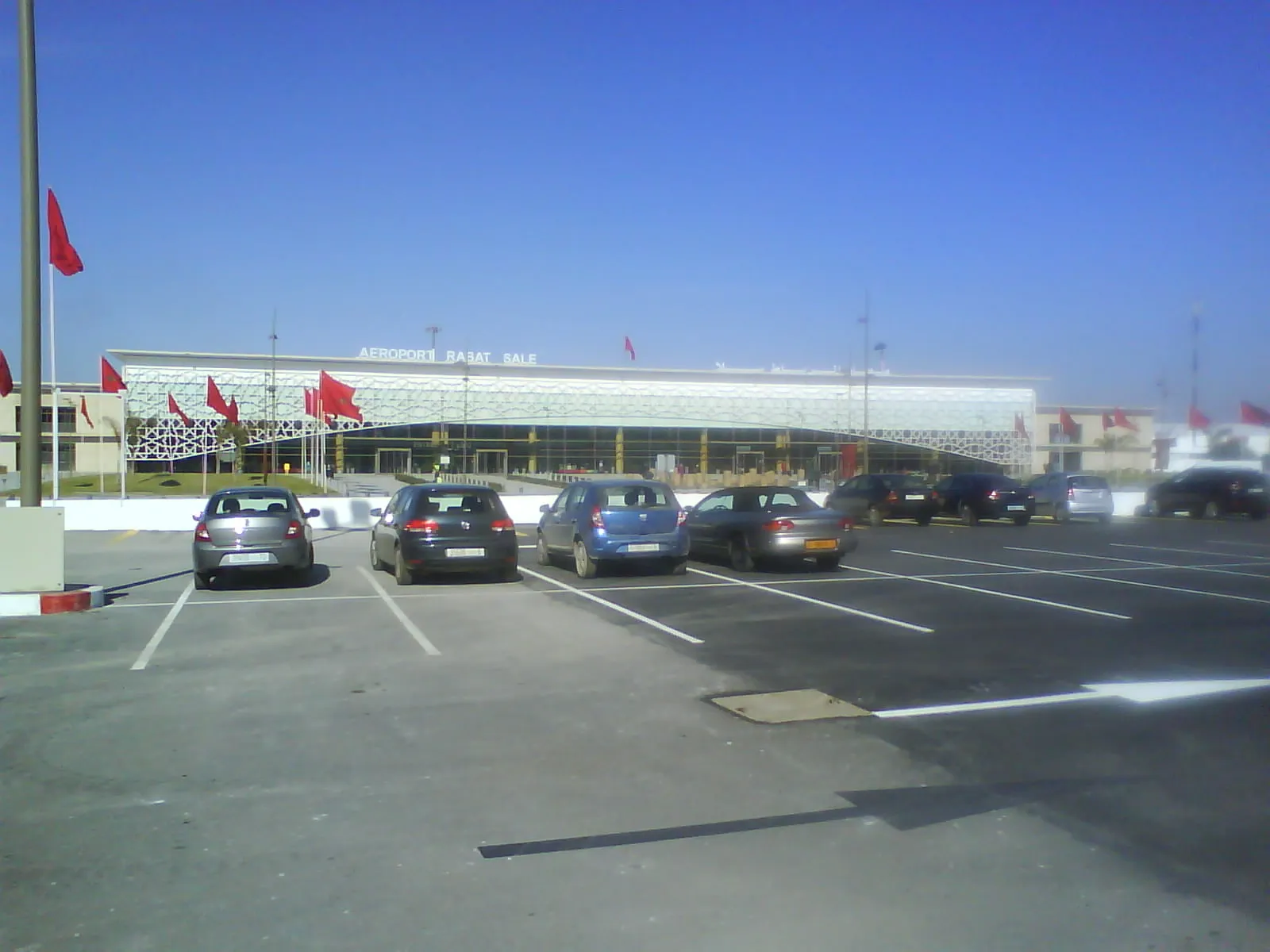
| Rabat-Salé | RBA | Biometric border-control gates |
Alongside these border gates, a separate system has been announced for Tangier, Fez, Agadir, Oujda and Nador: automated boarding-pass control giving access to the transit area after biometric identity verification. That is not the police check, but the filter into the departure lounge. The two systems complement each other.
How a biometric gate works, step by step
The principle is the same worldwide and simpler than it looks. The gate does not “recognise” your face in some vast database: it compares your face, filmed on the spot, with the photo stored in the chip of your own passport. That is verification, not identification.
- You present your electronic passport to the reader, photo page down, until the screen confirms it has been read. The contactless chip sits in the cover or in the data page.
- A camera captures your face. Stand square to the lens, look straight ahead, neutral expression. Some gates adjust their height automatically.
- The system compares the captured image with the one held in the chip. If it matches, the doors open and you walk through.
Under fifteen seconds
That is the stated duration for a normal crossing. In reality most of the time is consumed by the traveller: hunting for the passport, placing it upside down, adjusting glasses. Every airport that has deployed this equipment reports the same pattern: throughput collapses not because of the machine, but because passengers discover the system at the moment of using it. Which is exactly why it pays to know what to expect before you reach the gate.
What the gate actually checks
Three things, in this order: that the document is genuine and unaltered, that the chip has not been tampered with, and that the bearer is the person in the stored photo. Checking your right to enter, meaning whether you may legally stay, remains the job of the border police. That is why an officer always supervises the row of gates and can call you over at any moment.
Who can use the gates? What is confirmed and what is not
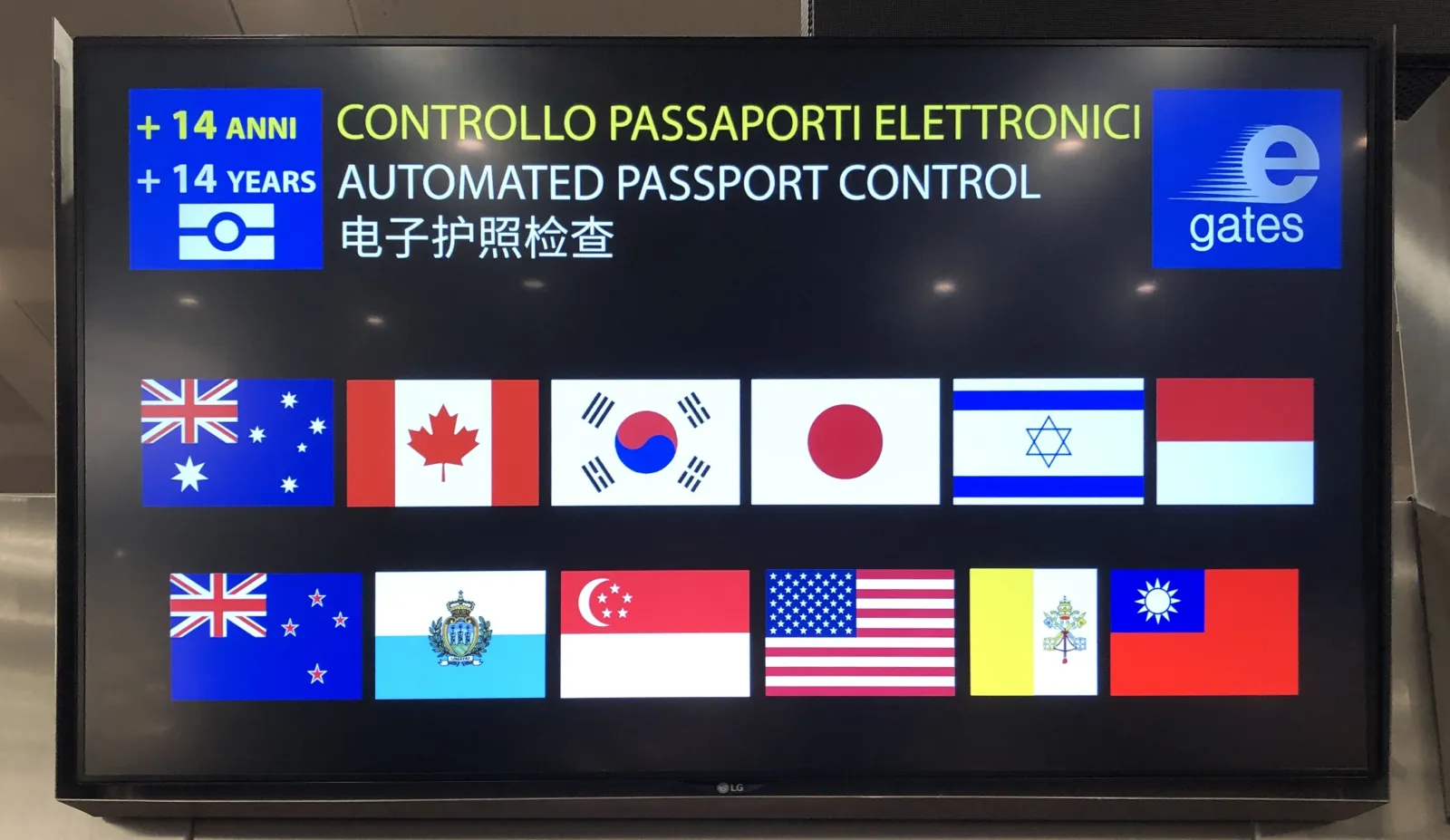
Let us be precise, because this is where the most unreliable information circulates. To date, official communications describe how the system works technically and which airports are concerned. They do not publish a detailed eligibility grid: no list of accepted nationalities, no minimum age, no specific treatment for residence-permit holders.
What is certain fits in one sentence: without a chipped electronic passport, the gate is unusable. The machine reads a chip; if there is none, there is nothing to read. Older passports, travel documents and non-biometric papers therefore mean the staffed desk.
In almost every country operating this equipment, four categories are routinely directed to an officer: young children, whose faces change too fast for reliable comparison, people whose passport is close to expiry, those travelling on a visa or special authorisation that needs checking, and any case requiring an interview. It is reasonable to expect the same logic in Morocco, but until criteria are published the only dependable rule is this: read the signage at the entrance to the control area, and follow the officers’ instructions.
What happens to the passport stamp?
This is the most common question, and it is not trivial. The entry and exit stamps are the physical proof of how long you stayed. They matter if you are checked, to demonstrate you respected the authorised duration, and sometimes for later administrative steps.
What was removed in Casablanca is the second presentation of the passport after the stamp, not the stamp itself. No official communication has announced the end of the entry stamp. So the practical advice stands: check that your passport carries an entry stamp before leaving the control area, and keep any document handed to you on arrival. If you go through an automated gate and no stamp appears, ask the supervising officer. It is a legitimate question, asked every day in airports everywhere.
Getting ready: the checklist
- Take the passport out before you reach the gate. Not in the suitcase, not at the bottom of the backpack. This is the number one cause of delay.
- Remove hats, caps and sunglasses. Prescription glasses usually pass, but take them off if the read fails.
- Open the passport at the photo page and lay it flat on the reader, still, until the signal.
- Look at the camera, not the screen. On most models they are not in the same place.
- One passenger at a time. A companion standing in the booth breaks the read and blocks the door.
- Protect the chip. A passport that has been bent, soaked or through the washing machine may have a dead chip, which sends you back to the desk.
- Plan ahead with children. Assume the family may not use the gate and head for the staffed lane.
If the gate refuses you
It happens, and it does not matter. A gate refusal is neither a flag nor a suspicion: in the overwhelming majority of cases it is a failed chip read or a poor-quality photo. The gate displays a message, the door stays shut, and an officer directs you to a staffed desk. You lose a minute, not your flight.
The three most frequent causes are a damaged chip, poor placement of the document on the reader, and a partly obscured face. One retry is often enough. Beyond that, do not hold up the queue: go to the desk.
How much time to allow at the airport
Automation shortens border control, not the rest of the journey. On arrival you still have taxiing, disembarking, the walk to control, then baggage reclaim, which is usually the slowest step. On departure, check-in, security and boarding are unchanged.
| Step | Before automation | With gates |
|---|---|---|
| Passport control on arrival | Several minutes of queueing, two checks | One check, under 15 seconds at the gate |
| Baggage reclaim | 15 to 40 minutes depending on the flight | Unchanged |
| Recommended margin before an international flight | 3 hours | 3 hours, security remains the limiting factor |
A useful reflex: if you have a tight connection or a booked transfer, keep the same margin as before. The gain shows up on the day, it cannot be planned. To organise the onward journey, our comparison of airport transfers in Morocco sets out the options for each airport.
Why Morocco is accelerating now
The gates are one brick in a far larger programme. The national airport strategy running to 2030 provides for investment of around 38 billion dirhams over five years, with a stated goal of raising network capacity from roughly 34 million to 80 million passengers a year. Most of the envelope goes to Casablanca’s future terminal and additional runway, the rest to modernising and maintaining the existing network.
In that context, digitalising the passenger journey is not a gimmick: it is the only way to absorb double-digit growth without endlessly multiplying desks and officers. Automating border control, automating access to the transit area and modernising terminals all answer the same arithmetic. The operator has also used the transformation to adopt a new identity, Airports of Morocco, rolled out since the summer across terminals and communication channels.
Where does the new Moroccan passport fit in?
On 9 July 2026 the government approved a draft decree amending the 2008 biometric passport framework, paving the way for a new generation of passport. The key point for travellers: current passports remain valid and will keep being used until they are replaced in the normal course. Precise technical features and an issue date have not been announced; they depend on a joint decision by the competent authorities.
In other words, there is no need to rush and renew your passport in order to use the gates. If your current document is a valid electronic passport, the readers can read it, because they apply an international standard common to all chipped passports.
Your biometric data: what to understand
The question deserves a calm answer, because it worries people and a great deal of loose talk surrounds it. A border gate performs what specialists call a one-to-one verification: it compares an image taken now with an image already present in the document you hand over yourself. That is not the same as one-to-many identification, which would mean searching for your face in a database of millions of portraits.
The distinction changes how the system should be understood. The photo stored in your passport chip was placed there by the state that issued it, when you applied. The gate reads it, compares, then opens or does not. How captured images are retained falls under Moroccan personal-data rules and the services responsible for border control; no detailed public statement has been made on that point.
Two common-sense reflexes apply everywhere: you cannot decline border control itself, but you can always ask to use a staffed desk rather than a gate. And if you have a specific question about how your data is handled, it goes to the competent authorities, not to airport staff, who do not operate these systems.
What automation does not change
It is tempting to assume an automated airport becomes fast from end to end. It does not, and confusing the steps is how people miss flights. Three distinct checks coexist, run by three different authorities.
- Security screening, meaning the bag scanner and the metal detector, is untouched. It stays manual, and it is often the longest queue on departure.
- Customs is a separate control, concerned with what you carry rather than who you are. A lightning-fast police gate exempts you from nothing on the way out.
- Boarding depends on the airline, not the airport. Gate closing times have not changed.
One more useful detail: the gates equip border control, which you meet both on arrival and on departure for international flights. On domestic flights there is no border police check, only an identity check and security.
Moroccan gates, European gates: a difference worth knowing
Travellers shuttling between Morocco and Europe have noticed longer queues on the European side since 2026, because of the entry/exit system for the Schengen area, which records biometric data for non-EU nationals. That system is specific to the European Union and has no connection with Moroccan gates.
The practical consequence, often badly anticipated: your crossing may be very quick leaving Marrakesh and much slower arriving in Paris, Madrid or Milan, especially at first biometric enrolment. Build the margin on the European side, not the Moroccan one.
Things to check before you fly, regardless
A fast gate is no substitute for paperwork in order. Three checks are always worth the detour, and automation has not made them any less important.
- Your entry formalities. They depend on your nationality and length of stay: review the Morocco visa and entry requirements before you buy the ticket, not the night before departure.
- What you are carrying. Border control and customs are two different things; our guide to Moroccan customs rules covers the limits on the way in and the way out.
- Your cabin bag. Nothing to do with the police, but it is the other great source of unpleasant surprises at the gate: see our Morocco carry-on baggage rules.
Finally, if you are planning a trip this winter, the flight offer is shifting sharply: we have detailed the new flight routes to Morocco airport by airport.
FAQ — Biometric e-gates at Morocco’s airports
Which Moroccan airports have biometric e-gates?
Five airports are named in official announcements: Casablanca Mohammed V, Marrakesh Menara, Agadir Al Massira, Fez-Saïss and Rabat-Salé. Casablanca was the first to drop the double passport check thanks to automatic gates.
How long does it take to go through a gate?
Under fifteen seconds when everything runs normally: chip read, face capture, comparison, doors open. The real duration depends mostly on how quickly the traveller presents the document correctly.
Do I need a biometric passport to use the gates?
Yes. The gate reads the passport’s electronic chip and compares your face with the photo it contains. Without a chip the read is impossible and you must use a staffed desk.
Can foreign nationals use Morocco’s gates?
Detailed eligibility criteria have not been made public: no list of nationalities, no minimum age, no specific rule for residents. Rely on the signage at the entrance to the control area and on the instructions of the officers present.
Will I still get a passport stamp?
What was removed in Casablanca is the second presentation of the passport after the stamp, not the stamp itself. No official announcement has ended the entry stamp. Check it is there before leaving the control area and flag its absence to an officer.
What if the gate will not open?
Nothing to worry about: the cause is almost always technical, a misread chip or a badly framed face. Try once more, then join a staffed desk where an officer will process you manually.
Can children use a gate?
No age rule has been published for Morocco. Wherever this equipment exists, young children are generally directed to an officer, because their faces change too quickly for a reliable comparison with the passport photo. Plan for the staffed lane if you travel as a family.
Should I renew my passport for the new generation announced?
No. The government has stated that current passports remain valid until they are replaced in the normal course. The issue date for the new document and its features have not yet been announced.
In summary
Moroccan border control is entering the age of automation: the double check dropped in Casablanca, biometric gates deployed across five airports, crossings in under fifteen seconds, and automated access control to transit areas in several regional terminals. For travellers, preparation comes down to three moves: a valid electronic passport, taken out in advance, and a clear face towards the camera. The rest still depends on the signage of the day, because precise eligibility criteria have not been published. When in doubt, the officer supervising the row of gates remains the best source of information. Safe travels!
Official sources
- National Portal of the Kingdom of Morocco — announcement on removing the double check at Mohammed V.
- Airports of Morocco (ONDA) — modernisation programme and airport strategy.
- International Civil Aviation Organization — international standard for chipped electronic passports.
- General Directorate of National Security — authority responsible for border control.
- European Union Entry/Exit System — the European scheme, distinct from Moroccan gates.
Informational article, accurate at the date of publication. Border-control procedures may change without notice and are a matter for the competent Moroccan authorities; always follow posted instructions and the directions of officers on site.
Photo credit
Images: featured image « Zurich International Airport e-Passport control gates » — Zurich International Airport (CC BY-SA 4.0); « EGate eligibility screen in Venice » — Edoardo1208 (CC BY-SA 4.0); « MA Airport Rabat Sale New Terminal » — Froik (CC BY-SA 3.0), via Wikimedia Commons.