Basel-Mulhouse (EuroAirport) flights to Morocco all leave from a single terminal building, but not necessarily from the same country: EuroAirport Basel-Mulhouse-Freiburg (codes BSL, MLH and EAP) sits on French soil in Saint-Louis, in the Haut-Rhin, while housing a Swiss customs sector linked to Basel by a dedicated road. As of September 2026, five Moroccan cities are served non-stop from the platform: Marrakech, Agadir and Tangier with easyJet, Casablanca and Rabat with Air Arabia Maroc. Knowing which side to park on, which door to use on the way back and which customs regime applies changes the real cost of a trip.
Information verified in September 2026.
In brief
- Five Moroccan destinations non-stop from EuroAirport: Marrakech, Agadir and Tangier (easyJet), Casablanca and Rabat (Air Arabia Maroc); Agadir and Tangier are seasonal. Neither Nador, nor Fes, nor Oujda appears among the direct routes.
- Flight times range from around 2 hr 35 min to Tangier to 3 hr 35 min to Agadir.
- There is one terminal but two customs sectors: a Swiss one (payments in francs) and a French one (payments in euros), linked by a pedestrian crossing point on level 3 of the departures hall.
- One week of parking costs at least CHF 106 on the Swiss side and at least EUR 81 on the French side, according to the airport’s official 2026 schedules.
- Basler Verkehrs-Betriebe bus 50 links Basel SBB railway station to the terminal in about 20 minutes, every 7 to 10 minutes from 04:30 to midnight.
- EuroAirport handled 9,631,209 passengers in 2025, an all-time record; easyJet accounts for 53 % of its traffic.
- On the way home, the Swiss duty-free value allowance has been CHF 150 per person per day since 1 January 2025, against EUR 430 on the French side for an air traveller.
EuroAirport fact file for a flight to Morocco
EuroAirport Basel-Mulhouse-Freiburg lies about twenty minutes by bus from Basel SBB station and roughly ten minutes from Saint-Louis station on the Alsatian side. One terminal, two customs exits, two currencies: the table below gathers the details travellers actually look up shortly before leaving for Morocco.
| Item | Detail |
|---|---|
| Name and codes | EuroAirport Basel-Mulhouse-Freiburg; IATA: BSL (Swiss), MLH (French), EAP (neutral); ICAO: LFSB |
| Location | French territory, commune of Saint-Louis (Haut-Rhin), a few kilometres north-west of Basel |
| Status | Binational Franco-Swiss airport, convention of 4 July 1949, opened 8 May 1946 |
| Moroccan destinations | Marrakech, Agadir, Tangier, Casablanca, Rabat |
| Airlines to Morocco | easyJet, Air Arabia Maroc |
| Access from Basel SBB | Bus 50 (BVB), about 20 minutes, every 7 to 10 minutes from 04:30 to midnight, departing from the Swiss sector |
| Access from Alsace | Distribus line 11 from Saint-Louis station, 10 to 15 minutes, every 15 to 30 minutes from 05:00 to midnight, French sector |
| Cheapest parking, 7 days | CHF 106 Swiss side; EUR 81 French side (official 2026 schedules) |
| Currency | Swiss francs in the Swiss sector, euros in the French sector |
| Entry formalities for Morocco | Passport required; Swiss nationals need no visa for tourist stays of up to 90 days |
| Recommended time before departure | 2 hours for a non-Schengen flight such as Morocco, more during school holidays |
Which airlines operate Basel-Mulhouse flights to Morocco in 2026?
Only two airlines link EuroAirport with Morocco non-stop as of September 2026: easyJet, which serves Marrakech, Agadir and Tangier, and Air Arabia Maroc, which serves Casablanca and Rabat. No carrier offers a direct service to Nador, Fes or Oujda from Basel-Mulhouse, whatever some booking engines may suggest.
That confusion deserves an explanation. When a comparison site displays a “Basel-Mulhouse – Nador” itinerary, it is in fact selling a connecting journey, usually via Casablanca or via a European hub. The flight is not direct, the travel time doubles, and liability for a missed connection depends on how the ticket was issued. EuroAirport’s own destinations page lists only five Moroccan cities: Agadir, Casablanca, Marrakech, Rabat and Tangier.
| Destination | Code | Airline | Indicative flight time | Observed frequency |
|---|---|---|---|---|
| Marrakech Menara | RAK | easyJet | about 3 hr 15 min | the busiest Moroccan route, around fifteen rotations a month |
| Agadir Al Massira | AGA | easyJet | about 3 hr 35 min | seasonal route, a few flights a month, absent in some off-peak periods |
| Tangier Ibn Battouta | TNG | easyJet | about 2 hr 35 min | low frequency, sensitive to the season |
| Casablanca Mohammed V | CMN | Air Arabia Maroc | about 3 hr 05 min | around two flights a week, roughly ten a month |
| Rabat-Salé | RBA | Air Arabia Maroc | about 2 hr 55 min | around one flight a week, four to five a month |
easyJet, 53 % of the airport’s traffic
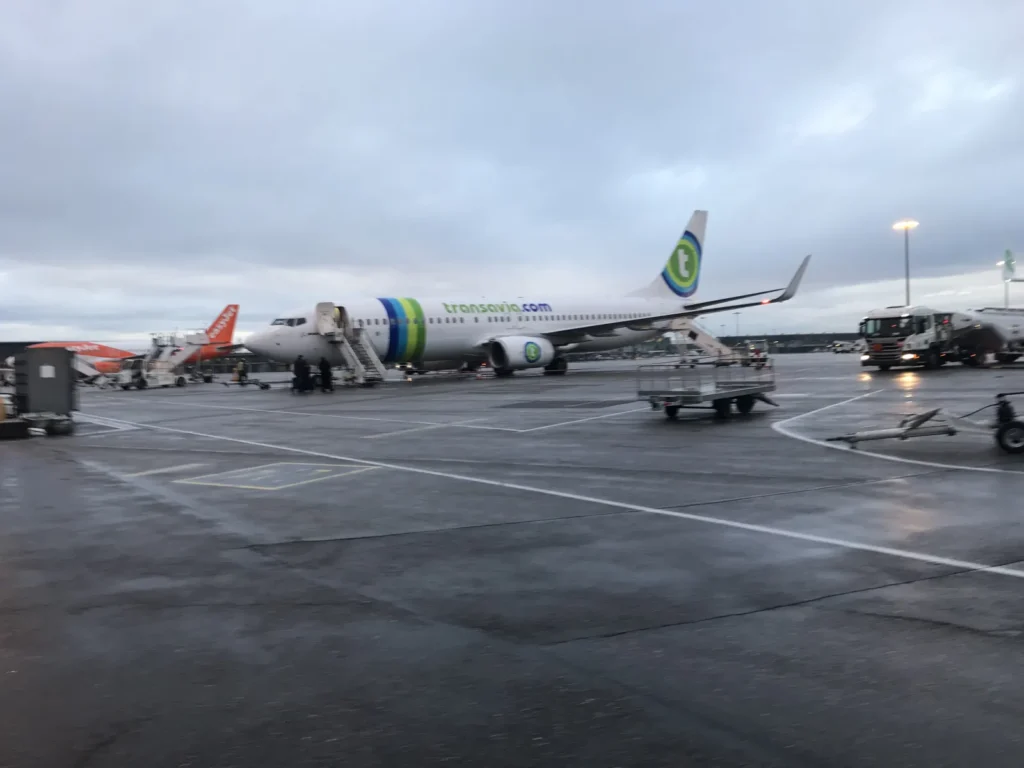
EuroAirport’s 2025 annual report is unambiguous: easyJet accounts for 53 % of the platform’s passenger traffic, far ahead of Wizz Air (14 %), Pegasus (3.6 %), British Airways (3.1 %) and Lufthansa (3 %). Basel is one of the orange airline’s long-standing continental European bases, which explains the density of its Mediterranean network from here.
For Morocco, that dominance has a direct consequence: the three easyJet routes follow beach and city-break logic, peaking in autumn, in winter and during school holidays. easyJet has also opened a base in Marrakech, its first on the African continent, which thickened its Moroccan network overall. The flip side of the model is volatility: the specialist site Bladi reported in late August 2026 that no easyJet flight was scheduled on the Basel-Mulhouse – Tangier axis between 20 January and 11 February 2027. A few weeks of suspension in the depths of winter is nothing unusual for a low-cost carrier, but it can wreck a trip booked long in advance.
Air Arabia Maroc, the gateway to Casablanca and Rabat
Air Arabia Maroc, the Moroccan subsidiary of the Emirati Air Arabia group and itself a low-cost carrier, appears on EuroAirport’s list of airlines. It operates the two routes easyJet does not cover: Casablanca, the economic capital, and Rabat, the administrative capital, whose Salé airport remains far quieter.
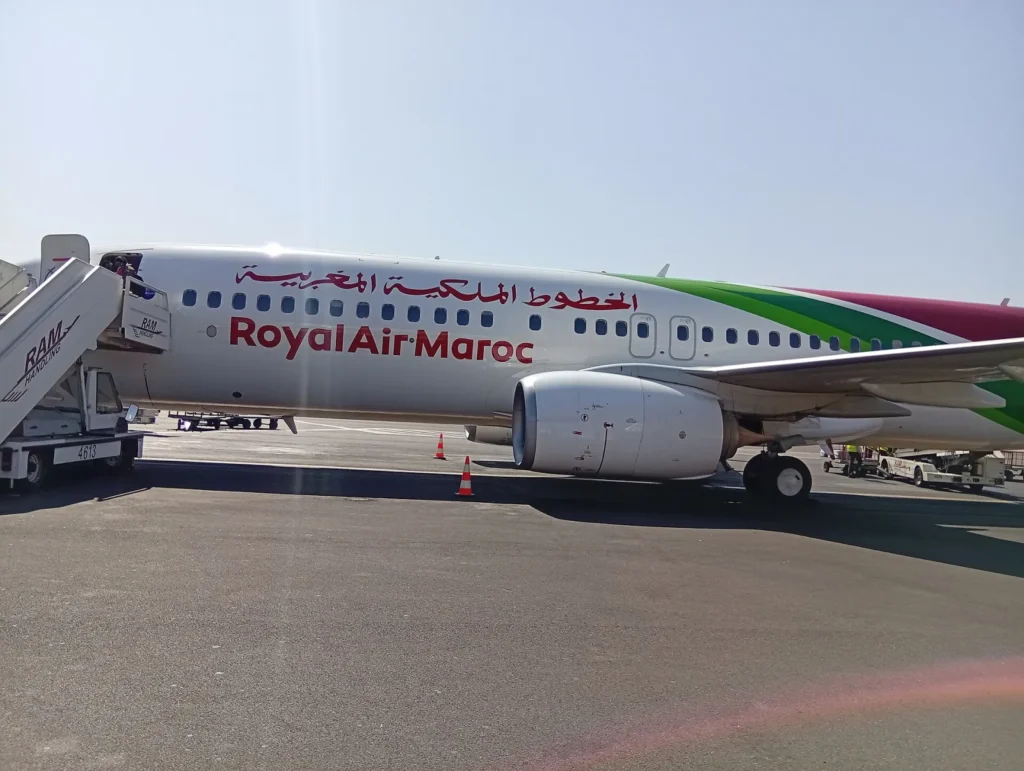
These two lines appeal to a different public from the leisure crowd: the Moroccan diaspora of north-western Switzerland and Alsace, business travel to Casablanca, families going home. Frequencies are more modest than on Marrakech, and operating days shift with the seasons. Royal Air Maroc, by contrast, does not appear on EuroAirport’s list of resident carriers: a “Basel – Casablanca” ticket sold under a Royal Air Maroc code therefore involves a connection.
What prices to expect, and when
On these five routes, lead-in fares observed on comparison sites in September 2026 started at around EUR 55 to 95 one way outside school holidays. Those figures are theoretical floors: they assume a midweek flight, no hold baggage, no seat selection and an early booking. During the Swiss autumn holidays, at Christmas or during the February break, the same routes routinely sell for two to three times as much.
The school calendar plays an unusual role here. Basel-Stadt, Basel-Landschaft, Solothurn, Aargau and the Haut-Rhin do not set their holidays on the same dates, and EuroAirport draws on all three catchment areas. Shifting a departure by a few days relative to the Basel holidays can therefore be enough to find a sensible fare, provided you check all three calendars before locking in a date.
Swiss sector or French sector: how EuroAirport really works
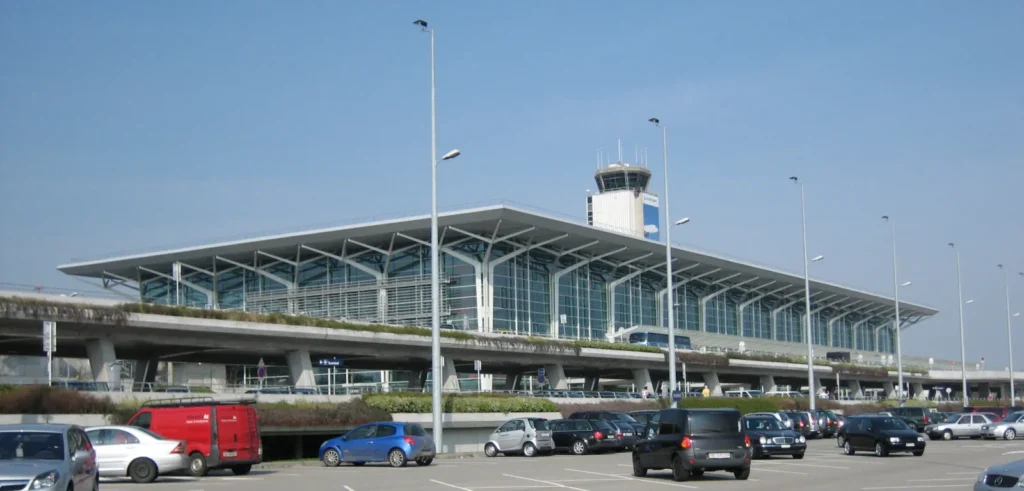
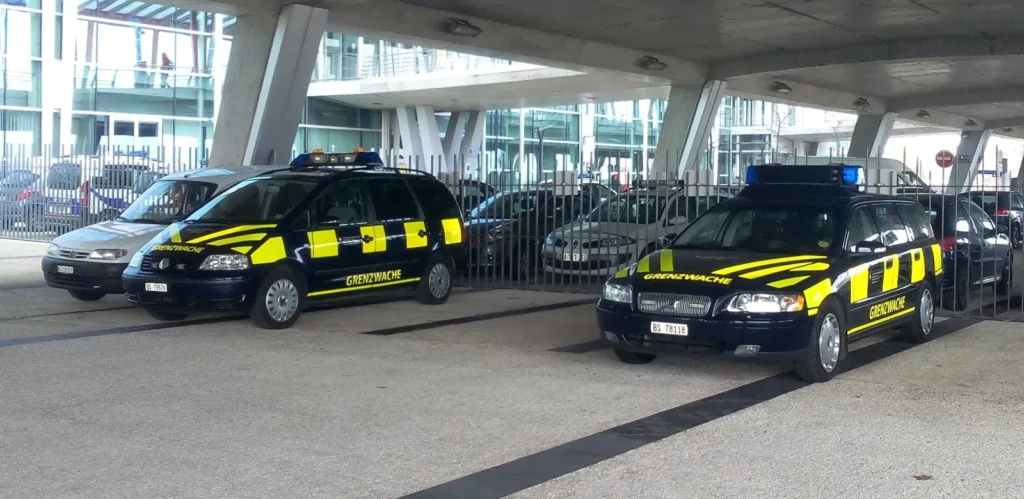
EuroAirport describes itself as the only binational airport in the world: built entirely on French ground, it contains a Swiss customs sector where Swiss authorities check people and goods, and a French customs sector under French law. A customs sector is an area in which one country’s customs rules apply, regardless of who holds sovereignty over the land.
The arrangement flows from the Franco-Swiss convention of 4 July 1949. The board brings together eight French members, eight Swiss members and two German representatives in an advisory capacity; management rests with a Swiss director and a French deputy director. In practice the Swiss orientation dominates: around 90 % of departing and arriving passenger flights operate under Swiss traffic rights, and 99 % of cargo.
The customs road, a Swiss corridor on French soil
To connect Basel with the terminal without bringing travellers into France, a so-called customs road of about 2.5 kilometres was built. It crosses French territory but stays fenced off and disconnected from the French road network: you enter it from Switzerland, you leave it in the airport’s Swiss sector, and that is all. A driver setting off from Basel therefore completes no French entry formality on the way to the flight.
The mirror image applies on the Alsatian side: the French access serves the French sector and its car parks. The practical consequence, which many discover too late, is that you cannot switch sectors by car inside the airport perimeter. The airport says so plainly in its own FAQ. If you have arrived on the wrong side with a vehicle, you must drive out and start again via the main customs post.
The level 3 pedestrian crossing, the trick the airport does not advertise
On foot, however, moving between sectors is free. A pedestrian border crossing point sits on level 3 of the terminal building, in the departures hall. That passage makes possible a strategy you will not read elsewhere: park in the cheaper sector, then walk to the check-in area for your flight.
The airport confirms it explicitly: you can park your vehicle in the car parks either in the French or the Swiss sector, regardless of the registration and check-in area for your departure. In other words, a Basel resident taking an easyJet flight to Marrakech is not obliged to pay in Swiss francs: they can reach the airport by the French road and park on the euro side. The price is accepting a detour around the city instead of using the customs road.
A flight to Morocco is still a non-Schengen flight
France and Switzerland both belong to the Schengen area, the zone of free movement without internal border checks. Morocco does not. A departure for Marrakech, Agadir, Tangier, Casablanca or Rabat therefore involves a passport check on the way out, then a Moroccan police check on arrival (the disembarkation form was abolished in 2019).
In practice, that means allowing two hours between reaching the airport and take-off, against a workable ninety minutes for an intra-Schengen flight. That same non-EU status is also what opens access to the duty-free shops in the boarding area, a point we return to below.
How much does parking cost for a week-long Basel-Mulhouse flight to Morocco?
Seven days of parking cost at least CHF 106 in EuroAirport’s Swiss sector and at least EUR 81 in the French sector, according to the official 2026 schedules published by the airport. The gap is not trivial: over two weeks it comfortably exceeds the price of a low-cost one-way ticket to Marrakech, for an identical service.
The two schedules are separate and denominated in two currencies, Swiss francs on one side, euros on the other. Both state that they include VAT at 20 %, the French rate, since the facility stands in France. Swiss car parks carry the letter S, French ones the letter F.
| Car park | Sector | 1 day | 7 days | 14 days | Each extra day |
|---|---|---|---|---|---|
| S1 Premium | Swiss | CHF 33.00 | CHF 189.00 | CHF 311.00 | CHF 16.00 |
| S2 Terminal zone | Swiss | CHF 32.00 | CHF 123.00 | CHF 207.00 | CHF 12.00 |
| S4, S12, S13, S47 | Swiss | CHF 30.00 | CHF 106.00 | CHF 176.00 | CHF 10.00 |
| F1 Premium | French | EUR 33.00 | EUR 153.00 | EUR 293.00 | EUR 20.00 |
| F8 Terminal | French | EUR 32.00 | EUR 107.00 | EUR 165.00 | EUR 8.00 |
| F4 ParkHaus | French | EUR 32.00 | EUR 95.00 | EUR 153.00 | EUR 8.00 |
| F5 Proximity | French | EUR 30.00 | EUR 90.00 | EUR 148.00 | EUR 8.00 |
| F3, F6, F7 | French | EUR 27.00 | EUR 81.00 | EUR 132.00 | EUR 7.00 |
Three details that prevent unpleasant surprises. First, transit time is free for ten minutes, from the entry barrier to the exit barrier, which is enough to drop someone off without paying provided you do not linger. Second, some car parks are not open all year, as the official schedule states. Third, the airport’s 2025 annual report acknowledges that car park capacity reached its limits at peak times: booking online in advance is not a marketing gimmick, it is the only way to guarantee a space on a Saturday morning in the holidays.
How do you reach EuroAirport from Basel, Bern, Zurich or Alsace?
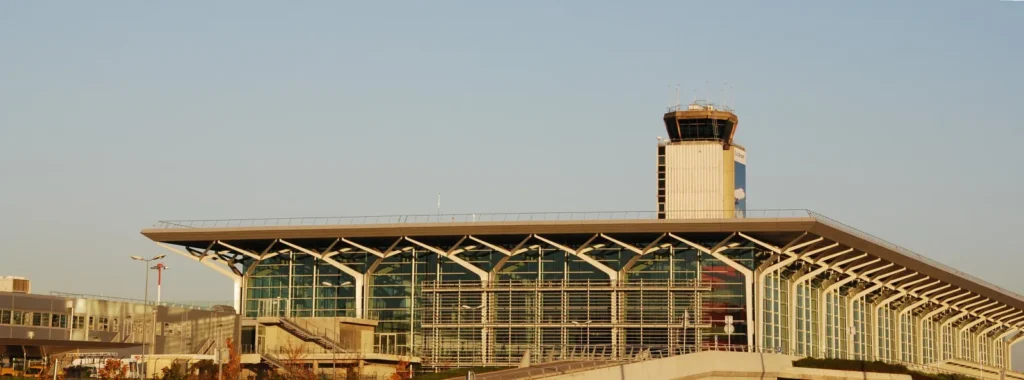
Basler Verkehrs-Betriebe bus 50 links Basel SBB station to the terminal in about twenty minutes, every 7 to 10 minutes from 04:30 to midnight, leaving from the forecourt of the Swiss sector. From Alsace, Distribus line 11 reaches Saint-Louis station in 10 to 15 minutes, every 15 to 30 minutes from 05:00 to midnight, on the French side.
These two lines are the backbone of access to the airport, and its structural weakness. EuroAirport itself acknowledges in its 2025 annual report that ground access accounts for more than half of its CO2 emissions, partly because the public transport offer remains insufficient. The comparison with Geneva, whose airport has a railway station inside the terminal, or with Zurich, served by S-Bahn and mainline trains, is unflattering.
How much does bus 50 cost from Basel SBB?
Bus 50 belongs to the Tarifverbund Nordwestschweiz, the north-western Switzerland fare community, usually shortened to TNW. A second-class adult single ticket costs CHF 4.20 for one zone and CHF 5.10 for two zones, CHF 2.60 for a short-distance journey of at most four stops, rates in force since December 2023. Half-fare card holders pay CHF 2.90, CHF 3.40 and CHF 2.00 respectively.
One point few travellers anticipate: the ticket machine is at the stop, not on board, and inspections are frequent on this line. Buy your ticket before boarding, or use the TNW Tickets app. For a same-day return, a day ticket often works out cheaper than two singles.
From Bern, Zurich, Lucerne or Ticino
There is no direct rail link to the airport: everything goes through Basel SBB station, then bus 50. Allow roughly an hour by train from Zurich HB or from Bern, a little under three hours from Geneva, and longer from Ticino with a change. Check the official SBB timetable for your specific date, since journey times vary by train type.
The calculation deserves an honest look. From Bern, two hours door to terminal is realistic once you add a margin for the connection. From Zurich the same journey is feasible, but Zurich Airport now offers its own service to Marrakech: with comparable transfer times, the question becomes financial rather than logistical. We compare the three Swiss gateways in our guide to flights between Switzerland and Morocco from Geneva, Zurich and Basel.
Taxis, German coaches and the railway project
The taxi fares published by the airport give a useful order of magnitude. On the Swiss side, a run into Basel is quoted at CHF 50 and a flat rate to Zurich at CHF 440. On the French side, Mulhouse station works out at EUR 60-65 by day and EUR 85-90 at night, Colmar at EUR 125-135 by day. A line 220 operated by Freund serves Lörrach and Weil am Rhein every thirty minutes, and a Freiburger Reisedienst service reaches Freiburg im Breisgau in about an hour.
As for the station promised beneath the terminal, it will have to wait. The project, costed at EUR 250 million at 2017 economic conditions, envisaged six kilometres of new track branching off the Strasbourg – Mulhouse – Basel line and two trains an hour in each direction, for a service launch around 2028. The airport’s 2025 annual report states that the French state’s financial contribution was provisionally suspended in September 2025. Do not build your travel plans around that deadline.
Baggage: what easyJet and Air Arabia Maroc actually allow
On EuroAirport’s five Moroccan routes, no full-service airline operates: easyJet and Air Arabia Maroc both apply a low-cost model in which baggage is charged separately. Yet the two policies are nothing alike, and the difference starts with what the cheapest ticket includes.
With easyJet, the base fare includes only a small bag of 45 × 36 × 20 cm that must fit under the seat. The large cabin bag of 56 × 45 × 25 cm, up to 15 kg, is a paid option, though it is included in the higher fare bundles. Hold baggage is chosen in tiers of 15, 23 or 32 kg, with the sum of the three dimensions kept under 275 cm. With Air Arabia Maroc, a 10 kg cabin bag measuring 55 × 40 × 20 cm is included, and the hold allowance is booked in tiers of 20, 30 or 40 kg, with a maximum of 32 kg per piece.
| Item | easyJet | Air Arabia Maroc |
|---|---|---|
| Included in the base fare | Small bag 45 × 36 × 20 cm under the seat | Cabin bag 10 kg, 55 × 40 × 20 cm |
| Large cabin bag | 56 × 45 × 25 cm, 15 kg, paid option | Covered by the cabin allowance |
| Hold baggage tiers | 15, 23 or 32 kg | 20, 30 or 40 kg |
| Maximum weight per piece | 32 kg | 32 kg |
| Hold baggage dimensions | Sum of the three sides under 275 cm | Per the airline’s conditions |
One remark specific to the return leg. Objects brought back from the souk, clay tagines, copper trays, wrought-iron lanterns, fit badly into a cabin gauge and travel badly in the hold without packing. Plan the space and the weight before departure rather than improvising an extra bag at the Marrakech counter, where last-minute rates are the highest. Our carry-on baggage rules for Morocco also cover prohibited items, notably liquids and kitchen knives bought locally.
Customs on the way home: the exit you choose changes your allowances
When a flight from Morocco lands, you choose your exit, and that choice determines which customs rules apply to you. Leave through the Swiss side and Swiss allowances apply: CHF 150 of value per person per day. Leave through the French side and European Union allowances apply: EUR 430 for an air traveller aged 15 or over, and EUR 150 for under-15s.
The least understood point concerns Switzerland. The value allowance, meaning the total worth of goods that may be imported without paying VAT, fell from CHF 300 to CHF 150 on 1 January 2025. It applies once a day per person, children included, and the trap lies in the arithmetic: if the total exceeds CHF 150, VAT is calculated on the entire value of the imported goods, not merely on the excess. The rates are 8.1 % as a rule and 2.6 % for certain goods such as foodstuffs or books.
| Allowance | Swiss sector exit | French sector exit |
|---|---|---|
| Value of goods | CHF 150 per person per day, children included | EUR 430 per air traveller aged 15 or over; EUR 150 for under-15s |
| Strong spirits | 1 litre above 18 % vol. | 1 litre above 22 % vol. |
| Other alcoholic drinks | 5 litres up to 18 % vol. | 2 litres up to 22 % vol., plus 4 litres of still wine and 16 litres of beer |
| Tobacco | 250 cigarettes or 250 g of tobacco | 200 cigarettes |
| Meat and meat preparations | 1 kg | Meat imports from a third country are tightly restricted |
| Minimum age for alcohol and tobacco | 17 | 17 |
Two pieces of advice follow from that table. If you are coming home with argan oil, spices and pottery for the whole family, add it all up before you reach the baggage belt: four people each have their own allowance, but a single expensive item cannot be split. And if you leave through the French side while living in Switzerland, you will cross the Swiss border anyway on the way home, so the Swiss allowance is the one that counts. The Swiss customs QuickZoll app lets you declare and pay from your phone. The detail of what may be brought back is set out in our guide to what you can bring back from Morocco.
Money, health and insurance: the reflexes specific to Swiss residents
Three subjects genuinely set a departure from Switzerland apart from a departure anywhere else: converting francs into dirhams, the very partial cover provided by compulsory health insurance outside Europe, and the role of Rega in a repatriation. None of the three can be sorted out at the airport; all three are prepared at home.
You cannot buy dirhams in Basel
The Moroccan dirham is a currency with restricted convertibility: importing and exporting it is prohibited in principle. The Office des Changes of the Kingdom of Morocco nonetheless tolerates travellers importing or exporting up to 2,000 dirhams in banknotes. You will therefore not find dirhams in quantity at a Swiss bureau de change, and you must not leave Morocco with a thick wad.
Exchange happens on arrival. Bank Al-Maghrib, the Moroccan central bank, publishes a daily rate for foreign banknotes: when we consulted it in September 2026, the Swiss franc stood at 10.7470 dirhams buying and 12.4890 dirhams selling. Remember the order of magnitude, not the decimal: one franc is worth roughly eleven to twelve dirhams, and the gap between the two columns is the banking chain’s margin. Our page on changing Swiss francs into dirhams compares the practical options.
With Swiss cards, the rule that costs most is not the bank’s commission but dynamic currency conversion. When a Moroccan cash machine offers to debit your account in francs rather than dirhams, it applies its own rate, invariably less favourable. Decline, always choose the local currency, and check before leaving what foreign-currency surcharge your bank applies: it varies considerably from one Swiss institution to another.
What Swiss basic health insurance covers in Morocco, and what it does not
LAMal is Switzerland’s compulsory health insurance. Outside the European Union and EFTA, and therefore in Morocco, the Federal Office of Public Health is explicit: the costs of emergency treatment are reimbursed up to twice the amount the insurer would have paid for the same treatment in Switzerland. For hospital stays, cover is capped at 90 % of what the stay would have cost in Switzerland.
The mechanism looks generous as long as care costs less than in Switzerland, which is generally the case in Morocco for a consultation or a night in hospital. It becomes inadequate as soon as an international private clinic, a medical evacuation or an ambulance transfer is involved, none of which compulsory insurance covers. The Federal Office of Public Health duly recommends supplementary travel insurance for stays outside the European Union. Check three guarantees in particular before leaving: private clinic fees, local medical transport and repatriation.
Rega, the card many Swiss travellers already hold without thinking about it
Swiss Air-Rescue, known as Rega, organises medical repatriations from abroad. Patronage costs CHF 40 for a single person and CHF 80 for a couple or a family; children and young people are exempt. Legally it is not insurance but a donation: Rega may waive the costs an insurer is not obliged to pay, without being bound to do so.
The value is easy to quantify. Rega states that a repatriation from Spain costs around CHF 30,000 and one from Thailand more than CHF 100,000. Morocco sits between the two in terms of distance. If a Rega medical consultant judges repatriation medically necessary, Rega organises the flight, either in one of its ambulance jets or on a scheduled service. Forty francs a year for that safety net is, for a regular traveller, one of the most profitable lines in a trip budget.
Who are Basel-Mulhouse flights to Morocco best suited to?
EuroAirport is the best departure point for Morocco for residents of both Basel half-cantons, Solothurn, Jura, Aargau and the Haut-Rhin, as well as for travellers from southern Baden-Württemberg. Beyond that perimeter, Geneva and Zurich become competitive again, not because of flight time but because of easier ground access and denser frequencies.
| Criterion | Basel-Mulhouse (BSL/MLH) | Geneva (GVA) | Zurich (ZRH) |
|---|---|---|---|
| Direct rail access to the terminal | No, bus 50 from Basel SBB | Yes, SBB station in the airport | Yes, SBB station under the airport |
| Direct Moroccan destinations | Five | Marrakech, plus seasonal services | Marrakech, Agadir |
| Choice of airlines to Morocco | Two low-cost carriers | Low-cost and full-service carriers | Low-cost and full-service carriers |
| Parking, 7 days, entry level | CHF 106 (Swiss) or EUR 81 (French) | Geneva’s own schedule | Zurich’s own schedule |
| Dual currency and dual customs | Yes, francs and euros | No | No |
The Alsatian case deserves a mention. A resident of Mulhouse, Colmar or Saint-Louis has, in EuroAirport, an airport twenty minutes away offering five Moroccan destinations: better than Strasbourg and better than most French regional airports. They pay in euros, park more cheaply and have no formality to complete. The one thing not to forget is the F car parks and the French access, failing which you will circle for a long time.
The case of a Swiss resident of another nationality is trickier. Visa exemption for Morocco depends on the nationality shown in the passport, not on the Swiss residence permit. A B or C permit holder from a country subject to visa requirements must apply to the Embassy of the Kingdom of Morocco in Bern or the Consulate General in Zurich, and separately check that their residence document remains valid for the return to Switzerland. Our page on Morocco entry requirements sets out the general rules.
Swiss-Moroccan dual nationals form the third special case. Morocco regards its nationals as Moroccan whatever their other nationality, with consequences for the documents to present and for Swiss consular room for manoeuvre in case of difficulty. Read the Federal Department of Foreign Affairs travel advice before departure, and register your trip in the Travel Admin app.
Mistakes to avoid when departing from Basel-Mulhouse
The mistakes made at EuroAirport are not the ones made at other airports: almost all of them stem from the platform’s Franco-Swiss duality. Here are the seven traps most often seen among travellers bound for Morocco, and how to defuse them before you even leave the house.
- Taking the wrong road access. You cannot switch sectors by car inside the airport. Decide on the sector before setting off and programme the right access into your navigation app.
- Booking parking the day before. The airport admits that parking capacity saturates at peak times. Booking online costs less and guarantees the space.
- Counting on a station under the terminal. It does not exist, and French funding for the rail project was provisionally suspended in September 2025.
- Buying your bus ticket on board. On the TNW network the ticket is bought before boarding, from the machine or on the app.
- Allowing 90 minutes before departure. Morocco is outside Schengen: a passport check is mandatory, so allow two hours, more during school holidays.
- Confusing Swiss and European allowances on the way back. CHF 150 on one side, EUR 430 on the other, and Swiss VAT is charged on the total value from the first franc over the limit.
- Accepting conversion into francs at a Moroccan cash machine. The rate offered is always worse than your bank’s. Choose dirhams.
Around the airport: Saint-Louis, Basel and the waiting hours
EuroAirport is not marooned in open fields: it stands a few minutes from Saint-Louis on the French side, some twenty minutes from central Basel on the Swiss side, and within immediate reach of the German border. A long connection or an early flight can therefore be handled in better ways than sitting in the hall.
Just outside the platform, an observation deck known as the Belvédère offers a clear view over the runways. It sits along the road that passes under runway 15 and links the airport to Blotzheim, on the French side. It is free, it is in the open air, and it is the best way to occupy children during an hour’s wait. From there you can see main runway 15/33, 3,900 metres long, and the much shorter secondary runway.
On accommodation, Swiss and Alsatian logic diverge sharply. Sleeping in Saint-Louis or Village-Neuf the night before an early flight costs appreciably less than sleeping in Basel, while staying ten minutes from the terminal. For a 06:00 departure to Marrakech, when the first bus 50 leaves Basel SBB around 04:30, the question is worth asking seriously.
One last marker that helps to understand the platform. In 2025 EuroAirport’s top five markets were Spain, Turkey, Great Britain, Italy and Kosovo, and its top five destinations Pristina, London, Istanbul, Palma and Budapest. Morocco appears in neither list: Moroccan routes remain a niche segment on a platform handling 9.6 million passengers, which explains both the modest frequencies and the sensitivity of these lines to seasonal adjustment.
FAQ: your questions about Basel-Mulhouse flights to Morocco
Are there direct flights from Basel-Mulhouse to Nador or Fes?
No. As of September 2026, EuroAirport serves only Marrakech, Agadir, Tangier, Casablanca and Rabat in Morocco. “Basel – Nador” or “Basel – Fes” itineraries offered by online agencies involve at least one connection. For Nador and Fes, the Air Arabia Maroc bases provide connections via Casablanca, at the cost of a markedly longer journey.
Can I park on the French side even if my flight checks in on the Swiss side?
Yes. The airport states that you may park in the car parks of either the French or the Swiss sector, regardless of the check-in area for your departure. Moving between the two sectors is done on foot, through the crossing point on level 3 in the departures hall. Switching by car inside the airport perimeter, however, is impossible.
How much time should I allow before a flight to Morocco?
Two hours is a sensible minimum. Because Morocco lies outside the Schengen area, a passport check is added to the security check, which lengthens the process compared with a European flight. During the Basel, Alsatian and Baden school holidays, which do not always coincide, add half an hour. Low-cost bag-drop queues are longest in the morning.
Do I need a visa for Morocco if I live in Switzerland?
Swiss nationals need no visa for tourist stays of under 90 days. A passport is required; an identity card is not accepted. Note that nationality is what counts, not place of residence. A B or C permit holder of a nationality subject to visa requirements must complete the formalities with the Moroccan representation in Switzerland before departure.
How much does a week of parking at EuroAirport cost?
Seven days come to at least CHF 106 in the Swiss sector and at least EUR 81 in the French sector, according to the official 2026 schedules. Premium car parks rise to CHF 189 and EUR 153. Each additional day costs CHF 10 to 16 on the Swiss side and EUR 7 to 20 on the French side. Online booking is strongly advised at peak times.
What can I bring back from Morocco to Switzerland duty free?
Up to CHF 150 of goods per person per day, children included, since 1 January 2025. Quantitative allowances apply on top: 1 litre of alcohol above 18 % vol., 5 litres up to 18 % vol., 250 cigarettes or 250 grams of tobacco, 1 kilo of meat, from the age of 17. Above CHF 150, VAT is charged on the total value imported.
Can I take dirhams with me from Switzerland?
Very few. The Office des Changes of the Kingdom of Morocco states that importing and exporting dirhams is prohibited, with a tolerance of 2,000 dirhams in banknotes for travellers. Change your money on arrival, at a bank or an authorised bureau, and decline the conversion into francs offered by Moroccan cash machines, whose rate is consistently unfavourable.
Is EuroAirport reliable in winter for a flight to Morocco?
Broadly yes, with two reservations. Low-cost carriers adjust their programmes from season to season and may suspend a route for a few weeks in midwinter. And in 2026 the airport launched a multi-year investment programme worth more than EUR 600 million, including the refurbishment of the main runway, which closed it from 15 April to 20 May 2026. Always check the current schedule before booking.
In summary
EuroAirport Basel-Mulhouse-Freiburg offers five direct routes to Morocco, operated by two low-cost carriers: easyJet to Marrakech, Agadir and Tangier, Air Arabia Maroc to Casablanca and Rabat. For anyone living in the two Basels, the Jura, Solothurn, Aargau or the Haut-Rhin, it is the quickest gateway to the Kingdom.
Its binational character is not folklore: it determines the price of your parking, the currency you pay in, the customs you clear on the way home and the road you take to get there. A week of parking costs at least CHF 106 on the Swiss side and at least EUR 81 on the French side, and it is entirely permitted to park on one side and board on the other, on foot, via level 3.
That leaves the distinctly Swiss reflexes: passport required, a CHF 150 customs allowance on return, LAMal cover limited to twice the Swiss tariff for emergencies outside Europe, Rega patronage at CHF 40, and a systematic refusal of conversion into francs at Moroccan cash machines. Prepared at home, those five points turn a low-cost flight into a genuinely cheap trip. To compare with the other major German-speaking gateway, see our page on Zurich – Morocco flights.
Official sources
- EuroAirport Basel-Mulhouse-Freiburg – access and transport
- Swiss Federal Office for Customs and Border Security – traveller allowances
- Swiss Federal Department of Foreign Affairs – travel advice, Morocco
- Swiss Federal Office of Public Health – treatment abroad
- Office des Changes of the Kingdom of Morocco
- Moroccan National Airports Office
Informative article. The fares, timetables, frequencies and customs rules quoted are those observed in September 2026 and are liable to change: always verify with the airline, the airport and the relevant authorities before travelling.
Photo credit
Images: featured image « File:Aéroport Bâle-Mulhouse 2.jpg » — Fanny Schertzer (CC BY-SA 3.0); « File:Grenzwache EuroAirport 2015.jpg » — Taxiarchos228 (CC BY-SA 4.0); « File:Flughafen Basel Mulhouse.jpg » — Wladyslaw (CC BY-SA 3.0), via Wikimedia Commons.