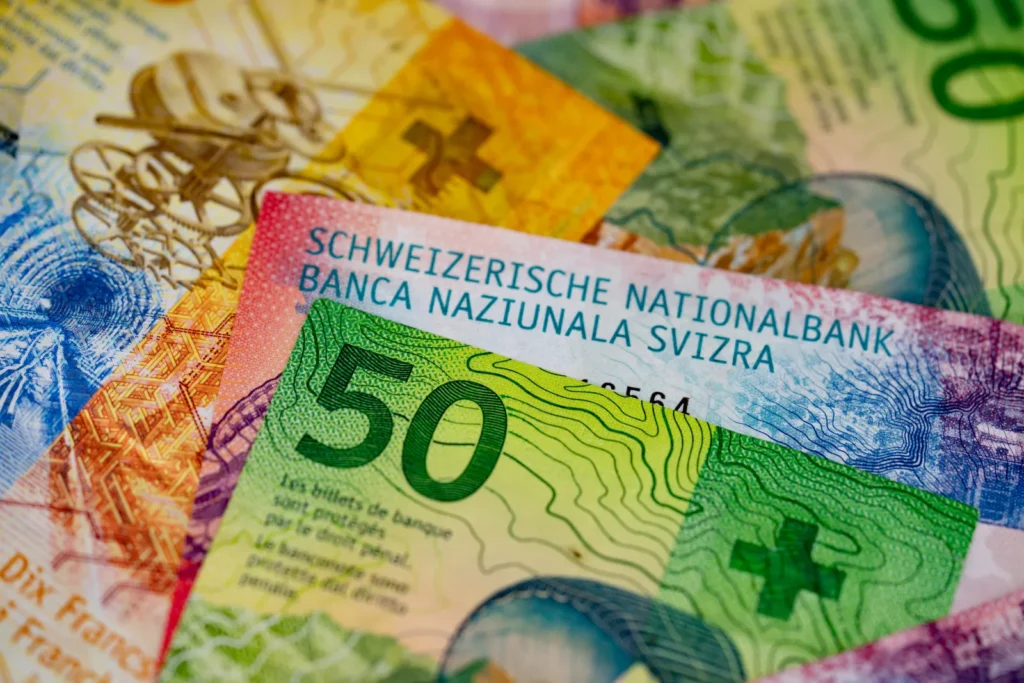
Converting Swiss francs to dirhams cannot be done before you leave: the Moroccan dirham (MAD, درهم مغربي) is a non-convertible currency, exports are capped at 2,000 dirhams per traveller, and you will only be able to build up your spending money once you land in Morocco. The question is how: by changing banknotes, by withdrawing at an ATM, or by paying by card. Depending on which Swiss card is in your pocket, the same week in Marrakech can cost you ten francs in fees or sixty. This guide compares the published fees of Swiss banks and neobanks, sets out the rules of Morocco’s Office des Changes and of Swiss customs, and gives realistic daily budget figures in francs.
Information verified in September 2026
In brief
- The reference rate published by Bank Al-Maghrib on 18 September 2026 was 11.531 dirhams to one Swiss franc, and 10.9166 dirhams to one euro.
- Importing and exporting dirhams is prohibited, except for 2,000 dirhams per traveller (about 173 francs), under the Office des Changes General Instruction on Foreign Exchange Operations 2026.
- In Morocco a customs declaration is mandatory on entry and on exit from 100,000 dirhams in banknotes, roughly 8,670 francs, which is well below the Swiss threshold of 10,000 francs.
- Switzerland requires no advance cash declaration, but above 10,000 francs you must answer customs officers accurately or risk a fine.
- Withdrawing 5,000 dirhams costs between nothing and more than 25 francs in fees depending on the card: the gap between a neobank and a classic credit card is a factor of five to ten.
- Twint only works in Swiss francs: no Moroccan merchant accepts it and no conversion into dirhams is provided for, even though sending money between Swiss users still works from abroad.
- Exchange desks at Moroccan airports can only convert 2,000 dirhams back per passport on presentation of a boarding pass.
Quick facts: changing Swiss francs to dirhams
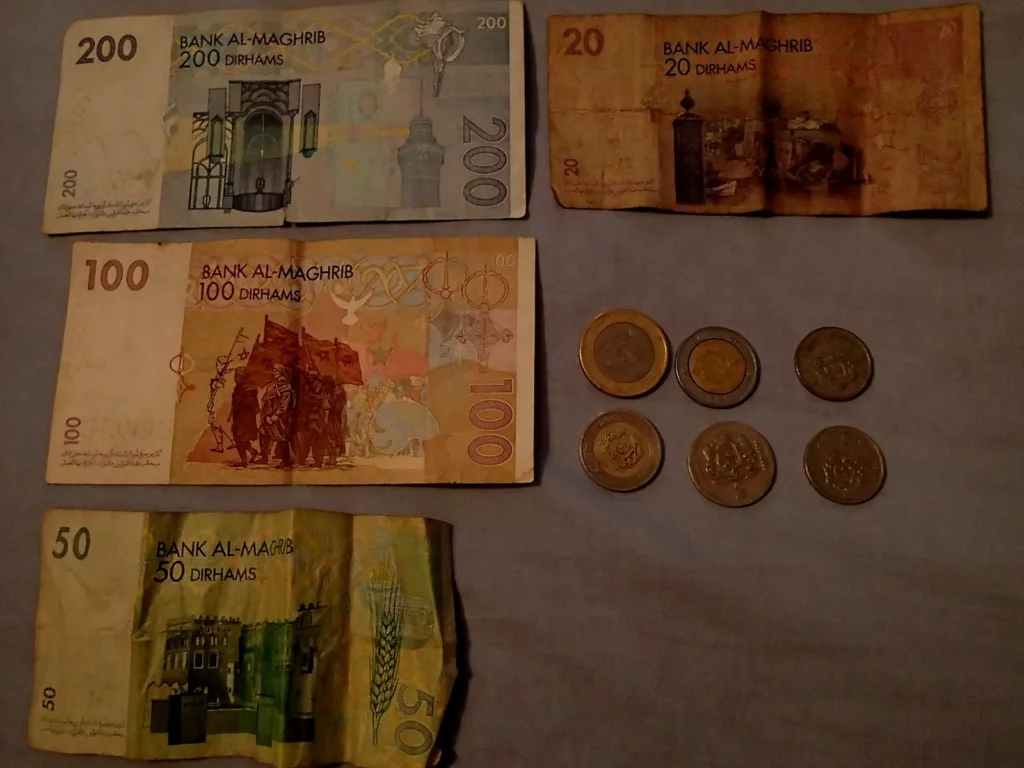
The Moroccan dirham is divided into 100 santimat, commonly called centimes; it is written MAD as an international code and DH on price tags. Bank Al-Maghrib, the central bank of the Kingdom of Morocco based on Avenue Mohammed V in Rabat, issues the 20, 50, 100 and 200 dirham notes and publishes the reference rate every working day. The table below sums up what a traveller leaving Switzerland needs to know before boarding.
| Point | What to know |
|---|---|
| Currency | Moroccan dirham, code MAD, symbol DH, divided into 100 santimat (centimes) |
| Reference rate | 1 CHF = 11.531 DH and 1 EUR = 10.9166 DH on 18 September 2026 (Bank Al-Maghrib) |
| Buying dirhams in Switzerland | Not realistic: non-convertible currency, exports capped at 2,000 DH |
| Where to get dirhams | Banks, licensed exchange operators, exchange machines and ATMs, in Morocco only |
| Exchange machine limit | 6,000 DH per operation, about 520 CHF (Office des Changes, IGOC 2026) |
| Moroccan customs declaration | Mandatory from 100,000 DH in banknotes, about 8,670 CHF, on entry and on exit |
| Swiss customs declaration | No advance declaration; duty to answer accurately from 10,000 CHF if questioned |
| Card payments | Accepted in hotels, chain stores, petrol stations and city restaurants; rarely in souks and small taxis |
| Twint | No payment possible at a Moroccan merchant; app limited to Swiss francs |
| Converting back before departure | 2,000 DH per passport at airport and port desks, on presentation of a boarding pass |
| Last update | Rates and bank fees verified in September 2026 and subject to change |
Why you cannot buy dirhams in Switzerland
You cannot buy Moroccan dirhams in Switzerland because the currency is not freely convertible: the Office des Changes General Instruction on Foreign Exchange Operations 2026, in force since 1 January 2026, states that importing and exporting dirhams is prohibited, travellers being allowed to carry no more than 2,000 to cover small expenses when they return to Morocco. There is therefore no wholesale market for the dirham outside the Kingdom.
The consequence is direct for a traveller from Geneva, Lausanne or Zurich: the habit of stopping at the bank the day before departure to pick up cash, as you would before a trip to Thailand or the United States, simply does not apply. A few Swiss exchange bureaux do hold some dirham notes taken back from returning travellers, but in tiny quantities and at a rate that is nothing like attractive. Call ahead rather than counting on it.
So what should you do? Two options, and they combine well. First, take Swiss francs or euros in cash and change them on arrival. Second, take nothing and withdraw at an ATM from the airport onwards. Most regular travellers do both, keeping a small reserve of notes in case of a card network outage, which remains possible in Morocco as anywhere else.
Can you bring back dirhams from a previous trip?
Yes, up to 2,000 dirhams, and that is exactly the purpose of the allowance: the Office des Changes text specifies that it exists to let travellers meet certain expenses on their return to Morocco. A 200 dirham note kept in a drawer in Fribourg is perfectly legal, and very handy for paying the first small taxi without hunting for an ATM with a suitcase in hand. Beyond 2,000 dirhams you are breaching foreign exchange rules on both ends of the journey.
Converting Swiss francs to dirhams: what is the rate today?
One Swiss franc was worth 11.531 dirhams according to the reference rate published by Bank Al-Maghrib on 18 September 2026, against 10.9166 dirhams for one euro on the same date. The dirham does not float freely: the central bank moves it within a fluctuation band around a central rate set by a basket made up of the euro and the US dollar. The Swiss franc is therefore quoted indirectly, through those two currencies.
That reference rate is not what you will get at the counter. Bank Al-Maghrib also publishes a foreign banknote rate for customers: consulted on 18 September 2026, it showed 10.7470 dirhams buying and 12.4890 dirhams selling for one Swiss franc. The gap between those two bounds and the reference rate frames the margin within which manual exchange operates. Put plainly, if someone offers you 10.20 dirhams per franc, that is not a good rate and you should walk on.
| Swiss francs | Dirhams (reference rate) | Dirhams | Swiss francs |
|---|---|---|---|
| 10 CHF | 115 DH | 20 DH | 1.73 CHF |
| 20 CHF | 231 DH | 50 DH | 4.34 CHF |
| 50 CHF | 577 DH | 100 DH | 8.67 CHF |
| 100 CHF | 1,153 DH | 200 DH | 17.34 CHF |
| 200 CHF | 2,306 DH | 500 DH | 43.36 CHF |
| 500 CHF | 5,766 DH | 1,000 DH | 86.72 CHF |
| 1,000 CHF | 11,531 DH | 2,000 DH | 173.45 CHF |
How to read the rate board in a Moroccan exchange office
Boards show two columns, buy and sell, from the establishment’s point of view. The one that concerns you when you arrive with francs is the buy column: it is the number of dirhams the office gives you for one franc. An establishment that charges no separate commission builds its margin into that rate, which is the norm in Morocco. Ask for the exact dirham amount you will receive before handing over your notes, and count the cash at the window.
One detail matters for franc holders: the euro is by far the most traded currency in Morocco and the Swiss franc sits in the second rank. Banks and large operators handle it without difficulty, since Bank Al-Maghrib publishes its rate, but a small neighbourhood office may refuse it or quote a poor rate. For a short stay, aim for a bank counter or an operator located in a tourist area.
Where to change Swiss francs to dirhams in Morocco
Exchange takes place at three families of licensed establishments: banks, foreign exchange operators and sub-delegated establishments, often hotels or agencies in tourist areas. The Office des Changes is explicit: for their spending in Morocco, non-resident individuals must exchange their foreign currency through those channels. Changing money in the street is not a legal alternative, and the exceptional rate offered on a pavement regularly ends with a miscounted stack of notes.
An exchange slip, the bordereau de change, is issued for every transaction: establishments are required to draw one up and give you a copy. That piece of paper looks like nothing, yet it is the key to converting money back before your return flight. Keep it, photograph it, and store it with your boarding pass rather than at the bottom of a bag.
Should you change money at the airport on arrival?
Changing a small sum at the airport is sensible; changing your whole budget is not. The desks in the arrivals areas at Casablanca Mohammed V, Marrakech Menara, Agadir Al Massira or Fez Saiss apply less generous rates than city centre branches, as everywhere in the world. Good practice: the equivalent of 50 to 100 francs on arrival for the transfer and the first evening, then the rest in town or at an ATM. To plan that first journey, the comparison of airport transfers in Morocco lists prices and accepted payment methods airport by airport.
Exchange machines, an overlooked option
Moroccan banks are allowed to install exchange machines operating under their responsibility. These kiosks swallow your foreign notes and dispense dirhams, with no queue and often outside opening hours. The regulation sets a clear limit: operations must not exceed the equivalent of 6,000 dirhams per transaction, about 520 francs at the 18 September 2026 rate. That is ample for a one-week stay, and the rate displayed before you confirm lets you compare before inserting a single note.
What Swiss cards really cost in Morocco
Withdrawing 5,000 dirhams, about 434 francs, costs between nothing and more than twenty-five francs in fees depending on the Swiss card you use. The gap does not come from a detail: it is built from three stacked layers, the withdrawal commission, the exchange rate markup, and any processing fee. The table below gathers the published tariffs of each institution with their reference date.
| Card | Published fees abroad | Estimated cost for 5,000 DH (≈ 434 CHF) |
|---|---|---|
| neon free | 1.5% of the amount withdrawn + 0.35% exchange markup | ≈ 8.00 CHF |
| neon plus (2 CHF/month) | 1.0% of the amount, no exchange markup | ≈ 4.35 CHF |
| neon global (8 CHF/month) | 0.5% of the amount, no exchange markup | ≈ 2.17 CHF |
| neon metal (15 CHF/month) | 0%, no exchange markup | 0 CHF |
| Yuh | 4.90 CHF per withdrawal abroad + 0.95% markup on the interbank rate | ≈ 9.00 CHF |
| PostFinance Card, Smart package | 5 CHF per withdrawal outside Switzerland, plus the PostFinance rate | 5 CHF + exchange margin |
| PostFinance Card, SmartPlus, SmartStudents, SmartYoung | Withdrawals abroad free of PostFinance charges | 0 CHF + exchange margin |
| UBS debit card | 5 CHF per withdrawal at other banks’ ATMs abroad, at the UBS selling rate which includes a surcharge | 5 CHF + exchange margin |
| UBS Visa or Mastercard credit card | 4% of the amount, minimum 10 CHF, plus 1.75% processing fee on conversion | more than 25 CHF |
| BCV Visa Debit | 5 CHF + 0.5% of the amount, converted at the BCV rate | ≈ 7.15 CHF |
| Wise card issued in Switzerland | Free up to 230 CHF of withdrawals per month, then 2.69% above | ≈ 5.50 CHF if the monthly allowance is untouched |
Two lessons jump out. First, the credit card is the worst possible withdrawal instrument: UBS charges 4% of the amount with a minimum of 10 francs on cash withdrawals, in Switzerland and abroad, and BCV applies the same 4% scale with a 10 franc minimum on its Visa and Mastercard Silver and Gold cards. Keep the credit card for the hotel and the car rental, never for the ATM.
Second, the visible commission is only part of the cost. UBS states in its conditions valid from 24 June 2026 that conversion of foreign currency transactions uses the card organisation rate plus a 1.75% processing fee, and that this rate itself includes a surcharge which varies between 1.7% and 3.6% depending on the currency. On the same bank’s key4 cards the rule is different: Mastercard rate plus a 0.5% surcharge. Two cards from one bank, two different worlds.
Among the neobanks, neon sets out tiered pricing in its price list dated 6 November 2025: 1.5% of the amount withdrawn abroad plus a 0.35% exchange markup on the free plan, 1.0% with no markup on the plus plan at 2 francs a month, 0.5% on the global plan at 8 francs, and zero on the metal plan at 15 francs. Yuh publishes 4.90 francs per withdrawal abroad and a 0.95% markup on the interbank rate. For a single one-week trip, paying 8 francs a month to save 6 francs of commission makes no sense; for someone who flies three times a year, the arithmetic flips.
The dynamic currency conversion trap
At the ATM and at the payment terminal, the Moroccan screen will often offer to debit your account in Swiss francs rather than dirhams, showing an amount that looks reassuring. That is dynamic currency conversion, and it is consistently unfavourable: the rate applied is the local operator’s, not your bank’s, and it includes a margin you never see. PostFinance describes the mechanism precisely on its card pages. The rule is simple and admits no exception: decline, always choose to pay or withdraw in dirhams, and let your own bank handle the conversion.
Withdraw large amounts, rarely
As long as your card charges a flat fee per withdrawal, such as the 5 francs on the UBS debit card or the PostFinance Card with the Smart package, or the 4.90 francs at Yuh, the winning strategy is to withdraw large amounts infrequently. Three withdrawals of 2,000 dirhams cost the flat fee three times, where a single withdrawal of 6,000 dirhams costs it once. With purely proportional pricing such as neon’s, splitting changes nothing. Check which type of scale applies to your card before you leave and plan your withdrawals accordingly.

Paying by card in Morocco: where it works and where it does not
Card payment works widely in Morocco in hotels, registered riads, supermarkets, petrol stations, pharmacies, restaurants in modern districts and ticket offices at managed sites. It does not work in the souks, at most craft workshops, in small taxis, with street vendors and in many rural guesthouses. The card covers the big outlays, cash covers daily life.
The volumes show the scale. According to figures from the Bank Al-Maghrib report on financial market infrastructures and means of payment, relayed in November 2025, foreign cards carried out 43.5 million transactions in Morocco in 2024 worth 47.8 billion dirhams, up 14% in number year on year, while all card payments in the country reached 192.5 million operations worth 63 billion dirhams. A Swiss cardholder is in no way an exotic case for a merchant in Marrakech or Casablanca.
The network should widen further. Bank Al-Maghrib and the Competition Council announced on 10 July 2026 that the interchange fee ceiling on card payments in Morocco would fall from 0.65% to 0.50% from 1 October 2026, with a specific ceiling of 0.15% for payments to public administrations and neighbourhood merchants, in a card acquiring market now open to several operators after the gradual withdrawal of the Centre Monétique Interbancaire from that activity. Cheaper for the merchant means, in time, more terminals, including among small traders. Until then, plan for cash.
That leaves the security reflexes, which apply in Morocco as in any busy destination. Never let your card out of sight during payment, and ask for the terminal to come to you rather than the other way round. Switch on transaction notifications in your banking app so you see every debit in real time. Note your bank’s card-blocking number before you leave, because finding it from abroad without a connection is an ordeal. And keep your documents and your cash reserve in the accommodation safe rather than in a bag carried around town. The Federal Department of Foreign Affairs also publishes up-to-date travel advice for Morocco, worth reading before departure.
Twint cannot pay for anything in Morocco
Twint cannot pay for anything in Morocco, and it is better to absorb that before departure. Raiffeisen states on its help page devoted to use abroad that its Twint solution can only be used in francs and that conversion into a foreign currency is not possible, while noting that sending or requesting money from abroad remains feasible. On the ground that means no Moroccan merchant accepts a Twint QR code, no gateway converts into dirhams, and the app will never hand you cash on the spot.
The point is less trivial than it sounds for a group of Swiss travellers used to settling up with a single gesture. Between two Swiss users that franc reimbursement does still work from Morocco, but it pays neither the restaurant bill nor the taxi fare, both of which are settled in dirhams. A simple trick: appoint a treasurer who fronts the bills by card and notes the amounts, with everyone reimbursing by Twint. That avoids multiplying withdrawals and therefore flat fees.
How much cash to carry: Swiss and Moroccan thresholds
No ceiling forbids carrying cash from Switzerland to Morocco, but two sets of rules overlap on the same Geneva to Marrakech flight, and they do not set the same thresholds. On the Swiss side, the Federal Office for Customs and Border Security requires no advance cash declaration but demands accurate information in the event of a check. On the Moroccan side, the Office des Changes requires a written declaration from 100,000 dirhams. The table puts the two regimes side by side.
| Situation | Switzerland | Morocco |
|---|---|---|
| Advance cash declaration | None, whatever the amount | Mandatory from 100,000 DH (≈ 8,670 CHF) on entry and exit |
| Questioning threshold | From 10,000 CHF, duty to answer accurately | Checks possible at any time |
| Optional declaration | Not applicable | Possible below 100,000 DH, valid 6 months for a non-resident |
| Local currency | No restriction on the franc | Import and export of dirhams prohibited, except 2,000 DH per traveller |
| Penalty | Fine for refusal or false information; seizure possible on suspicion | Breach of foreign exchange regulations, liable to sanctions |
The trap: the Moroccan threshold is lower than the Swiss one
Here is the case nobody covers and that can spoil an arrival. A traveller leaves Zurich with 9,000 francs in notes, say to fund building work on a family house. In Switzerland he stays under 10,000 francs and will probably not be questioned. In Casablanca those 9,000 francs represent roughly 103,800 dirhams at the 18 September 2026 rate: he is therefore above the Moroccan threshold of 100,000 dirhams and must complete a written declaration with customs. Failing to do so puts him in breach from the baggage belt onwards.
The rule of thumb to remember: the Moroccan threshold lands around 8,700 francs, not 10,000. And it is assessed across all bearer payment instruments, travellers cheques and negotiable instruments included, not only banknotes. If in any doubt, declare: the optional declaration exists precisely for smaller amounts, it remains valid for six months for a non-resident, and it is what will let you leave again with your unspent foreign currency.
The special case of EuroAirport in Basel
EuroAirport Basel-Mulhouse-Freiburg is a binational airport operated on French soil with a Swiss sector and a French sector. A departure through the French sector towards Morocco is an exit from the customs territory of the European Union, which triggers the European obligation to declare any cash transport of 10,000 euros or more, a different regime from the Swiss sector. If you are travelling from Basel with significant sums, identify which sector your flight departs from and check the procedure with the relevant customs authority before you reach check-in.
Daily budget in Morocco, in Swiss francs
A Swiss traveller spends a fraction in Morocco of what they spend at home, and the gap is sharpest on food and transport. The amounts below are orders of magnitude observed in 2026, converted at the reference rate of 18 September 2026: they vary a great deal between a medina in Fez and a tourist district in Marrakech, and should be verified on the spot. They do not replace displayed prices.
| Item | Range in dirhams | Equivalent in francs |
|---|---|---|
| Mint tea or coffee | 10 to 25 DH | 0.90 to 2.20 CHF |
| Sandwich or street food dish | 20 to 45 DH | 1.70 to 3.90 CHF |
| Meal in a neighbourhood restaurant | 60 to 120 DH | 5.20 to 10.40 CHF |
| Meal in a tourist restaurant | 150 to 350 DH | 13 to 30 CHF |
| City ride in a petit taxi | 15 to 50 DH | 1.30 to 4.30 CHF |
| Night in a mid-range riad | 500 to 1,200 DH | 43 to 104 CHF |
| Entry to a monument or museum | 60 to 120 DH | 5.20 to 10.40 CHF |
| Typical day excluding accommodation | 250 to 600 DH | 22 to 52 CHF |
Tipping deserves its own line, because Swiss habits mislead in both directions. In Morocco the gesture is common and expected in service trades, but the amounts stay modest: a few dirhams for a porter or a parking attendant, rounding up to the next dirham for a taxi, around 10% in a restaurant when service is not included. Carry small 20 and 50 dirham notes: an ATM that only dispenses 200s will leave you without change at the moment you need it. For the detail of local customs, the guide to money in Morocco, exchange, cards and tipping covers the basics this article does not repeat.
Special cases: dual nationals, foreign residents in Switzerland and MRE
Moroccan exchange control rules think in terms of residence, not nationality, and that distinction changes your rights at the counter. A Portuguese, French or Italian national living in Geneva is, for the Office des Changes, a foreign individual not resident in Morocco: exactly the same regime as a Swiss citizen, with a currency import declaration valid for six months and the right to convert unspent dirhams back.
The case of Moroccans living in Switzerland differs, and is more favourable on one specific point. The General Instruction on Foreign Exchange Operations 2026 provides that Moroccans residing abroad may repurchase from banks and exchange operators, and take out with them, the amount of foreign currency repatriated and sold on the exchange market over the previous twelve months, up to 100,000 dirhams a year. The operation requires presenting the original currency import declaration filed on entry together with the exchange slips issued in their name. Without those papers the right exists but cannot be exercised.
A Swiss-Moroccan dual national settled in Switzerland falls into this category of Moroccans residing abroad. If they move to Morocco, however, they become resident for exchange control purposes, with quite different obligations, notably that of selling imported foreign currency payment instruments within thirty days. That change of status is worth checking with a Moroccan bank before any relocation. Entry conditions depend on the passport presented: the guide to Morocco entry requirements from Switzerland sets out the dual nationality cases.
Mistakes to avoid with money between Switzerland and Morocco
- Accepting a debit in Swiss francs. Every time a screen in Morocco offers to convert into CHF, you pay an invisible margin. Choose dirhams, without exception.
- Withdrawing with a credit card. Four per cent of the amount with a ten franc minimum at UBS and at BCV alike: the most expensive way to get dirhams.
- Throwing away the exchange slip. Without it, converting your dirhams back before the return flight becomes impossible or capped.
- Leaving with 9,000 francs and declaring nothing. You are under the Swiss threshold but above the Moroccan threshold of 100,000 dirhams.
- Relying on cards alone. Souks, small taxis and many rural guesthouses work exclusively in cash.
- Bringing back more than 2,000 dirhams. Exporting dirhams beyond that cap is prohibited, including notes forgotten in a jacket pocket.
- Counting on Twint to pay. No Moroccan merchant accepts Twint and the app does not handle dirhams; only sending money in francs between Swiss users still works.
- Changing your whole budget at the airport. Rates there are less favourable than in town or at an ATM.
Getting unspent dirhams back before the return flight
You must convert your dirhams back before check-in, and the procedure depends on the paperwork you kept. The Office des Changes allows foreign non-resident individuals to exchange the remainder of dirhams previously bought, on presentation of the original currency import declaration filed on entry together with the exchange slips issued in their name. That is the full regime, with no specific ceiling other than the amounts actually changed.
If you made no import declaration on arrival, which is the case for the vast majority of travellers, banks and exchange operators may still convert up to 20,000 dirhams back for you, about 1,735 francs, against an exchange slip issued in your name and less than six months old. The condition therefore rests on that single piece of paper, handed to you during your initial exchange.
The last safety net is the narrowest: desks located inside ports and airports may carry out these operations on simple presentation of a boarding card or ticket for an international destination, up to 2,000 dirhams per passport. If you reach Marrakech Menara with 4,000 dirhams in your pocket and no supporting document, half of it stays in Morocco. Spend the surplus beforehand, or keep at most 2,000 dirhams for a future trip, which the regulation expressly allows.
A final word on what you buy to bring home. Moroccan customs on the way out and Swiss allowances on the way in are separate matters from exchange control: the guide on what you can bring back from Morocco duty free covers carpets, silverware and foodstuffs.
FAQ: Swiss francs to dirhams
Can you buy dirhams at a Swiss bank before leaving?
No, not reliably. The dirham is not a freely convertible currency and its export from Morocco is capped at 2,000 dirhams per traveller, so there is no normal supply chain in Switzerland. A few exchange bureaux hold notes taken back from returning travellers, in small quantities and at an unfavourable rate. Take francs or euros instead, or withdraw on the spot.
Is it better to take Swiss francs or euros to Morocco?
Euros are easier to change everywhere, francs are easy at banks and large operators. Bank Al-Maghrib publishes a rate for both currencies, so neither is refused by a licensed establishment. If your trip takes you outside the big cities, a few euros in small notes will get you out of trouble more reliably than francs. In a tourist medina the difference is negligible.
How much does an ATM withdrawal in Morocco cost with a Swiss card?
Between nothing and more than twenty-five francs for 5,000 dirhams, depending on the card. A neon metal card charges nothing, a neon free card takes 1.5% plus 0.35% exchange markup, Yuh applies 4.90 francs per withdrawal, the UBS debit card 5 francs, BCV 5 francs plus 0.5%, and a UBS or BCV credit card 4% with a 10 franc minimum. Check your own scale before leaving.
Do you need to declare cash when leaving Switzerland for Morocco?
Not in Switzerland, but possibly in Morocco. The Federal Office for Customs and Border Security requires no advance declaration whatever the amount, but requires accurate answers from 10,000 francs if you are questioned. On arrival in Morocco a written declaration becomes mandatory from 100,000 dirhams, about 8,670 francs. The Moroccan threshold is therefore the more demanding of the two.
Can you pay by card everywhere in Morocco?
No. Cards work in hotels, chain stores, petrol stations, pharmacies and restaurants in modern districts, but not in souks, at craft workshops, in small taxis or with most street vendors. Bank Al-Maghrib is lowering the interchange fee to 0.50% on 1 October 2026, which should widen the terminal network, but cash remains essential day to day.
Does Twint work in Morocco?
No, not for paying. Raiffeisen states that Twint can only be used in francs and that conversion into a foreign currency is not possible: no Moroccan merchant accepts a Twint QR code. Sending money in francs between two Swiss users still works from abroad, but to spend on the spot you need a debit card suited to foreign currency payments and a reserve of dirhams in cash.
How many dirhams can you take back to Switzerland?
Two thousand dirhams at most, about 173 francs. The General Instruction on Foreign Exchange Operations 2026 prohibits importing and exporting dirhams, with that single exception, designed to let travellers meet certain expenses on a return to Morocco. Above that, convert back before check-in, with your exchange slip in hand.
What daily budget in francs should you plan for Morocco?
As an order of magnitude, allow 22 to 52 francs per person per day excluding accommodation for meals, city transport and visits, plus 43 to 104 francs for a night in a mid-range riad. These ranges vary considerably by city and season and should be verified on the spot. A very frugal trip falls well below them, a stay in upmarket hotels goes well beyond.
In summary
Managing money between Switzerland and Morocco comes down to four decisions. Do not hunt for dirhams before departure: the currency is not convertible and exports are capped at 2,000 dirhams. Choose your card deliberately, because between a neobank with no exchange markup and a credit card charging 4% with a ten franc minimum, the gap over a week exceeds the price of a good dinner. Always decline the dynamic conversion into francs offered by Moroccan screens. And keep your exchange slips, the only documents that will let you convert dirhams back before the return flight, beyond the 2,000 dirhams granted at an airport desk on a boarding pass alone.
The rest of the preparation depends on your route and your mobile operator: the flights between Switzerland and Morocco from Geneva, Zurich and Basel determine your arrival airport and therefore your first exchange desks, and roaming in Morocco with a Swiss subscription governs your access to the banking app needed to validate a transaction by strong authentication. No mobile data, no validation code: check that point before relying on your card.
Official sources
- Bank Al-Maghrib, reference exchange rates against the dirham
- Office des Changes, General Instruction on Foreign Exchange Operations 2026
- Federal Office for Customs and Border Security, transporting cash
- FDFA, travel advice for Morocco
- Office des Changes of the Kingdom of Morocco
Informational article. Exchange rates, bank tariffs and regulatory thresholds are subject to change: check the figures on the official pages cited before you travel.
Photo credit
Images: featured image « File:Swiss Franc Currency – Switzerland Money.jpg » — Tony Webster (CC BY 2.0); « File:Dirhams marocains (MAD).jpeg » — Freepius (CC0); « File:Bank Al-Maghrib, Rabat.jpg » — ImpatientMailbox (CC0), via Wikimedia Commons.