To get from Fes to Marrakech, the ONCF Al Atlas train is the simplest answer: a direct service with no change, about seven hours door to door between the two main stations, and roughly fifteen departures a day from Fes-Ville station. The CTM coach takes eight and a quarter to nine and a half hours for a few dozen dirhams less, driving covers the 530 kilometres of motorway in five and a half to six hours, and flying — a single direct route, operated by Ryanair a few days a week — only saves time if the schedule happens to line up. The city is also written Fez in English, Fès in French and فاس in Arabic; Marrakech appears as Marrakesh and مراكش.
Information verified in September 2026
In brief
- The Al Atlas train links Fes to Marrakech without a change in 7 hours 3 minutes on ONCF’s official timetable, pausing a few minutes at Casablanca-Voyageurs.
- Departures from Fes run from about 04:35 to 18:35, roughly one train an hour for most of the day.
- There is no couchette or sleeper train between Fes and Marrakech: ONCF runs its sleeping cars on the Marrakech–Tangier, Tangier–Oujda and Casablanca–Oujda/Nador axes instead.
- The CTM coach takes eight and a quarter to nine and a half hours for roughly 140 to 200 dirhams, with both daytime and overnight departures from the CTM station in the Atlas district.
- Ryanair is the only airline flying Fes–Marrakech non-stop (flight FR6730 southbound), about 1 hour 5 minutes in the air, two to four rotations a week.
- By car, allow about 530 km on the A2, A1 and A3 motorways via Rabat and Casablanca, five and a half to six hours, and around 215 dirhams in tolls for a passenger car.
- ONCF introduced a new transport plan on 14 September 2026 because of the Kenitra–Marrakech high-speed line works, so timetables must be rechecked for your exact date.
Fes to Marrakech at a glance
| Item | Verified detail |
|---|---|
| Departure points in Fes | Fes-Ville railway station (Ville Nouvelle) for the train; CTM station in the Atlas district, opposite the court of first instance, for the coach; Fes-Saiss airport (FEZ) for flights |
| Arrival points in Marrakech | Marrakech station, corner of Avenue Hassan II and Boulevard Abdelkrim El Khattabi (Gueliz); CTM station on Boulevard Abou Bakr Seddik; Marrakech Menara airport (RAK) |
| Train journey time | 7 hours 3 minutes on the current ONCF timetable, no change of train |
| Coach journey time | 8 to 9 hours depending on the service and stops |
| Flight time | About 1 hour 5 minutes airborne, 4 to 5 hours door to door |
| Driving time | 5 hours 30 to 6 hours by motorway, breaks included |
| Indicative fares | Train: roughly 200–250 MAD second class, 320–400 MAD first class; CTM coach: roughly 140–200 MAD; flight: highly variable — check before booking |
| Frequency | Train: about 15 departures a day; coach: about 4; flight: 2 to 4 a week |
| Best timing | An early departure (before 09:00) puts you in Marrakech by late afternoon; avoid public holidays and peak summer without a booking |
| Booking | Train: oncf-voyages.ma or the station counter; coach: ctm.ma or the counter; flight: the airline’s own site |
| Accessibility | Both Fes and Marrakech stations are step-free with lifts and an ONCF assistance service for reduced-mobility travellers — request in advance, conditions to be checked locally |
How long does it take to get from Fes to Marrakech?
Allow seven hours by direct train, eight and a quarter to nine and a half hours by coach, five and a half to six hours by car on the motorway, and about four and a half hours door to door by air when a direct flight operates that day. Nothing drops below four hours: more than 500 kilometres and the Middle Atlas separate the two cities.
That distance explains most of the confusion around this route. As the crow flies the two imperial cities are not far apart, but no fast infrastructure links them directly. Both the railway and the motorway swing north-west through Meknes, Sidi Kacem, Kenitra, Rabat and Casablanca before turning south again through Settat and Benguerir. That detour easily adds a hundred kilometres, and it is precisely what the two construction projects described below are meant to fix.
One point deserves clearing up, because many English-language pages say the opposite: on ONCF’s published timetable the Fes–Marrakech trains are direct. The train stops for a few minutes at Casablanca-Voyageurs, but you stay in your seat. No luggage to haul down, no platform to change, no connection to run for.
| Mode | Duration | Indicative price | Frequency | Best suited to |
|---|---|---|---|---|
| Al Atlas train (ONCF) | 7 h 03 | 200–400 MAD | About 15 departures/day | Almost everyone: comfortable, punctual, city centre to city centre |
| CTM coach | 8 h 15 – 9 h 30 | 140–200 MAD | About 4 departures/day | Tight budgets, travellers with bulky luggage |
| Flight (Ryanair) | 1 h 05 airborne, 4–5 h door to door | Highly variable | 2 to 4 flights/week | Short trips, only if your date matches a flight day |
| Car | 5 h 30 – 6 h | Fuel plus around 215 MAD in tolls | At will | Families and anyone wanting to stop along the way |
| Grand taxi (in relays) | 7–9 h | Variable, negotiated leg by leg | Departs when full | Nobody, over this distance: a fallback only |
The train from Fes to Marrakech: times, duration and comfort
ONCF’s Al Atlas train links Fes-Ville to Marrakech in 7 hours 3 minutes on the official grid, with no change, and departures spread from about 04:35 to 18:35. Al Atlas is the name of the national railway’s classic long-distance trains: air-conditioned, with reserved seats in first and second class, and distinct from the Al Boraq high-speed service, which does not serve Fes.
ONCF — the Office National des Chemins de Fer, Morocco’s state rail operator — publishes a dedicated timetable for the Marrakech–Fes axis. On that document, trains coming from Fes carry even numbers in the 100 series: 104 leaves at 04:35, 114 at 08:35, 124 at 13:35, 134 at 18:35. The pattern is strikingly regular, roughly one departure an hour at the same minute past the hour, which makes it easy to remember on the ground even without mobile data.
What are the Fes to Marrakech train times?
These are the departures shown on the timetable published by ONCF for this axis. A warning: on 31 August 2026 the operator announced a new transport plan taking effect on 14 September 2026, tied to progress on the high-speed line works. The times below are a structural guide, not a guarantee for your date.
| Train | Fes departure | Meknes | Casablanca-Voyageurs | Marrakech arrival |
|---|---|---|---|---|
| 104 | 04:35 | 05:11 | 08:44 | 11:38 |
| 110 | 06:35 | 07:11 | 10:44 | 13:38 |
| 114 | 08:35 | 09:11 | 12:44 | 15:38 |
| 118 | 10:35 | 11:11 | 14:44 | 17:38 |
| 122 | 12:35 | 13:11 | 16:44 | 19:38 |
| 126 | 14:35 | 15:11 | 18:44 | 21:38 |
| 130 | 16:35 | 17:11 | 20:44 | 23:38 |
| 134 | 18:35 | 19:11 | 22:44 | 01:38 |
The most useful train for a visitor is the 08:35 service: you leave Fes after breakfast and roll into Marrakech at 15:38, with enough daylight left to find your riad — a traditional courtyard house converted into accommodation — before dark. The 04:35 departure only makes sense if you absolutely must be in Marrakech for lunch. As for the 18:35, it arrives at 01:38: an awkward hour, with a shuttered medina and night-rate taxis.
How much does a Fes to Marrakech train ticket cost?
Expect roughly 200 to 250 dirhams in second class and 320 to 400 dirhams in first class for a one-way Fes–Marrakech ticket, about 19 to 37 euros. ONCF does not publish a detailed public fare grid route by route: the exact price appears when you search a date on oncf-voyages.ma or ask at the counter. Treat these ranges as indicative and verify them.
Several official discounts are worth three minutes of your time before you buy. ONCF has launched a 31-59 age card giving 15% off Al Atlas and Al Boraq tickets, alongside its Youth, Senior and Attalib student cards. During its Summer 2026 special plan, running 22 June to 13 September, the operator put 250,000 tickets on sale at the promotional Yalla Al Atlas fare of 49 dirhams, bookable in advance. The same mechanism returns each season, and it rewards early planners.
First class or second class?
Over seven hours, first class earns its price. It guarantees a numbered seat in a six-seat compartment, which changes everything if you are travelling with luggage or children. Second class, in open coaches with a central aisle, is decent and air-conditioned, but it fills quickly at peak times and a seat is not always guaranteed depending on the ticket type. The gap is around 120 to 150 dirhams — modest against the length of the journey.
Is there a night train with couchettes between Fes and Marrakech?
No. ONCF does not run sleeping cars or couchettes on the Fes–Marrakech relation. Its night trains with bed compartments operate on other axes: Marrakech–Tangier, Tangier–Oujda and Casablanca towards Oujda and Nador. The last direct departure from Fes, at 18:35, uses standard seated coaches and reaches Marrakech at 01:38.
If sleeping on a train genuinely appeals, the only credible combination is to reach Tangier from Fes during the day and take the Tangier–Marrakech night train. The detour is substantial and only defensible if Tangier was already on your itinerary. For a straightforward Fes–Marrakech trip, the CTM night coach fills that role better.
How do you book an ONCF ticket?
Tickets are sold on oncf-voyages.ma, through the ONCF Voyages mobile app, and at station counters. Sales open several weeks before departure, which leaves plenty of room to plan. International bank cards are accepted, with occasional rejections reported depending on the issuer; if payment fails, the counter at Fes station is the safest fallback. One rule holds all year: book ahead in July and August, during Moroccan school holidays and around Eid, when ONCF carries exceptional volumes. Our guide to Fes railway station and trains from Fes covers the station itself in detail.
The coach from Fes to Marrakech: CTM, Supratours and local operators
The CTM coach connects Fes to Marrakech in eight and a quarter to nine and a half hours for roughly 140 to 200 dirhams, with about four daily departures spread across the early morning, the day and the evening. CTM is Morocco’s historic intercity coach company; its vehicles are air-conditioned, fitted with USB sockets and a hold for luggage, and tickets carry a seat number.
The price gap with the train is real but not dramatic: a few dozen dirhams saved for one to two extra hours, in a narrower seat with no corridor to stretch in. The coach keeps two concrete advantages. First, the hold swallows large suitcases without argument, which the train’s overhead racks do not. Second, the overnight departures mean you do not lose a sightseeing day — provided you can sleep sitting up.
In Fes, CTM lists a single address on its own website: the CTM station in the Atlas district, opposite the court of first instance, in the Ville Nouvelle. Do not confuse it with the large municipal bus station near Bab Mahrouk, below the medina, from which private operators leave. In Marrakech, arrival is on Boulevard Abou Bakr Seddik in Gueliz, about twenty minutes on foot from Jemaa el-Fna square.
Does Supratours serve the Fes to Marrakech route?
Supratours, the coach subsidiary of the ONCF group founded in 1982, is not designed to duplicate an existing railway line. Its network radiates from Marrakech towards towns the train does not reach: Essaouira, Agadir, Tiznit, Guelmim, Laayoune, Dakhla. On the Fes–Marrakech axis it appears mainly within combined train-plus-coach tickets.
That logic matters if your final destination is not Marrakech but Essaouira or Agadir. In that case a single ONCF train-plus-Supratours ticket takes you off the train at Marrakech and onto the Supratours coach beside the station, with no second purchase. Private operators such as SATAS and Ghazala round out the offer from the Fes municipal bus station, with lower fares but vaguer schedules and variable comfort: they suit travellers who know what they are doing.
Flying from Fes to Marrakech: is it actually faster?
Ryanair is the only airline operating a direct flight between Fes-Saiss airport and Marrakech Menara, as FR6730 outbound and FR6731 on the return, taking about 1 hour 5 minutes with two to four weekly rotations. Royal Air Maroc does not fly this route non-stop: from Fes its RAM Express subsidiary serves Casablanca, from where a second flight is needed.
Do the arithmetic honestly before booking. Fes-Saiss airport sits about fifteen kilometres from the centre, a 20 to 30 minute taxi ride; the airline asks you to arrive two hours ahead; the flight itself is an hour; Marrakech Menara is roughly six kilometres from the centre, another quarter of an hour. A realistic total is around four and a half hours door to door against seven by train. The saving is real, but it is two and a half hours, not six.
More decisively, two to four rotations a week means the route does not operate every day. If your date falls outside the operating days, the alternative becomes a connecting flight through Casablanca — longer than the train and far more expensive. Add the carrier’s strict baggage policy and flying only wins in one case: a very short trip, a matching date, and a ticket bought early. Our guide to Fes-Saiss airport covers terminals, access and services.
Driving from Fes to Marrakech: motorway, tolls and the Middle Atlas road
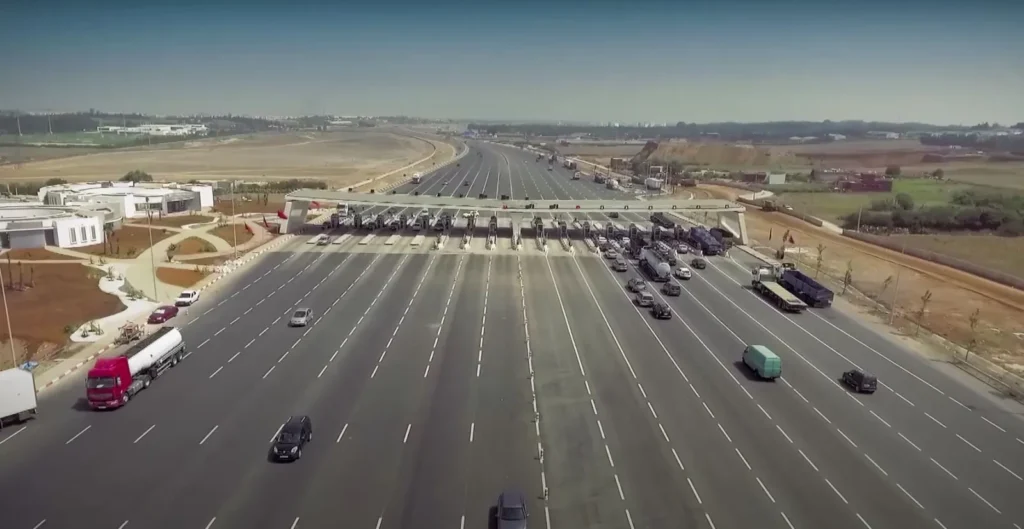
By car, two routes compete: the motorway via Rabat and Casablanca, about 530 kilometres and five and a half to six hours of driving, or the N8 national road through Ifrane, Azrou, Khenifra and Beni Mellal, some fifty kilometres shorter but distinctly slower. Morocco’s motorway network is operated by Autoroutes du Maroc (ADM) and is tolled throughout.
The motorway itinerary takes the A2 from Fes to Rabat, then the A1 to Casablanca and the A3 towards Marrakech. It is a wide, well-signed road limited to 120 km/h, with service areas at regular intervals. Tolls add up across three sections: around 106 dirhams between Fes and Rabat, 25 dirhams between Rabat and Casablanca and in the region of 85 dirhams between Casablanca and Marrakech for a light vehicle, about 215 dirhams in total — a figure to confirm against ADM’s published rate grid, since rates were revised in 2025. Payment is by cash, card or the Jawaz electronic badge; keep dirhams in cash, as not every booth accepts foreign cards.
The Middle Atlas road is a completely different experience. It climbs to Ifrane and the cedar forest around Azrou, crosses the Khenifra plateaux, drops onto the Tadla plain at Beni Mellal, then passes El Kelaa des Sraghna before Marrakech. The scenery is superb and the detour makes sense if you plan to stay overnight. But these are two-lane roads with lorries, tractors, village crossings and frequent winter fog on the passes. Seven to eight hours of actual driving is a minimum, and driving it after dark is a bad idea.
A word on grands taxis, the shared Mercedes and Dacia saloons that leave when full. They work in relays from town to town and do not cover Fes–Marrakech in one go. Stringing together four or five legs over 500 kilometres, six passengers to a car, ends up costing more than the train for incomparably less comfort. Our comparison of airport transfers across Morocco sets out the usual rates for each option.
Which option from Fes to Marrakech suits your budget and season?
Take the train in nine cases out of ten: it leaves central Fes, arrives in central Marrakech, costs the price of a meal, and lets you walk, read or sleep for seven hours. Choose the coach if every dirham counts or if you are carrying bulky luggage. Flying only makes sense on a short trip whose dates coincide with the rare direct rotations.
Season changes the equation seriously. From June to September the heat presses down on the plain between Settat and Marrakech: an early start avoids the worst hours, and the air conditioning works better in first class. This is also when ONCF strengthens its service — 237 trains a day, 70 of them Al Atlas, under the Summer 2026 special plan — and when seats disappear fastest. In December and January the issue shifts: fog and frost on the Middle Atlas plateaux make the N8 unpleasant, while the train is indifferent to weather. Around Eid al-Adha, crowding is extreme on every mode; ONCF reported carrying close to two million travellers under its exceptional Eid 1447 arrangements.
If you are still weighing the cities rather than the transport, our comparison of Marrakech or Fez: which to choose asks the question from the other end.
Where to stop between Fes and Marrakech
Four stops slot naturally into this journey: Meknes, 40 minutes by train from Fes; Rabat at about 3 hours 07; Casablanca at 4 hours 09; and Beni Mellal, reachable only by the Middle Atlas road. Splitting the trip turns a transport day into a genuine stage of the journey, without noticeably raising the budget.
Meknes, the short stop
Forty minutes on the train is enough to reach one of Morocco’s four imperial cities. Bab Mansour, the Heri es-Souani granaries and the mausoleum of Moulay Ismail fill half a day, and Volubilis lies about thirty kilometres away. The drawback: boarding at Meknes can mean standing or taking an unreserved seat if the train arrives full from Fes. Buy the second ticket separately and in advance.
Casablanca or Rabat, the logical stops
Both cities sit on the line, and therefore on your ticket. Rabat-Agdal, 3 hours 07 from Fes, serves the Kasbah of the Udayas and the Hassan Tower. Casablanca-Voyageurs, at 4 hours 09, puts the Hassan II Mosque within a short petit taxi ride. Casablanca has one practical edge: it is the point on the route with the most trains in both directions, so an unplanned night is easiest to recover from the next morning.
Beni Mellal and the Middle Atlas, for drivers
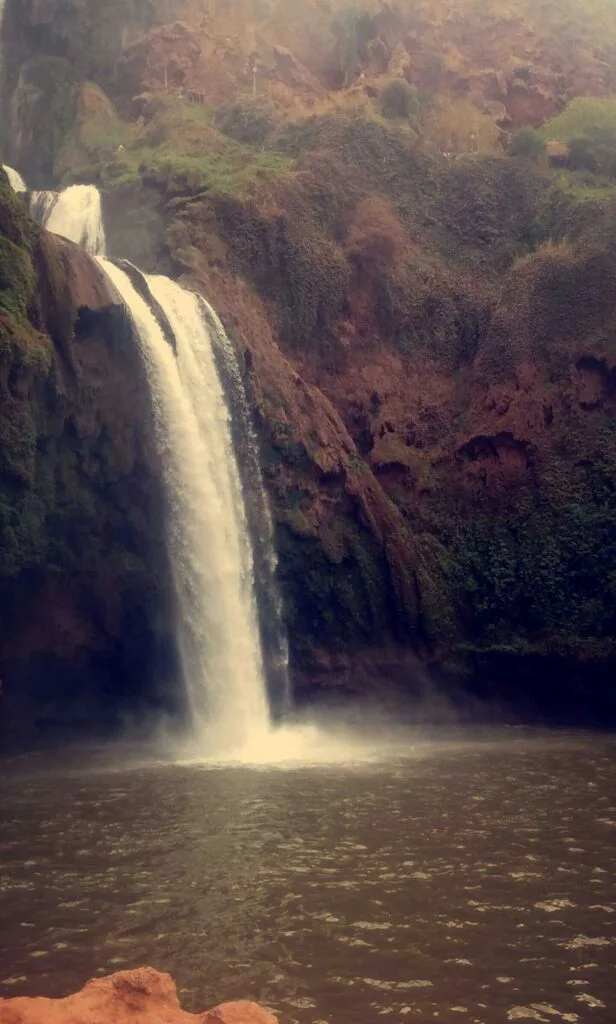
Beni Mellal has no railway station: it concerns drivers and N8 coach passengers only. Backed against the Atlas foothills, the town is a base for the Ouzoud waterfalls, about 120 kilometres away. On the same axis, Ifrane and the cedar forest at Azrou, an hour from Fes, are worth the halt: this is upland Morocco, with Barbary macaques and steep-pitched roofs. That stretch features in our article on what to see in Fes and its region.
Departure and arrival: Fes and Marrakech stations
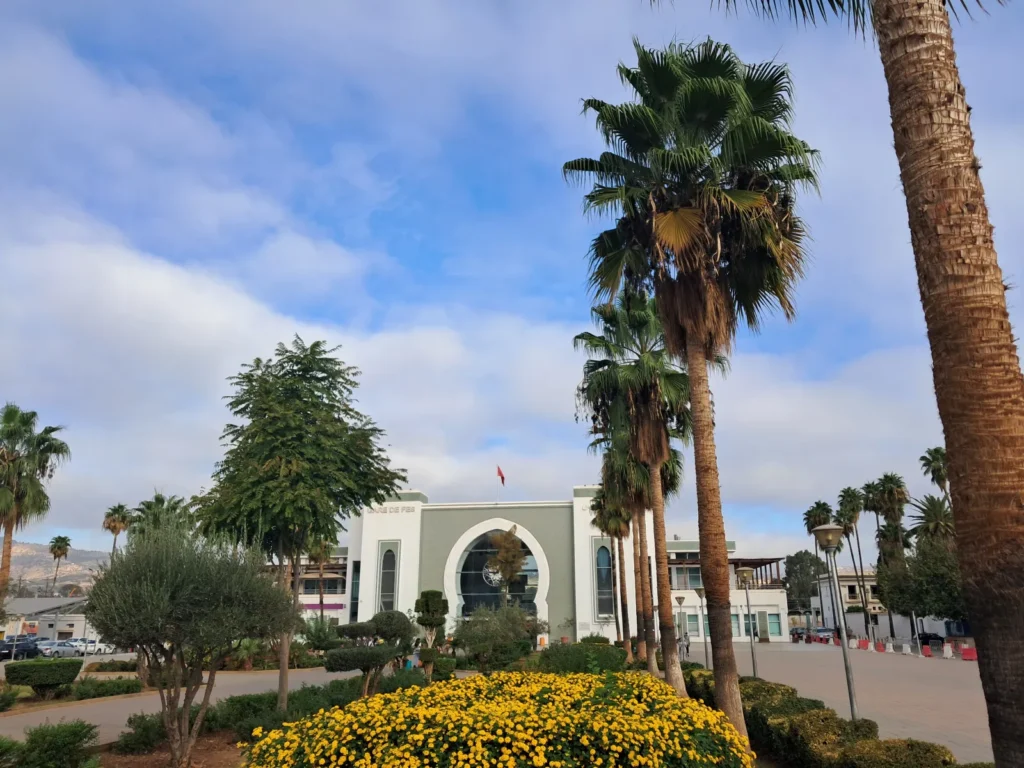
Fes-Ville station stands in the Ville Nouvelle, about ten minutes by petit taxi from the medina, while Marrakech station sits at the corner of Avenue Hassan II and Boulevard Abdelkrim El Khattabi in the Gueliz district. Both were completely rebuilt in the late 2000s and are nothing like provincial halts.
Fes has a longer railway history than most visitors expect. A first military station, terminus of a 600-millimetre narrow-gauge line from Sale, opened on 21 February 1915 and closed on 24 January 1934. Standard gauge reached Fes from Meknes on 1 September 1923, and the line towards Oujda opened on 1 April 1934. The present station was inaugurated on 27 November 2009 after twenty months of works: five tracks, a passenger hall, a 7,500 m² forecourt, a 100-space car park and around 900 m² of retail units. It lies on both the Tangier–Oujda and Marrakech–Oujda axes.
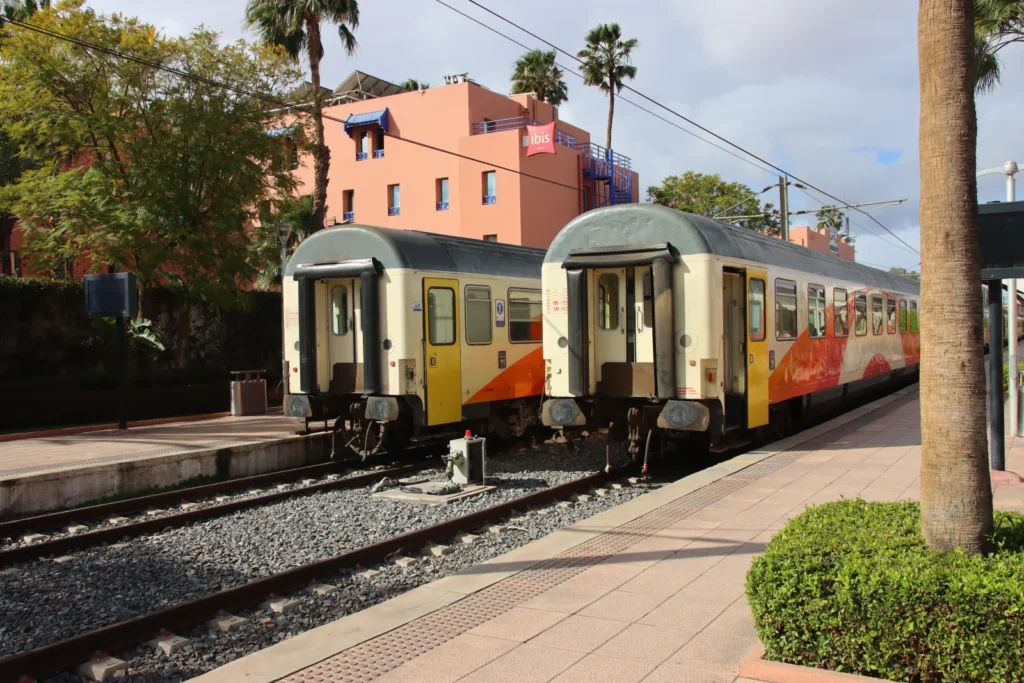
At the other end, Marrakech station impresses by scale: 25,000 m² overall, a 1,250 m² passenger hall, a 5,000 m² forecourt and a 2,800 m² shopping gallery on two levels. Built in 1923 and fully renovated in 2008, it handles about three million travellers a year according to published figures. It is a terminus station: trains arrive and leave the way they came. Marrakech’s line A bus rapid transit and several ALSA bus routes serve it, and petits taxis wait on the forecourt. Allow about fifteen minutes by taxi to Jemaa el-Fna, a little more on foot.
Before departure, the last urban leg matters at both ends. In Fes, red petits taxis on the meter and city bus routes serve the station from the medina and the Ville Nouvelle: our guide to getting around Fes explains the usual rates and the classic traps.
Mistakes to avoid on the Fes to Marrakech journey
Things go wrong on this route for three reasons almost every time: an unverified timetable, a ticket bought too late, and an overnight arrival nobody thought through. Here are the errors first-time Fes–Marrakech travellers make most often.
- Trusting a timetable found on a blog. ONCF changed its transport plan on 14 September 2026 because of the high-speed line works, and warned that delays and journey-time adjustments were to be expected on Al Atlas trains. Check your date on oncf-voyages.ma, nowhere else.
- Believing you must change at Casablanca. Several English-language sources still say so. On the official grid the train is direct; getting off at Casablanca-Voyageurs to “catch the connection” would cost you your seat.
- Booking the 18:35 to “save a day”. It arrives at 01:38. At that hour the Marrakech medina is shut, riads are asleep and taxis charge night rates.
- Leaving it to the last day in July or August. Under the summer plan ONCF runs up to 237 trains a day and still fills them. Promotional tickets go weeks ahead.
- Counting on a direct flight without checking the day. With only two to four weekly rotations, there is a strong chance your date is not served.
- Starting the N8 late in the day in winter. Fog on the Middle Atlas passes, slow lorries and no street lighting: drive it in daylight or not at all.
- Travelling without cash. Tolls, petits taxis and porters run on dirham notes. Withdraw before leaving Fes.
What is about to change: high-speed rail and a new motorway
Two major projects will reshape this journey before the decade ends: the Kenitra–Marrakech high-speed line, announced for service in September 2029, and a planned direct Fes–Marrakech motorway of 400 to 420 kilometres. Neither is usable today, but both explain the current disruption.
The Kenitra–Marrakech high-speed line covers 430 kilometres at 320 km/h. Moroccan authorities reported in 2026 that the works had passed roughly 30% completion, with dynamic testing planned for early 2029 and delivery in September 2029. Once running, it will put Rabat 1 hour 40 from Marrakech against 3 hours 44 today, and Tangier 2 hours 45. For a traveller starting in Fes, that will most likely mean an Al Atlas to Kenitra and then an Al Boraq — Morocco’s high-speed train — to Marrakech: one change, but a markedly shorter total. It is this project that forces the current service adjustments, ONCF having announced in August 2026 timetable changes, shortened routes and the progressive closure of certain stations.
On the road side, the planned Fes–Marrakech motorway would link the two cities through the interior via Meknes, Khenifra, Beni Mellal and El Kelaa des Sraghna, in three sections. Moroccan sources put the cost near 28 billion dirhams, about 2.8 billion dollars, and mention an opening around 2029, with studies under way. That alignment would remove the detour through Rabat and Casablanca and bring the cities a good hundred kilometres closer. Until it exists, the A2-A1-A3 chain remains the sensible route.
Nearby: before you leave, after you arrive
Around Fes-Ville station, the Ville Nouvelle offers plenty to fill an hour: the cafés of Avenue Hassan II, the Jnan Sbil gardens ten minutes away, and the Bab Boujloud gate at the medina entrance about three kilometres off. At the Marrakech end, arriving in Gueliz leaves you a quarter of an hour from the medina and the souks.
With an hour to spare before your train in Fes, walk to the Jnan Sbil gardens rather than sitting in the hall: it is the city’s oldest public garden, laid out in the 18th century, with its pools and waterwheel, and it lies between the station and the medina. In Marrakech, the useful first move after the station is not Jemaa el-Fna but the Majorelle garden or the Koutoubia, both less saturated in late afternoon while the heat drops.
One last point, valid in both directions: luggage. Neither ONCF nor CTM systematically weighs bags on this route, but the train has no hold and the racks fill up. A large suitcase travels better by coach. Conversely, a backpack and seven hours of open window over the Saiss, Gharb and Chaouia plains is one of the best price-to-scenery ratios in Morocco.
FAQ about travelling from Fes to Marrakech
Is there a direct train from Fes to Marrakech?
Yes. ONCF’s official timetable for the Marrakech–Fes axis shows direct Al Atlas trains with no change, taking 7 hours 3 minutes. These trains pause for a few minutes at Casablanca-Voyageurs, but passengers keep their seats. Some sources still claim a connection is compulsory at Casablanca; that is not what the operator’s own document says.
How long is the train journey from Fes to Marrakech?
Seven hours and three minutes on the ONCF grid, with striking consistency from one train to the next: for example, leaving Fes at 08:35 and arriving in Marrakech at 15:38. The useful intermediate markers are Meknes at about 40 minutes, Rabat-Agdal at 3 hours 07 and Casablanca-Voyageurs at 4 hours 09. Delays remain possible during the high-speed line works.
What is the cheapest way from Fes to Marrakech?
The CTM coach, with tickets around 140 to 200 dirhams against 200 to 250 dirhams for second-class rail. The gap is modest given the one to two extra hours. ONCF promotional fares, such as the Yalla Al Atlas ticket at 49 dirhams offered during seasonal plans, can make the train cheaper than the coach if you book very early.
Can you travel from Fes to Marrakech overnight?
Yes, but by coach rather than train. CTM operates night departures on this axis. On the rail side, the last direct train leaves Fes at 18:35 and arrives at 01:38 in ordinary seats: there are no sleepers or couchettes on this relation, ONCF reserving those coaches for the Marrakech–Tangier, Tangier–Oujda and Casablanca–Oujda/Nador axes.
Should you book train tickets in advance?
Yes, as soon as you know your date. Sales open several weeks before departure on oncf-voyages.ma and the ONCF Voyages app. In summer, during Moroccan school holidays and around Eid, trains sell out: the operator reported carrying close to two million travellers under its Eid al-Adha 1447 arrangements alone.
How many kilometres is Fes from Marrakech?
About 530 kilometres by motorway, going via Rabat and Casablanca. The N8 national road through Ifrane, Khenifra and Beni Mellal is roughly fifty kilometres shorter but considerably slower. The planned direct Fes–Marrakech motorway, announced at 400 to 420 kilometres, would reduce the distance to a near-straight line through the interior.
Is the Fes to Marrakech flight worth it?
Rarely. The flight lasts 1 hour 5 minutes, but door to door comes to about four and a half hours once you count the fifteen kilometres to Fes-Saiss, two hours of check-in and the arrival at Menara. With only two to four weekly rotations operated by Ryanair, the route does not cover every day of the week. The train stays more flexible and more central.
Can you stop at Meknes or Casablanca on the way?
Yes, both cities are on the line. Meknes is about 40 minutes from Fes and Casablanca-Voyageurs 4 hours 09. An ONCF ticket does not, however, allow you to break the journey: you need two separate tickets. Buy the second in advance, because a train arriving full from Fes leaves few seats free at Meknes.
In summary
On the Fes–Marrakech axis the Al Atlas train almost always wins: direct, 7 hours 3 minutes, about fifteen departures a day, city centre to city centre, for 200 to 400 dirhams. The CTM coach saves a few dozen dirhams at the cost of one to two extra hours and suits bulky luggage. Driving makes sense if you want to stop at Ifrane, Azrou or Beni Mellal, accepting 530 kilometres and close to 215 dirhams in tolls. Flying only holds up on a date that matches one of Ryanair’s two to four weekly rotations.
The most useful rule for 2026 fits in one sentence: verify your timetable on the day you book. The Kenitra–Marrakech high-speed works led ONCF to change its transport plan on 14 September 2026, and the operator itself announces journey-time adjustments. Book early, leave in the morning, and keep cash dirhams for the last kilometre.
Official sources
- ONCF – Moroccan National Railways
- ONCF Espace Voyageurs – timetables and tickets
- CTM – Compagnie de Transports au Maroc
- ONDA – Moroccan Airports Authority
- ADM – Autoroutes du Maroc
- Moroccan National Tourist Office
Informational article. Fares, timetables and frequencies shown here may change: confirm them with the operators before booking.
Photo credit
Images: featured image « File:Fes railway station.jpg » — Ideophagous (CC BY-SA 4.0); « File:Nádraží Marrákeš, 2025 (01).jpg » — Draceane (CC BY-SA 4.0); « File:Highway morocco pay checkpoint.jpg » — Ministère de l’Equipement et du Transport (CC BY-SA 4.0), via Wikimedia Commons.