Things to do in Errachidia is a question that is best answered by shifting it slightly. The town itself, set on the Oued Ziz where the High Atlas gives way to the desert, is a recent administrative centre with no monumental heritage. What it commands, however, is one of the most spectacular routes in Morocco: the Ziz Valley, its gorges, its palm groves running for tens of kilometres, and the descent towards the Tafilalet and the great dunes. Few people come to Errachidia; most pass through it, and that is precisely where the interest of a stay lies. This guide sets out what to see in town and, above all, around it, including how to get there from the UK and how to reach Merzouga.
In short: Errachidia at a glance
- Position: Errachidia is the gateway to the Tafilalet, at the junction between the mountains and the desert.
- The town: there is no old medina; it grew in the twentieth century around an administrative role.
- The Ziz Valley: this is the real subject, a continuous palm grove running for tens of kilometres, best seen from the viewpoints along the road.
- The Ziz Gorges: to the north, towards Midelt, a narrow defile between red walls.
- Meski blue spring: about 20 kilometres to the south, a natural spring turned into a pool.
- Merzouga: the Erg Chebbi dunes are two to three hours by road to the south-east.
- Weather: a continental desert climate, with very hot summers and genuinely cold winter nights.
- How long: two to three days as a base, longer if you push on to the dunes.
- Car: essential if you want to see the region properly.
- Flights: the airport is a few kilometres from town and serves mainly the domestic network; our route data shows no direct flight from the UK or Ireland.
Where Errachidia is and what the town offers
The town sits at a crossroads. To the north, the road crosses the High Atlas towards Midelt and Meknes; to the south, it follows the Ziz Valley down to Erfoud, Rissani and the dunes; to the west, it joins the Dades Valley and the Todra Gorges. That position makes Errachidia an almost obligatory stop for anyone travelling through the south-east of Morocco.
Today Errachidia is the capital of its province and a university town. It has what a comfortable stopover needs, namely hotels, petrol stations, shops and a hospital, which is no small thing in a region where services thin out quickly once you leave the main roads.
Is Errachidia worth visiting?
Let us be clear: Errachidia offers no heritage sightseeing. It is an orderly town of wide avenues, organised around its administration and its university, and local life centres on the central market, the cafés and the bridge over the Ziz. What is worth your time is the palm grove that borders the town, reachable on foot from some neighbourhoods: a first glimpse of the oasis system you will meet again, on a far larger scale, down the valley. Judge the region, not the town.
The Ziz Valley, the landscape that justifies the trip
South of Errachidia, the Oued Ziz feeds a palm grove that stretches for tens of kilometres between two arid slopes. Seen from the viewpoints built along the road, the scene is striking: a dense green ribbon, dotted with mud-brick villages, in the middle of a stony plateau.
You will want to stop several times. The first viewpoint, a few kilometres after the southern edge of town, already gives a good overview; the following ones offer different perspectives as you descend. Take the time to walk into the palm grove itself: the tracks that leave the road lead to villages where the traditional irrigation system is still in use.
The best light is in the late afternoon, when the low sun picks out the green of the palms against the ochre of the slopes. In the middle of the day the contrast flattens everything and photographs disappoint.
The Ziz Gorges and the Hassan Addakhil dam
Heading north towards Midelt, the road enters a defile where the river has cut its way between steep walls. The so-called Legionnaire tunnel marks the start of the narrowest stretch. It is a short but memorable section, one that many people drive through without stopping even though it deserves a pause.
A little earlier, the Hassan Addakhil dam holds back the waters of the Ziz and forms a lake that contrasts sharply with the surrounding landscape. It regulates irrigation for the whole valley downstream, which explains the density of the palm grove further south. Allow half a day for the round trip from Errachidia to see all of it.
The Meski blue spring
About 20 kilometres to the south, a spring of clear water comes out of the rock at the foot of a cliff and feeds a landscaped pool lined with palm trees. Local families come here, especially at weekends and in summer, and it makes a refreshing stop on the road to the desert.
Nearby, the ruins of a mud-brick ksar recall the traditional architecture of the region. The whole site can be seen in an hour or two and combines naturally with the drive down the Ziz Valley.
Erfoud and Rissani: fossils, souk and Sijilmassa
About an hour and a half to the south, Erfoud is known for its deposits of marine fossils, worked in cutting workshops that you can visit. The slabs of black limestone studded with ammonites and orthoceras that you see for sale all over the country come largely from here.
A little further on, Rissani stands on the site of the historic Tafilalet. Its souk, one of the most authentic in the south, is held on certain days of the week and is well worth planning around, so check the market days locally before you set out. The ruins of Sijilmassa, a former caravan city, lie right next to it.
Errachidia to Merzouga: distance, transport and timing
This is the most frequent practical question, and the answer is simple on paper: Merzouga lies two to three hours by road to the south-east of Errachidia, through Erfoud. The choice that matters is how you cover the distance, because the region has very little public transport that suits a visitor.
| Option | Best for | Practical notes |
|---|---|---|
| Hire car, driven yourself | Flexibility and viewpoint stops | The most useful choice in the region; book ahead and read the driving advice below |
| Private driver or agency tour | Travellers who do not want to drive on desert roads | Arranged through local agencies; agree the route and the price before you set off |
| Shared grand taxi | Getting between the main towns cheaply | Links the principal towns but does not make the intermediate stops that make the trip worthwhile |
| Public coach | Reaching larger towns on a fixed budget | Timetables change, so confirm them locally; it does not serve the viewpoints, Meski or the dune camps |
A practical timing tip: from Errachidia the great advantage is proximity. You can leave in the middle of the afternoon and arrive in time for sunset over the dunes. If you arrange the trip from another city, the logic is quite different, and we compare the options in our guide to the Sahara desert from Marrakech, Merzouga and Zagora and in the one on the Merzouga desert from Fes.
Merzouga and the Erg Chebbi dunes
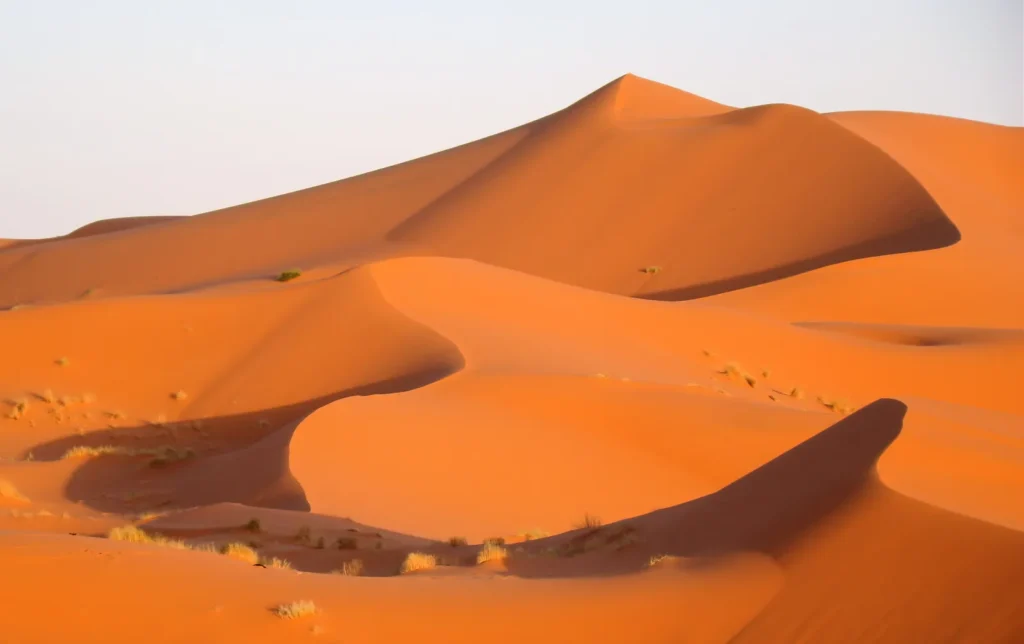
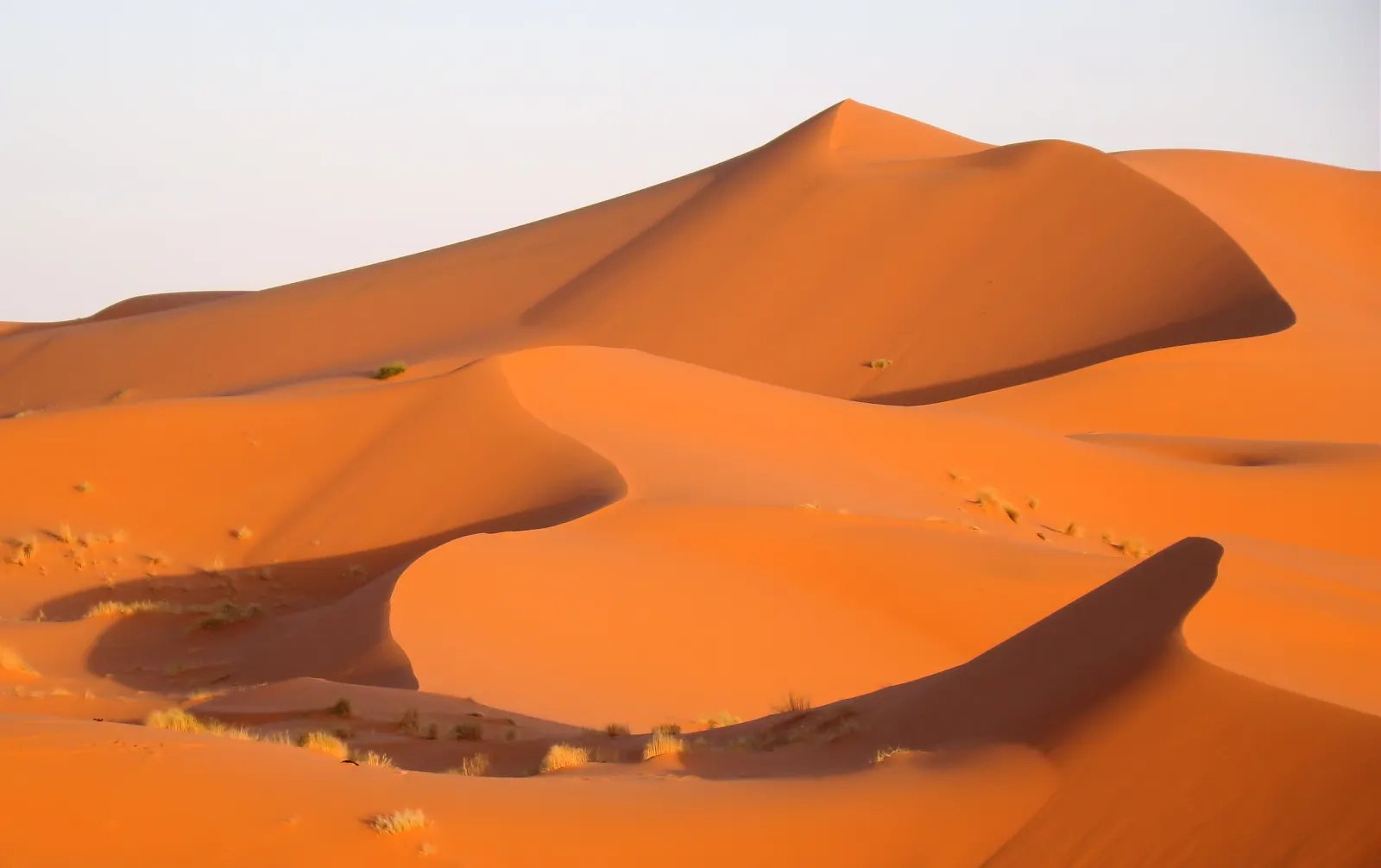
This is the destination that brings most travellers to this part of the country. Two to three hours by road to the south-east of Errachidia, the Erg Chebbi raises dunes several tens of metres high along a length of around twenty kilometres. The camps set up at the foot of the dunes, or inside the erg, offer a night under canvas, with the approach by camel or by vehicle.
How an oasis works
Understanding the oasis system transforms the drive through the valley. A palm grove is not a natural forest: it is an agricultural construction arranged on three levels. Date palms form the high layer and create the shade; beneath them grow fruit trees, pomegranates, figs or olives; at ground level, the plots carry cereals, lucerne and vegetables.
The whole arrangement depends on water, shared between the plots according to a watering rota set by custom, often over generations. The seguias, open-air channels, bring the water from the river or from underground galleries. When you walk through a palm grove, the small earth structures you step over are the sluices that control this sharing.
Two consequences for the visitor. First, a palm grove is private, cultivated land, not a park: stay on the paths and pick nothing. Second, the health of an oasis can be read with the naked eye, in the density of the palms, the state of the channels and the crops on the ground, and it is one of the most interesting things to watch as you go down the valley.
How many days to stay
| Length of stay | Realistic programme | Who it suits |
|---|---|---|
| 1 night | A stop on the road, with a Ziz viewpoint on departure | A driving tour of the south |
| 2 days | Ziz Valley, Meski and the gorges to the north | A first look at the nearby region |
| 3 to 4 days | Add Erfoud, Rissani and a night in Merzouga | The most complete format |
| Regional base | Day trips towards the Todra and Dades gorges | Travellers with their own vehicle |
When to go: Errachidia weather month by month
Climate is the deciding factor for this region, much more than crowds. Summer is very hot, and winter brings genuinely cold nights, which many travellers underestimate before a night in the dunes. If you are checking the Errachidia weather for October, December or January, the table below gives the pattern for each season.
| Period | Conditions | Good to know |
|---|---|---|
| March to May | Warm by day, mild nights | The best period, with green palm groves |
| June to August | Very hot, often beyond comfortable | Go out early in the morning or in the evening only |
| September and October | Heat easing, superb light | An excellent compromise |
| November to February | Pleasant days, cold nights | Pack proper warm clothing for a night in the dunes |
Spring and autumn are the safe choices; December and January suit a driving trip if you accept nights that can approach zero. For the whole country, see our guide to the best time to visit Morocco.
Flying to Errachidia from the UK and Ireland
The airport is a few kilometres from the town and serves mainly the domestic network, with a few European links depending on the season. Its small size keeps the formalities quick. In our route data, the services are Royal Air Maroc to Casablanca and Rabat, Ryanair to Marrakech and Transavia to Paris-Orly. There is no direct flight from the UK or Ireland, so a search for flights from London to Errachidia will always involve a connection.
The simplest way for most British and Irish travellers is to fly to Marrakech, which has direct services from many airports in the two countries, and then continue to Errachidia on the Ryanair link or by road. Another route is through Casablanca, from where Royal Air Maroc serves Errachidia. Fes, reached directly from London Stansted by Ryanair, is a third starting point if you plan to drive south through Midelt. Networks change with the seasons, so always confirm the current schedule on the Errachidia airport departures and arrivals page before you book.
One detail that helps with planning: since 20 September 2026 Morocco has been on GMT all year round, and clocks no longer change during Ramadan. There is therefore no time difference with the UK or Ireland in winter, and Morocco is one hour behind during British Summer Time. Flight times on our airport pages are in Moroccan local time. Our Errachidia airport guide details the services, the access and the layout of the terminal.
Getting to Errachidia by road
This is the most common way to arrive, since most visitors come as part of a tour. From Meknes or Fes, the road crosses the Middle Atlas and then the High Atlas via Midelt, with passes that can be snowy in winter. From Ouarzazate, the road through the Dades and Todra gorges joins the Ziz Valley. In both cases, allow generously: distances are covered slowly in the mountains.
Getting around and hiring a car
The centre of Errachidia can be covered on foot. For everything else a car is a necessity: the Ziz viewpoints, Meski, the gorges and Merzouga are not served by transport that a visitor can use in practice. Shared grand taxis link the main towns, and local agencies offer tours with a driver, a reasonable solution if you would rather not drive long distances on desert terrain.
If you plan to drive yourself, arrange the car before you arrive: the choice at a small airport is narrower than at Marrakech or Casablanca. Our guide to car rental at Morocco’s airports explains what to compare and check at pick-up.
Where to stay
Errachidia has a functional range of hotels, suited to passing travellers and business visitors. For a more memorable experience, many people prefer to go down for an hour and stay in a guesthouse in the Ziz Valley or in a restored ksar, where the setting is worth the detour on its own. For a night in the dunes, you need to book a camp around Merzouga.
What to eat in the Tafilalet
The cooking of the Tafilalet relies on what the oasis produces: dates in many varieties, vegetables from the irrigated gardens, goat and mutton. Medfouna, sometimes called Berber pizza, is the best-known speciality of Rissani: a flatbread stuffed with minced meat, onions and spices, baked in the oven. It often has to be ordered in advance.
The dates of the region are famous throughout the country, and the autumn harvest is the best time to buy them directly in the markets rather than in roadside shops. A word on varieties, because the difference in quality is considerable. Most of what is sold at tourist stalls is common, sweet and cheap. The sought-after varieties, fleshier and clearly more expensive, are bought in the Rissani market or directly from growers in the valley. Taste before you buy: it is customary, and it is the only way to form an opinion.
As for drinks, tea is served very sweet and very hot, often flavoured with wormwood in winter rather than mint. In the guesthouses of the valley, breakfast almost always includes local olive oil, honey and bread baked on the premises. It is one of the best moments of the day, and it is a good reason not to leave too early.
The ksour and mud-brick architecture
The valley is dotted with ksour, fortified villages of rammed earth that grouped homes, granaries and defences behind a shared wall. Many are now partly abandoned in favour of concrete-block houses, and their condition deteriorates quickly once maintenance stops, since earth does not stand up well to rain.
Several can be visited freely or with a resident who opens up the lanes. It is one of the most interesting discoveries in the region, and it is made by chance at the stops rather than from a list. Always ask before entering a courtyard: some ksour are still lived in.
Driving in the region: what to know
The main roads are tarred and in good condition, but they cannot be driven at the speed the map suggests. The mountain roads towards Midelt have long runs of bends and passes that can be snowy from December to March. To the south the road is straight, but it crosses areas where services are tens of kilometres apart.
Four habits apply throughout the region. Fill up as soon as the gauge drops below half, rather than waiting for the reserve. Carry more water than you think you need, even in winter. Avoid driving at night, because of stray animals and poorly lit vehicles. And never take an ordinary hire car onto a sandy track, even for a few hundred metres: getting stuck is easy and recovery is a long way off.
One last point concerns flash floods. The wadis of the region are dry most of the time, but a storm over the High Atlas can send the water rising fast downstream, even under a locally blue sky. Take signed fords seriously: if there is water, you wait.
Errachidia with children
The region works well with children from about six or seven. The Meski pool, the dunes and a night under canvas leave lasting memories, and the fossil workshops in Erfoud usually go down very well. The point to watch is the road: journeys are long, winding in the mountains, and summer heat makes the days gruelling. Break them up, and avoid July and August with young children.
Combining Errachidia with another stop
Three routes dominate. To the south-west, the road through the Todra and Dades gorges to Ouarzazate forms one of the finest itineraries in the country. To the north, Midelt then Meknes and Fes, and if Fes is your base, our guide to things to do in Fes will help you plan the other end of the journey. To the south-east, Merzouga and the dunes. The classic southern loop often combines all three in a week to ten days.
If you are tempted by the mountains and lakes of the centre, our guide to things to do in Beni Mellal covers a quite different foothill landscape, and our overview of what to do in Morocco shows how the south-east fits into a longer trip.
The most common mistakes
The first is to judge the region by the town, and to leave thinking there is nothing to see. The second is to drive through the Ziz Valley without stopping at the viewpoints because you have a schedule to keep. The third is to underestimate the cold at night in winter, especially for a camp in the dunes. The fourth is to try to link Fes and Merzouga in a single day: it can be done but it is exhausting, and you miss everything that makes the journey worthwhile.
Frequently asked questions about Errachidia
Is Errachidia worth a detour?
The town itself is a functional stopover with no monumental heritage. What justifies the trip is the region: the Ziz Valley and gorges, the Meski spring, the mud-brick ksour and the road to the Erg Chebbi dunes.
How long does it take to get from Errachidia to Merzouga?
Allow two to three hours by road to the south-east, passing through Erfoud. Leaving in the middle of the afternoon lets you arrive for sunset over the dunes, which is the best moment.
What is the best time of year to visit the Ziz Valley?
Spring, from March to May, and autumn, in September and October. Temperatures are bearable and the light is at its best. Summer is very hot and winter brings cold nights, especially at altitude towards Midelt.
Do I need a car to explore the region?
Yes, in almost every case. The viewpoints, Meski, the gorges and the ksour are not served by suitable regular transport. The alternative is a local agency offering a tour with a driver.
Is it cold at night in the desert?
Yes, and noticeably so from November to February. The gap between day and night is large all year, but in winter night-time temperatures can approach zero. Bring warm clothes even if the day has been mild.
Is there an airport at Errachidia?
Yes, a few kilometres from the town. It handles mainly domestic flights, with European links depending on the season. Its small size makes arrival and departure particularly quick.
Are there direct flights from the UK to Errachidia?
Not in our route data: the services listed are to Casablanca, Rabat, Marrakech and Paris-Orly. From the UK or Ireland, most travellers fly to Marrakech, Casablanca or Fes and continue by a domestic flight or by road. Check the live departures and arrivals board for the current schedule.
Is there a time difference between Morocco and the UK?
Since 20 September 2026 Morocco has been on GMT all year. The UK and Ireland are on the same time in winter, and an hour ahead of Morocco during summer time.
In summary
Errachidia works as a base, not as a sight. The essentials come down to four stops: the viewpoints over the Ziz palm grove, the gorges to the north, the Meski spring to the south and the descent to Erfoud, Rissani and the dunes. Allow two to four days, hire a car, aim for spring or autumn, and pack enough to stay warm at night. From the UK, plan on a connection through Marrakech, Casablanca or Fes.
Sources
Location data and regional background: Encyclopaedia Britannica, Er-Rachidia. The flights mentioned come from our monitoring of scheduled services, which is revised continuously; frequencies vary by season and should be checked with the airlines.
Image credits
Dunes of the Erg Chebbi near Merzouga: Bjørn Christian Tørrissen (CC BY-SA 3.0), via Wikimedia Commons.