The Marinid Tombs of Fes are the ruins of a 14th-century royal necropolis on the hill of al-Qula, just north of the Fes el-Bali medina: you climb up for two gutted mausoleums, a small ruined dome and, above all, for the most complete view you can get of the old city, free of charge and with no opening hours. The sultans buried here, between 1361 and 1398 and again in 1465, ruled a declining empire; their tombs have lost their marble and their colours, but the hill has kept its original purpose intact: to look down on Fes (often spelled Fez).
This page is devoted to this one site: what is actually still standing, who was buried here, what 16th-century travellers wrote about it, what recent archaeology has found, the restoration project announced in 2024, how to read the panorama, how to get there and, a point many guides skip, how to go safely at the end of the day. For the rest of the city, our guide to things to do in Fes gathers all the essential visits.
At a glance
- The Marinid Tombs stand on the hill of al-Qula (or El Qolla), north of Fes el-Bali, above the large Bab Guissa cemetery.
- The known royal burials here range from 1361 to 1398, with a final one in 1465: that of the last Marinid sultan, Abd al-Haqq II.
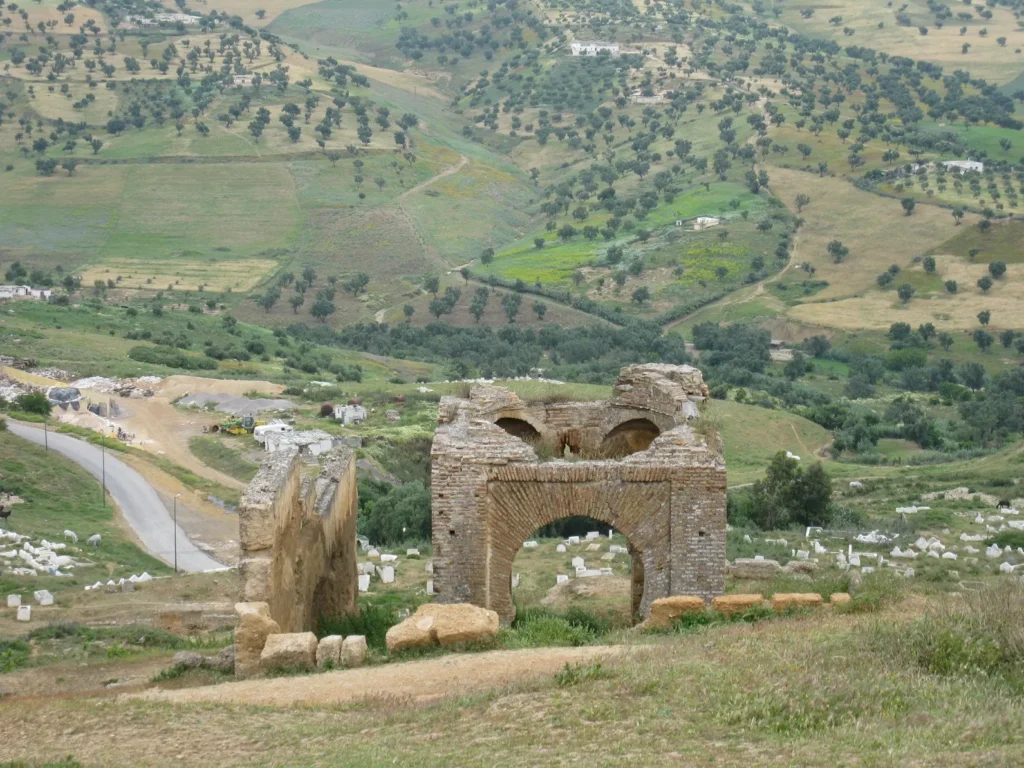
- What remains are two large mausoleums on rectangular bases, opened by wide horseshoe arches, and a small square qubba lower down, in ruins.
- A few fragments of carved stucco and an Arabic inscription survive; the marble and colours described by Leo Africanus have gone.
- In August 2024, the ADER-Fès agency launched a 12-million-dirham tender to restore the site and the Al Anouar Mosque in the medina.
- Access is free, with no ticket and no official hours; people come mainly for the panorama over Fes el-Bali and the sunset.
- Avoid going up alone or walking back down after dark: come in a group or keep a taxi waiting.
The Marinid Tombs: what you actually see on the hill
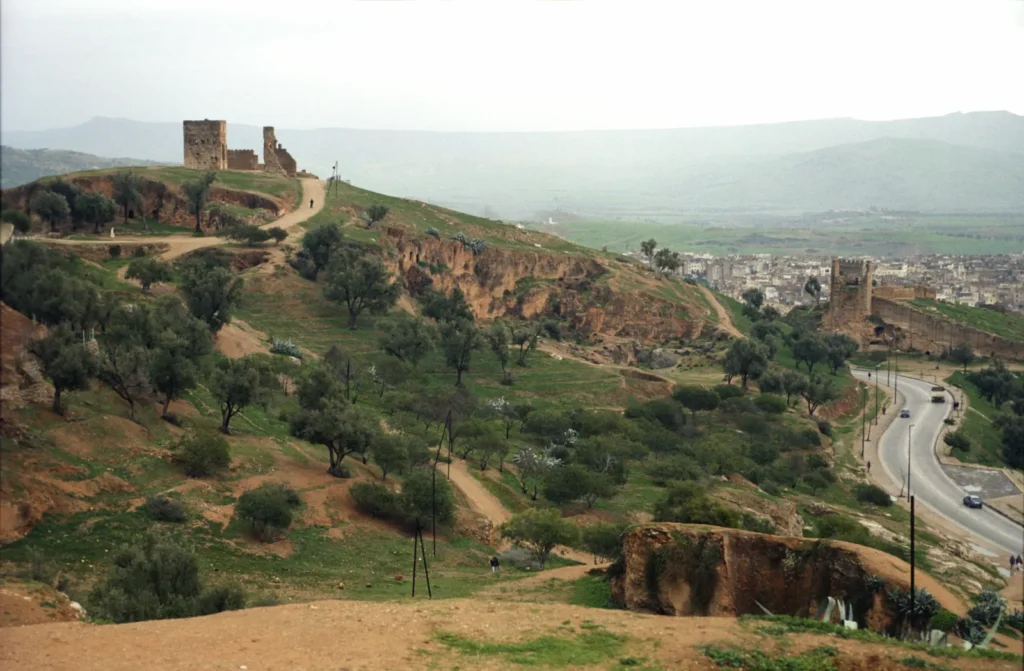
Let us be clear from the start: anyone expecting a necropolis like the Chellah in Rabat, with its enclosure wall, monumental gate and gardens, will be disappointed. Here there is no ticket office, no information panel worth the name and no laid-out path. There are rammed-earth and brick walls worn down by six centuries of wind, sitting on a ridge that is grassy or bare depending on the season, and an entire city at your feet. The whole appeal of the place lies in the contrast between the poverty of the remains and the scale of what they look at.
The two large mausoleums
These are the structures that cut the skyline of the hill when you see it from the medina. They are two tall buildings on rectangular bases, each pierced by a large entrance in the shape of a horseshoe arch, the form typical of western Islamic architecture. Nineteenth-century photographs show that these funerary halls were topped with pyramidal wooden roofs covered in green tiles, the colour of religious and dynastic roofs in Morocco. Nothing of them survives: the timber frames have gone, the walls are bare and the sky is now the ceiling.
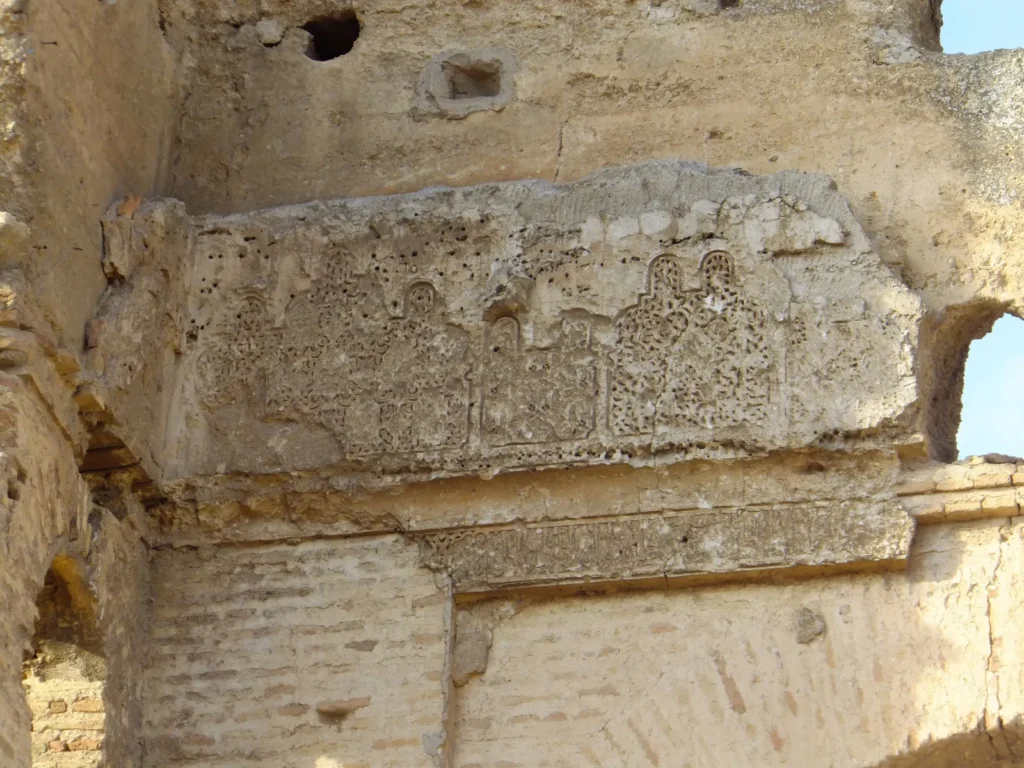
Step up to the inner walls and look for traces of plaster. In one of the mausoleums a few fragments of carved stucco and the remains of an Arabic inscription survive. It is not much, but it is the only visible clue to the decoration that once covered these walls, in the spirit of the Marinid madrasas in the medina. A tip: come in the low light of late afternoon, which brings out the relief of these fragments far better than the midday sun.
The small qubba below
Many visitors miss it because it is not on the ridge. A little behind the two large mausoleums and slightly to the north, on lower ground, stands a more modest qubba on a square base. Each of its four walls opens through a horseshoe arch, and it was covered by a twelve-sided, or dodecagonal, dome. Now in ruins, it nonetheless gives the best idea of what a complete Marinid mausoleum looked like: a cube open on all four sides, under a dome, among ordinary graves.
The Bab Guissa cemetery below
The slopes running down towards the city walls are covered with graves: this is the Bab Guissa cemetery, which spreads outside the gate of the same name. It forms the transition between the royal hill and the city. It is still in use. You cross part of it if you walk up, and it calls for simple conduct: do not walk on the graves, do not sit on them and do not photograph families who have come to pray.
Who is buried in the Marinid Tombs?
To understand why a dynasty as wealthy as the Marinids left such bare tombs, you have to look at the history of its burials. For more than half a century the sultans were not buried in Fes but at the Chellah, near Rabat. Abu Yusuf Yaqub, who died in 1286, lies there, as do his son Abu Yaqub Yusuf, who died in 1307, and Abu Thabit, who died in 1308. Abu al-Hasan, the most powerful of them all, who died in 1351, was the last sultan buried at the Chellah.
His son Abu Inan, assassinated in 1358, broke with this custom: he is thought to be buried in Fes el-Jdid, in a chamber attached to the Great Mosque of the new city, although no inscription confirms it. After him, the dynasty chose the hill of al-Qula. Why the change? Henri Bressolette, quoted by the local history blog “À l’ombre du Zalagh”, raises it only as a question: the anarchy then spreading through the kingdom may have forced the choice of a burial place closer to Fes. It remains a hypothesis, and no contemporary text settles the matter.
Historical sources make it possible to identify several burials on the hill. The table below lists those that are documented; with no inscription in place, however, nobody knows which mausoleum held which ruler.
| Person | Status | Date of death |
|---|---|---|
| Abu Salim Ibrahim | Sultan, first known burial at al-Qula | 28 September 1361 |
| Abu al-Abbas Ahmad | Sultan (two reigns) | 12 November 1393 |
| Abu Faris Abd al-Aziz II | Sultan | 11 November 1396 |
| Abu Amir Abdallah | Sultan | 20 or 21 March 1398 |
| Abd al-Haqq II | Last Marinid sultan, killed in a revolt | 1465 |
| Zineb | Princess, known from a stele found on the site | 1335 |
| Abu Ali al-Nasir | High official, known from a stele | Early 14th century |
The two marble stelae, that of Princess Zineb and that of Abu Ali al-Nasir, are reported in the literature as kept at the Dar Batha museum in Fes. Their dates, earlier than 1361, show that the hill was already receiving burials from the royal circle before it became the sultans’ necropolis. If you visit Dar Batha, ask whether they are on display: the presentation of the collections varies and we have not been able to check how they are currently shown.
The Marinids, the dynasty that made Fes a capital
The Banu Marin were a Zenata Berber tribe from the steppes to the east who settled in eastern Morocco at the beginning of the 13th century. Taking advantage of the collapse of the Almohads, they seized Fes in 1248, then Marrakesh in 1269, which effectively ended Almohad rule. Instead of returning to Marrakesh, their predecessors’ capital, they made Fes the centre of their state. In 1276 Sultan Abu Yusuf Yaqub founded an administrative and military city next to the old medina: Fes el-Jdid, “New Fes”.
Fes owes this dynasty much of what visitors admire today: the madrasas, the colleges that housed the students of the Qarawiyyin, with their zellij tilework, stucco and carved wood. Under Abu al-Hasan, from 1331 to 1348, the empire reached its greatest extent in the Maghreb. But the defeat at the Río Salado in 1340 against the Castilians and Portuguese, followed by the loss of Algeciras in 1344, closed the door to Spain. Abu Inan tried to regain the upper hand before being assassinated in 1358.
That is exactly where the story of the al-Qula tombs begins. After 1358 the viziers held real power and sultans followed one another quickly, some assassinated, some deposed. The Portuguese took Ceuta in 1415. The Wattasids, a related branch, acted as regents, and in 1465 a popular revolt in Fes killed Abd al-Haqq II, the last Marinid ruler. The tombs on the hill therefore belong to a dynasty on its way out, which probably explains why they never matched the splendour of the Chellah.
| Date | Event |
|---|---|
| 1248 | Abu Yahya takes Fes from the Almohads |
| 1269 | Abu Yusuf Yaqub captures Marrakesh, effective end of Almohad rule |
| 1276 | Foundation of Fes el-Jdid, the new royal city |
| 1286 to 1351 | Sultans are buried at the Chellah, near Rabat |
| 1331 to 1348 | Reign of Abu al-Hasan, territorial peak |
| 1340 | Defeat at the Río Salado |
| 1358 | Assassination of Abu Inan, probably buried in Fes el-Jdid |
| 1361 to 1398 | Burials of sultans on the hill of al-Qula |
| 1415 | The Portuguese take Ceuta |
| 1465 | Death of Abd al-Haqq II, end of the dynasty; last known burial at al-Qula |
| August 2024 | ADER-Fès tender to restore the tombs |
Al-Qula before the necropolis: a vanished fortified palace
The hill was not chosen at random as a burial place for kings. The Marinids had built a fortified palace here, known as al-Qula, which included a mosque and a bathhouse; remains of the mosque, including a mihrab, survived into modern times. Its date is disputed: according to some sources the palace predates the foundation of Fes el-Jdid in 1276, and these buildings, or an earlier structure, may go back to the Almohad caliph Muhammad al-Nasir (ruled 1199-1213); another author instead dates its construction to after 1287. The debate remains open.
Leo Africanus, who knew Fes at the very beginning of the 16th century, described this palace as impressive, although its layout cannot be reconstructed. For today’s visitor, this history changes the way you read the landscape: the isolated sections of wall you pass while walking along the ridge are not all tombs. Some belonged to this palace complex, about which almost nothing is known. Without full excavations, nobody can tell you with certainty what each ruin was used for, and you should be wary of anyone who claims otherwise.
What travellers wrote, what archaeology says
Coloured marble in the 16th century
The most valuable account remains that of Leo Africanus. He describes tombs adorned with fine decoration and marble epitaphs heightened with bright colours. In the early 16th century, roughly a century and a half after the first royal burial and barely half a century after the last, the tombs therefore still kept rich decoration. Their decline came later, with the lack of interest of the following dynasties, the Saadians and then the Alaouites, who had their own burial places, and the slow action of the weather on earthen walls.
Serious study of the site only began in the 20th century. Georges Marçais described the small qubba and its dodecagonal dome in L’Architecture musulmane d’Occident (1954), and in 1983 Henri Bressolette and Jean Delarozière published a study of Fes el-Jdid in the journal Hespéris-Tamuda. Yet as late as 2014, researchers noted that no thorough excavation had ever been carried out on the hill. The names of the buried sultans were known, but not how the necropolis was organised. A book by Xavier Salmon, Fès mérinide, une capitale pour les arts, 1276-1465 (2021), devotes several pages to the tombs and draws on 19th-century photographs to document the lost roofs.
Recent rescue excavations
The situation changed with the preparation of the restoration project. In March 2024 the news site Médias24 presented the tombs as a textbook case of preventive archaeology in Morocco, interviewing the lecturer and researcher Samir Kafas. According to figures reported in the press, the rescue excavations involved seventeen test pits and ten excavation areas over more than 2,000 square metres. To our knowledge, the details of the finds had not been published in a scientific form accessible to the public at the time of writing.
The restoration project announced in 2024
On 14 August 2024, the Moroccan magazine La Vie Éco reported that ADER-Fès, the public agency responsible for rehabilitating the Fes medina, was launching a tender for the restoration and landscaping of two sites: the Marinid Tombs of al-Qula, described as the remains of three domes, a mosque and several sections of wall, and the Al Anouar Mosque in the Andalusian quarter. The announced budget is 12 million dirhams for both sites. The project is part of the complementary programme for the enhancement of the Fes medina for 2018-2023, worth 583 million dirhams and covering 113 sites.
The length of the works and their exact schedule have not been made public. In practice, this means that when you reach the hill you may find hoardings, scaffolding or closed areas. If so, respect the fences: the panorama remains accessible from the edges of the site.
The view from the Marinid Tombs: reading Fes el-Bali
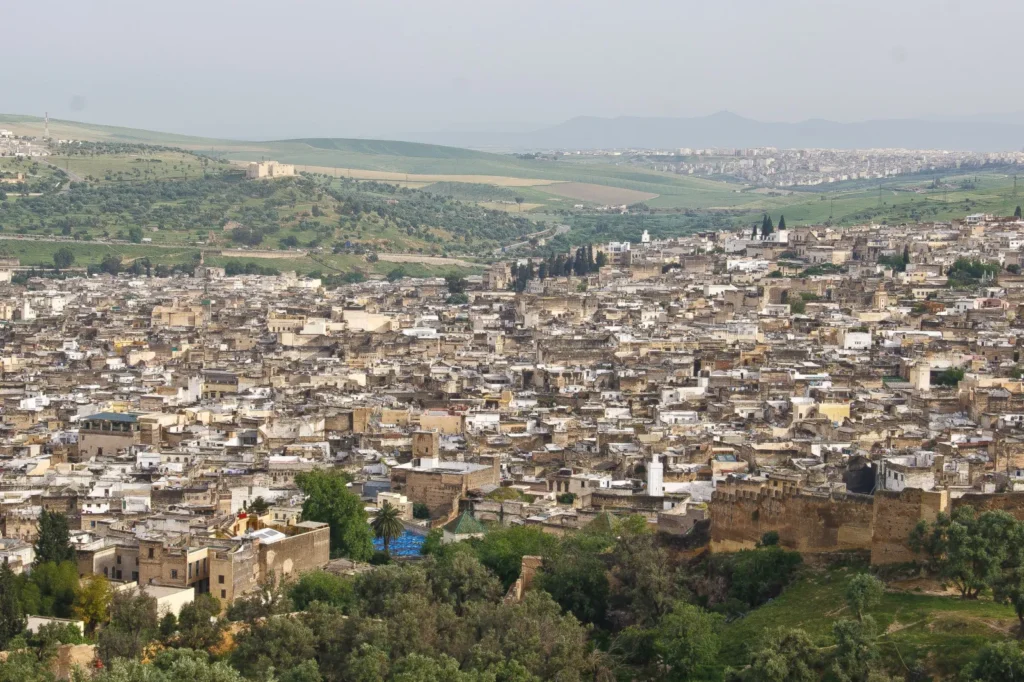
From the ridge, the medina appears as a bowl: Fes el-Bali covers both sides of the valley of the Oued Fes, and the tombs’ hill looks at it from the north. In one glance you take in the dense fabric of flat-roofed houses, ochre and off-white, bristling with satellite dishes, from which minarets rise. What catches the eye first are the green-tiled roofs. The largest belong to the religious heart of the city, the complex of the Qarawiyyin Mosque and the shrine of Moulay Idriss II, at the bottom of the bowl. Bring binoculars if you have them: this is the only place where you can see at once what walking through the alleys never lets you grasp.
On the opposite hill, to the south, stands the Borj Sud, the counterpart of the northern fortress. To the west, on your right as you face the medina, Fes el-Jdid and the modern city begin. On clear days, mountains stand out far to the south. The view is not just scenery: it explains the location of the necropolis, and that of the neighbouring Borj Nord, built later by the Saadians to keep watch over a restless city. Whoever holds this hill holds Fes in sight. Our selection of the best viewpoints in Fes compares this lookout with the others, from the Borj Sud to the medina rooftops.
Sunset and the call to prayer
The moment everyone comes for is the end of the day. The sun sets in the west, on your right: it lights the medina from the side, the light turns golden, then pink on the earthen walls, and the shadows draw out the shape of the bowl. Just after sunset comes the maghrib call to prayer. The voices of the muezzins rise from dozens of minarets across the medina, slightly out of step with one another, and carry up to the hill. It is the memory most visitors take home from Fes. Arrive at least forty-five minutes before sunset to enjoy the light, and plan to head down right after the call, not an hour later.
Photography tips
- For a picture combining ruins and city, stand behind the mausoleums and frame the medina through or beside a horseshoe arch.
- In the morning the light comes from the east, on your left: the medina is sharper, often less hazy with dust than in late afternoon, and you will be almost alone.
- A telephoto lens or a good smartphone zoom lets you pick out the green roofs and minarets; a wide-angle lens flattens the bowl.
- In summer, heat haze strongly softens the landscape at midday; it is the worst time for photos and for your comfort.
Visiting the Marinid Tombs: access, hours and safety
The site is not a paying monument: no ticket office, no reception guard, no official hours. You can go at any time, but common sense says go by day or at sunset, not later. Here are the two ways up, and how to choose.
By taxi: the simplest choice
The red petits taxis of Fes drop you at the foot of the site via the road that serves the Borj Nord and the Les Mérinides hotel. If the driver hesitates, give one of these two landmarks, which they all know. From Bab Boujloud or Place Batha the ride is short; insist on the meter or agree on the price before getting in, and check the fare locally because it varies with the time of day. For a sunset visit, the most comfortable solution is to arrange for the driver to wait thirty to forty-five minutes and then take you back down. It costs a little more, but saves you looking for a taxi at nightfall on a hill where they do not always pass.
On foot from Bab Guissa
From inside the medina, the climb starts at Bab Guissa, one of the main northern gates of Fes el-Bali. Once through the gate heading outwards, you climb through the cemetery on steep, unimproved dirt paths. Allow roughly fifteen to twenty minutes of climbing depending on your fitness; travellers’ accounts agree on this order of magnitude. The path is not signposted: simply aim for the silhouettes of the mausoleums at the top. Wear proper shoes, not sandals, as the ground is stony and slippery after rain.
Our firm advice: walk up if you like, in broad daylight and in a group, but come back down by taxi if you stay for sunset. The little-used cemetery path is the least advisable part of the route once night has fallen.
Safety: go with others at the end of the day
The site is busy and generally quiet during the day, especially at sunset, when locals and visitors gather there. But travellers’ reports mention thefts and muggings on the isolated paths between the hill and the medina. There are no official statistics on this specific point, and the aim is not to paint a dark picture but to follow a few simple rules. Do not go up alone, especially if you are a woman travelling solo. Do not take out an expensive camera on the cemetery path. Do not walk back down in the dark. And if a stranger insists on guiding you to a “shortcut”, decline politely. The safest option is to ask your riad or hotel to arrange the trip, and to tell them what time you expect to be back.
Dress and behaviour
No dress code is posted, but you are crossing a Muslim cemetery that is still in use. Clothing that covers shoulders and knees is the most appropriate, and it also protects you from the sun, as there is no shade at all on the hill. Speak quietly near the graves and do not climb on the ruins: the rammed-earth walls are fragile, and the restoration project aims precisely to consolidate them.
| Information | Details |
|---|---|
| Location | Hill of al-Qula, north of Fes el-Bali, above Bab Guissa, near the Borj Nord |
| Price | Free access at the time of writing |
| Opening hours | Open-air site with no official hours; some areas may be closed during works |
| By taxi | Petit taxi to the Borj Nord or the Les Mérinides hotel; metered fare, to be checked locally |
| On foot | About 15 to 20 minutes of steep climbing from Bab Guissa, through the cemetery |
| Time needed | 30 minutes to 1 hour; longer if you wait for sunset |
| Best time | Late afternoon and sunset; early morning for peace and quiet |
| Dress | Shoulders and knees covered, closed shoes, a hat in summer |
| On site | No shops, no water, no shade, no toilets |
| Safety | Come in a group, do not walk back down after dark |
Mistakes to avoid
- Going up at noon in summer: no shade, harsh light and heat that makes the climb hard work.
- Forgetting water: there is nothing to buy on the hill; the bar of the neighbouring hotel is the only option, and access for non-guests is not guaranteed.
- Paying an impromptu “guide” for a path you can see from the gate: the direction is obvious, and the mausoleums are visible from below.
- Staying after dark with no way back: this is the mistake that turns a lovely evening into a bad memory.
- Confusing the tombs with the Borj Nord: they are two separate sites, a few hundred metres apart.
Around the Marinid Tombs
The Borj Nord and its Arms Museum
A few hundred metres to the west, on the same ridge, stands the Borj Nord, a fortress built in 1582 under the Saadian sultan Ahmad al-Mansur, which has housed an Arms Museum since 1963. The two visits follow on naturally: the fort in the afternoon, the tombs for sunset. Its history, collections and opening status are covered in our article on the Borj Nord fortress and Arms Museum.
The Les Mérinides hotel
The large neighbouring hotel, Les Mérinides, is in the Borj Nord area, a few minutes’ walk from the tombs. Its official website highlights a terrace with a swimming pool, three restaurants, including a Moroccan restaurant on the third floor facing the medina, and a terrace bar with a view of the sunset. For travellers who want to enjoy the view without walking at night, staying or dining there is an obvious solution. We have not been able to confirm that the bar and restaurants are open to non-residents: ask at reception.
Bab Guissa and the north of the medina
On the way down, Bab Guissa deserves a few minutes. The present gate dates essentially from the works of the Almohad caliph Muhammad al-Nasir, around 1212, and was restored by the Marinid Abu Yusuf Yaqub in the 13th century. Its name is said to come from Ajisa ibn Dunas, a Zenata emir who controlled this quarter in the 11th century. Just inside stand the Bab Guissa Mosque and its madrasa. From there, the alleys lead down into the heart of the Fes el-Bali medina and the Qarawiyyin quarter, in about twenty minutes’ walk through the souks.
A half-day itinerary
- Early afternoon: explore the northern medina from Bab Guissa, then take a taxi to the Borj Nord.
- Mid-afternoon: the Borj Nord Arms Museum, if it is open.
- One hour before sunset: walk along the ridge to the Marinid Tombs.
- Sunset and the maghrib call to prayer from the mausoleums.
- Back by taxi, or dinner at the neighbouring hotel before heading down.
Arriving by plane
The Les Mérinides hotel states that it is about 15 kilometres from Fes-Saïss airport. Our guide to Fes-Saïss airport explains how to reach the city, and our comparison of airport transfers in Morocco helps you choose between a grand taxi and a pre-booked transfer. If your flight lands in the late afternoon, keep the tombs for the next day: the evening light is the best, and it is better not to improvise the climb after dark.
FAQ about the Marinid Tombs in Fes
Do you have to pay to visit the Marinid Tombs?
No. At the time of writing the site is freely accessible, with no ticket office or guard. You only need to budget for your taxi and possibly a tip for a driver who waits for you. During the restoration works, some areas may be closed to the public.
How old are the Marinid Tombs?
They are attributed to the 14th century. Known burials of sultans range from 1361, with Abu Salim Ibrahim, to 1398, and a final one took place in 1465 with Abd al-Haqq II, the last ruler of the dynasty. Two stelae from 1335 and the early 14th century show that the hill was already receiving graves from the royal circle before that.
Is it dangerous to go to the Marinid Tombs?
The site is generally calm during the day and lively at sunset, but travellers have reported thefts on the isolated cemetery paths. Come in a group, do not go up alone, keep valuables out of sight and do not walk back down in the dark: take a taxi or ask one to wait for you.
How long does it take to walk up from the medina?
Allow about fifteen to twenty minutes from Bab Guissa, on a steep, unimproved path through the cemetery. From Bab Boujloud, add the time needed to cross the medina to Bab Guissa, or take a petit taxi directly.
Which sultans are buried in the Marinid Tombs?
The sources name Abu Salim Ibrahim (died 1361), Abu al-Abbas Ahmad (1393), Abu Faris Abd al-Aziz II (1396), Abu Amir Abdallah (1398) and Abd al-Haqq II (1465). With no inscriptions in place, nobody knows which mausoleum belongs to which ruler.
When is the best time for the view?
Late afternoon and sunset, for the golden light on the medina and the maghrib call to prayer rising from the minarets. Early in the morning the light is flatter but the site is almost deserted. Avoid midday in summer.
Are the Marinid Tombs being restored?
A project has been launched: in August 2024, ADER-Fès issued a 12-million-dirham tender covering the tombs and the Al Anouar Mosque, after rescue excavations carried out on the site. The works schedule has not been made public; check the state of the site when you visit.
Marinid Tombs or Borj Sud: which is better for the panorama?
The tombs offer the widest and closest view over Fes el-Bali, with ruins in the foreground, which makes them the most photogenic lookout. The Borj Sud looks at the medina from the opposite hill. If you only have time for one viewpoint, choose the Marinid Tombs at sunset.
In summary
The Marinid Tombs are not visited like a monument: you come for a hill steeped in history and for the best view over Fes el-Bali. What remains are two large mausoleums opened by horseshoe arches, a small qubba with a dodecagonal dome and a few pieces of stucco, the vestiges of the necropolis of the last Marinid sultans, buried there between 1361 and 1465. Go up at the end of the day, in a group, by taxi or on foot from Bab Guissa, stay for the maghrib call to prayer and come back down by taxi. Combine the visit with the neighbouring Borj Nord, and keep an eye on the restoration project launched in 2024, which could change access to the site.
Official sources
- UNESCO World Heritage Centre: the Fes medina
- ArchNet: Marinid Tombs record
- Moroccan National Tourist Office
- National Museums Foundation of Morocco
- National Airports Office (ONDA)
Informational article updated in September 2026. Access, the state of the restoration works, taxi fares and visiting conditions may change: check locally before you go.
Photo credits
Images: featured image « File:Marinid Tombs(js).jpg » — Jerzystrzelecki (CC BY 3.0); « File:Stucco fragments at Merinid tombs of Fes.jpg » — R Prazeres (CC BY-SA 4.0); « File:Ruins and cemeteries behind the Merinid Tombs.jpg » — R Prazeres (CC BY-SA 4.0), via Wikimedia Commons.