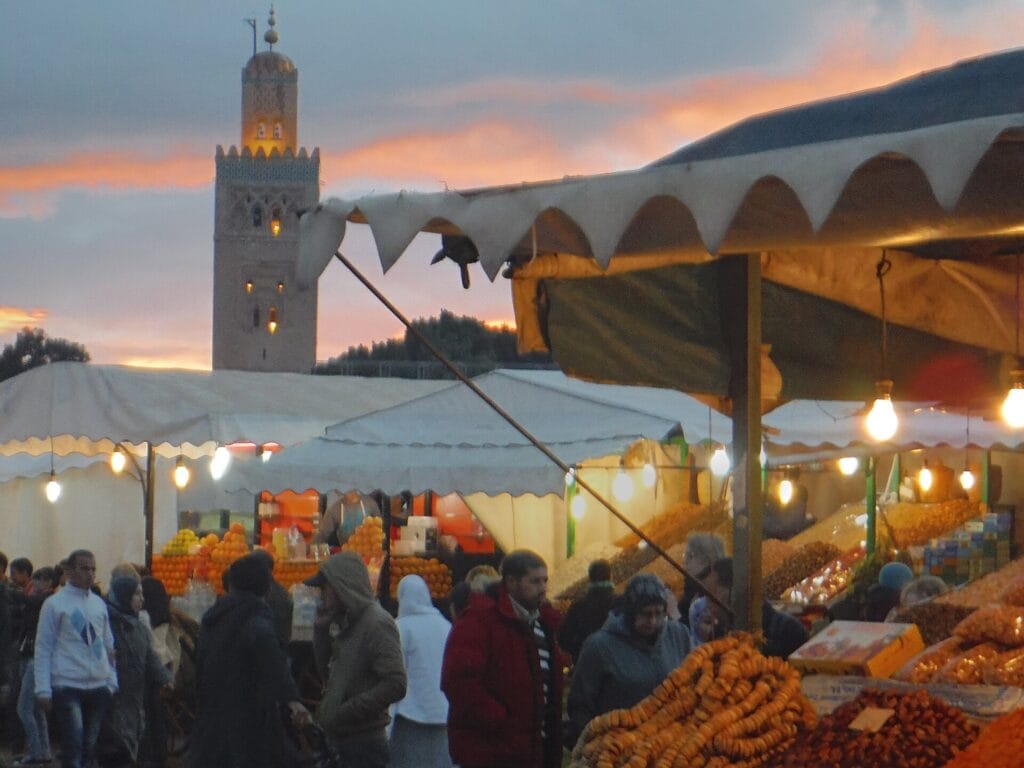
Arriving in Marrakech with no connection quickly gets complicated: booking a ride, opening a map, translating a menu or sending a photo of Jemaa el-Fna square to your loved ones all require data. The good news is that a SIM card in Marrakech is easy to find, costs very little and works the moment you step off the plane. The quick answer: for most travellers, the cheapest solution remains a local prepaid SIM with a data plan, bought at the airport or in a shop with your passport; prices start around 100 MAD (about €10) for several dozen gigabytes valid for 30 days.
If you would rather not handle anything physically, a Morocco eSIM lets you activate a data plan before you even take off, straight from a compatible smartphone. And if you travel light, the free wifi in hotels, riads and cafés covers most of your day-to-day needs. This guide runs through every option for staying connected: the operators, buying the SIM, the plans, the eSIM, wifi, 4G/5G coverage, roaming and the smart habits to adopt once you are there. The goal: to help you choose the solution that fits your profile, without overpaying or falling into the classic traps.
In short: staying connected in Marrakech
- Cheapest solution: a local prepaid SIM (Maroc Telecom, Orange or Inwi) with a data plan, from ~100 MAD / €10.
- Most convenient, no handling: an eSIM activated before departure (budget ~€5 to €15 depending on volume).
- Where to buy: operator stands at Marrakech-Menara airport, or official shops in town (Guéliz, medina).
- Essential: your passport to register the SIM (a legal requirement).
- Coverage: excellent 4G in the city, 5G launched in late 2025 in the major cities.
- Free: wifi in most hotels, riads and cafés (quality varies).
Mobile operators in Morocco
The Moroccan market rests on three national operators, all present and well established in Marrakech. Knowing them helps you make an informed choice for your internet in Marrakech:
- Maroc Telecom (IAM): the incumbent operator, often regarded as the one with the best network coverage, including in rural, mountainous and desert areas. It is the go-to choice if you plan excursions towards the Atlas, Ouarzazate or the Sahara.
- Orange Maroc: a very solid network in the city, well-designed mobile apps and competitive tourist plans. It is frequently the best-rated operator for 4G and 5G in large urban centres like Marrakech.
- Inwi: the challenger, known for its aggressive pricing and frequent promotions. A good option if you stay mostly in the city and are after the best gigabyte-for-price ratio.
For a classic city stay in Marrakech, all three operators are perfectly fine. The difference mainly comes into play if you leave the city: in that case, Maroc Telecom remains the safe bet for coverage in remote areas. You will find more detail on Moroccan telecommunications on the Telecommunications in Morocco page on Wikipedia.
Good to know: all three operators offer prepaid deals designed for visitors, with no commitment and no monthly bill. So there is nothing complicated to arrange. Sellers in major tourist cities like Marrakech are used to setting up foreign travellers and often speak French and English, which makes buying and configuring your SIM much easier. If you are unsure which deal suits you best, don’t hesitate to compare the packs displayed in two neighbouring shops: promotions change often and the price gap can be worth it.
Buying a SIM card in Marrakech: where and how
Getting a SIM card in Marrakech is simple and quick. You mainly have two options: at the airport on arrival, or in an official shop in town.
At Marrakech-Menara airport
In the arrivals hall of Marrakech-Menara airport, you will usually find official stands for the three operators (Maroc Telecom, Orange, Inwi). This is the most convenient option: the seller registers your SIM with your passport, installs the card, activates the plan and checks that data works before you leave the counter. You walk away connected, stress-free.
The flip side: the tourist packs sold at the airport are often a little more expensive per gigabyte than in town. You pay for the comfort of arriving ready to go. Expect to pay roughly €15 to €20 (about 150 to 200 MAD) for a pack including 10 to 40 GB depending on the current promotions. The stands usually accept euros as well as dirhams, and frequently card payments too.
In a shop in town
If you want to optimise the price, head to an official operator shop; there are plenty in the Guéliz district and around the medina. A bare prepaid SIM (without a plan) typically costs 20 to 50 MAD there, on top of which you add the data plan of your choice. On the spot, staff help you set up the phone and activate the offer.
One important tip: always favour an official shop over a small street reseller or a corner grocery. Official registration with a passport is mandatory, and a properly registered SIM saves you nasty surprises (cut-off, plan not activated, scams). To avoid the common travel traps, check out our guide to safety and scams in Marrakech.
The passport, a mandatory document
In Morocco, buying a tourist SIM in Morocco requires ID by law, in practice your passport for foreign visitors. It is a legal requirement to identify mobile lines, applied everywhere. So keep your passport on you when you buy; without it, no serious shop will be able to activate your card.
Data plans: indicative prices
Data plans in Morocco are known to be cheap compared with Europe. The prices below are indicative: operators regularly change their offers and launch promotions, so always check the exact rate at the time of purchase. As a reference point, here are the typical ballpark figures:
- Bare prepaid SIM: 20 to 50 MAD (about €2 to €5).
- Small data plan (5–10 GB): often 30 to 50 MAD (€3 to €5) in a shop, valid ~30 days.
- Mid-range plan (~20 GB): around 100 MAD (about €10), valid 30 days.
- Large plan (40 GB and up): around 200 MAD (about €20), valid 30 days.
- Airport tourist pack: 150 to 200 MAD (€15–20), including data and sometimes a few call minutes.
For a stay of a week to ten days, a 20 GB plan at around 100 MAD is easily enough for browsing, maps, social media and WhatsApp calls. If you watch a lot of video or share your connection, aim for a 40 GB plan. These amounts remain very reasonable: it is one of the reasons the local SIM is unbeatable on budget. To plan all your spending, take a look at our Marrakech travel budget guide.
How can you estimate your usage? As a benchmark, an hour of web browsing and social media uses a few hundred megabytes, GPS navigation is very light, while high-definition video streaming can swallow 1 to 2 GB per hour. A traveller who mainly uses maps, messaging and a bit of social media rarely uses more than 10 to 15 GB over a week. Budgeting for 20 GB therefore leaves a comfortable margin, and you can always top up an extra pass in a few minutes if needed. There is no point, though, in overpaying for a very large plan you will never use up on a short trip.
The eSIM: for whom and why
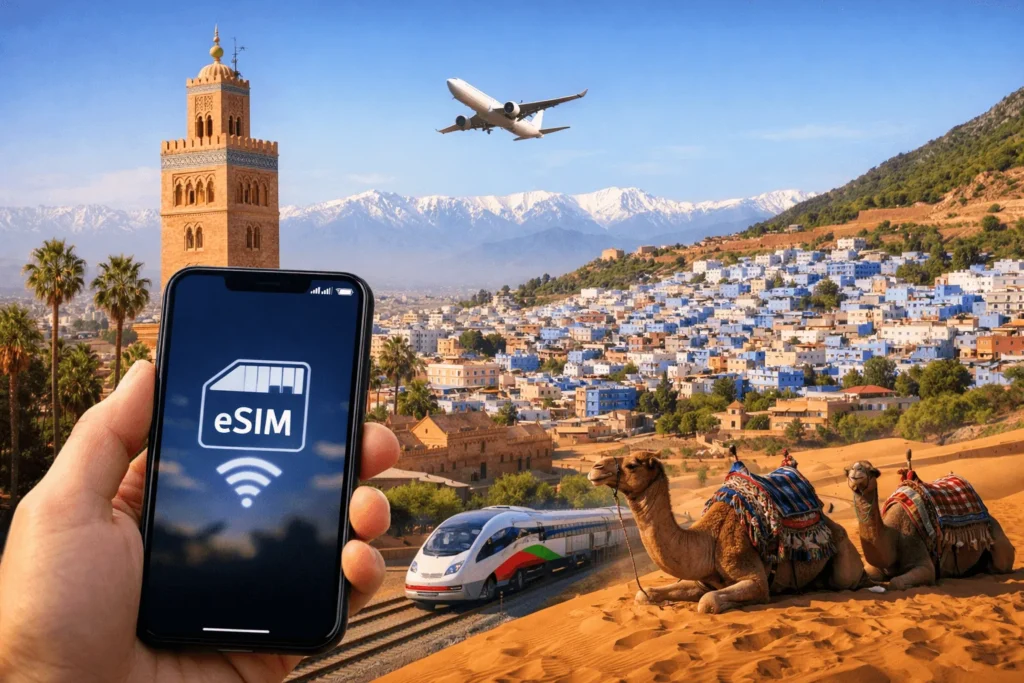
The Morocco eSIM (an embedded, digital SIM) is a modern alternative to the physical card. Instead of inserting a chip, you download a profile straight onto your phone via a QR code, and the data plan activates in a few minutes. Many recent smartphones (iPhone, Google Pixel, high-end Samsung ranges, etc.) are eSIM-compatible; check your device’s compatibility before relying on it.
The idea is simple: several international providers (well-known travel platforms available in the app stores) offer “Morocco” data plans that you buy online before leaving. On landing, you activate the plan and you are connected without having to look for a shop. eSIM rates often run around €5 to €15 depending on the volume and duration. As this guide is independent and not affiliated, we do not recommend any brand in particular: feel free to compare offers based on your data volume and validity period.
The eSIM is ideal for anyone who wants to:
- Be connected on arrival, without queuing at a stand.
- Keep their physical SIM (and therefore their usual number) active in parallel, in dual SIM.
- Avoid any handling of the chip and the risk of losing their original card.
Its downside: the price per gigabyte is generally higher than a local SIM bought in a shop. The eSIM therefore prioritises simplicity, while the local SIM prioritises budget. It is up to you to decide based on your priorities.
Wifi in Marrakech: hotels, riads and cafés
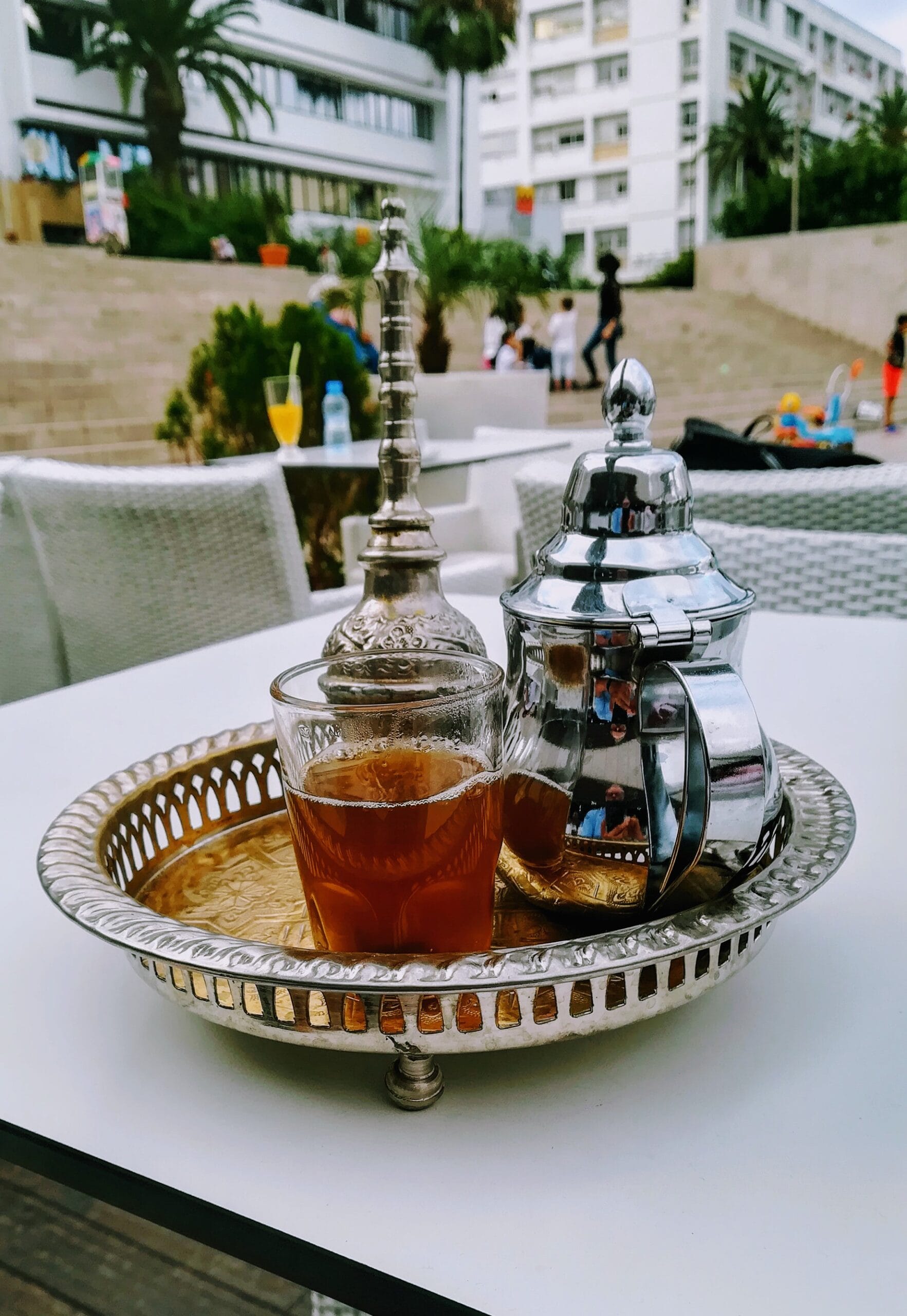
Free wifi is very widespread in Marrakech and can be enough for a traveller who is light on mobile data. Almost all hotels, riads and guesthouses offer a free wireless connection for their guests. In the medina’s riads, quality can vary from one room to another because of the thick, traditional walls: the connection is often excellent in the patio or at reception, and weaker in some bedrooms.
As for cafés and restaurants, wifi is common, especially in the modern establishments of the Guéliz and Hivernage districts, as well as in the big coffee chains. Ask for the password at the counter: it is often displayed or handed over with your order. That said, don’t count on a reliable connection in the medina’s traditional stalls or the stands of Jemaa el-Fna square.
Free wifi does have its limits, though: it ties you to one place, the speed is hit or miss and, above all, the security of public networks is uncertain. For browsing, booking a restaurant or planning your visits from your riad, it does the job very well. But to be self-sufficient on the move — hailing a taxi, following a route, looking up an address in the medina — a SIM or eSIM with data is far more comfortable. To organise your outings, our guide on what to do in Marrakech will give you plenty of ideas.
4G and 5G coverage in Marrakech
Mobile coverage in Marrakech is excellent. 4G is available everywhere in the city and works very well for browsing, streaming and video calls. All three operators deliver more than enough speed in the tourist districts, the medina, Guéliz, Hivernage and the Palmeraie.
A notable development: the three national operators launched commercial 5G in Morocco in November 2025, first in the major cities, including Marrakech. If your phone is 5G-compatible and you are in a covered area, you will enjoy even faster speeds. Orange is frequently cited as the best placed on urban 5G, but the gap with its competitors remains small in everyday use.
As soon as you leave the city — towards the Atlas valleys, Ouarzazate, the Ourika valley or the desert — coverage becomes more uneven. This is where Maroc Telecom stands out, thanks to its extensive network in rural and mountainous areas. If your plans include excursions far from Marrakech, take this into account when choosing your operator. For your journeys, also check our page on how to get around Marrakech.
Roaming and keeping your usual number
Beware of a common misconception: Morocco is not part of the European Union, and the “roam like at home” rule that applies within the EU does not hold here. Using your French or European plan on roaming in Morocco can cost a great deal, both for data and for calls. Be sure to check your operator’s non-EU roaming rates before you leave, or turn off mobile data roaming to avoid a hefty bill.
The good news is that you can perfectly well keep your usual number while using a local SIM or an eSIM. Two methods:
- Dual SIM: if your phone accepts two cards (or a physical SIM + an eSIM), keep your original SIM active for important calls/texts and use the Moroccan SIM for data. Remember to turn off mobile data on your original line so you don’t trigger roaming.
- Messaging apps: even with a local SIM, you stay reachable via WhatsApp, Signal or Telegram, which work with your original number as long as the app is connected to data.
Topping up and managing your Moroccan SIM
Once your SIM card in Marrakech is active, managing it is simple. Credit and data plans work on a prepaid basis: you top up when you need to, with no commitment.
- Topping up: you can buy top-ups (“recharge” or “pass”) in operator shops, but also in a host of small businesses, groceries, kiosks and tobacconists that display the operator’s logo. Amounts start at a few dirhams.
- Official apps: each operator offers a mobile app to top up, activate a data plan, track your usage and manage your line. Handy once the SIM is in hand.
- USSD codes: short codes (dialled like a phone number) let you check your balance or activate a pass; the seller will tell you which ones when you buy.
Note your plan’s validity date: most last 30 days. For a longer stay, you simply reactivate a pass from the app or in a shop. Also keep the little plastic holder from your original SIM so you can slot it back in easily when you return.
Practical tips: VPN, WhatsApp and security
A few useful habits to get the most out of your internet in Marrakech:
- WhatsApp for calls: voice and video calls go through perfectly via WhatsApp, Signal or Messenger as soon as you have data. It is the cheapest way to stay in touch with your loved ones, without using up traditional call credit.
- VPN on public wifi: on a café or airport wifi network, a VPN encrypts your connection and protects your sensitive data (banking, passwords). Install it before departure if you plan to use public networks.
- Offline maps: download your maps (for example the map of Marrakech) for offline use in your navigation app. You will keep GPS even without a connection, which saves data and is reassuring in the medina’s narrow alleys.
- Check the plan before leaving the stand: at the airport as in a shop, ask the seller to confirm that data works and to show you the volume and validity. A simple test (opening a web page) saves a lot of hassle.
Which option to choose for your profile
To help you decide quickly, here is a summary by traveller type:
- Tight budget, city stay: a local prepaid SIM bought in a shop in town. Best price per gigabyte. Inwi or Orange for 100% Marrakech use.
- Comfort first, connected on landing: an eSIM activated before departure, or a tourist pack at the airport stand. A little more expensive, but zero effort.
- Excursions in the Atlas or the desert: a local Maroc Telecom SIM, for the best coverage outside the cities.
- Very short stay (1–2 days): hotel and café wifi may be enough, topped up if needed with a small data eSIM.
- Traveller who wants to keep their number: a dual SIM setup (original SIM for calls + Moroccan SIM/eSIM for data), with roaming turned off.
In every case, mobile connection transforms the trip: hailing a taxi, comparing the prices of an airport transfer, following a route or improvising a visit becomes far easier. If you are preparing your programme, our 3-day Marrakech itinerary is best explored with your smartphone in hand.
FAQ: SIM card and internet in Marrakech
Can you buy a SIM card at Marrakech airport?
Yes. The arrivals hall of Marrakech-Menara airport usually hosts stands for the three operators (Maroc Telecom, Orange, Inwi). This is the most convenient option: the SIM is registered with your passport and activated on the spot. The packs are sometimes a little more expensive than in town, but you walk away immediately connected.
How much does a SIM with data cost in Morocco?
As a guide, a bare SIM costs 20 to 50 MAD, a 20 GB plan around 100 MAD (€10) and a 40 GB plan around 200 MAD (€20), valid for 30 days. Tourist packs at the airport often fall between €15 and €20. Prices change, so always check the current offer at the time of purchase.
Do you need a passport to buy a SIM in Morocco?
Yes, it is mandatory. Registering a mobile line requires ID, meaning your passport for foreign visitors. Keep it on you when you buy: without it, an official shop will not be able to activate your card.
Does the eSIM work in Morocco?
Yes, if your smartphone is eSIM-compatible. International providers offer “Morocco” data plans that you buy online and activate before landing. It is very handy for being connected on arrival and keeping your original number in parallel. The price per gigabyte is generally higher than a local SIM bought in a shop.
Will my European plan work in Marrakech?
Technically yes, but on roaming outside the European Union, which can be very expensive. Morocco is not part of the EU: the included European roaming rule does not apply. Check your operator’s non-EU rates, or turn off mobile data roaming and switch to a local SIM/eSIM.
Is free wifi enough for a stay in Marrakech?
For moderate use and a short stay, often yes: hotels, riads and cafés offer free wifi. The quality remains variable, especially in the medina’s thick-walled riads. But to be self-sufficient on the move (taxi, GPS, addresses), a SIM or eSIM with data is far more comfortable.
This guide is independent and not affiliated with ONDA or the telecom operators mentioned. Prices are given for indicative purposes only and may change.
Images under free licence via Wikimedia Commons: © Ben Bender (CC BY-SA 3.0); © Munfarid1 (CC BY-SA 4.0); © Elgaard (CC BY-SA 4.0). Sources: Wikimedia Commons.Image credits: illustrative photos. Information sources: Moroccan operators (Maroc Telecom, Orange Maroc, Inwi) and the Morocco page on Wikipedia.