Planning your trip and wondering how to handle money in Marrakech? Quick answer: the local currency is the Moroccan dirham (MAD), which is not exportable, so you get your dirhams on the spot (a bureau de change or, more simply, an ATM as soon as you arrive). In the medina, the souks and for petits taxis, cash is king: always carry some, preferably in small denominations. Hotels, tourist restaurants and larger shops often accept cards, but never rely on plastic alone.
This practical guide covers everything you need to know to pay in Marrakech stress-free: understanding the denominations, getting the best currency exchange in Marrakech, withdrawing at ATMs, using your card in the right places, working out how much cash to carry, tipping (the famous “bakchich”), avoiding change-related scams and keeping your money safe. The goal: arrive relaxed and spend smart, with no nasty surprises or needless fees.
In short: the essentials on money in Marrakech
- Currency: the Moroccan dirham (MAD or Dh), non-exportable — you exchange it locally.
- The simplest option: withdraw dirhams from an ATM on arrival, in town rather than at the airport.
- Cash is king: medina, souks, petits taxis, neighbourhood hammams, tips — all in cash.
- Cards: accepted in many hotels, restaurants and tourist shops, but never guaranteed elsewhere.
- Small denominations: keep 20 and 50 Dh notes plus coins for change and tips.
- Tipping: common and expected, around 10% at a restaurant, a few dirhams elsewhere.
| Payment method | Where it works | Tip |
|---|---|---|
| Cash (dirhams) | Everywhere: medina, souks, taxis, cafés, tips | Essential; favour small denominations |
| Bank card | Hotels, tourist restaurants, larger shops, supermarkets | A backup, not a standalone solution |
| ATM | Airport, Guéliz, Ville Nouvelle, medina entrances | Withdraw in town, decline the on-screen “conversion” |
| Bureau de change | Airport, Guéliz, medina | Compare rates, count your money before leaving the counter |
| Contactless / mobile payment | Modern outlets only | Handy but far from widespread |
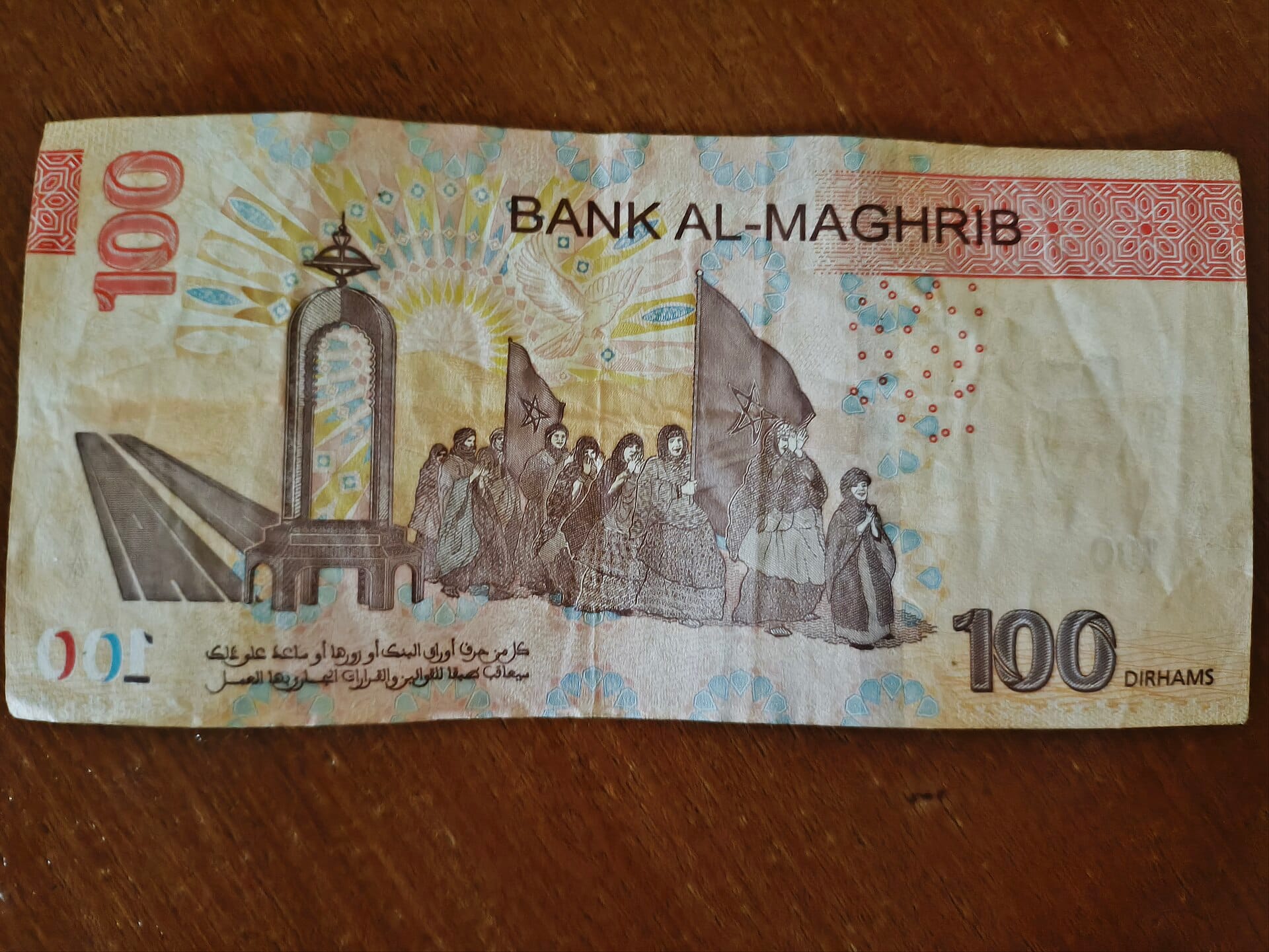
The currency: the Moroccan dirham, notes and coins
The official currency is the Moroccan dirham, abbreviated MAD in banking codes and often written “Dh” or “DH” on price tags. One dirham is divided into 100 centimes. In everyday speech you may also hear about the “rial” or the “franc”, especially in local markets: these are older units of account that can sometimes cause confusion. In practice, stick to the dirham shown on the labels and, if in doubt about a price quoted out loud, ask for confirmation “in dirhams”.
The notes in circulation come in denominations of 20, 50, 100 and 200 dirhams, each bearing the effigy of King Mohammed VI and national symbols. As for coins, you will mostly handle the 1, 2, 5 and 10 dirhams, along with half-dirhams (50 centimes) and small centime coins. The 200 Dh note is the largest note in common use: bear in mind that it can be hard to break a big note with a small trader or in a taxi.
A crucial point for organising your budget: the dirham is a non-exportable currency. Officially, you cannot take more than 2,000 Dh out of the country, and you will not easily find dirhams to buy in your home country before you leave. The direct consequence: there is no point trying to buy them in advance — you will get your dirhams once you arrive. At the end of your stay, spend your cash or convert it back at the airport (keep your exchange receipts carefully, as they may be requested for the reconversion).
As a rough guide, the rate has stayed relatively stable in recent years, at around 10 to 11 dirhams to 1 euro. This figure is given as an order of magnitude for your mental maths: roughly divide a price in dirhams by 10 to get an approximate value in euros. The exact rate changes daily; check it before you leave. To understand what these amounts really mean in day-to-day spending, see our Marrakech travel budget guide.
Exchanging money in Marrakech: where and at what rate
For currency exchange in Marrakech, several options are open to you, with varying rates and levels of convenience. Euros and dollars are exchanged without difficulty; other currencies (pound sterling, Swiss franc, etc.) too, but sometimes at less attractive rates. Here are the main possibilities and their advantages.
- Licensed bureaux de change: plentiful in Guéliz, in the medina and at the airport. They display the rate and, in principle, take no commission beyond the quoted rate. It is often the most transparent option.
- Banks: they also exchange currency during opening hours, sometimes with a little more paperwork but in a reassuring setting.
- Hotels: handy and available at any hour, but the rate is generally less favourable. Best kept for emergencies.
- ATMs: technically this is not “exchange” but a withdrawal in dirhams, often the simplest solution and at the interbank rate (see the next section).
The question that always comes up: should you exchange at the airport or in town? The airport bureaux de change are convenient when you land without a single dirham, but their rate is frequently worse than in the city centre. The smart strategy: exchange only a small amount at the airport (enough for a taxi and your first purchases), then top up in town, either at a bureau de change in Guéliz or by withdrawing at an ATM. That way you avoid locking a large amount in at a poor rate.
A few useful habits when you change money. First, compare the rates on display: they can vary from one counter to another just a few hundred metres apart. Next, ask for the net amount you will receive before handing over your notes, to avoid unpleasant surprises. Finally, always count the notes handed back to you in front of the teller, before leaving the counter, and keep your receipt. These receipts are useful in particular if you want to convert dirhams back at the end of your stay.
If you arrive by plane and want to compare transport options from the airport (and therefore anticipate your first cash needs), take a look at our comparison of airport transfers in Morocco. It will help you work out how much cash to have ready the moment you step off the plane.
Withdrawing at ATMs: using a cash machine in Marrakech
Finding an ATM in Marrakech is very easy: cash machines (ATMs) are plentiful at the airport, in the modern Guéliz district, in the Ville Nouvelle, around Jemaa el-Fna square and at the main medina entrances. Most accept international Visa and Mastercard and offer an interface in French, Arabic and English. For many travellers, withdrawing dirhams directly from an ATM is the simplest and often the most economical way to get cash, because the rate applied is close to the interbank rate.
Watch out, though, for withdrawal fees. They can come from two stackable sources: your own bank (foreign withdrawal fees and/or exchange fees) on one side, and sometimes the Moroccan bank that owns the ATM on the other, which may charge a fixed commission on withdrawals with a foreign card. To limit the damage, check your card’s overseas fees before you leave, and favour less frequent withdrawals of slightly larger amounts rather than lots of small withdrawals that multiply the fixed commissions.
Two habits that save money. First, when the ATM offers to let you “choose your currency” or be charged in euros rather than dirhams (so-called “dynamic currency conversion”), always decline and choose to be charged in dirhams (MAD): letting your own bank do the conversion is almost always more favourable than the rate imposed by the machine. Second, keep in mind that withdrawal limits per transaction exist and vary between Moroccan banks (often a few thousand dirhams per transaction); if needed, make two withdrawals in a row or move to another machine.
- Favour in-branch ATMs (set into a bank wall) and during the day: if something goes wrong (a swallowed card), staff are on hand.
- Tell your bank about your trip to avoid the card being blocked for a “suspicious transaction abroad”.
- Shield your PIN and be wary of isolated machines or ones that look tampered with.
- Withdraw in town rather than at the airport, where the choice of machines and the terms may be less favourable.
Paying by card in Marrakech: where it works, where it doesn’t
Bank cards are increasingly accepted, but Marrakech remains a city where cash largely dominates. Understanding where cards work will save you plenty of awkward moments. In short, cards work mainly in “structured” and tourist businesses, while the economy of the medina and the street stays in cash.
Where cards are generally accepted:
- Hotels and a good share of riads (especially those booked online).
- Tourist restaurants, modern outlets and hotel bars.
- Supermarkets, larger stores and the designer boutiques of Guéliz.
- Major car-rental agencies and some activities booked in advance.
Where you will need cash:
- The stalls and craftsmen of the souks of Marrakech, where you haggle and pay in cash.
- The petits taxis (the famous beige “petits taxis”), horse-drawn carriages and many informal transport options.
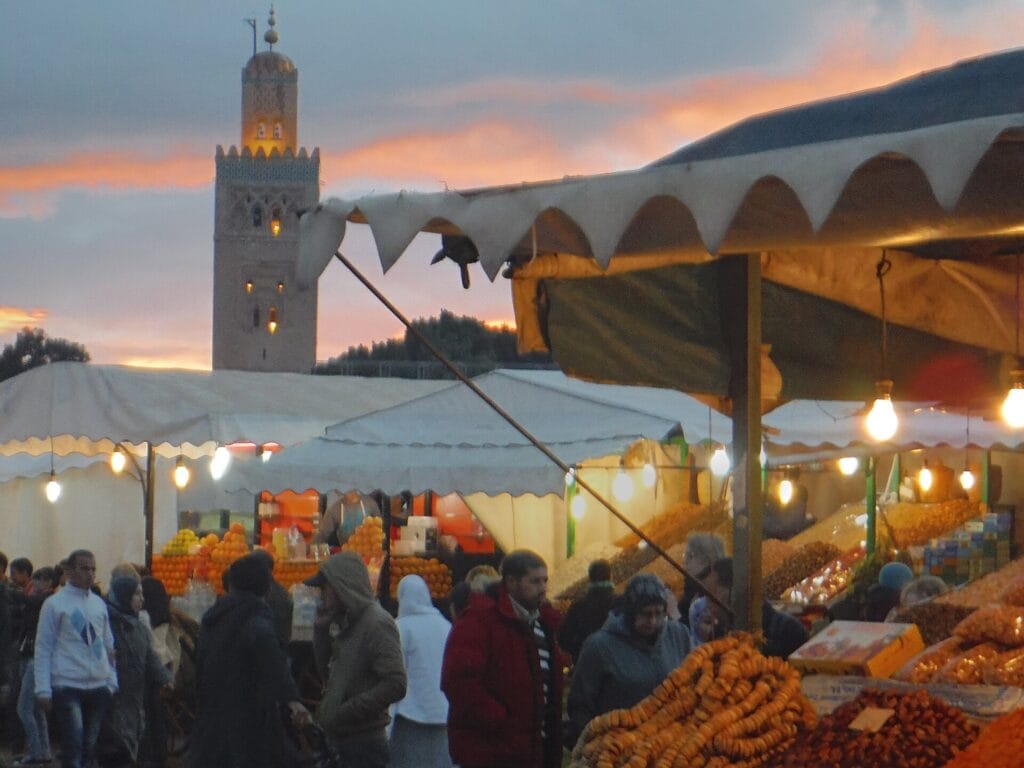
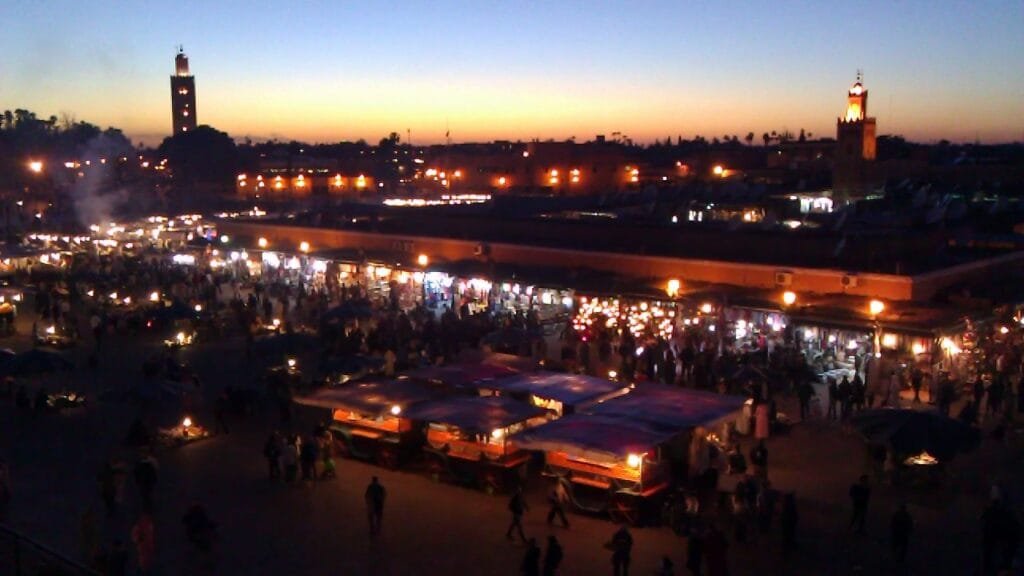
- Street-food stands, local cafés and most of the spots on Jemaa el-Fna square.
- Neighbourhood hammams, tips, small services and entry to certain sites.
Even where cards are accepted, keep a few precautions in mind. Some traders apply a minimum amount for card payment, or pass on fees. Others will claim the “terminal is down” on a busy day. So never head out shopping or to dinner in the medina counting on your card alone. To choose your spots and know what to expect, our selection of places where to eat in Marrakech and our complete guide to things to do in Marrakech will come in handy.
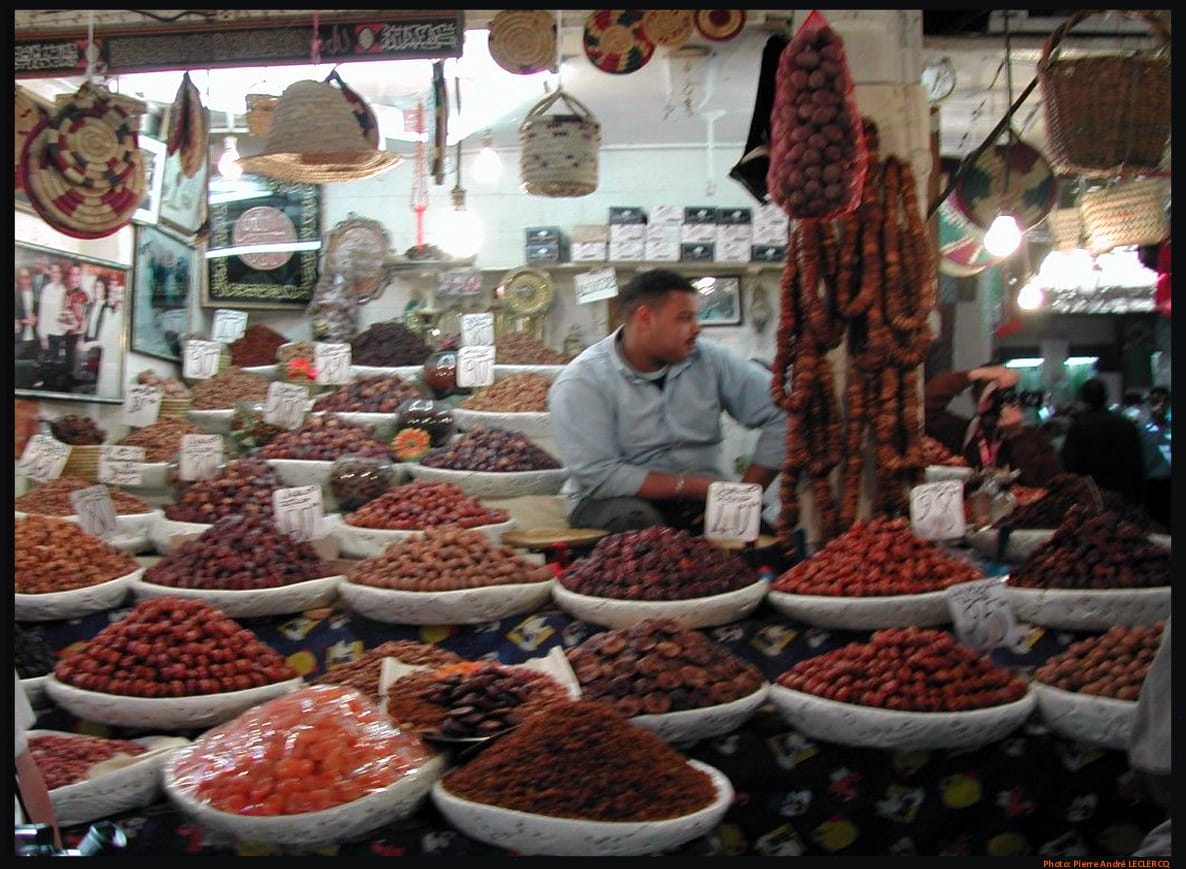
How much cash to carry each day
Since cash is unavoidable, the real question becomes: how much to keep on you? The right approach is not to withdraw everything at once, but to calibrate your cash to one or two days of everyday spending, topping up at an ATM as needed. That way you limit the risk in case of loss or theft, while always having enough to pay where cards don’t work.
The category that “eats” the most small denominations is micro-spending: a tea, a taxi, a tip, a purchase in a souk, a ticket. So always keep a stash of 20 and 50 dirham notes and coins. A useful habit: when you pay a larger amount at a hotel or restaurant that accepts cards, pay by card and keep your cash for the street. Conversely, break your big notes (100 and 200 Dh) at larger businesses, not with the small vendor who “never has change”.
How you manage cash obviously depends on your travel style. To fine-tune your ballpark figures (transport, meals, activities, shopping), refer to the Marrakech travel budget, which details the price ranges. Also think about how you get around: the way you travel influences how many small denominations you need — it’s all explained in our guide to getting around Marrakech.
Tipping in Marrakech: who, how much, how
Tipping — often called “bakchich” — is an integral part of the culture in Morocco. It is not just an occasional extra: it is a common practice, often expected in return for a service, however modest. The good news is that the amounts stay small and you keep control: a tip is always given in cash, in dirhams and in small denominations. Here are the benchmarks so you don’t get it wrong.
- Restaurants: around 10% of the bill in a decent establishment if service is not included. In a café, a few coins or 5% is enough.
- Porters and hotel staff: a few dirhams per bag or per service rendered (housekeeping, a receptionist who helps you out).
- Parking attendants: those “guardians” in vests who watch your car expect a few dirhams (often 2 to 5 Dh, a little more at night).
- Guides and drivers: for a guided visit or a full-day excursion, a tip is appreciated and proportional to the quality and length of the service.
- Small services: the person who genuinely shows you the way, the street server, the craftsman who shows you his workshop… a few coins are customary.
Two important nuances. First, tipping should remain voluntary and proportionate: don’t feel obliged to give for a service that wasn’t rendered, or in the face of insistent solicitation. Second, always keep a small reserve of coins and 20 Dh notes accessible: pulling out a 200 Dh note for a tip will leave you unlikely to get any change back. A separate “tips” purse, kept apart from the rest of your money, is a simple and effective trick.
Haggling: its direct link with money
It’s impossible to talk about money in Marrakech without mentioning haggling, which remains the norm in the souks and for many informal services. In practice, in the medina, the displayed (or quoted) price is a starting point, not a fixed price. This has very concrete consequences for managing your cash: you need to be able to pay the exact negotiated amount, in cash, without flashing your whole wad of notes.
A few money-related principles. Always negotiate before taking out your wallet, and set your maximum price in your head. Once the price is agreed, pay as close to that amount as possible with suitable denominations: preparing the sum in advance, discreetly, avoids the “I don’t have change” that pushes the bill up. Never show all your money: keep the bulk of your cash out of sight and only take out what you need. To master the codes of negotiation and spot the good deals, our guide to the souks of Marrakech and our ideas for souvenirs to bring back from Marrakech will give you solid bearings.
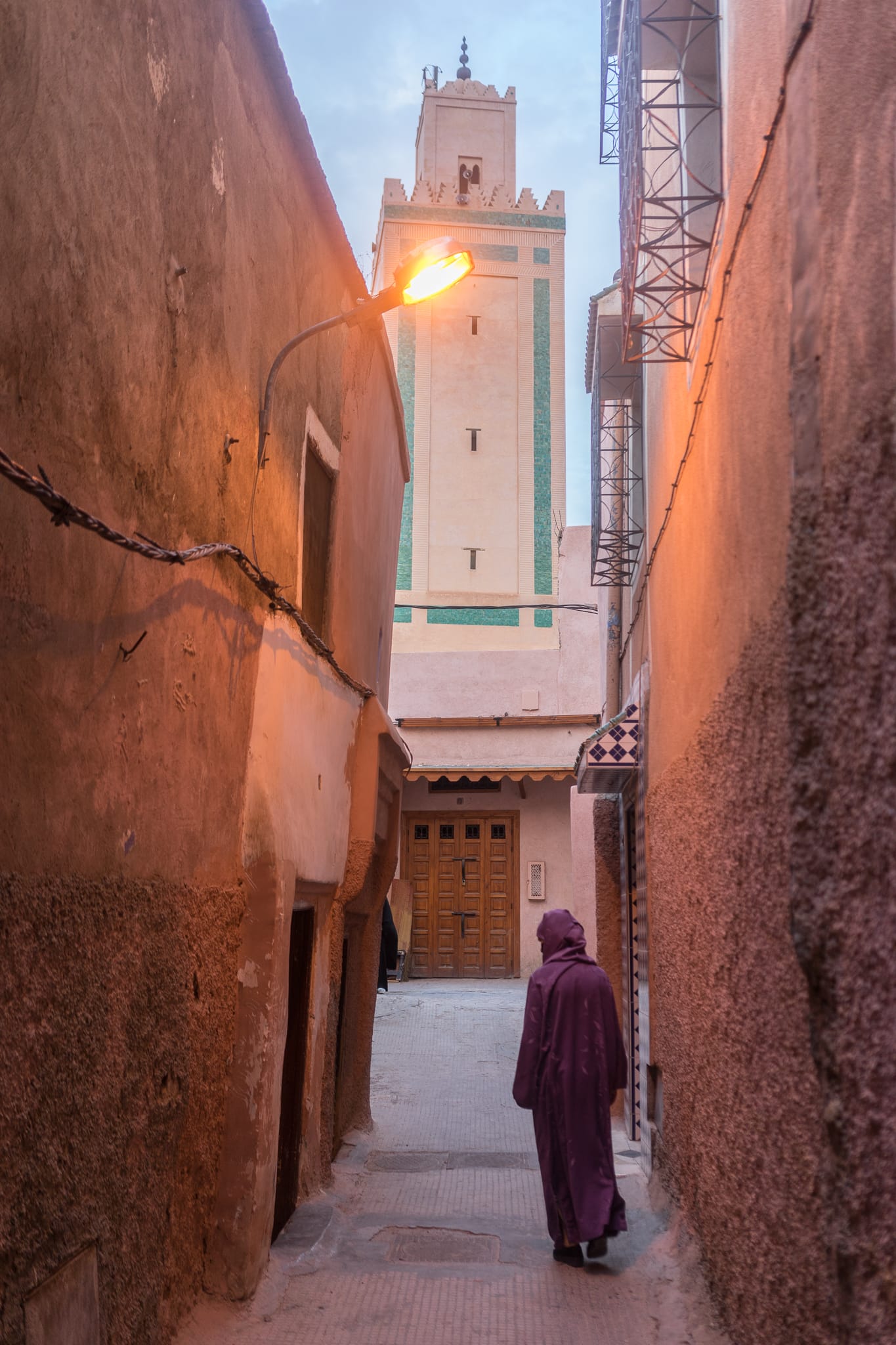
Money-related scams: counterfeit notes and change
Marrakech is a broadly safe destination, but as in any major tourist city, a few money-related traps exist. Knowing them is already half of neutralising them. Most rely on confusion, haste or a lack of attention at the moment of paying.
- “Short-changing”: an error (deliberate or not) on the change is the great classic. Always count what you’re given, on the spot, before leaving.
- Confusion over denominations: taking advantage of a tourist who struggles to tell their notes apart. Quickly get familiar with the colours and values of the 20, 50, 100 and 200 Dh notes.
- The “no change” line: a vendor who claims to be unable to give change on a big note in order to round up in his favour. Hence the value of having small denominations.
- Black-market exchange: offers of “favourable” exchange in the street expose you to counterfeit notes and expired bills. Only exchange in licensed places.
- The fake rate “mistake”: check the rate and the net amount quoted before any exchange transaction.
The defence comes down to three words: slowness, verification, discretion. Take the time to count, don’t let yourself be rushed, and don’t display your money. These scams remain rare and easy to avoid with a minimum of vigilance. For a broader overview of tourist traps (fake guides, solicitations, etc.), see our feature on safety and scams in Marrakech.
Payment apps and contactless
Contactless payment is spreading in the modern outlets of Marrakech: many terminals now accept a card “tap”, and sometimes mobile payment via smartphone or smartwatch. In a hotel, a supermarket or a restaurant in Guéliz, you can often pay contactless just like at home. That technology, however, stays confined to structured businesses: don’t imagine paying a taxi or a souk purchase with a simple flick of the wrist.
As for money-transfer apps or digital wallets, bear in mind that the local ecosystem differs from your home country’s and that everything ultimately rests on the availability of cash. The wisest approach is to treat your smartphone as a handy backup in certain places, and not as a substitute for cash. In plain terms: charged phone and activated card for the big outlets, but always dirhams in your pocket for the rest. This mixed approach is also the most comfortable day to day, including when choosing your accommodation — see our tips on where to stay in Marrakech.
Safety tips: spreading out and protecting your money
The best way to manage your money in Marrakech comes down as much to organisation as to exchange rates. The guiding idea: never put all your eggs in one basket. By spreading out your means of payment, you stay operational even in case of loss, theft or a blocked card.
- Split your cash: a small, accessible amount in a pocket for the day, the rest in the safe of your riad or hotel.
- Two means of payment: ideally two cards stored in two different places, plus cash, so you are never completely stuck.
- Avoid open bags: in the crowds of the souks or Jemaa el-Fna, favour a closed satchel worn in front of you.
- Note the useful numbers: your bank’s card-cancellation number, accessible offline, so you can block a lost card quickly.
- Keep your exchange receipts and a record of your withdrawals, useful in case of a dispute or for a reconversion at the end of your stay.
Finally, a word of common sense: keep a cool head in the face of solicitations. The vast majority of Marrakchis are welcoming and honest, and the precautions above are not meant to breed mistrust, but to let you travel with peace of mind. Good financial preparation ultimately means time and energy you can spend enjoying the city rather than dealing with money hassles.
Note: this guide is published by an independent information site, not affiliated with ONDA or any bank; the rates, fees and amounts are given purely for indicative purposes and may change.
FAQ: money and payment in Marrakech
Should you exchange money before leaving for Marrakech?
No, it’s not necessary and it’s even difficult: the Moroccan dirham is not exportable and is hard to find abroad. The simplest option is to get your dirhams on the spot, by withdrawing at an ATM on arrival or exchanging a small amount at the airport before topping up in town.
Can you pay in euros in Marrakech?
Some very touristy shops, riads or guides sometimes accept euros, but the rate they apply is almost always unfavourable to you, and your change will be given in dirhams. To pay in Marrakech at a fair price, it’s better to use the local currency.
Are ATMs reliable and easy to find?
Yes, you can find an ATM in Marrakech almost everywhere: airport, Guéliz, Ville Nouvelle, the edges of the medina. They accept international cards. Remember to decline the on-screen conversion into euros (choose to be charged in dirhams) and favour ATMs attached to a bank branch.
How much cash to carry per day?
Carry enough to cover one or two days of everyday spending, in small denominations (20 and 50 Dh) and coins, rather than pulling out all your money at once. You limit the risk in case of loss while always having cash for taxis, souks and tips.
Is tipping mandatory in Marrakech?
It’s not mandatory in the strict sense, but very common and often expected. Reckon on around 10% at a restaurant if service is not included, and a few dirhams for porters, parking attendants and small services. Always give in cash and in small denominations.
How can you avoid change-related scams?
Always count the change you’re given, before leaving the counter, and learn to recognise the 20, 50, 100 and 200 Dh notes. Always keep small denominations so you don’t depend on the vendor’s change, and only exchange money in licensed places.
To go further, the encyclopaedic entry on the Moroccan dirham on Wikipedia details the history and features of the currency. And to plan the rest of your stay, explore our complete guide to things to do in Marrakech.
Images under free licence via Wikimedia Commons: © فاطمة الزهراء (CC BY-SA 4.0); © Pierre André Leclercq (CC BY-SA 4.0); © Omalihy (CC BY-SA 4.0). Sources: Wikimedia Commons.Photo credits: royalty-free illustrative images. Content for informational purposes, independent of ONDA and any banking institution.