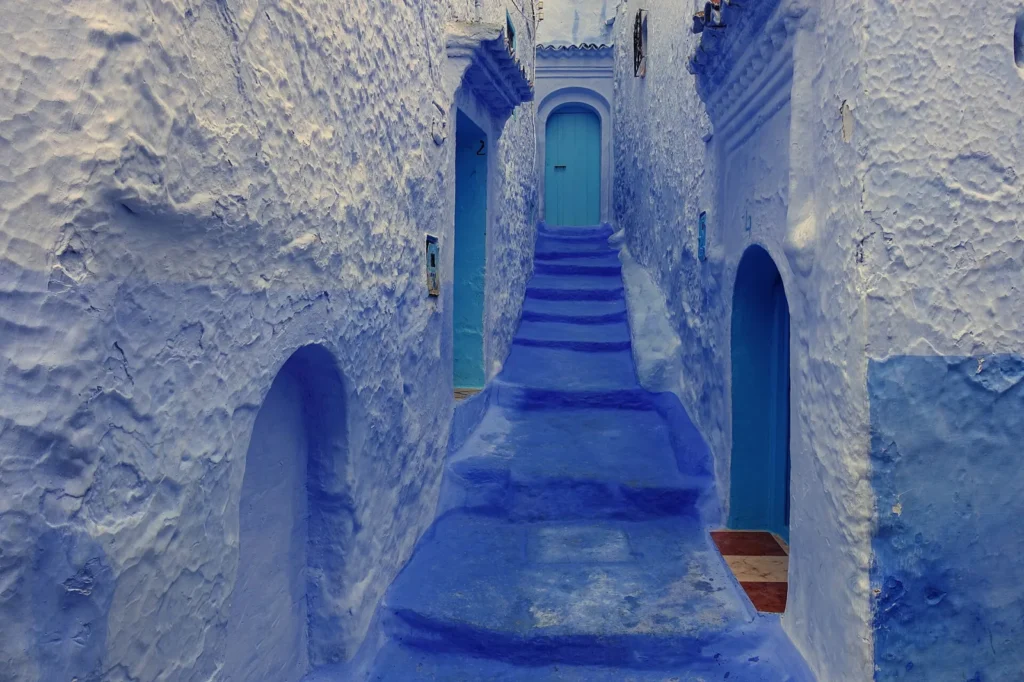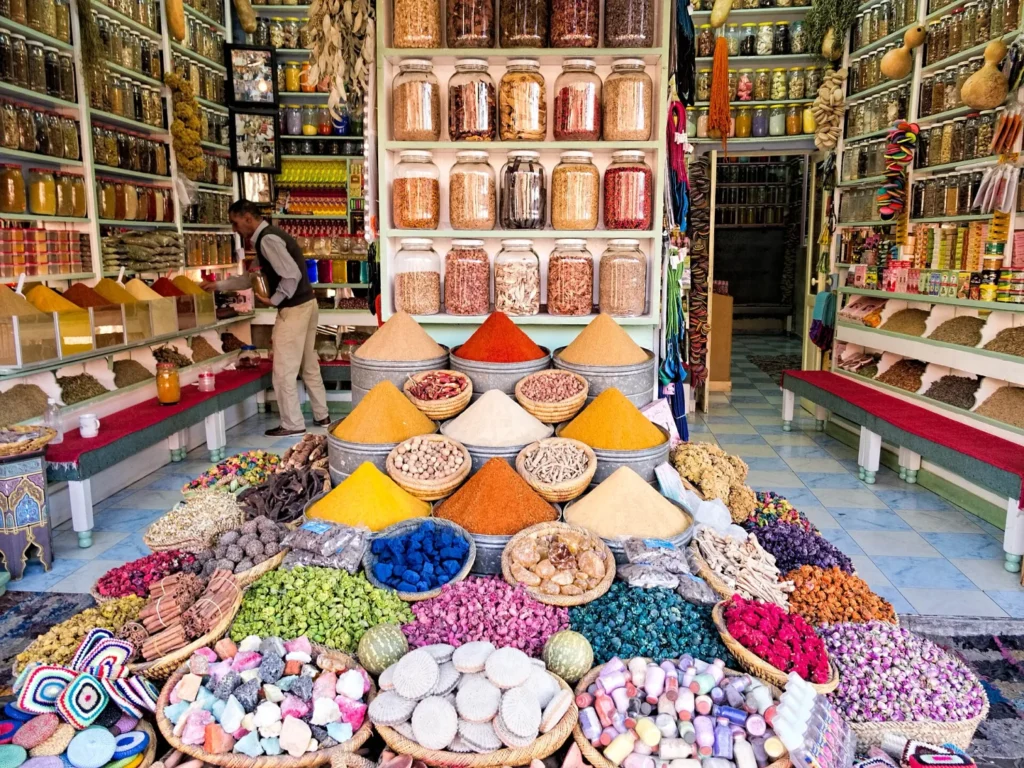
Looking for things to do in Chefchaouen? The answer starts with something that should be said straight away: the town is small, and that is its strength. You do not come here to tick off a list of monuments, you come to walk through a medina painted entirely in blue, set against the mountains of the Rif, and the plan builds itself around two or three fixed points plus a great deal of wandering.
This guide separates what is genuinely unmissable from what has to be earned, explains what to see at which hour — the decisive factor here — and sets out how to get there, since Chefchaouen has no airport and is reached by road from Tangier or Fez.
In brief: the essentials of Chefchaouen
- The blue medina: the heart of the stay, to be walked with no itinerary, preferably early in the morning.
- Outa el-Hammam square: the large central square, with the kasbah and the mosque, your landmark in the maze.
- The Spanish Mosque: the viewpoint over the town, a good half-hour’s climb away.
- Ras el-Maa: the spring at the top of the medina, where water comes down from the Rif and locals still wash clothes.
- The Akchour waterfalls: the big hike of the area, to be counted as a full day.
- No airport: you arrive by road, around two hours from Tangier and four from Fez.
Why is the town blue?
This is the first question everyone asks, and the honest answer is that there is no single established one. Several accounts circulate locally and in guidebooks, and they do not necessarily exclude each other.
The one most often heard attributes the colour to the Jewish community that settled in the town, for whom blue carried symbolic value. Another holds that blue keeps mosquitoes away, which belongs more to local belief than to entomology. A third, the most prosaic, points out that tinted limewash keeps walls cool, and that the colour, having become the town’s visual identity, is now maintained because it brings visitors in.
We present all three as competing accounts without settling the matter: none is decisively documented. What is certain is that the blue is repainted regularly, by the residents, and that this upkeep is part of life in the quarter. You will come across people applying limewash, and that is a truer image of the town than any explanation.
The medina: getting lost, and where exactly
Chefchaouen’s medina is one of the few in Morocco where you can walk with no map and no anxiety. It is small, enclosed, set against the slope, and every lane eventually drops back down to the central square or climbs up towards the spring. You do not stay lost for long, and that is exactly what you should do: visiting it means walking at random.
One thing to grasp immediately: the gradient. The town is built on a steep slope, the lanes are made of steps and uneven cobbles, often slippery after rain. Bring closed shoes with grippy soles; flip-flops and smooth soles are a bad idea here.
Outa el-Hammam square
This is the town’s centre of gravity. A large irregular square lined with café terraces, overlooked by the kasbah on one side and the great mosque with its octagonal minaret on the other. This is where you sit down when you have finished walking, and it is also the landmark that stops you ever being truly lost: ask for the square and everyone will point you to it.
The terraces around it are touristy and the prices reflect it, but the view over the square in the late afternoon easily justifies a tea. In the evening the square stays lively and it is one of the most pleasant places in town.
The kasbah and its garden
The old fortress occupies one side of the square. It can be visited: a planted inner garden, ramparts you can walk around, and a tower whose floors you climb for a first view over the rooftops and the minaret. The circuit is short, a small hour is enough, and the ticket stays cheap. It is Chefchaouen’s only monument in the strict sense, and its main interest is precisely that view from the tower, more accessible than the climb to the Spanish Mosque.
Ras el-Maa, the spring
Walking up the medina to its highest point brings you out at Ras el-Maa, where the water comes down from the mountain. There is nothing monumental about the place, and that is the whole point: basins, a wash house where women still do laundry, cafés clinging above the stream. It is the point where the tourist town and the lived-in town overlap most clearly.
It is also the start of the path up to the Spanish Mosque, which lets you link the two without walking back down.
The Spanish Mosque: the viewpoint not to miss
On the hill facing the medina stands a small disused mosque, built in the 1920s during the Spanish protectorate period and never really used. Nobody climbs up for the building, which is modest: you climb for what you see from its forecourt, the whole blue medina spread out at the foot of the mountain.
The climb is on foot from Ras el-Maa, by a switchback path, and takes in the order of thirty to forty minutes depending on your pace. The path is clearly traced but stony and without shade: take water, and avoid the middle of the day in summer.
The right moment is the late afternoon, an hour before sunset: the light comes straight onto the medina and the blue takes on its full depth. It is also the busiest slot, which hardly matters since the forecourt is wide. Head back down before full darkness: the path is not lit.
The other viewpoints
If the climb puts you off, two shorter options exist: the kasbah tower, already mentioned, and the terraces of the medina’s guesthouses, many of which welcome passers-by for a tea. They are not the same images — you see rooftops rather than the town head-on — but the effort-to-result ratio is excellent.
Photographing Chefchaouen without bothering anyone
This is a town where a great deal of photography happens, and where residents live with it all year round. Two or three simple habits make things considerably more pleasant for everyone.
For the light, the slot is early: between daybreak and nine o’clock the lanes are empty, the shops still shut, and the blue is even without harsh contrast. After eleven, the sun reaches into the narrow lanes and creates differences you cannot recover. In the late afternoon the light softens again but the lanes are full.
As for people, the rule is the same as anywhere but more visible here: you ask before photographing someone, and you accept a refusal. Avoid photographing the inside of houses from the street, even when the door is open. And be aware that some particularly photogenic lanes are private entrances: residents sometimes put out flowerpots and welcome photographs, sometimes not.
Hiking around Chefchaouen
This is the other half of the stay, and the one many visitors discover too late. Chefchaouen sits at the threshold of Talassemtane National Park, a forested mid-mountain massif with a real network of trails. The town is therefore as much a hiking base as a photographic destination.
| Outing | Distance from town | Suggested length | Level |
|---|---|---|---|
| Spanish Mosque | On foot from the medina | 1 h 30 round trip | Easy, sustained climb |
| Akchour waterfalls | ≈ 30 km | Full day | Moderate, path along the river |
| God’s Bridge (Akchour) | ≈ 30 km | Half a day from Akchour | Moderate |
| Talassemtane Park | Variable | A day or more | Moderate to demanding, guide advised |
The Akchour waterfalls are the most requested outing. You reach the trailhead by shared taxi or car, then walk along a river up to the falls, with pools where you can swim in season. Count on the whole day: the drive, the walk there and back, and a lunch stop at one of the eateries at the trailhead. The path is busy and worn in by use, but it remains a mountain path, with sections over rock.
God’s Bridge, a natural arch carved out by the water, is in the same area and can be combined with the falls if you set off early. For longer hikes in Talassemtane, a local guide changes everything: not all the trails are obvious and distances are easily underestimated.
When to come: the altitude changes everything
This is the point visitors most underestimate. Chefchaouen is not a coastal town: it is in the mountains, several hundred metres up, and its climate has nothing to do with that of Marrakech or Agadir. It rains considerably more, nights are cool for much of the year, and snow can fall on the heights of the Rif in winter.
| Period | What defines the season | Who it suits |
|---|---|---|
| December to February | Cool and damp, frequent rain, slippery lanes. Quiet town and soft light. | A quiet stay, photography, small budgets |
| March to May | The best window: green vegetation, high water at Akchour, ideal walking temperatures. | Hiking, waterfalls, a first visit |
| June to August | Hot by day but bearable thanks to the altitude. Busy, with accommodation under pressure. | Swimming in the pools, school holidays |
| September to November | Still mild, crowds thinning, the first autumn rains. | Hiking, a quiet stay |
Two practical consequences. First, bring a jacket even in summer: in the evening the gap with daytime is marked. Second, if the Akchour waterfalls are your goal, spring is clearly better than late summer, when the flow drops. To decide across the whole country, see our guide to the best time to visit Morocco.
How to get to Chefchaouen
Chefchaouen has no airport, and that is the first thing to factor into your planning: you always arrive by road. The two air gateways are Tangier Ibn Battouta Airport, the nearest of the large airports, and Fez-Saïss Airport if you are combining with the imperial cities. Tétouan airport is closer still but far less well served.
| From | Approximate time | Worth knowing |
|---|---|---|
| Tangier | ≈ 2 h by road | The most practical gateway; regular buses and shared taxis. |
| Tétouan | ≈ 1 h by road | The shortest run; useful if you are coming via the Mediterranean coast. |
| Fez | ≈ 4 h by road | The classic leg on an imperial cities circuit. |
| Casablanca | ≈ 6 h by road | Long; better to go via Tangier or Fez by domestic flight or train. |
The long-distance bus is the simplest option from Tangier or Fez: regular services, tickets to book ahead in high season, and arrival at Chefchaouen’s bus station, from where a taxi takes you up to the medina. Shared taxis are faster and more flexible but leave when full, which takes a little patience.
If your flight leaves you time in Tangier before taking the road, we have detailed where to eat in the terminal and how to get online: worth knowing, since the run to Chefchaouen is then done in one go.
One useful warning: the road climbing into the Rif is very winding over the last stretch. If you are prone to travel sickness, sit at the front, avoid reading, and do not set off on an empty stomach. It is the detail nobody mentions and which nonetheless spoils many arrivals.
How long to stay
The question genuinely arises, because the obvious answer — one night, long enough to see the medina — leaves out half of what makes the place interesting.
| Length | What we would do | What we would skip |
|---|---|---|
| One night | Medina in the late afternoon, Spanish Mosque at sunset, medina early the next morning | Akchour and any hiking |
| Two nights | The same, plus a full day at Akchour | Talassemtane in any depth |
| Three nights or more | All of the above, plus a hike in Talassemtane with a guide | Nothing essential |
The format we would recommend is two nights. It lets you see the medina at its two good hours — evening and early morning — and devote a full day to the waterfalls without rushing. With a single night you will see the town and nothing of the massif, which is a shame since that is precisely what sets Chefchaouen apart from a merely photogenic stop.
Eating in Chefchaouen
The cooking is that of northern Morocco, and two or three things are worth seeking out rather than putting up with. The region’s goat cheese is the local speciality most often mentioned: fresh, sometimes in small moulds, sold at the markets and served in guesthouses at breakfast. Bissara, a thick broad bean soup served very hot with a thread of olive oil and cumin, is the morning dish for cool weather, and that is exactly Chefchaouen’s climate in winter.
Otherwise you find the usual tagines and grills. The rule is the same as everywhere: the terraces on the central square charge for the view, while addresses in the lanes slightly off to the side and those in the modern quarter below serve the same thing at the prices locals pay. The difference adds up over a two- or three-day stay.
Guesthouses in the medina often offer dinner on request, served on the terrace. It is a formula that works well in this town: the lanes are dark in the evening, the slopes steep, and eating in saves you going down and climbing back up.
Where to stay: medina or lower town
| Area | What it is | Who it suits |
|---|---|---|
| Medina | Guesthouses in the blue houses, rooftop terraces, reachable on foot only. | The full experience, short stays |
| Edge of the medina | Hotels reachable by car, a few minutes’ walk from the gates. | Travellers with a car, heavy luggage |
| Lower / modern town | A residential and commercial quarter, less charm, lower prices. | Small budgets, longer stays |
The point to anticipate is access. You do not drive inside the medina: you leave the vehicle at a car park on the edge and walk up, sometimes dozens of steps, with your luggage. That is no problem with a rucksack, it is one with two large suitcases. Before booking, ask your accommodation how far it is from which gate and how many steps lie between the two.
Crafts: wool and weaving
Chefchaouen is a weaving town, and that is the purchase that makes most sense here: wool blankets, long-pile rugs, thick woollen djellabas, shawls. The Rif is a livestock region, the raw material is local, and several workshops in the medina still work at looms visible from the street.
Two pieces of common sense. First, touch the cloth: real wool is heavy, slightly greasy, and does not shine. Very light, very shiny pieces at low prices are synthetic fibre, which is no scandal but should be reflected in the price. Second, haggle, but over what you actually want: bargaining is the custom, and it goes better when you genuinely intend to buy.
On bulk, think about the journey home: a wool blanket takes up a considerable amount of space in a bag. It is the kind of purchase to decide once you know your flight’s baggage allowance.
Practical advice
Money
There are cash machines in the lower town and on the edge of the medina, but fewer than elsewhere and they can be out of service. Bring cash on arrival: many small addresses, taxis and workshops do not take cards, and you do not want to be hunting for a cash machine while walking up a slope with your luggage.
Shoes and gradient
We repeat it because it is visitors’ first regret: the town is on a slope, the cobbles are uneven and slippery in damp weather. Closed shoes with a lugged sole completely change the experience, and they will serve for the climb to the Spanish Mosque and for Akchour too.
Dress and customs
Chefchaouen is a small northern town, more conservative in its customs than a beach resort. Clothing that covers the shoulders and knees is appropriate in the medina, for men as much as for women. It is not a heavy constraint, and in any case it coincides with what you would wear in the mountains in the evening.
Languages
Here is a local peculiarity worth knowing: Spanish is far more present here than in the rest of Morocco, a legacy of the Spanish protectorate period in the north. Many shopkeepers speak it fluently. French works too, and English increasingly in accommodation. If you speak Spanish, this is the Moroccan town where it will serve you best.
Chefchaouen with children
The town is easier to manage as a family than most Moroccan medinas, for one simple reason: there is almost no traffic in the lanes. No speeding mopeds, no cars, no carts — children walk without you holding their hand the whole time, which is impossible in Marrakech or Fez.
The trade-off is the gradient. Steps are everywhere, and a pushchair is frankly unsuited to the medina; a baby carrier works far better. Choose accommodation near a gate to limit the climb with luggage.
As for activities, the central square is good ground for a late-afternoon run-around, Ras el-Maa appeals because of the water, and the Akchour pools are a goal that motivates a walk. The climb to the Spanish Mosque, on the other hand, is long and shadeless: with young children, prefer the kasbah tower.
Frequently asked questions about Chefchaouen
How many days do you need in Chefchaouen?
One night is enough for the medina and the viewpoint, but two nights are clearly better: they let you give a full day to the Akchour waterfalls without rushing. Beyond that, the town becomes a hiking base in Talassemtane park.
Why is Chefchaouen blue?
Several explanations circulate — a tradition linked to the town’s Jewish community, the idea that blue keeps mosquitoes away, the use of tinted limewash to keep walls cool — and none is decisively established. What is certain is that the blue is maintained regularly by the residents.
Is there an airport in Chefchaouen?
No. You arrive by road: around two hours from Tangier, one hour from Tétouan and four hours from Fez. Tangier Ibn Battouta is the most practical large airport.
Can you visit Chefchaouen as a day trip from Tangier?
It is feasible, around four hours of driving in total, but you will arrive and leave at the wrong moment for the light and miss the medina early in the morning, which is one of its best hours. A night on site changes the experience a great deal.
What is the best time to go?
Spring, from March to May: ideal walking temperatures, green vegetation and high water at the falls. Winter is cool and wet but very quiet; summer is hot by day and very busy.
Are the Akchour waterfalls worth a whole day?
Yes if you like walking and if the season suits. The path follows a river and remains a mountain path, with sections over rock. By late summer the flow drops noticeably: in spring the interest is far greater.
Is the medina hard to walk around?
It is small and you do not stay lost for long, but it is steeply sloped, made of steps and uneven cobbles that get slippery after rain. Closed shoes with grippy soles are genuinely recommended.
Can you photograph freely in the lanes?
The lanes, yes. For people, ask first and accept a refusal; some very photogenic lanes are in fact private entrances. The light is best before nine in the morning, when the medina is still empty.
In summary
Chefchaouen is a small town whose programme is written in hours rather than monuments: the medina early in the morning when it is empty, Outa el-Hammam square in the late afternoon, the Spanish Mosque an hour before sunset. Add a full day at the Akchour waterfalls and you will have seen the essentials without rushing anything.
The two mistakes to avoid are spending only a handful of hours here on a day trip from Tangier, and forgetting that the town is in the mountains: grippy shoes, a jacket for the evening, and cash on arrival. The rest takes care of itself, and that is precisely why people love this town.
Sources and updates
Journey times come from our own records and our airport guides; they are orders of magnitude on a mountain road where conditions vary. Entry fees, opening hours and bus frequencies can change without notice: check on site. For entry requirements to Morocco, refer to the official guidance issued by your own country, for example the UK Foreign Office travel advice. To prepare your arrival, see also our complete list of Moroccan airports. Page updated in October 2026.
Photo credit: see the media record for the author and licence.