Looking for things to do in Agadir? The question works differently here than anywhere else in Morocco. Agadir is not an imperial city: an earthquake destroyed it in 1960 and it was rebuilt as a modern seaside resort facing the Atlantic. You do not come here for a thousand-year-old medina, but for ten kilometres of sand, sunshine that holds up all year round, and a hinterland that switches from beachfront to the mountains of the Anti-Atlas in half an hour.
This guide gathers what genuinely deserves your time, what depends on the season, and how to plan a day without losing hours in transit. It is written from the angle we know best: that of the traveller landing at Al Massira Airport who wants to know what to do from the very first afternoon.
In brief: the essentials of Agadir
- The beach: 10 km of sand in a crescent, lined by a promenade. It is the heart of the resort and the reason Agadir exists as a destination.
- Oufella kasbah: the remains of the old fortress, up on the hill, for the panorama over the bay.
- Souk El Had: the city’s largest market, and the most authentic breath of air in the whole stay.
- Taghazout: a surf village roughly 40 km to the north, one of the best spots in Morocco.
- Paradise Valley: natural pools and a palm grove in the Anti-Atlas, about an hour’s drive away.
- The airport sits around 22 km south-east of the centre, roughly twenty minutes by taxi.
Agadir beach, and how to actually enjoy it
Agadir bay traces a crescent of almost ten kilometres, facing due south-west. That orientation explains two things visitors discover on arrival: the sun stays on the sand late into the afternoon, and the Atlantic swell arrives softened, which makes swimming far more practical than on the north-facing stretches of coast.
The promenade running along the sand is the backbone of the resort. You walk it early in the morning or at the end of the day, when the light rakes across the beach and the terraces fill up. The busiest section runs from the marina in the north down to the large hotel district. The further south you go, the emptier the beach becomes, which is good news for anyone looking for quiet.
A word about the water: the Atlantic stays cool all year, somewhere between 17 and 21 °C depending on the season. This is not the Mediterranean. Families cope with it perfectly well in summer, rather less so in winter, when the beach is more for walking than for swimming.
The marina
Built at the northern end of the bay, the marina is a district of its own: pontoons, restaurants, white apartment blocks. It is the most polished corner of Agadir, pleasant for dinner facing the boats, less so for anyone after a Moroccan atmosphere. Its practical advantage is that it sits at the foot of the climb up to the kasbah.
Oufella kasbah, to understand the city
This is the only place in Agadir where history is still legible. The kasbah looked out over the bay from the sixteenth century onwards; the 1960 earthquake reduced it to its ramparts. People climb up today for two reasons: the panorama, which takes in the whole bay and the port, and the sense it gives of what the disaster meant for the city.
You can drive up, take a taxi, or use the cable car installed on the northern side. On foot the gradient is punishing and the road has no pavement, so it is not the option to recommend under the afternoon sun.
The best moment is late in the day, an hour before sunset: the low light brings out the shape of the bay, and the heat has dropped.
Souk El Had, the city’s real market
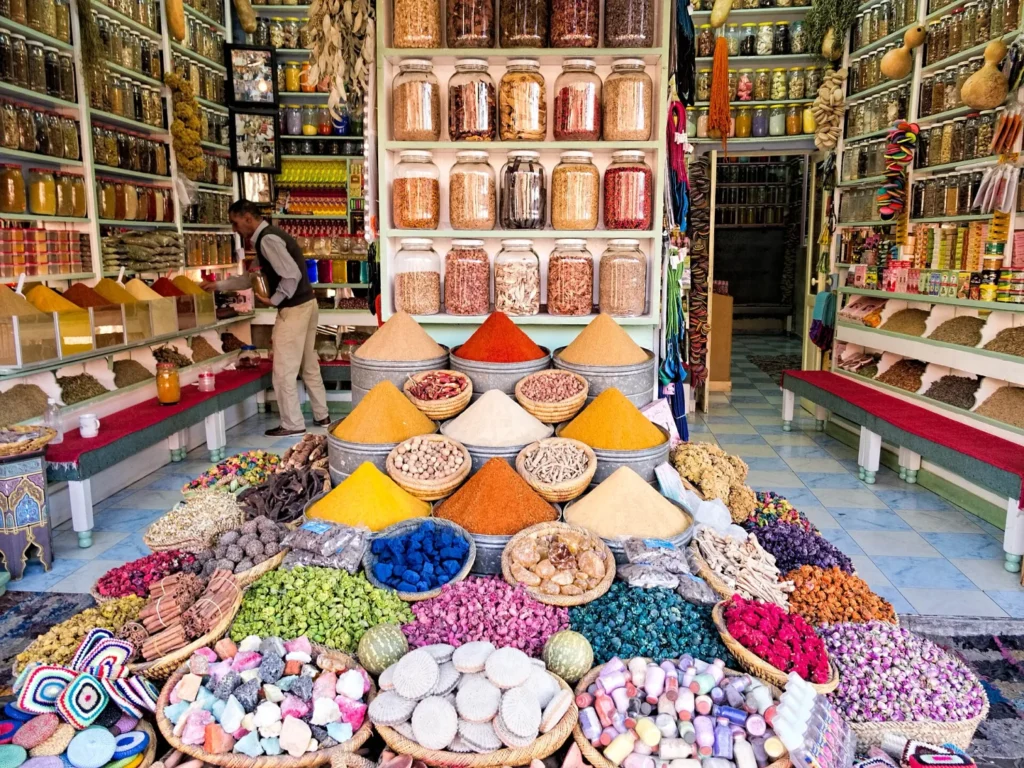
If you do only one thing away from the beach, make it this one. Souk El Had is a very large covered market, organised by section: fresh produce, spices, textiles, crafts, general bazaar. This is not a tourist market grafted onto a reconstructed medina, it is where the city does its shopping.
Two practical notes. Haggling is the rule in the crafts and textile sections, not in the food aisles. And the market closes on Mondays: that is the classic trap of a one-week stay, where the visit gets postponed to exactly the wrong day.
Surfing: Taghazout, Tamraght and the northern coast
The coast north of Agadir is one of the best-known surf destinations in the world, and it works for complete beginners as well as for experienced surfers. The village of Taghazout, some forty kilometres away, is its centre: surf schools, board rentals, cafés, and a laid-back mood very different from the resort.
Tamraght, slightly closer, is the quieter and often cheaper alternative. The surrounding spots — Devil’s Rock, Banana Beach, Anchor Point for the experienced — are spread over about twenty kilometres of coastline.
The surf season peaks from autumn through to spring, when the Atlantic swells are at their most reliable. Summer remains perfectly usable for learning, with smaller and gentler waves, which is precisely what makes it the right time for a first lesson.
How much time to give it
Half a day is enough for an introductory lesson and lunch in the village. If surfing is the reason for the trip, it is better to stay in Taghazout or Tamraght rather than in Agadir: you will save an hour of driving back and forth every day.
Day trips from Agadir
| Trip | Distance | Suggested length | Who it suits |
|---|---|---|---|
| Taghazout and the surf coast | ≈ 40 km north | Half a day | Surfing, village atmosphere |
| Paradise Valley | ≈ 60 km north-east | Full day | Natural pools, palm grove, easy walking |
| Souss-Massa National Park | ≈ 60 km south | Full day | Birdlife, dunes, estuary |
| Essaouira | ≈ 175 km north | Long day | Medina, wind, atmosphere |
| Marrakech | ≈ 250 km north-east | Two days minimum | Imperial city |
Paradise Valley is the most requested trip after surfing: a steep-sided valley in the Anti-Atlas, with clear natural pools and a palm grove. The water level depends entirely on the season and on the previous winter’s rainfall; by late summer some pools are dry. Ask locally before setting off, because disappointment is common among those who go in September expecting the photographs taken in spring.
Marrakech as a day trip from Agadir is a bad idea: six to seven hours of driving for a few hours on the ground. If the red city interests you, allow at least one night. We compared the two destinations in detail in our guide Marrakech or Agadir.
When to come: Agadir month by month
This is the question that comes up most often, and the answer is more nuanced than a simple “the weather is good all year”. Agadir enjoys a mild climate and high sunshine in every season, but the experience genuinely changes from one month to the next.
| Period | What defines the season | Who it suits |
|---|---|---|
| December to February | Mild sunny days, cool evenings. Cold ocean. European crowds during school holidays. | Escaping winter, hiking, surfing |
| March to May | The best overall window: pleasant temperatures, green landscapes after the rains, pools full of water. | Day trips, Paradise Valley, a first swim |
| June to August | Moderate heat on the coast thanks to the Atlantic, far more bearable than Marrakech. Busy season. | Families, swimming, learning to surf |
| September to November | Water at its warmest, crowds thinning out, swells returning. | Experienced surfers, a quiet stay |
One local quirk is worth knowing: the morning coastal fog, common in summer. It usually lifts by late morning, but it can surprise visitors who expected immediate sunshine in July. For a country-wide view season by season, see our guide to the best time to visit Morocco.
Getting to Agadir and getting around
Al Massira Airport (code AGA) lies about 22 kilometres south-east of the centre, roughly twenty minutes by road outside rush hour. It is one of the few Moroccan airports where the distance to the city is genuinely short and predictable.
| Option | Journey | Worth knowing |
|---|---|---|
| Bus 37 | Airport ↔ city centre | The budget solution. Limited frequency: check before relying on it for an early or late flight. |
| Grand taxi | ≈ 20 min | Agree the fare before getting in, or ask for the meter. |
| Shuttle or private transfer | ≈ 20-30 min | Bookable in advance, useful with luggage, with children, or to go straight to Taghazout. |
| Car hire | depends on route | Real comfort if you are planning Paradise Valley or the surf coast. |
Within the city itself, the whole seafront is walkable. The small orange taxis cover the rest for modest sums; again, meter or price agreed in advance. Hiring a car only makes sense if you plan to leave Agadir, which is precisely where the interest of the trip lies.
Before heading to the airport on the way home, check the real status of your flight on our page of live Agadir departures and arrivals. And if you have time to spare at check-in, we have detailed where to eat in the terminal and how to get online.
Planning your stay: three possible rhythms
Three days
One day of beach and promenade to settle in, a morning at Souk El Had followed by the kasbah in the late afternoon, and a full day at Taghazout or Paradise Valley. It is the most common format, and it works well.
One week
The same backbone, plus a day in Essaouira, an outing to Souss-Massa park, and two or three free mornings. A week also lets you take several surf lessons back to back, which changes everything for a beginner: a single isolated lesson is not enough to stay on the board for long.
Agadir as a base
Some travellers use Agadir as a landing point for exploring the Souss and the Anti-Atlas: Tafraout, Tiznit, the villages of the interior. In that case a car becomes essential, and a seafront hotel loses its appeal in favour of somewhere more central.
Taroudant, around 80 km east across the Souss plain, is the easiest outing to underestimate: a town ringed by earthen ramparts, without the tourist pressure of Marrakech, which can be visited in half a day from Agadir. It is also the road of the argan co-operatives, so the two combine neatly into a single day.
Eating in Agadir: the fishing port above all
This is the most distinctive experience in the city, and the one visitors most regret missing. The fishing port houses a row of grill stalls lined up under one roof, where you pick your fish from the display before it goes on the grill. Sardines, sea bream, squid, prawns: the choice depends on what the boats brought in that morning.
The way it works surprises anyone expecting a conventional restaurant. Each stall has its tout, prices are negotiated, and it is wise to ask the price per kilo before letting anything be weighed. The bill stays modest for those who settle terms in advance; it can double for those who simply go along with it. Lunch is the right moment: the fish is at its freshest and the place is running at full tilt.
In town, the seafront promenade concentrates the tourist restaurants, decent without being memorable. For everyday Moroccan cooking — tagines, harira, grilled skewers — you need to move away from the sand and look for addresses in the centre, around Souk El Had and in the streets of the Talborjt district. Prices there are the ones locals pay.
Two regional specialities are worth tasting: amlou, a spread made from almonds, argan oil and honey, and argan oil itself, produced in the Souss. Mind the quality: the culinary oil, made from roasted kernels, has neither the taste nor the purpose of the cosmetic one. Co-operatives on the Taroudant or Essaouira roads are more reliable than the shops along the seafront.
Where to stay: the districts of Agadir
| Area | What it is | Who it suits |
|---|---|---|
| Seafront | The hotel strip, right on the sand, with pools and the promenade. | Beach holidays, families, a first trip |
| Marina | A recent, quiet district with restaurants around the pontoons. | Couples, peace and quiet, short stays |
| Talborjt / centre | The real city centre, commercial and lively, within walking distance of the beach. | Tight budgets, immersion, local restaurants |
| Taghazout / Tamraght | Surf villages to the north, relaxed atmosphere. | Surfers, long stays, remote working |
The thing to anticipate is distance. Staying on the seafront and wanting to surf every day at Taghazout means accepting nearly an hour and a half of driving daily. Conversely, staying in Taghazout while wanting Agadir’s beach and services creates the same problem in reverse. Choose according to the activity that will fill most of your days.
Practical advice for a stay in Agadir
Money and payments
The Moroccan dirham cannot be obtained abroad: you withdraw it on arrival. Cash machines are plentiful in the centre and at the airport. Always keep cash on you: the small taxis, the port grill stalls and the souk traders do not take cards. Note too that the dirham cannot be freely exported, so change or spend what you have left before flying home.
Dress and customs
Agadir is the most relaxed Moroccan city on this point: swimwear is normal on the beach and around the pools. In town, at the souk or in the villages inland, clothing that covers the shoulders and knees spares you the stares and shows a basic degree of consideration. It is not a legal requirement, it is a matter of custom.
Sun and ocean
Sunshine is intense all year and the sea breeze masks the heat: sunburn is common among visitors who never felt hot. For swimming, stick to the supervised zones: rip currents do exist on this Atlantic coast, particularly outside the sheltered bay.
Languages
Arabic and Tachelhit are the everyday languages of the Souss. French is very widely understood in tourism and trade, English increasingly so, and German is spoken in the hotels that regularly host German-speaking guests.
Agadir with children
This is one of the easiest Moroccan destinations to manage as a family, and the reason is geography. The bay is sheltered, the beach shelves gently, and the promenade lets you walk with a pushchair without facing the alleys and mopeds of a medina. Anyone who has already travelled to Marrakech with young children will feel the difference.
The seafront concentrates everything you need day to day: pharmacies, small supermarkets, restaurants used to families. Hotels with a heated pool are a real advantage in winter, when the ocean stays at seventeen degrees and sea swimming is cut short.
For outings, a half-day at Taghazout works well, surf schools take children from around six to eight years old depending on the school, and Paradise Valley is an easy walk in spring. Long excursions to Marrakech or the deep south, on the other hand, are best avoided with young children: the road is the real constraint, far more than the heat.
Frequently asked questions about Agadir
Is Agadir worth it if you are looking for traditional Morocco?
Not as a priority. Agadir was rebuilt after 1960 and has no old medina. If you are after the architecture and atmosphere of the imperial cities, Marrakech or Fez will serve you better. Agadir is worth it for its beach, its climate, the surf and access to the Anti-Atlas.
How many days do you need in Agadir?
Three days are enough for the city and one day trip. A week becomes worthwhile if you want to surf seriously, go to Essaouira and take your time over the hinterland.
Can you swim in Agadir in winter?
The water stays cool, around 17 to 18 °C in winter. The days are mild and sunny, but swimming is more a matter of courage than pleasure. Winter is an excellent season for walking, surfing in a wetsuit and visiting the interior.
Is Souk El Had open every day?
No, it is closed on Mondays. That is the most common mistake on short stays: bear it in mind when planning your week.
Can you reach Taghazout without a car?
Yes. Taxis and shuttles run from Agadir, and many surf schools include transport with the lesson. Reckon on about forty kilometres, so three quarters of an hour depending on traffic.
Does Paradise Valley always have water?
No, and that matters. The level depends on the previous winter’s rainfall. In spring the pools are generally full; by late summer some can be dry. Ask locally before making the drive.
How far is the airport from central Agadir?
About 22 kilometres to the south-east, so around twenty minutes by taxi outside rush hour. It is one of the shortest airport transfers in Morocco.
Agadir or Marrakech for a first trip to Morocco?
It depends what you are after: Marrakech for heritage and energy, Agadir for the beach, the climate and a calmer pace. We compared the two in detail in a dedicated guide.
In summary
Agadir makes more sense once you stop looking for what it is not. The city has no historic medina, and that is not a flaw: it is an efficient, well-connected seaside resort with an exceptional climate and one of the world’s better surf coasts forty kilometres away. A good stay combines the beach, a morning at Souk El Had, the panorama from the kasbah, and at least one outing towards Taghazout or Paradise Valley.
The rest comes down to the season: spring for a hinterland full of water, autumn for the warmest ocean and the quiet, summer for families, winter for escaping the European cold.
Sources and updates
Distances and journey times come from our own records and our airport guides. Price indications are approximate and change over time: always agree a fare before getting into a taxi. Bus 37 timetables and site opening hours may change without notice. For entry requirements to Morocco, refer to the official guidance issued by your own country, for example the UK Foreign Office travel advice. Page updated in October 2026.
Photo credit: see the media record for the author and licence.