Deciding what to buy in Morocco is less about finding a shop than about knowing which things are genuinely made here, which are mass-produced imports sold to visitors, and which will cause you trouble at the airport on the way home. This guide covers all three, with the customs allowances for the UK, the European Union and the United States set out plainly, because that is the part most souvenir guides leave out entirely.
In short: the souvenirs worth your luggage space
- The safe bets: argan oil, saffron from Taliouine, a hand-knotted rug, babouches, a tea glass set, rhassoul clay and black soap.
- Buy at a cooperative, not a bazaar, for argan oil, saffron and rose water. The product is traceable and the price is fixed.
- The one real warning: glazed souk tajines are not tested against European or British limits for lead and cadmium. Use them to serve, not to cook, unless the piece is marked food-safe.
- Liquids go in the hold. Argan oil, rose water and olive oil above 100 ml cannot go through security in your cabin bag.
- Customs, at the time of writing: £390 of goods into the UK, €430 by air into the EU, 800 dollars for returning US residents.
- Dirhams do not travel. The currency is closed, so you cannot top up at home and buy later: decide while you are there.
The three things Morocco does better than anywhere else
If you only bring back three things, these are the ones with a real claim to being Moroccan rather than merely bought in Morocco.
Argan oil, and the difference between the two kinds
Argan grows in the south-west, roughly in the triangle between Agadir, Essaouira and Taroudant, and nowhere else at this scale. There are two distinct products and they are not interchangeable. Cosmetic oil is cold-pressed from unroasted kernels, is pale and almost odourless, and is what you want for skin and hair. Culinary oil is pressed from roasted kernels, is darker and smells strongly of hazelnut, and belongs on bread or in amlou.
Buy from a women’s cooperative if you can. They are concentrated along the Agadir-Essaouira road, they will show you the pressing, and the bottle carries a label with a batch. What is sold as argan oil in a tourist bazaar is often cut with cheaper oil, and you cannot tell by looking. A simple test: pure cosmetic argan oil absorbs into skin within a couple of minutes and leaves no greasy film.
A hand-knotted rug, if you have the budget and the patience
A Moroccan rug is the one souvenir that can genuinely be an heirloom, and it is also the one where the gap between the real thing and the imitation is widest. Hand-knotted means the pattern is visible from the back, knot by knot, with slight irregularities; machine-made means a uniform back and a glued or overlocked edge. Turn the rug over before you discuss price, every time.
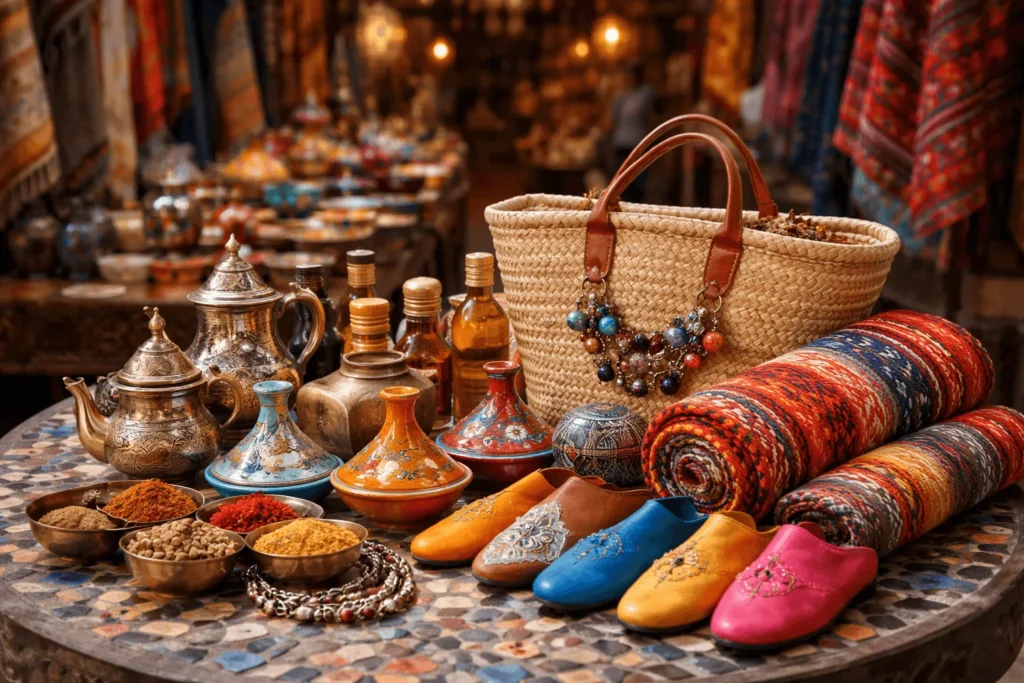
The main families are worth knowing by name so you can ask for what you want: Beni Ouarain, thick cream wool with a dark geometric line, from the Middle Atlas; Azilal, lighter and more colourful; Boucherouite, made from recycled fabric strips and the cheapest honest option; and the flat-woven kilim, which packs small and travels well. Expect to carry a rug as hold luggage; most sellers will sew it into a cloth parcel for you, and that parcel counts as a normal bag.
Ceramics and tajines, with one important caveat
Fez is the reference for blue-and-white, Safi for green glazes, and Tamegroute in the south for the distinctive rough green pottery. A hand-painted Fez plate is a genuinely beautiful object and nothing like the stencilled version sold by the stack.
The caveat matters more than the aesthetics. Glazes applied in artisan workshops are not tested against the European or British limits for lead and cadmium release. That is not an accusation, it is simply the state of the regulation: those limits apply to products placed on the EU or UK market, not to a pot bought in a souk. If you want a tajine to cook in, buy one sold as food-safe, ideally from a shop that can tell you so in writing. Otherwise treat your tajine as a serving dish and cook in something else. Unglazed terracotta tajines are a separate and safer case.
For the house: lanterns, leather and thuya wood
Pierced-metal lanterns are the single most photogenic thing in any souk and the easiest to buy badly. Check the thickness of the metal: a lantern that flexes when you squeeze it will arrive home bent. Look for soldered joints rather than folded tabs, and buy a candle lantern rather than an electric one, because Moroccan wiring and plugs will not match a British or North American socket.
Leather is Morocco’s other signature, and the tanneries of Fez and Marrakech are the source. Poufs are sold unstuffed, which is exactly what you want: flat-packed leather weighs little and you fill it at home. The thing to check is the smell. Properly tanned leather smells of leather; a sharp chemical smell means a rushed finish that will not fade. Bags and babouches should have stitched seams, not glued ones.
Thuya wood comes almost entirely from the Essaouira region and is worked into boxes, bowls and marquetry. It is light, it survives a suitcase, and the burl grain is genuinely distinctive. Buy pieces finished with wax rather than thick varnish, and keep them out of direct heat at home or the joints will open.
The hammam shelf: black soap, rhassoul and rose water
This is the best value category in Morocco and the one most visitors underbuy. Beldi soap is a soft olive-based paste, sold by weight, used before scrubbing. Rhassoul is a mineral clay from the Atlas, sold as a dry block or powder, used as a hair and body wash. Both are light, neither is a liquid for security purposes in dry form, and both last months.
Rose water from Kelaat M’Gouna in the Dadès valley is the real thing, distilled from the damask roses harvested there each spring. Buy it in a sealed bottle with a label, not decanted in front of you, and put it in the hold. The same applies to orange-blossom water, which Moroccan kitchens use more than tourists expect.
Two things to approach with care on this shelf. Kohl sold loose in souks can contain lead compounds and is not a cosmetic you should bring home for a child. And essential oils sold very cheaply are usually diluted; if the price looks impossible for a pure oil, it is.
For the kitchen: spices, saffron and sweet things
Spices are the lightest souvenir with the longest afterlife, and the one where a few minutes of knowledge saves you from the standard tourist purchase.
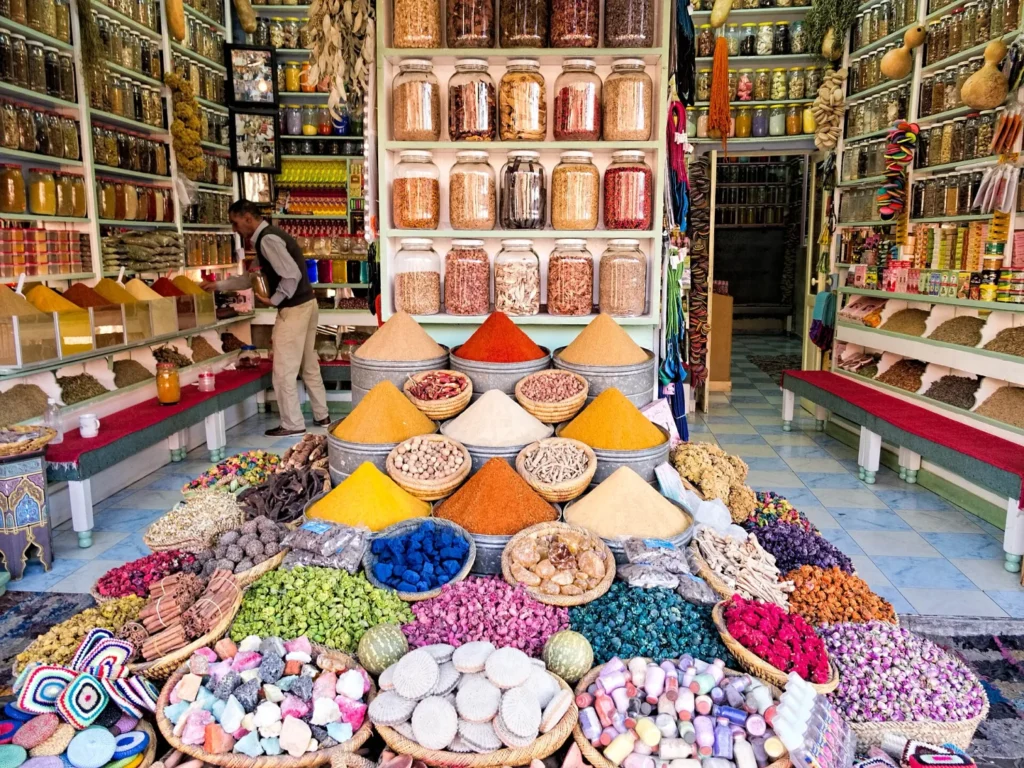
- Ras el hanout is a blend, not a single spice, and every shop mixes its own. Ask to smell it; a good one is warm rather than sharp, and you should be able to pick out cinnamon and rose.
- Saffron from Taliouine, in the Anti-Atlas, is the Moroccan origin worth paying for. Buy threads, never powder. Real threads are deep red with a pale trumpet-shaped end, and a pinch turns water golden slowly, over minutes. Safflower, the usual substitute, colours water instantly and smells of nothing.
- Cumin, paprika and dried mint are cheap, excellent and the things you will actually use. Buy more than you think.
- Amlou, the almond, argan oil and honey paste from the south, travels well in a sealed jar and has no equivalent on a British or American shelf.
- Dates, especially Mejhoul from the Tafilalet oases, are a genuine Moroccan product. They are a plant product, so they are generally admissible, but see the customs table below.
Mint tea deserves its own note. The leaves are ordinary gunpowder green tea, usually imported, so the tea itself is not the souvenir. The teapot and the glasses are. Buy a stainless-steel pot rather than a plated one, because plating lifts after a few months of heat, and buy the glasses in a padded box. Six glasses wrapped in your socks is a false economy.
To wear: djellaba, babouches and Berber silver
A djellaba is the hooded full-length robe worn by both men and women, and the wool winter version is a serious garment rather than a costume. The lighter cotton version is the one that gets worn at home. A kaftan is the formal, often embroidered dress, and it is worth having it adjusted on the spot, which most tailors in a medina will do within a day.
Babouches, the backless leather slippers, are the most practical thing on this list. Buy them a touch snug, because the leather gives. Hand-stitched soles last; glued ones separate within a season.
Berber and Tuareg silver is sold by weight as much as by design, and the hallmark to look for is a small stamp. Much of what is offered as antique Berber jewellery is recent work in the same style, which is fine as long as the price reflects it. Ask directly whether a piece is old; a serious seller will tell you, and an evasive answer is its own answer.
Where to buy: souk, cooperative or fixed-price shop
Where you buy changes the price, the quality and how much energy the transaction costs you. There is no single right answer, but there is a right answer per product.
| Where | Best for | Price | What to watch |
|---|---|---|---|
| Medina souk | Rugs, leather, lanterns, ceramics | Negotiable, wide range | Quality varies enormously; inspect before you discuss price |
| Women’s cooperative | Argan oil, amlou, saffron, rose water | Fixed, fair | Check there is a label and a batch number |
| Ensemble Artisanal (state craft centre) | A first look at quality and realistic prices | Fixed, slightly above souk | Less choice, but it calibrates your eye before you haggle |
| Spice shop in a residential quarter | Cumin, paprika, ras el hanout, mint | Local prices | Buy where Moroccans buy, a street back from the tourist route |
| Airport shop | A forgotten gift, dates, packaged argan | Highest | Convenient and sealed, but the worst value: a backup, not a plan |
If you are shopping in Marrakech, the medina around Jemaa el-Fna is the densest concentration of all of this, and also the most practised at selling to visitors. Getting there and back is part of the plan: our guide to taxis and ride-hailing in Morocco explains how to agree a fare before you set off, which matters more when you are carrying parcels.
Haggling, and telling the real thing from the copy
Haggling in Morocco is normal, expected and not adversarial. It is a conversation with a shape: the seller opens high, you counter low but not insultingly, and you converge. Two rules make it work. Never start negotiating on something you do not want, because walking away afterwards is the rude part, not the low offer. And decide your ceiling before you open your mouth, because the price you will pay is the one you decided calmly, not the one you reached while tired.
- Rugs: look at the back. Visible knots and small irregularities mean handmade.
- Argan oil: a label, a batch, and a cooperative name. Pale and nearly odourless for cosmetic use.
- Saffron: threads with a pale trumpet end, slow colour release, strong hay-like smell.
- Leather: stitched seams and a leather smell, not a chemical one.
- Silver: a hallmark stamp, and an honest answer about age.
- Ceramics: brush strokes that vary slightly between pieces. Identical pieces mean a transfer, not a hand.
What you are allowed to bring home
This is where good souvenir shopping turns into a problem at the airport, and it is almost always food that causes it. Morocco is outside the European Union, outside the United Kingdom and outside the United States customs territory, so everything you carry home is an import.
| Returning to | Goods allowance | Food rule that catches people |
|---|---|---|
| United Kingdom | Around £390 of goods, with separate alcohol and tobacco limits | Meat, dairy and most animal products are not allowed. Spices, dried fruit, honey and oil are. |
| European Union | €430 arriving by air or sea, €300 by land | Meat and dairy are banned outright, in any quantity, however it is packaged. |
| United States | 800 dollars personal exemption for returning residents | Declare all food. Spices and commercially packaged goods usually clear; fresh produce and meat do not. |
| Switzerland | Lower value threshold than the EU, and it changes | Separate meat allowance by weight; check before you buy. |
Three practical consequences. Vacuum-packed camel or beef sausage is the classic confiscation at a European airport, and the fact that it is sealed makes no difference. Fresh dates are fine as a plant product but check for the small insects that occasionally travel with them. And the amount of argan oil people buy, often several litres between a family, is a goods-value question rather than a food question, so keep your receipts. For the Moroccan side of the journey, and what you may take out, see our guide to Moroccan customs and what you can bring.
Getting it home in one piece
Moroccan souvenirs are disproportionately fragile and liquid, which is an unhelpful combination for air travel. A few decisions at the point of purchase save the whole thing.
- Liquids always go in the hold. Argan oil, rose water, olive oil and honey over 100 ml will be taken off you at security. There is no appeal and no exception.
- Double-bag every liquid. A bottle that opens at altitude ruins a suitcase, and pressure changes do open badly sealed caps.
- Ask for a wooden crate for ceramics. Many Fez and Safi shops will build one, and it is the difference between a plate and a bag of shards.
- Buy the padded box for tea glasses. It costs very little and it is the only thing that works.
- Have a rug sewn into cloth and check it in as a separate bag. Sellers do this routinely and it protects the edges.
- Keep your receipts together in one envelope. At customs, a receipt is the difference between a conversation and a charge.
- Weigh your bag before the airport. Rugs, lanterns and ceramics are heavy, and excess baggage at the counter costs more than the souvenir did.
If you are flying out of Marrakech and have shopping to pack or post, it is worth knowing the layout of the terminal in advance: our complete guide to Marrakech Menara airport covers what is on site, and the airports in Morocco does the same for every other departure point.
FAQ: what to buy in Morocco
What is the most authentic souvenir from Morocco?
A hand-knotted rug and cold-pressed argan oil have the strongest claim, because both are made at scale nowhere else. If you want something lighter, saffron threads from Taliouine and rhassoul clay from the Atlas are just as specifically Moroccan and fit in a coat pocket.
How do I know if argan oil is real?
Buy from a cooperative and check that the bottle has a label with a producer and a batch. Cosmetic argan oil is pale and almost odourless and absorbs within a couple of minutes without a greasy film. Culinary argan oil is darker and smells strongly of roasted hazelnut. A strong perfume in a cosmetic oil means it has been cut.
Can I cook in a tajine I bought in a souk?
Only if it is sold as food-safe. Artisan glazes are not tested against the European or British limits for lead and cadmium release, because those limits apply to products placed on those markets. Unglazed terracotta is the safer choice for cooking; keep a decorated glazed tajine for serving.
How much should I haggle?
Enough to reach a price you are happy with, and no further. Set your ceiling before you start, counter low without being insulting, and never open a negotiation on something you do not intend to buy. Prices in cooperatives and state craft centres are fixed and are not haggled.
Can I bring food back from Morocco?
Plant products such as spices, dried fruit, dates, honey, oil and amlou are generally fine. Meat and dairy are banned into the European Union and the United Kingdom regardless of packaging, and all food must be declared on entry to the United States. Vacuum packing makes no difference to the rule.
Can I take argan oil in my hand luggage?
Not above 100 ml per container. Argan oil, rose water and honey all count as liquids at security, so they belong in checked baggage, double-bagged. Buying oil after security at the airport is the only way to carry it in the cabin, and it is the most expensive way to buy it.
Is it cheaper to buy souvenirs at the airport?
No. Airport prices in Morocco sit well above city prices for the same item, as they do everywhere. The airport shop is a sensible backup for a forgotten gift or a sealed jar of dates, not a shopping plan.
Can I pay by card, and can I take dirhams home?
Larger shops and cooperatives often take cards; souk stalls frequently do not, so carry cash in small notes. The dirham is a closed currency, which means you cannot reliably obtain it before you arrive or spend it after you leave. Spend what you have before you reach the departure gate.
Sources
- UK government, bringing goods into the UK
- European Commission, taxation and customs union
- US Customs and Border Protection, travel
- Moroccan Customs Administration
Summary
Buy what is actually made here: argan oil and amlou from a cooperative, saffron threads from Taliouine, a hand-knotted rug you have turned over, leather with stitched seams, thuya wood from Essaouira, rhassoul and beldi soap by weight. Treat a glazed souk tajine as a serving dish rather than a cooking pot. Put every liquid in the hold, keep your receipts in one envelope, and remember that meat and dairy will not enter the European Union or the United Kingdom whatever the packaging says. Decide while you are in Morocco, because the dirham does not follow you home.