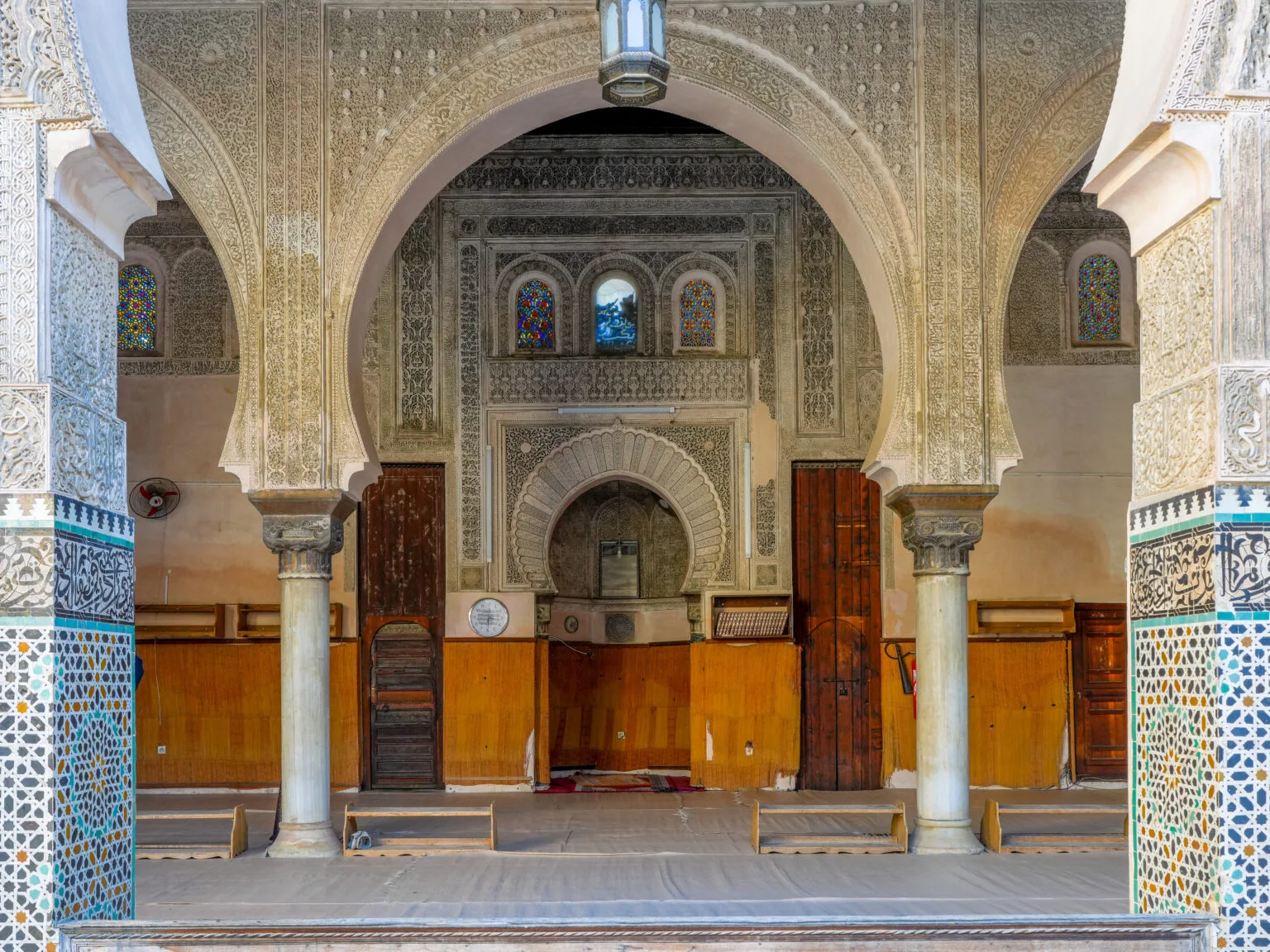
Fez-Saïss Airport (FEZ)
The complete 2026 guide to the gateway of Morocco's spiritual capital: live flights, bus 16, taxi, access to the medina, services and what to see in Fez.
ℹ️ Independent information guide. This site is not affiliated with the official Fez airport or the ONDA — it simply helps you plan your trip.
Fez-Saïss Airport: the gateway to the imperial city
About 15 km south of the city, Fez-Saïss International Airport (FEZ / GMFF) is the main gateway to Fez, Morocco's spiritual and cultural capital. It serves the oldest of the imperial cities and its UNESCO World Heritage medina, one of the largest car-free areas on earth.
- 20 minutes from the medina of Fès el-Bali
- Served by Royal Air Maroc, Ryanair and Air Arabia Maroc
- Springboard to Meknes, Volubilis and Chefchaouen
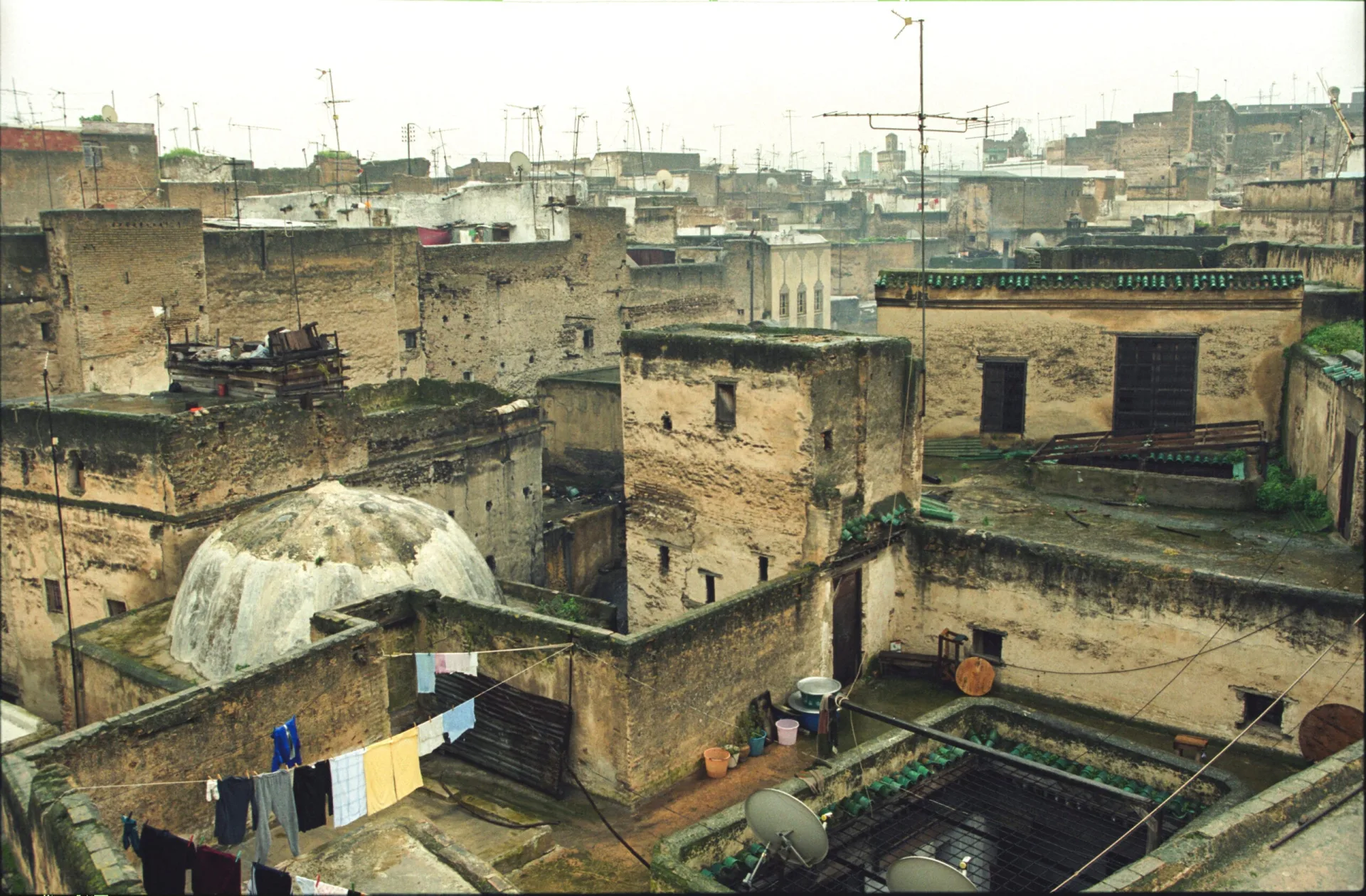 Medina of Fez
Fez, spiritual and cultural capital of Morocco
Founded in the late 8th century, Fez is the oldest of Morocco's four imperial cities and its intellectual and religious heart. This is home to the University of Al Quaraouiyine, founded in 859 and recognised by UNESCO and Guinness as the oldest continuously operating university in the world. Landing at Fez-Saïss Airport means stepping up to the gates of more than a thousand years of history.
The city falls into three parts: Fès el-Bali, the walled medieval medina; Fès el-Jdid, the Marinid "new" town home to the Mellah and the royal palace; and the more modern, colonial-era Ville Nouvelle. Most visitors stay in a riad in the heart of the medina to soak up the old city's unique atmosphere.
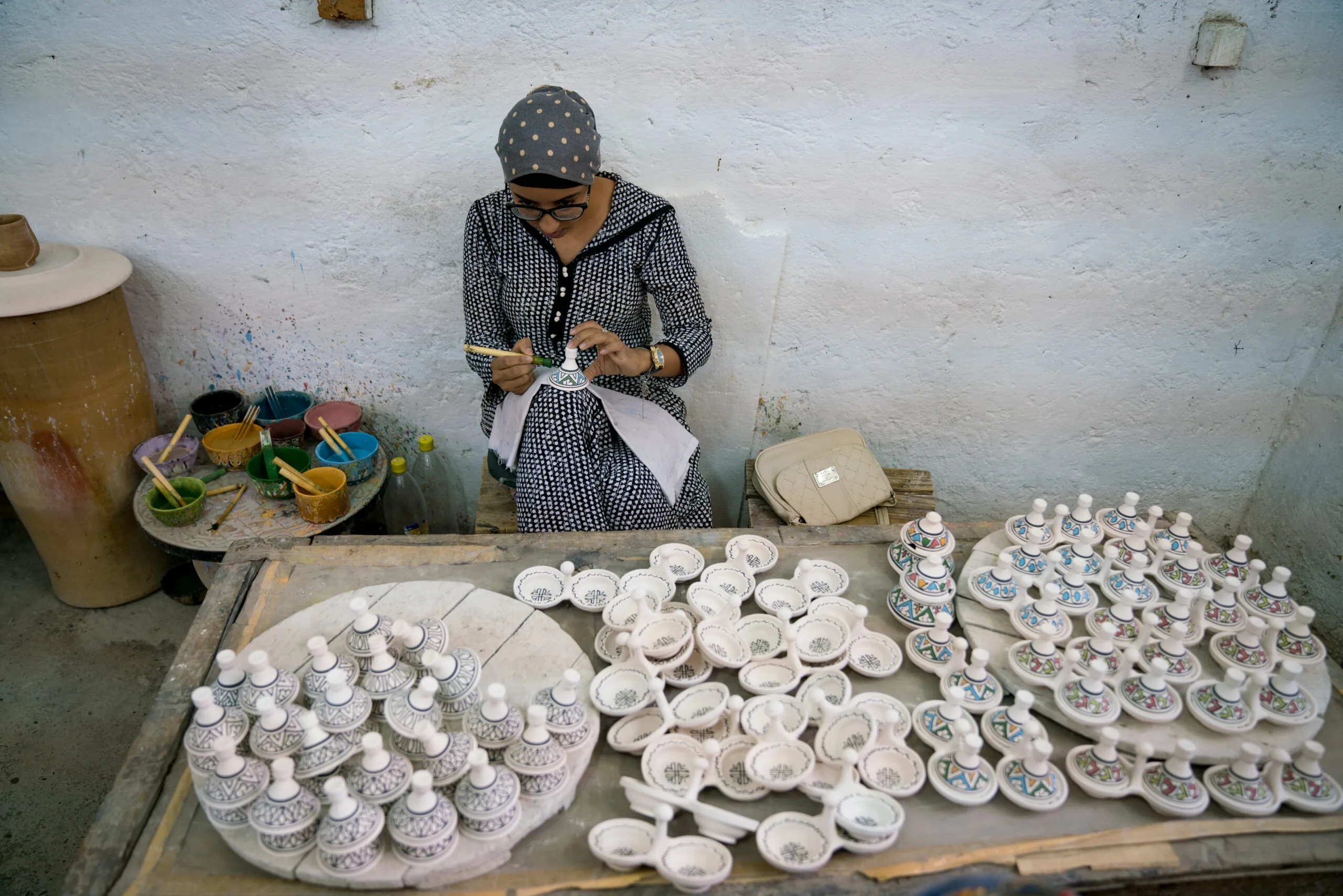
Fez is also the capital of Moroccan craftsmanship: leather from the famous Chouara tanneries, the blue ceramics and zellige of Fez, metalwork and embroidery. These skills, handed down over generations, turn every alleyway into an open-air workshop.
The medina of Fès el-Bali, the world's largest car-free area
With its thousands of alleys where no car can pass, Fès el-Bali is often cited as the largest urban car-free zone on the planet. You happily lose yourself among the souks of the coppersmiths, dyers and perfumers, carried along by the scents of spices and cedar.
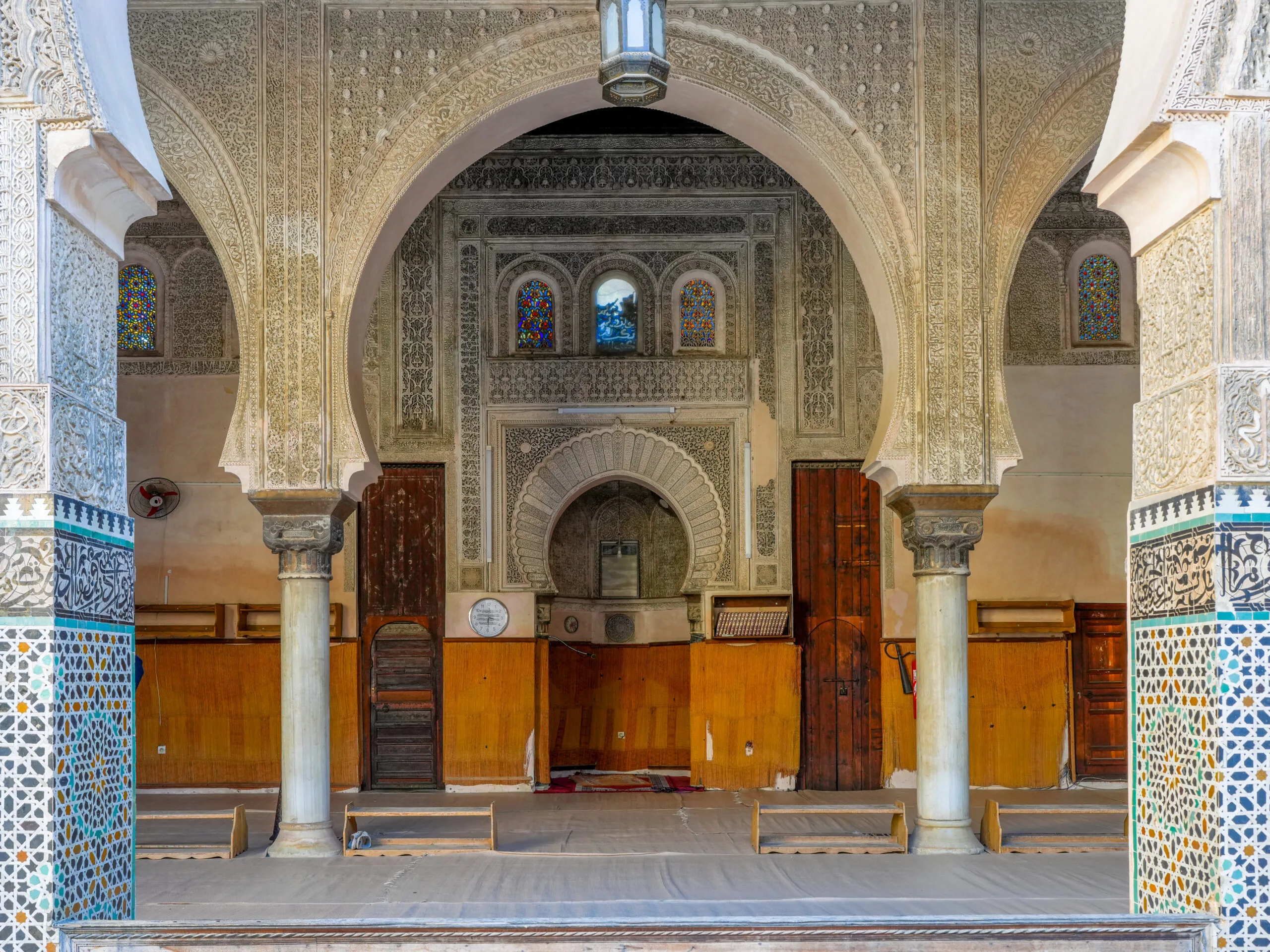
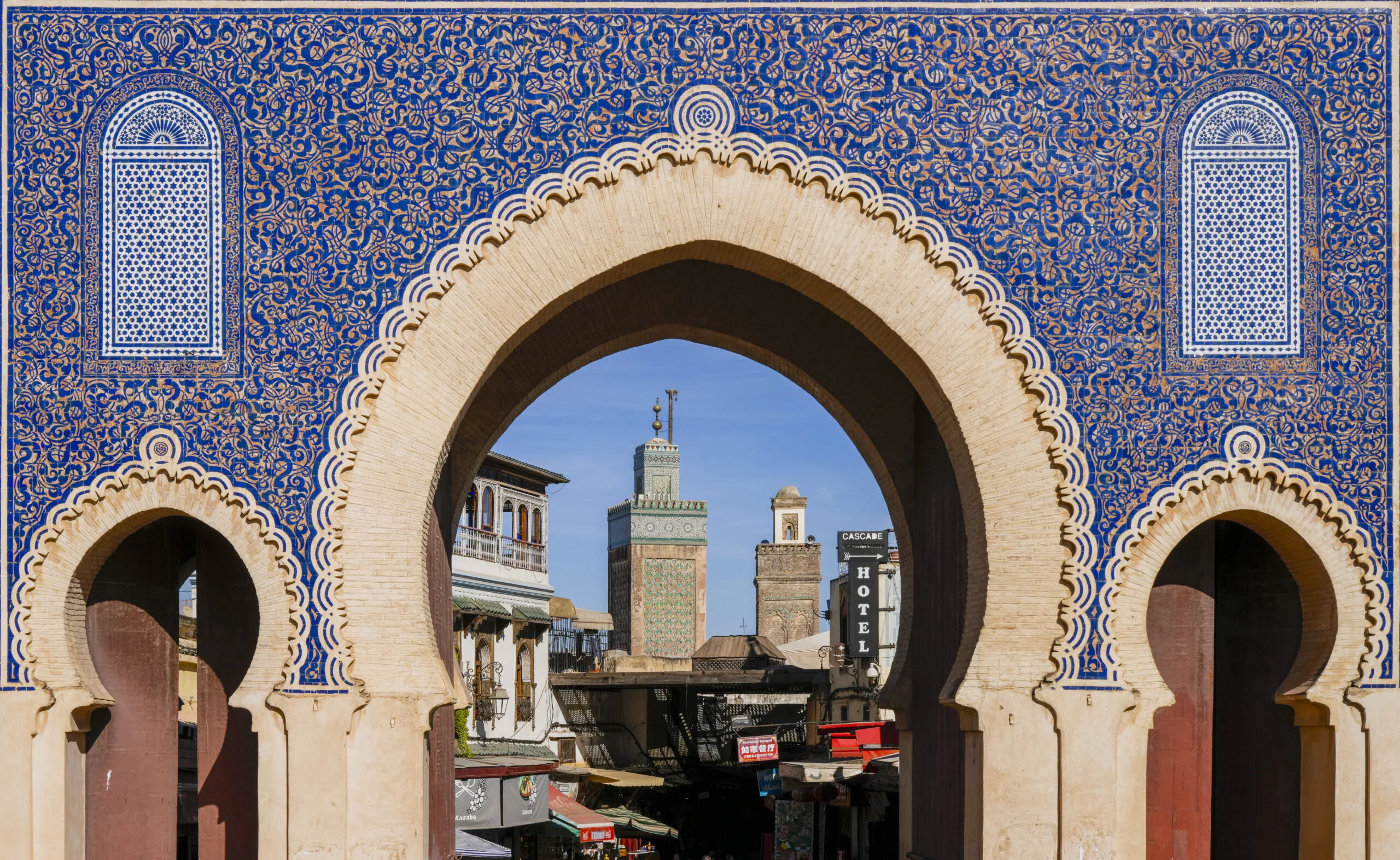
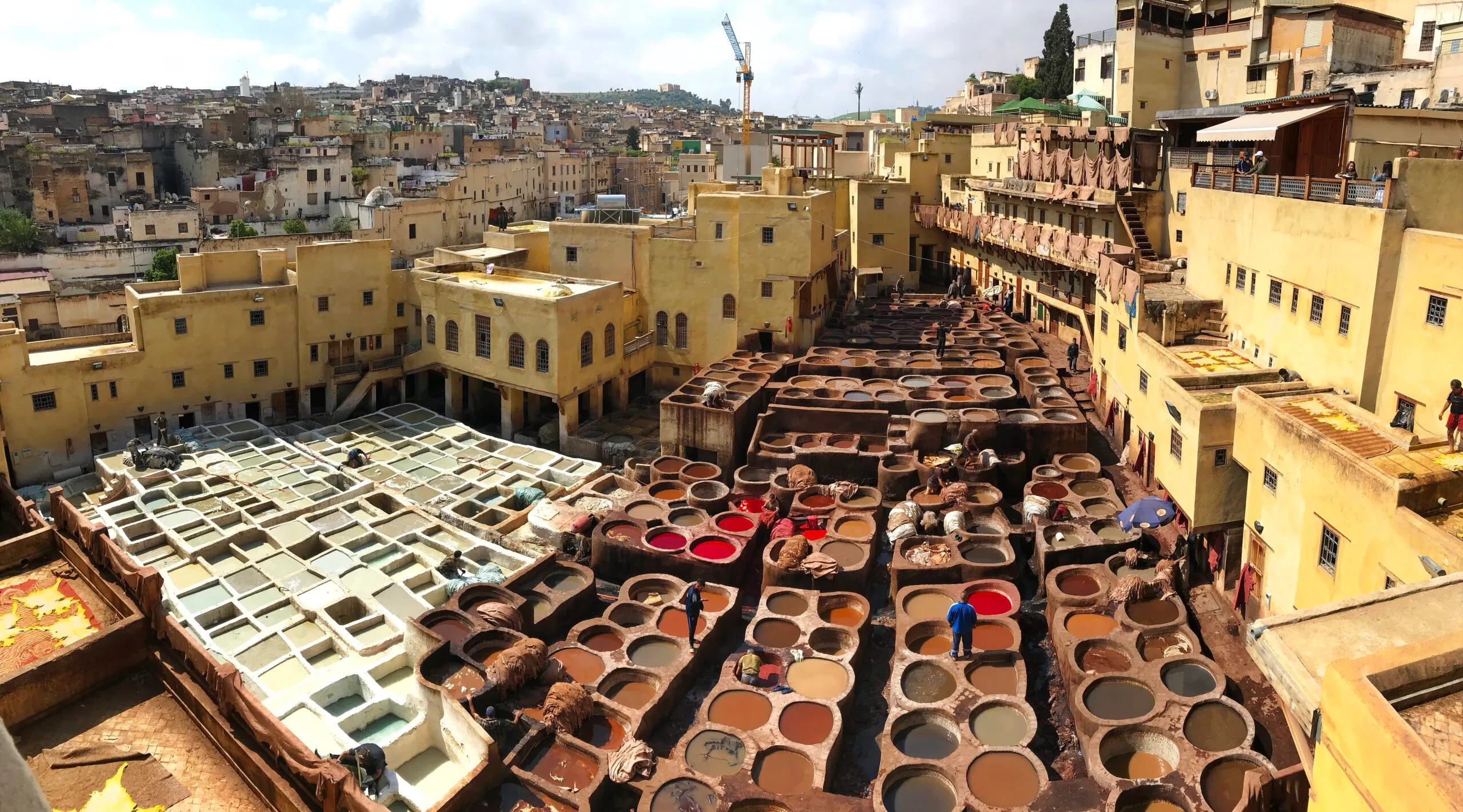
Highlights include the blue gate Bab Bou Jeloud, the Bou Inania and Al-Attarine madrasas, masterpieces of Marinid architecture, and the emblematic Chouara tanneries, whose colourful vats are best admired from the terraces of the leather shops. Bring good shoes: here, everything is discovered on foot.
Fez airport flights: live departures & arrivals
Up-to-date flight times, delays and gates for Fez and every airport in Morocco.
Fez airport transport: getting to the city centre
Fez-Saïss Airport is about 15 km from the centre. Bus 16, taxi or private transfer — here is every option to reach the medina or the new town.
Bus 16
Links the airport to central Fez, roughly every hour. The most budget-friendly option.
Grand taxi
Red taxis 24/7 outside arrivals. Agree the fare before you set off.
Private transfer
A driver waiting with a sign, ideal with luggage or for a riad in the medina.
| Option | Duration | Indicative fare | Best for |
|---|---|---|---|
| Bus 16 | ~ 40–45 min | ≈ 4 MAD | Tight budgets |
| Grand taxi (new town) | ~ 20–25 min | ≈ 150 MAD | Speed |
| Grand taxi (medina) | ~ 25 min | ≈ 170 MAD | Riads & medina |
| Private transfer | ~ 20 min | variable | Comfort & luggage |
| Car rental | depends | from ~250 MAD/day | Meknes, Volubilis… |
💡 Good to know: reaching your riad in the medina
Since the medina is car-free, your taxi or transfer will drop you at one of its gates (Bab Bou Jeloud, Bab Rcif…). Many riads send a porter to guide you through the alleys to your lodging — remember to tell them your arrival time.
Indicative 2026 fares, subject to change (time, traffic, luggage). Always agree the taxi price before you go.
What to do when you land at Fez airport
Passport control
Passport and entry form. Many nationalities enter visa-free for up to 90 days.
Withdraw dirhams
ATMs and exchange desks in the hall. Keep cash for the taxi or bus 16.
Bus 16 or taxi
Bus stop and red taxi rank right outside arrivals.
Alert your riad
Share your arrival time: many arrange a welcome at the medina gate.
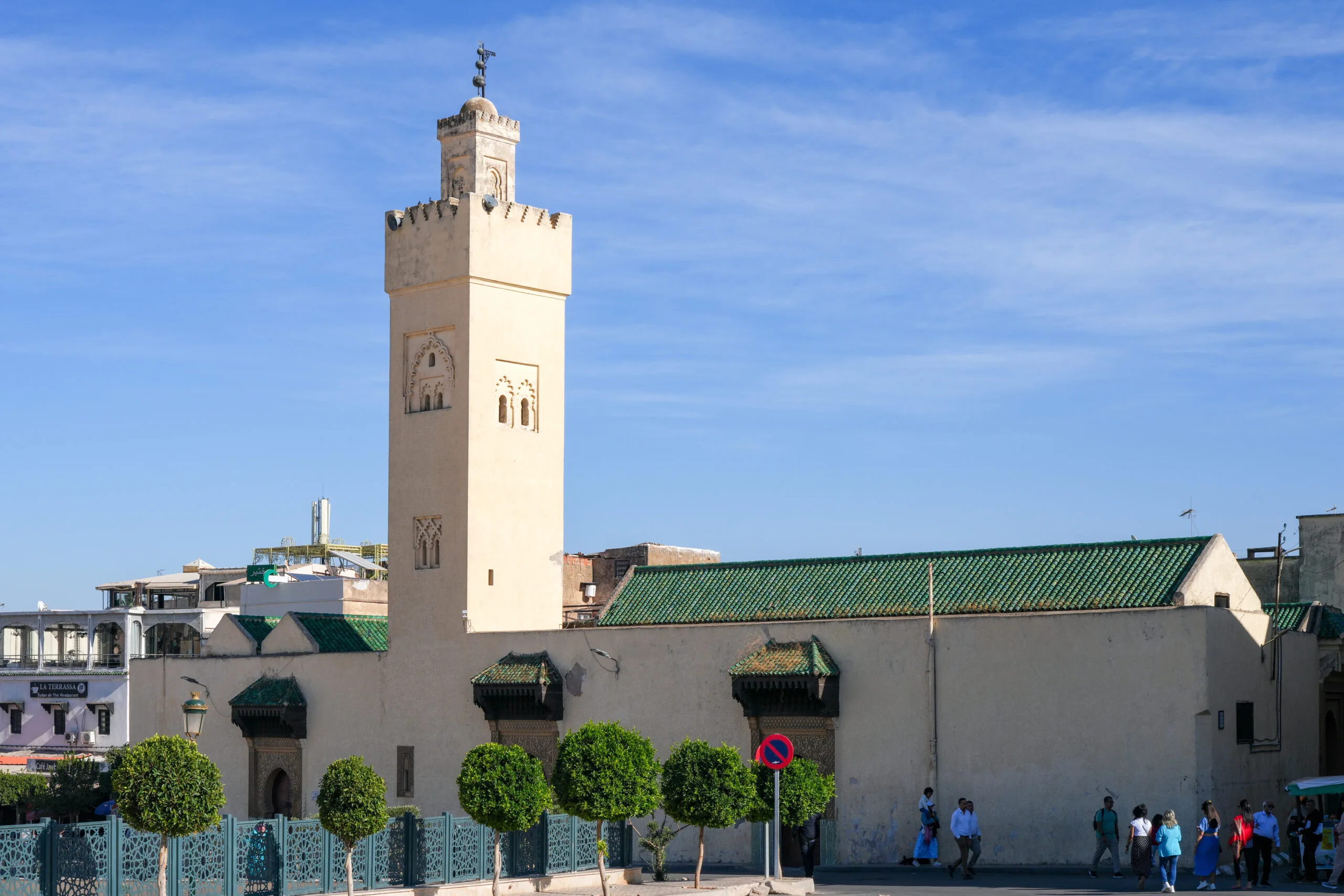 Fez
Fez-Saïss Airport terminal
The airport has a human-scale terminal handling both domestic and international flights: check-in, security, shops, cafés and car-rental desks.
Its compact size makes for a quick passage — a real comfort on arrival and departure. The airport has undergone major expansion works to keep pace with the imperial city's tourism growth.
Fez at a glance
From the blue gate to the tanneries, a glimpse of the treasures awaiting you minutes from the airport.
Services and facilities at Fez airport
Free Wi-Fi
Wireless connection in the terminal.
Exchange & banking
Currency exchange desks and ATMs on arrival.
Car rental
Desks of the main agencies.
Shops
Souvenirs, crafts and local products.
Cafés & dining
Snacks and cafés on the city and boarding sides.
Accessibility
Reduced-mobility assistance and first aid.
Flights and airlines at Fez airport
Fez is well connected to Europe by scheduled and low-cost flights, driven by the city's cultural appeal.
🇫🇷 France
Paris, Marseille, Lyon, Nantes…
🇮🇹 Italy
Milan, Bologna…
🇧🇪 Belgium & Netherlands
Brussels, Charleroi, Amsterdam…
🇪🇸 Spain
Madrid, Barcelona…
🇩🇪 Germany
Frankfurt, Cologne…
🇲🇦 Domestic flights
Casablanca and connections.
What to visit in Fez near the airport
An open-air museum city, Fez packs a thousand years of history and craft just minutes from the airport.
Medina of Fès el-Bali
The world's largest car-free medina and its thousands of alleys.
Chouara tanneries
The centuries-old dyeing vats, seen from the leather terraces.
Bab Bou Jeloud
The famous blue gate, majestic entrance to the medina.
Bou Inania Madrasa
A Marinid masterpiece of zellige and carved wood.
Pottery & zellige
Fez blue, handmade ceramics and mosaics.
Al Quaraouiyine
The oldest still-operating university in the world (859).
Distances from Fez airport
| Destination | Distance | Time |
|---|---|---|
| Medina of Fez (Fès el-Bali) | ~ 15 km | ~ 20–25 min |
| Ville Nouvelle (new town) | ~ 12 km | ~ 20 min |
| Meknes | ~ 65 km | ~ 1 h |
| Volubilis (Roman site) | ~ 80 km | ~ 1 h 15 |
| Chefchaouen | ~ 200 km | ~ 3 h |
Fez airport: practical information
Practical tips for your time at the airport
Arrive early
2 h 30 to 3 h before an international flight, especially in high season.
Agree the price
Set the red-taxi fare before you get in.
Riad & medina
Alert your riad: the welcome often takes place at the medina gate.
Good shoes
The medina is explored on foot, on sometimes slippery cobbles.
Carry dirhams
Dirhams are only available in Morocco; handy for the bus and taxi.
Stay connected
An eSIM connects you the moment you land.
Fez-Saïss Airport by the numbers
A single 3,200 m runway on the Saïss plateau, a terminal opened in 2017, and just over 1.92 million passengers in 2025.
The airport takes its name from the plain around it. The Saïss is the broad farming plateau that stretches between Fez and Meknes at the foot of the Middle Atlas: cereals, olive groves, orchards, and a very open horizon that explains why a runway 3,200 metres long and 45 metres wide could be laid out here with no constraint from the terrain. The airport sits at 579 metres above sea level, about 15 km south of Fez and some fifty kilometres from Meknes.
Administratively it stands in the rural commune of Oulad Tayeb, outside the urban boundary of Fez. That detail has a practical consequence many travellers discover too late: the city's small red taxis are in principle restricted to the urban area, and it is the grands taxis that serve the airport. Looking for a small red taxi outside the terminal wastes time for nothing.
The airport is run by the National Airports Office (ONDA), which now trades as Airports of Morocco. It belongs to the same network as Casablanca Mohammed V, Marrakech-Ménara and Rabat-Salé, with the same security rules and the same way of handling checks.
| Year | Milestone | What it means for travellers |
|---|---|---|
| 2003 | 128,778 passengers | A regional airport with few international flights |
| 2006 | 228,399 passengers | The opening up to low-cost carriers begins |
| 2013 | Ryanair opens a base at Fez | Direct routes to Europe multiply |
| 2016 | 892,974 passengers | The old terminal is saturated, queues are common |
| 28 May 2017 | New terminal of about 28,000 m² opens | Capacity raised to 2.5 million passengers a year |
| 2019 | 1,417,881 passengers | Pre-pandemic record |
| 2024 | About 1.948 million passengers | The 2017 terminal nears its summer limits |
| 2025 | Just over 1.922 million passengers | A slight fall (−1.34%), 12,988 aircraft movements |
| First half of 2026 | 935,382 passengers | Almost flat year on year (937,427 in the first half of 2025) |
Timeline compiled from ONDA and MAP news agency figures.
The 2017 terminal and the planned extension
For decades Fez made do with a modest terminal built for a handful of domestic flights and a few links to France. The rise of the low-cost carriers changed everything: traffic went from 228,399 passengers in 2006 to 892,974 in 2016, almost four times as many in ten years, while the old building had been designed for around 500,000 travellers a year.
The present terminal was inaugurated on 28 May 2017 by King Mohammed VI. The official MAP news agency describes it as a building of about 28,000 m², representing an investment of some 471 million dirhams, with an apron enlarged for four more aircraft. Annual capacity was raised to 2.5 million passengers. The programme included a public hall, a departure lounge, duty-free shops, an arrivals hall, a children's play area, restaurants, bank branches and exchange offices.
On the city side, the façade is articulated by a long row of tall leaning pillars, each clad in an interlace of stars and polygons that echoes the geometry of the medina's zellige tilework and mashrabiya screens. The patterns shift in tone from one pillar to the next and turn coppery at sunset. Inside, the same decorative grammar returns on pierced panels and screen-printed glazing. The whole thing stays plain and legible: a single circulation level for most of the journey, short distances, and signs in Arabic, French and English. For an airport of under two million passengers that is a genuine advantage — from the aircraft door to the exit it is rarely more than a few hundred metres.
🏗️ An extension announced with 2030 in view
In September 2024 ONDA launched a tender for the architectural studies and works supervision for extending and renovating the terminal. The project, presented with the 2030 World Cup that Morocco is co-hosting with Spain and Portugal in view, provides for a terminal of about 46,000 m² on two levels: a basement of roughly 13,590 m² for baggage sorting and technical plant, and a main level of roughly 32,150 m² for check-in, controls and boarding. The stated aim is a capacity of 5 million passengers a year, on a budget the business press puts at between 500 and 600 million dirhams.
No detailed works timetable has been published officially. Expect temporary walkways, relocated desks and altered car parks: follow the signage rather than your memory of an earlier trip.
Airlines and destinations, route by route
Around thirty non-stop destinations across eight countries, with Ryanair far in front.
Fez lives first and foremost on low-cost carriers. Ryanair dominates clearly: on its own it operates more than twenty routes, well ahead of Air Arabia Maroc, the second carrier. It was Ryanair's decision to open a base at Fez in 2013 that explains the reach of that network. Airlines open, suspend and make routes seasonal at every IATA season, in late March and late October: always confirm on the airline's own site before building an itinerary.
| Airline | Main destinations from Fez | Worth knowing |
|---|---|---|
| Ryanair | Paris-Beauvais, Marseille, Toulouse, Nantes, Lille, Nîmes, Dole, Brussels-Charleroi, Eindhoven, Weeze, Frankfurt-Hahn, Karlsruhe/Baden-Baden, London-Stansted, Madrid, Barcelona, Málaga, Bergamo, Bologna, Rome-Ciampino, Marrakech, Agadir; Alicante and Valencia in season | The airport's leading carrier. Cabin bag charged depending on the fare, boarding pass to be shown printed or in the app |
| Air Arabia Maroc | Paris-Charles-de-Gaulle, Lyon, Marseille, Montpellier, Bordeaux, Toulouse, Strasbourg, Brussels, Amsterdam, Barcelona, Bergamo, Agadir; Nice in season | Often the only direct option to Charles-de-Gaulle, Montpellier or Strasbourg |
| Transavia | Paris-Orly, Lyon, Rotterdam/The Hague | Handy for arriving at Orly, with frequencies that vary by season |
| Royal Air Maroc | Paris-Orly; Casablanca (operated by Royal Air Maroc Express) | The Casablanca link opens connections to the rest of the national carrier's network |
| Other airlines | TUI fly Belgium (Brussels), Binter Canarias (Gran Canaria, in season), Discover Airlines (Munich, one weekly flight announced from late October 2026) | Often seasonal programmes or limited to a few days a week |
No long-haul flights
No scheduled long-haul service leaves Fez. From North America, sub-Saharan Africa or Asia the route runs through Casablanca. A single through ticket protects your bags and your connection; two separate tickets do not.
Strongly seasonal
Capacity swells in summer, during the European school holidays and with the return of the Moroccan diaspora. In winter some routes run only two or three times a week, so a cancelled flight can cost several days. Rabat-Salé is a little over two hours away by road, Tangier about four.
Few domestic flights
Apart from Casablanca, Marrakech and Agadir there is no direct air link to other Moroccan cities. For Marrakech the plane saves a great deal of time; flying one way and returning from the other city avoids retracing the route.
Indicative schedules recorded at the time of writing and subject to change each IATA season. See also our live departures and arrivals for Fez.
The arrival sequence, step by step
Aircraft park on the apron in front of the terminal: you walk to the building along a marked path, or take an apron bus.
Border police
Since 16 September 2019 the paper embarkation and disembarkation card has been abolished at Moroccan airports: the passport is read electronically. Even so, have the address of your first accommodation and your return date ready, as the officer may ask for them. Queues are usually split between Moroccan and foreign passports, so join the right one from the start. When two flights land almost together, common in summer, the wait can exceed half an hour. Entry conditions depend on your nationality: see our guide to Morocco visa and entry requirements.
Baggage and customs
The reclaim hall is compact: a few belts and trolleys available. Bags go through a scanner again before the exit, which is standard in Morocco, so do not be surprised to be asked to open a case. Drones in particular are tightly regulated and can be held by customs: check before you travel rather than at the counter. If a bag is missing, report it before you leave the hall; once you are in the public area it is hard to go back.
Getting dirhams
The dirham cannot be bought freely outside Morocco, and Office des Changes rules cap at 2,000 dirhams in banknotes what a traveller may bring in or take out, so you will arrive without local currency. The terminal has bank branches, exchange offices and cash machines. Draw enough for the taxi and the first few days, no more: rates at banks in the new town are often comparable. Keep your exchange receipts, which may be requested if you want to convert dirhams back before leaving.
Phone and internet
European roaming does not apply in Morocco: without a suitable plan, mobile data gets expensive fast. Two options: a local SIM card topped up with data, or an eSIM bought before departure. In the meantime the terminal Wi-Fi lets you warn your riad or your driver; how it works and where it falls short is set out in our guide to Wi-Fi at Fez airport.
Getting into Fez: taxi, bus and transfer in detail
The main road is the N8, running north through the southern suburbs; the A2 motorway between Rabat and Oujda also passes nearby.
The taxi: three habits are enough
As you leave the hall the rank is directly opposite. These are grands taxis, which charge a price for the journey rather than running a meter. The usual fare is around 150 DH to the new town and a little more to the medina; higher demands are reported late in the evening or when several flights land together. Three habits are enough: state your exact destination, have the price confirmed before the bags go in, and pay on arrival in small notes, because drivers rarely have change for a 200 DH note.
The bus: cheap, but check on the spot
For years city route 16 linked the airport to the ONCF railway station in the new town for about 4 dirhams, every 30 to 60 minutes, taking around 40 minutes. That changed in 2025: the city of Fez ended the contract of the former operator, City Bus, and an agreement signed on 11 September 2025 handed the network to a subsidiary of the CTM group, with a phased rollout and a renewed fleet. An airport service remains in principle, but the route number, the timetable and the fare may have changed: ask at the airport information desk before relying on the bus, especially in the evening.
The bus makes sense if you travel light, by day, and your hotel is in the new town or near the station. With a large suitcase or a destination in the medina the saving soon evaporates: you will need a small taxi from the station anyway, roughly ten to twenty dirhams on the meter, more at night.
Private transfer and car hire
Most riads offer a transfer, with a driver waiting at the exit holding a sign and a member of staff to guide you through the lanes afterwards. It costs more than a taxi, but for an arrival after 10 pm or a first visit to Fez it is the option we recommend without hesitation: see our comparison of airport transfers in Morocco. A hire car, by contrast, is only useful if you are leaving Fez: in the city itself it becomes a burden, with no access to the medina and awkward parking around the gates. The sound approach is to visit Fez without a car, then pick a vehicle up on the day you move on.
🚪 The key point: which medina gate to give the driver
No taxi will drop you at your riad door: cars are banned from the lanes of Fes el-Bali. The driver stops at the nearest gate, and they are not interchangeable: Bab Boujloud for the upper medina and the Talaa quarter, Bab Guissa for the north, R'cif or Bab Ftouh for the lower old town. Ask your riad which gate to name and, if you can, have a member of staff meet you there. A porter with a handcart can then take your cases for a few tens of dirhams: agree the price first. To understand how the quarters fit together, read our guide to the Fes el-Bali medina.
| Option | Indicative price | Time | Who it suits |
|---|---|---|---|
| Grand taxi from the rank outside arrivals | ≈ 150 DH to the new town, ≈ 170 DH to the medina, per vehicle; night surcharge possible | 20 to 35 min | Most travellers, especially in twos or fours |
| City bus (former route 16 to the ONCF station) | ≈ 4 DH, to be checked since the change of operator | ≈ 40 min to the station | Tight budgets, light luggage, daytime arrival |
| Private transfer (riad, hotel, agency) | agreed in advance, usually above the taxi fare | 20 to 35 min | Late arrival, first visit, hard-to-find riad |
| Hire car | depending on the company and the season | 20 to 35 min | Touring beyond Fez (Meknes, Volubilis, Middle Atlas) |
Fares recorded in 2025-2026, to be confirmed locally. Outside peak hours, allow 20 to 25 minutes to the new town and 25 to 35 minutes to the medina gates.
Leaving Fez-Saïss without stress
Departure holds more surprises than arrival: the checks come one after another, and you often set out from the medina, far from the airport road.
Book the taxi the day before
Ask your riad to arrange the grand taxi or the transfer, meeting you at the medina gate. Allow 15 to 20 minutes to walk there with your bags, then 25 to 35 minutes on the road.
Arrive early
Two hours before an international flight is a sensible minimum, two and a half to three hours in summer. Low-cost carriers close their desks strictly on time.
First check at the door
As at other Moroccan airports, bags and passengers go through a scanner at the terminal entrance itself, before check-in. A queue builds quickly when several flights leave at the same hour.
Check-in, then police
After dropping your bags comes the outbound passport check, then a second security screening before the boarding area. Three stops in all, which is why the margin matters.
Spend your last dirhams
You may not take out more than 2,000 DH in banknotes. Duty-free and the cafés in the boarding area take dirhams; to convert the rest back into foreign currency, keep your exchange receipts.
🕐 Legal time: what changed in September 2026
A detail that used to catch travellers out every year no longer has the same answer. Morocco kept GMT+1 all year, with a return to GMT during Ramadan. That is over: decree no. 2.26.530, published in Official Bulletin no. 7521 of 29 June 2026, moved legal time back to GMT (UTC+0) on 20 September 2026 and repealed the 2018 arrangement. Morocco no longer changes its clocks at all, Ramadan included. The direct consequence is that the gap with France, Spain, Belgium or Germany is no longer fixed, since Europe still changes its clocks in late March and late October. Read the time on your ticket exactly as printed, with no mental arithmetic, and check it in the airline's app.
Mistakes to avoid at Fez airport
Eight traps that cost time or dirhams, and that ten minutes of preparation will avoid.
Looking for a small red taxi
They are in principle restricted to the urban area, and the airport lies in the commune of Oulad Tayeb. It is the grand taxi that serves the airport.
Naming the riad but not the gate
Without the nearest medina gate you risk being dropped on the wrong side of the old town, a twenty-minute walk from your bed.
Accepting an unsolicited "guide"
At the medina entrance, help offered to find a riad is charged for. If you accept it, agree the price first.
Arriving with no local money
Late in the evening the exchange office may be closed. Plan to withdraw in the arrivals hall rather than counting on the city.
Two separate tickets via Casablanca
With a short connection and a delay, the second airline owes you nothing. A single through ticket protects both bags and connection.
Forgetting the luggage scale
Low-cost carriers weigh without mercy on departure from Fez. Excess paid at the desk costs several times an allowance bought online.
A dash out and back on flight day
Chefchaouen or the Middle Atlas on the day you fly home is a gamble: mountain roads do not forgive the unexpected.
Planning to sleep in the terminal
There is no hotel inside the airport and services are reduced at night. For a dawn flight, sleep in the new town, which is closer to the airport road than the medina.
Around the airport, and the practical fact sheet
Its position south of Fez makes the airport a good starting point for places rarely combined with a visit to the medina.
- The new town of Fez. The natural first stop coming from the airport: Avenue Hassan II with its cafés and banks, and the ONCF station. A good place to stay the night before an early flight.
- Fes el-Jdid and the royal palace. The Marinid city and the great palace gates lie between the new town and the medina; you often glimpse them from the taxi, arriving from the south.
- Sidi Harazem. The spa town, famous for its mineral water, is east of Fez on the Taza road.
- Imouzzer Kandar, Ifrane and Azrou. South along the N8: mid-mountain lakes, steep-roofed chalets at Ifrane, and the cedar forests of Azrou a little further on, where you may meet Barbary macaques.
- Meknes, Volubilis and Moulay Idriss Zerhoun. West by motorway for a day trip: Meknes is some fifty kilometres away and the Roman site fits into the same day.
- Chefchaouen. The blue city of the Rif is about four hours away by road; the travel options are set out in our article on getting from Fez airport to Chefchaouen.
- Sefrou. If you have a car, the finest run reaches Ifrane along the N8 and comes back through Sefrou, a small town with a quiet medina at the foot of the Middle Atlas.
For Rabat, Casablanca, Tangier or Marrakech, the train from Fez station remains the most comfortable solution; timetables are published by ONCF. For the city itself, our suggestions are gathered in our guide to things to do in Fes.
| Item | Information |
|---|---|
| Official name | Fès-Saïss Airport |
| Codes | IATA: FEZ; ICAO: GMFF |
| Location | About 15 km south of Fez, commune of Oulad Tayeb; some fifty kilometres from Meknes |
| Elevation and runway | 579 m; a single runway 09/27 of 3,200 m × 45 m |
| Terminal | About 28,000 m², opened 28 May 2017; extension to about 46,000 m² announced |
| Operator | National Airports Office (Airports of Morocco) |
| 2025 traffic | Just over 1.92 million passengers; 12,988 aircraft movements |
| Main airlines | Ryanair, Air Arabia Maroc, Transavia, Royal Air Maroc |
| Getting into town | Grand taxi (about 150 to 170 DH depending on destination), city bus (to be checked), private transfer |
| Time to the medina | 20 to 35 minutes by car depending on traffic |
| Legal time | GMT (UTC+0) all year since 20 September 2026, with no clock change |
| Arrive before an international flight | 2 hours minimum, 2.5 to 3 hours in summer |
Official sources: National Airports Office (Airports of Morocco); MAP news agency for the 2017 terminal opening; Office des Changes for bringing dirhams in and out; Official Bulletin no. 7521 of 29 June 2026 for legal time; ONCF for trains from Fez; Ryanair and Royal Air Maroc for routes and connections. Information current in November 2026: taxi and bus fares, timetables, air routes and terminal services are subject to change — check with ONDA, your airline and locally.
FAQ: everything about Fez airport
Where is Fez-Saïss Airport?
It is about 15 km south of central Fez, roughly 20 to 25 minutes by taxi from the medina.
How do I get from Fez airport to the city centre?
You can take bus 16 (~4 MAD, ~40 min), a red grand taxi (~150 MAD to the new town, ~170 MAD to the medina) or a private transfer.
What is the Fez airport code?
The IATA code is FEZ and the ICAO code is GMFF.
Which airlines fly to Fez?
Royal Air Maroc, Ryanair, Air Arabia Maroc, Transavia and TUI fly, among others, with many flights to Europe.
How do I reach a riad in the Fez medina?
Since the medina is car-free, the taxi drops you at a gate (Bab Bou Jeloud, Bab Rcif…). Alert your riad, which often sends a porter to guide you.
How long do I need to visit Fez?
Allow at least 2 days for the medina and its monuments, more to branch out to Meknes and Volubilis.
Is there free Wi-Fi at Fez airport?
Yes, free Wi-Fi is available in the terminal. An eSIM lets you connect the moment you arrive.
How many passengers does Fez airport handle?
Just over 1.92 million passengers in 2025, across 12,988 aircraft movements, after about 1.948 million in 2024. The pre-pandemic record dates from 2019 with 1,417,881 travellers. The 2017 terminal is designed for 2.5 million passengers a year.
Are there long-haul flights from Fez?
No. No scheduled long-haul service leaves Fez: the network faces western Europe, led by Ryanair and Air Arabia Maroc. From North America, sub-Saharan Africa or Asia the route runs through Casablanca, and a single through ticket is better than a connection bought separately.
Is there a bus between Fez airport and the railway station?
Yes, a city bus serves the airport; historically this was route 16 to the ONCF station, for about 4 dirhams and some forty minutes. The network changed operator in autumn 2025, an agreement of 11 September 2025 having handed it to a subsidiary of the CTM group, so check the route number, timetable and fare locally, especially in the evening.
Can you change money at Fez airport?
Yes, the terminal has bank branches and exchange offices, and cash machines are the most common solution. The dirham cannot be bought freely outside Morocco, so you will arrive without local currency. Change enough for the taxi and the first few days, since banks in the new town offer comparable rates.
Do you have to fill in a police form on arrival?
No. The paper embarkation and disembarkation card was abolished at Moroccan airports on 16 September 2019 and the passport is read electronically. Even so, have the address of your first accommodation and your return date ready, as the officer may ask for them.
How early should you get to Fez airport?
Two hours before an international flight as a minimum, and two and a half to three hours in summer. The reason is the number of checks: bags go through a scanner at the terminal entrance before check-in, and then come the passport control and a second security screening.
How many dirhams can you take out of Morocco?
Office des Changes rules cap at 2,000 dirhams in banknotes what a traveller may bring in or take out. Spend the rest before boarding, or convert it back into foreign currency: keep your exchange receipts for that, as they may be requested.
Can you sleep at Fez airport before an early flight?
It is not advisable: there is no hotel inside the airport, no long-stay luggage storage, and services are reduced at night. Better to sleep in the new town, twenty minutes away by taxi and closer to the airport road than the medina, booking the ride the day before.
Does Morocco change its clocks?
No, not since 20 September 2026. Decree no. 2.26.530, published in Official Bulletin no. 7521 of 29 June 2026, set legal time at GMT (UTC+0) all year and repealed the GMT+1 arrangement introduced in 2018, including the one-hour shift during Ramadan. The gap with Europe therefore varies by season, because Europe still changes its clocks.
Fez-Saïss Airport location
About 15 km south of Fez, reached by road and by bus 16.
- This Photo was taken by Timothy A. Gonsalves. Feel free to use my photos, but p — CC BY-SA 4.0 (via Wikimedia Commons)
- This Photo was taken by Timothy A. Gonsalves. Feel free to use my photos, but p — CC BY-SA 4.0 (via Wikimedia Commons)
- Jerzystrzelecki — CC BY 3.0 (via Wikimedia Commons)
- Uwe Brodrecht — CC BY-SA 2.0 (via Wikimedia Commons)
- This Photo was taken by Timothy A. Gonsalves. Feel free to use my photos, but p — CC BY-SA 4.0 (via Wikimedia Commons)
- This Photo was taken by Timothy A. Gonsalves. Feel free to use my photos, but p — CC BY-SA 4.0 (via Wikimedia Commons)
- Mrinal Mohit — CC BY-SA 4.0 (via Wikimedia Commons)