The best viewpoints in Fes sit on the two hills that frame the old city: to the north, the Marinid Tombs and Borj Nord; to the south, Borj Sud and the Bab Ftouh cemetery hill. Inside the walls, the terraces above the Chouara tannery, the rooftop of the Nejjarine Museum and the roofs of riads and cafés give closer views, where you can pick out minarets, green tiles and daily life on the rooftops. Fes is also spelled Fez in English and فاس in Arabic; the Marinid Tombs are called قبور المرينيين in Arabic (Tombeaux mérinides in French), Borj Nord البرج الشمالي and Borj Sud البرج الجنوبي. This guide compares the seven panoramas one by one: what you see, when to go, how to get there, what it costs and what to know to stay safe.
Information verified in September 2026
At a glance
- The two complete panoramas of the Fes medina are to the north (Marinid Tombs, Borj Nord) and to the south (Borj Sud, Bab Ftouh cemetery): they face each other across the valley of the Oued Fes river.
- The hills and their views are free; only the museums (Nejjarine, 20 dirhams according to published sources) and rooftop drinks cost money.
- From the Marinid Tombs you look south: the best time is late afternoon, with side light coming from the west.
- From Borj Sud you look north: the sun is never in front of you, which makes it the easiest viewpoint to photograph during the day.
- The terraces above the Chouara tannery are reached through the leather shops; access is presented as free, but a tip is customary.
- The hills are unlit: go up in a group, come down before dark and avoid isolated paths.
- No hilltop panorama is wheelchair-accessible; the most accessible option is a hotel terrace reachable by car.
Fes viewpoints: practical information
The viewpoints in Fes fall into three groups: the northern hill, reached by petit taxi or on foot from Bab Guissa; the southern hill, reached via the Bab Ftouh road; and the terraces inside the walls, reached on foot from Bab Boujloud or Seffarine Square. The hills are free and open, while the museums and cafés charge.
| Item | What you need to know |
|---|---|
| Area and access | Northern hill (Marinid Tombs, Borj Nord): petit taxi or a walk up from Bab Guissa. Southern hill (Borj Sud, Bab Ftouh cemetery): petit taxi via the Bab Ftouh road. Terraces: on foot from Bab Boujloud (Café Clock), Nejjarine Square or Seffarine Square (tannery). |
| Opening hours | Hills: open sites with no ticket office, best visited in daylight. Nejjarine Museum: 10 am to 5 pm according to most sources, sometimes 6 pm (check on site). Tannery: daytime, most activity in the morning. Borj Nord Arms Museum: published hours vary, check on site. Borj Sud: reopened on 27 March 2026 as a fortifications museum; hours not officially published at the time of writing. |
| Price | Hills, Borj Sud surroundings and cemetery: free. Borj Sud museum: check the price on site. Nejjarine Museum: 20 dirhams according to published sources (check on site). Tannery: terraces presented as free, tip customary. Rooftops: the price of a drink or a meal. |
| Suggested time | 30 to 45 minutes per hill; half a day to combine one northern viewpoint, one southern viewpoint and a medina terrace. |
| Best time | Marinid Tombs: late afternoon. Borj Sud: morning or late afternoon. Tannery: morning. Rooftops: sunset and the evening call to prayer. |
| What to wear | Closed shoes (dirt and gravel paths), a hat, water. Shoulders and knees covered in the Bab Ftouh cemetery, a place of prayer. |
| Accessibility | Hills are undeveloped, with no ramps or shade; medina terraces are reached by narrow stairs. Visitors with reduced mobility: choose a hotel terrace reachable by car (check indoor access with the hotel). |
What can you see from the heights of Fes?
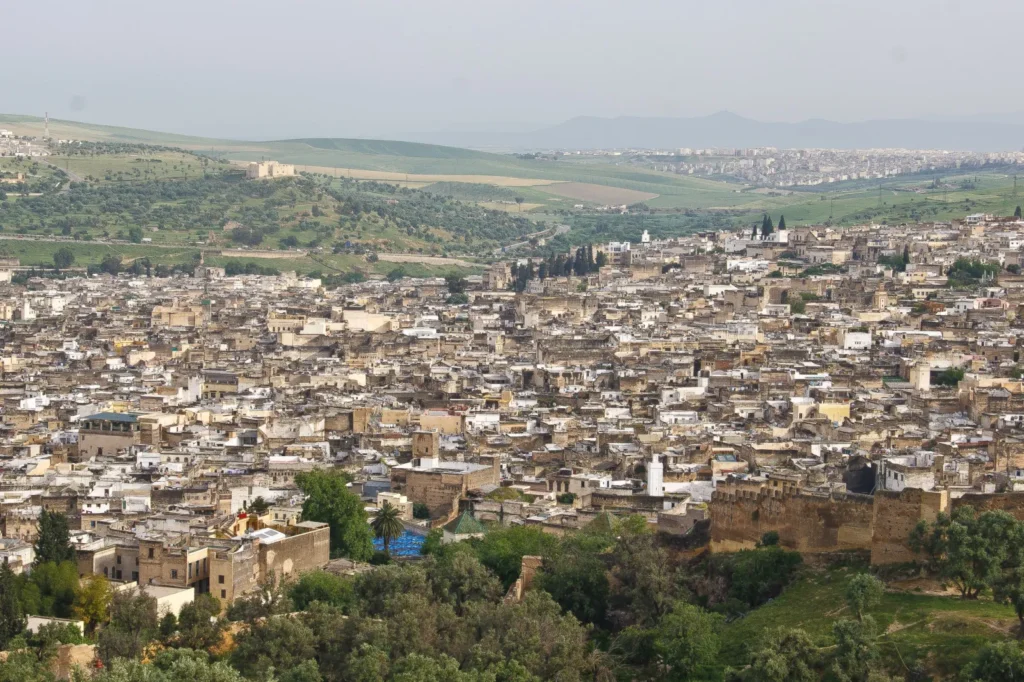
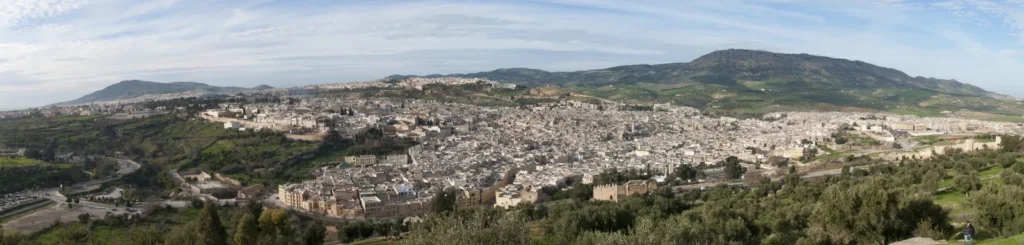
From above, Fes reads like a map: Fes el-Bali, the old city founded between 789 and 808 according to UNESCO, fills the valley of the Oued Fes; Fes el-Jdid, founded in 1276 by the Marinids, stretches to the west; the new town and Mount Zalagh close the horizon. Knowing how to spot these three blocks changes the whole experience.
The medina, meaning the walled historic city, looks from above like a continuous sheet of sand-coloured flat roofs with no visible streets: the derbs, narrow lanes that are often dead ends, vanish between the houses. Only the minarets and a few pyramid roofs covered in green tiles stand out. The two easiest to identify are those of the Al-Qarawiyyin Mosque, in the middle of the valley, and the mausoleum of Moulay Idriss II, one of the city’s zaouias. A zaouia is a shrine linked to a saint or a Sufi brotherhood, often built around a tomb.
UNESCO, which inscribed the medina of Fes on the World Heritage List in 1981, notes that the original city had two quarters separated by the river: the Andalusian bank to the east and the Kairouanese bank to the west. From above, that division can still be read in the dip of the valley. The organisation also states that the surroundings of the medina must remain unbuilt to preserve its visual integrity: it is precisely because these hills are free of housing estates that today’s panoramas exist.
Another useful landmark: to the north-east, the rounded outline of Jebel Zalagh dominates the city. From the south, it forms the backdrop of every photo; from the north, it is behind you. This simple orientation explains why Borj Sud and the Marinid Tombs produce completely different pictures, even though they look at the same city.
Marinid Tombs: the most famous viewpoint in Fes
The Marinid Tombs, on El-Qolla hill north of Fes el-Bali, offer the city’s best-known panorama: the whole medina spreads out due south below you, with the ruins of 14th-century mausoleums in the foreground. Access is free and open; the best time is late afternoon until sunset.
The hill holds the remains of a necropolis of the Marinid dynasty, which ruled Morocco from the 13th to the 15th century. Several sultans were buried here between 1361 and 1398, and the last of them, Abd al-Haqq II, in 1465. In the 16th century the traveller Leo Africanus described richly decorated tombs with colourful marble epitaphs. Only rammed-earth and brick walls remain, including two tall rectangular structures pierced by horseshoe arches, typical of Maghrebi architecture. The full history of the site, its sultans and the state of the remains are covered in our dedicated article on the Marinid Tombs in Fes; here, the focus is the view.
What you see from the Marinid Tombs
Facing south, you take in all of Fes el-Bali, from Bab Boujloud on the left to the Andalusian quarters on the right, with the Borj Sud hill and the large white cemeteries of Bab Ftouh in the background. The strength of this belvedere is the sound: at the end of the day, the calls to prayer from dozens of mosques in the valley answer one another and rise up to the hill. The foreground of ochre ruins gives depth to photos, something no medina terrace can offer.
Best time, access and safety
Because you look south, the midday sun is straight ahead: photos come out flat and hazy. In late afternoon it moves west, to your right, and lights the façades at an angle: this is the golden hour that made the site famous. You get there by petit taxi (drivers know the name “Mérinides”, as the hotel of the same name is close by) or on foot from Bab Guissa, via a short but steep climb. The top has neither lighting nor shade. Travellers’ accounts recommend going in a group and planning the return: after sunset, the descent is in the dark, by phone torch. A simple tip: on the way up, note the path you will take back, and keep a driver’s number.
Note: the Agency for the Development and Rehabilitation of the City of Fes (ADER-Fès) announced in August 2024 a restoration and landscaping project for the site, together with the Al-Anouar Mosque, with a combined budget of 12 million dirhams according to La Vie éco. Rescue excavations over 2,547 m², described by Médias24 in March 2024, preceded the works. Depending on progress, parts of the hill may be fenced off: check on site.
Borj Nord: the view over Fes from the Saadian fortress
Borj Nord is a fortress built in 1582 by the Saadian sultan Ahmad al-Mansur on the northern hill, a few minutes from the Marinid Tombs. Its esplanade gives a plunging view of the medina, slightly lower and closer than from the tombs. It houses the Arms Museum, whose opening hours and price should be checked on site.
The word borj means a tower or small fort in Arabic. The Saadians, whose capital was Marrakech, distrusted the population of Fes el-Bali: Borj Nord and its twin, Borj Sud, served as much to keep the city under the threat of cannon as to defend it. They are among the first fortifications in Fes designed for artillery, probably built with the help of European prisoners captured at the Battle of the Three Kings in 1578. The Arms Museum has been housed there since 1963. For the collections, the famous Saadian cannon and the interior visit, see our article on Borj Nord and the Arms Museum.
As a panorama, Borj Nord pairs naturally with the Marinid Tombs: you can walk between them along the road that follows the ridge. The view has the same orientation, due south, with the same light constraints. Its advantage: the fortress stands beside a busy road and a hotel, which makes it less isolated than the top of the tombs. Its drawback: walls, trees and the terrain hide part of the valley depending on where you stand. Walk around the enclosure before you take out your camera.
Borj Sud: the Fes viewpoint photographers prefer
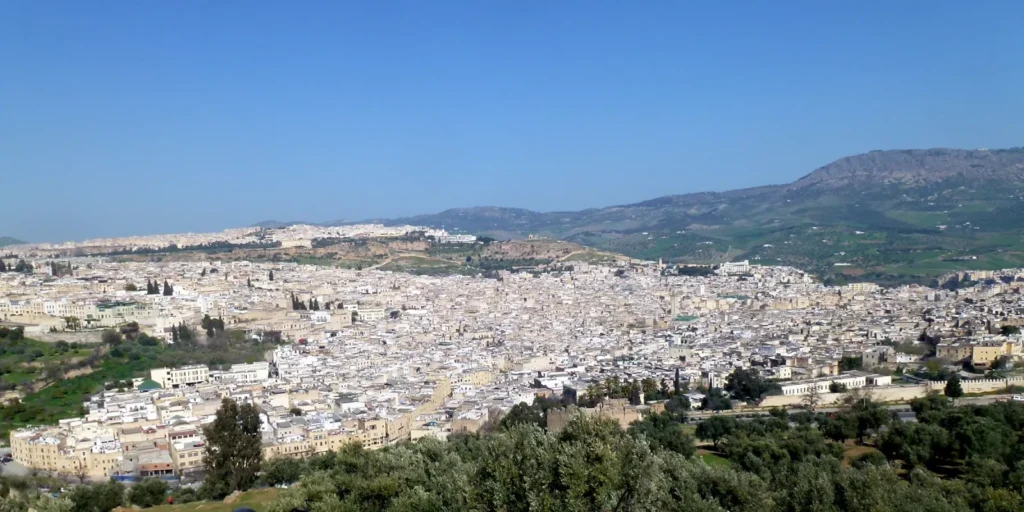
Borj Sud is the Saadian fort built in 1582 on the heights south of Fes el-Bali, facing Borj Nord. Its panorama shows the whole old city with Jebel Zalagh in the background, and because you look north, the sun is never in the lens. The view from the hill is free; long closed, the restored fort reopened on 27 March 2026 as a museum devoted to Morocco’s fortifications.
This is the image found on most postcards: the sand-coloured medina climbing up the valley to the Marinid hill, where the ruins can be made out on the horizon, with the mountain behind. Turning around, you also see Fes el-Jdid and the site of the royal palace to the west, the olive trees on the hills and the white tombs of the cemeteries below. The panorama is wider than from the tombs, almost circular depending on where you stand on the mound. According to the regional press, the fort, which covers about 1,500 m², was inaugurated on 27 March 2026 after restoration: it now houses exhibition rooms on the Kingdom’s historic fortifications. Opening hours and admission price had not been officially published at the time of writing.
How to get to Borj Sud
Borj Sud is poorly signposted from the medina. The easiest option is a metered petit taxi, asking for “Borj Sud” or “Borj Janoubi”; from the medina, published descriptions mention a 10 to 15-minute ride depending on traffic (check locally). On foot, you leave the medina via Place R’cif or Bab Ftouh and climb the hill; the walk is hard work in hot weather and the paths are not marked. During museum opening hours, you can enjoy the view from the fort itself; outside them, from its surroundings, on bare ground.
Best time and safety
Early in the morning, light comes from the east, on your right, and brings out the relief of the rooftops; in late afternoon it arrives from the left. In high summer, heat haze veils the mountain from late morning: aim for the first two hours after sunrise. The area around Borj Sud is less visited than the Marinid Tombs, which makes it calm but more isolated. Go with at least one other person, keep valuables out of sight, and do not linger at nightfall.
The Bab Ftouh cemetery hill
The Bab Ftouh cemetery covers the slopes east of Fes el-Bali, outside the gate of the same name: it is one of the largest and oldest cemeteries in the city. Its upper slopes give a close view of the Andalusian quarter. It is a sacred place, free to enter, where visitors behave with restraint.
Bab Ftouh is one of the main gates of the medina; its current form dates essentially from the rebuilding ordered in 1212 by the Almohad caliph Muhammad al-Nasir. Beyond it, thousands of whitewashed graves cover the hill. Two areas can be distinguished: el-Kbab, “the domes”, to the west, where saints’ mausoleums are grouped, and the Sidi Harazem section to the east. The most visible monument is the mausoleum of Sidi Ali ibn Harazem, a Sufi mystic who died in 1164-1165, recognisable by its green pyramid roof. These small domed mausoleums are called koubbas.
The view is not the most spectacular on the list, but it is the most singular: in the foreground, the sea of white tombs; in the middle, the ramparts; behind, the roofs of the Andalusian bank rising towards the centre. Looking up, you can see the Marinid hill across the valley. The top of the hill joins the Borj Sud area, so the two can be combined in a single outing.
Rules of conduct: walk on the paths, never on the graves; do not photograph funerals or families in prayer; dress modestly. On Fridays and religious holidays, many families come to pray: that is the time to stay discreet, or even postpone your visit. Several published accounts advise caution in some isolated sections, especially late in the day. If you are not comfortable, simply enjoy the view from the road that runs along the cemetery.
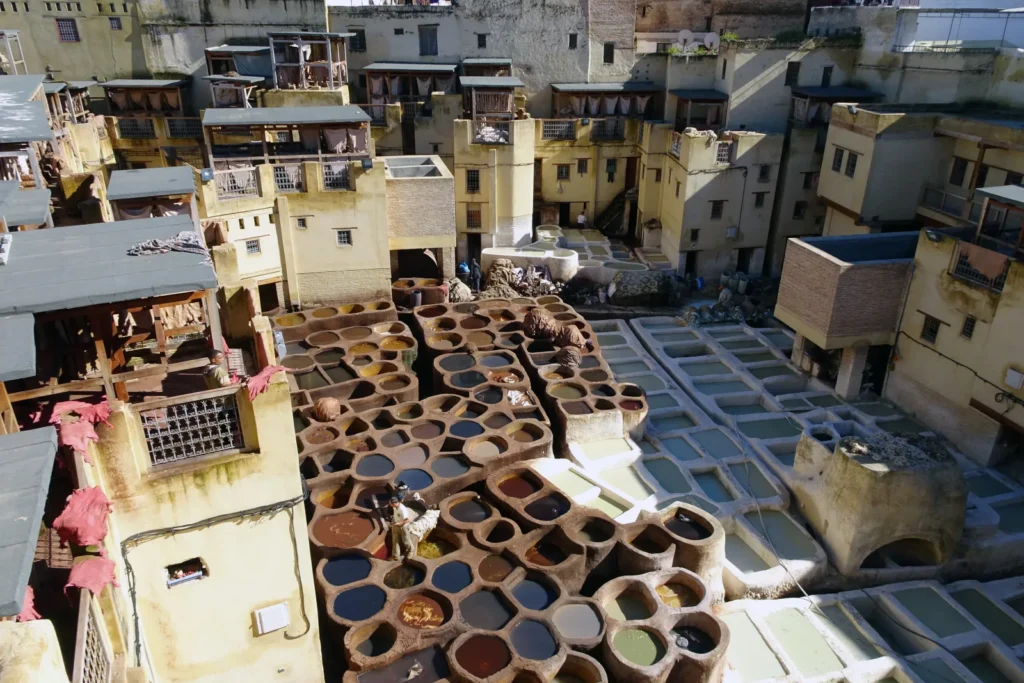
Chouara tannery terraces: a bird’s-eye view in the heart of the medina
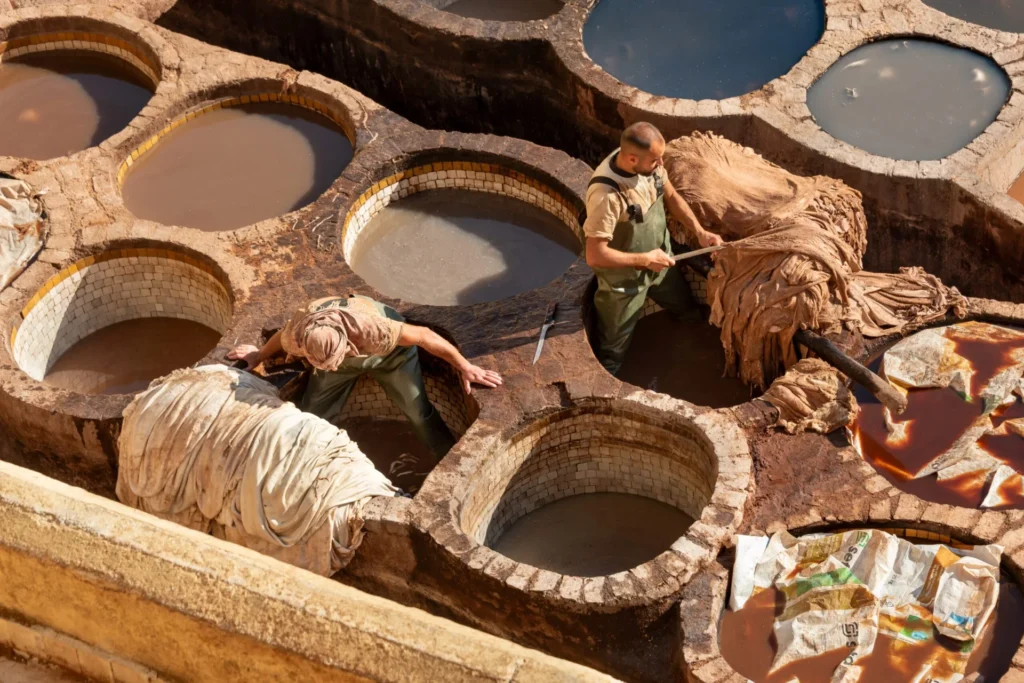
The terraces overlooking the Chouara tannery, near Seffarine Square, offer the most colourful viewpoint in Fes: dozens of stone vats filled with dyes, where the tanners work. You reach them through the leather shops surrounding the site; access is presented as free, but a tip is expected.
This is not a panorama of the city but a bird’s-eye view of a workplace, and that is what makes it unique. Chouara is the largest of the three tanneries in Fes. Its pits were restored between 2014 and 2016, as part of the medina rehabilitation works, without changing the working methods. For the tanning technique, the colours and buying leather, read our guide to the Chouara tannery.
Morning is the best time: workers are busy in the vats, hides are drying on the roofs and light reaches the bottom of the yard more easily. Shops often hand out a sprig of mint to sniff against the smell. In the nearby lanes, touts offer to “show you the terrace”: there is no need to follow them, the shop signs are enough. Once upstairs, nobody forces you to buy; a modest tip for the person who accompanies you is the most common custom. Ask the price before going up if you are offered a guided visit.
Nejjarine Museum rooftop: the roofs of Fes within arm’s reach
The rooftop of the Nejjarine Museum of Wooden Arts and Crafts, on Nejjarine Square in the heart of Fes el-Bali, overlooks the medina roofs and has a small tea room. Access comes with the museum ticket, 20 dirhams according to published sources. It is the most comfortable viewpoint in the old city: shaded, seated, with views of nearby minarets.
The museum occupies a fondouk, a former warehouse and inn for merchants and pack animals built around a courtyard. This one was commissioned in 1711 by the amin (provost) ‘Adiyil, during the reign of the Alaouite sultan Moulay Ismail. Restored between 1990 and 1996, it reopened on 23 May 1998 as a private museum devoted to wood. Right next to it, the Nejjarine Square fountain, decorated with zellij, dates from the 19th century and the reign of Sultan Moulay Abderrahmane. Zellij is a mosaic of small hand-cut ceramic tiles.
From the terrace, the view is close and horizontal: interlocking roofs, satellite dishes, laundry drying, the minarets of the neighbourhood and, on clear days, the hills in the distance. Go up at the end of your visit, around midday, when the outer hills are baking in the sun: this is where you catch your breath between two alleys. Published hours range from 10 am to 5 pm or 6 pm depending on the source: check on site, especially during Ramadan.
Riad and café rooftops: the evening viewpoints
The rooftops of riads, cafés and hotels in Fes are the only viewpoints where you can stay safely after nightfall. A riad is a traditional house built around a planted courtyard, often turned into a guesthouse. Access is through a drink, a meal or an overnight stay.
Three addresses come up in every recommendation, for different reasons:
- Café Clock, 7 Derb el-Magana, in a lane off the Talaa Kebira, a few minutes from Bab Boujloud and the Bou Inania Madrasa. Opened in 2007, it occupies an old house on several levels; its terrace looks over nearby minarets and, in the distance, Jebel Zalagh. Relaxed atmosphere, concerts on some evenings.
- L’Amandier at Palais Faraj, 16-18 Derb Bensouda, near Bab Ziat, on the southern edge of the medina. A fine-dining restaurant whose terrace overlooks the entire old city: the in-town equivalent of Borj Sud, with a night view of the illuminated medina.
- The terrace of Hotel Les Mérinides, on the northern hill, a few minutes’ walk from the tombs. For those who want the Marinid Tombs view with an armchair, a drink and a road to leave by taxi.
Do not forget the roof of your own riad: in the medina, almost every house has a terrace, and many enjoy a remarkable view. Ask to go up at sunrise, when the city wakes. Etiquette: roofs are private and often used by families, never step from one terrace to another and avoid photographing neighbours.
Comparison table of the viewpoints in Fes
Each viewpoint in Fes meets a different need: the hills give the full panorama but require vigilance, while medina terraces are safer but show less. This table compares the seven options by view, ideal time, access, cost and the level of caution required.
| Viewpoint | What you see | Best time | Access | Cost | Safety |
|---|---|---|---|---|---|
| Marinid Tombs | All of Fes el-Bali due south, ruins in the foreground | Late afternoon, sunset | Petit taxi or climb from Bab Guissa | Free | In daylight and in a group; no lighting |
| Borj Nord | Medina due south, closer | Late afternoon | Northern hill road, on foot from the tombs | View free; museum to be checked | Busier, roadside |
| Borj Sud | Whole medina and Jebel Zalagh, almost circular view | Morning, then late afternoon | Petit taxi; unmarked climb from Bab Ftouh | View free; museum reopened in 2026, price to be checked | Isolated: at least two people, not at night |
| Bab Ftouh cemetery | White tombs, ramparts, Andalusian quarter | Morning | On foot from Bab Ftouh | Free | Sacred place; avoid isolated sections |
| Chouara tannery terraces | Dye vats and tanners at work | Morning | Through the leather shops, near Seffarine Square | Customary tip | Safe; pushy touts |
| Nejjarine Museum | Medina roofs and minarets, up close | Midday | Nejjarine Square, in the medina | 20 dirhams (check) | Very safe |
| Rooftops (Café Clock, Palais Faraj, Les Mérinides) | Depending on the address: nearby minarets or the whole medina | Sunset and evening | Bab Boujloud, Bab Ziat, northern hill | Drink or meal | Very safe, including in the evening |
Which viewpoint should you choose for your trip?
If you only have time for one viewpoint in Fes, go up to the Marinid Tombs in late afternoon, then come down for a drink on the terrace of a hotel on the northern hill. With a full day, combine Borj Sud in the early morning, the tannery mid-morning, the Nejjarine Museum at midday and a rooftop in the evening.
A day of panoramas in five stages
- Sunrise: your riad’s terrace, for the first call to prayer and the city waking up.
- Early morning: petit taxi to Borj Sud, low-angled light and a still-sharp mountain.
- Mid-morning: back to the medina and the Chouara tannery, when the vats are in use.
- Midday: Nejjarine Museum and tea on its terrace, in the shade.
- Late afternoon: Marinid Tombs and Borj Nord, then dinner on a rooftop.
By traveller profile
- Photographers: Borj Sud at dawn, Marinid Tombs at golden hour. A medium telephoto lens isolates the green tiles of Al-Qarawiyyin among the roofs.
- Families with children: Nejjarine Museum and a hotel terrace, with no dirt paths or isolated alleys.
- Reduced mobility: the terrace of a hotel on the northern hill, reachable by car; check the lift with the hotel.
- Tight budget: both hills and the cemetery, all free, plus the roof of your guesthouse.
- Women travelling alone: favour medina terraces and the Marinid Tombs at busy times; for Borj Sud, come by taxi and keep it waiting if possible.
If you are still deciding where to stay, our comparison Marrakech or Fes will help. On this point Fes has a clear advantage: its medina can be read in full from the surrounding hills, something Marrakech’s flat terrain does not allow.
What is the best time to photograph Fes?
The best time to photograph Fes depends on which side of the valley you are on. From the north (Marinid Tombs, Borj Nord), you look south: aim for late afternoon, never midday. From the south (Borj Sud), you look north: morning is ideal and the light remains usable for almost the whole day.
The season matters as much as the hour. In summer, the heat creates a haze that blurs Jebel Zalagh from late morning and makes the shadeless hills exhausting. In spring and autumn, the air is clearer and the olive-covered hills greener. In winter, the light is softer, sunsets come earlier, and heavy skies after rain often give the sharpest images. Check the day’s sunset time and arrive on the hills at least forty minutes before: golden light does not last.
During Ramadan, the breaking of the fast empties the streets at sunset: the hills become deserted, which makes it even more important to go with company. On the other hand, the terraces then offer a special spectacle, with the city’s silence followed by the return of sounds after the call to maghrib, the sunset prayer.
Mistakes to avoid at the Fes viewpoints
The most common mistakes at the Fes viewpoints are climbing the hills at the wrong time, lingering after dark and following touts to the terraces. All of them can be avoided with a little preparation, and none requires paying a guide.
- Going up to the Marinid Tombs at midday: sun in your face, hazy photos, no shade. Come back after 4 pm in summer, earlier in winter.
- Staying on the hill after dark: no lighting, uneven paths. Plan your return before taking out your camera.
- Following an improvised “guide” to the tannery: the terraces are signposted by the shops themselves. If someone accompanies you, agree the price first.
- Relying on an old guidebook for Borj Sud: long closed, the fort reopened in March 2026 as a fortifications museum. Check opening hours on site before going up.
- Crossing the Bab Ftouh cemetery like a park: it is a place of prayer. Paths, covered clothing, no photos of people.
- Climbing onto neighbouring terraces from your riad: roofs are private spaces, often used by the women of the house.
- Forgetting water and a hat: there are no shops or fountains at the top of the hills.
What is near the viewpoints?
Each viewpoint in Fes leads on to a walking visit: the Bou Inania Madrasa near Bab Boujloud and Café Clock, Seffarine Square next to the tannery, the Nejjarine fountain in front of the museum, and the Al Batha Museum, reopened in February 2025, between Bab Boujloud and Fes el-Jdid.
Below the Chouara terraces, Seffarine Square rings with the sound of coppersmiths hammering metal. The madrasa, a religious college where students lodged, is the type of building that made Fes famous: the Bou Inania, on the Talaa Kebira, is a few steps from Café Clock. According to the National Museums Foundation (Fondation nationale des musées), the Al Batha palace reopened in February 2025 after restoration work begun in 2019, as the Al Batha Museum of Islamic Arts. To plan the rest of your stay, our guide to things to do in Fes brings together every place in the series.
If you arrive by plane, the views of Fes start on the approach: the airport lies on the Saïss plain, south of the city. Our guide to Fes-Saïss Airport details the options for reaching the medina.
FAQ about the viewpoints in Fes
What is the best viewpoint in Fes?
The most famous is the Marinid Tombs, north of the medina, especially at sunset. The most complete is Borj Sud, which shows the entire old city with Jebel Zalagh behind it and can be photographed for almost the whole day. If you can only do one, choose the tombs for the evening atmosphere and Borj Sud for photography.
Do you have to pay to visit the Marinid Tombs?
No, the Marinid Tombs hill is free and open access, with no ticket office or opening hours. The only possible costs are the petit taxi ride and a drink if you end on a nearby hotel terrace. As ADER-Fès announced restoration work in 2024, parts of the site may be fenced off depending on progress: check on site.
Is it dangerous to go up to the Marinid Tombs at sunset?
No, not in daylight and in a group, but caution is needed after dark. The site is unlit, the paths are uneven and travellers report some persistent solicitations. Go with others, keep valuables discreet, note the way back and arrange a taxi. The nearby hotel offers a safe alternative for enjoying the end of the sunset.
Can you see the Chouara tannery without buying anything?
Yes, the terraces of the shops around the tannery are presented as free and no purchase is required. In practice, sellers will show you their shop after the terrace, and a small tip for the person who took you up is customary. Politely but firmly turn down the touts in the lane: the shop signs are enough to find the entrance.
How much does the Nejjarine Museum rooftop cost?
The rooftop is included in the Nejjarine Museum ticket, 20 dirhams according to published sources, to be checked on site. Tea and drinks from the rooftop tea room are paid separately. The museum is generally open from 10 am to 5 pm, sometimes 6 pm depending on the source; hours change during Ramadan and on public holidays.
Can you go inside Borj Sud?
Yes, since 27 March 2026: after restoration, the Saadian fort of Borj Sud reopened as a museum devoted to Morocco’s fortifications, with exhibition rooms and a view over the medina. Opening hours and admission price had not been officially published at the time of writing: check on site. Outside opening hours, the view remains freely accessible from the surroundings on the hill.
Which viewpoint in Fes is best in the evening?
In the evening, choose a rooftop: the terrace of Hotel Les Mérinides on the northern hill, L’Amandier restaurant at Palais Faraj near Bab Ziat, or Café Clock near Bab Boujloud. These are the only viewpoints where you can stay after nightfall in complete peace, with the illuminated medina below.
Summary
The best viewpoints in Fes are shared between two hills and a handful of terraces. To the north, the Marinid Tombs and Borj Nord offer the sunset panorama, with 14th-century ruins in the foreground. To the south, Borj Sud gives the most complete view and the easiest to photograph, while the Bab Ftouh cemetery offers a more intimate image of the Andalusian bank. In the medina, the Chouara tannery offers the most colourful view, the Nejjarine Museum the most comfortable, and the rooftops the only one possible at night. The hills are free but isolated: go in daylight, with others, and bring water. If you remember only one thing, make it the orientation: late afternoon in the north, morning in the south.
Official sources
- UNESCO: Medina of Fez, World Heritage List
- National Museums Foundation: museums in Fes, including the Al Batha Museum
- Moroccan National Tourist Office (Visit Morocco)
- National Airports Office (ONDA)
- La Vie éco: restoration of the Marinid Tombs by ADER-Fès (August 2024, in French)
- L’Economiste: Borj Sud reopens as a fortifications museum (2026, in French)
This article is for information only. Prices, opening hours and access conditions at the sites mentioned may change; check them on site before your visit. Last updated: September 2026.
Photo credits
Images: featured image « File:Panorama Fes el Bali Borj Sud Fez morocco – panoramio.jpg » — Hiroki Ogawa (CC BY 3.0); « File:Panorama of Fes (5364676502).jpg » — Michal Osmenda (CC BY-SA 2.0); « File:Tanneries Chouara 1.jpg » — Alacoolwiki (CC BY-SA 4.0), via Wikimedia Commons.