Quick answer: the Yves Saint Laurent Museum Marrakech (mYSLm) opened its doors on 19 October 2017, on Rue Yves Saint Laurent, a short walk from the Majorelle Garden. Designed by the French firm Studio KO, this nearly 4,000 m² terracotta-brick building houses an exceptional selection from the collection of the Fondation Pierre Bergé – Yves Saint Laurent: around fifty haute couture creations, presented by theme, along with an auditorium, a research library, a café and a bookshop. Allow roughly one hour to an hour and a half for the visit, ideally paired with the neighbouring Majorelle Garden thanks to the combined ticket.
In brief: the YSL Museum Marrakech
- Opening: 19 October 2017
- Architect: Studio KO (Olivier Marty and Karl Fournier)
- Floor area: around 4,000 m²
- Address: Rue Yves Saint Laurent, Hivernage / Guéliz district, Marrakech
- What to see: permanent haute couture exhibition hall, temporary gallery, room dedicated to Jacques Majorelle, auditorium (130 seats), research library, café and bookshop
- Collection: Fondation Pierre Bergé – Yves Saint Laurent (several thousand garments and accessories, sketches, photographs)
- Right next door: the Majorelle Garden and the Pierre Bergé Museum of Berber Arts
- Distinction: “best new public building” at the 2018 Wallpaper Design Awards
There are few places in the world where fashion, contemporary architecture and the soul of a city echo one another so harmoniously. The Yves Saint Laurent Museum Marrakech is one of them. At once a tribute to one of the greatest couturiers of the 20th century and a declaration of love to a city that deeply inspired him, this cultural landmark has become, in just a few years, an essential stop on any stay in the Red City. In this complete guide, we tell you the museum’s story, its remarkable architecture, what you will actually see there, and all the practical information you need to plan your visit in 2026.
Yves Saint Laurent and Marrakech: a love story of more than forty years
To understand why an entire museum devoted to a Parisian couturier stands at the heart of Marrakech, you have to go back to 1966. That year, Yves Saint Laurent and his partner and business associate Pierre Bergé discovered Morocco. The impact was immediate. The light, the colours, the architecture of the medina, the intensity of the markets: everything transformed the outlook of the young couturier, then in his early thirties. Captivated, the two men quickly decided to buy a first house in the medina, named Dar el-Hanch, “the house of the serpent” in Arabic.
From then on, Marrakech would become a second homeland for Yves Saint Laurent. He returned regularly, often twice a year, to design his haute couture collections there, far from the bustle of Paris. The couturier himself confided how much the city had transformed his perception of colour: it was in Morocco, he said, that he dared the bold combinations of vivid tones that would become the signature of the house of Saint Laurent. The pink of the ramparts, the deep blue of the ceramics, the green of the gardens, the ochre of the walls: the palette of Marrakech runs through much of his work.
In 1980, Yves Saint Laurent and Pierre Bergé made a decisive gesture for the city’s heritage: they bought the Majorelle Garden, then threatened with destruction to make way for a real-estate project. In doing so they saved this botanical garden created by the French painter Jacques Majorelle, restored it with passion and enriched its plant collection. They settled in the adjoining villa, renamed Villa Oasis. When the couturier died in 2008, his ashes were scattered in the rose garden of the Majorelle Garden, where a memorial is dedicated to him. Pierre Bergé, who passed away in September 2017 just a few weeks before the museum’s inauguration, also rests in this place they loved so much.
The Yves Saint Laurent Museum Marrakech is therefore far more than a cultural institution: it is the natural culmination of a visceral bond between an artist and a city. To place this story within the wider context of the destination, you can consult our complete guide “Things to do in Marrakech”, which lists the great must-sees of the Red City.
Two museums, one foundation
It is worth clarifying to avoid any confusion: there are in fact two Yves Saint Laurent museums, born of the same desire to preserve and pass on the couturier’s legacy. One is in Paris, on Avenue Marceau, in the historic premises of the fashion house where the collections were created for nearly thirty years. The other, the one that concerns us here, stands in Marrakech. Both institutions draw on the collection of the Fondation Pierre Bergé – Yves Saint Laurent and mirror each other like the two poles of a single life: Paris, the city of work and creation; Marrakech, the city of inspiration and renewal. Visiting the Marrakech museum therefore means discovering the Moroccan side, more intimate and more sunlit, of the couturier’s work.
The museum’s architecture: a lace of brick by Studio KO
The building is the work of the French architecture firm Studio KO, founded by Olivier Marty and Karl Fournier. Inaugurated on 19 October 2017, it spans nearly 4,000 m² and immediately made an impression: as early as January 2018, it won the prize for “best new public building” at the Wallpaper Design Awards.
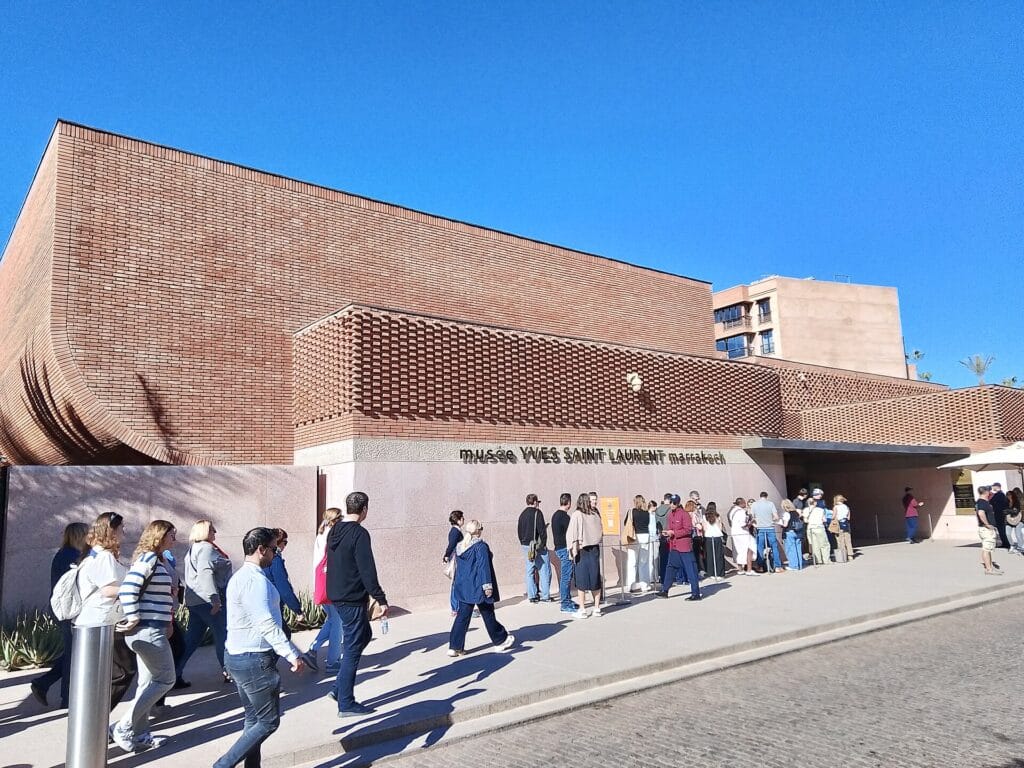
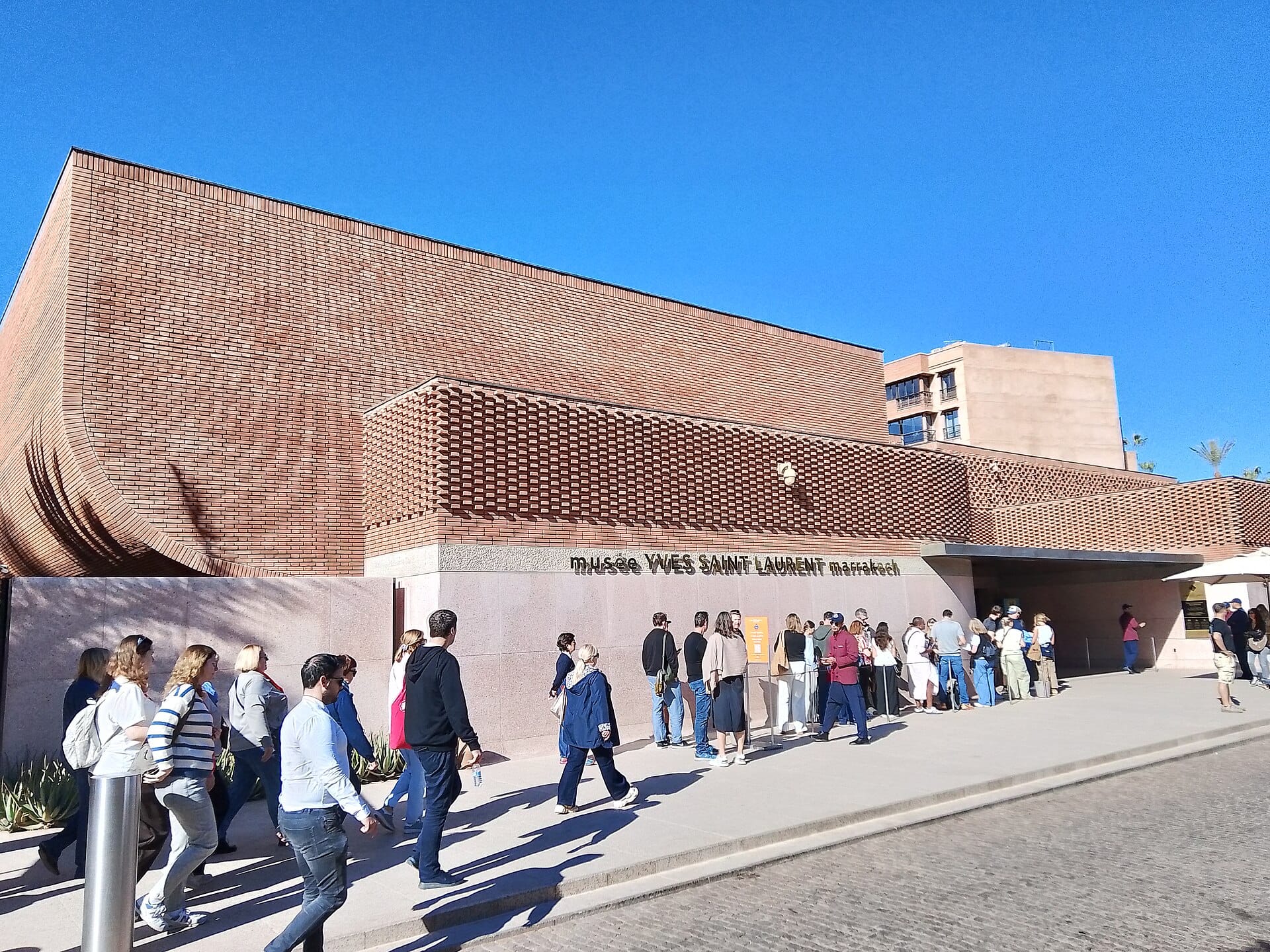
The façade is the most spectacular element. The architects imagined an assembly of cubes and curves dressed in a genuine lace of terracotta brick. This geometric motif is not decorative by chance: it evokes the weave of a fabric, the interlacing of warp and weft, in a direct nod to the couturier’s craft. Depending on the position of the sun, the brick changes hue and casts shifting plays of shadow across the walls, like the threads of a cloth catching the light.
Studio KO drew on local materials and know-how. The construction combines terracotta brick, concrete and a terrazzo made from Moroccan earth and marble, in mineral, earthy tones. Inside, the atmosphere shifts: after the rough, warm texture of the façade, the visitor discovers smooth, hushed and luminous spaces, conceived as the silky reverse of a garment. This contrast between the raw exterior and the velvety interior is a deliberate metaphor for couture itself.
The result is a profoundly contemporary building that nonetheless converses with traditional Moroccan architecture, without ever pastiching it. It is this success that earned the museum its international recognition and made it, in itself, a fully-fledged work of art — even before you step into the galleries.
The project was championed and funded by Pierre Bergé, notably thanks to a major art sale held in Marrakech in 2015. The choice of local craftsmen and materials was no mere detail: the aim was to anchor the building in Moroccan soil, to make it rise from the very earth of the region. This coherence between substance and form explains why the museum is often cited as a model of contemporary cultural architecture in the Maghreb, studied well beyond the kingdom’s borders.
What do you discover inside the YSL Museum Marrakech?
The heart of the museum is its permanent exhibition hall, entirely devoted to the work of Yves Saint Laurent. Within a sober, theatrical staging, around fifty haute couture creations are presented. They are not arranged chronologically but organised around the great themes that structure the couturier’s world:
- Masculine-Feminine: the tuxedo for women, the safari jacket, the trouser suit — the pieces that revolutionised the female wardrobe.
- Black, Africa and Morocco: the direct influence of the African continent and Moroccan culture on his collections.
- Imaginary Journeys: China, Russia and Spain dreamed and reinvented through fabrics.
- Gardens: nature, flowers and plant colours as a source of inspiration.
- Art: the couturier’s dialogues with Mondrian, Picasso, Matisse or Van Gogh, transposed into dresses.
The pieces on display come from the collection of the Fondation Pierre Bergé – Yves Saint Laurent, one of the most important fashion archives in the world, which holds several thousand haute couture garments, tens of thousands of accessories, as well as a considerable body of sketches, drawings, photographs and objects. For conservation reasons — old textiles are fragile and sensitive to light — the models on display are regularly rotated. In other words, no two visits are quite alike, and it is common to discover different pieces from one year to the next.
The temporary exhibition gallery
The museum also has a temporary exhibition gallery that hosts, throughout the year, displays devoted to fashion, art, design or photography. As these exhibitions change regularly, it is advisable to check the current programme before your visit: it is often an opportunity for unexpected discoveries, beyond the work of Yves Saint Laurent alone.
The Jacques Majorelle room, the auditorium, the library
One room is dedicated to the painter Jacques Majorelle, creator of the neighbouring garden, whose works recall the deep bond that unites the museum with the artistic history of Marrakech. The building also includes a 130-seat auditorium, which hosts screenings, lectures, concerts and cultural gatherings, as well as a research library rich in several thousand works devoted to fashion, decorative arts, botany, literature and the history of Morocco and Andalusia — the great interests of Yves Saint Laurent.
The café and the bookshop
Before or after the visit, you can enjoy the café-restaurant with its patio terrace, ideal for a break in an elegant setting. The bookshop-boutique, for its part, offers works on fashion and art, prints, posters and carefully selected objects: a good address for bringing back a refined souvenir of Marrakech. Access to the café and the bookshop is generally possible without a museum ticket, which makes it a pleasant stop even for passing visitors.
YSL Museum and Majorelle Garden: two inseparable visits
The museum is just a few steps from the Majorelle Garden, on the street that already bears the couturier’s name. The two sites are so closely linked that it would be a shame to separate them. The Majorelle Garden, with its famous “Majorelle” blue, its bamboo, its cacti and its pools, welcomes more than 700,000 visitors each year and ranks among the most photographed places in Morocco. On site you will also find the Pierre Bergé Museum of Berber Arts, which presents a superb collection of objects, jewellery and costumes from the Amazigh cultures.
Our advice: set aside a full half-day to combine the Majorelle Garden, the Museum of Berber Arts and the Yves Saint Laurent Museum. These three sites form a coherent whole that tells, on its own, the story of Yves Saint Laurent in Marrakech. To plan this visit in detail — the best time to come, tips for avoiding the crowds, booking — see our complete Majorelle Garden guide 2026, which perfectly complements this article.
Practical information: opening hours, prices and tickets
The information below is given as a guide only: opening hours and prices may change depending on the season and closure periods. We strongly recommend checking and booking directly on the official website jardinmajorelle.com before your visit.
Opening hours
The Yves Saint Laurent Museum Marrakech generally opens every day, from around 10 a.m. to 6 p.m., with a last admission around 5.30 p.m. (hours may be reduced in the evening during Ramadan and on certain public holidays). The neighbouring Majorelle Garden opens earlier, around 8 a.m. Arriving right at opening or at the end of the day lets you avoid the heavy midday crowds.
Prices and combined ticket
Several ticket options exist: entry to the Yves Saint Laurent Museum alone, entry to the Majorelle Garden, and above all a combined ticket giving access to the whole Majorelle Garden + Museum of Berber Arts + Yves Saint Laurent Museum. This combined ticket is the best value if you want to see everything. As prices are reassessed periodically, refer to the official website for up-to-date rates as well as discounts (children, students, Moroccan residents).
Important points to remember about ticketing:
- Tickets are now personal (named) and tied to a specific time slot: arrive at the stated time (a limited tolerance applies).
- Booking online in advance is strongly advised, especially in high season, as the slots sell out fast.
- Beware of unofficial resellers: buy only on the official website to avoid unpleasant surprises.
How to get there from the airport and the city centre
The museum is in the Guéliz / Hivernage district, Marrakech’s new town, about 10 to 15 minutes by taxi from Jemaa el-Fna square. From the airport, allow around fifteen minutes by road depending on traffic. For everything you need to know about your arrival, transfers and taxis, see our dedicated guide to Marrakech-Menara Airport (RAK). On site, opt for a petit taxi with a meter, or a fare agreed in advance; parking is limited around the museum.
Tips for a successful visit
- Book in advance: the morning and end-of-day slots are the most sought-after and the most pleasant (soft light, fewer people).
- Allow the right amount of time: around 1 hour to 1 hour 30 for the museum alone, and a half-day if you add the Majorelle Garden and the Museum of Berber Arts.
- Photography: the permanent exhibition hall is generally subject to restrictions to protect the textiles; the façade and the patio, on the other hand, lend themselves perfectly to photos.
- Dress and comfort: bring water and sun protection for the outdoor queues in summer, as the heat in Marrakech can be intense.
- Combine wisely: fold this cultural visit into a day in Guéliz, a modern district with fine café and shopping addresses.
If you are planning a stay of several days, this visit fits ideally into a structured itinerary. Discover our suggested Marrakech in 3 days to balance culture, medina and relaxation. And to choose your base as close as possible to the sites, our guide on where to stay in Marrakech will help you select the right district, from the charm of a riad in the medina to the modern comfort of Guéliz.
Why the YSL Museum Marrakech is truly worth the trip
You might think a fashion museum only appeals to haute couture enthusiasts. That is a mistake. The Yves Saint Laurent Museum Marrakech charms a far wider audience, for at least three reasons. First, the architecture: even without crossing the threshold, the brick façade is a contemporary masterpiece that alone justifies the trip. Then, the history: the museum tells of a rare relationship between an artist and a city, a story of colours, light and loyalty that goes far beyond the field of fashion. Finally, the setting: combined with the Majorelle Garden, it forms one of the most beautiful cultural ensembles in all of Morocco.
Whether you are an art lover, curious about architecture, passionate about history or simply a traveller seeking a moment of quiet beauty, the visit leaves a lasting impression. It reminds us that Yves Saint Laurent did not merely love Marrakech: he helped preserve its heritage, and the city, in return, today pays him a tribute worthy of their shared story.
Frequently asked questions (FAQ)
Where is the Yves Saint Laurent Museum in Marrakech?
The museum is on Rue Yves Saint Laurent, in the Guéliz / Hivernage district (the new town), right next to the Majorelle Garden. It is about 10 to 15 minutes by taxi from Jemaa el-Fna square and from Marrakech-Menara Airport.
When did the YSL Museum Marrakech open?
The museum was inaugurated and opened to the public on 19 October 2017. It was designed by the French architecture firm Studio KO, founded by Olivier Marty and Karl Fournier, and as early as 2018 it received the prize for best new public building at the Wallpaper Design Awards.
How much time should you allow for the visit?
Allow around 1 hour to 1 hour 30 for the museum alone. If you combine the visit with the Majorelle Garden and the Pierre Bergé Museum of Berber Arts — which is highly recommended — plan instead for a full half-day.
Is there a combined ticket with the Majorelle Garden?
Yes. A combined ticket gives access to the Majorelle Garden, the Pierre Bergé Museum of Berber Arts and the Yves Saint Laurent Museum. It is the best-value option if you want to see everything. Up-to-date prices and booking are available on the official website jardinmajorelle.com.
Should you book your tickets in advance?
Yes, it is strongly recommended, especially in high season. Tickets are personal (named) and tied to a specific time slot, and they are sold mainly online on the official website. Booking in advance guarantees your preferred time and saves you long waits.
What connection did Yves Saint Laurent have with Marrakech?
Yves Saint Laurent discovered Marrakech in 1966 and immediately bought a house there. The city became his major source of inspiration, especially for colour. In 1980, with Pierre Bergé, he bought the Majorelle Garden to save it from destruction. On his death in 2008, his ashes were scattered in that same garden. The museum naturally extends this love story of more than forty years.
Going further
Useful sources and references: the Wikipedia page for the Yves Saint Laurent Museum, Marrakech and, for the city’s heritage context, the Medina of Marrakech, a UNESCO World Heritage Site. For any booking, refer exclusively to the official website jardinmajorelle.com.
Images under a free licence via Wikimedia Commons: © Pivari (CC BY 4.0); © A. van Achterberg / ASC Leiden (CC BY-SA 4.0). Sources: UNESCO and Wikipedia.
Disclaimer: the opening hours, prices and ticketing arrangements mentioned in this article are given for guidance only and are subject to change. Always check the up-to-date information on the official website before your visit. This article is independent and is neither affiliated with nor sponsored by the Yves Saint Laurent Museum Marrakech, the Fondation Pierre Bergé – Yves Saint Laurent or the Majorelle Garden.