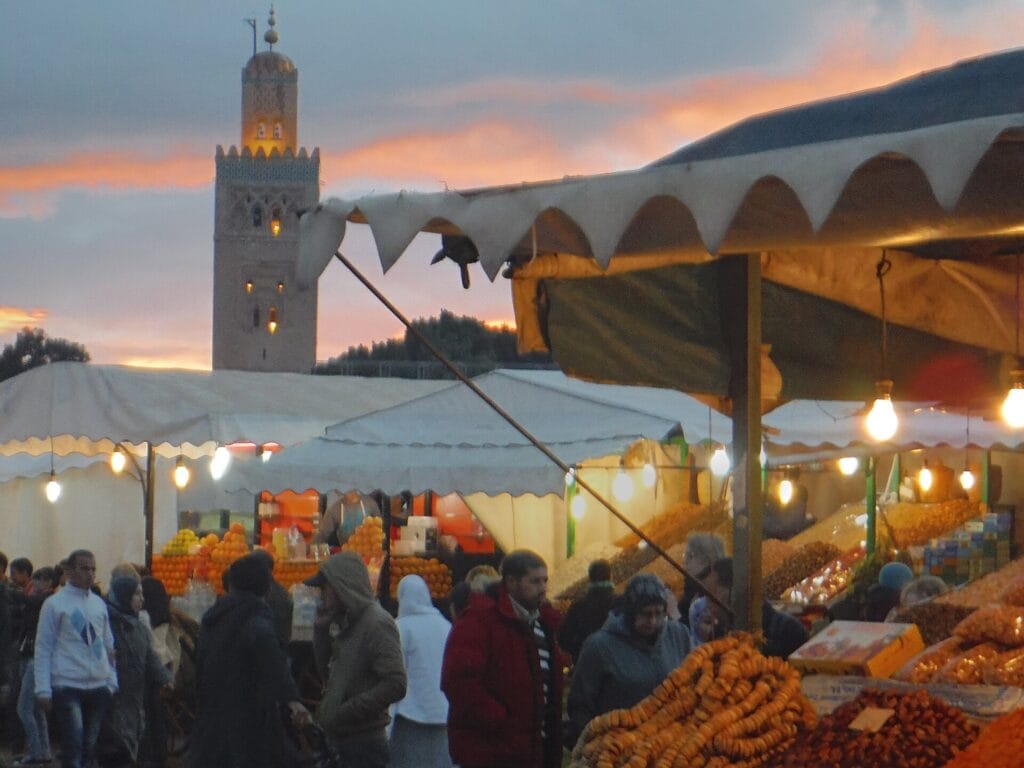
The Marrakech medina is the city’s historic heart: a vast walled quarter of red clay ramparts, founded in the 11th century and a UNESCO World Heritage Site since 1985. People come for its maze of souks, its Almoravid, Saadian and Alaouite monuments, its riads hidden behind unassuming doors, and a singular atmosphere in which everyday Moroccan life unfolds exactly as it has for centuries. Quite simply, it is the largest medina in Morocco and one of the most alive in the Arab world.
In brief: the essentials on the Marrakech medina
- Size: roughly 600 to 700 hectares, making it the largest medina in Morocco and one of the biggest in North Africa.
- UNESCO: a World Heritage Site since 1985 (cultural criteria i, ii, iv and v).
- Founded: around 1070, by the Almoravid dynasty and Youssef ben Tachfine.
- Main quarters: Kasbah, Mellah, Riad Zitoun, Mouassine, Bab Doukkala, all around Jemaa el-Fna square.
- Recommended visiting time: at least one full day for the highlights, two to three days to explore in depth.
- Good to know: narrow lanes (derbs), foot and two-wheeler traffic, fake guides at the entrance to the souks, and prices that are always negotiable and should be treated as indicative.
What is the Marrakech medina?
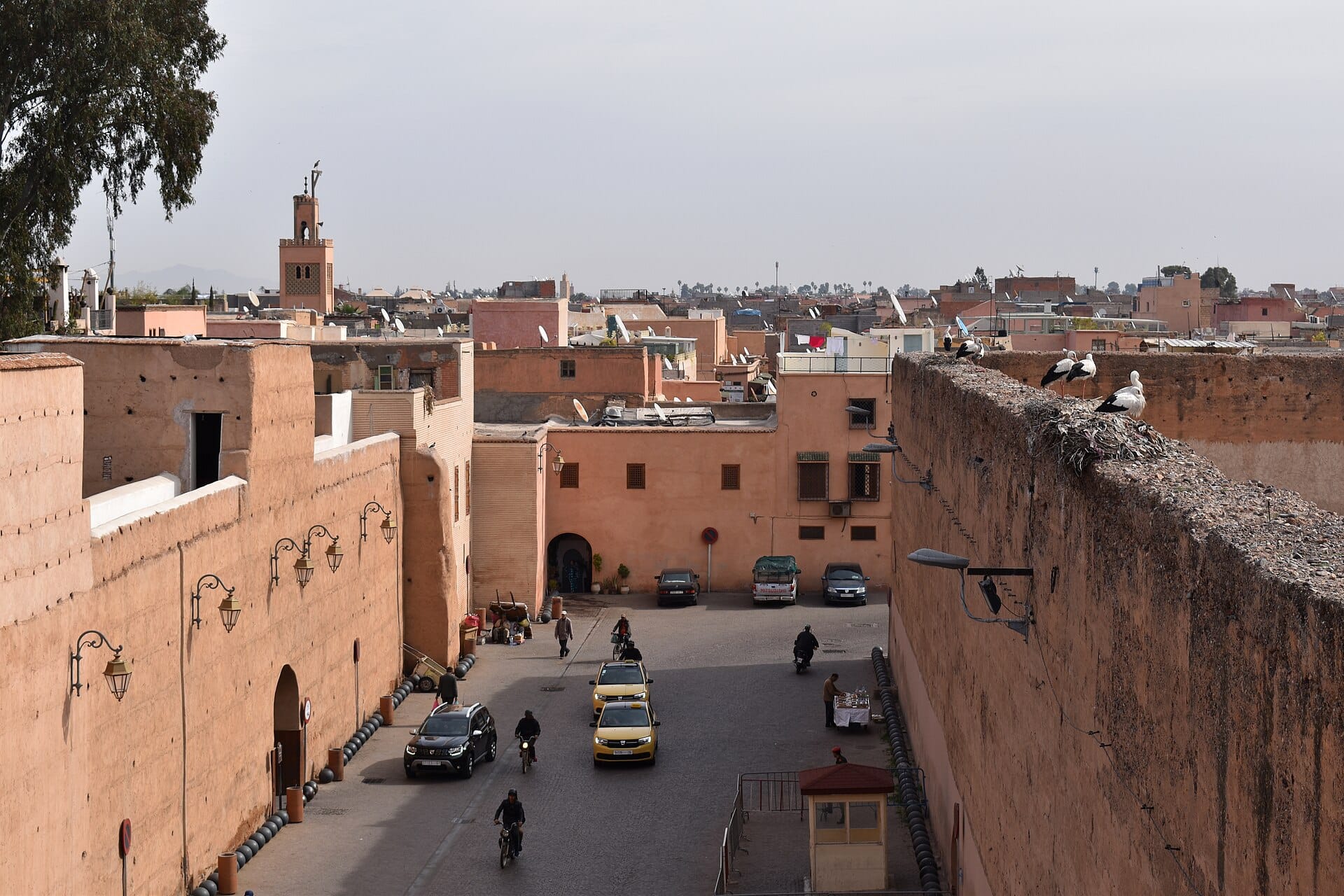
In Arabic, the word “medina” means the old town, the ancient core of a Muslim city as opposed to the modern districts built later. The Marrakech medina is therefore the historic city enclosed within its ramparts, in contrast to the new town (Gueliz and Hivernage) that grew up during the protectorate era in the early 20th century. Today this historic quarter forms one of the districts of the municipality of Marrakech.
What strikes visitors first is the density: a labyrinth of lanes known as “derbs,” covered souks, squares, mosques, fountains, fondouks (former merchant inns) and hundreds of riads, the traditional houses built around an inner courtyard. The medina is no frozen museum: it is a lived-in place, where craftspeople, shopkeepers and families work and go about their days, which explains much of its charm and its intensity. To plan your trip, our complete guide to things to do in Marrakech sets the medina within the city’s full list of must-sees.
History of the Marrakech medina: nine centuries of dynasties
Marrakech was born of the ambition of the Almoravids, a Berber dynasty that came from the Sahara. The city’s founding is traditionally dated to around 1070 and linked to Youssef ben Tachfine, who made it the capital of a vast empire stretching across North Africa and Andalusia. This period saw the first great works take shape: mosques, gardens and the famous underground irrigation system (the khettaras) that carried water to the city from the foothills of the Atlas.
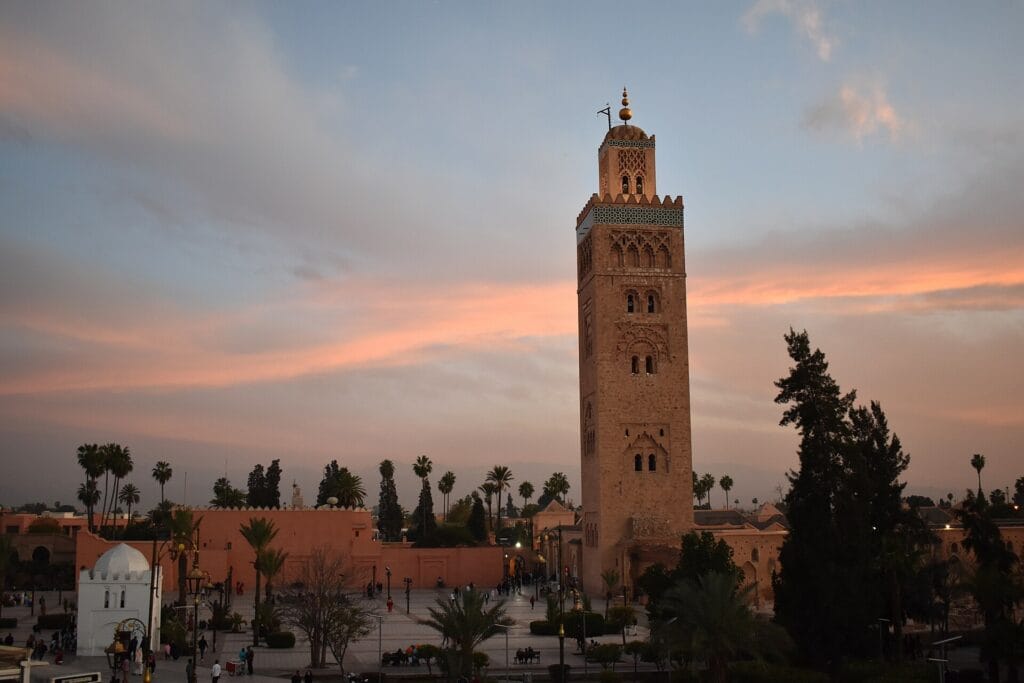
In the 12th century, the Almohads seized Marrakech and reshaped the medina. To them we owe the Koutoubia Mosque and its celebrated minaret, along with the monumental gateway of Bab Agnaou. After a period of decline under the Merinids, who favored Fez, the city rose again spectacularly in the 16th century under the Saadians: they built the El Badi Palace and the sumptuous Saadian Tombs, and created the Mellah, the Jewish quarter, in 1558. Finally the Alaouite dynasty, still reigning in Morocco today, left behind numerous buildings, including the Bahia Palace in the 19th century. This succession of dynasties explains the medina’s exceptional wealth of heritage.
Each dynasty left its mark on the old town, so that a stroll through the medina is like walking through nearly a thousand years of history under open skies. The Almoravids laid out the city and its ingenious water network; the Almohads gave it its great religious landmarks; the Saadians dressed it in splendor and refinement; and the Alaouites endowed it with palaces and gardens right up to the modern era. This constant layering, in which every era built on the one before without erasing it, is precisely what UNESCO set out to protect.
The Marrakech medina and UNESCO: a heritage of worldwide value
The Marrakech medina has been inscribed on the UNESCO World Heritage List since 1985. That recognition honors a remarkably well-preserved medieval urban ensemble, one that had a considerable influence on the development of architecture and art across the Muslim West, from the Maghreb to Andalusia and as far as sub-Saharan Africa.
The listed property takes in major landmarks: the Koutoubia Mosque, the ramparts and their monumental gates, the gardens, several palaces, the Ben Youssef Madrasa, the Saadian Tombs and Jemaa el-Fna square. The square itself, in fact, is singled out separately by UNESCO as a Masterpiece of the Oral and Intangible Heritage of Humanity, thanks to its storytellers, musicians and living traditions. You can dig deeper on the Wikipedia page devoted to the Marrakech medina.
The ramparts and gates of the medina
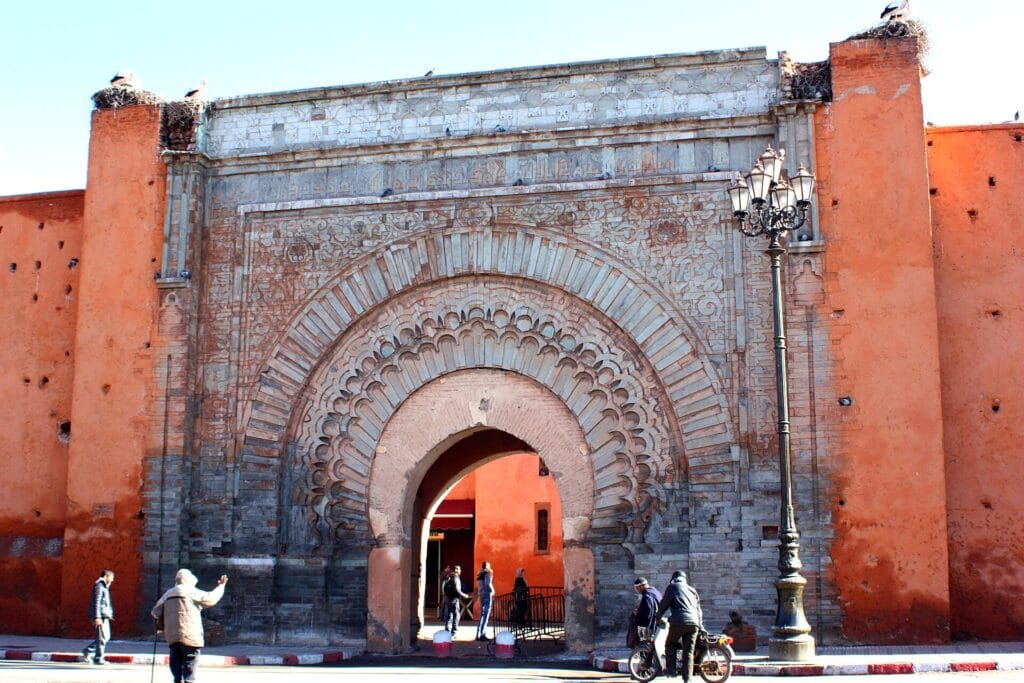
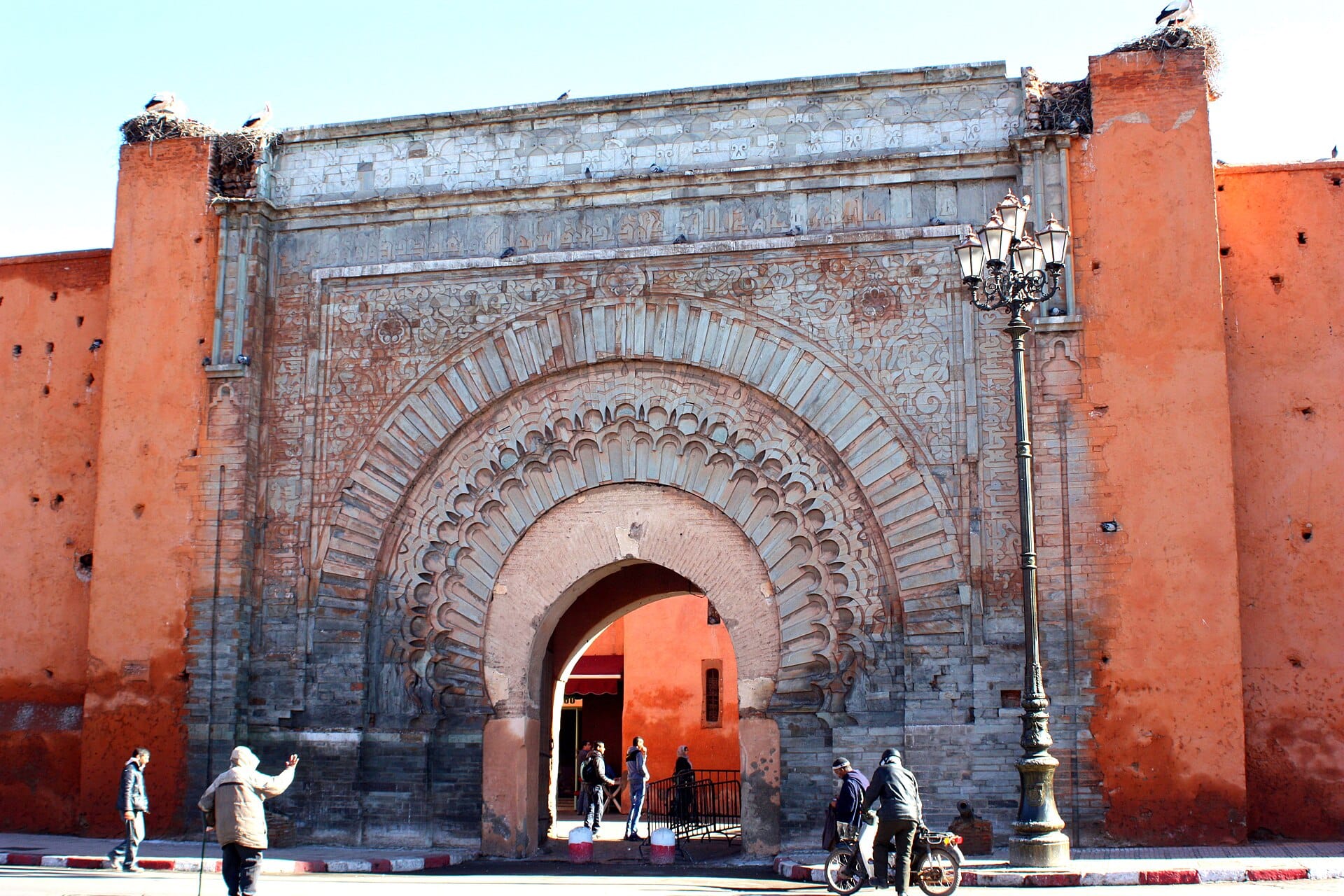
The medina is entirely ringed by rammed-earth ramparts, that raw earth mixed with lime which gives Marrakech its famous ochre color and its nickname, the “Red City.” Raised from the 12th century onward, these walls stand on average between 6 and 8 meters tall and 1.4 to 2 meters thick, reinforced at regular intervals by square towers. A total length of around 19 kilometers is often cited for the circuit around the old town.
These ramparts are pierced by numerous gates, the “bab,” which once regulated entry into the city and its trade. The most famous is Bab Agnaou, an Almohad gate from the 12th century, remarkable for its bluish-stone carvings that make it one of the finest in Morocco. The table below lays out the main gates worth knowing.
| Gate (Bab) | Location / quarter | Good to know |
|---|---|---|
| Bab Agnaou | South, near the Kasbah | The most monumental Almohad gate, carved in stone; leads toward the Saadian Tombs. |
| Bab Doukkala | Northwest | A large gate that gives its name to a working-class quarter and its mosque. |
| Bab el-Khemis | North | Famous for its Thursday market (souk el-Khemis) and its flea market. |
| Bab Debbagh | East | A gate close to the tanners’ quarter (leather tanneries). |
| Bab er-Robb | South | The old gateway in from the roads of the south and the Atlas. |
The quarters and derbs of the medina
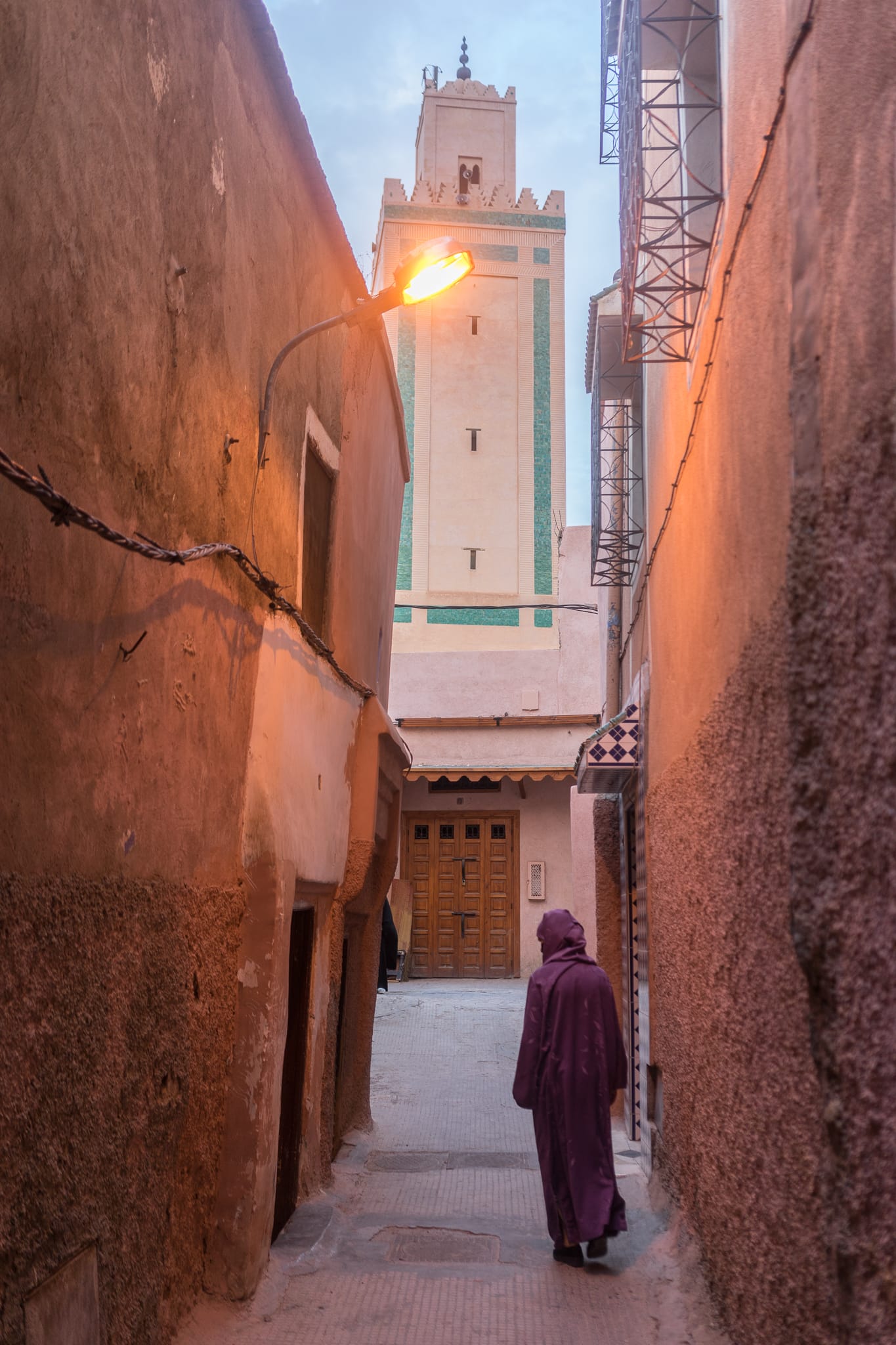
The medina is far from uniform: it breaks down into several historic quarters, themselves splintered into countless “derbs,” the dead-end alleys and residential lanes where neighborhood life is concentrated. Understanding this layout makes it far easier to find your bearings and to decide where to stay.
Around Jemaa el-Fna
The nerve center of the medina is Jemaa el-Fna square, the central landmark from which the souks radiate to the north and the main monuments fan out all around. It is the best place to reorient yourself when you get lost, because sooner or later every major thoroughfare leads back to it.
Mouassine and the northern souks
North of the square stretch the souks and the Mouassine quarter, prized for its handsome riads, its mosque, its restored fondouks and its designer boutiques. It is an area both commercial and residential, and a firm favorite with travelers.
Kasbah and Mellah, to the south
To the south, the Kasbah once housed the royal city and today holds several gems: the Saadian Tombs, the El Badi Palace and the Kasbah Mosque. Right next door, the Mellah, the former Jewish quarter founded in the 16th century, keeps a distinctive atmosphere, with its synagogue and its spice market.
Riad Zitoun and Bab Doukkala
The Riad Zitoun el-Kedim and Riad Zitoun el-Jedid axes link Jemaa el-Fna to the Bahia Palace, running through a lively area that blends craftspeople, grocers and guesthouses. Further to the northwest, Bab Doukkala shows a more down-to-earth, authentic side of the medina, away from the tourist crowds.
The souks and craftsmanship of the Marrakech medina
The souks are the commercial lungs of the old town. Historically organized by trade guilds, they form an immense covered market in which each section had its own specialty. The Semmarine Souk, the widest, serves as the main artery before branching off into dozens of themed lanes.
Here you’ll traditionally find babouches (Souk Smata), metalwork and lanterns (Souk Haddadine, the blacksmiths’ quarter), carpets (Souk Zrabi, or Berber auction), wool dyeing (the Dyers’ Souk), leather goods, basketry, pottery and spices. Haggling is part of the game: always open below the first offer, keep smiling, and remember that prices are purely indicative and swing with the season and the seller. Our dedicated guide to the Marrakech souks breaks down each section and the art of bargaining.
The fondouks and everyday life of the medina
To grasp the soul of the Marrakech medina, you have to look beyond the monuments and take in the life that animates it. The fondouks are precious witnesses to that life: these former merchant inns, built around a large inner courtyard, once lodged caravan traders and their animals on the ground floor, while the upper floors served as storerooms and bedrooms. Many have now been converted into artisans’ workshops, galleries or shops, and some, beautifully restored, can be visited freely around Mouassine or in the souk district.
Daily life also revolves around traditional amenities you come across as you wander the derbs: the communal bread oven (ferran), where families bring their dough to bake, the neighborhood hammam, the public fountain and the small local mosque. This layout, inherited from centuries of Islamic urban planning, turns each derb into a self-contained micro-village. It is this human dimension, far more than any postcard, that makes the medina so endearing and explains why it remains a living place, home to tens of thousands of people.
The monuments to see in the medina
The medina holds most of Marrakech’s historic monuments. Here are the must-sees, all reachable on foot from Jemaa el-Fna.
- The Koutoubia Mosque: a 12th-century Almohad masterpiece whose 77-meter minaret is the symbol of the city. Our page on the Koutoubia Mosque tells its full story (the interior is open to Muslims only).
- The Bahia Palace: a 19th-century Alaouite palace famous for its patios, painted ceilings and zellige tilework. Explore it through our guide to the Bahia Palace.
- The Ben Youssef Madrasa: a former Saadian Quranic school, one of the finest in Morocco for its carved stucco and woodwork. See the Ben Youssef Madrasa.
- The Saadian Tombs: a 16th-century royal necropolis rediscovered in the 20th century, a jewel of funerary art. Details on our Saadian Tombs page.
- The El Badi Palace: the majestic ruins of the former Saadian palace, today a refuge for storks.
- Jemaa el-Fna square: the great open-air theater of the medina, buzzing from morning until late into the night.
Where to stay in a riad in the heart of the medina
Sleeping in the medina almost always means sleeping in a riad. These traditional houses are built around a central patio, often graced with a fountain and orange trees, sheltered from the noise of the street. Behind an ordinary-looking door often hides a sumptuous interior: that is the whole principle of the medina’s introverted architecture, turned inward toward intimacy rather than outward to the façade.
Staying in the medina has a real advantage: you are within walking distance of every monument and of the nighttime buzz. The drawback is access: taxis can’t reach the narrowest derbs, and you often have to finish the trip on foot, sometimes with a porter to help with the bags. Pick a riad near a drivable access point if you’re traveling with large suitcases. To compare neighborhoods and options, see our guide on where to stay in Marrakech.
How to find your way in the medina and avoid getting lost
Getting lost in the Marrakech medina is almost a rite of passage: the lanes all look alike, change names, twist with no apparent logic, and mapping apps can be unreliable here. Rather than fight it, it’s better to fall back on a few simple habits.
- Fix a few reference points: Jemaa el-Fna at the center, the Koutoubia minaret visible from afar, or the gate closest to your riad.
- Download an offline map and note the exact address of your accommodation in both Arabic and English.
- Follow the flow: in the souks, the main shopping arteries always end up leading back to a square or an exit.
- Don’t hesitate to ask directions from a shopkeeper settled in their shop rather than from someone who approaches you out of the blue.
- Allow yourself to get a little lost: it’s often in the least touristy derbs that the real life of the medina reveals itself.
Fake guides and common scams in the medina
The medina is generally safe, but it does harbor a few annoying practices worth knowing about in advance. The most common is the fake guides: people approach you, claim the street is closed or that “the souk ends over that way,” then escort you before demanding money or steering you into shops where they earn a commission.
- Politely but firmly decline any unsolicited help; a simple “la, choukran” (no, thank you) does the trick.
- Be wary of the “it’s closed that way” line: it is almost always false.
- For a guided tour, go through an official licensed guide with a badge, arranged via your riad or a reputable agency.
- Always agree on the price before any service (horse-drawn carriage, porter, henna) and treat every quote as indicative and negotiable.
- Keep your valuables close to you in the busiest areas.
None of this should put you off visiting: with a little vigilance, the experience stays relaxed. To go further, our article on safety and scams in Marrakech walks through each situation and how best to respond.
Practical tips: hours, dress and respect
The medina is best experienced fully, provided you respect a few customs. For dress, favor clothing that covers the shoulders and knees, out of respect for a lived-in and often traditional quarter; this applies particularly to women near the mosques. Mosques, including the Koutoubia, cannot be visited from the inside if you are not Muslim, but the civil monuments (palaces, madrasa, tombs) are open to the public.
- Hours: the souks come to life mainly in the late morning and afternoon; many stalls partly close on Friday, the day of prayer.
- Photos: always ask permission before photographing a person; some shopkeepers or performers expect a small contribution.
- Payment: always keep cash on hand (dirhams), as few small stalls take cards.
- Best time: early morning for the light and the calm, evening for the atmosphere of Jemaa el-Fna.
- Ramadan: a slower pace during the day, but especially lively evenings after the breaking of the fast.
Getting around in and near the medina
Inside the medina, walking rules: most lanes are too narrow for cars, and you share the space with motorbikes, bicycles, carts and sometimes donkeys. It’s the only real way to appreciate every nook and cranny. On the edges, the small (beige) taxis serve the main gates and Jemaa el-Fna; agree on the fare or insist on the meter before getting in.
From Marrakech-Menara airport, allow a short fifteen minutes by car to the gates of the medina, but keep in mind that the final stretch to your riad will generally be on foot. The horse-drawn carriages (“caleches”) circle the ramparts and make a lovely way to take in the walls and gates, provided, once again, that you set the fare in advance.
Frequently asked questions about the Marrakech medina
What is the Marrakech medina?
The Marrakech medina is the historic old town, a walled quarter founded around 1070 and surrounded by red clay ramparts. It brings together the souks, the ancient monuments, the riads and Jemaa el-Fna square, and it has been a UNESCO World Heritage Site since 1985.
Why is the Marrakech medina a UNESCO site?
It was inscribed in 1985 because it is an exceptionally well-preserved medieval urban ensemble that influenced architecture across the entire Muslim West. The listed property includes the Koutoubia, the ramparts and their gates, several palaces, the Ben Youssef Madrasa, the Saadian Tombs and Jemaa el-Fna square.
Is the Marrakech medina dangerous?
No, the medina is generally safe for visitors, including in the evening on the busy thoroughfares. The main nuisances are fake guides and small scams, easy to avoid by politely declining unsolicited help and setting every price in advance.
How long do you need to visit the medina?
Allow at least one full day to see Jemaa el-Fna, the souks and two or three major monuments. To explore the different quarters, wander the derbs and visit all the sites, plan on two to three days instead.
Can you stay overnight in the Marrakech medina?
Yes, and it’s actually the most authentic experience: the medina counts hundreds of riads, those traditional patio guesthouses. Ideally pick a riad near a drivable access point if you have heavy luggage, as the last stretch is often on foot.
How do you avoid getting lost in the medina?
Fix reference points like Jemaa el-Fna square and the Koutoubia minaret, download an offline map and note the exact address of your riad. If in doubt, ask directions from a shopkeeper settled in their shop rather than from someone who approaches you out of the blue.
Editorial independence: this article is informational and independent. The prices, hours and access details mentioned are given purely as a guide and may vary with the season, public holidays and decisions made by the sites. Always check official hours and entry conditions before your visit.
The true beating heart of the Red City, the Marrakech medina remains one of the most powerful experiences Morocco has to offer: lose yourself in its derbs, let its souks take you by surprise, and you’ll understand why it has fascinated travelers for nearly a thousand years.
Images under free license via Wikimedia Commons: © Misa.stefanovic.07 (CC BY-SA 4.0); © Omalihy (CC BY-SA 4.0); © Safia Shutterbug (CC BY-SA 3.0). Sources: UNESCO and Wikipedia.