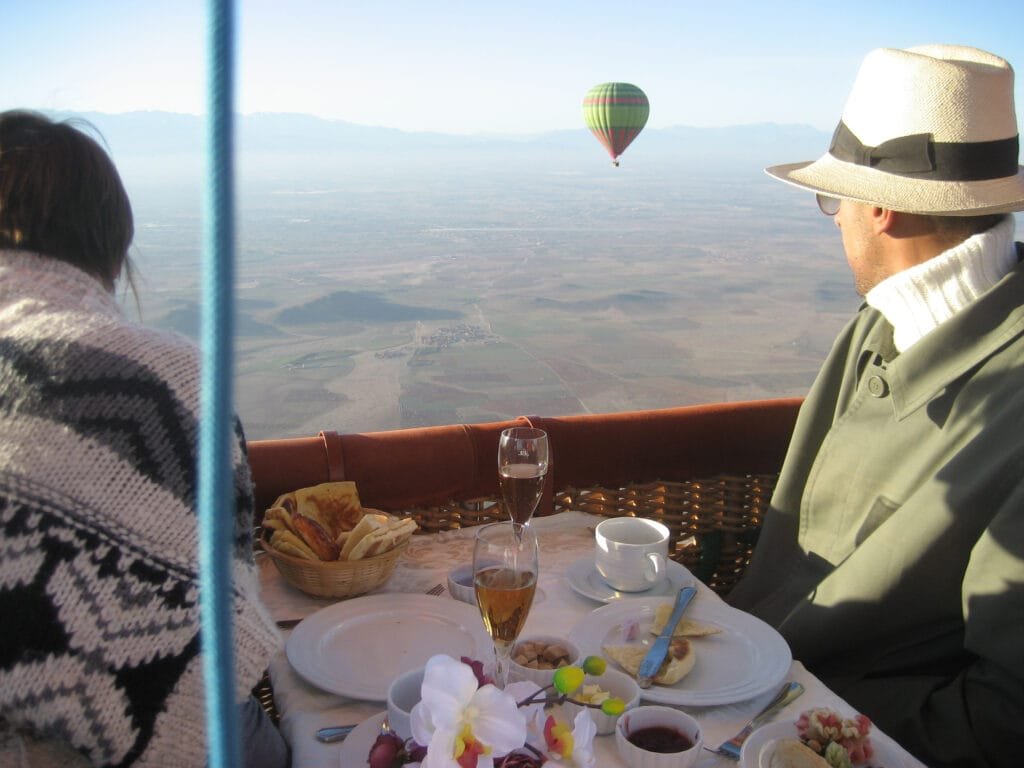
Riding a hot air balloon in Marrakech is one of the most beautiful ways to wake up in Morocco: you take off just before dawn, rise in silence above the plains that fringe the red city and watch the sun climb over the snow-capped wall of the Atlas mountains. The experience is a free flight in a hot air balloon lasting about an hour, guided by a professional pilot, followed by a Berber breakfast under a tent. It is calm, poetic and open to almost everyone: you don’t need to be athletic or know anything about aviation. You simply step into the basket and take in the view.
In practical terms, budget an indicative rate of around 1,300 to 2,200 dirhams per adult (roughly 120 to 200 € depending on the package and the season) for an outing that takes up half a day, transfer included. The flight itself lasts between 40 and 60 minutes, but the full adventure — pick-up before daybreak, inflating the balloon, the flight, landing and breakfast — stretches over four to five hours. This independent guide explains in detail how a hot air balloon flight in Marrakech unfolds, what you actually fly over, how much it costs, the best time of year to try your luck, the safety questions and every practical tip for booking your first flight with complete peace of mind.
In brief: the essentials before you book
- Flight duration: about 40 to 60 minutes in the air.
- Total outing length: 4 to 5 hours (half a day), round-trip transfer included.
- Timing: pick-up before dawn (often between 5 a.m. and 6:30 a.m. depending on the season), take-off at sunrise.
- Indicative price: ~1,300 to 2,200 MAD per adult (around 120 to 200 €), with reduced rates for children common.
- Usually included: hotel transfer, hot drinks before the flight, a pilot-guided flight, Berber breakfast, flight certificate.
- Ideal for: couples, families, photography and landscape lovers, first-time flyers.
- Worth noting: morning flights only, cancellable in case of wind or unfavourable weather.
Good to know: this guide is published by an independent media outlet, not affiliated with ONDA or any hot air balloon operator. The rates quoted are given purely as a guide and change according to the season, the operator and the exchange rate.
How a hot air balloon flight in Marrakech works
The ritual never changes, and that is part of the charm. It all begins well before daybreak: a minibus comes to collect you directly from your hotel or riad, usually between 5 a.m. and 6:30 a.m. depending on the time of year and the exact hour of sunrise. The transfer takes between thirty minutes and an hour, long enough to reach the take-off site in the plains to the north or west of the city. Plan to go to bed early the night before: the wake-up is early, but the hushed atmosphere of dawn and the promise of the spectacle are well worth the effort.
On arrival at the field, you are usually welcomed with mint tea, coffee and a few pastries, giving you time to warm up. Then comes one of the most impressive moments: inflating the balloon. The crews spread the envelope out on the ground, fill it with cold air using powerful fans, before the pilot fires up the burners. In front of your eyes, a mass of inert fabric slowly rises and comes to life in a breath of heat, until it stands upright above the basket. This inflation spectacle alone, in the low-slanting light of early morning, is worth the trip.
Once on board, take-off is perfectly gentle, often a few minutes before the sun breaks the horizon. Contrary to what you might imagine, there is no sensation of vertigo: the balloon moves at the speed of the wind, so you feel no draught and the ascent is completely silent, interrupted only by the occasional roar of the burners. For 40 to 60 minutes, you drift on the wind above the awakening landscapes, while the pilot adjusts the altitude to give you now a bird’s-eye view of the villages, now a wide panorama of the Atlas.
The landing depends on the direction of the wind: the pilot spots a clear field and sets the basket down gently, where a ground team follows the balloon by 4×4 to pick you up. After a final touch of solid ground, you are usually taken to a Berber tent where a full Moroccan breakfast awaits — bread, pancakes (msemen and baghrir), eggs, olive oil, honey, olives and mint tea. Many operators also hand out a souvenir flight certificate before driving you back to your hotel. This experience fits perfectly into an active stay: discover all the other activity ideas in our complete guide to things to do in Marrakech.
Where you fly and what landscapes you discover
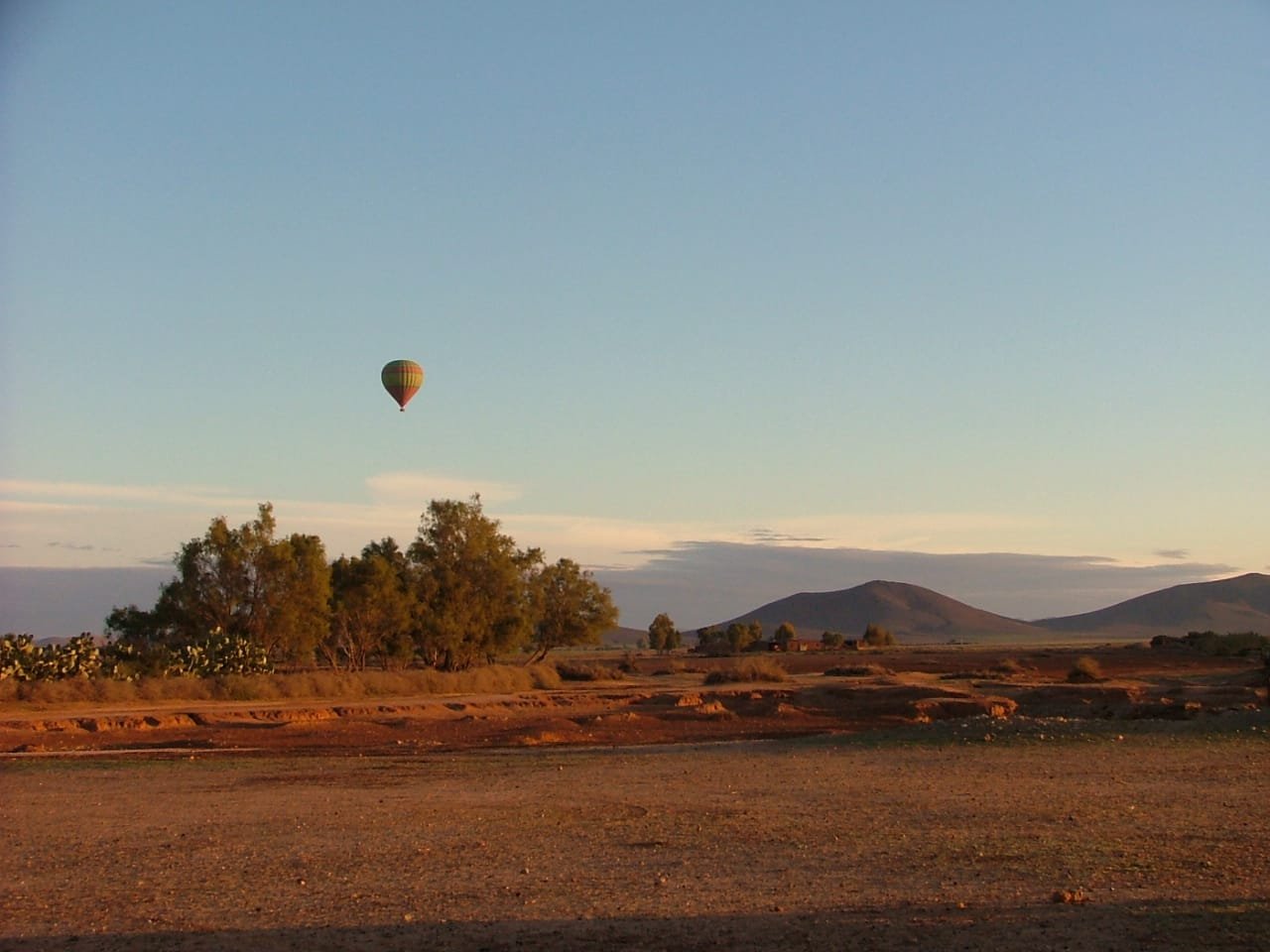
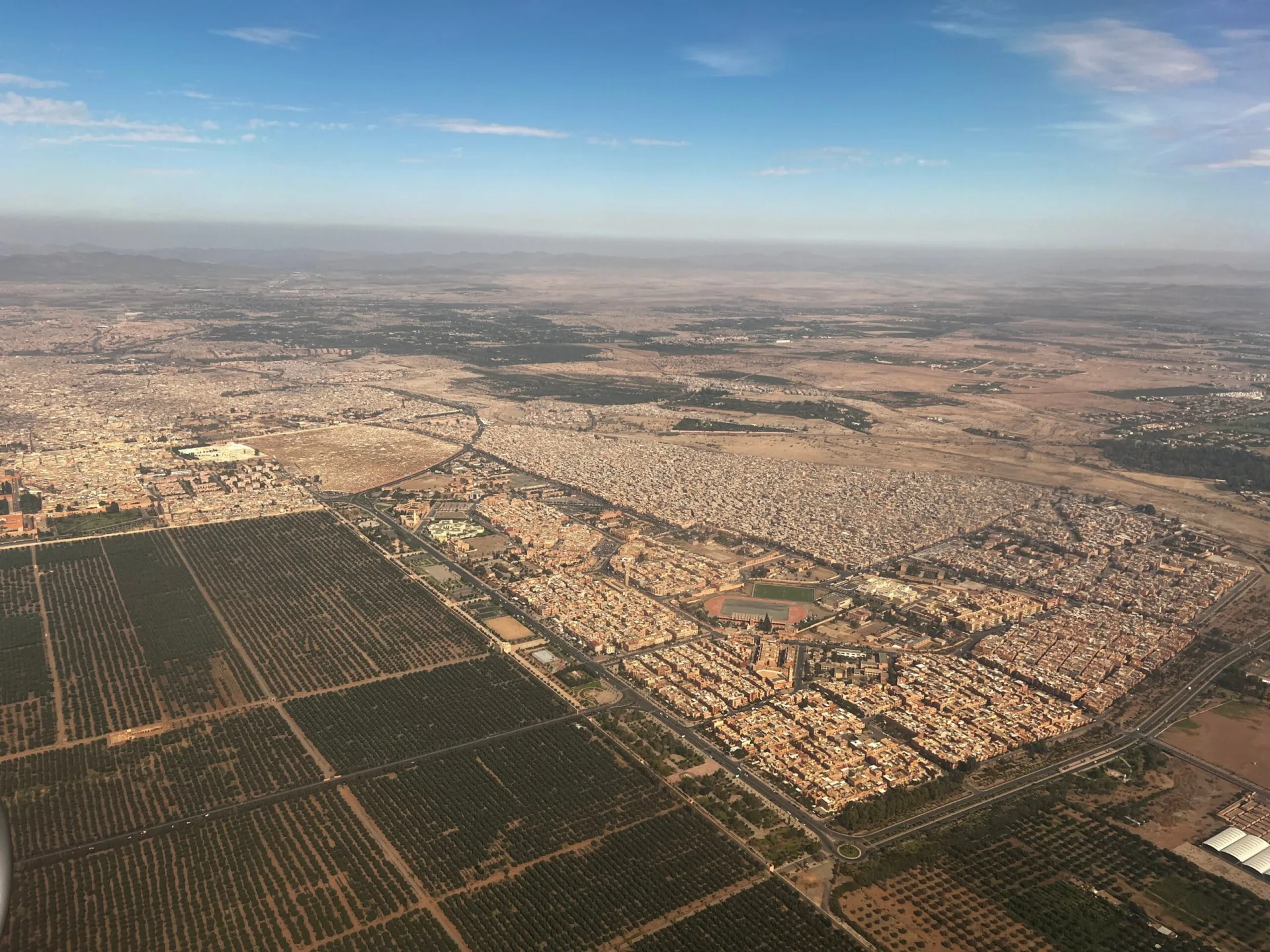
Hot air balloons do not take off from the city centre, but from the rural plains surrounding Marrakech, most often to the north or west of the built-up area, some thirty kilometres out. That is where the wind conditions are most favourable and the landscapes most open. The balloon then drifts above a typically Moroccan patchwork: cultivated fields, olive groves, palm groves, mud-brick hamlets, herds and small Berber villages where you can see the inhabitants starting their day.
The highlight remains the ridgeline of the High Atlas on the horizon, often crowned with snow from October to April, which turns pink as the sun rises. Depending on the wind’s path, you fly over orchards and palm trees that evoke the atmosphere of the famous Palmeraie of Marrakech, with its thousands of date palms. From the basket, the golden morning light, the long shadows and the silence compose a scene that few travellers forget. Photography enthusiasts are spoiled: it is probably the best possible vantage point over the Marrakech countryside and the mountain barrier that closes it off to the south.
If flying over the plains appeals to you, know that the region offers other spectacular settings accessible by road, such as the mineral expanses of the Agafay desert, that lunar “stone desert” located less than an hour from the city and perfect as a complement to a morning in a balloon.
Price of a hot air balloon flight in Marrakech and what is included
Budget is often the first question. As a guide, a standard shared flight generally falls between 1,300 and 2,200 dirhams per adult, which works out to a ballpark of around 120 to 200 € per person depending on the current exchange rate. The differences come down to the package chosen, the season (prices climb in the high tourist season), the size of the basket and the extra services. “Private” or small-group flights also exist, noticeably more expensive, as do premium packages with a private transfer or champagne on landing.
In the vast majority of cases, the rate includes the round-trip transfer from your hotel, a welcome with hot drinks and light snacks before take-off, the flight guided by a licensed pilot, passenger insurance, the Berber breakfast on landing and a souvenir flight certificate. Some items remain optional and are paid for separately, such as drone-filmed videos (often around 300 MAD, roughly 25 to 30 €) or private packages. Always remember to check, when booking, what is really included in the advertised price.
To place this expense within your overall stay, our Marrakech travel budget guide helps you split your costs between accommodation, activities and transfers. The hot air balloon is one of those slightly pricey “favourite” experiences that many travellers consider the highlight of their trip.
Best time and weather: when to try a balloon flight
The good news is that you can ride a hot air balloon in Marrakech almost all year round, because the climate is sunny and dry most of the time. Flights always take place early in the morning, at sunrise, for a simple reason: it is the time of day when the air is most stable and the winds are lightest, which guarantees the best conditions for safety and comfort. As the sun climbs and the ground warms up, thermal turbulence makes flying impossible.
The most pleasant seasons are spring (March to May) and autumn (September to November), when morning temperatures are mild and the sky is clear. Winter often offers magnificent visibility with the snow-capped Atlas, but the early starts are decidedly cold: wrap up well. Summer remains possible, provided you accept a very early wake-up to take off before the heat. To fine-tune your calendar, read our analysis of the best time to visit Marrakech.
The crucial point to understand is that ballooning depends entirely on the weather. A flight can be cancelled on the morning itself if the wind is too strong, if visibility is poor or in case of rain. These cancellations, decided by the pilot for your safety, are more frequent than people think. Two pieces of advice follow: book your hot air balloon flight in Marrakech at the start of your stay, to keep some room to reschedule in case of cancellation, and check the operator’s refund or rebooking policy before you pay.
Total length of the outing: plan for half a day
It is sometimes forgotten: while the flight itself lasts only about an hour, the experience takes up a good part of your morning. Between the pick-up before dawn, the drive to the site, the wait and the inflation of the balloon, the flight, the landing, the breakfast and the return to the hotel, count on four to five hours in total. Most travellers are back in their riad by mid-morning, which leaves the afternoon free for other visits.
This half-day arrangement fits very well into a packed programme. If you are planning your schedule, our 3-day Marrakech itinerary shows how to slot in a morning in a balloon without sacrificing the must-sees of the medina. Simply plan a nap or a quieter morning the next day: the pre-dawn wake-up, magical as it is, does take its toll.
Safety and regulation of balloon flights
Statistically, the hot air balloon is one of the safest forms of flight, provided it is run by serious professionals. In Morocco, civil aviation regulates the activity and commercial passenger flights must be operated by licensed pilots, with regularly inspected equipment. The pilot is the sole authority on board: it is the pilot who decides whether or not to fly according to the weather conditions, and who manages the altitude and the landing.
To fly with an easy mind, favour an operator that is transparent about its insurance, the experience of its pilots and the maintenance of its balloons. A good provider will give you a safety briefing before take-off: instructions for the landing (bent-knee position, holding on to the handles of the basket), behaviour on board, no smoking. Follow these instructions to the letter. Modern baskets generally hold several passengers divided into compartments, with reassuringly high walls. Finally, as noted above, be aware that this media outlet is not affiliated with ONDA or any operator: always check directly with the provider you choose.
To learn more about the physical principle and the history of ballooning, the Hot air balloon page on Wikipedia offers a complete and independent overview of these hot air balloons invented in the 18th century.
What to wear and practical tips for your first flight
The key to it all is dressing well. Even in summer, it is chilly before sunrise and when you land in the fields. The right strategy is to dress in several layers you can take off: a jumper or fleece, a windproof jacket, and long trousers. In winter, add a hat and gloves. At altitude it is no colder than at ground level (the heat of the burners even warms the top of your head a little), but it is the early morning close to the ground that really bites.
- Closed, flat shoes (trainers), because you sometimes land in grassy or dusty fields; avoid sandals and heels.
- A hat or cap and sunglasses for the end of the flight, when the sun rises.
- A camera or phone with a wrist strap: never drop it overboard and keep a firm grip on it.
- A small bottle of water and something to nibble on if you are sensitive to very early starts.
- Confirm the pick-up: check the time and meeting point the day before, along with a contact number in case the minibus is late.
One last tip: use the toilet before departure, because there obviously isn’t one on board and the flight lasts about an hour. And leave your apprehension on the ground: the ascent is so gentle that even people prone to vertigo generally feel perfectly at ease, the basket offering a stable and reassuring support.
Is it suitable for children, seniors and pregnant women?
Good news for families: a hot air balloon flight is a gentle activity, with no physical effort, that suits a broad audience. Most operators accept children from a certain age and above all a certain height, because you need to be able to look over the rim of the basket safely — often from around 6 or 7 years old as a minimum, to be confirmed case by case. Reduced children’s rates are frequently offered. For other activity ideas with younger ones, see our Marrakech with family guide.
Older travellers can absolutely fly, provided they can climb in and out of the basket (access is over the rim, which requires a minimum of mobility) and stand for the entire duration of the flight, since you do not sit down on board. In case of a heart condition, joint problems or reduced mobility, it is wise to mention it to the operator in advance and, if needed, to your doctor. Finally, most companies advise against flying for pregnant women, notably because of the prolonged standing position and the landing, which can occasionally be a little firm depending on the wind. When in doubt, the opinion of a healthcare professional always comes first.
Alternatives to a hot air balloon flight around Marrakech
If the budget, the weather or the early wake-up put you off, the Marrakech region is packed with other adventure and nature experiences. The nearby Agafay desert lends itself perfectly to a quad, buggy or camel ride, with dinner under the stars in a camp — another way to admire the Atlas and the wide open spaces without leaving the ground. Our dedicated guide to the Agafay desert details all these options.
Thrill-seekers can also opt for a hike in the Ourika valley or the Ouzoud waterfalls, a day trip into the Atlas, or a light-aircraft flight for those who want to fly a different way. Each of these outings has its own atmosphere: the hot air balloon, however, remains unmatched for contemplation and silence. Many travellers in fact choose to combine several of these activities within a single stay.
How to book your hot air balloon flight in Marrakech well
Without recommending any particular operator, here are the criteria that set a reliable provider apart. First check recent, detailed traveller reviews, paying attention to comments on safety, the punctuality of the transfer and the handling of weather cancellations. Next, make sure the advertised price is genuinely “all-inclusive”: transfer, flight, insurance, breakfast and taxes. Be wary of abnormally low rates, which sometimes hide extra charges on arrival or overcrowded baskets.
Find out about group sizes: a large shared basket will be cheaper but more impersonal, whereas a small-group flight offers more space and comfort. Confirm the cancellation policy (full refund or rebooking), the minimum age for children and the exact pick-up time. Finally, keep in mind that a flight is sometimes rescheduled at the last minute for weather reasons: booking at the start of your stay will save you a lot of stress.
A word on arrival logistics: since the pick-up takes place at your hotel before dawn, it is better if your transfer from the airport went smoothly the day before. To organise your journeys with peace of mind from the moment you land at Marrakech-Menara, see our comparison of airport transfers in Morocco. A well-planned stay, from the tarmac to the dawn sky, is the best guarantee of a successful experience. To dig deeper into the context of the city and its founding, the Marrakesh page on Wikipedia usefully places the red city in its history.
Frequently asked questions
How much does a hot air balloon in Marrakech cost?
As a guide, a standard shared flight generally costs between 1,300 and 2,200 dirhams per adult, or around 120 to 200 € depending on the package, the season and the exchange rate. This price most often includes the transfer from the hotel, the flight of about an hour, a Berber breakfast and a flight certificate. Private or premium packages are noticeably more expensive, and reduced rates often exist for children.
How long does the flight last?
The flight itself lasts between about 40 and 60 minutes. But the full experience — pick-up before dawn, transfer, inflating the balloon, flight, landing and Berber breakfast — takes up four to five hours in total, that is half a day. Most participants are back at their hotel by mid-morning.
What time do you need to get up for the flight?
Flights take off at sunrise, when the air is most stable. The hotel pick-up therefore takes place before dawn, usually between 5 a.m. and 6:30 a.m. depending on the season and the exact hour of daybreak. It is an early wake-up, but essential to enjoy the best flying conditions and the most beautiful light.
Is a hot air balloon flight dangerous?
The hot air balloon is one of the safest forms of flight when run by licensed professionals with inspected equipment. The pilot decides whether or not to fly according to the weather and cancels without hesitation if the wind is too strong. There is no sensation of vertigo, the ascent being very gentle. Simply follow the safety briefing, in particular the position to adopt on landing.
What is the best time to fly?
You can fly almost all year round in Marrakech, but spring (March to May) and autumn (September to November) offer the most pleasant conditions, with mild mornings and clear skies. Winter gives superb views of the snow-capped Atlas but cold starts, while summer requires a very early take-off to avoid the heat. Book preferably at the start of your stay to keep some room in case of a weather cancellation.
Can children ride a hot air balloon in Marrakech?
Yes, most operators accept children from a certain age and above all a height sufficient to see safely over the rim of the basket, often from around 6 or 7 years old. Reduced children’s rates are frequently offered. For seniors, the activity remains accessible provided they can climb into the basket and remain standing during the flight. Pregnant women, for their part, are generally advised against flying: when in doubt, always seek the advice of a healthcare professional and of the operator.
Images under free licence via Wikimedia Commons: © Imaneb82 (public domain); © Hamza Izourane (CC0); © Munfarid1 (CC BY-SA 4.0). Sources: Wikimedia Commons.