Perched at around 1,500 metres above sea level, right at the far end of the Ourika Valley, Setti Fatma is the Berber village where the tarmac road ends and the mountain truly begins. It’s here, some 60 kilometres south-east of Marrakech (about a 1h30 drive), that the famous Seven Waterfalls hike sets off: a trail that climbs the rocky slope above the village to reach, fall after fall, the cool waters flowing down from the High Atlas. Café terraces set right in the riverbed, tagines simmering by the water, Berber guides calling out to you at the trailhead: Setti Fatma is as much lived as it is walked.
This article focuses on Setti Fatma and its waterfall hike: where the village is, how the climb unfolds, whether you need a guide, when to go safely, how to get there from Marrakech and what to eat on the spot. For the full context of the valley (the other villages, the organic garden, the viewpoints further up), see our dedicated guide to the Ourika Valley from Marrakech. Here, we’re heading straight for the seven falls and the village.
In brief: the essentials on Setti Fatma
- Where: a village at the end of the Ourika Valley, High Atlas, ~1,500 m altitude.
- Distance from Marrakech: ~60 km, about a 1h30 drive.
- The flagship hike: the Seven Waterfalls of Setti Fatma, ~2 to 4 hours round trip depending on how far up you go.
- Difficulty: 1st waterfall easy (20-40 min); the ones above become strenuous, with a steep, slippery trail.
- Guide: strongly recommended beyond the 1st fall; price to be negotiated BEFORE setting off (indicative ~150-300 MAD / ~15-30 €).
- Shared grand taxi: in the region of ~30-50 MAD/person from Marrakech (indicative).
- Souk: on Mondays (“Tnine”) at Tnine-l’Ourika, on the road to Setti Fatma.
- Safety: never climb in stormy weather — risk of flash flooding.
Independent guide: moroccoairport.com is affiliated with neither ONDA nor any tour operator; all prices quoted are indicative and to be confirmed locally.
Where exactly is Setti Fatma?
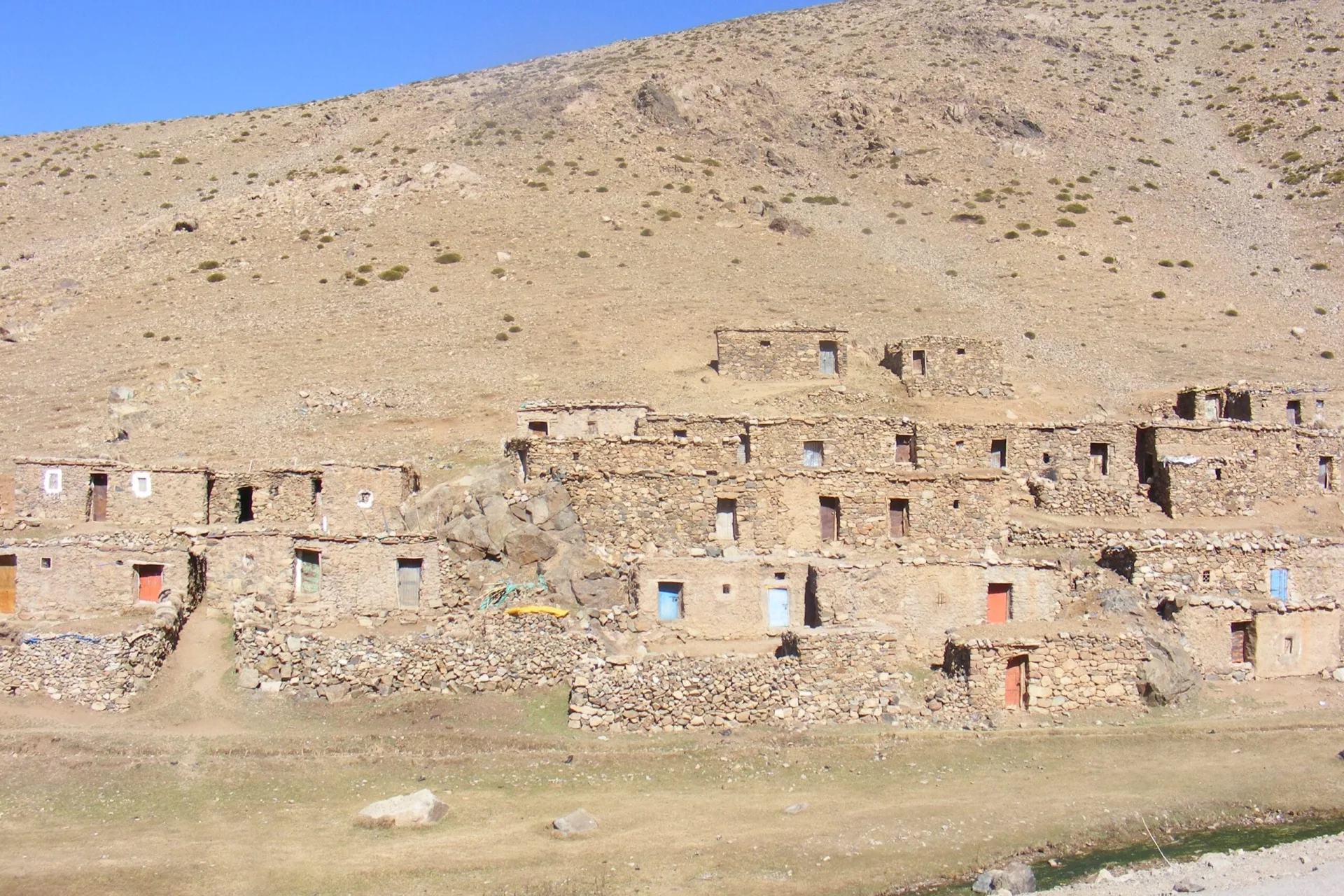
Setti Fatma (sometimes written Setti Fadma) is the last village reachable by tarmac road in the Ourika Valley, at around 1,500 metres above sea level. The village stretches along the Ourika river, the watercourse born in the summits of the High Atlas that gives its name to the whole valley. All around, the slopes are covered with walnut trees, cultivated terraces and Berber houses clinging to the rock. It’s a genuine end-of-the-world spot on the Marrakech scale: a mere hour and a half of driving separates the bustle of the medina from this mountain village where people mostly speak Tachelhit (Shilha Berber).
Historically, Setti Fatma is also a place of devotion: the village is home to the koubba (small mausoleum) of a local saint, and each summer, over four days in August, it hosts a renowned moussem that draws pilgrims, traders and families from across the region. But for the great majority of visitors setting out from Marrakech, Setti Fatma means above all one thing: the starting point of the Seven Waterfalls hike, the first of which stands just a few hundred metres above the last café terraces.
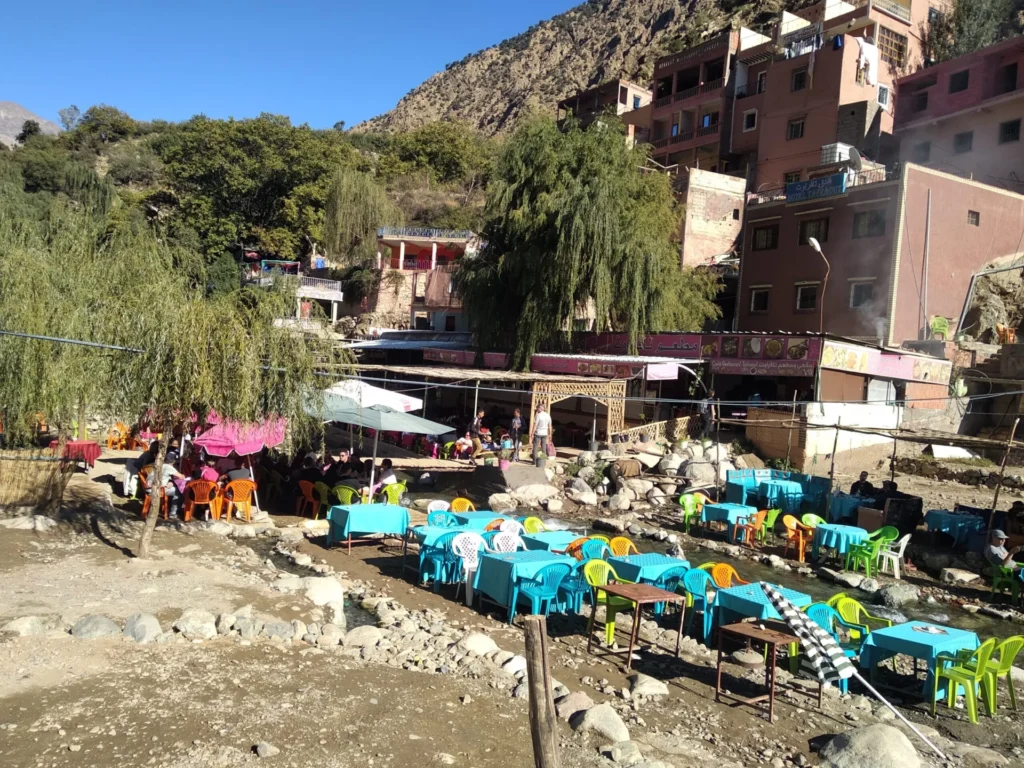
The village itself is modest: a main street, small shops, guesthouses, and above all those restaurants that spread their tables and chairs right at the water’s edge. People come here to walk, but also for that simple pleasure of lunching “with your feet in the river”. Setti Fatma marks the border between the green valley you drive through and the real mountain where you now need your legs.
The Seven Waterfalls hike at Setti Fatma: how it unfolds
The Seven Waterfalls of Ourika hike starts at the far end of the village, where the cafés give way to a stony trail climbing up the mountainside. The idea is simple: each waterfall lies a little higher than the last, and the higher you go, the tougher the terrain gets. Allow, depending on your pace and where you stop, between 2 and 4 hours round trip for a route of roughly 4 cumulative kilometres — it’s not the distance that tires you, it’s the elevation gain and the technical nature of the path.
The 1st waterfall: easy and accessible to almost everyone
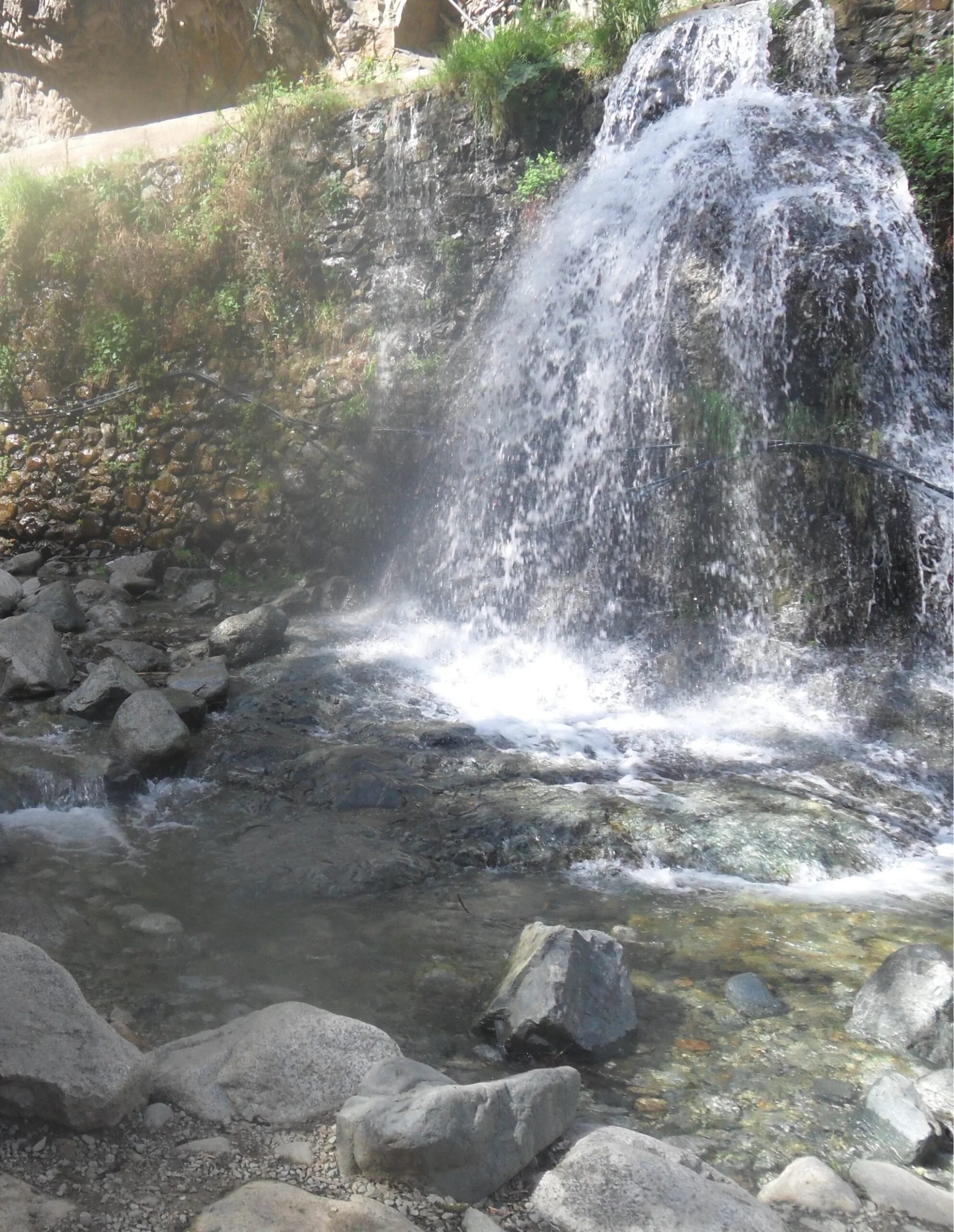
The first waterfall is reached in 20 to 40 minutes of climbing from the village. The trail is steep in places, with a few sections over boulders and a footbridge, but it stays doable for a reasonably fit walker, including with older children. This is the goal of most visitors: you take a photo in front of the fall, sit on a rock, dip your feet in the pool, then head back down calmly to a café. If you simply want to “see a Setti Fatma waterfall” without launching into a proper mountain challenge, this first fall is more than enough.
From the 2nd to the 7th waterfall: it gets strenuous
Beyond the first (and possibly the second, still relatively manageable), the trail changes character. It climbs sharply, narrows at the edge of the drop, crosses smooth slabs made slippery by the spray and demands genuine scrambling over the rocks — your hands are as useful as your feet. The trickiest stretches are generally between the fifth and seventh falls: nothing insurmountable for a seasoned hiker, but there’s no safety infrastructure at all, no railings, and rockfall is always possible along the walls. Reaching the 7th waterfall is a real little expedition, often reserved for confident, well-shod walkers.
Be honest about your level: many visitors imagine they’ll “do the 7 waterfalls” and actually stop at the third, out of breath or unnerved by the terrain. That’s not a failure — the upper falls aren’t necessarily more spectacular than the lower ones, and most of the pleasure lies in the route itself, the views over the valley and the coolness of the water. If you’re after a more ambitious, waymarked mountain trek, turn instead to the ascent from Imlil towards Toubkal, which plays in another league entirely.
Do you need a guide for the Setti Fatma waterfalls?
For the first waterfall, no: the trail is obvious and busy, you need no one. On the other hand, as soon as you’re aiming for the upper falls, a local guide becomes a real asset. They know the best passages, know where to place your feet on the slippery slabs, and stop you from committing to a dangerous stretch through unfamiliarity with the terrain. The price is negotiated BEFORE setting off and depends on how many waterfalls you’re targeting: reckon, as a rough guide, on the order of 150 to 300 MAD (about 15 to 30 €) for a small group up to the higher falls. Agree clearly on the price, the number of people and the stopping point before the first step.
Beware of fake guides
Setti Fatma, like many Moroccan tourist sites, attracts its share of “fake guides”: people who approach you insistently from the car park or trailhead, latch on to you without any prior agreement, then demand a hefty sum on arrival. To avoid unpleasant surprises: don’t let yourself be taken in by someone who’s “just walking with you” without a set price, ideally choose a guide recommended by your restaurant or accommodation, and politely but firmly refuse those who push too hard. A serious guide states their rate upfront and respects your pace.
When to go: seasons, floods and safety
Spring (April to June) is the ideal time for the Ourika hike: the valley is green, the waterfalls well fed by the snowmelt, and the temperatures pleasant for walking. Summer draws Moroccan crowds escaping the Marrakech heat, especially at weekends: it’s lively and festive, but the trail can get crowded. Autumn offers beautiful light and fewer people. Winter is still possible for the lower falls, but the summits can be snow-covered and the mornings cold. To slot your visit in with the rest of your trip, see our guide to the best time to visit Marrakech.
One essential safety point, never to be taken lightly: never climb to the waterfalls in stormy weather or heavy rain. The Ourika river is sadly notorious for its flash floods. On the night of 17 August 1995, a devastating flood swept away houses and cars and killed more than 200 people in the valley. A downpour up in the highlands, even a distant one, can turn a peaceful stream into a torrent within minutes. If the sky clouds over, give up on the climb, don’t settle in the riverbed and move away from the banks. Also watch for rockfall along the walls and keep children close to you on the exposed sections.
How to get to Setti Fatma from Marrakech
Three main options are open to you to reach Setti Fatma from Marrakech, depending on your budget and how much independence you want.
By grand taxi (the most economical)
The shared grand taxis (the old beige Mercedes) leave from a dedicated departure point in Marrakech, historically near Bab er-Robb / the former Grand Hôtel Tazi. You can either travel direct to Setti Fatma, or change at Tnine-l’Ourika for the final stretch. Reckon, as a rough guide, on the order of 30 to 50 MAD per person for a shared seat. You often have to wait for the taxi to fill up (6 passengers) or pay for the empty seats. It’s the most economical and most “local” solution, but also the least predictable in terms of timing.
By rental car
The Ourika road is good and the drive from Marrakech is simple: head south-east, then follow the valley up to its terminus at Setti Fatma. By car, you’re free to set your own timings, stop at the viewpoints and leave before the crowds. A car park (paid, a few dirhams) takes vehicles at the entrance to the village. It’s the most flexible option if you want to combine the waterfalls with other stops in the valley.
On an organised excursion
A great many agencies offer the “Ourika Valley and Setti Fatma waterfalls” day trip from Marrakech, often with transport, photo stops and sometimes lunch. It’s comfortable and logistically worry-free, but the time on the ground for walking is limited — the afternoon goes by fast and you generally only reach the first waterfall. If your priority is the hike up to the higher falls, opt for independence (car or taxi) so you can leave early. Many visitors discover the valley just after arriving at the airport; to organise that transfer, see our comparison of airport transfers in Morocco.
What to eat in Setti Fatma: tagines by the river
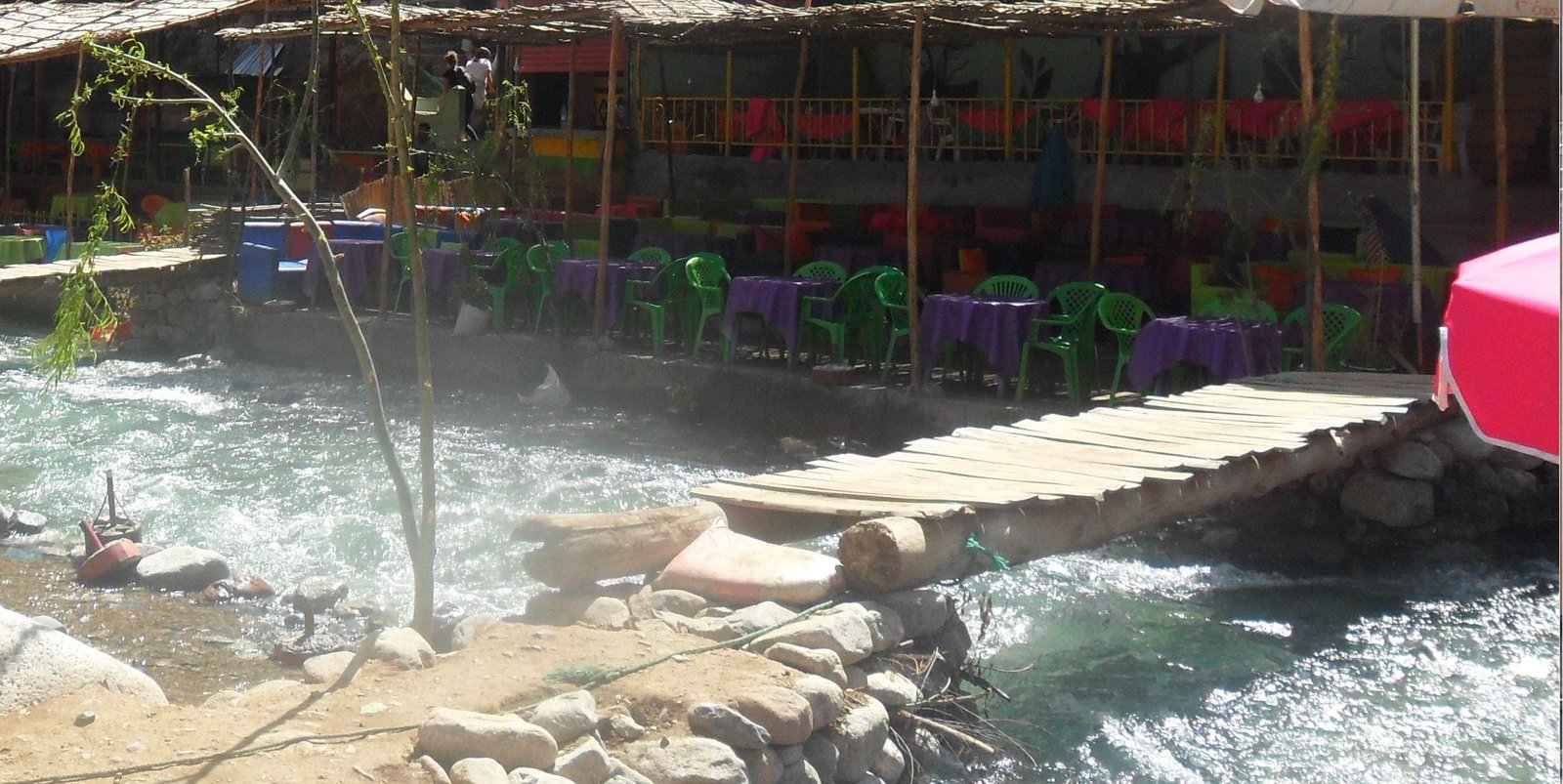
It’s one of the great joys of Setti Fatma: the restaurants set up their tables and chairs directly in the shallow riverbed, so that you literally lunch with your feet in the water, in the shade of the trees, lulled by the sound of the current. On a hot summer’s day, it’s pure bliss. On the menu, mountain cooking at its best: tagines simmered over a wood fire (chicken-lemon, kefta-egg, vegetables), grilled skewers, and often fresh trout caught in the river and grilled on the spot.
A few common-sense tips: ask the prices before ordering, as they aren’t always displayed and the bill can climb; a mint tea on a terrace is enough if you just want to enjoy the setting without a full meal; and keep the flood risk in mind — you settle at the water’s edge in fine weather, never under a threatening sky. To carry on the pleasure of the table once back in the city, our selection of good addresses is in the guide on where to eat in Marrakech.
The Monday souk of Ourika
If you want to add an authentic touch to your day, time your visit to coincide with the weekly Monday souk. It’s held at Tnine-l’Ourika, on the road leading to Setti Fatma — and indeed “Tnine” means Monday in Arabic, which shows just how much the market is bound up with the place. There you’ll rub shoulders with the inhabitants of the surrounding villages who come to sell and buy: fruit and vegetables, spices, pottery, rugs, argan oil, mountain honey, almonds, stone mortars. It’s a rural market, not a sanitised tourist attraction: the atmosphere is real, colourful and noisy. By stopping there in the morning before the climb to the waterfalls, you experience the valley as it beats day to day.
What to bring for the hike
- Proper footwear: trainers with good grip or hiking shoes. Flip-flops are dangerous beyond the 1st waterfall.
- Water: at least 1 to 1.5 L per person, especially in summer; you’ll find vendors lower down but few higher up.
- Sun protection: hat, sunglasses, cream — the mountain sun is fierce.
- A light jumper or windbreaker: it’s cooler at altitude and near the falls.
- Cash: notes and coins for the café, the car park, the guide and a tip.
- A light bag, hands free: you’ll need both hands on the rocky sections.
- Swimwear / towel: if you plan to dip your feet or bathe in a pool.
Combining Setti Fatma with the Ourika Valley
Setti Fatma is merely the terminus of a valley that deserves to be worked up slowly. On the road, between Marrakech and the village, you can multiply the stops: waterside gardens, small Berber villages, a saffron farm, viewpoints over the river. The smartest way to organise your day is to make the valley stops on the way out or the way back, and keep your morning energy for the climb to the waterfalls. To build that complete itinerary, everything is detailed in our guide to the Ourika Valley.
Setti Fatma also fits very well into a broader stay around Marrakech. If the waterfalls appealed to you, push on to the spectacular Ouzoud waterfalls, the highest in Morocco, or towards the mountain of Imlil and Toubkal for a proper trek. Travelling with children, the first waterfall and lunch with your feet in the water are a sure bet: other family-friendly ideas are gathered in our guide to Marrakech with family. And to place this excursion within the whole of your visits, see our complete guide to what to do in Marrakech.
Mistakes to avoid at Setti Fatma
- Underestimating the trail: turning up in flip-flops and wanting to “do the 7 waterfalls” is the classic of the genre. Wear proper footwear.
- Leaving too late: on an afternoon excursion, you only have time for the 1st fall. To climb high, set off in the morning.
- Not fixing the guide’s price: always negotiate and agree the rate BEFORE setting off, not on arrival.
- Ignoring the weather: never climb or settle in the riverbed in stormy weather — flooding is the real danger.
- Ordering without asking prices: agree on the bill before sitting down.
- Believing the 7 falls are essential: the 1st or 2nd is enough for most; no need to put yourself in danger.
Frequently asked questions
How long does the Seven Waterfalls hike at Setti Fatma take?
It depends on your goal. Reaching the first waterfall takes 20 to 40 minutes of climbing, so about 1 hour round trip with a break. Climbing up to the higher falls takes 2 to 4 hours round trip, depending on your pace and how far up you go. The technical route and the elevation gain count for more than the distance, which is relatively short (~4 cumulative km).
Is the Setti Fatma hike difficult?
The first waterfall is accessible to most walkers, including families with older children. Beyond that, the trail becomes markedly more strenuous: steep sections, slippery slabs, little scrambles over the rocks, with no safety infrastructure at all. The trickiest stretches are between the 5th and 7th falls. A good level of fitness and proper footwear are essential to go high.
Is a guide compulsory?
No for the first waterfall, where the path is obvious and busy. Yes, it’s strongly recommended if you’re aiming for the higher falls: the guide knows the good passages and makes the climb safer. Negotiate the rate in advance (indicative ~150-300 MAD for a small group) and beware of fake guides who impose themselves without any prior agreement.
How to get to Setti Fatma from Marrakech without a car?
The shared grand taxi is the simplest and most economical solution: in the region of 30 to 50 MAD per person (indicative), from the Ourika taxi departure point in Marrakech, sometimes with a change at Tnine-l’Ourika. Otherwise, many organised day trips include round-trip transport from your hotel.
Can you swim in the waterfalls?
You can dip your feet and sometimes bathe in the pools at the foot of certain falls, but the water is cold and the pools shallow or rocky. Stay cautious: the rocks are slippery and the current can be strong after rain. Bathing is mostly done in fine weather and never when the level of the river is rising.
What is the best time to visit Setti Fatma?
Spring (April-June) is ideal: green valley, well-fed waterfalls and mild temperatures. Autumn is pleasant and less busy. Summer is very lively but packed at weekends, and winter is still possible for the lower falls despite the chill. In all cases, be sure to avoid stormy days because of the flood risk.
In summary
Setti Fatma packs into a single day everything we love about the High Atlas within reach of Marrakech: a Berber village at the end of the road, a Seven Waterfalls hike that ranges from a family stroll to a little expedition, terraces with your feet in the river and a lively Monday souk. Wear proper footwear, set off early, negotiate your guide, watch the sky — and let the first waterfall make you want to climb a little higher. For the full context of the valley, keep our guide to the Ourika Valley to hand. To dig deeper into the site’s history, the entry on the Ourika Valley on Wikipedia usefully rounds out this field guide.
Images under free licence via Wikimedia Commons: © Abbas9 (CC BY-SA 4.0); © Abbas9 (CC BY-SA 4.0); © Anasrahmoun (CC BY-SA 4.0). Sources: Wikimedia Commons.