Before you pack your bags, one question always comes up: what does Morocco customs allow, and what can you really bring in or take out? Tobacco, alcohol, gifts, cash, handicrafts, drones… the rules exist, they are precise, and it pays to know them to avoid a surprise tax — or worse, a seizure. This 2026 guide brings together, in a neutral and factual way, the allowances and obligations both when entering and leaving the country, based on official sources (the Customs and Indirect Taxes Administration and the Foreign Exchange Office). The goal: to help you clear the checkpoints with peace of mind.
In brief: Moroccan customs in 6 points
- Tobacco & alcohol: allowances for adults (200 cigarettes, 1 bottle of wine + 1 of spirits).
- New gifts & souvenirs: tolerated up to MAD 2,000 in total value, with no commercial character.
- Foreign currency: free to import, but a written declaration is mandatory at or above MAD 100,000 (equivalent) if you want to take it back out.
- Dirham: a closed currency — entry and exit limited to MAD 2,000 in banknotes.
- Prohibited/restricted: drones, weapons, narcotics, certain medicines, counterfeit goods.
- On the way out: handicrafts are freely exported, but antiques and protected species (CITES) are controlled.
These thresholds can change: the up-to-date reference is always the Customs and Indirect Taxes Administration (ADII). This guide gives you a clear, practical reading of it.
Entering Morocco: allowances for travellers
When you arrive in Morocco as a tourist or non-resident visitor, customs grants you allowances: quantities you may import for your personal use without paying any duties or taxes. Beyond these, the excess becomes taxable. Here is what the official texts provide for an adult traveller.
Tobacco: a single choice among the permitted quantities
The tobacco allowance is reserved for travellers aged 18 and over and is taken “as a choice”: you do not combine the categories. In practice, you may bring in, duty-free, one of the following quantities:
- 200 cigarettes (i.e. one carton), or
- 100 cigarillos, or
- 25 cigars, or
- 250 g of smoking tobacco.
Alcohol: wine and spirits
For alcoholic drinks, the traveller allowance generally covers one bottle of wine (about 1 litre) and one bottle of spirits or liquor (about 1 litre). Alcohol is freely sold in Morocco through certain channels (dedicated supermarkets, hotels, licensed bars), but remains subject to local rules: this allowance concerns only what you import with you.
Perfume and eau de toilette
For perfumery, the usual tolerance is one 150 ml bottle of perfume and one 250 ml bottle of eau de toilette. Enough to travel with your products without any formality.
New gifts and souvenirs: the MAD 2,000 limit
This is the point many travellers overlook. Gifts and new items with no commercial character that you bring in are admitted duty-free within an overall value of 2,000 dirhams. Beyond that, customs may apply duties and taxes on the portion that exceeds it (taxation can reach around 25% depending on the type of product). So keep your receipts: they serve to justify the real value if any doubt arises. If in doubt about what will fit and how much you can carry, our guide to the Royal Air Maroc baggage allowance is a useful companion.
Personal belongings: temporary admission
Your personal travel effects enter without any declaration, provided you leave with them. This is called temporary admission: camera, camcorder, binoculars, laptop, phone, tablet, personal jewellery, portable musical instrument, sports equipment… These items are deemed to accompany you and must be re-exported when you leave. For unusually valuable equipment (professional gear, a drone, audiovisual equipment), it is best to check in advance, as a special regime may apply.
| Category | Allowance on entry (adult traveller) |
|---|---|
| Cigarettes | 200 (or 100 cigarillos, 25 cigars, 250 g of tobacco) |
| Wine | 1 bottle (≈ 1 L) |
| Spirits / liquor | 1 bottle (≈ 1 L) |
| Perfume | 1 bottle of 150 ml |
| Eau de toilette | 1 bottle of 250 ml |
| New gifts & souvenirs | Overall value ≤ MAD 2,000 |
| Personal belongings | Temporary admission (to be re-exported) |

Money and currency: what you must declare
The question of cash is one of the most sensitive with Moroccan customs, because the dirham is a closed currency (not freely convertible internationally) and currency movements are governed by the Foreign Exchange Office. Two different logics apply: one for foreign currency, and one for the dirham.
Foreign currency: free, but declarable above a threshold
You may freely import foreign currency (euros, dollars, pounds…) in the form of banknotes, traveller’s cheques or means of payment. However, as soon as the amount reaches the equivalent of MAD 100,000 or more, you must declare it in writing to customs at the border post. This declaration is essential if you wish to take all or part of that currency back out of the country: it remains valid for six months. Failing to declare exposes you to seizure of the undeclared excess and a fine of up to 50% of that amount.
The Moroccan dirham: MAD 2,000 maximum in banknotes
The dirham cannot be freely exchanged abroad. Its cross-border transport is therefore limited to MAD 2,000 in banknotes, both on entry and on exit. In short: do not accumulate large sums in dirhams to leave with, and change or spend your local money before departure. Keep your exchange receipts: they justify the origin of your dirhams and allow you, where applicable, to change unused dirhams back into foreign currency before leaving Morocco.
| Type of money | Rule | Formality |
|---|---|---|
| Foreign currency | Free import | Written declaration if ≥ MAD 100,000 (equiv.) |
| Dirham (MAD) | Limited to MAD 2,000 in banknotes | Entry and exit |
| Unspent dirhams | Reconvertible into foreign currency | On presentation of the exchange receipt |
Prohibited or restricted items on entry
Some items are not a matter of a simple allowance: they are either prohibited or subject to authorisation. It is best to know this before landing, because Moroccan customs monitor these categories closely.
- Drones: bringing a drone into Morocco is strictly regulated and requires prior authorisation. Without it, the device is frequently held in customs on arrival, then returned on departure. Do not assume it will pass “without a problem”. Read our dedicated guide on drone rules in Morocco before you travel.
- Weapons and ammunition: prohibited without specific authorisation.
- Narcotics: strictly prohibited, with heavy penalties.
- Certain medicines: treatments containing psychotropic or narcotic substances may be checked; travel with the prescription and original boxes.
- Walkie-talkies and radio transmitters: transmission equipment may be regulated.
- Counterfeit goods: counterfeit products are prohibited.
If in doubt about a specific item (medical equipment, valuable electronics, particular foodstuffs), the safest reflex is to declare it spontaneously and ask the officer. A voluntary declaration is always better received than an item discovered during inspection.
And what about food when entering Morocco? Non-perishable foods for your personal consumption (biscuits, canned goods, coffee, infant formula, dietary supplements) generally pose no difficulty. On the other hand, fresh products of animal or plant origin (meat, dairy, fruit and plants) may be subject to sanitary or phytosanitary checks. For a simple tourist trip, there is no need to load up your suitcase: you will find everything on site.
Special cases: vehicle, pets and Moroccans living abroad
Beyond ordinary luggage, certain situations follow specific rules with Moroccan customs. Here are three of the most frequent.
Coming to Morocco with your vehicle
You may enter with your foreign-registered car under the temporary admission regime, without clearance or payment of duties. The period is 180 days per calendar year, to be used in one or several stays, and it is not renewable. The vehicle is declared on entry (border post or port), and it must leave within the deadline: exceeding it exposes you to penalties and to the vehicle being impounded. This regime applies to foreign tourists as well as to Moroccans living abroad.
Travelling with a dog or a cat
To bring in a pet, three things are essential: identification by microchip (ISO standard), a valid rabies vaccination (carried out after the chip was fitted), and an international health certificate issued by an official veterinarian in the country of origin, drawn up just before departure. At customs you will be asked for the animal’s passport as well as these supporting documents. As Morocco is classified as a country at risk regarding rabies, these documents are not optional: travel with the originals.
The case of Moroccans living abroad (MRE)
Moroccans residing abroad benefit from specific customs facilities, notably for the temporary admission of their vehicle and, under conditions, for certain belongings or removals upon a permanent return. These regimes follow their own rules, distinct from the simple traveller allowance. If you are concerned, enquire in advance with the ADII: the supporting documents required (foreign residence permit, length of residence, etc.) determine whether these advantages are granted.
On the way out: what you can bring back from Morocco
Good news for souvenir lovers: the vast majority of what you buy on site can be brought back without difficulty. Here are the main export rules.
Handicrafts and local produce: free export
Handicraft products bought locally — rugs, leather and babouches, pottery and ceramics, thuya wood objects, lanterns, Berber jewellery, argan oil, spices, tea, pastries — are exported freely, with no particular value limit for personal use. To fit it all in on the way home, it helps to know your baggage allowance in advance.
Fossils, minerals and stones: the souvenir rule
Morocco is renowned for its fossils and stones. As souvenirs, fossils, rocks and semi-precious stones are tolerated as long as you do not bring back large quantities (as a guide, no more than about ten pieces). Beyond that, it may be considered a movement of a commercial nature and require supporting documents.
Antiques and works of art: certificate required
This is the main point of caution on export. Works of art, collector’s items and antiques of historical, archaeological or cultural interest to Morocco may only leave the territory accompanied by a certificate issued by the cultural authorities (Department / Ministry of Culture). Without this document, departure may be blocked. An “old” rug or an antique piece of jewellery bought in a souk may, depending on its nature, fall into this category: ask the seller for a detailed invoice.
Protected species: what is prohibited
Products derived from endangered species protected by the Washington Convention (CITES) are regulated or even prohibited: coral, certain skins, tortoiseshell, ivory, objects made from protected species. Avoid these “souvenirs”: they may be seized on departure from Morocco as well as on arrival in your country, with penalties to follow.
For an at-a-glance overview, here is the customs status of the most common souvenirs when leaving Morocco:
| Souvenir | Status when leaving Morocco |
|---|---|
| Rugs, leather, babouches, pottery, thuya wood | Free export |
| Argan oil, dried spices, tea, dry pastries | Free export |
| New handmade jewellery | Free export |
| Fossils, minerals, semi-precious stones | Tolerated in small quantity (≈ 10 pieces max) |
| Antique items, old rugs, antiques | Restricted — certificate from cultural authorities |
| Coral, ivory, skins of protected species | Prohibited (CITES) |
| Meat, cured meats, dairy (to the EU) | Prohibited for personal import into the EU |
Back in the European Union: the allowances to know
Moroccan customs are only half the story: on your return, you also pass through your own country’s customs. For travellers returning to the European Union from a third country such as Morocco, allowances also apply. Here they are, according to the EU rules (official “Your Europe” portal).
| Category | Allowance on entry into the EU (by air) |
|---|---|
| Goods (gifts, purchases) | Up to €430 per traveller (€150 for those under 15) |
| Cigarettes | 200 (or 100 cigarillos, 50 cigars, 250 g of tobacco) |
| Spirits (> 22%) | 1 litre (or 2 L of fortified/sparkling wine < 22%) |
| Still wine | 4 litres |
| Beer | 16 litres |
Beware of food souvenirs: the European Union prohibits importing, in personal luggage, meat, cured meats and dairy products from non-EU countries. A dried-meat tagine or some local cheese therefore has no place in your return suitcase. On the other hand, argan oil, dried spices, tea or dry pastries generally pose no problem.
How it actually works at the airport
On arrival at a Moroccan airport, after passport control and baggage collection, you reach the customs area. The principle is the dual channel: a “nothing to declare” passage and a “goods to declare” passage. If you respect the allowances and carry nothing sensitive, you take the green channel. Otherwise — or at the slightest doubt — you present yourself spontaneously at the red channel to declare. Officers may carry out random checks and scan luggage.
For the currency declaration (above the threshold), the form is filled in at the border post; keep the copy. To calmly prepare the rest of your arrival, see which airlines fly to Morocco and our comparison of airport transfers in Morocco. And if you have not yet checked your entry conditions, our article on the Morocco visa and entry requirements sums it up.
Our tips for clearing customs with peace of mind
- Keep your receipts to justify the value of your new purchases (useful for the MAD 2,000 threshold).
- Declare spontaneously anything that exceeds an allowance or seems sensitive: it is always better received.
- Do not carry dirhams beyond MAD 2,000; change or spend your money before leaving.
- Keep your exchange receipts so you can change back your unused dirhams.
- Drone, professional gear, specific medicines: check before departure, do not rely on luck.
- Avoid coral, ivory and antiques without a certificate: the souvenir can cost a great deal.
- On the way back, respect your own country’s customs too (EU allowances, ban on meat/dairy).
FAQ — Morocco customs
How many cigarettes can I bring back from Morocco?
On entry into Morocco, the allowance is 200 cigarettes (or 100 cigarillos, 25 cigars, 250 g of tobacco) for an adult traveller. On return to the EU, the allowance is also 200 cigarettes by air. These quantities do not combine within the same category.
How much money can I take to Morocco?
Foreign currency is freely imported, but any amount equal to or above the equivalent of MAD 100,000 must be declared in writing to customs in order to be re-exported. The dirham, for its part, is limited to MAD 2,000 in banknotes both on entry and on exit.
Can you bring a drone into Morocco?
Bringing in a drone is subject to prior authorisation. In practice, an unauthorised drone is often held by customs on arrival and returned on departure. Be sure to enquire before travelling with a drone.
What is the maximum value of gifts allowed?
Gifts and new items with no commercial character are admitted duty-free up to an overall value of 2,000 dirhams. Beyond that, duties and taxes may apply on the excess portion.
Can I bring back argan oil and spices?
Yes. Argan oil, dried spices, tea and dry pastries are exported freely and are generally admitted on entry into the EU. Meat, cured meats and dairy products, however, are prohibited for personal import into the EU from a third country.
Can I travel with an e-cigarette?
An e-cigarette for personal use is generally tolerated. Be careful, however, of the aviation rule: the vape and its lithium batteries must travel in cabin baggage, never in the hold, for safety reasons. Recharge discreetly and respect the airport’s non-smoking areas.
Do duty-free purchases count towards the allowance?
Yes. Everything you carry on arrival, including items bought in duty-free shops, is included in the calculation of the destination country’s allowances. A “tax-free” purchase on departure does not escape the tobacco, alcohol or value limits on entry.
Where can I find up-to-date official information?
On the website of the Customs and Indirect Taxes Administration (ADII) for allowances and goods, and on that of the Foreign Exchange Office for currency rules. These are the reference sources, because the thresholds may be revised.
In summary
Morocco customs are no maze: clear allowances for tobacco, alcohol and gifts (MAD 2,000), a currency declaration above MAD 100,000, a dirham capped at MAD 2,000, and genuine vigilance over drones, antiques and protected species. Respect these rules, keep your supporting documents, declare at the slightest doubt, and also bear in mind your own country’s customs on the way back. For the most recent information, always rely on official sources. Have a good trip!
Official sources
- Customs and Indirect Taxes Administration (ADII) — allowances and goods.
- Foreign Exchange Office — rules on currency and the dirham.
- Your Europe — allowances on entry into the EU.
- CITES — protected species.
This article is provided for information purposes. Amounts and rules may change; always check with the official sources before your trip.
Photo credit
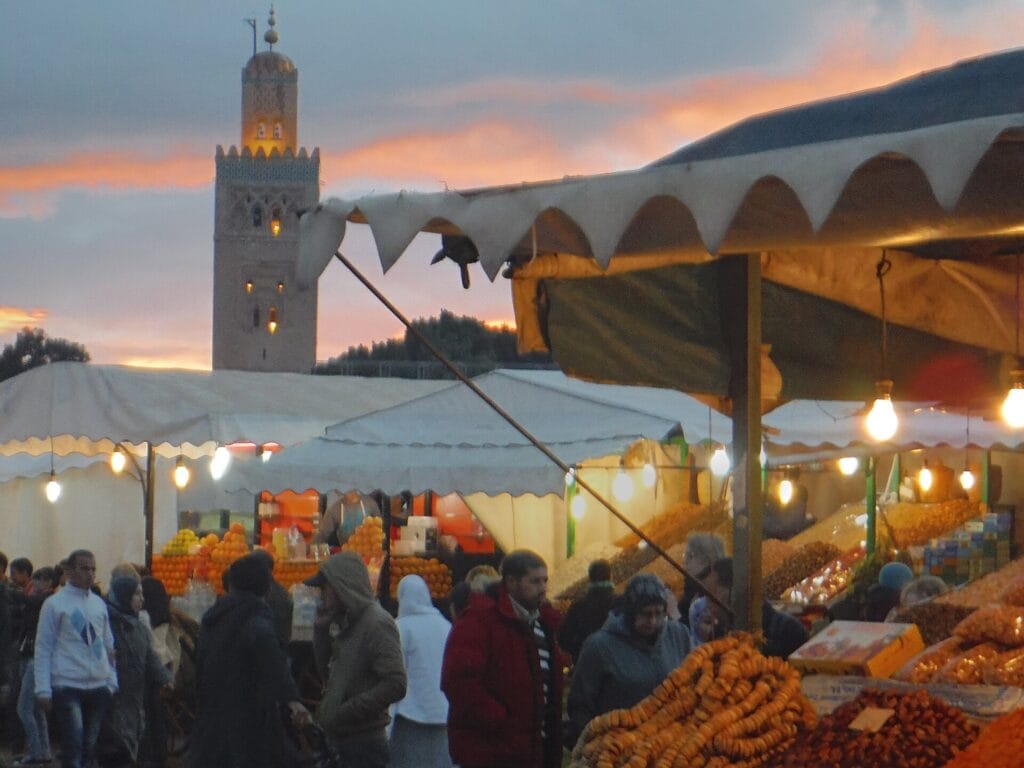
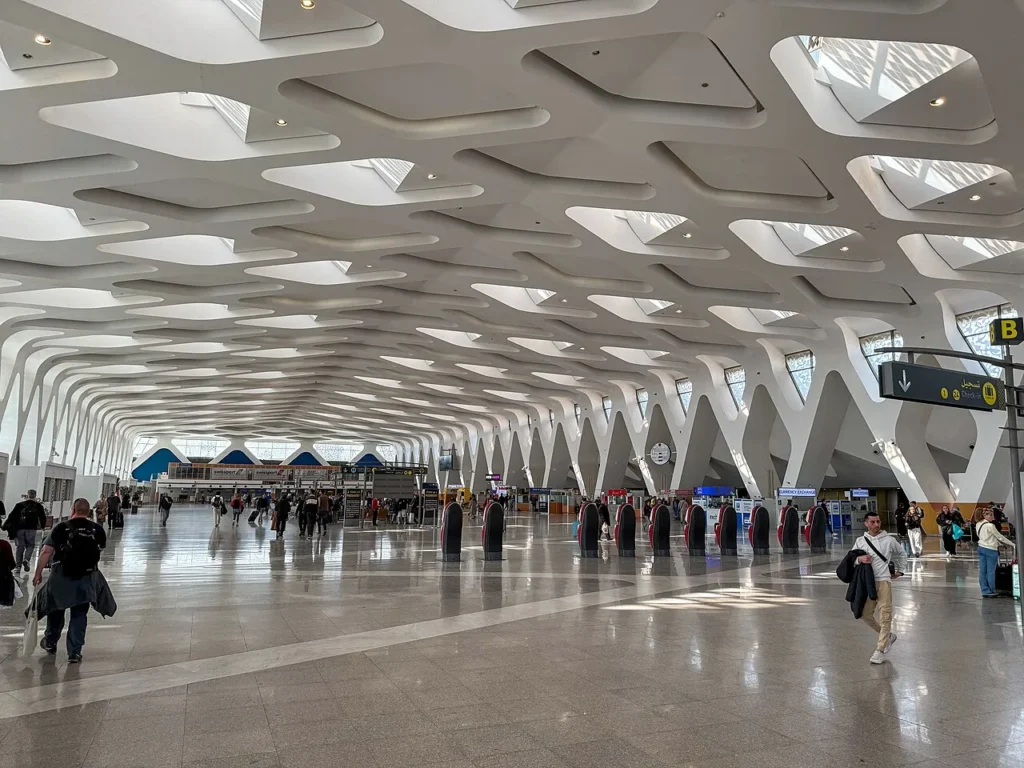
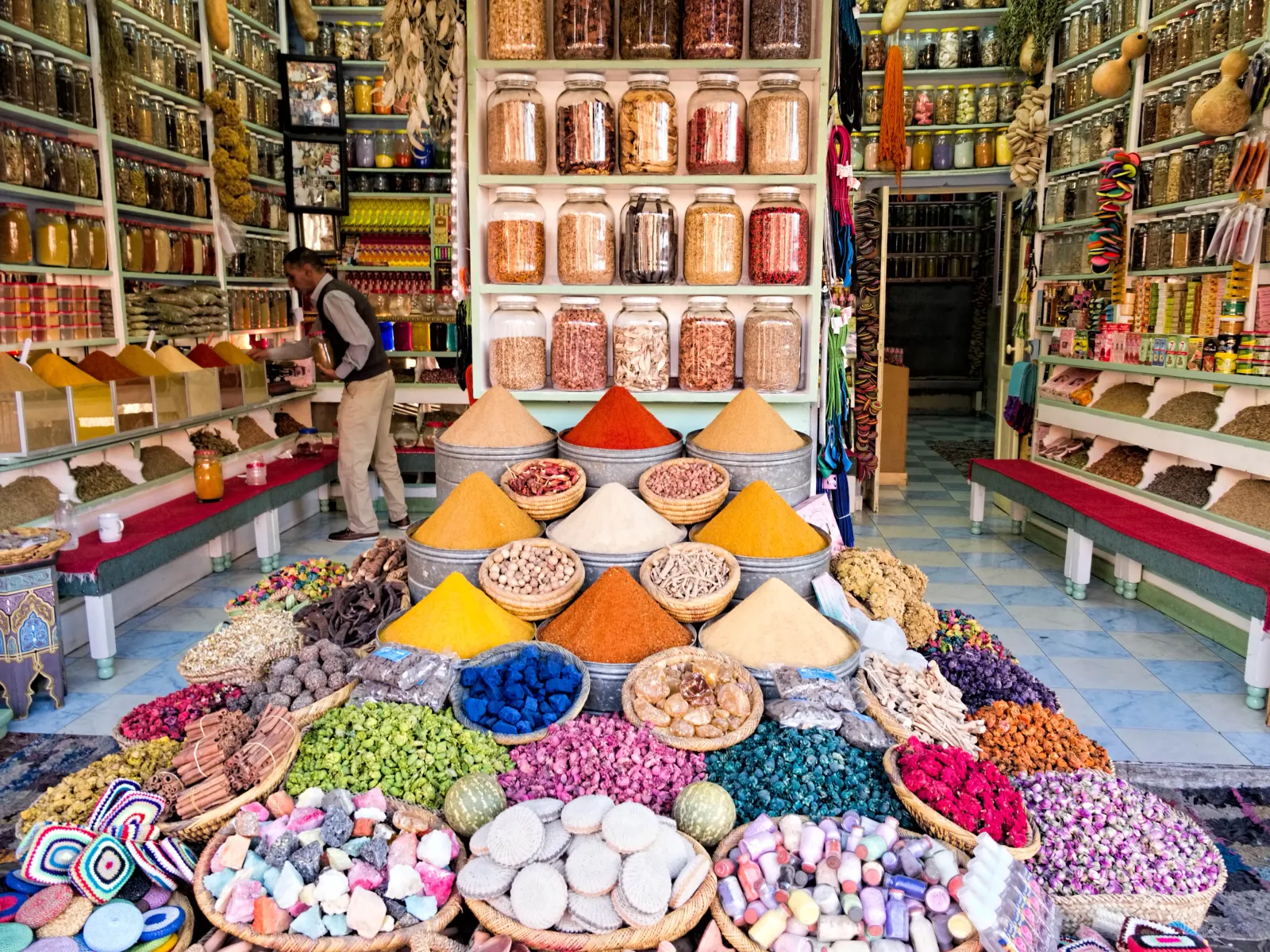
Illustrations: “Marrakech Airport terminal — interior” — 瑞丽江的河水 (CC BY-SA 4.0); “Spice shop in the souks” — Dan Lundberg (CC BY-SA 2.0), via Wikimedia Commons.