Fes-Saïss Airport (IATA code FEZ, ICAO code GMFF) is the international airport of Fes, also spelled Fez: it lies about 15 km south of the city on the Saïss plateau and links Morocco’s spiritual capital to around thirty cities, mostly in France, Spain, Italy, Belgium and the Netherlands, with Ryanair and Air Arabia Maroc as the main carriers. Allow 20 to 35 minutes by road to the gates of the medina. This guide covers what you need to know before landing or flying out: the terminal, the airlines, arrival formalities, money, taxis and buses, and the traps that cost time or dirhams.
At a glance
- Fes-Saïss Airport is about 15 km south of Fes and roughly 50 km from Meknes, at an elevation of 579 m, with a single 3,200 m runway.
- The current terminal, of about 28,000 m², was inaugurated on 28 May 2017; it raised capacity from 500,000 to 2.5 million passengers a year.
- In 2025, just over 1.92 million passengers used the airport, a slight decrease (-1.34%) compared with 2024.
- Ryanair operates most flights, ahead of Air Arabia Maroc; Transavia, Royal Air Maroc and a few seasonal airlines complete the picture.
- To reach the city, a taxi is the simplest option (around 150 MAD to the new town, a little more to the medina); a city bus exists, but its operator changed in 2025.
- Since 16 September 2019, no paper landing card has been required at passport control in Moroccan airports.
- Travellers may bring in or take out a maximum of 2,000 dirhams in banknotes: you change money on arrival.
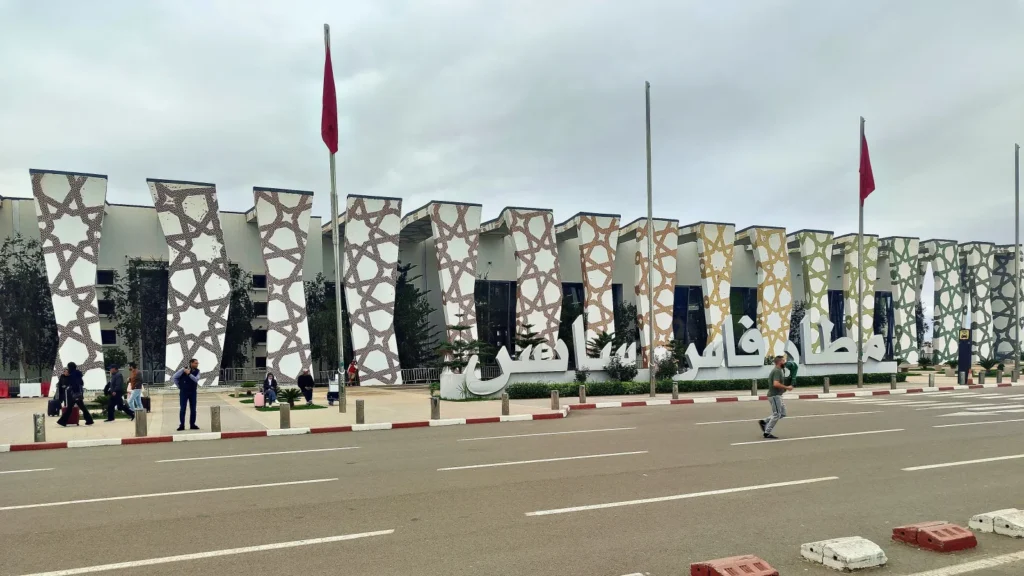
Fes-Saïss Airport: key landmarks
The airport takes its name from the surrounding plain. The Saïss is the vast farming plateau stretching between Fes and Meknes at the foot of the Middle Atlas: cereals, olive groves, orchards and a wide-open horizon, which explains why a 3,200-metre runway could be laid out here without any terrain constraints. On approach, on a clear day, you can make out the first ridges of the Atlas to the south and, to the north, the Fes conurbation spreading over its hills. The medina itself, tucked into its valley, is usually invisible from the plane: do not expect to fly over the tanneries.
Administratively, the airport sits in the rural commune of Oulad Tayeb, outside the urban boundary of Fes. This detail has a practical consequence that many travellers discover too late: the city’s small red taxis are, in principle, restricted to the urban area, and it is the grand taxis that serve the airport. More on this below.
The airport is managed by the National Airports Office (ONDA), which now operates under the Airports of Morocco brand. It belongs to the same network as Casablanca Mohammed V, Marrakech-Menara and Rabat-Salé, with the same security rules and the same inspection procedures.
From a small terminal to the 2017 building
For decades, Fes made do with a modest terminal designed for a few domestic flights and a handful of routes to France. The rise of low-cost airlines changed everything. According to figures quoted at the inauguration of the new terminal, traffic grew from 228,399 passengers in 2006 to 892,974 in 2016: almost four times as many in ten years. The old terminal, designed for about 500,000 travellers a year, was saturated long before the end of that period.
The new terminal was inaugurated on 28 May 2017 by King Mohammed VI. The official MAP news agency described a building of about 28,000 m², representing an investment of around 471 million dirhams, with an apron enlarged to take four more aircraft. Annual capacity was thus raised to 2.5 million passengers. The programme included a public hall, a departure lounge, duty-free shops, an arrivals hall, a children’s play area, restaurants, bank branches and currency exchange offices.
The one-million-passenger mark was passed in 2017, and the pre-pandemic record dates from 2019, with 1,417,881 travellers. After the collapse of 2020 and 2021, traffic went beyond that level: about 1.948 million passengers in 2024, then just over 1.922 million in 2025. In the first half of 2026, the airport handled 935,382 passengers, almost unchanged from the same period of 2025 (937,427).
| Year | Milestone | What it means for travellers |
|---|---|---|
| 2003 | 128,778 passengers | A regional airport with few international flights |
| 2006 | 228,399 passengers | Low-cost airlines start to arrive |
| 2013 | Ryanair opens a base in Fes | Many new direct routes to Europe |
| 2016 | 892,974 passengers | Old terminal saturated, frequent queues |
| 28 May 2017 | Inauguration of the terminal of about 28,000 m² | Capacity raised to 2.5 million passengers a year |
| 2019 | 1,417,881 passengers | Pre-pandemic record |
| 2024 | About 1.948 million passengers | The 2017 terminal nears its limits in summer |
| 2025 | Just over 1.922 million passengers | Slight drop (-1.34%), 12,988 aircraft movements |
| September 2024 onwards | Expansion project announced by ONDA | Target: a terminal of about 46,000 m² and 5 million passengers |
A facade that announces Fes before you reach the city
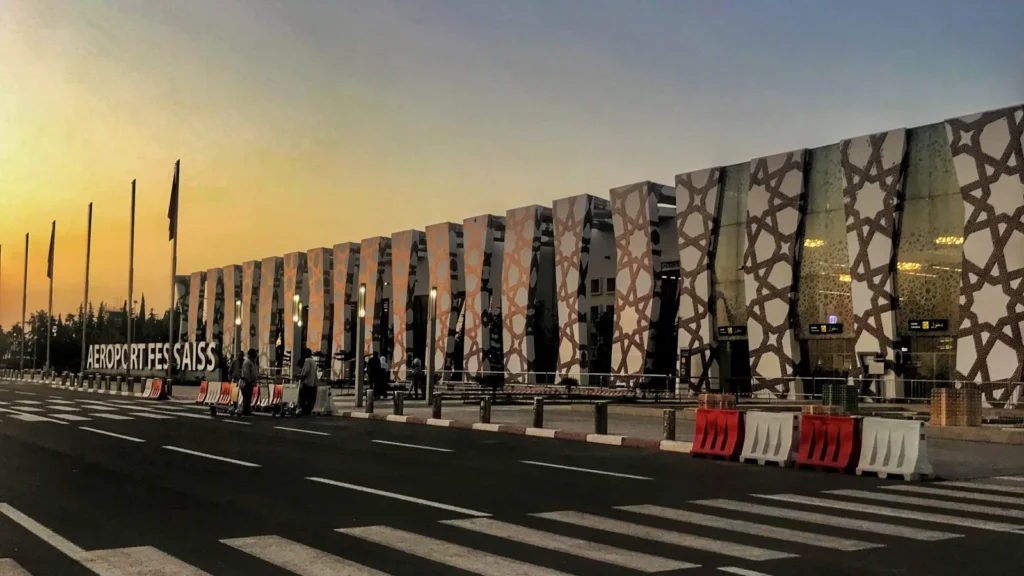
The 2017 terminal does not look like an anonymous glass hangar. On the landside, its facade is punctuated by a long row of tall, slanting pillars, each clad in an interlace of stars and polygons that echoes the geometry of the zellige tilework and mashrabiya screens of the medina. The patterns change colour from one pillar to the next, from off-white to pale green, and turn a coppery shade at sunset. In front of the entrance, large letters in Arabic and French spell out the name of the airport: this is where almost everyone takes their first photo.
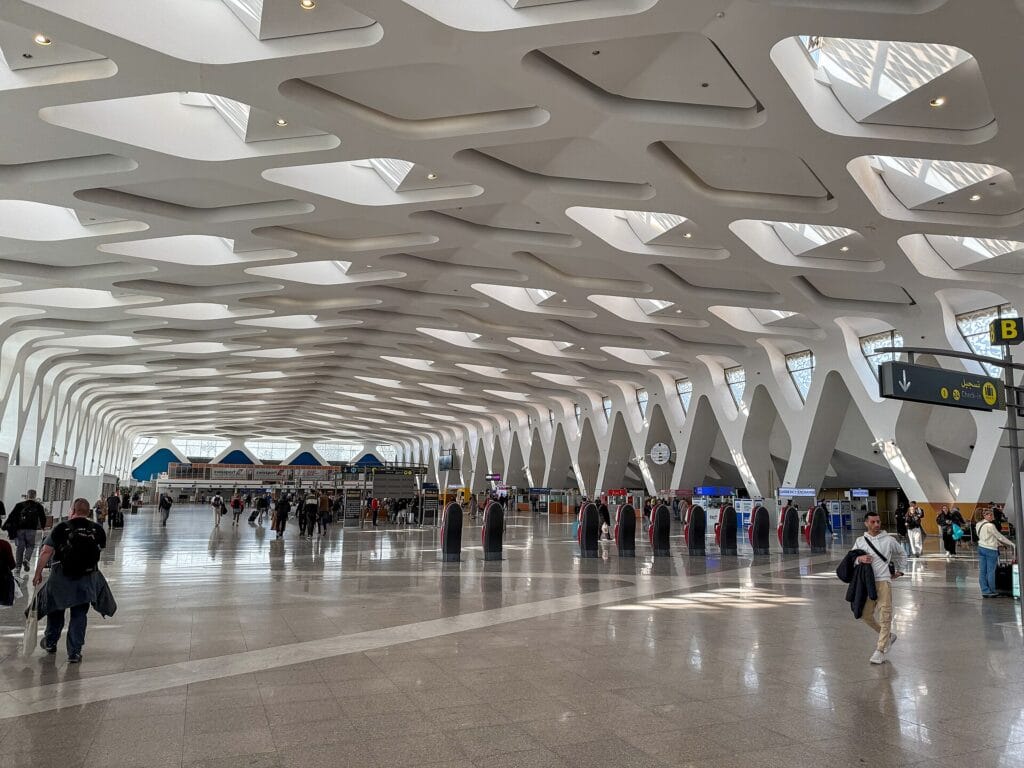
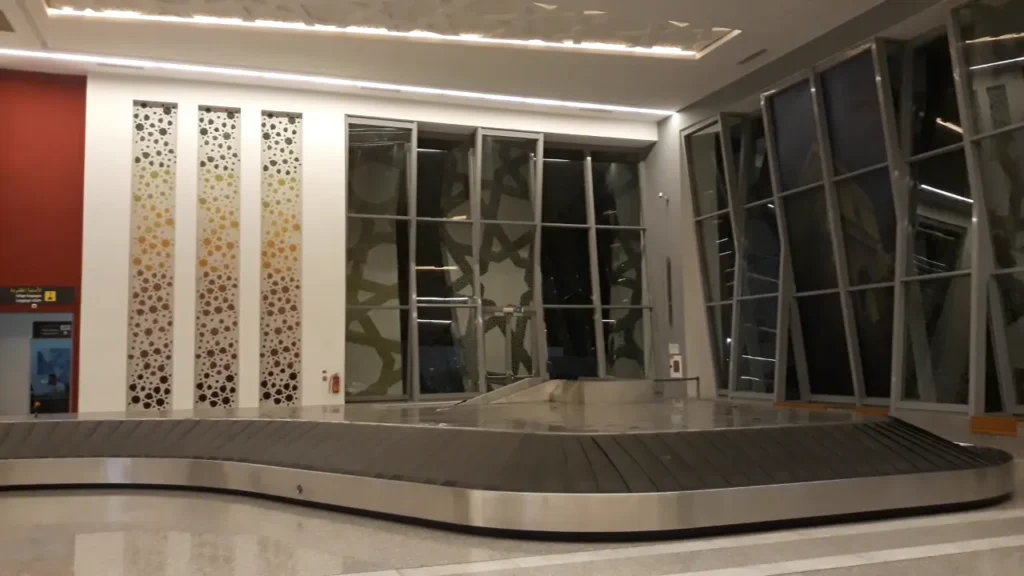
Inside, the same decorative language appears on perforated panels, glazing screen-printed with geometric motifs and a false ceiling with strict lines. The whole remains sober and easy to read: a single level for most of the passenger journey, short distances, and signs in Arabic, French and English. For an airport with fewer than two million passengers, this is a real advantage: you rarely get lost, and between the aircraft door and the exit there are rarely more than a few hundred metres.
The expansion project for 2030
In September 2024, ONDA launched a tender for the architectural studies and supervision of the terminal’s expansion and renovation works. The project, presented with the 2030 World Cup in mind, which Morocco is co-hosting with Spain and Portugal, provides for a terminal of about 46,000 m² on two levels: a basement of about 13,590 m² for baggage sorting and technical rooms, and a main level of about 32,150 m² for check-in, security and boarding. The stated goal is to raise capacity to 5 million passengers a year, with a budget that business media reports put at between 500 and 600 million dirhams, depending on the announcement.
A detailed works schedule has not been officially published. In practice, expect some parts of the terminal to be reorganised in the coming years: temporary walkways, relocated counters, altered car parks. Follow the signs rather than your memories of a previous trip.
Airlines and destinations from Fes-Saïss Airport
Fes lives mainly on low-cost airlines. Scheduling data lists around thirty non-stop destinations in eight countries, served by fewer than ten airlines. Ryanair clearly dominates: on its own it operates more than twenty routes, far ahead of Air Arabia Maroc, the second-largest carrier. In 2013, Ryanair opened a base in Fes, with one aircraft based there at the time, and this presence explains the breadth of its network.
The table below lists the main routes scheduled at the time of writing. Airlines open, suspend and switch routes to seasonal operation every IATA season (late March and late October): always check on the airline’s website before building an itinerary.
| Airline | Main destinations from Fes | Good to know |
|---|---|---|
| Ryanair | Paris-Beauvais, Marseille, Toulouse, Nantes, Lille, Nîmes, Dole, Brussels-Charleroi, Eindhoven, Weeze, Frankfurt-Hahn, Karlsruhe/Baden-Baden, London Stansted, Madrid, Barcelona, Málaga, Bergamo, Bologna, Rome Ciampino, Marrakech, Agadir; Alicante and Valencia in season | The airport’s largest carrier; cabin bags charged depending on fare; boarding pass shown printed or in the app |
| Air Arabia Maroc | Paris-Charles de Gaulle, Lyon, Marseille, Montpellier, Bordeaux, Toulouse, Strasbourg, Brussels, Amsterdam, Barcelona, Bergamo, Agadir; Nice in season | Often the only direct option to Roissy, Montpellier or Strasbourg |
| Transavia | Paris-Orly, Lyon, Rotterdam/The Hague | Convenient for Orly, with frequencies that vary by season |
| Royal Air Maroc | Paris-Orly; Casablanca (flights operated by Royal Air Maroc Express) | The Casablanca link offers connections to the rest of the national airline’s network |
| Other airlines | TUI fly Belgium (Brussels), Binter Canarias (Gran Canaria, seasonal), Discover Airlines (Munich, one weekly flight announced from late October 2026) | Often seasonal or limited to a few days a week |
How to read this network when planning a trip
First observation: there is no scheduled long-haul flight from Fes. If you are coming from North America, sub-Saharan Africa or Asia, the route almost always goes through Casablanca, either on the Royal Air Maroc Express shuttle or by train from Mohammed V Airport with a change in the city. A single Royal Air Maroc ticket with a connection in Casablanca protects your bags and your connection; two separate tickets do not.
Second observation: the schedule swells in summer, during European school holidays and when the Moroccan diaspora returns home. That is also when the terminal is at its busiest. Conversely, some routes operate only two or three times a week in winter: a cancelled flight can then mean waiting several days. In that case, remember that Rabat-Salé is a little over two hours away by road and Tangier about four hours; these are the most realistic plan Bs.
Third observation: domestic flights are rare. Apart from Casablanca, Marrakech and Agadir, there is no direct air link from Fes to other Moroccan cities. For Marrakech, flying saves a considerable amount of time compared with train or road; if you are combining both cities, a one-way flight followed by a return from the other city avoids retracing the same road.
Arriving at Fes-Saïss Airport: from the aircraft to the public hall
Aircraft park on the apron in front of the terminal. Depending on the stand, you walk to the building along a marked path or take an apron bus. On a summer morning, the short walk across the tarmac gives you a taste of the Saïss climate: dry air, harsh light, and a temperature gap with northern Europe that is immediately obvious. Keep a bottle of water and light clothing within reach in your cabin bag.
Passport control
First stop: passport control. Since 16 September 2019, the General Directorate for National Security has abolished the paper embarkation and landing card at airports; passports are read electronically. Still, have the address of your first accommodation and your return date ready: the officer may ask for them. Entry requirements depend on your nationality (visa exemption, visa, e-visa, passport validity); they are detailed in our guide to Morocco visa and entry requirements.
When two flights land almost at the same time, which is common in summer in the late morning and evening, the wait can exceed half an hour. Queues are usually separated between Moroccan passports and foreign passports: join the right one from the start, or you will be sent to the other.
Baggage and customs
The baggage reclaim hall is compact: a few carousels and trolleys available. Bags are then scanned before the exit, which is standard in Moroccan airports; do not be surprised if you are asked to open a suitcase. Drones in particular are subject to strict rules in Morocco and may be held by customs: check before you travel rather than finding out at the counter. If a bag is missing, file the report before walking through the exit, at the lost baggage desk or with the airline’s handling agent; once you are in the public hall, it is difficult to go back.
Getting dirhams on arrival
The dirham cannot be freely bought outside Morocco, and the regulations of the Office des Changes limit the amount a traveller may bring in or take out to 2,000 dirhams in banknotes. You will therefore probably arrive without local currency. The terminal has bank branches and exchange offices; cash machines are also the most common solution. Withdraw or change enough for the taxi and the first few days, no more: rates in town, at banks in the new town, are often comparable, and you avoid ending up with too many dirhams when you leave.
Keep your exchange receipts. You may be asked for them if you want to convert dirhams back into foreign currency before leaving the country, and the conditions for reconversion are set by the Office des Changes.
Phone and internet
European roaming does not apply in Morocco: without a suitable plan, mobile data quickly becomes very expensive. Two solutions: a local SIM card from a Moroccan operator with a data top-up, or an eSIM bought before departure. In the meantime, the terminal Wi-Fi lets you contact your riad or driver; how it works, its limits and our connection tips are explained in our article on Wi-Fi at Fes Airport.
Services at Fes-Saïss Airport
For an airport of this size, facilities are adequate without being plentiful. Here is what you will find, and what you should not expect.
- Food and drink. Cafés and food outlets landside and in the departure area, with a short menu: hot drinks, pastries, sandwiches and a few dishes. Prices are higher than in town. Details and our recommendations are in our article on Fes Airport restaurants.
- Duty-free shops. In the departure area: perfume, cosmetics, sweets and regional products. For crafts, argan oil or spices, the medina is far better stocked and cheaper.
- Banks and exchange. Bank branches and exchange offices are part of the terminal’s facilities; opening hours generally follow flight times, with no guarantee in the middle of the night.
- Children’s area. A play area is part of the 2017 terminal’s facilities.
- Car hire. Rental agencies are located in or near the arrivals hall. Book ahead in high season, and check the vehicle’s condition and the excess before signing.
- Parking. Paid car parks in front of the terminal for drop-off and waiting; rates are posted at the entrance.
- Assistance for passengers with reduced mobility. Request it from the airline when booking, ideally at least 48 hours before the flight.
What not to expect: a hotel on the airport grounds, long-term left luggage or a wide choice of restaurants open all night. If your flight leaves at dawn, sleeping at the airport is not a good idea; it is better to book in the new town, which is closer to the airport road than the medina.
Getting from Fes-Saïss Airport to the city
The main road between the airport and the city is the N8, which runs north through the southern suburbs of Fes. The A2 motorway, linking Rabat and Oujda, also passes nearby. Outside rush hour, a car reaches the new town in 20 to 25 minutes and the medina gates in 25 to 35 minutes. You have four options.
| Option | Indicative price | Journey time | Best for |
|---|---|---|---|
| Grand taxi from the rank in front of arrivals | About 150 MAD to the new town, around 170 MAD to a medina gate, per vehicle; possible night surcharge | 20 to 35 min | Most travellers, especially groups of 2 to 4 |
| City bus (former line 16 to the ONCF station) | About 4 MAD, to be checked since the change of operator | About 40 min to the station | Tight budgets, light luggage, daytime arrivals |
| Private transfer (riad, hotel, agency) | Price agreed in advance, usually higher than a taxi: ask for a written quote | 20 to 35 min | Late arrivals, first visits, hard-to-find riads |
| Hire car | Depends on the agency and season | 20 to 35 min | Trips beyond Fes (Meknes, Volubilis, Middle Atlas) |
Taxis: how to avoid unpleasant surprises
As you leave the hall, the taxi rank is right in front of you. These are grand taxis, which charge a price per trip rather than using a meter. The most common fare to the new town is around 150 MAD, and a little more to the medina; some travellers report higher demands late in the evening or when several flights land at once. Three habits are enough: give your exact destination, have the price confirmed before loading your bags, and pay on arrival with small notes (drivers rarely have change for a 200 MAD note).
A crucial point for anyone staying in the medina: no taxi will drop you at your riad’s door. The lanes of Fes el-Bali are closed to cars, and the driver will stop at the nearest gate: Bab Boujloud for the upper medina and the Talaa area, Bab Guissa for the north, R’cif or Bab Ftouh for the lower old town. Ask your riad which gate to give the driver and, if possible, for a member of staff to meet you there. A porter with a handcart can then take your suitcases for a few dozen dirhams; agree the price first. To understand how the districts and gates are laid out, read our guide to getting around Fes.
The bus: cheap, but check first
For years, line 16 of the city network linked the airport with the ONCF railway station in the new town for about 4 dirhams, with a bus every 30 to 60 minutes depending on the period and a journey of around 40 minutes. The situation changed in 2025: the city of Fes ended the contract of the former operator, City Bus, and an agreement signed on 11 September 2025 handed the network to a subsidiary of the CTM group, with a gradual roll-out and fleet renewal. An airport service remains in principle, but the line number, timetable and fare may have changed. Ask at the airport information desk before relying on the bus, especially in the evening.
The bus makes sense if you travel light, by day, and your hotel is in the new town or near the station. With a big suitcase or a medina address, the saving quickly disappears: you will have to take a petit taxi from the station anyway (roughly 10 to 20 dirhams on the meter to a medina gate, more at night).
Private transfers and car hire
Most riads offer an airport transfer, with a driver waiting at the exit holding a sign and a member of staff who then guides you through the lanes. It costs more than a taxi, but for an arrival after 10 pm or a first time in Fes, it is the option we recommend without hesitation. To compare formulas and prices at the country’s main airports, see our comparison of airport transfers in Morocco.
A hire car is only useful if you are leaving Fes. In the city itself, it becomes a burden: no access to the medina, difficult parking around the gates and heavy traffic at rush hour. A good approach is to visit Fes without a car, then pick one up at the airport or in town on the day you continue your trip.
Travelling beyond Fes
Fes-Saïss Airport is also a gateway to the whole of northern Morocco. Meknes is about fifty kilometres away; the Roman ruins of Volubilis and the holy town of Moulay Idriss Zerhoun can be visited on the same day. To the south, the N8 climbs towards Imouzzer Kandar, then Ifrane and the cedar forests of the Middle Atlas. Chefchaouen, the blue town of the Rif, is about four hours by road: our route options, from grand taxi to a car with driver, are set out in our article from Fes Airport to Chefchaouen. For Rabat, Casablanca, Tangier or Marrakech, the train from Fes station remains the most comfortable option; timetables are published by ONCF.
Leaving Fes-Saïss Airport without stress
Departure holds more surprises than arrival, because the checks come one after another and you often set off from the medina, far from the airport road.
- Book the taxi the day before. Ask your riad to arrange the grand taxi or transfer, with a meeting point at the medina gate. Allow 15 to 20 minutes’ walk with your luggage from the riad to the gate, then 25 to 35 minutes by road.
- Arrive early. Two hours before an international flight is a reasonable minimum, two and a half to three hours in summer. Low-cost airlines close their counters strictly on time.
- A first check at the entrance. As at other Moroccan airports, bags and passengers are scanned at the very entrance of the terminal, before check-in. A queue builds quickly when several flights leave at the same time.
- Check-in, then police. After bag drop comes departure passport control, then a second security check before the departure area.
- Spend your last dirhams. You cannot take out more than 2,000 MAD in banknotes. Duty-free and cafés in the departure area accept dirhams; to convert the rest, keep your exchange receipts.
One detail catches travellers out every year: the legal time. Morocco uses GMT+1 all year round, except during the month of Ramadan, when clocks go back one hour. If your stay overlaps the start or end of Ramadan, check your flight time in the airline’s app and the time shown on your phone.
Mistakes to avoid
- Looking for a small red petit taxi outside the terminal: they are in principle restricted to the urban area; the grand taxi serves the airport.
- Giving the driver your riad’s name without the nearest medina gate: you may be dropped on the wrong side of the old town.
- Accepting unsolicited help from a “guide” at the medina gate to find your riad without agreeing a price.
- Arriving late in the evening with no local means of payment, counting on an exchange office that may be closed.
- Booking two separate tickets via Casablanca with a short connection: if there is a delay, the second airline owes you nothing.
- Forgetting a luggage scale: low-cost airlines weigh bags without leniency when leaving Fes.
- Planning a quick return trip to Chefchaouen or the Middle Atlas on the day of your flight home: mountain roads leave no room for the unexpected.
Around the airport
The airport is not a place for a stroll, but its position south of Fes makes it a good starting point for several sites that people rarely combine with a visit to the medina.
- The new town of Fes. The natural first stop coming from the airport: Avenue Hassan II, its cafés and banks, and the ONCF station. A good place to stay the night before an early flight.
- Fes el-Jdid and the royal palace. The Marinid town and the great palace gates lie between the new town and the medina; you often see them from the taxi when arriving from the south.
- Sidi Harazem. The spa town, famous for its mineral water, lies east of Fes on the road to Taza.
- Imouzzer Kandar and Ifrane. South along the N8: mid-mountain lakes, chalets with steep roofs in Ifrane, and the Azrou cedar forests a little further on, where you may meet Barbary macaques.
- Meknes, Volubilis and Moulay Idriss. West along the motorway, for a day trip.
If you have a car, the most beautiful loop is to drive to Ifrane along the N8, then return via Sefrou, a small town with a peaceful medina at the foot of the Middle Atlas, before returning the vehicle.
Practical information
| Item | Information |
|---|---|
| Official name | Fès-Saïss Airport |
| Codes | IATA: FEZ; ICAO: GMFF |
| Location | About 15 km south of Fes, commune of Oulad Tayeb; roughly 50 km from Meknes |
| Elevation and runway | 579 m; one runway 09/27, 3,200 m × 45 m |
| Terminal | Terminal of about 28,000 m² inaugurated on 28 May 2017; expansion to about 46,000 m² announced |
| Operator | National Airports Office (Airports of Morocco) |
| 2025 traffic | Just over 1.92 million passengers; 12,988 aircraft movements |
| Main airlines | Ryanair, Air Arabia Maroc, Transavia, Royal Air Maroc |
| Getting to the city | Grand taxi (about 150 to 170 MAD depending on destination), city bus (to be checked), private transfer |
| Time to the medina | 20 to 35 minutes by car depending on traffic |
| Arrival before an international flight | 2 hours minimum, 2.5 to 3 hours in summer |
FAQ about Fes-Saïss Airport
How far is Fes Airport from the medina?
The airport is about 15 km south of Fes. By road, allow 25 to 35 minutes to reach a medina gate such as Bab Boujloud, a little less for the new town, depending on the time of day and traffic.
How much is a taxi from the airport to Fes?
The usual grand taxi fare is around 150 MAD per vehicle to the new town and about 170 MAD to the medina, with a possible night surcharge. Always have the price confirmed before setting off.
Is there a bus between Fes Airport and the train station?
Yes, a city bus line serves the airport; historically it was line 16 to the ONCF station, for about 4 MAD. The network changed operator in autumn 2025: check the number, timetable and fare on site.
Which airlines fly to Fes-Saïss Airport?
Ryanair is by far the largest carrier, followed by Air Arabia Maroc. Transavia, Royal Air Maroc (Paris-Orly and Casablanca) and several seasonal airlines complete the offer, mainly to France, Spain, Italy, Belgium and the Netherlands.
Can you change money at Fes Airport?
Yes, the terminal has bank branches and exchange offices, and cash machines are the most common solution. Change enough for the taxi and the first few days; banks in the new town offer comparable rates.
Do you need to fill in a landing card on arrival?
No. The paper embarkation and landing card was abolished at Moroccan airports on 16 September 2019. Only your passport and, depending on nationality, your visa are checked.
How early should you arrive at the airport before your flight?
At least two hours before an international flight, and two and a half to three hours in summer, because a first security check takes place at the terminal entrance and several flights often leave at the same time.
Can you sleep at Fes Airport before an early flight?
It is not recommended: there is no hotel on site and services are reduced at night. It is better to sleep in the new town, about twenty minutes away by taxi, and book the ride the day before.
Summary
Fes-Saïss Airport is a human-scale airport housed in a 2017 terminal whose geometric facade sets the tone for the city. Its network relies on low-cost airlines, led by Ryanair, with routes mostly to Western Europe and a shuttle to Casablanca for connections. On arrival, formalities are quick; you change enough money to pay the grand taxi, which remains the most reliable way to reach the city in about half an hour, knowing that it will drop you at a medina gate and not at your riad’s door. When leaving, allow plenty of time: the journey from the medina, the first security check at the entrance, and the 2,000-dirham limit in your pocket. With these landmarks in mind, Fes-Saïss is one of the easiest arrivals in Morocco.
Official sources
- National Airports Office (Airports of Morocco): Fès-Saïss Airport
- MAP news agency: inauguration of the new Fès-Saïss terminal (2017)
- Office des Changes: import and export of dirhams by travellers
- ONCF: train timetables from Fes
- Ryanair: routes and travel conditions
- Royal Air Maroc: flights and connections via Casablanca
This article is for information only and was updated in September 2026. Taxi and bus fares, timetables, air routes and terminal services are subject to change: check them with ONDA, your airline and on site before you travel.
Photo credits
Images: featured image « File:Fes Airport (cropped).jpg » — Flower.brp (CC BY-SA 4.0); « File:AEROPORT FES SAISS FES Commune Oulad Tay (cropped).jpg » — Rachid Baya (CC0); « File:Fes-new-terminal.png » — Abderrahman Chayadmi (CC BY-SA 4.0), via Wikimedia Commons.